
Further details are available here.
Further details are available here.

The image at the head of this blog, entitled “the death struggle”, was painted by Edvard Munch. The struggle depicted is not primarily that of the person dying, who cannot be seen, but is found in the faces of those expressing their grief. In some measure, in their bereavement, they are beginning to grapple with an altered reality. Very often the faces and experiences of both the unwell, and those who care about them, are remote in the work of theology. In health care chaplaincy in particular, the vast majority of theological reflection and writing is done by the professionals, not by the people undergoing the experiences of illness. This is why a recent article by Professor Graeme Smith is interesting. It draws on evidence from research into the experiences of seafarers who have received ministry from chaplains. Entitled “A theology of chaplaincy from below”, it explores the sailors’ narratives to make the argument that the recipients of chaplains’ care are people who produce of a theology of their own.
It is true that there is a very limited range of material which elicits and explores the experiences of people who receive chaplaincy care. Even when it does happen, it is often filtered through the voice of the chaplain, describing the chaplain’s perception of how people have responded to what has been offered. Equally, a large proportion of what is gleaned is framed as “customer satisfaction” rather than theological insight. The reasons for this are clear, as the secular employers of many chaplains are much more comfortable with these kinds of metrics than with data from a field of study and information with which they may be unfamiliar: theology. Graeme Smith is also right in identifying a suspicion of theology and religion, which may make the use of material framed in this discipline a matter of contestation and doubt.
Smith also analyses of the chaplains’ responses to questions about their theology and purpose. Here he finds that their theology of chaplaincy is both brief and vague. The chaplains would speak about a “ministry of presence” and might expand that to include reference to “incarnational theology”. While I am familiar with this style of response from chaplains I think it would be accurate to note that health care chaplains might also add theodicy and ethics. Similarly, in recent years, some military chaplains would be able and willing to articulate their theology in relation to the growing field of “moral injury”. Perhaps one of the systemic issues Smith identifies in his work has developed as a result of greater inter-faith working. While this is excellent and valuable it may have inclined teams to focus on their areas of common concern and diminished some of the deeper exploration of theology within a particular faith.
While the notion of “being there” in chaplaincy has been a widely accepted trope for professional spiritual care, the COVID-19 pandemic placed that concept under considerable pressure. Being there added to the risk factors of caring institutions. One more body out and about on the wards, or in care homes, added to the risk of the virus being brought into the setting. Was being there essential? As it emerged over time, there were marked differences between chaplains ministering at a distance and those still able to be a physical presence in the hospital or care home. While it might be possible to interpret the incarnation as the needless burdening of Mary and Joseph, with pain and cost to come, God-at-a-distance and God-among-us represent theologies that are worlds apart. Good things did happen at a distance, but it appears that the presence of the chaplain in places of acute loss and suffering had an altogether different quality and consequence.
“It must be very difficult for chaplains who are not able to go into their home and schemes, because I’ve experienced that for retirement living, really not the same. It’s really not the same. Chaplaincy is hands on, face to face and I’m very conscious at least I’ve been able to do, and that must be frustrating for others who have not been able to”.
Swift, C. (2020). Being There, Virtually Being There, Being Absent: Chaplaincy in Social Care During the COVID-19 Pandemic. Health & Social Care Chaplaincy, 8(2).
Without doubt chaplains could do more to articulate and develop the theologies of their ministry. Megan Smith sees this as essential in order for chaplains to sustain their identity and not get wholly absorbed into the institutional paradigms of the places in which they serve. Further, she argues that a simplistic interpretation of incarnation as “being Christ to others” often fails to take full account of all the dimensions inherent in the incarnation. For example, the Word made flesh has a prophetic, critical and challenging edge, which may not be understood or expressed in the ministry of chaplains. At the same time, there can be a misperception that the chaplain comes to bring theology into the institutional setting, while not taking proper account of the possibility that theology is already there – waiting to be encountered.
In my role as a chaplain I have never doubted the importance of theology in what I do, or for the context of a large and complex institution. Theology asks unusual questions and stimulates debates which often lie silent within the discourses of the spiritual. Accessing the theology of the recipients of care is not always easy, but I agree that it is necessary. This is not only for the benefit of chaplains and those to whom they offer care. I have long said that the place where theology is written is very significant. Theology written in intensive care; during a pandemic; in A&E; or from a prison cell, speaks from a place where the tidiness and safety of doctrinal certainty often buckles under the messy complexity of living. The work of Jens Zimmermann on incarnational humanism might offer one route to finding a fuller account of the incarnation as a basis for a theology developed by everyone caught up in a community defined by common characteristics. This might be NHS patients; military personnel; or a community of seafarers. It is significant that Zimmermann finds in Dietrich Bonhoeffer, the prisoner-theologian, the epitome of this approach to theology, where the Christ comes to fulfil our humanity:
“because Christ died for our true humanity, the Christian works for the common good in society as best as possible under any given circumstances”.
Zimmermann, J. (2016). Bonhoeffer’s incarnational humanism. Theologica Wratislaviensia, (11 Dietrich Bonhoeffer na 500 lat Reformacji), 73-86.

I am banned from cycling in misty conditions. This followed a rather painful altercation with some construction fencing that had strayed into the road at the bottom of a long downward incline. On a grey morning, in grey weather, and against a grey road-surface, the grey fencing didn’t register: until I hit it. Suddenly, I was sailing through the air, extending my left arm ahead of me, a reflex action of protection, and landed painfully some yards ahead of the now stationary bike. A lorry driver stopped. Dazed and disorientated I got myself up, beginning to feel an intense pain in my left shoulder. With all the ridiculous desire of an Englishman not wanting to make a fuss, I declined all offers of assistance, placed my bike out of the way, and decided to get a bus towards the hospital where I worked. Once there I went to my office in order to get changed before presenting myself at A&E (one has to have standards). I thought I had broken my shoulder but, it turned out, I had broken the fifth metacarpal of my left hand in two places. I soon learned that it’s an injury called “boxer’s fracture”. At a later date, casting an uncertain eye over me, a surgeon (who clearly didn’t feel I fitted his image of a pugilist) asked me how I acquired the breaks. He suggested that perhaps I should desist from cycling in the future.

Low mist across a ploughed field, near Linton-on-Ouse, October 2024
I did not follow the consultant’s advice, although I have made it a general rule not to ride me bike when visibility is impaired. However, last week, setting out on a beautifully clear sunlit morning in York, I began to encounter misty conditions on the outskirts of the city. Weighing up the likelihood that conditions would improve I pressed on to my planned destination of the Aldwark Toll Bridge, about 15 miles from the centre of York. As I anticipated, when the sun got higher the mist receded and it turned into the kind of bright and clear autumnal day which is the muse of poets. Down country lanes the landscape spoke of the changing season: ploughed fields with the dark earth turned in readiness for growth to come. Trees beginning to bear a foliage of yellow, bronze and green-become-gold.
What is divinity if it can come
Only in silent shadows and in dreams?
Shall she not find in comforts of the sun,
In pungent fruit and bright, green wings, or else
In any balm or beauty of the earth,
Things to be cherished like the thought of heaven?
Divinity must live within herself:
Passions of rain, or moods in falling snow;
Grievings in loneliness, or unsubdued
Elations when the forest blooms; gusty
Emotions on wet roads on autumn nights;
All pleasures and all pains, remembering
The bough of summer and the winter branch.
These are the measures destined for her soul.
Extract from Sunday Morning by Wallace Stevens
It would be very hard to live without this cycle of outer change. In the northern hemisphere they are part and parcel of my spirituality. Within the altering length of days, and the transitions of spring and autumn, Western Christianity has moulded itself into the furniture of the seasons. From the heavenly sparks of Michaelmas, with the equinox behind us, to the remembrance of All Saints and All Souls, liturgy marches to the tune of a changing year. Over the past three decades I have taken funerals in autumn that have a particular poignancy – of change and decay – with a need, somehow, to return home before the darkness falls. A time to comfort one another in a season that tells us, as all seasons do, that while they might occupy a span of time, they can also be a mood; an atmosphere; and a state of being, which greets us on any given day. Divinity is not only something that comes to us in silence. Nor is she confined to some specific time of the year. God is in all these seasons, and the spirit of all these seasons dwells in us.


Recently I was prompted to ponder whether angels have beards. I was visiting St John’s church at Howsham, in the Harton Benefice, north east of York. In the church’s porch is a carving of an angel sporting a beard (below). It was a sight that stimulated thoughts about angels, our tendency to anthropomorphise these heavenly beings, and what our long history says, across many faiths, about angels in the 21st century. As it happens, the appearance of angels has a lot to do with our imagination and how people conceived of beings who can span the divide between the secular and the sacred.

Today, on the Feast of St Michael and All Angels, it might be helpful to recall that many theologians across church history have not viewed angels as corporeal. Instead they have been regarded as expressions of Divine thought and agency; the light of heaven that breaks into the darkness of this world. Of course, in the history of art they are consistently represented as beings akin to people, albeit extra-shiny and with a pair of wings. Their expressions are typically impassive, like good servants they betray neither joy nor sorrow about the news being conveyed. The notable exception to this is the antics of the heavenly host at the Incarnation, joyfully praising God and generally whooping it up.
Thomas Aquinas, the Angelic Doctor, famously wrote of the “Bread of Angels, made the bread of people”. Panis angelicus is a stirring hymn of praise to God for the grace of sharing with humanity food which is the everyday fare of heaven. Consequently, at the Eucharist, angels are always referenced in the liturgy. As bread and wine are taken and consecrated, the material becomes one with the Divine, just as it did when the Word became flesh. This enacts a significant truth of Christianity: that in Christ the world is being redeemed. It is a central tenet of orthodox Christology, expressed in the Athanasian creed, that Jesus was perfectly divine and perfectly human. This was not God and a man sharing a room! The presence and witness of the angels in the liturgy expresses this fulfilment of the secular in the sacred. In the birth, death and resurrection of Christ, humanity is truly “ransomed, healed, restored, forgiven”.

“The beast taken” Revelation 19:20. York Minster Great East Window
Angels are not beings confined to churches and places of worship. The biblical references to them are most often in the secular, encountering people out in the world. Their strangeness and seemingly random appearances inspired the author of the Letter to the Hebrews to remind us that in our reception of others “some have entertained angels unawares”. During a time as poet in residence at Bradford Cathedral, Diane Pacitti published a collection of poems entitled Dark Angelic Mills. In the final entry, ‘Angels in Bradford’, Pacitti reflects that angels come in many guises. Perhaps as ‘kindertransport children, Asian workers, Syrian refugees, Rohingya Muslims’. In her poem, just as each church had its angel in the Book of Revelation, she invokes the spirit of St John to call into being the Cathedral’s angel:
Let it spread
huge-feathered wings over this hut of stone.
Let the song of wonder weave into its prayers
and seep into its silences. Angel-voice,
speaker of demanding truth, send out this church
to affirm the holy in what seems most broken.
Dark Angelic Mills by Diane Pacitti, Norwich, Canterbury Press, 2020.
The Church should always be the place which drives the heart of our participation in God’s mission of love for the world. We are drawn in, revitalised, and expelled back into the pathways that take us to both places of obvious significance, as well as to the peripheral and the neglected. In the ‘hut of stone’ where the church gathers we should encounter again the moment when the secular and the sacred meet: ‘the end of all symbols’ and the place where we are fed with the bread of angels.

During our recent sojourn in Spain we visited the Centro de Arte Caja de Burgos. The exhibition currently on show comprises various works by the Swiss-born artist, Pablo Armesto. A key theme across the works is the use of light, shapes and, consequently, the implication of shadow. To quote Armesto: “Between science, geometry and spirituality, this is how I conceived this exhibition”.
This exhibition appealed to me because of the interaction of light and material surfaces. It is executed beautifully, and serves to remind us that casting a particular light can change completely the underlying structure on which the light falls – or doesn’t. In other words, by illuminating some threads rather than others the surface appearance can be changed radically. Our eyes are drawn to the light and the form it implies, not the unlit shape of everything underneath. As the commentary on the exhibition says, these are “installations in which light and shadow transform the chromatic perception of the viewer”. Here lines of light address our perception:
“The line is a metaphor for the path, both physical and allegorical, sometimes traveling parallel to the initial idea, sometimes divergent when it has to choose between different options, but never schismatic, never discordant”.
Pablo Armesto
The title for the exhibition is “Complejidad, araña, laberinto”. I think that this is best translated into English as “complexity, spider-webs, labyrinths”. This phrase comes from a poem by the Andalusian poet Rafael Alberti, entitled “a la linea” (‘To the line’). While a line may sound a modest thing to be the subject of a poem, Alberti reminds us of the joyous capacity for it to be a “beautiful expression of the different”. Certainly, in Armesto’s installations, the vibrancy of illuminated lines could not be made clearer. It reminded me of the well-known comment by the artist Paul Klee, in his Pedagogical Sketchbook of 1925, that he was engaged in “taking a line for a walk”.

A circle of light created with the use of curved lines – by Pablo Armesto
The recent work I have been doing about Laurence Sterne includes the representation of a physical gesture – the waving of a stick – in volume IX. It is nothing more than a squiggle; a pen-line dancing across the page. It is used to express the notion of liberty and is, perhaps, the representation of the neat text going ferrel. A reminder that the careful shaping of ink that allows us to see letters and to read them, is made of the same stuff as this dramatically inserted hieroglyph. Different forms of the same material may shatter our expectations and leave us wondering what will come next. Art has this capacity to subvert our smooth reading of life and question the solidity and what we see. Like Sterne, Armesto’s filaments stretch our imagination, providing an intense optical experience and stimulating our thoughts about patterns – whether they are there, or simply the imposition of our expectations on the otherwise chaotic things we behold.

Some years ago, an academic at the University of Leeds commented to me about his experiences in teaching students studying chaplaincy at postgraduate level. He was not a religious person. While many essays which he marked contained good arguments and relevant sources, he noted a tendency for several students to write a conclusion in which some random bit of the Bible would suddenly trump all previous discussion. This would happen in such a way that there was no context or scholarly debate – as though whatever it was that Jesus had said in the Gospel of Matthew was clearly intended to be the final word on the NHS in the 21st century. Sadly, I am not persuaded that this problem in hermeneutics has been addressed in the intervening years.
Reflecting on this issue I began to wonder, for the first time, whether the physical presentation of bibles is part of the problem. All the books are bound together as a single volume, with an identical font and layout. There are many advantages in doing this, not least the referencing system that allows a chapter and verse to be identified quickly and accurately. It also conveys the fact that these particular books have been given a distinct and common authority by the Church. However, I suspect it has some homogenising effect which may incline people to regard it as some kind of dictionary or encyclopedia, with a common framework of description and interpretation. Little could be further from the truth.
In preparing this piece I assembled a collection of 66 books. The photograph of these titles heads the blog. There is poetry; fiction; history; biography; law and much, much more. Of course, through their distinct bindings, illustrations and typefaces, all these books appear as individual volumes. Many of them relate in different ways to the same subject but, even then, the audiences for which they are written are different and this shapes the style and content of the writing. I offer this as a visual image of what the Bible might look like freed from the effects of common presentation. Perhaps, if we hold this diversity in our mind’s eye, we might read and understand the Bible differently.
Documents became ‘scripture’ not, initially, because they were thought to be divinely inspired but because people started to treat them differently.
Armstrong, K. (2009). The Bible: the biography (Vol. 8). Atlantic Books Ltd.
At the most simple level, it is a reasonable question to ask whether a book of poetry is the best place to find advice about writing laws. Or that an allegorical method of discussing suffering in a universe with a omnipotent God provides us with material for a book on history? When the presentation of books indicates their topic and approach, we start to read them in a way that is appropriate for their genre.
I am not a professor of biblical studies. Knowing that this is the case makes me all the more cautious about lifting isolated phrases from scripture to support particular arguments. It’s not that I think the books of the Bible are irrelevant to these debates, but I appreciate that understanding the context and purpose of biblical passages is a precaution against their misuse. It also seems to me that it is important to be open to where this kind of study of scripture takes us. It is all too easy to have a determined position on an issue and recruit the Bible to our cause. When supervising students’ work I often ask people to read Paul Ballard’s important chapter on the Bible and practical theology published in 2012. In this paper he appeals for more work to be done in this area but, alas, there appears to have been only limited development in the past decade.
“More important, the use of scripture is an area that has not received sufficient attention in practical theology. It is imperative, therefore, that greater attention be paid to how the Bible actually functions and how it acts as scripture. The Bible is too important to be left to biblical scholars and the systematic theologians”.
Ballard, P. (2012). The use of Scripture. The Wiley-Blackwell companion to practical theology, 163-172.
I shall continue to encourage students to review their use of scripture and consider how it is featured in practical theology and the study of chaplaincy. I certainly would not wish to see the Bible being avoided, but more nuance and awareness is needed when a few words are drawn upon and inserted into an otherwise well-argued essay. Perhaps my greatest concern is that people outside chaplaincy and ministry might assume that a sophisticated and well-informed knowledge of scripture should be a basic skill for clergy and licensed lay workers. All too often, at the moment, this does not seem to be the case.


When I was training for ministry (several decades ago) there were many memorable moments. On one occasion a tutor was preaching for an act of corporate worship in the college when she happened to remark that, amongst other things “good taste” would not save us. A frisson ran through the student body. Ordinands at Westcott House rather prided themselves in aspirations to good taste, and this act of plain speaking was not altogether welcome. However, it hit home and – as all sermons should – gave us food for reflection.
During a recent visit back to Cambridge I was reminded of this criticism. It occurred to me while visiting the fabulous Kettle’s Yard, the University’s collection of modern and contemporary art. This gallery-in-a-home is the last word in aesthetics, where each object is placed with exquisite care to balance and complement the whole experience of being there and responding to the art. Even down to the daily placement of a fresh lemon. The collection was the creation of Jim Ede, an enthusiastic supporter of young artists in the early days of their careers. The setting for the works Ede acquired was a reaction to “the greater austerity of the museum or public art gallery”. It was to be a place where people could sit in contemplation.
Pebbles and sea-light,
drift of grain across an ebbing floor,
land’s end. The wind is sharp as gulls
pat David Pembroke’s window,
lettering the e stars across
a winter wall.Extract from Rowan Williams, “Kettle’s Yard”, 4 March 1984 in Williams, R. (2014). The Poems of Rowan Williams. Carcanet.
There is something inspiring and daunting about this relentless commitment to art in a domestic setting. The inclination is to take a seat in every room (this is allowed) and contemplate the shape of the space; the artworks; and the light coming from generous windows. I could have spent all day walking amongst this careful and spiritual placement of works by renowned 20th century artists. We went there with two friends from South Africa and they were equally bowled over by the rich diversity of works.
Because so much about Kettle’s Yard is breathtaking, it is hard to think that salvation cannot be achieved by art and aesthetics. Like the work of the tragically young Henri Gaudier-Brzeska, killed in the First World War, all these works point to something else: they are not consumed by their own necessity. Art is always going somewhere else and, even in the case of Gaudier-Brzeska who died aged 23, it is natural to ask ‘what would have been next?’ Given such talent at so young an age, what other works would this genius have brought into the world.
Good taste may not be salvation, but sharing thought-provoking beauty across so many different forms is surely a step to thinking beyond ourselves; to enlarge our world; and to wonder about what other acts of creativity are yet to enrich us.
“Finally, beloved, whatever is true, whatever is honourable, whatever is just, whatever is pure, whatever is pleasing, whatever is commendable, if there is any excellence and if there is anything worthy of praise, think about these things”.
Philippians 4:8-9
Recently I visited the exhibition William Blake’s Universe, in Cambridge. For many decades I have admired and enjoyed Blake’s work as both an artist and a poet. This exhibition sets Blake’s work alongside British and European Romantics who influenced his development. A review in The Guardian found this to be a weakness in the exhibition at the Fiztwilliam. Given that the space allotted is not overly large, Jonathan Jones found Blake to be overshadowed by the other artists, whose works are numerous in the gallery. This is a reasonable criticism, although I felt that the range of artists represented had its own merits – but perhaps this detracted from the ambitious title for the exhibition.
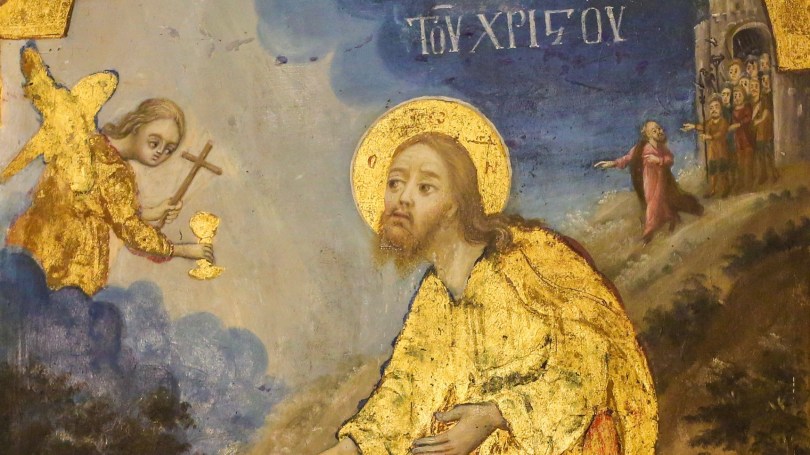
Blake is known for his paintings of vibrant angels and mythical characters. As in the way of classical painting, heavenly figures might be denoted by the presence of a halo. In the art of the Renaissance it can feel at times that the gift of a halo is a game of celestial quoits. Such paintings depict the lucky recipients of a shining disk as those rewarded for faithful and sacrificial behaviour. Often these heavenly signs shimmer and blaze with the finest gold, testimony that someone has achieved divine approval. They stand out from the canvas as the bright honorific of exceptional virtue.
Perhaps it was due to the nature of the medium, but at the William Blake exhibition I was stopped in my tracks by a rather different impression of a halo. A key supporter of Blake during his life, the sculptor and artist John Flaxman created many mythical and Neoclassical figures. In his illustration to accompany Chatterton’s poem the Battle of Hastyngs, Flaxman depicts “Queen Kenewalcha”.
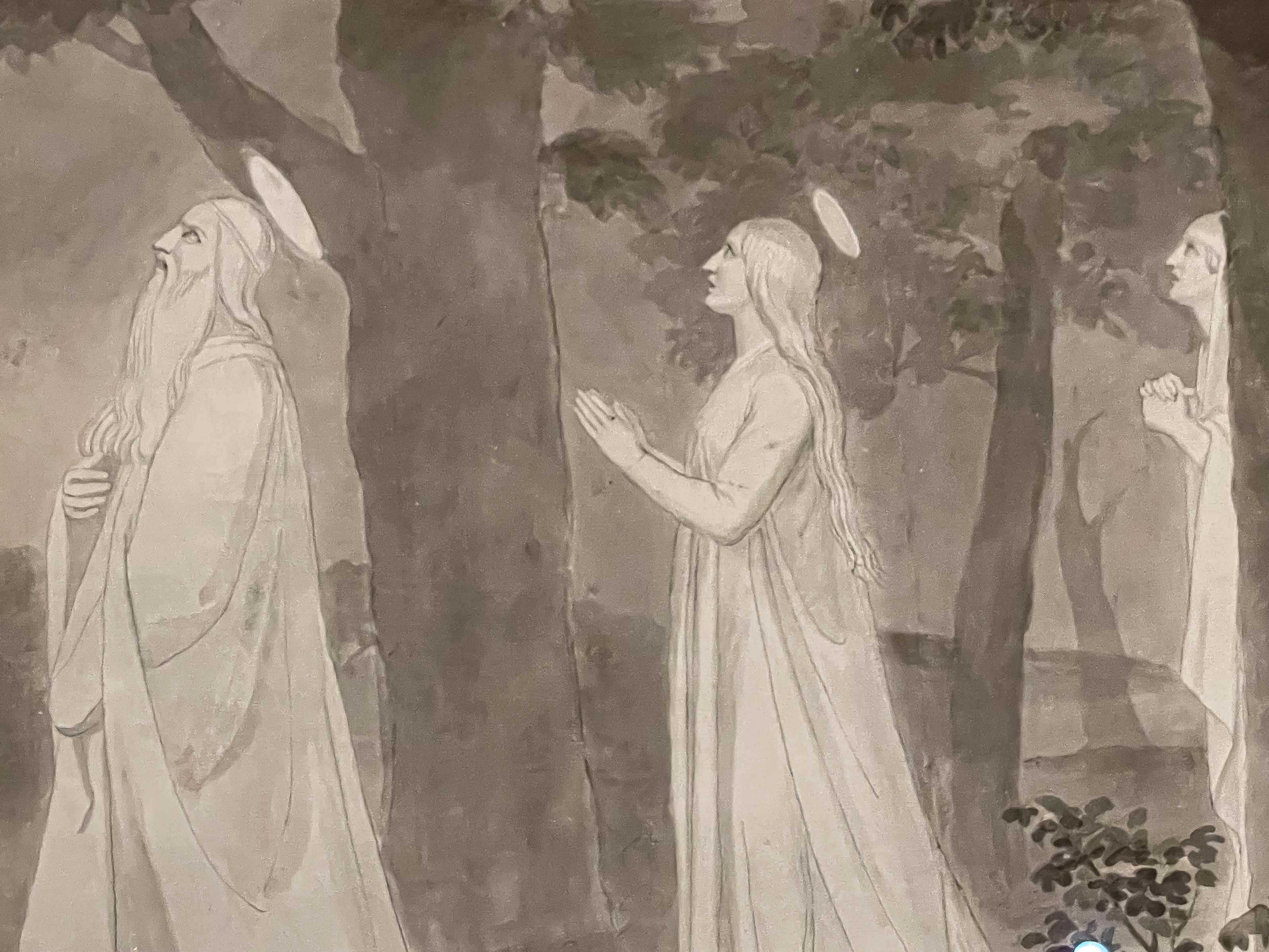
Queen Kenewalcha by John Flaxman
Looking at this painting I was struck by the depiction of the halo as an absence. It felt as though this was a gap in the paper rather than any addition of splendour. In the review of the exhibition Jones quotes Blake’s writing about the production of his books combining, as they did, both text and illustrations:
“in the infernal method, by corrosives … melting apparent surfaces away, and displaying the infinite which was hid”
The Marriage of Heaven and Hell, William Blake, 1790
The halo Flaxman gives Queen Kenewalcha seems to be this kind of melting away, as though sanctity has worn a hole in the fabric of reality and allowed the underlying brightness to shine through. This halo isn’t a painstaking accretion of gold but an elliptical opening that has emerged in the life of someone who isn’t wholly captured by the beguiling surface of a reality we take for granted. Getting to the light, for the artist, becomes the act of stripping away the stuff that pleads its own importance and necessity. In this illustration, the saint is lit by this small portal of connection with a radiance which comes from the reality that is our true destiny.
“To be a human person is to be a per-sona, through whom (per-) lights and fluids, vibrations and sounds (-sonae) flow. Living in attunements, we become “resonant selves,” and being religious is to a wide extent about attuning to the reality to which we belong.”
Gregersen, N. H. (2023). “THE GOD WITH CLAY”: THE IDEA OF DEEP INCARNATION AND THE INFORMATIONAL UNIVERSE: with Finley I. Lawson,“The Science and Religion Forum Discuss Information and Reality: Questions for Religions and Science”…

Management is an integral part of all organisations. It existed long before it was much spoken about or, indeed, became a field of study and development in its own right. Modern general management was introduced into the NHS following the Griffiths Inquiry in the mid 1980s. It paved the way for streamlining NHS processes and enhancing accountability which – eventually – even incorporated chaplaincy within its structures. Since then, in many organisations, I have witnessed and experienced the power of good management to exclude waste and improve efficiency. However (and there was always going to be an ‘however’!), there is plenty of evidence that contemporary management and executive leadership is far from perfect. Perhaps the instantaneous and seemingly universal response to Mr Bates v. The Post Office arises to a significant extent from the resonance of this story with many people’s experiences of institutional behaviour.
When I reflect upon my own professional journey there have been several key points when I have found myself in disagreement with a majority view. This is very inconvenient because, being naturally inclined to a quiet life, feeling compelled to express contrary views is time-consuming and energy-sapping. Often it requires detailed work to elucidate arguments and marshal the evidence that suggests – at the very least – that there is more than one way of looking at something. ‘Group-think’, especially when the leader’s views are clear and unequivocal, is far too easily generated in an environment which is unwelcoming of dissent. Over the years this is something I’ve observed in many contexts, including those of a research ethics committee and in church settings. The latter may be especially susceptible when the charisma of a Bishop is invested in a particular approach. Criticism of the approach can all too easily be perceived as criticism of the person.
It seems to me that a primary flaw in the case of the Post Office, and in many other institutions, is an inability to require a perspective 180° away from the one holding sway. For example, when a surprising number of post office staff were accused of fraud, and many maintained their complete innocence and were supported by local communities, why didn’t someone at a senior level think the unthinkable: what if they were right and Horizon was wrong? It isn’t difficult to speculate why a supplier might be reticent about admitting faults with a service it had provided. System error can be very costly and damage reputations (leading to even more adverse financial impact).
It would appear that often, as in the case of the Post Office, even independent reviews can encounter opposition if their findings differ from the dominant narrative of the organisation. When in leadership in health care chaplaincy I called on numerous occasions for an independent review of the operation of the Hospital Chaplaincies Council (HCC). There were many reasons for this, not least indications that something was wrong in the core operation of this Church of England quango. Eventually a review took place under Dame Janet Trotter, which concluded that the HCC was “too large and cumbersome for its purposes” and should be dissolved. Its findings were not welcomed by everyone and consequently the report was criticised from several quarters. However, the Hospital Chaplaincies Council no longer exists.

In leadership there is always more you could know, and the data will only ever be partial. Having a healthy appreciation of the gaps – the dark matter – is a key component in grasping the gravity of a situation. Being alert to seemingly insignificant anomalies can lead to the early detection of systemic failures. Simply closing ranks and moving into denial will only work for so long. Eventually, as the case of the Post Office demonstrates, you come up against the tenacity and determination that bends back into shape the distorted reality that huge resources have attempted to impose.
A wise leader doesn’t only want to hear the view of the majority. In 1 Kings chapter 22 we learn how King Jehoshaphat wasn’t content with the homogeneous advice of 400 prophets: ‘Is there no other prophet of the Lord here of whom we may inquire?’ Micaiah had the wisdom to make himself scarce when he knew the King wanted to hear from all the prophets. Micaiah was’t going to fall in line with the rest, and this would eventually earn him a slap and see him thrown into prison. Micaiah had the same inconvenient trait demonstrated by Mr Bates – he wouldn’t sign off on something he knew to be wrong.
“But Micaiah said. ‘As the Lord lives, whatever the Lord says to me, that I will speak.'”
I Kings 22:14 NRSV

Recently I was introduced to the writing of Jon Fosse. The latest author to be awarded the Nobel Prize in Literature, this accolade was recognised by Pope Francis, who praised the Norwegian’s “gentle testimony of faith“. As a leading figure in the world of creative writing, who exchanged atheism for Catholicism some years ago, the pontifical praise for Fosse is hardly surprising. The quality of the prose in the books authored by Fosse is the most striking aspect of his work. The books can be surprisingly brief – A Shining comes to just 46 pages in the English translation. Even as a slow reader I managed to finish this novella over breakfast. However, it is a work that lingers in the imagination, shaped by writing which left me with a sense of shimmering uncertainty. It is a book that makes you wonder ‘what was all that about?’ (in a good way). In terms of spirituality and faith it achieves a credible doubt about our perceptions and consequently allows something beyond our understanding to glow at the periphery of vision. In the words of the Nobel judges Fosse gives ‘voice to the unsayable’. In A Shining the protagonist’s certainties and confidence suddenly evaporate, and time and again what seemed logical is found wanting. Into this scenario comes the strange light of a shining presence.
“I don’t write about characters in the traditional sense of the word. I write about humanity”
Fosse speaking to the French newspaper Le Monde in 2003.
It is not easy to offer a narrative of spiritual enquiry in a Western world that is deemed disenchanted and post-religious. The skill of Fosse is to develop his text with painstaking honesty about the uncertainty of what we see, and the apparently random events that intersect with our lives. To reflect the language of the season, Fosse follows his evolving story with a constant determination. It feels as though his commitment and skill to write whatever comes next, draws us into the wake of his quest. As Fosse said in an interview: “To me, writing is listening, not seeing.” As we read, we are allowed to discover what Fosse has heard.
Across the world the church is celebrating the Feast of the Epiphany. The shining star leads the Magi on an extensive journey. Thankfully, they are also discovering that their search for the meaning of this light did not conform to their expectations. At first they seek the new King in a palace. If they had lacked the flexibility to reassess their beliefs about sovereignty, then the mission to find the King might have ended there. Herod knew nothing about it – and how could a future King be born without the monarch’s knowledge? Their determination overruled the power of their assumptions. Having made the decision to follow the star, and allow it alone to denote sovereignty, they left their homes; walked away from a palace; departed from a capital city; quit imposing accommodation; and completed their journey in humble – but holy – circumstances. This could not have been an easy journey and TS Eliot concludes The Journey of the Magi with reflections that suggest abiding questions: ‘were we led all that way for Birth of Death?’

Expectations can have the power to obscure the presence of things that are surprising, novel or outside our experience. The risk is that familiarity shapes our world as we anticipate it to be, and we make our way through life imposing a pattern that demonstrates little recognition of the differences we encounter. When something breaks through our imposition of normality, it might be said that we experience an epiphany. A vision of reality re-ordered which questions our everyday certainties. The Bible is full of such moments and they are often far from being comfortable or comforting. Easier to lie, like Lazarus, in the shroud of endings, than be re-awakened to new life; new insights; or fresh possibilities.
The Magi allowed the star to reveal unexpected news. They took their gifts where the star commanded, bypassing palaces and people of honour. In the end, when they reached a simple home, they fulfilled their mission with obeisance and splendour. The circumstances were circumstantial. The wise had committed to their truth and followed unwaveringly where it led. It was their resolve to be undeflected in their purpose that led them to a foreign infant of doubtful parentage, in an insignificant town. The encounter – in Eliot’s poem – leaves them ill at ease with life when they return home. It is a reminder that away from the saccharine carols and excesses of Christmas there is a Word revealed that can, if we listen, release us from the captivating assumptions that tame our spirits.
But the child that is Noble and not Mild
He lies in his cot. He is unbeguiled.
He is Noble, he is not Mild,
And he is born to make men wild.
Extract from ‘Christmas’ by Stevie Smith

