Refreshment

Today passes by all sorts of names: Mothering Sunday; Mothers’ Day; Mid-Lent Sunday; Rose Sunday; Laetare Sunday; Simnel Sunday and Refreshment Sunday. Despite the differences, there is a kinship between them, laying emphasis on different aspects of this waypoint through the long sojourn of Lent. For the vast majority of people, who aren’t making any particular commitment to the season, Mother’s Day will be the most recognisable name.

Refreshment seldom seems a bad idea. When we embark upon any long project, or simply feel weighed down with the routine tasks of daily life, pausing to be refreshed sounds a positive step. In some churches, after the weeks of purple, the vestments and hangings on this Sunday will be a vibrant pink. Colour refreshes the dullness of abstinence, flowers will be given and received, and family dinners will be eaten. In gardens and parks in the northern hemisphere this moment in Lent is accompanied by the emerging colours of spring and, hopefully, some slightly drier and warmer days.

In some traditions and ways of living, the idea of refreshment might be regarded as an indulgence. The consequences of this can be seen all too plainly in Hard Times. Dickens locates the exclusion of play, childlike wonder and a lively imagination, in the pattern of life imposed by a father:

“You have been so careful of me that I never had a child’s heart. You have trained me so well that I never dreamed a child’s dream. You have dealt so wisely with me, Father, from my cradle to this hour, that I never had a child’s belief or a child’s fear”.

Dickens, C., Hard Times, 1854.

Dickens may have exaggerated several aspects of Victorian England in his novels, or placed together less common experiences in a single story, but it all flowed out of a reality with which he was familiar. Allowing space for refreshment in the 19th century could be a dangerous step. People might begin to think; to feel; to dream. Better to do your duty, however bleak the prospects, than imagine a life of being ‘fed on turtle soup and venison with a gold spoon’. In that era few were wealthy and many were poor, and finding any kind of middle way between the two was not in the interests of the powerful. ‘Plus ça change, plus c’est la même chose’.

Rather than being simply a pleasant 5 minutes pausing on a bench, or walking through a wood, refreshment can mean the moment we begin to see life anew, and wonder how to live the lives we are given. It might be the time we decide that change is needed, and that bobbing along as we are isn’t how we are meant to use this one, precious, opportunity we have to be here. Pulling the levers and turning the handles of our part of existence can fill the time – but it should never stop us pausing and lifting our eyes to the horizon.

Refreshment can be dangerous. It can lead to revolution. It may resolve our heart to pursue a different path. It is never time wasted – but the space in which a different future might be imagined.

What Shapes Us

I probably shouldn’t be allowed in bookshops – perhaps, especially, the second hand variety. It’s not that I steal from them, but I am mesmerised by so many tantalising titles that whisper: ‘read me – come and see the world from where I’m standing’. All too often I succumb to the siren call of these exciting doors into new worlds of information; history; narrative and imagination. I am at a particular risk living where we are now, as the excellent Minster Gate Bookshop (pictured) stands less than a 3 minute walk away on the other side of the cathedral.

“A bookshop is an idea in time”

Carlos Pascual quoted in Carrión, J. (2016). Bookshops. Hachette UK.

Growing up there were few books in our house. These consisted of map books, a Bible, some children’s books, cookery tomes and a Readers’ Digest three volume ‘Great Encyclopaedic Dictionary’ (the latter now a mere £5 on Abebooks.com: I found it very helpful on many occasions). At my grandparents it was a different story. Bessie, my grandmother, had been a primary school teacher before her marriage to Robert. The small bookcase in the sitting room was crammed with novels by Walter Scott; Dickens and Thackeray. There was also an atlas with a remarkable number of countries shaded in red. It was here that my love of literature began, but its development and maturity came via a charismatic English teacher at secondary school. Before the first years’ long summer holiday Mrs Boll handed round a list of books. Apparently we were supposed to choose one to read: I misheard, and read them all (and I’m a slow reader).

When I look around the study where I am sitting, the books are a record of my evolving interests and passions. There are a few books from undergraduate studies in English Literature and Theology. A selection of novels and poetry titles. More books linked to my PhD research and subsequent publications. A Bible in Spanish. Copies of journals for which I’ve been an editor and a host of miscellaneous and probably ill-advised further purchases. Nevertheless, they are very good company and sometimes I’ll wander about looking for a title (which I know is somewhere) and become distracted picking up these old friends and reminding myself of their contents.

Some years ago I was given a copy of Jorge Carrión’s Bookshops. This recounts the author’s visits to bookshops in many different parts of the world. It has been described as an extended essay and ‘a vital manifesto for the future of the traditional bookshop’. Some of these bookshops are ancient; others are works of art in their own right, employing the skills of local carpenters to fashion the shelving. For Carrión such places are about more than the retail of print, they are the context for people to meet, debate, share new ideas and inspire one another. After all, books have always – to some degree – been dangerous. There is a reason that despotic regimes burn them. No doubt, today, the internet has provided another forum to share ideas and this can be shut down when authorities feel threatened. It’s much harder to track-down and deactivate inked paper.

My most recent visit to Minster Gate Bookshop saw me give in to temptation (twice). I could hide behind a facade of professional interest for one title, an exploration of Jeanette Winterson’s writing and its relationship to religion. I’ve always loved Winterson’s novels. The other is justifiable (I protest too much?) because it concerns Laurence Sterne, and his work is my current hobbyhorse. Incidentally, I have found on occasion that another advantage of second hand books is that they sometimes contain material from a previous owner. In one case this was a typed letter in which the author told a librarian that all his children had turned out to be nincompoops. Reflecting on the chronology, I suspect that they’re probably now all in high-powered jobs.

On the wall of my study is a work of art by Wilkinson. It contains a block of acetate pages printed with a novel, written by the artist: ‘The Alabaster Child’. The work appeals to me for a number of reasons. It gives physical expression to the fact that reading is not simply linear. Later chapters of a novel are in dialogue with earlier sections, or certain words, as they weave towards a particular conclusion. In the case of ‘The Alabaster Child: A Novel’, the sheen of the acetate captures the reflection of my bookshelves on the other side of the room. Books speak to books and the relationship is both constant and dynamic. All my reading, what I remember and what has shaped my unconscious imagination, is in dialogue. As Doris Lessing put it in her Nobel Prize acceptance speech: “it is our imaginations which shape us, keep us, create us – for good and for ill”.

The Watchful Bailiffs

I have been reading Mary Fulbrook’s challenging new book Bystander Society. It is subtitled ‘Conformity and Complicity in Nazi Germany and the Holocaust’, which makes clear what the book is about. This is a forensic historical study of how in the mid to late 1930s the German population as a whole was moved into a position of compliance with the emerging practices of the Nazi regime. Fulbrook understands bystanding as a posture that is socially constructed and capable of undergoing change. At a time when Western populations (in particular) seem to be more and more indifferent to egregious acts of violence and the curbing of peaceful protest, this book is a timely publication. As I recall saying at the very start of the COVID-19 pandemic, if you only act when it is blindingly obvious that you need to do something – then that is the definition of having left it too late.

“And for anyone who, in the aftermath of the Holocaust, wants to give more meaning and content to the oft-repeated refrain ‘never again’, this may suggest many potential points for earlier or more effective intervention. It is, then, vital that we extend our understanding of the historically contingent conditions for the production of a bystander society”.

Fulbrook, Mary, 1951- author. (2023). Bystander society : conformity and complicity in Nazi Germany and the Holocaust. New York, NY :Oxford University Press, p. 399

The most dangerous circumstances steal upon us in such a way that by the time society might be roused to action, the means of action have been disassembled and silenced. Last week’s pantomime in the House of Commons, when something was both done and not done, epitomises a wilful complicity with chaos even while – elsewhere – a society is being dismantled by sustained violence. Distraction is the art of manipulation and deceit. While some bystanders may be innocent, and deprived of any realistic prospect of intervening, other bystanders occupy a role best described as ‘neutral’. These bystanders could do something, or work with others to intervene, but they choose to remain inactive.

Knud Nellemose 1908-1997 Dansk/Danish – Erindring/ Remembrance 1987 in the SMK – Statens Museum for Kunst, Copenhagen

‘Bystanding’ has been identified as a problem in society for a long time. The phrase ‘watchful bailiffs’ comes from the poem ‘A Description of the Morning’ by Jonathan Swift, written in 1709. Many older adults of that time lived with the memory of the English Civil War and a nation torn apart by violence and radical change. Describing the urban twilight of London as it awakes to an unheroic dawn, the poem observes the effects of growing trade, wealth and criminality. Swift describes a society busy sustaining mechanisms where servants are the victims of the powerful; apprentices carry the marks of malnutrition; and the destitute young are sent up chimneys. At the end of the poem, Swift writes:

The watchful bailiffs take their silent stands;
And schoolboys lag with satchels in their hands.

Swift, J. (1879). The Poetical Works of Jonathan Swift (Vol. 1). Houghton, Mifflin,.

A great deal of harm and inequality is woven into this observation of the early morning. The bailiffs – court attendants – were people of authority to whom the behaviour and conduct of the affluent would be known. Transcripts from trials are often the clearest historic records of people’s behaviour and relationships. It is here, in the courts, that at least some of the underbelly of capitalism could be seen. Yet the bailiffs are silent. Swift’s poem demonstrates the need for change, to end the cycles of exploitation he sees, but the people best placed to enable this are doing (and saying) nothing. They have their place, and watchful complicity comes with rewards.

In every organisation there are people behind those who appear in public. Often these servants of power are the ones who can alter the course of events. They are the people who enact the decision of the leaders and turn the cogs to make things work. Without their active help no regime can enact its policies, whatever these might be, and the ‘bailiffs’ can never be innocent bystanders. For good or ill they share the responsibility for each and every policy that is implemented by those in positions of executive power.

An Incorruptible Crown

For many years the 30th of January was widely observed across England as the day King Charles I was executed. It is retained in the calendar of the Church of England, but the degree of emphasis attached to the commemoration has diminished. Charles King and Martyr is kept as a ‘lesser festival, 1649’ with a single prayer to be said. In the Book of Common Prayer there was a entire service provided for this day (removed in 1859).

“I go from a corruptible, to an incorruptible Crown; where no disturbance can be, no disturbance in the World”.

King Charles I, spoken at his place of execution 30 January 1649

Following the Restoration the Church of England played a significant role in shaping official history and sustaining the belief and convictions that underpin monarchy. Sermons were preached and many were published. The date provided the occasion for bishops and senior clergy to demonstrate their loyalty and prevent any thoughts returning to the idea of a commonwealth. Across the land, from village church to metropolitical cathedral, it was expected that royal subjects would observe this solemn day.

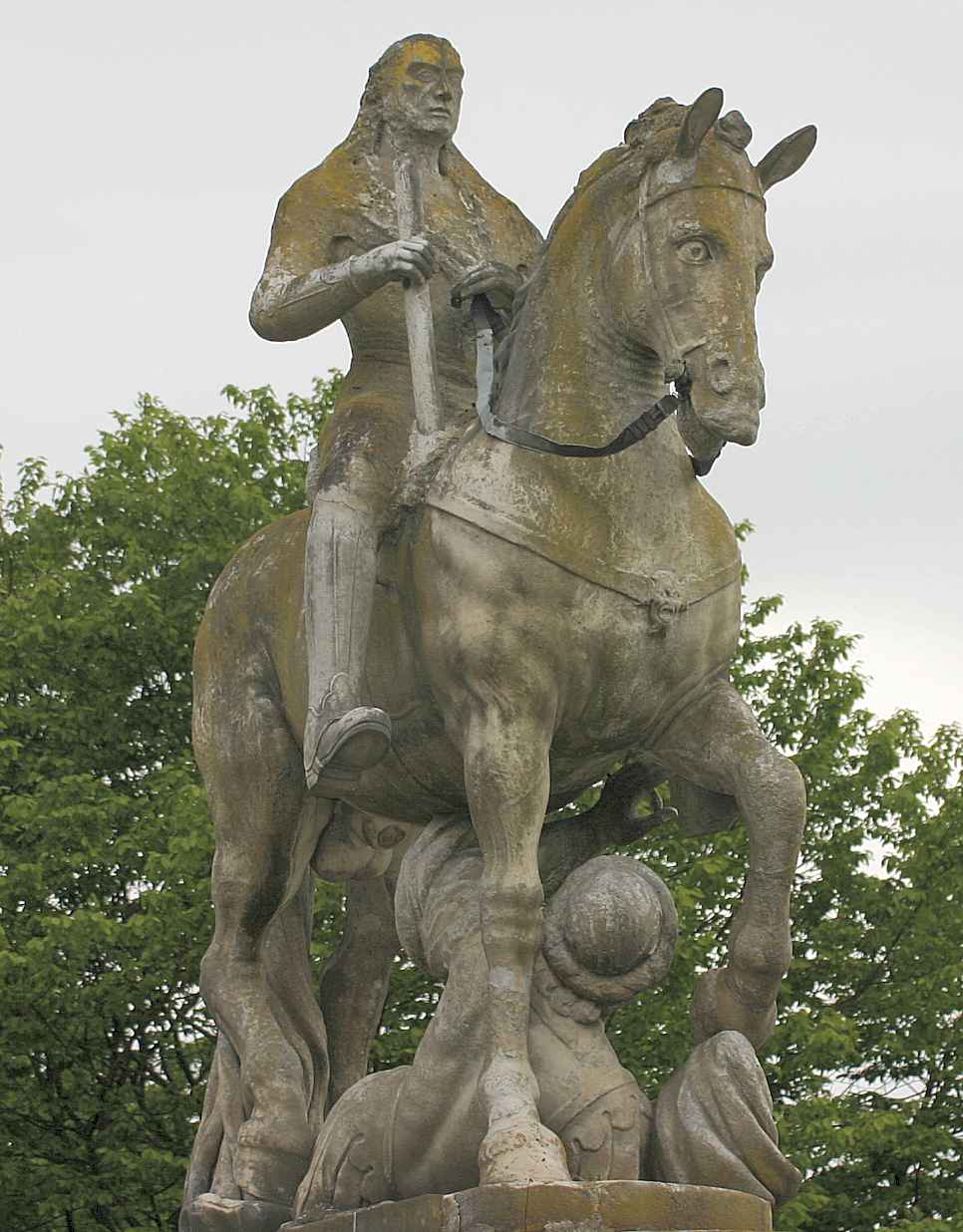
There were other ways in which the return of the monarchy was welded into popular imagination. This included the creative arts, especially portraiture. One enterprising donation took the form of a recycled statue. Now sited at Newby Hall in North Yorkshire, the monument to King Charles II was previously a statue showing the Polish commander John III Sobieski riding down a Turkish soldier. In its revised form substantial work was done to modify the head of the figure, to resemble Charles II, but the trampled figure of Oliver Cromwell retains a decidedly unusual appearance (i.e. he’s wearing a turban).

There should probably be a maxim to beware of sycophantic royalists bearing gifts. The first attempt to donate the statue to a prominent London location (the Royal Exchange) was rejected. The statue’s owner, Sir Robert Vyner – who might be said to have a stake in the royal franchise (he created new coronation regalia for Charles II) – then offered the work to a City church. This was accepted (perhaps it was too hard to say ‘no’?) and the statue occupied space at the Stocks Market. It later moved to Lincolnshire, before settling at Newby Hall in Yorkshire.

The recycled statue used to depict Charles II, Newby Hall, photo by David Bridgwater

The 17th century poet Andrew Marvell made satirical comment on the statue when it was still in London. He suggested that there was more than a passing resemblance between the horse rider and the man who had commissioned the work:

When each one that passes finds fault with the horse,
Yet all do affirm that the King is much worse ;
And some by the likeness Sir Robert suspect
That he did for the King his own statue erect.

Andrew Marvell, A Poem on the Statue in the Stocks-Market

Having been shuffled off to the north country, London had performed that subtle process of sifting out mediocre work at odds with its ambitions in art and public monuments. Following the Great Fire the city was modelling itself as an international capital for trade and culture where, alas, Sir Robert’s reworked homage did not belong. Marvell’s intimation that the statue bore a likeness to its commissioner may also have helped seal its fate.

As it is one of my principal areas of reading at present, I feel bound to mention that Laurence Sterne published a sermon marking the 30th January. Compared with many of the thundering homilies delivered on this date, Sterne’s offering has been described as ‘innocuous’. Although thoroughly loyal, and referencing ‘our forefathers trespass’, Sterne adds the comment that: ‘to avoid one extreme, we began to run into another’. Perhaps this indicates a more critical understanding of what led to the Civil War and how future progress might be made without recourse to arms. This appears to be a lesson the world is still struggling to comprehend, let alone enact.

Good Lord, Deliver Us

Management is an integral part of all organisations. It existed long before it was much spoken about or, indeed, became a field of study and development in its own right. Modern general management was introduced into the NHS following the Griffiths Inquiry in the mid 1980s. It paved the way for streamlining NHS processes and enhancing accountability which – eventually – even incorporated chaplaincy within its structures. Since then, in many organisations, I have witnessed and experienced the power of good management to exclude waste and improve efficiency. However (and there was always going to be an ‘however’!), there is plenty of evidence that contemporary management and executive leadership is far from perfect. Perhaps the instantaneous and seemingly universal response to Mr Bates v. The Post Office arises to a significant extent from the resonance of this story with many people’s experiences of institutional behaviour.

When I reflect upon my own professional journey there have been several key points when I have found myself in disagreement with a majority view. This is very inconvenient because, being naturally inclined to a quiet life, feeling compelled to express contrary views is time-consuming and energy-sapping. Often it requires detailed work to elucidate arguments and marshal the evidence that suggests – at the very least – that there is more than one way of looking at something. ‘Group-think’, especially when the leader’s views are clear and unequivocal, is far too easily generated in an environment which is unwelcoming of dissent. Over the years this is something I’ve observed in many contexts, including those of a research ethics committee and in church settings. The latter may be especially susceptible when the charisma of a Bishop is invested in a particular approach. Criticism of the approach can all too easily be perceived as criticism of the person.

It seems to me that a primary flaw in the case of the Post Office, and in many other institutions, is an inability to require a perspective 180° away from the one holding sway. For example, when a surprising number of post office staff were accused of fraud, and many maintained their complete innocence and were supported by local communities, why didn’t someone at a senior level think the unthinkable: what if they were right and Horizon was wrong? It isn’t difficult to speculate why a supplier might be reticent about admitting faults with a service it had provided. System error can be very costly and damage reputations (leading to even more adverse financial impact).

It would appear that often, as in the case of the Post Office, even independent reviews can encounter opposition if their findings differ from the dominant narrative of the organisation. When in leadership in health care chaplaincy I called on numerous occasions for an independent review of the operation of the Hospital Chaplaincies Council (HCC). There were many reasons for this, not least indications that something was wrong in the core operation of this Church of England quango. Eventually a review took place under Dame Janet Trotter, which concluded that the HCC was “too large and cumber­some for its purposes” and should be dissolved. Its findings were not welcomed by everyone and consequently the report was criticised from several quarters. However, the Hospital Chaplaincies Council no longer exists.

In leadership there is always more you could know, and the data will only ever be partial. Having a healthy appreciation of the gaps – the dark matter – is a key component in grasping the gravity of a situation. Being alert to seemingly insignificant anomalies can lead to the early detection of systemic failures. Simply closing ranks and moving into denial will only work for so long. Eventually, as the case of the Post Office demonstrates, you come up against the tenacity and determination that bends back into shape the distorted reality that huge resources have attempted to impose.

A wise leader doesn’t only want to hear the view of the majority. In 1 Kings chapter 22 we learn how King Jehoshaphat wasn’t content with the homogeneous advice of 400 prophets: ‘Is there no other prophet of the Lord here of whom we may inquire?’ Micaiah had the wisdom to make himself scarce when he knew the King wanted to hear from all the prophets. Micaiah was’t going to fall in line with the rest, and this would eventually earn him a slap and see him thrown into prison. Micaiah had the same inconvenient trait demonstrated by Mr Bates – he wouldn’t sign off on something he knew to be wrong.

“But Micaiah said. ‘As the Lord lives, whatever the Lord says to me, that I will speak.'”


I Kings 22:14 NRSV

Bright Expectations

Recently I was introduced to the writing of Jon Fosse. The latest author to be awarded the Nobel Prize in Literature, this accolade was recognised by Pope Francis, who praised the Norwegian’s “gentle testimony of faith“. As a leading figure in the world of creative writing, who exchanged atheism for Catholicism some years ago, the pontifical praise for Fosse is hardly surprising. The quality of the prose in the books authored by Fosse is the most striking aspect of his work. The books can be surprisingly brief – A Shining comes to just 46 pages in the English translation. Even as a slow reader I managed to finish this novella over breakfast. However, it is a work that lingers in the imagination, shaped by writing which left me with a sense of shimmering uncertainty. It is a book that makes you wonder ‘what was all that about?’ (in a good way). In terms of spirituality and faith it achieves a credible doubt about our perceptions and consequently allows something beyond our understanding to glow at the periphery of vision. In the words of the Nobel judges Fosse gives ‘voice to the unsayable’. In A Shining the protagonist’s certainties and confidence suddenly evaporate, and time and again what seemed logical is found wanting. Into this scenario comes the strange light of a shining presence.

“I don’t write about characters in the traditional sense of the word. I write about humanity”

Fosse speaking to the French newspaper Le Monde in 2003.

It is not easy to offer a narrative of spiritual enquiry in a Western world that is deemed disenchanted and post-religious. The skill of Fosse is to develop his text with painstaking honesty about the uncertainty of what we see, and the apparently random events that intersect with our lives. To reflect the language of the season, Fosse follows his evolving story with a constant determination. It feels as though his commitment and skill to write whatever comes next, draws us into the wake of his quest. As Fosse said in an interview: “To me, writing is listening, not seeing.” As we read, we are allowed to discover what Fosse has heard.

Across the world the church is celebrating the Feast of the Epiphany. The shining star leads the Magi on an extensive journey. Thankfully, they are also discovering that their search for the meaning of this light did not conform to their expectations. At first they seek the new King in a palace. If they had lacked the flexibility to reassess their beliefs about sovereignty, then the mission to find the King might have ended there. Herod knew nothing about it – and how could a future King be born without the monarch’s knowledge? Their determination overruled the power of their assumptions. Having made the decision to follow the star, and allow it alone to denote sovereignty, they left their homes; walked away from a palace; departed from a capital city; quit imposing accommodation; and completed their journey in humble – but holy – circumstances. This could not have been an easy journey and TS Eliot concludes The Journey of the Magi with reflections that suggest abiding questions: ‘were we led all that way for Birth of Death?’

Expectations can have the power to obscure the presence of things that are surprising, novel or outside our experience. The risk is that familiarity shapes our world as we anticipate it to be, and we make our way through life imposing a pattern that demonstrates little recognition of the differences we encounter. When something breaks through our imposition of normality, it might be said that we experience an epiphany. A vision of reality re-ordered which questions our everyday certainties. The Bible is full of such moments and they are often far from being comfortable or comforting. Easier to lie, like Lazarus, in the shroud of endings, than be re-awakened to new life; new insights; or fresh possibilities.

The Magi allowed the star to reveal unexpected news. They took their gifts where the star commanded, bypassing palaces and people of honour. In the end, when they reached a simple home, they fulfilled their mission with obeisance and splendour. The circumstances were circumstantial. The wise had committed to their truth and followed unwaveringly where it led. It was their resolve to be undeflected in their purpose that led them to a foreign infant of doubtful parentage, in an insignificant town. The encounter – in Eliot’s poem – leaves them ill at ease with life when they return home. It is a reminder that away from the saccharine carols and excesses of Christmas there is a Word revealed that can, if we listen, release us from the captivating assumptions that tame our spirits.

But the child that is Noble and not Mild
He lies in his cot. He is unbeguiled.
He is Noble, he is not Mild,
And he is born to make men wild.

Extract from ‘Christmas’ by Stevie Smith

Gates Drawn Apart

On most days we are heading towards either the longest day or the shortest day. On two days each year the world turns, and we are – for a moment – at the extremity of our shifting balance of night and day. The Church traditionally parked St Thomas on the day of greatest darkness. Perhaps a choice designed to support the idea that too much doubt can only lead into the night, so we better get our beliefs in order and welcome the returning sun.

I love the seasons, and regret that our colder days are fewer and farther between. Heat lasts later, and returns sooner, as we reap the consequences of human folly. The climate is a delicate mechanism and we have placed too great a burden on its capacity to absorb the punishment we mete out every hour. Thankfully, the reliability of the winter solstice is a reminder that while we might be intent on ruining the invaluable gift of our natural world, we cannot touch the vast expanse of space that doesn’t give two hoots whether or not humanity is intent on destroying its habitat.

Let us continue to enjoy it while we may, and do whatever we can to reduce the changes taking place. Part of my delight in the seasons lies in the subtle presence of another season buried in the one that precedes it. We have hardly entered December and the corkscrew hazel has finally shed its last leaves, revealing the tortuous structure of branches to which it owes its name. However, at this very moment, the catkins that will flourish in March have begun to appear. In branches that hold the darkness of winter, and twist hither and thither, the marks of spring are already written.

It was this interrelatedness of our seasons that became the central idea of a story I wrote in anticipation of our daughter’s birth, 27 years ago. It was the only time I worked on anything like this with my late father, as he provided illustrations for a story to celebrate his grandchild’s birth. We produced this simple book by photocopies and an office printer, happy to keep this piece of work purely for the family. His original artwork was framed and became a beautiful reminder of his joy in Abigail’s arrival.

As we journey through the final week of Advent, and some in the church will mark the feast of St Thomas, the season reminds us that time itself will one day cease. That all will be gathered in, and the work of the world will be done. As each season is intimated in the days of another, so the end of all things is bound up in the transitory lives we lead. For those who hold the light of faith this is not a doom of destruction but a making whole; a healing of every hurt; the final coming home of a humanity that has endured the final agonies of its own folly.

This year time’s nature will no more defeat you,
Nor all the promised moments in their passing cheat you.

This time they will not lead you round and back
To Autumn, one year older, by the well-worn track.

This year, this year, as all these flowers foretell,
We shall escape the circle and undo the spell.

Often deceived, yet open once again your heart,
Quick, quick, quick, quick! – the gates are drawn apart.

Part of ‘What the Bird Said Early in the Year’ by C.S. Lewis

In the Midst

Increasingly I find Radio 4 a disturbing listen. Not because the content is controversial (usually), or offensive, but because every time I switch it on I realise how much I don’t know. Whether it’s In Our Time, or some other consideration of a niche topic, I’m made aware of the vast range and depth of human knowledge about which I was oblivious. One example of this arose last week, listening to the Seven Deadly Psychologies. While I certainly have views about why greed is bad, this programme delved into the mechanics of why this might be the case. In the discussion there was a fascinating debate about the fact that, generally speaking (but with notable exceptions), research has demonstrated that rich people have less empathy and compassion than poorer people. In charity, the poor overwhelming give away a significantly higher proportion of their wealth when compared with the financially advantaged.

One reason offered to explain this was that wealth meant people became more distant from communities. It was not possessing a fortune per se which caused this lack of compassion, but the acquisition of space. The consequence of an exclusive lifestyle is that it removes us from close company of our ‘fellow-passengers to the grave’, to quote A Christmas Carol. In turn, this increasing remoteness appears to dull the understanding of the thoughts and feelings of other people. Richer people often feel entitled to their wealth – and perhaps see poverty as simply other people’s failure to accrue resources. Perhaps some of the present UK Government should listen to this episode.

A crowded nativity scene in St. Hippolytus Pfarrkirche, Zell am See, Austria January 2023

While wealth and power no doubt brought King Herod a significant ‘exclusion zone’ this can hardly be said of Jesus. The narrative of the nativity describes a Bethlehem bursting at the seams. In the traditional portrayal, Jesus and his family are cheek by jowl with the beasts of the stall; receive a stream of uninvited visitors; and find themselves in a town where every bed is taken. Lack of worldly privilege ensured that Jesus grew up close to a wide variety of trades, in a community where modest livelihoods required people to cooperate.

Sovereignty in a cattle stall is one example of the paradox that runs through the Christian story. If wealth dulls our capacity to be compassionate it can also diminish our ability to recognise a God who expresses a preferential option for the poor. A God who, in Christ, is able to hear the plea of the Syro-Phoenician woman; the prisoner on the cross; the dilemma of the rich young man. Only when the Word-made-flesh pitches its tent in the heart of humanity is the gulf between God and creation closed. Ultimate power and splendour, commanding more space than we can ever imagine, chooses to renounce entitlement and make the ultimate identification with humanity.

For Dietrich Bonhoeffer the paradox lies partly in the idea that this God is not seen easily by those who have the most resources, or education, or stability in their lives.

“The celebration of Advent is possible only to those who are troubled in soul, who know themselves to be poor and imperfect, and who look forward to something greater to come.”

Dietrich Bonhoeffer

Knowing our need for one another, and our need of God, is a prerequisite for our spiritual growth and maturity. It is one of the reasons why Advent is an uncomfortable season. Many of us recognise the greed we feel for our own space, and to have the freedom to do as we wish. Community implies compromise and association, experiences which appear to have fading appeal in the West. However, to know God seems to require us to be immersed in the dependencies of human society – a truth which both Advent and Christmas impress upon us each passing year.

Advent’s Bitter Chill

The cold has come. In an era of climate change there is no guarantee that winters will bring us frost or snow – at least, not for any extended period of time. Parson Woodforde, an undistinguished parson in a small rural parish, would have been consigned to oblivion except for one unusual practice: he kept a diary. Woodforde’s world of the 18th century witnessed some of the final decades of the Little Ice Age, which began around 1300 and lasted until 1850. It is quite likely that the Christmas we call ‘Dickensian’ holds some folk memory of the unusually bitter weather that occurred before the Victorian era got into its stride. Woodforde’s winters are hard to imagine given our experiences today.

“We breakfasted, dined, &c. again at home. Very hard Frost indeed, last Night, froze above Stairs in the Stair-Case window quite hard. It froze the whole day within doors in a few Minutes – very severe Weather indeed – So cold last Night that it was a long time before I could get any sleep at all… We were obliged to have Holly-branches without berries to dress up our Windows &c. against Christmas, the Weather having been so severe all this Month, that the poor Birds have entirely already stript the Bushes.”

Christmas Eve, 1796

Perhaps some of us have childhood memories, before double-glazing and central heating, which include times when there was ice on the inside of the windows. However, on the whole, better insulation and heating – combined with climate change – mean that fewer of us experience this degree of harshness in winter. In a different age, Woodforde’s diligent pastoral ministry was no doubt challenging and costly. It also had its rewards and, however difficult it might have been, the clergy were better-off than the vast majority of their parishioners. The question for many of them was how to live in the style they associated with being a gentleman, and living in houses which towered above neighbouring dwellings. Nevertheless, there is a lovely detail in the diaries of how the parson’s diligent ministry was recognised with anonymous generosity:

“Had another Tub of Gin and another of the best Cognac Brandy brought me this Evening about 9. We heard a thump at the front Door at this time, but did not know what it was, till I went out and found the 2 Tubs – but nobody there”.

Woodforde, J. (2011). The diary of a country parson, 1758-1802. Hymns Ancient and Modern Ltd.

I’m not sure what quantity of liquor a tub contained but I’m confident it would have kept the parson and his guests well supplied during long winter evenings.

It is into this growing darkness and falling temperatures that Advent arrives. With Christmas Eve landing on a Sunday, this is the shortest period of Advent the calendar allows. Across the three frenetic weeks before Christmas the season urges reflection on sombre themes. Calling into a supermarket in the middle of York the other day, a member of staff on the till commented that it was so busy ‘you’d think the world was about to end’. Ironically, this may be the point where the extremes of consumerism and the message of Advent collide.

Worlds end all the time. In Gaza children have spoken about how they simply want things ‘to go back to the way they were’. Not that this was ideal, but there were homes, families, stability and some kind of future ahead. For them a world they knew has come to an end, in a way that is devastating. This is true across every theatre of war, where destruction is easy and instant – and building a meaningful future is slow, arduous and uncertain.

Advent can bring a chill that serves to focus our thoughts on the cost of these ongoing end-times, and the task of holding a light when surrounded by a cynicism that gives way to darkness. The cold reminds us of the need for homes, and the suffering of people who lack shelter, support or the means to find warmth. Advent tells us the sobering news that all we take for granted is only temporary, and we must be stirred and watchful for the moments God’s light breaks through. Parson Woodforde offers us perspective about the enduring nature of crisis. On Advent Sunday 1797, he wrote that ‘the present times seem to prognosticate e’er long very alarming circumstances. No appearance of Peace…’. To hold an improbable light in this fearful darkness is the work of Advent – and it is certainly needed no less today than it has been in centuries past.

Common Sense

In the 18th century the fortunes of the city of York, along with its Minster and clergy, were enjoying a rise in both wealth and status. This led to the creation of prestigious new buildings, sweeping away some of the more mundane Medieval dwellings. This was a time when the buildings surrounding York Minster began to change with dramatic effect. Demolishing – and in some degree, incorporating – 15th century cottages to the north-east of the cathedral, Dr William Ward built himself a fine Georgian townhouse (pictured). He was the chief legal officer (‘commissar’) for the Dean and Chapter of York, a role which brought many pecuniary benefits. The new house was a fitting expression of his wealth and status.

The role of ‘commissary’ brought both influence and financial reward. There is every indication that Ward used his position to become wealthy and further the ambitions of his family. His daughter, Sarah, married a baronet and become Lady Fagg. While little is known about Ward, like many gentleman of his era, we know that he had a significant personal library. This is indicated by an Item in the late lawyer’s Last Will and Testament in which he bequeathed to his wife and daughter, ‘Forty English Books each such as they shall chuse out of my Library excepting the large Bible’. Perhaps foreseeing that this could lead to some dispute over which books each should have, Ward adds: ‘my wife to have the first choice’. In all likelihood the large bible would have passed to his son.

The wealth of legal officer such as Ward was built on a considerable degree of misery. Misery, that is, for the poor souls who came before the ecclesiastical courts. The leading Sterne scholar Arthur H. Cash described these courts as:

‘weak remnants of what had once been a terrifying Protestant inquisition’

Cash, A. H. (1971). Sterne as a Judge in the Spiritual Courts: The Groundwork of A Political Romance. In English Writers of the Eighteenth Century (pp. 17-36). Columbia University Press.

The main purpose of these courts was to deter pregnancy outside wedlock. It often led to both fines and public humiliation. It is hard for us to understand the level of pastoral disregard and cruelty which this system could produce. For example, Cash cites an incident where Robert Milburn was tried in 1753 in the village of Alne, just north of York, for antenuptial fornication ‘with Jane his wife, now dead’. It is little wonder that these courts were abolished or that clergy came to have a very mixed reputation through their enthusiasm to become judges. It provides some insight about how Lawrence Sterne came to be so familiar with a range of conduct and human emotion. Perhaps the perceived bawdiness of Tristram Shandy owes something to the process of examining cases that were brought to the courts by church wardens. In addition to his responsibilities as a parson, as the son of an army officer; a sometime farmer; and a judge in the courts, Sterne must have heard and seen a wide spectrum of life. Additionally, as a frequent visitor to nearby York, he was also connected to middle class mores and cosmopolitan life.

Perhaps William Ward’s main claim to fame is that his death precipitated a decade long dispute between the Dean of York and the Archbishop’s chief legal officer. It was a disagreement concerning the many legal roles which Ward had occupied and how these were to be inherited on his death. The Archbishop’s legal officer believed that the Dean had promised them to him, a promise on which he claimed the Dean reneged. Finally, after heated public exchanges between these two worthies, the situation provoked Laurence Sterne to publish his first significant literary work – a satire on the dispute entitled ‘A Political Romance’ or, as it is often known, ‘The History of a Good Warm Watch-Coat’. It was so accurate and effective that the Archbishop of York instructed all copies to be returned and the entire stock to be burned. Thankfully, at least six people either didn’t get the memo, or they decided not comply with the instruction.

Which brings me to common sense. Looking back it is easy to name the intolerable cruelties of another ago, or of a different place and people. In the style of Jonathan Swift, Sterne brings to the dispute a creative reframing that allows people to see their conduct in a different light. What may have appeared to be an obvious and inevitable response, suddenly becomes more complex and questionable. Creative writing invited the reader to wonder about the behaviour of those involved and the apparent inevitability of the dispute that unfolded. In many ways Sterne was an actor within events that seemed natural and necessary – and in the end he inherited some of Dr Ward’s legal responsibilities. However, he was also able to see beyond the near horizon of common sense and question the relationships and conduct which were doing little to promote the reputation of the church. Common sense in one age can appear as outrageously cruel in another – and I hope that in her new role of ‘minister for common sense’ Esther McVey will recognise the provisionality of her brief. The common sense of one group in society may be seen very differently by another group. Unless handled with the greatest of care, common sense can conserve and perpetuate some of our worst practices and behaviours.

  • The illustration of Dr Ward’s house, Chapter Yard, York, is by Allan T Adams BA FRSA FSAI