Truth Stretched Thin

I love visiting Spain and Spanish-speaking countries. Ever since spending a year in South America in my early 20s, and acquiring a feel for the language, a small part of my growing up was rooted in hispanic culture. A recent trip to Spain brought introductions to new cities, including Burgos and Alcalá de Henares. The latter visit arose from a longstanding wish to see the birthplace of Spain’s most distinguished writer, Miguel de Cervantes Saavedra. The author of Don Quixote was born there in 1547 and it is where he spent the first four years of his life. Understandably, alongside his former home which is now a museum, the city celebrates its famous author in numerous statues, street names and public institutions. Don Quixote is considered to be the world’s first novel in the modern sense of the word.

Given the date of his birth and the febrile politics of a recently re-conquered Spain, Cervantes was born into a world in which it had been decided that the co-existence of faiths was intolerable. In 1492 the Muslims and Jews who had not converted to Christianity were expelled from Spain. Those who had converted lived amongst neighbours who, very often, sought any sign that the conversion was one of “convenience” and would report people to the authorities. This was the time when the Inquisition was in full force and those who converted were keen to appear compliant. Many years ago, while participating in a canyoning activity north of Almuñécar, in Andalusia, a young instructor accompanying us told me that his surname was the same as the name of a local village. His family’s story was that they had been Jewish and, like many of the converts who remained, they took the name of a local town in order to immerse themselves in Christian Spain and avoid suspicion. Such practices were commonplace.

There is a claim that the family name of Cervantes came from a town of that name in Galicia, and may have been taken for reasons of conversion. However, this is far from certain. The proximity of the Cervantes family’s home to the Jewish quarter of Alcalá de Henares might be a more persuasive argument for some kind of connection. Today, all that indicates the onetime presence of a synagogue and Jewish “corral”, as it was called, is a small plaque. Cervantes senior was a doctor and the family lived both opposite this old Jewish quarter and beside the city’s ancient hospital.
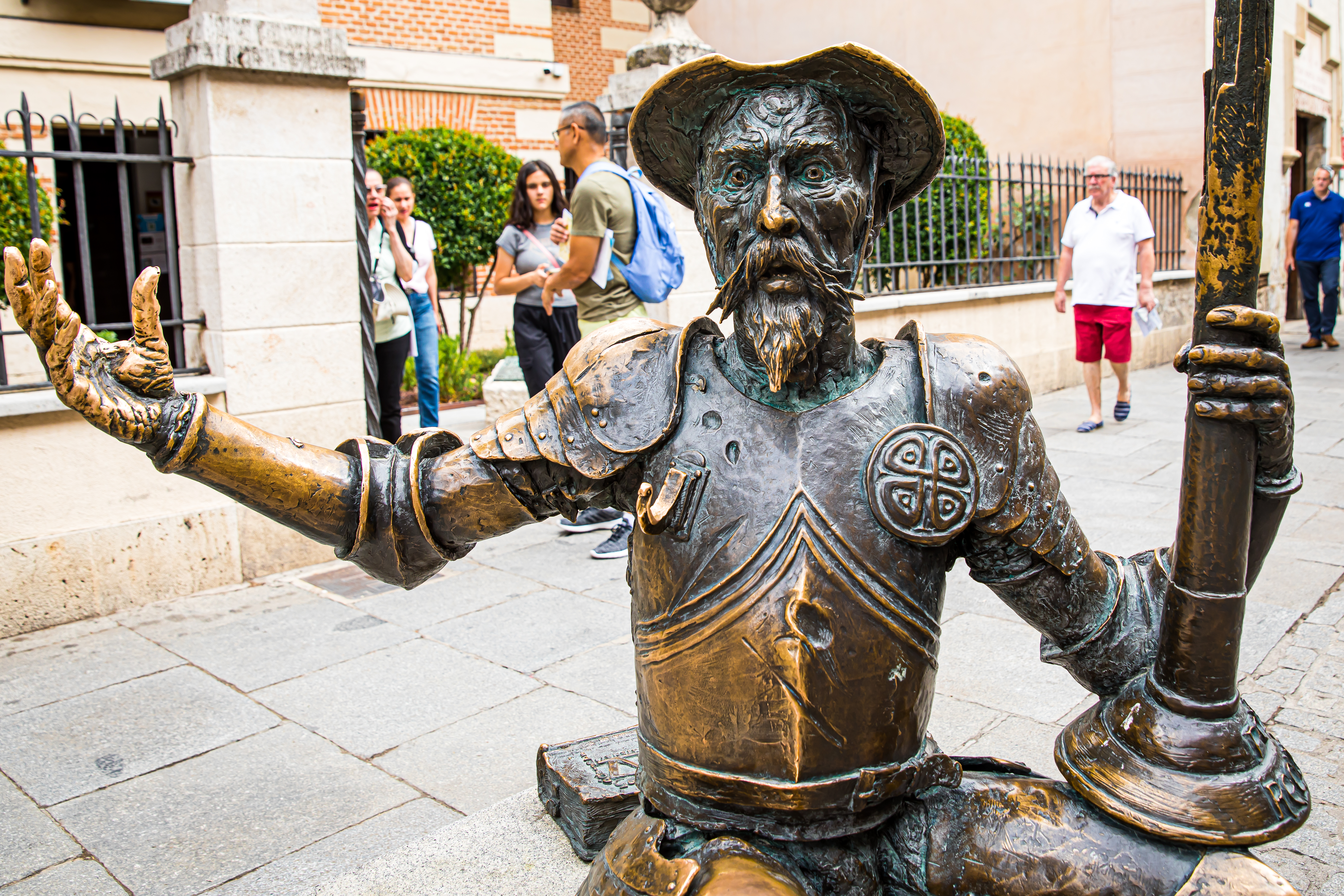
A statue of Don Quixote outside the house in which Cervantes spent the first four years of his life in Alcalá de Henares, near Madrid

Initially, after the Reconquest, the Jewish community experienced relative security compared with other European countries. This did not endure.

“Yet Jews were still better off than their Ashkenazic brethren in the rest of Europe who were expelled from England and France and faced continuing and unrelenting pogroms and persecution in Germany and Central Europe, eventually driving them eastwards to Poland and Lithuania. The Christian rulers of Spain exploited the skills of their Jewish subjects and a thin layer of upper class Jews remained wealthy and influential. The Jewish population of Spain generally still felt comfortable there. After all, they had lived as Spaniards for many centuries. Why should the situation change now?”

The Spanish Expulsion from the Jewish History website accessed 28/06/24

Perhaps the strongest argument that Cervantes had Jewish ancestry comes from evidence internal to Don Quixote. In an excellent BBC World Service edition of The Forum scholars argue that in his novel there is “an implicit cultural critique” which questions, as far as it can, some of the negative narratives about the descendants of Muslims and Jews still living in Spain. In a section of the novel where Don Quixote is in Toledo, he seeks and finds someone to translate a text in Arabic. By showing the continued presence of Hebrew and Arabic speakers in Spain Cervantes put in doubt the official story of a single, homogenous, Christian culture.

Out of the troubled waters of post-reconquest Spain Cervantes created a story capable of finding a broad and appreciative audience. Don Quixote might be seen as a kind of Rosetta Stone, enabling different communities to discern for themselves an intelligible and constructive place in Spanish society. That is no small feat, and the unparalleled significance of Cervantes in Spanish culture bears testimony to his achievement in enabling humour, insight and compassion to leaven the complex experience of living in a society where the past was an ever-present and potent challenge to the present.

“The truth may be stretched thin, but it never breaks, and it always surfaces above lies, as oil floats on water”.

Don Quixote
Those who do not think as we do

I am standing in a Spanish market town which looks like so many others which I’ve visited over the years. As it happens, by longstanding tradition, Monday has been market day from time immemorial. However, on Monday April 26th 1937 – about a month after Easter – it was a day like no other. From 4 pm, and lasting for several hours, German and Italian planes bombed the hell out of Guernica. The buildings consisted mainly of wood, and the aircraft first targeted the town’s water tanks and fire station. Those who attempted to flee into the countryside were strafed by German fighters circling the drop zone of the bombers. It is estimated that with visitors to the market from nearby Bilbao, there were 10,000 people in the town that day. Three days after the attack the forces of General Franco occupied the town and, consequently, it is very difficult to know the true human cost of this atrocity. The most likely figures estimate 1,645 dead and 889 injured. Given the length and intensity of the attack these numbers may be underestimates, but we shall never know for certain. Due to the longevity of Franco’s reign independent data-gathering and interviews with survivors only took place long after the destruction of the town.

Guernica had no air defences. In fact, there was nothing in the town which could have responded to an attack from the air. Without fear of their own losses, German and Italian forces reigned down terror – and this was a primary goal of the mission. It communicated around the world that Axis forces could, and would, attack civilian targets with impunity, wherever it was deemed necessary. Reducing a town to rubble simply became one strategy in the ambitions of conquest which the dictators desired and sought to enact. It was a powerful example to anyone contemplating resistance about the cost of non-compliance.

“It is necessary to spread terror,” General Emilio Mola declared on 19 July 1936, just a day after the coup began. “We have to create the impression of mastery, eliminating without scruples or hesitation all those who do not think as we do.”

General Emilio Mola quoted in “Guernica” in the BBC History Magazine

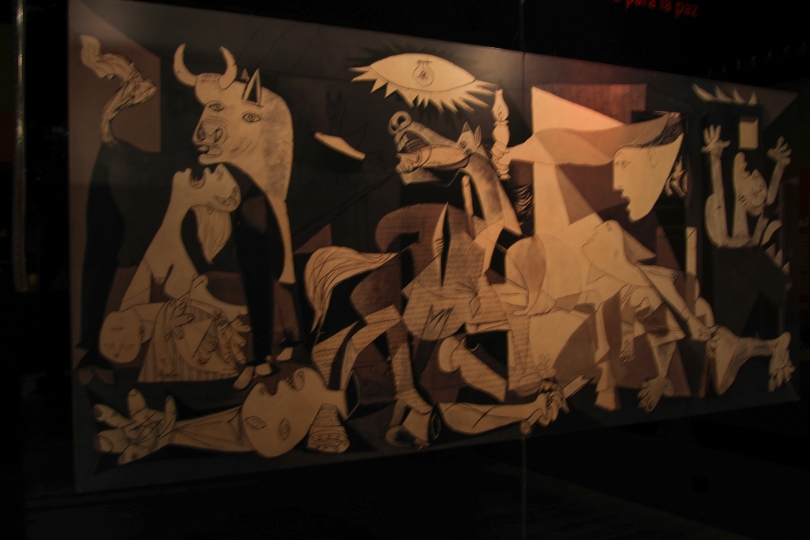
It was the event which inspired what has been described as the last political masterpiece of art, Picasso’s Guernica. Visiting the peace museum in the town there are several representations of Picasso’s work, set alongside many photographs of the destruction left behind. As with Ukraine and Gaza, and so many other places, the piles of rubble and scorched buildings stand as symbols of desecrated communities. There are always narratives that seek to find excuses for such actions. “Local people were sympathetic to terrorists; they sheltered them; they conspired with them”: therefore the cost they have paid is entirely proportionate. Only the delusional can believe that the eradication of schools; hospital and places of worship will bring about an enduring peace. Instead, it plants in the hearts of the survivors, and especially the young, a determination fuelled by a loss which seeks justice by all available means. These fires burn long, long, after the incendiary devices have done their worst.

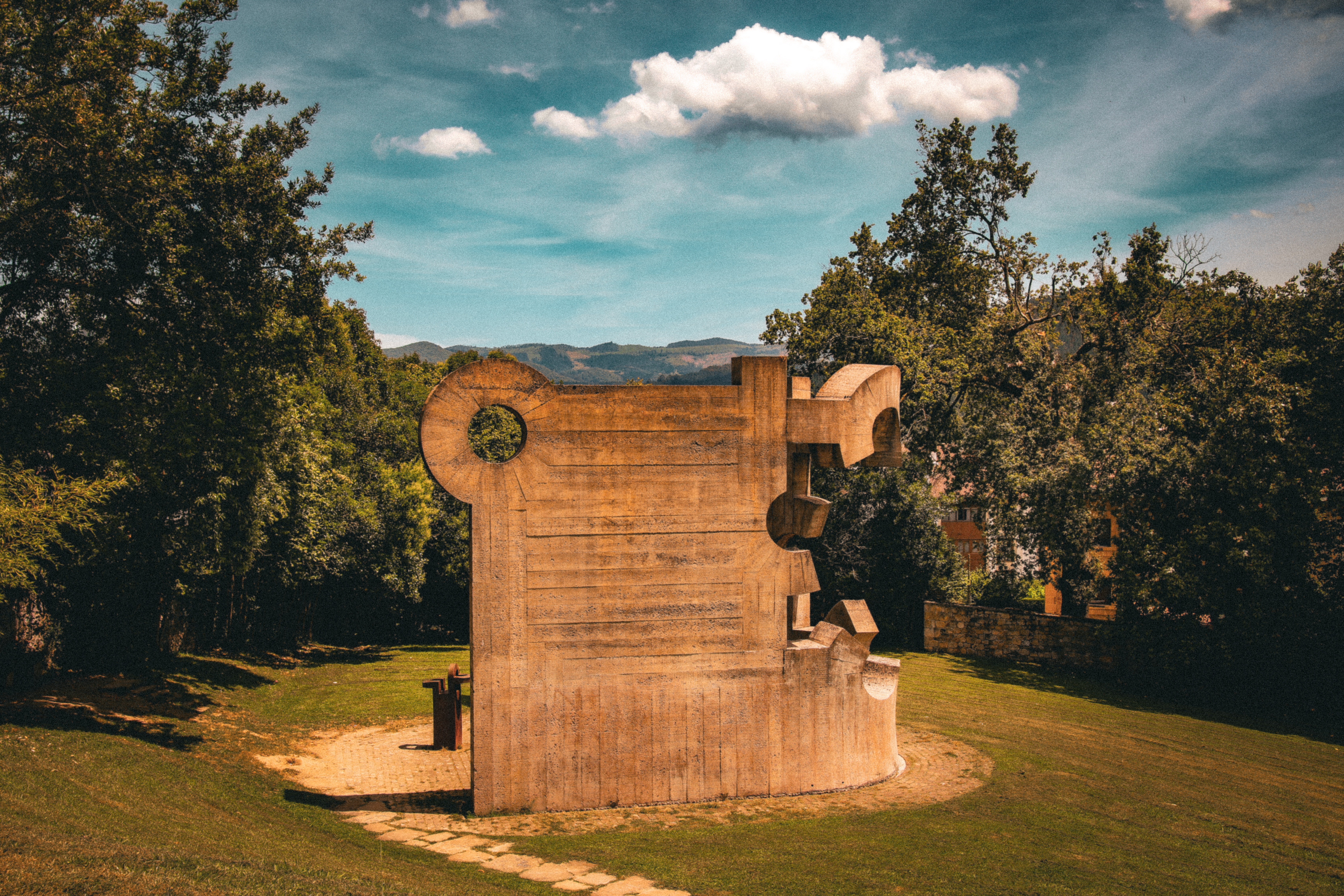
In Guernica’s ‘Park of the Peoples of Europe’ are works by the Basque sculptor Eduardo Chillida (pictured) and Henry Moore. Chillida’s piece (pictured) is entitled “Our Father’s House” and was commissioned to mark the 50th anniversary of the bombing.

The desire to eradicate difference is perhaps one of the most pernicious threads pulled through the most shameful parts of human history. When our arguments don’t prevail, or people seem unreasonably stubborn to retain their language or culture, let’s simply bomb them into submission. What we never seem to learn, despite the beguiling simplicity of this approach, is that it doesn’t work. It perpetuates hatred and drives culture underground, not to extinction. If a fraction of the energy and resource that went into war were taken to promote peace, we would live in a very different world. It took the horrors of WWII to create the United Nations, and several other institutions dedicated to promote understanding, peace and reconciliation. At some point, God willing, may we find in the aftermath of today’s destruction an equal determination to seek peace and pursue it.

Shameless

Many businesses have compliance officers. It is the responsibility of these members of staff to ensure that a firm complies with all the legal and regulatory requirements laid upon it. However, I am going to suggest that there is a different understanding of compliance which is a significant dimension in the various scandals that have come to light in recent months. Whether it is the Post Office, or the entire system of politics and health care provision, in the case of contaminated blood, something has led seemingly intelligent and responsible people not only to fail to act, but to actively work to suppress concerns and continue with dangerous treatments for which other – safer – options were available. What has led these people to comply with behaviours and a culture they knew to be wrong?

Organisations are very good at suppressing criticism. Even when there are good policies and procedures for raising concerns, unspoken influences shape the course of action people feel able to use. For example, without overwhelmingly compelling evidence – and other willing witnesses – the balance of power sits with management. Managers organise rotas; authorise annual and compassionate leave requests; they write appraisals and references. Suggesting that something is wrong means that a manager has allowed something to happen under their watch; been so ill-informed as to be unaware; or are directly complicit in some aspect of a negative culture. In all circumstances it is a risk to whistleblow, whatever paper assurances exist in corporate policies. Even if nothing negative happens at the time, managers may salt away their feelings about the employee and save their retribution for a future time when their action, and past events, can no longer be connected.

Sometimes chaplains fail to recognise these dynamics and express their views with naive candour. I have known several chaplains over the past couple of decades who decided to raise a concern directly with a CEO or organisational chair. This may be no bad thing, but it can irritate all the managers they have cut out between their organisational position and the top of the chain. Perhaps, in the spirit of naval chaplains, the chaplains regard themselves to be the equal of whoever they happen to be addressing. In some cases they have not even bothered to voice their concerns internally but, in the first instance, have gone to an external party. This kind of behaviour was picked in early drafts that led to the NHS England chaplaincy guidance of 2003, Caring for the Spirit. At one point there was text to the effect that chaplains could offer critical insights about an organisation, so long as this did not come as a surprise to that organisation. In other words, chaplains should escalate things internally before writing to their bishop etc..

The problem with internal escalation is that it can be stimied in a number of ways. I have seen on many occasions how the legitimate concerns of a chaplain have been reinterpreted and dismissed while, at the same time, subtle changes may have been made quietly in the background. While it is good that a chaplain’s observations might help put things right, it may also have marked the chaplain out as a troublemaker as far as management was concerned. Organisations possess a gravity that bends behaviour towards various degrees of compliance.

Watching the recent questioning of the former Post Office CEO, Paula Vennells, I was struck by the complete absence of shame in the testimony. There were tears; apologies; and a lot of regret that she had been poorly advised, but no shame. This was an organisation that persecuted and prosecuted its own staff; trusted a faulty software programme more than people; and defended its wrongful actions long after it was clear that reasonable doubt existed about Horizon. At least one person caught up in these horrors committed suicide, and many others were falsely imprisoned. Surely the person who sat at the top of such an organisation, receiving an enormous salary and bonuses, would be ashamed to say they were in charge? Yet that was not the impression given during the testimony.

“A certain kind of shame is valid in its proper context. If you do something morally wrong – steal a colleague’s idea or make a promise you don’t intend to keep – you should regret it, feel guilty, even ashamed of your actions. That’s not unhealthy. It might lead you to apologize and might prevent you from doing it again”.

This Leadership Motivation Is Toxic. Here’s Why You Shouldn’t Do It by Erica Ariel Fox, Forbes Magazine 5 December 2022

All this suggests that the training and formation of senior managers gets so invested in processes and operating systems that some of the core humanity of leadership gets left behind. In the case of the Post Office, the voices of staff working in the branches were given remarkably little weight. To meet financial targets, and defend an eye-watering investment in Fujitsu, people were simply thrown overboard. If that isn’t something a leader should feel ashamed about, then our selection and development of leaders needs a serious overhaul.

The Bible Unbound

Some years ago, an academic at the University of Leeds commented to me about his experiences in teaching students studying chaplaincy at postgraduate level. He was not a religious person. While many essays which he marked contained good arguments and relevant sources, he noted a tendency for several students to write a conclusion in which some random bit of the Bible would suddenly trump all previous discussion. This would happen in such a way that there was no context or scholarly debate – as though whatever it was that Jesus had said in the Gospel of Matthew was clearly intended to be the final word on the NHS in the 21st century. Sadly, I am not persuaded that this problem in hermeneutics has been addressed in the intervening years.

Reflecting on this issue I began to wonder, for the first time, whether the physical presentation of bibles is part of the problem. All the books are bound together as a single volume, with an identical font and layout. There are many advantages in doing this, not least the referencing system that allows a chapter and verse to be identified quickly and accurately. It also conveys the fact that these particular books have been given a distinct and common authority by the Church. However, I suspect it has some homogenising effect which may incline people to regard it as some kind of dictionary or encyclopedia, with a common framework of description and interpretation. Little could be further from the truth.

In preparing this piece I assembled a collection of 66 books. The photograph of these titles heads the blog. There is poetry; fiction; history; biography; law and much, much more. Of course, through their distinct bindings, illustrations and typefaces, all these books appear as individual volumes. Many of them relate in different ways to the same subject but, even then, the audiences for which they are written are different and this shapes the style and content of the writing. I offer this as a visual image of what the Bible might look like freed from the effects of common presentation. Perhaps, if we hold this diversity in our mind’s eye, we might read and understand the Bible differently.

Documents became ‘scripture’ not, initially, because they were thought to be divinely inspired but because people started to treat them differently.

Armstrong, K. (2009). The Bible: the biography (Vol. 8). Atlantic Books Ltd.

At the most simple level, it is a reasonable question to ask whether a book of poetry is the best place to find advice about writing laws. Or that an allegorical method of discussing suffering in a universe with a omnipotent God provides us with material for a book on history? When the presentation of books indicates their topic and approach, we start to read them in a way that is appropriate for their genre.

I am not a professor of biblical studies. Knowing that this is the case makes me all the more cautious about lifting isolated phrases from scripture to support particular arguments. It’s not that I think the books of the Bible are irrelevant to these debates, but I appreciate that understanding the context and purpose of biblical passages is a precaution against their misuse. It also seems to me that it is important to be open to where this kind of study of scripture takes us. It is all too easy to have a determined position on an issue and recruit the Bible to our cause. When supervising students’ work I often ask people to read Paul Ballard’s important chapter on the Bible and practical theology published in 2012. In this paper he appeals for more work to be done in this area but, alas, there appears to have been only limited development in the past decade.

“More important, the use of scripture is an area that has not received sufficient attention in practical theology. It is imperative, therefore, that greater attention be paid to how the Bible actually functions and how it acts as scripture. The Bible is too important to be left to biblical scholars and the systematic theologians”.

Ballard, P. (2012). The use of Scripture. The Wiley-Blackwell companion to practical theology, 163-172.

I shall continue to encourage students to review their use of scripture and consider how it is featured in practical theology and the study of chaplaincy. I certainly would not wish to see the Bible being avoided, but more nuance and awareness is needed when a few words are drawn upon and inserted into an otherwise well-argued essay. Perhaps my greatest concern is that people outside chaplaincy and ministry might assume that a sophisticated and well-informed knowledge of scripture should be a basic skill for clergy and licensed lay workers. All too often, at the moment, this does not seem to be the case.

Photo by Pixabay on Pexels.com

Pebbles and sea-light

When I was training for ministry (several decades ago) there were many memorable moments. On one occasion a tutor was preaching for an act of corporate worship in the college when she happened to remark that, amongst other things “good taste” would not save us. A frisson ran through the student body. Ordinands at Westcott House rather prided themselves in aspirations to good taste, and this act of plain speaking was not altogether welcome. However, it hit home and – as all sermons should – gave us food for reflection.

During a recent visit back to Cambridge I was reminded of this criticism. It occurred to me while visiting the fabulous Kettle’s Yard, the University’s collection of modern and contemporary art. This gallery-in-a-home is the last word in aesthetics, where each object is placed with exquisite care to balance and complement the whole experience of being there and responding to the art. Even down to the daily placement of a fresh lemon. The collection was the creation of Jim Ede, an enthusiastic supporter of young artists in the early days of their careers. The setting for the works Ede acquired was a reaction to “the greater austerity of the museum or public art gallery”. It was to be a place where people could sit in contemplation.

Pebbles and sea-light,
drift of grain across an ebbing floor,
land’s end. The wind is sharp as gulls
pat David Pembroke’s window,
lettering the e stars across
a winter wall.

Extract from Rowan Williams, “Kettle’s Yard”, 4 March 1984 in Williams, R. (2014). The Poems of Rowan Williams. Carcanet.

There is something inspiring and daunting about this relentless commitment to art in a domestic setting. The inclination is to take a seat in every room (this is allowed) and contemplate the shape of the space; the artworks; and the light coming from generous windows. I could have spent all day walking amongst this careful and spiritual placement of works by renowned 20th century artists. We went there with two friends from South Africa and they were equally bowled over by the rich diversity of works.

Because so much about Kettle’s Yard is breathtaking, it is hard to think that salvation cannot be achieved by art and aesthetics. Like the work of the tragically young Henri Gaudier-Brzeska, killed in the First World War, all these works point to something else: they are not consumed by their own necessity. Art is always going somewhere else and, even in the case of Gaudier-Brzeska who died aged 23, it is natural to ask ‘what would have been next?’ Given such talent at so young an age, what other works would this genius have brought into the world.

Good taste may not be salvation, but sharing thought-provoking beauty across so many different forms is surely a step to thinking beyond ourselves; to enlarge our world; and to wonder about what other acts of creativity are yet to enrich us.

“Finally, beloved, whatever is true, whatever is honourable, whatever is just, whatever is pure, whatever is pleasing, whatever is commendable, if there is any excellence and if there is anything worthy of praise, think about these things”.

Philippians 4:8-9

The Apparent Surface

Recently I visited the exhibition William Blake’s Universe, in Cambridge. For many decades I have admired and enjoyed Blake’s work as both an artist and a poet. This exhibition sets Blake’s work alongside British and European Romantics who influenced his development. A review in The Guardian found this to be a weakness in the exhibition at the Fiztwilliam. Given that the space allotted is not overly large, Jonathan Jones found Blake to be overshadowed by the other artists, whose works are numerous in the gallery. This is a reasonable criticism, although I felt that the range of artists represented had its own merits – but perhaps this detracted from the ambitious title for the exhibition.

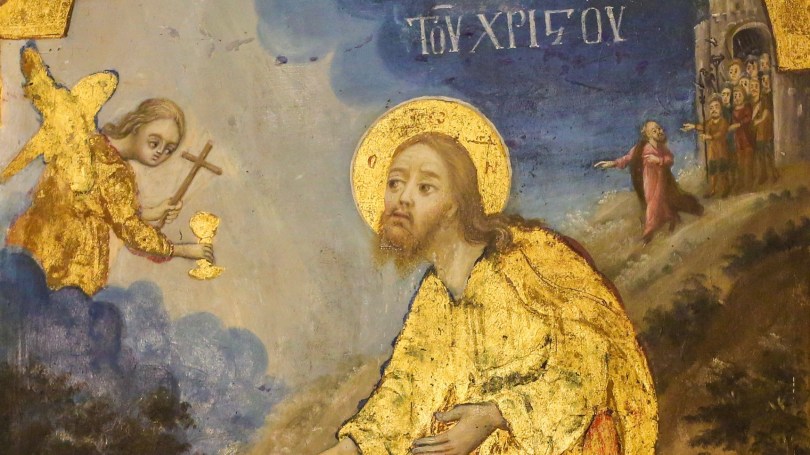
Blake is known for his paintings of vibrant angels and mythical characters. As in the way of classical painting, heavenly figures might be denoted by the presence of a halo. In the art of the Renaissance it can feel at times that the gift of a halo is a game of celestial quoits. Such paintings depict the lucky recipients of a shining disk as those rewarded for faithful and sacrificial behaviour. Often these heavenly signs shimmer and blaze with the finest gold, testimony that someone has achieved divine approval. They stand out from the canvas as the bright honorific of exceptional virtue.

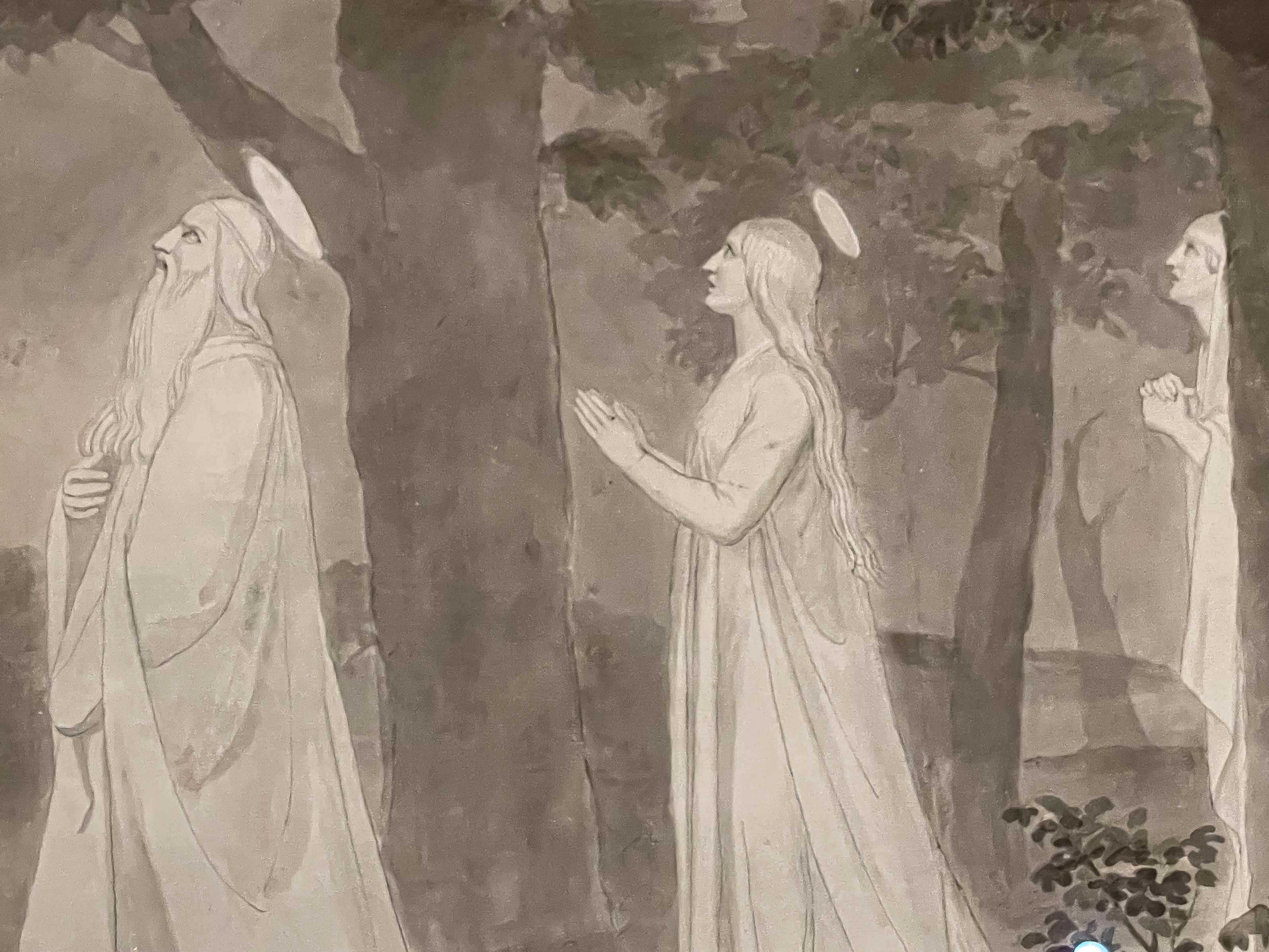
Perhaps it was due to the nature of the medium, but at the William Blake exhibition I was stopped in my tracks by a rather different impression of a halo. A key supporter of Blake during his life, the sculptor and artist John Flaxman created many mythical and Neoclassical figures. In his illustration to accompany Chatterton’s poem the Battle of Hastyngs, Flaxman depicts “Queen Kenewalcha”.

Queen Kenewalcha by John Flaxman

Looking at this painting I was struck by the depiction of the halo as an absence. It felt as though this was a gap in the paper rather than any addition of splendour. In the review of the exhibition Jones quotes Blake’s writing about the production of his books combining, as they did, both text and illustrations:

“in the infernal method, by corrosives … melting apparent surfaces away, and displaying the infinite which was hid”

The Marriage of Heaven and Hell, William Blake, 1790

The halo Flaxman gives Queen Kenewalcha seems to be this kind of melting away, as though sanctity has worn a hole in the fabric of reality and allowed the underlying brightness to shine through. This halo isn’t a painstaking accretion of gold but an elliptical opening that has emerged in the life of someone who isn’t wholly captured by the beguiling surface of a reality we take for granted. Getting to the light, for the artist, becomes the act of stripping away the stuff that pleads its own importance and necessity. In this illustration, the saint is lit by this small portal of connection with a radiance which comes from the reality that is our true destiny.

“To be a human person is to be a per-sona, through whom (per-) lights and fluids, vibrations and sounds (-sonae) flow. Living in attunements, we become “resonant selves,” and being religious is to a wide extent about attuning to the reality to which we belong.”

Gregersen, N. H. (2023). “THE GOD WITH CLAY”: THE IDEA OF DEEP INCARNATION AND THE INFORMATIONAL UNIVERSE: with Finley I. Lawson,“The Science and Religion Forum Discuss Information and Reality: Questions for Religions and Science”…

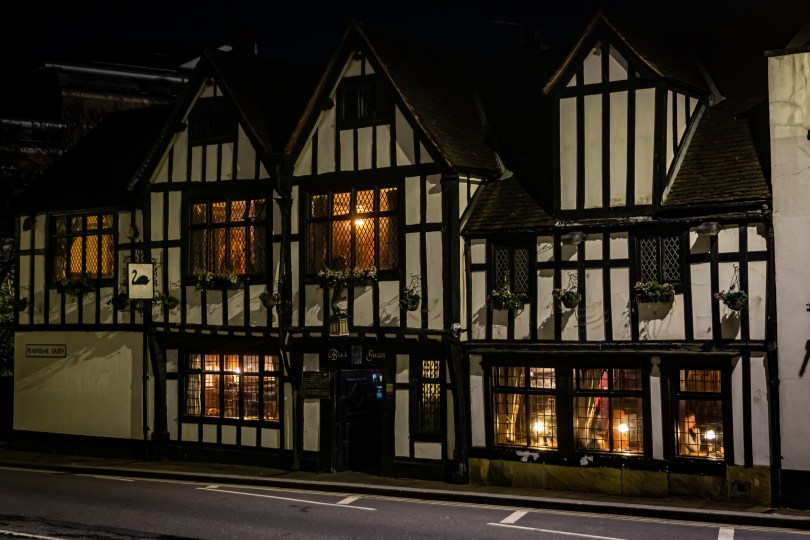
The Last Inn

I once worked with a secretary who was fond of pithy analogies. As we age, she remarked one day, it’s like the old fashioned reel-to-reel recording machines. As it nears the end the depleting spool turns ever faster. Perhaps it’s the effect of familiarity that means some days pass almost unnoticed – we are established in our routines and the lack of new experiences or surprises causes our perception of time to drift. This may be why just a few days away from home may seem to occupy much more time. A new location; new people to meet; unfamiliar experiences to share.

Since August last year I have been working on a project to produce a Lent book. This has developed as a conversation between my own experiences in ministry and the legacies, literary and otherwise, of Laurence Sterne, 18th century parson and author. There are several reasons for this choice, circumstantial and otherwise. The echoes of Sterne haunt the streets of York, from the Minster where he preached, to the nearby building where Tristram Shandy was first printed. The villages just north of the city contained the parsonages where he lived and Bishopthorpe Palace was home to his great grandfather. Much further afield the work of Sterne continues to inspire many different kinds of artistic response. The book for which he is best known, Tristram Shandy, has never been out of print since 1759. Sterne’s ghost is one whose latent power can still turn a coin.

Tristram Shandy was published episodically across many years, coming to an end with volume nine. During the production of the work Sterne’s health deteriorated. He suffered from tuberculosis and often travelled away from a cold and sodden Yorkshire to find a warmer clime. In volume seven he describes one such expedition, going by chaise and spending nights in various taverns. It is this setting that leads Tristram to think about his death (which he had already escaped once). Drawing on earlier writing, Sterne’s character reflects on his place of death, and which location would afford him the most comfort in his final hour.

The conclusion drawn is that an inn would be the best place for “this great catastrophe”. Tristram thinks that the understandable care and concern of friends, mopping his brow and smoothing his pillow, would “crucify my soul”. This thought occurs at an inn within the town of Abbeville where, it would appear, Tristram suddenly realised that choosing which pub might in fact be rather important. He concludes that it could not be the inn at Abbeville, even “if there was not another inn in the universe”. To avoid any possibility that it might be the setting for his last breath, the chapter ends with Tristram demanding that the coach and horses be ready to depart at four o’clock the next morning.

“He [Archbishop Leighton] used often to say, that if he were to choose a place to die in, it should be an inn; it looked like a Pilgrim’s going home, to whom this world was all an inn, and who was weary of the noise and confusion in it.”

Quoted in Bishop Burnet’s History of his own Time (1724)

If the wish that Sterne gave to Tristram was one which the author shared, then it was granted – partially. Sterne died on the 18th March 1768, away from his friends and family, in a boarding house that had become his London lodgings. Journeys constituted a significant part of Sterne’s life, both as a child and an adult, and his ultimate departure came in the city that had granted him fame and a modest fortune. In his last days he struggled even to pen a letter. In his final correspondence, to Anne James, he writes of being “at death’s door this week with pleurisy” and ends by commending her “to that Being who takes under his care the good and kind part of the world”. At 54 Sterne had gifted to the world a remarkable literary legacy and stimulated a debate about his life and thoughts which remains productive because it is still contested. He knew, as did Tristram Shandy, that life is fleeting – and he made the most of the joy that shone fleetingly between the clouds.

The Resurrections of Jesus

The shunned, the unloved, the bleeding – the despised and the dead – were all brought back into life by Jesus. In a culture of separation and holiness-by-isolation, the Nazarite Rabbi stepped over boundaries again, and again, and again. When that culminated in the raising of a man from the dead, Lazarus of Bethany, the authorities decided enough was enough. It was time for Jesus to go away. Better that one man should die than the nation perish. Utilitarian arguments often win the day, they are beguilingly simple and often easy to implement. Focused on what is obvious and immediate, they frequently omit or deny wider truths and bigger themes that are, perhaps, simply too inconvenient to contemplate.

Like the sower’s seed, or the prodigal’s father already upon the road, the resurrections of Jesus are strewn across the Gospels. He calls back to life those who have been taught to be dead. To the contamination of a bleeding woman who dares to touch him, a wretched life is made whole. Many are healed and the doubting are allowed to walk away. At a meal with his disciples a woman dares to waste the fragrance of rich perfume; anointing the feet beside which the barren branches bring forth blossom. Here is bread and water; body and blood, the words whispered to the unworthy and the hopeless: you are alive.

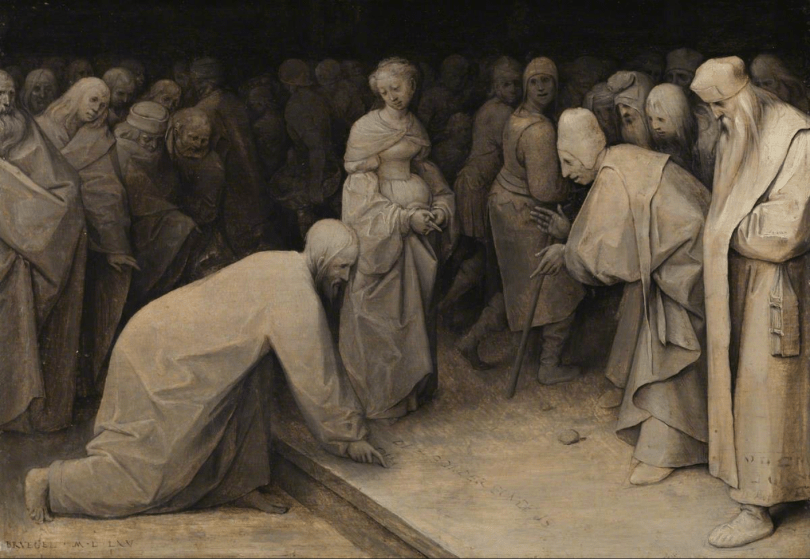
The picture at the head of this blog is called ‘Christ and the Woman Taken in Adultery‘ (1565) and was painted by Pieter Bruegel the Elder. The painting uses a technique called grisaille, meaning that it appears to be monochrome; everything is a neutral shade – sepia-like. It is hard to imagine any depiction which conveys a stronger sense of life drained away. In the crowded painting the head of Jesus is lowest of all. He writes. I have always believed that in this story, at this point, Jesus is incandescent with rage. He knows that the purpose of this moral tale is to trap him and condemn him. Did the Pharisees just happen to catch this woman in the very moment of committing adultery? Or did the lawyers’ question come first, and a cunning plan evolve to create the drama? She is caught in the act – and they know at that moment exactly where to find Jesus. He knows that those who bring her care neither for her sin nor her salvation. She is a prop. It is little wonder that this is one of very few Gospel stories where Jesus pauses and takes his time, perhaps to marshal his feelings before speaking.

“The stone-throwers walk away, one by one, according to age. Until the kneeling Christ and the standing woman remain, in an awkward reversal of their established sexual status. He tells her to go, to sin no more, to pass from this narrative, and out of our knowledge”.

https://www.theguardian.com/artanddesign/2011/sep/30/picture-this-iain-sinclair-bruegel?CMP=share_btn_url

The teachers and the crowd are dismissed by their recognition that no one is without sin. In this dismal tale of exploitation the one whom Christians claim has no sin does not pick up a stone. Violence is interrupted and a word of resurrection love is spoken: I do not condemn you. Like the woman at the well, she stands with Jesus alone. Another woman made the recipient of easy male judgement. The choreography of sin and punishment is cut short by someone who has no interest in this kind of dance. It is time for it all to stop.

On Good Friday we are supposed to think about the agony and suffering of Jesus, and so we should. But the resurrections continue, even on the cross. For the criminal who puts his faith in Jesus, the promise of the life to come: today. Slowly, the light of the world is extinguished. Its remains are planted in the darkness of the sealed tomb: and we wait. Today, at Easter, resurrection triumphs over death. The task of the church is to live this resurrection and set free people so quickly judged by those keen to weigh some sins more than others. To punish those whom it is easy to judge, and hide much greater sin in the folds of wealth. The resurrections of Jesus are not good news for everyone.

Photo credit: The Courtauld

The Flappers

In the weird and wonderful world of Gulliver’s Travels, Jonathan Swift described servants who performed a particular occupation encountered by Gulliver on his third journey. These servants were called ‘flappers’ and their job was to accompany their master or mistress and make sure they were paying attention to what was going on. They did this with the aid of an inflated bladder on a short stick which, when they deemed it important for the person to be alert and listening, was used to flap them on the ear with the bladder. Equally, if it was something they needed to look at carefully, to flap their employer – gently – upon the eyes, thereby preventing them falling down a cliff.

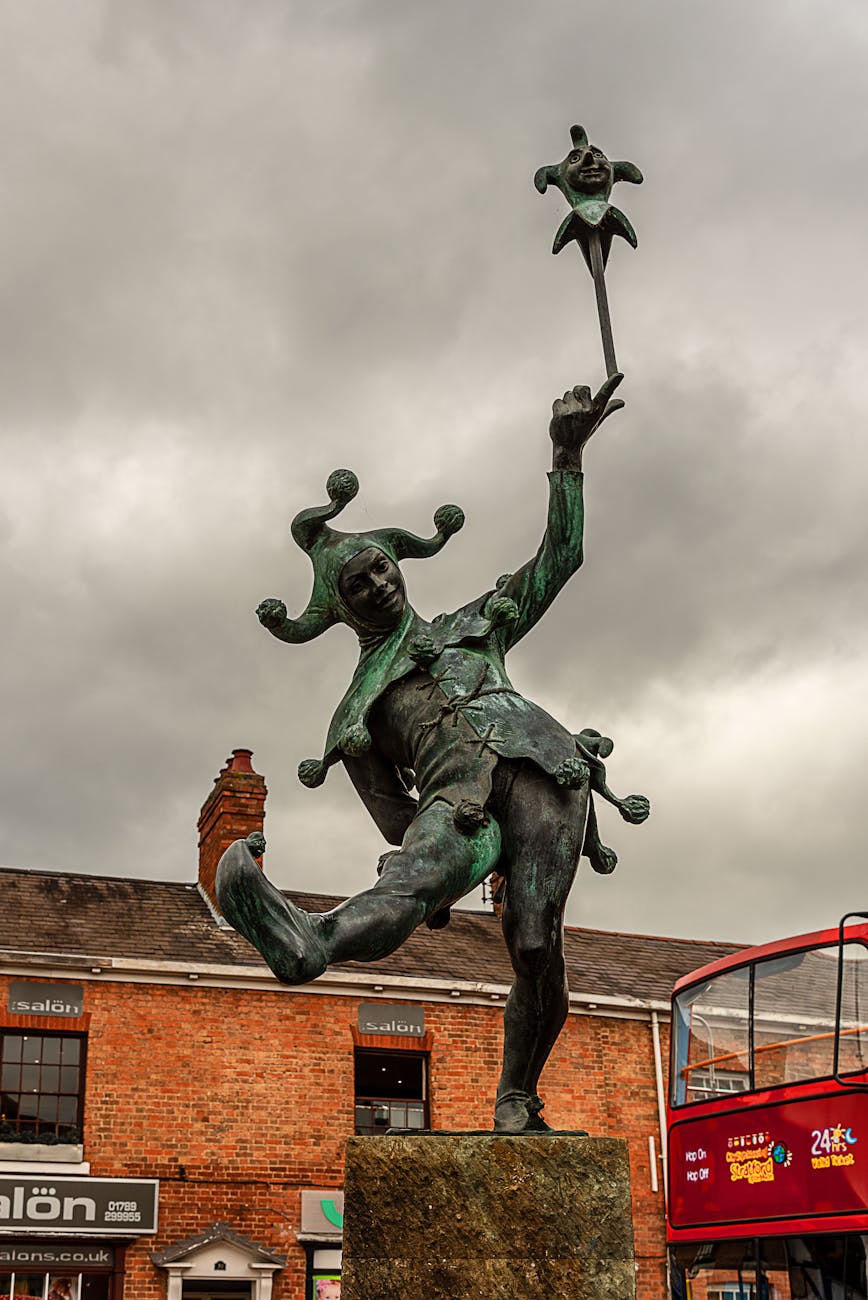
This rather dramatic premonition of contemporary mindfulness was Swift’s satire on the distractedness and self-absorption of philosophers. These 18th century thinkers are portrayed by Swift as disconnected from the world around them, requiring a ‘flap’ or, I would suggest, a slap, to reawaken them to reality. Gulliver was unimpressed by the aristocratic figures who needed flapping, and spent more time conversing with the flappers themselves who, of course, had to pay attention to the world on behalf of others. Swift would be aware that his description is reminiscent of the role played by court jesters, who also used inflated bladders, and were sometimes the only people who could speak truth to power.

Photo by John Nail on Pexels.com

It is not easy to see the world with clarity. Often our gaze is overlaid with memories and interpretations that make our observations conform to views we hold already. This can mean that we fail to discern new patterns or new dangers, in a context where we pull reality towards the norms of our own expectation. I have written before about the value of stringent seeing and speaking, when we try to strip away the layers we impose and see something afresh. It is not easy. Perhaps we all need a flap to the head now and then.

Until I began preparing a sermon for Palm Sunday I hadn’t noticed a comment toward the end of the appointed Gospel reading. St Mark tells us that on entering the Temple, Jesus remained there until ‘he had looked around at everything’. Not preaching; not teaching; not healing or anything else: simply looking. Further research led me to discover that the Greek word used here, περιβλεψάμενος, occurs only seven times in the gospels with all but one of these found in Mark. Why is the evangelist so keen to make this point about the behaviour of Jesus?

Referring to an earlier use of this word in Marks’ Gospel, one suggestion is that the pause for observation “helps to intensify what Jesus is about to do” (Christal, J. 2011). This could be interpreted as a word used to convey dramatic effect: something major is about to happen. That would fit with Jesus’ Palm Sunday entry into Jerusalem and the impending denouement of his mission. Equally, it is possible that Mark’s presentation of the passion captures a growing disparity between what Jesus was realising about the coming days, and a world unaware of events that would come to change history. It reminds me a little of the 2011 film Margin Call about the 2007-8 financial crash. A young financier, working for a large company, had calculated that the world was on the eve of a commercial meltdown. As he is driven across the city he gazes out on a world he knows is about to change, where everyone he sees is oblivious to how their lives will be altered. The character ‘looked around at everything’ because nothing would ever be quite the same again.

I am not convinced that having a flapper around to bop my eyes or ears would necessarily help me to see the world any more clearly. Like the ping of a message on my mobile phone, it would probably lead to irritation. Nevertheless, the point Swift is making is entirely valid. We are parochial and complacent creatures, wrapped up in our own concerns and often lacking the will to shake up our way of seeing the world. In a church where there is often an emphasis to ‘make disciples’ and to be incurious about a theology that questions our way of looking, it might help to remember that Jesus took the time to simply pay attention to the world. At the start of Holy Week it is a helpful reminder to us to ‘look around at everything’. To allow the narratives of Maundy Thursday and Good Friday to jolt our compassion into life, and to look forward with hope to the day of resurrection.

Nothings Monstered

I find being praised an uncomfortable experience. There are possibly several reasons for this, such as the inevitable injustice of elevating any one person’s efforts when so much excellent work goes unacknowledged and unseen. There is also the danger that praise is a tool of patronage and amounts to little more than a loan which will one day be called in. Lastly, the words used in praise inevitably fail to fully capture the deeds they describe: they are either too capacious or too perfunctory. Among other writers, Shakespeare is notable for his exploration of the ‘precarious correspondence between words and meanings’ (Sicherman, C. M. 1972. Coriolanus: the failure of words. ELH, 39(2), 189-207). Of course, praise can be genuine and well-intentioned – but I would much prefer not to be subjected to it.

Recently I watched a film adaptation of Coriolanus. The character of the play’s title is not a sympathetic figure. He is a stubborn, able and determined fighter, admired greatly by his troops. But he has very little time for ordinary people – the plebs – or their leaders. When he is seeking to become consul, encouraged by his mother, the Senate meets to recount the many worthy deeds which substantiate his appointment, Coriolanus moves to leave the chamber:

Your Honors, pardon.
I had rather have my wounds to heal again
Than hear say how I got them.

Coriolanus Act 2 scene 2

Despite attempting to persuade him to stay, Coriolanus eventually leaves the Senate. Perhaps he finds it impossible to remain when words sound so hollow compared with the deeds they describe. Warfare is a reality that none can imagine who have not stood within it, or know what it is to be such a danger to the lives of others. Oratory risks tidying away complex affairs and obliterating the wounds they leave. Before departing Coriolanus adds:

I had rather have one scratch my head i’ th’ sun
When the alarum were struck than idly sit
To hear my nothings monstered.

Ibid.

Perhaps surviving appears to be a nothing in the context of war. Many people caught up in the chance nature of conflicts, know that a decision to turn left, rather than right, is the difference between life and death. When I heard the remarkable Arek Hersh speaking about his time in a concentration camp, while standing in Auschwitz next to one of the kind of cattle trucks in which he was forced to travel decades before, it was a powerful testament to the apparent arbitrariness of survival.

USSR – CIRCA 1980: Postcard shows Italian Majolica from Hermitage Plate “Coriolanus’s mother and wife implore Coriolanus to spare Rome”, Faenza, 1523, workshop of Casa Priora, circa 1980

Shakespeare appears to have been very interested in ‘nothing’. The title of Much Ado is a play on the word, and ‘nothing’ occurs 34 times in King Lear. In Coriolanus’ bitter sense of rejection as he is sent away from Rome, he undergoes a fundamental crisis of identity. He has been a loyal and outstanding warrior for the Republic – his decision to cross into the camp of his enemy is a ‘Damascus Road’ transformation. His former commanding officer, Cominius, goes to entreat him to be at peace with Rome – and is rejected. Returning to the capital, Cominius describes the state in which he found his late deputy:

“Coriolanus”
He would not answer to, forbade all names.
He was a kind of nothing, titleless,
Till he had forged himself a name o’ th’ fire
Of burning Rome.

Shakespeare, W. Coriolanus Act 5 scene 1.

Forging a name in battle is a long-standing tradition in many cultures. As a result of his service in WWII Montgomery’s most senior title was ‘1st Viscount Montgomery of Alamein’. For Marcius it is the heat of battle that creates for him a title earned in combat, and takes a form of the name of the city where the battle occurred: Corioli. There appears to be genuine modesty in the response of Coriolanus to the gifts that are showered upon him in the moment of victory. He refuses the offer of a tithe of all the treasure in the city, and instead wants to receive the same portion as every other soldier. As he says: ‘I have done as you have done – that’s what I can’. However, refusing to play the game of reward and gratitude can be a dangerous course of action, as Coriolanus comes to discover. He is banished.

Renouncing his past titles and honours, walking away from his citizenship, leaves the resigned general in extreme isolation. I’m not sure that I agree with Ibsen that, “The strongest man upon the earth is he who stands most alone.” Nevertheless, Coriolanus sacrifices an enormity of rank and resources when he sides with his former enemy. As his mother tells him at one point: ‘You are too absolute’. In Shakespeare’s lifetime, people who took an absolute view about religion and the state could find themselves losing titles and property, not to mention their lives. The playwright was familiar with those who could, in a moment, become ‘a kind of nothing’. A state of loss which is perhaps the precursor of a wisdom that comes to us, all too often, far too late:

For wisdom is the property of the dead,
A something incompatible with life; and power, Like everything that has the stain of blood,
A property of the living …


William Butler Yeats, “Blood and Moon”