Love Letters

During a recent research day with chaplains it became clear that alongside a greater use of technology, the pandemic has stimulated letter writing. This may seem to be contrary to much of what we’ve heard about the way ministers have responded to enforced distancing. Many stories have emerged about the use of Zoom and similar technologies. Yet our conversation revealed a small but significant practice of increased letter writing.

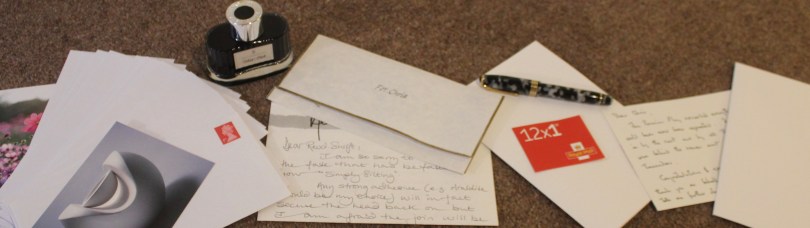
I like letters and cards. There is something both personal and enduring about hand-written communication. On our recent holiday I sent cards to two people I trained with – using the more leisured time to select a card and compose my greeting. Receiving letters always reminds me that people spent time thinking about me and thinking about our friendship. Handwriting can’t be cut and pasted.

“Letter writing is the only device combining solitude with good company.”

Lord Byron quoted in Williams, L. (2012). Kind regards: The lost art of letter writing. Michael O’Mara Books.

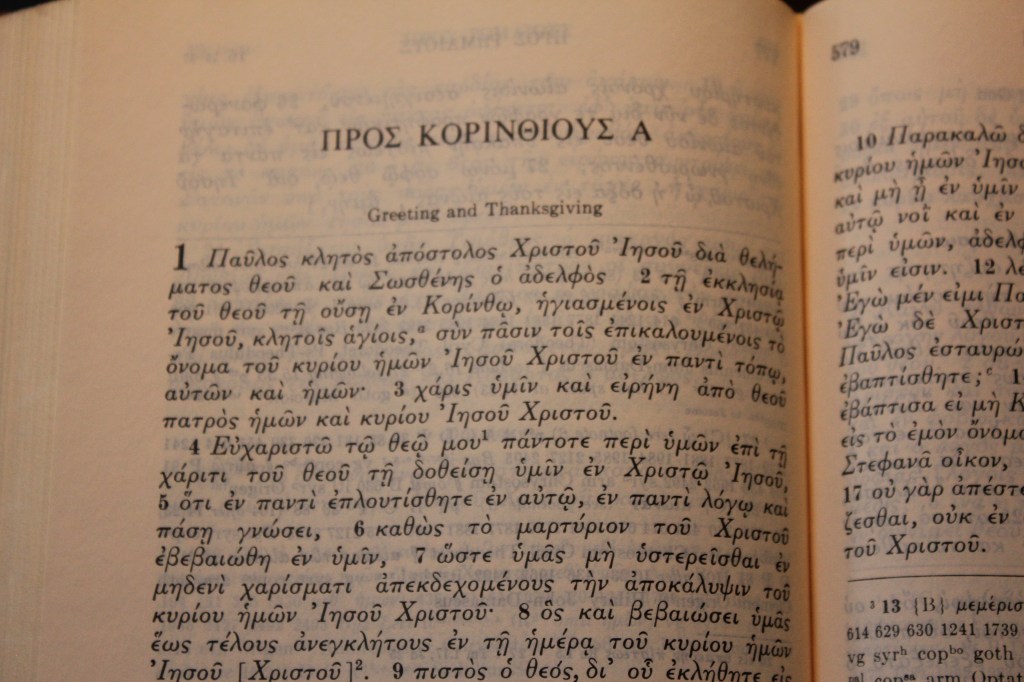
All this made me wonder about the place of letters in Christianity. The Epistles in the New Testament offer an insight into the theology, experience and mechanics of the early Church. I’m not sure whether Christianity is unique in having letters as sacred scripture, but it certainly seems unusual. Pursuing this thought I came across Antonia Sari’s work on letter writing in the Graeco-Roman world. It appears that the collection and publication of private correspondence doesn’t happen until the first century BC, when the letters of Cicero were made public. This suggests that the practice of publishing personal letters develops only shortly before the emergence of Christianity.

“The same written form that forces the author to more intense reflection also provides the addressee with opportunities for unhurried reading and interpretive rereading”.

Klauck, H. J., & Bailey, D. P. (2006). Ancient letters and the New Testament: A guide to context and exegesis. Baylor University Press.

Unlike electronic communications letters feel like they send something of oneself. They convey a high degree of peronsalisation – which is perhaps why charitable appeal letters often strive to mimic handwriting. We might think of the person composing the letter – knowing their home and their walk to the nearby letterbox. The whole ritual of writing, sealing, addressing and posting emphasises the care and thought committed to the process. For the chaplains on the research day the motivation to do this was also linked to people’s limited resources. Not everyone has e-mail or affordable access to the internet. The cost of letter writing sits with the sender, not the recipient.

At the University of Leeds School of English Alison Searle is leading an AHRC study which includes an examination of the use of letters as a form of pastoral care. Set in an historic context, this research has much to contribute to our present understanding of the way letters help or hinder the expression of care. Unexpectedly for those involved with the project, Covid-19 has created a situation in which support-at-distance has gained renewed relevance.

It is a pity that sending letters has become so expensive. There is a vicious cycle in which the post becomes more costly so fewer people use it – which in turn places pressure on its viability. Perhaps this year, given our unique circumstances, there will be a rise in the number of Christmas cards sent, reversing a longstanding decline. We may need to re-evaluate the trend to substitute the cost of cards with a gift to charity, or the tendency to opt for an e-greeting. Making time to send something of ourselves to the people we care about has a value beyond the influences which have reduced the custom. Perhaps this December, the love and care conveyed by handwritten messages will be rediscovered as one of the most valuable gifts of the festive season.

Autumn – Another Beauty

Today I had one of those salutary moments, when something simple makes you pause. For the first time in several month, with a slight chill in the early morning air, I put on a winter coat. As I reached into a pocket I pulled out a face mask. In an instant I was reminded just how long the pandemic is enduring and how, half a year later, we are once again looking at a curve that is rising at a vertiginous rate.

Most of the cost of this protracted crisis will not emerge until after a point of solution or stabilisation is reached. We are now living through what a friend describes as a ‘chronic emergency’, which will no doubt have more and less acute phases. A recent two week holiday in the UK had occasional moments when it felt as though I was on furlough from the front-line. Still hearing the reports of struggle and danger but removed from its immediate impact.

Spending time in the depths of rural mid-Wales had much of the benefit of being on retreat. The weather was an unexpected gift of warm days and comfortable nights. Across a landscape of hills, woodland and waterways, the turn of the year was coming into view as foliage showed the first signs of autumn. Sitting by the River Wye just above Rhayader I was reminded of a reflection which took place much further downstream. At Tintern Abbey, more than two hundred years ago, Wordsworth’s contemplation of a bucolic scene led to thoughts about the changes brought to us by the passage of time:

While here I stand, not only with the sense

Of present pleasure, but with pleasing thoughts

That in this moment there is life and food

For future years.

Wordsworth, Lines written a few miles above Tintern Abbey, 1798
The Wye River above Rhayader

In current circumstances we may all be drawing on ‘life and food’ laid down in past years to help us navigate turbulent waters. A Western tendency for several decades has been to assume a degree of certainty about the future. Only when viewed at a distance can we see how this is an aberration in terms of both human history and the reality of life in other parts of the world. If a pay cheque doesn’t come at the end of the month it is an outrage which leads to prompt correction and a shamefaced apology. Yet in the 1980s, while spending a year in South America, it was an accepted reality that sometimes pay might be delayed for one or more months – especially in the public sector. We need to be circumspect about what we take for granted. Will 2020 be viewed as a scary year that departed momentarily from story of economic growth and prosperity, or will we look back on it as the beginning of the decade of Covid? We don’t know – and we shouldn’t assume.

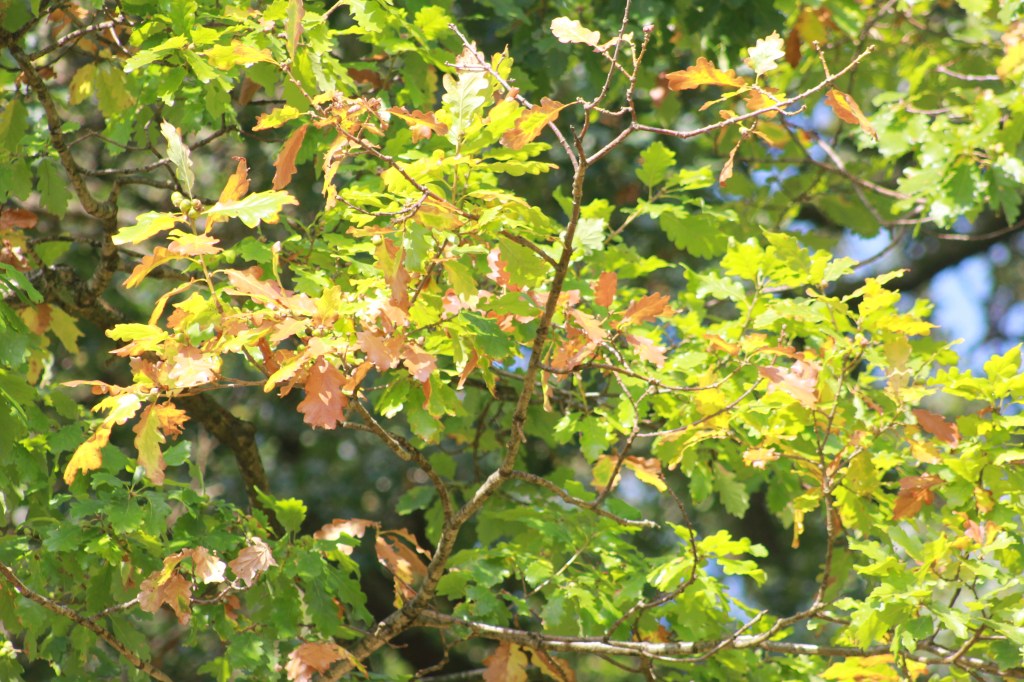
Emerging autumn colours

In uncertain times we can all benefit from contact with things that convey a sense of continuity. The seasons arrive with reassuring regularity, and each one with its own riches. Autumn has often been a metaphor for later life, and it is a reminder that even change which may not always be welcome comes with its own beauty. We may mourn the loss of summer’s rich canopies and expansive days of warmth, but in the transformation of the season there is a spectacular display of colour. Its fleeting nature, combined with the change in climate, can intensify the pleasure we take in a beauty made all the richer by our knowledge of its brevity.

We enter autumn with questions about the future which are unusual for many of us – but not for all. Living wisely with uncertainty can be a tall order, and finding reserves of reflection matter all the more when our footing feels less sure. Pausing to recognise the beauty of today, or recalling those past moments that have grounded and fed our spirit, will perhaps be more valuable now than we imagine.

Things of Mourning

Often bereavement leads to a major task of sorting. Deciding what to do with the stuff of long lives – items acquired over decades – can take a lot of time. Not only because of the volume of items, but also because each can stir a memory. In some cases there may be little that remains, as the work of sorting has been integral to moves from family home to smaller house, to a flat and maybe, finally, a single room. Yet this can also mean that the little which remains is the most moving.

It is tempting to become pious on this topic and tut at a materialism which many in the West take for granted. Yet tangible things have a potency when they are linked to lives we have known and loved. A simple item can be a connection across generations and remind us of an enjoyment they inspired in someone no longer here. The photo above is of my grandfather’s fountain pen – which I’m guessing was a gift for his twenty-first birthday in 1922. There’s no one still alive to ask, but its gold band bears his initials and it’s a lovely keepsake.

These reflection on the ‘Things of Mourning’ were prompted by a few words from Acts chapter 9. Following the death of Dorcas we hear that Peter went with the mourners to visit the deceased. On arrival the women were ‘weeping and showing tunics and other clothing that Dorcas had made’. There is a sense that in showing these items of creativity and skill the personality of Dorcas is evoked and honoured. ‘Things’ can aid our grieving as they bear the imprint of someone’s personality.

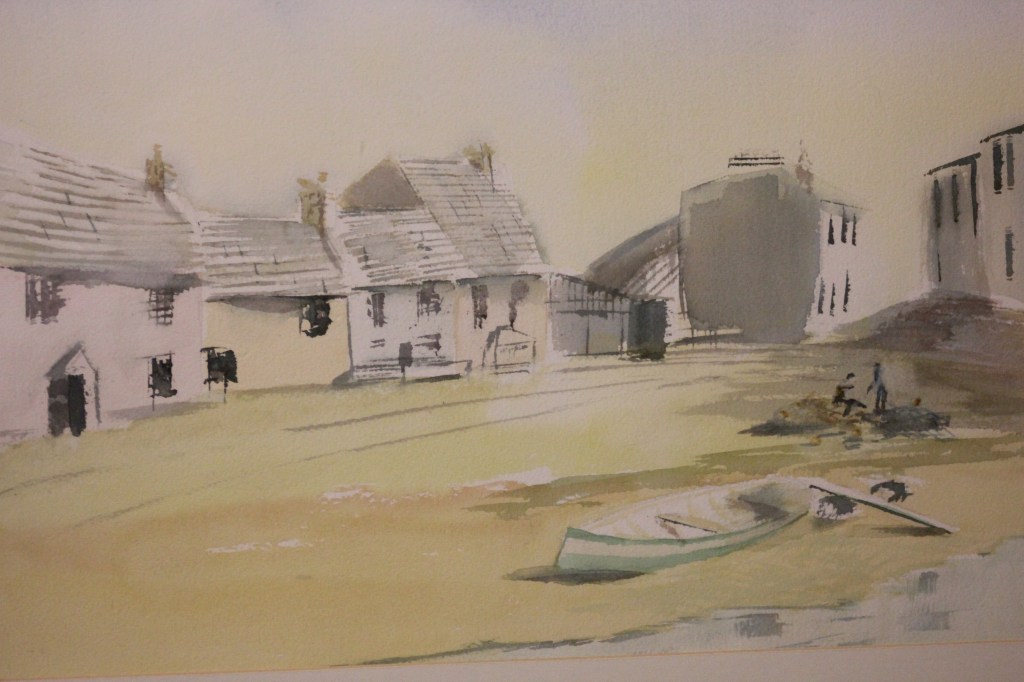
Painting by Stan Swift

My father was a prolific watercolour hobbyist. Retirement didn’t halt his enthusiasm and he continued to paint into his 80s. He was midway through a new picture when illness overtook him and his life came to an end. I still have this uncompleted work. After he died we found paintings everywhere. Some on the walls, others in boxes and some in bags. There were even unframed paintings behind the sofa. Every time we went to look for something we found more! So, at his funeral, a room adjacent to the church became a temporary exhibition where friends and family could help themselves to something for both memory and enjoyment.

For all these reasons it is easy to understand how people become so distressed when a burglary results in the loss of something with little financial value. The anguish has nothing to do with price, but everything to do with value. As Thomas A Kempis wrote many centuries ago:

A wise lover values not so much the gift of the lover as the love of the giver.

Thomas A Kempis, The Imitation of Christ

Gifts and the things we inherit have a power to token a love which continues to be lodged in our memory after someone has died. The things of mourning matter for the connections they enable. What they may be made of matters very little: what they mean can touch the depths of our soul.

Know Thyself

One of the scenes in Much Ado About Nothing sees the friends of Beatrice describe her faults. Beatrice supposes she is hidden, but the friends know full well that she is listening. When they have left, Beatrice steps forwards and concludes: “how happy are they that hear their detractions and can put them to mending”.

Self-knowledge and identity are themes that run through today’s readings in church. Isaiah’s message to those who seek the Lord:

Look to the rock from which you were hewn, and to the quarry from which you were dug.

Isaiah 51: 1b New Revised Standard Version

Our origins can be a significant part of our identity. In the Letter to the Romans members of the Church are urged “not to think of yourself more highly than you ought to think, but to think with sober judgment” (Romans 12:3b). Having an accurate self-understanding requires work and commitment. Lastly, in Matthew 16, Jesus questions the disciples about his identity and, in the same moment, we learn of Peter’s role as the rock on which the church will be built.

Understanding our own incompleteness is a prerequisite for growth. Only when we recognises our strengths and detractions can we be open to learn and to change. Like most people I always hear criticism more loudly than praise. Peter may have felt lifted up by the words of Jesus but it’s only a moment later that he is rebuffed as he attempts to intervene to prevent the suffering Jesus will undergo.

While Beatrice may have heard her faults discussed in an ad hoc manner, modern approaches to understanding personality are more systematic. There are many tools available to help us learn in greater depth about ourselves are how we can become more constructive in the way we work with others. We can’t change the “quarry from which we were dug” but we can learn to understand what that means for us and the ways we behave.

All of this has something to say about the way our formation as people can be furthered. For Christians the values which inform our understanding are orientated towards community and service. Like St Peter, we’re called to be ourselves in God’s presence – warts and all – and to discover more fully who God calls us to be.

It is already clear that the Covid-19 pandemic is testing people’s capacity to cope with a world that has become suddenly more dangerous and less certain. It seems that everyone is anticipating a rise in problems of mental health and wellbeing. In 2013 the successor of Peter addressed bishops in Brazil and spoke about human formation:

it is important to devise and ensure a suitable formation, one which will provide persons able to step into the night without being overcome by the darkness and losing their bearings; able to listen to people’s dreams without being seduced and to share their disappointments without losing hope and becoming bitter; able to sympathize with the brokenness of others without losing their own strength and identity.

Address of Pope Francis: Archbishop’s House, Rio de Janeiro Saturday, 28 July 2013

Impetuous Peter always took the plunge, as he did in declaring Jesus ‘the Christ’ and leaping into waves in order to meet him. Sometimes we feel we are sinking, and when we do, we need the hand of someone set on firmer ground. Someone able to “step into the night without being overcome by the darkness”. As the consequences of disruption in 2020 reverberate across the world we need those who feel at peace with their origins. People who do not think of themselves more highly than they ought and who, more than anything else, know themselves well enough to help in all the mending that will need to be done.

Ennobled Fractures

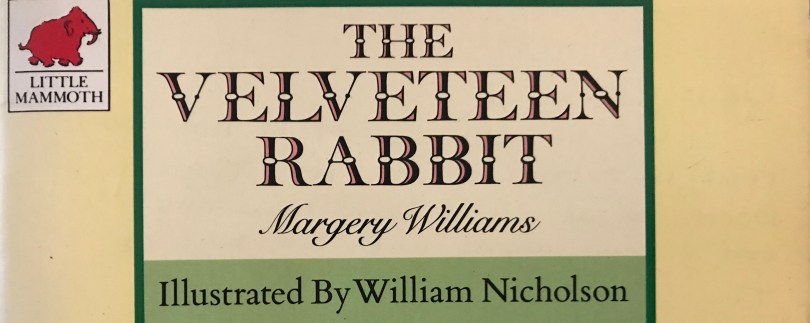
In some ways I took it as a mixed compliment. When I left the parish where I served as curate some good friends gave me a copy of The Velveteen Rabbit. If you’re unaware of this book, it’s a charming morality tale of how love brings us alive and makes us ‘real’. Centred on the toy of the title, we learn that in becoming real we tend to get rather well-used and worn.

by the time you are Real, most of your hair has been loved off, and your eyes drop out and you get loose in the joints and very shabby. But these things don’t matter at all, because once you are Real you can’t be ugly, except to people who don’t understand.

Margery Williams, 1881-1944. (2003). The velveteen rabbit : or how toys become real. Leesburg, VA :GiGi Books

Like many children our daughter had a favourite toy. Not a velveteen rabbit, but a cotton one named ‘Vicky’. As the years went on, grandmothers had faithfully repaired bits and replaced parts, but the love for this rabbit never diminished. Sadly, on a holiday in the Yorkshire Dales the toy was left on a bus – traumatising her parents even more than our daughter! I still think of Vicky Rabbit riding around the beautiful landscape in a bus full of children.

Repairing much loved things is an activity as old as humanity. Very often we aspire to ‘invisible mending’, and attempt the great skill required to conceal a fault. Sometimes it can be done – but for those who know what happened it may never seem the same. When a visiting vicar commented to my grandmother on a fine new piece of needlework hanging in her hall she couldn’t suppress the need to tell him where the fault was in the tapestry. Invisible to everyone else, Bessie felt that any admiration needed to be qualified by her knowledge that it was imperfect. The picture needed to be truthful.

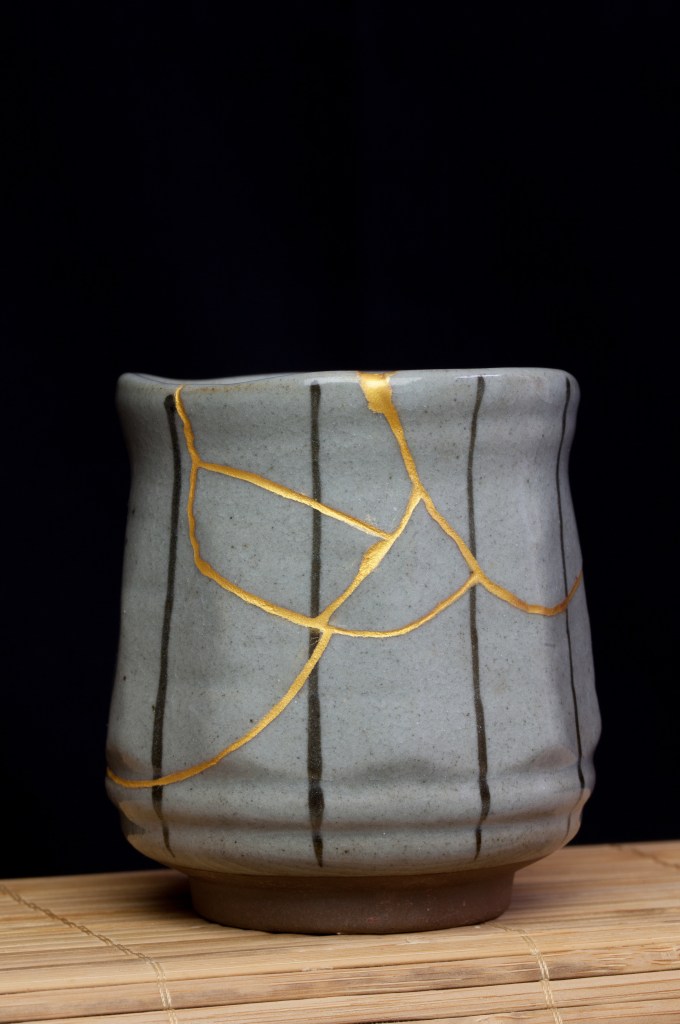
A small handmade tea cup repaired using the Japanese art form of kintsugi and a gold powder.

Not everyone aspires to this kind of good-as-new restoration. Reading Andrés Neuman’s new book fracture I was reminded of the ancient art of Kintsugi, when a pottery repair is accentuated by the use of gold. Rather than concealment, the crack becomes a rich vein within the ceramic work, adding interest and individuality. There is a lot of fracture in Neuman’s novel, set as it is against the backdrop of the 2011 tsunami but also connected to other events. It’s a book that feels very pertinent as we begin to see the scars exposed by the COVID-19 pandemic.

A question that emerges as we live through this extraordinary health, wellbeing, economic and political emergency concerns the way we respond to these multiple assaults. Perhaps we could try to conceal some of our unlooked-for experiences, and rush back to a limping version of our former ways? Alternatively, we could learn something important about how we live and relate to others. Learn to become more realistic in our living by stopping the pretence that we can behave as if we are unconnected to others on the small planet we share. To recognise that some of the things which shatter our self-assurance are not imperfections, but necessary interruptions in the smooth glaze of our story.

As the months roll on there will be much to repair and to heal. Perhaps some of this cannot be put to the good, reconstituted or restored. Yet there will be moments when we can choose to ennoble our repairs – to make life and the structures of society fairer and more caring. There will be glimmers of good amongst the pain that many are feeling, and we need to reveal the fractures that have allowed things to change for the better. Whether it’s a growing recognition of how support for older people has been neglected, or the daily injustices that have energised ‘Black Lives Matter’, there are some fractures in our common life we should seek to repair – but never conceal.