Change of a Lifetime

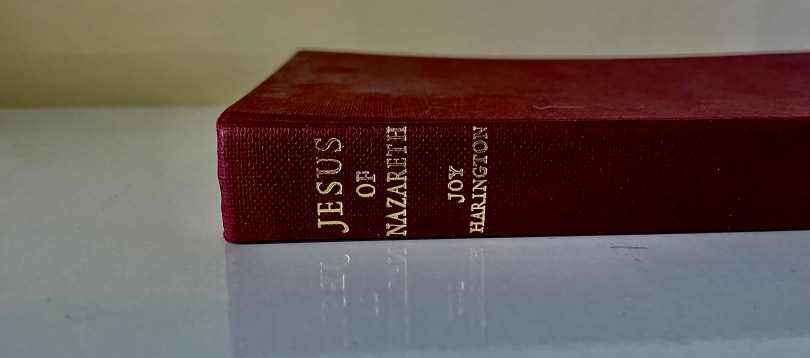
It was probably a gift for my baptism. Today the pages are well thumbed, and the dust jacket is faded, curled and torn. A brief inscription on the flyleaf , written by my godmother and dated, suggests that this was the second Sunday of Lent in 1965. From conversations with my mother during her lifetime I know that there may have been a poignant sense of thanksgiving at the time. I had nearly died within weeks of birth. With understandable feeling my mother once spoke about an exchange with her mother during those difficult days. Packing some clothes to take to me in hospital my grandmother said to her: ‘do you think they’ll be needed?’ Clearly she did not expect me to survive.

An illustration from the book

The BBC series which gave rise to the book Jesus of Nazareth by Joy Harrington was a landmark. Only a change in censorship laws allowed an actor to portray Jesus in a public performance. In 1956, across eight episodes, the BBC broadcast this groundbreaking series. It was billed as ‘a cycle of eight plays’ – perhaps echoing the tradition of mystery cycles which once took place in many towns and cities. Scheduled on Sundays leading up to Easter it was at the time of day when children’s programming was shown. However, it proved a very popular production for adults as well. The care taken with the series included a number of ‘firsts’. While most of the content was live when broadcast, there were inserts of footage taken on location in Galilee and Jerusalem.

“Our aim is to awaken the interest of children in the origins of the most significant influence in their lives, and help them to understand something of the background against which the Christian story was enacted”

Freda Lingstrom, Head of Children’s Television, interviewed in the Radio Times in February 1956.

The website Television Heaven quotes an interview published in 1956 in the Radio Times which gives an idea of the gravitas attached to the production. At a time long before liturgical developments would move the Church of England beyond the routine use of the Book of Common Prayer, these plays were given in contemporary language. The Times Educational Supplement described the book’s publication as ‘an event of incalculable importance’.

The book was no less popular than the TV series and mine is a 4th impression, with the look and feel of a very different world. Lingstrom speaks with an unchallenged assumption that Christianity was the most significant influence on the lives of young people. These are not remarks made about children who go to church, but the children of the nation. It reflects a continuing confidence in the 1950s that Christianity could weld the country together – and formed the values and outlook of society. A young Queen had ascended the throne and there was no doubt about her commitment and sense of duty for the faith she had sworn to defend.
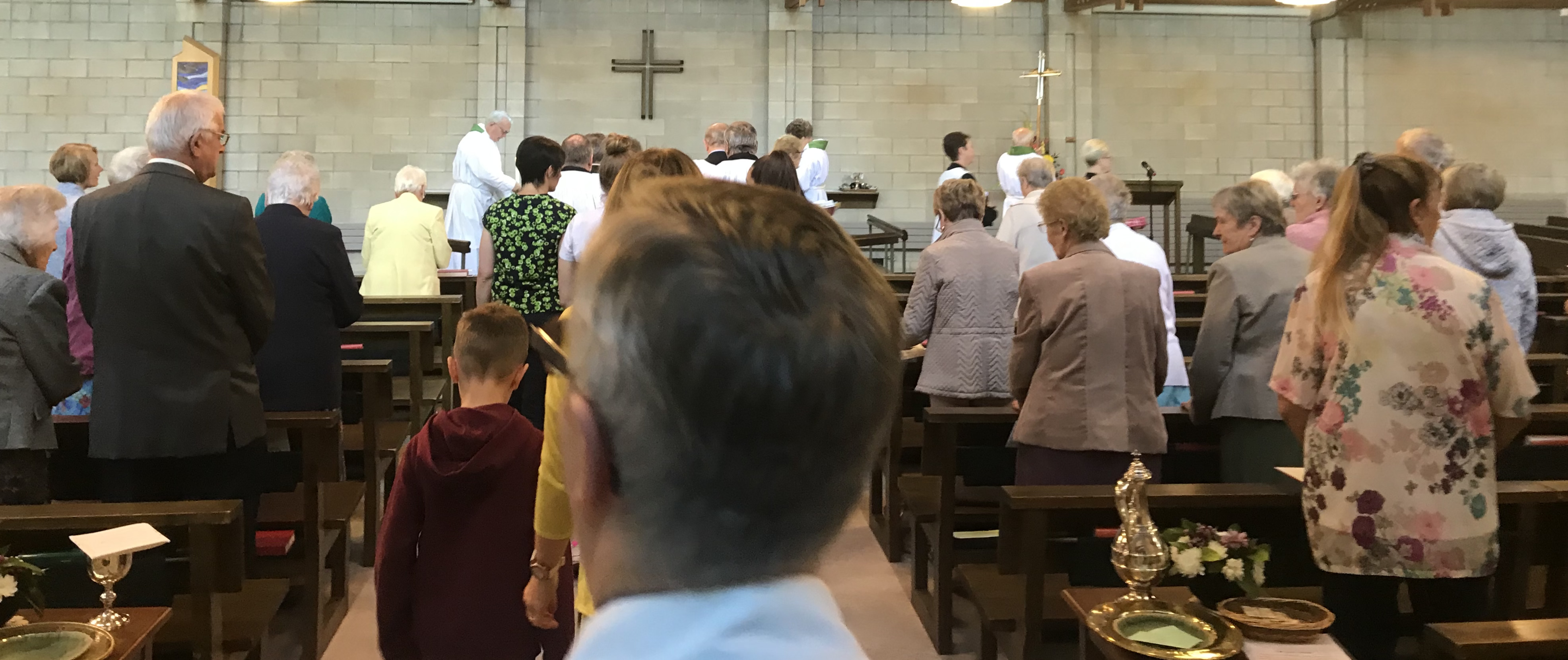
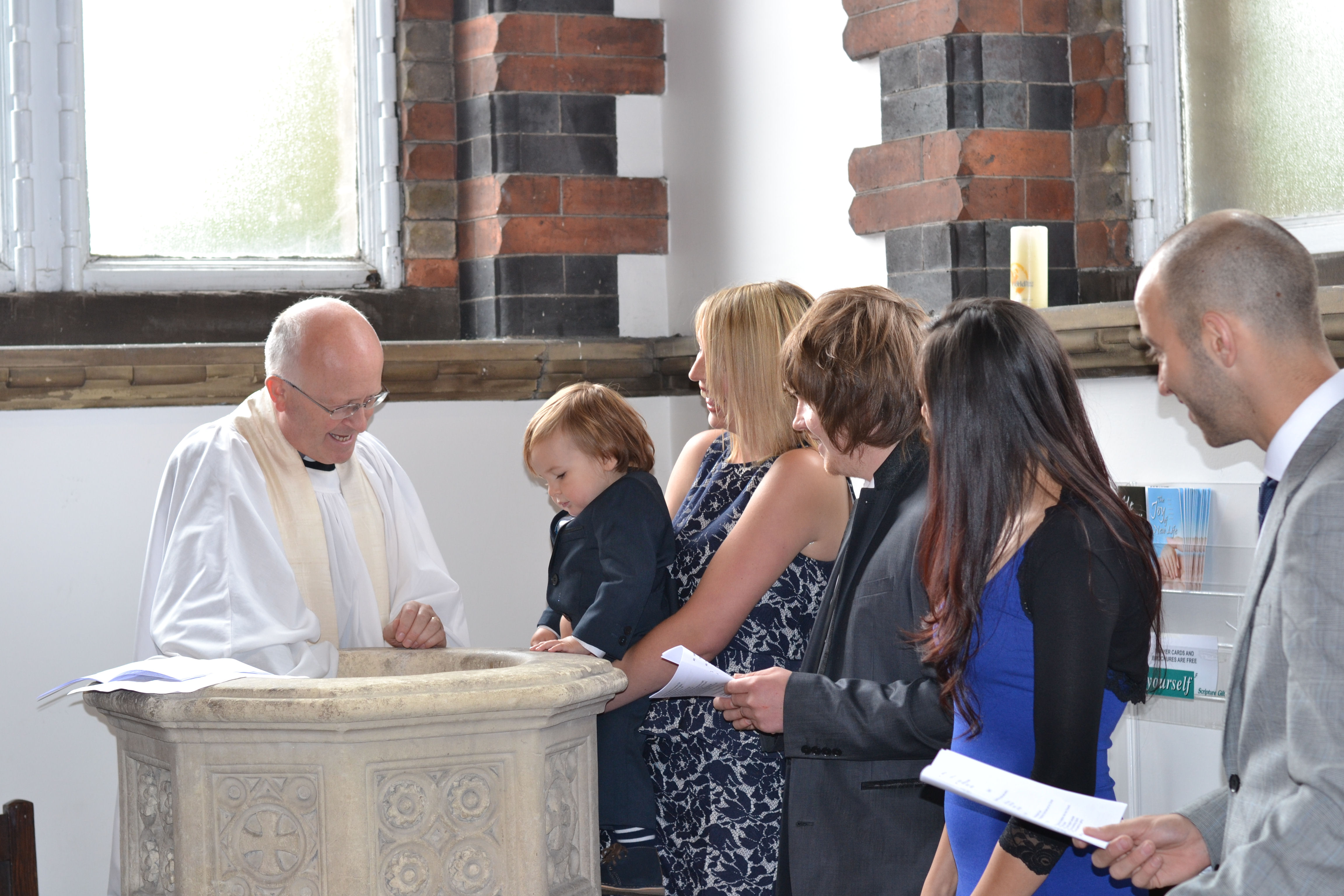
A church service in West Yorkshire, 2019

The Queen is still with us, but the presence, influence and power of the Church of England is a shadow of its former self. Much religious broadcasting has been pushed to the margins (or over the edge). A series such as Jesus of Nazareth would command a fraction of the audience it did in 1956 (‘as a BBC survey showed, next to the Coronation of 1953 in national appeal‘).

There are a vast array of reasons why these changes have taken place. Society has diversified in a range of ways which have contributed to the decline of churches. There is a plurality of religions; Sundays are no longer the exclusive preserve of Christian activity; as fewer people attend churches the social presence of religious language and ideas has eroded.

This kind of change in language has been addressed recently in a study by John Bernau in the USA. He examined in forensic detail the contents of a leading pastoral care journal over several decades to identify how the language had changed since the 1950s.

“To gain legitimacy in this secular space, chaplaincy has to eschew overt religious language in favor of modern individualistic spiritual conversations”


Bernau, J. A. (2021). From Christ to Compassion: The Changing Language of Pastoral Care. Journal for the Scientific Study of Religion. Chicago

This question of language and meaning has been a recurrent theme during the 30 years of my ordained ministry. As most of this has been spent in chaplaincy the need to find words to build bridges between different contexts has grown. Perhaps the bridges have needed to be longer as the distance between the religious and other professions has grown. While much has changed for the good – not least a wider inclusiveness in ministry – the transition from Christendom to a post-Christian society has been rapid and far reaching.

In my next Blog I’ll consider where this swift and extensive change leaves the Church of England and Christianity in the UK today.

Our Trespasses

I have no doubt that it is the first set of words I learned by heart. Not only a poem, but a prayer taught to me by parents, as their parents had, receding into a pre-Medieval time when some landowner, or Lord or Laird decided to accept the new religion. A curious collection of words first spoken two thousand years ago in Aramaic and translated into every language on the planet. Words said in every place where human beings have walked..

At a time when public knowledge about Christianity in the UK has certainly declined, along with the number of active worshipers, the Lord’s Prayer is perhaps the final vestige of faith for many. When I once attended a Delivery Suite to bless a still born baby the mother and her mother discussed with me what to include. ‘Oh you know’, the mother said, ‘what was that prayer gran liked?’ I wondered for a moment what collect or unusual prayer might be named but it was – as you’ve guessed – the ‘Our Father’.

From the poem Dead End by Nancy Mattson in The Poet’s Quest for God ed. Brennan et al.

I have been reminded of this while reading Stephen Cherry’s excellent Lent book Thy Will Be Done. It is a timely reminder of the centrality of this prayer in the life of both individual believers and the Church. During 20 years working as a hospital chaplain there was hardly an occasion when I would not use this prayer. At the bedsides of the dying, from the hours old to patients over 100. In emergency marriages with young people to the celebration of a Chapel’s 150th anniversary. Nor will I forget the patient who told me that he always began to say the Lord’s Prayer silently when he was finding it difficult to sleep – a mantra that would still his mind and bring rest.

At times it feels as though the prayer fits in my mind like a much turned stone sits in the hand. It is strong and enduring yet also fitting and weathered. Hard and weighty, it is familiar and comforting. As much a part of me as, I hope, I am of it and the God it addresses; the Son who taught it; and the Spirit that is the vital bridge between then and now, here and there; creator and created; me and us. One of the early reflections Cherry offers is a focus on the repeated us of the adjective ‘our’ rather than ‘my’. A key feature of the prayer is that reiterates the Christian understanding of our place in relationship, both with God and with our neighbours. The approach we make to God is in company and never wholly alone.

A ceramic hand-piece by Antonia Salmon

Perhaps for these reasons, at a moment I can no longer recall, I began introducing the Lord’s Prayer as ‘the family prayer of the Christian Church’. This became my practice when I was with people who may have been unfamiliar with the prayer or its place in the Christian faith. It brought into the isolation of a clinical room a sense of community and companionship. Links that were both local, to the homes and churches round the hospital, as well as offering connections to the past, a worldwide company of faith and the future. At many of these critical moments none of this was unpacked, but the prayer’s familiarity and depth travelled with those who left the hospital carrying their grief.

While spending a year in South America in my twenties it was one of my greatest frustrations that I couldn’t keep up with the congregation in saying the prayer in Spanish. At every service it felt like a moment when my separation from the other worshippers was most marked. However, in time, I learned and internalised the words and appreciated the new insights gained from the altered phonetics and different accent.

Visiting the Church of the Pater Noster on the Mount of Olives is an unforgettable reminder of this uniquely universal collection of words. Across the Church and its surroundings the prayer is written in over 140 languages. It would be easy to think that this familiarity generates a certain contempt, or failure to feel the heft of a form of language shared so far and wide. However, it navigates a set of relationships and obligations that continue to be radical and soul-shaping. This small piece of linguistic luggage travels with us with the reminder that humanity is about ‘our’ and not simply ‘my’. That daily needs cannot be taken for granted. nor the needs of our neighbours ignored. In seeking and addressing God we hunger for the Kingdom that is both different and better than our reality. As we talk to God about its coming rule, we express the desire to share in that ‘will’, playing our part in a world more aligned to God’s love.

If we are nearing the start of this pandemic’s ending, here is the prayer that will remind us that picking up where we left-off isn’t good enough. This is an experience we cannot leave without first seeking learning and wisdom. The pandemic has revealed the evils and disastrous consequences of allowing injustices to thrive in our world. Only when we can understand the trespasses that continue to sustain a frighteningly unequal world, can we begin to work with greater determination for that more perfect will for which we pray.

Picture Perfect

Recently I had a week’s holiday. As with most of the nation, this has become a rather trying experience of staying close to home and making the best of it – no great hardship, but not my destination of choice for a week in January. I decided to look round the web for a course to improve my photography and was delighted to find one on the RPS website led by Robert Harvey.

During the course some of the conversation turned to the boundaries and ethics of contemporary photography. I quickly learned that what some people do is beyond the pale; while quite significant editing and alteration has become an accepted part of the digital world. I imagine that these boundaries are shifting constantly as technology evolves and more and more becomes possible. However, it raised the question for me as to what may or may not be a good idea when it comes to editing.

There are elements of this which touch on research I’ve undertaken in the past. When it comes to the written description of experiences we can’t include everything. Much is omitted and some aspects of a situation become foregrounded and significant. A while ago I began using ‘constructed case studies’. This involved combining real and authentic events presented as an additional, fabricated, case. In part I did this to protect the privacy of those involved. However, there was also something leading me to think that a fiction drawing on fact can sometimes communicate the truth better than the limitations of a single incident. A possible parallel to ‘stacking’ in photography, where many shots are edited in order to enhance the clarity and quality of the final product. This can be achieved because multiple shots of the same subject are taken from the same place with the focus on different items in the frame – resulting in more depth of field. Of course, the analogy isn’t perfect but it suggest that sometimes we need to be creative in order to be accurate. It’s impossible to focus on everything involved in one pastoral encounter.

There is no doubt fiction makes a better job of the truth

Lessing, D. M. B. (1994). Under my skin: volume one of my autobiography, to 1949.
Chicago

Often I edit a photo because it doesn’t appear to reflect my naked eye observation of what I snapped. By changing a multitude of variables, the picture starts to look more like what (I believe) I saw. However, I can’t say that’s always the case and this morning I removed an inconveniently blurry pigeon from a photo of York Minster’s central tower! We can make images more representative of our perceived reality – or make them ideal, flawless and desirable. The latter is a significant issue for portraits when the gap is widened between a real appearance and one altered to an impossible standard of unblemished beauty. There is plenty of concern about the impact of impossibly perfect pictures on people using social media.

I write this at the start of the week when Lent begins. That may seem an unlikely segue, but I think there is a very natural link. On Ash Wednesday it is the tradition in many churches to place ashes on someone’s forehead. This isn’t a glamorous activity, and it is accompanied by words that assert the basic fact of our humanity: “Remember that you are but dust, and to dust you shall return”. Nothing is done to disguise this fact, although the life and promise of faith is offered at the same time: “Turn away from sin and be faithful to Christ”. Our reality is named, but we are not left without hope. In a year when we have been reminded more than ever of our human vulnerability, this ashing and calling seems to have greater relevance than over. A moment perhaps to hold two images in mind; the dust that falls between our fingers, and a glory no software can ever come near.

Support or Illumination?

Numbers have never really been my thing. However, a few years ago I knew I needed to learn more. Having joined an NHS research ethics committee, I wanted to understand more about health statistics. Fortunately I had the opportunity to complete a postgraduate course in health research – which included a module on statistics. Despite my misgivings about data this turned out to be one of the most enjoyable parts of the course, shedding light on the use and abuse of figures to further an argument.

“Most people use statistics as a drunk … uses lamp-posts for support rather than illumination”

Attributes to Andre Lang

Now, in the light of the pandemic, the world is trading statistics like never before. Government scientists present graphs and tables each week, sometimes daily, to explain the R number (transmissibility); exponential growth; and much, much, more. Even where it might seem that there should be greatest clarity, for example the number of people who have died, there are typically three figures offered. The nuances of criteria and methods reveal just how much the nature of the question influences the form of the answer.

Dorothy Bishop’s bishopblog is one of many sites on the internet that have interrogated the presentation of data and called for greater clarity. Using the example of the difference between relative risk and absolute risk the case is made for the importance of accuracy when communicating data to the public. What might seem to be a huge increase in risk (e.g. 30%) may make limited difference in actual cases depending on the total numbers involved.

“we might hope that, in a pandemic, where public understanding of risk is so crucial, particular care would be taken to be realistic without being alarmist”.

Dorothy Bishop, bishopblog, accessed on 27 January 2021

When I was a curate on placement in a rural church near Lancaster I took part in a service in which the Bishop confirmed 25% of the population of the parish. This meant about 15 people, and it was a fairly rare event for the bishop to come to confirm – so several years’ worth of candidates were gathered up together. It seems astounding that in England in the 1990s a quarter of a parish’s entire population was making a declaration of faith all at once – context is everything.

There appear to be more opportunities for people unaccustomed to interpreting statistical data to find accessible information. Radio 4’s More or Less is a good example of how academic expertise can engage with the questions people are keen to interrogate. In response to the emergence of ‘alternative facts’ there has also been growth in the independent reality checking for which there is an increasing demand. Nowhere could this be more important than in the need for accurate information about the vaccines being offered to combat COVID-19.

It seems to me that one of the problems faced by the desire for both clarity and accuracy is that the truth isn’t always simple. What is the difference between something being ‘safe’ and ‘completely safe’? When vaccines have been developed so quickly there are understandable questions about both immediate side-effects and longer-term consequences. Even a very good sample of people used in the testing phase of the vaccine development cannot be representative of every human characteristic. The question for me is not about the absolute safety of vaccines to be used on billions of people, but about their likely safety and the common good.

Born in a vicarage in the mid-1700s, Edward Jenner is usually seen as the founding figure in the development of modern immunology. At a young age he was given the maxim of William Harvey: “Don’t think; try”. We must be thoughtful, enquiring and considered in our choices – but there comes a time to act. It may be possible to wait for the complete clarity we desire, all the data weighed and balanced, but sometimes we need to make a judgement-call before we know as much as we would like. If the pandemic has taught us one thing, it is that if you wait until something is blindingly obvious you have left it too late. There is a stage in every pandemic when the damage being done is stealthy and silent – yet the foundations of tragedy are being laid comprehensively and irretrievably.

Perhaps one of the legacies of COVID-19 will be to create better systems of public education about risk and probability. Not that any of us will know everything, but – importantly – that each of us might be better able to ask the right questions. Numbers cannot tell us how to live. They provide illumination enabling us to see more clearly the context in which our choices are made. Used well, they support the priorities we have chosen based on our values and moral commitments.

Lonely Sits the City

The Book of Lamentations can hardly be described as a fun read. The concept of lament may seem old and irrelevant – a crying over spilled milk, rather than the ‘can do’ attitude needed to manage a crisis. Yet scholars have argued that this caricature misunderstands Lamentations. Rather than a self-absorbed despondency it is a book that reflects an accurate perception of tragedy. It names experience and seeks to convey the visceral reality of exceptional trauma in all its horror.

My eyes are spent with weeping; my stomach churns;

Book of Lamentations, 2: 11

Several writers have explored the meaning of Lamentations and its relevance for other situations of overwhelming loss. Certainly the writer of the book is engaged with an experience of catastrophic destruction, where a community has been ripped apart. It is common in many such experiences to search for meaning and interpretation, as well as to apportion blame. Garber has written about the relationship of this kind of literature with reference to trauma studies. He quotes O’Connor’s understanding of this type of text as an ‘ancient poetry of “truth telling”‘.

For vast as the sea is your ruin; who can heal you?

Book of Lamentations, 2: 13

There will be many who will not link this kind of traumatic lament with the experiences of COVID-19. While much has changed there remains a level of functioning in Western societies which suggests huge stress rather than catastrophic collapse. Nevertheless the level of human loss, especially considering the many mitigations which have been put in place, is remarkable. In some families and sections of society the cost of COVID has been dear, with deaths, severe illness, reduced income, disruption to social structures and lost education. To name these experiences accurately will give rise to lament.

“there may yet be hope” Book of Lamentations 3:29

Lamentation has a number of consequences. It begins to articulate experience, putting words and sound to voice the inner turmoil when the immediate crisis is passing. In the Book of Lamentations it wrestles with both God’s presence in disaster, and simultaneous silence in the face of the people’s prayers, pleading and petitions. It may have the effect of affirming a sense of community and shared experience that lays the foundations for recovery. At the time of lament this may not be apparent but it may be a consequence of putting words to a crisis which might otherwise disband the survivors of a common trauma.

Lamentation is a form of stringent speaking. It sees through the gloss, the veneer of interpretation, and names the truth of desperate times. It is not a counsel for despair but a cri de coeur for accuracy and understanding. In this there is a prophetic edge. It challenges the superficial discussion of events that shatter communities and wreck the lives of individuals. The loss of life and suffering with over 2 million worldwide COVID-19 deaths, is surely worthy of lament.

“We’re grieving the world we have lost: normal life, our routines, seeing our friends, going to work. Everything has changed. And change is actually grief – grief is a change we don’t want”.

David Kessler quoted in an interview with Joanna Moorhead, The Observer 17 January 2021

David Kessler, who has spent his career in palliative care, describes us as a ‘grief-adverse society’. The consequence of this is the failure to recognise and experience post-traumatic growth. Only by exploring the parameters of loss can we begin to see any meaning which may emerge from tragedy. As many of us have known through the pastoral support of the bereaved, as well as in our own experience, it is unhelpful to speak of hope in the midst of crisis. Yet even unspoken, hope is often present, and although straggling and diminished it has a remarkable capacity to grow.

I hope that there will be a willingness for society to lament. To trace the sharp edges of grief and in doing so, encounter unexpected gifts. Gifts that will arrive in their own time. I have already seen, as people write and paint and create in response to their suffering, the kind of lament that may yet lead to new meaning. The risk is that we will try to rush past this crisis and its consequences and silence the voices of those who recall us to the suffering that has been all too real. Hopefully, wisdom will remind us that a future of greater promise, fairness and compassion, cannot be built successfully on a buried past.

I pray that we shall both lament and learn.

Bleak Midwinter

As a chaplain I often had conversations about Christmas, anytime from autumn onwards. For example, Fred spoke to me about a family member he looked forward to seeing. Every Christmas this would lead to a catch up about life now, and reminiscences about a childhood that they had shared. As they recalled this past there would be humour and affection, as well as sorrow for the people no longer here. Even in September, Fred was thinking about this annual conversation and hospitable company.

When illness changes someone’s circumstances the prospect of Christmas, and how it will be celebrated, soon comes into focus. In care homes the festive season begins early and runs late. The great wealth of what is resonant and recognisable has real value for people beginning to experience dementia.

“I used to make paper chains like that with my Nan!”

Here is something in the middle of winter that touches all our senses as we celebrate with familiar festivities. A feast for the eyes; the smell of baking; the sound of carols; the taste of seasonal drinks; the touch of those we love.

Of course, this can stir sad memories, but it also offers the poetry of carols to console; the richness of food to comfort; and the frivolity of crackers and paper hats, to remind us we are all crowned with mortality – and we shouldn’t take ourselves too seriously.

The Nativity screen below the East Window, York Minster.

This year the weeks leading up to Christmas, like almost all of 2020, have brought news that has been both unusual and unwelcome. Tighter restrictions on the lives of ever more people; damage to livelihoods and the economy; myriad losses experienced by almost everyone – from the lives of loved ones, to cancelled events we once took for certain. Planning for Christmas has meant choices about bubbles and the kind of gifts it feels appropriate to give. Yesterday afternoon we learned that for many people even the possibility of being with others from a different household has vanished.

“They have passed one after the other;

Father and mother died,

Brother and sister and brother

Taken and sanctified.

I am left alone in the sitting,

With none to sit beside.”

From “Christmas Day: The Family Sitting” by John Meade Falkner

I am not surprised that people are distressed by these changes. For many, Christmas Day is a time-lapse biopic. For those of advanced years, it’s an 80 frame story told from our earliest memories. A production rich with the appearance of new characters, and alongside this the sudden absences of much loved figures. The other elements of the day offer a social history of changing taste, expectations and technology. This won’t be the case for everyone but it is for many.

Never in my lifetime has the celebration of Christmas been curtailed for millions upon millions of people. The central fact of the festival isn’t cancelled, and places of worship will remain open and active. Yet it will be a Christmas like no other for countless millions of us. Amongst whom we mustn’t forget those who have marked many festive Decembers, but who this year will not be present with those they love. For people who have spent much time and energy thinking and preparing for the festivities, it may make a difficult and uncomfortable day “with none to sit beside”.

In this bleakest of midwinters we draw to the end of a dreadful year. A year in which 1.7 million people have died from a disease we were unaware of until twelve months ago. Countless others have been unwell, some with stays in intensive care which they will never forget. Tomorrow in the Northern Hemisphere is the shortest day – the old date for the Feast of St Thomas, when the darkness of doubt was greatest, and light seemed to hold least sway. At this fulcrum of the year we are reminded that doubt and uncertainty do not endure indefinitely, and that by using the gifts of tenacity and understanding even humanity’s greatest nightmares are eventually dispelled.

To all those who read this blog I wish a very Happy Christmas. I hope and pray that each of us will do whatever we can to make it a celebration with some good to remember. Arrangements may be rushed and last minute – and we may feel upset that our plans have not gone the way we wished. Yet perhaps we can be consoled with the memory of the Nativity, and life beginning in a makeshift bed far from home. Good things can come out of circumstances we wouldn’t choose. Maybe we simply need to recognise it is beyond our control – and offer what it is to God. Which of us can know what might happen when we share the imperfection of our plans with the God who didn’t begrudge a stable as the place to birth perfection?

Being ‘for us’

During a year I spent in South America I got to know a university student of roughly the same age as myself. Apart from that single similarity, our lives could not have been more different. His childhood and youth had been very tough and appeared to offer only limited prospects. At the sage of 15 he’d left school and worked for his uncle in a car body repair shop. Yet he harboured the vocation to be a doctor. Eventually he got to university – when I met him for the first time. During a conversation about his situation he told me that he lacked ‘respalda’. It wasn’t a word I knew and I needed to look it up. It means ‘support’ or ‘back up’. Unlike many of those he studied alongside, there was no avenue of parental support; no community from his past which could offer help; little that enabled him to keep his head above water. Thankfully, at university, he found the support of a church, and friends: today he is a well-established surgeon.

Baptism expresses the Christian theology of our worth and calling: “As children of God, we have a new dignity and God calls us to fullness of life.”

In Pulp’s song Common People we hear how the story of a woman wanting to  ‘live like common people’ is challenged in several ways. However, the definitive obstacle to her achieving her stated ambition lies in the parental support she enjoys: “If you called your dad he could stop it all”. In reality this desire to experience the life of ordinary people is nothing more than a passing fad. As the lyrics bluntly put it: “Everybody hates a tourist”.

Knowing an emergency rescue is available alters our feelings about difficult situations. So long as it’s there we can never experience what it means to have no one to call – no emergency fund, get-out-of-jail free card or saviour. Sadly, all too many people in our world know what it is to lack ‘respalda’. Sharing something of ourselves to be support for others is one of the most constructive things we can do to make this a better world. At times it may cost us material effort, but mostly it will be our silent presence in someone’s life which reduces isolation and affirms both their dignity and worth. Without show or heroics, it can be transformative.

As we journey through Advent and draw nearer to Christmas, there is the opportunity for us to give thanks for the love and support we enjoy. When “the Word became flesh” it was not God among us as a tourist of mortal experience. On the cross there is no answered call which made the pain of life and death disappear. Jesus is truly and fully given into human experience, and shares life with us without a privileged route of miraculous removal. God is among us as our support, longing for us to use our gifts well and be at our best. This help is offered to us from within the experience of human living, not apart from it.

Walter Brueggemann calls Advent the “season of yearning”. It is the time when we hear of God’s desire for us to flourish as human beings – and learn to share that same longing for those around us. The late David Jenkins summed up the whole of the Bible with the simple phrase: ‘God is; and is for us’. As we come to the final weeks of an unimaginably difficult year, let us seek to know again what God’s being with us means, and how we need to live as those committed to the well-being of others.

Framed

Given the direction of modern art, a question has persisted about the basis of what constitutes a ‘work of art’. From pickled animals to an unmade bed, there have been plenty of voices to criticise works that fail to follow traditional approaches. It has long seemed to me that the question is best answered by the decision to frame something. A frame places a boundary which invites the gaze of a viewer, separating one thing from another. It adds human intent and purpose even when the contents of the frame may appear to be naturally occurring or pre-existent. While some artists may eschew a frame in a formal sense, there remains the boundary of the canvas, block or space, which delineates what we are able to see.

The frame is the necessary condition for perception being possible, for any kind of structural perception.

Kemp, W. (1996). The narrativity of the frame in ‘The Rhetoric of the Frame’, Cambridge

It would be misleading to suggest that frames have a consistent meaning across the history of art. Kemp’s thesis, quoted above, addresses the role of the frame in the creation of Medieval altarpieces. Kemp argues that for approximately a thousand years frame-making was the task of leading artists and had a critical role in organising the elements within the frame to enable perception. For Kemp a previous understanding that art brings the frame to life, is inverted to become: “The frame brings the work of art into existence”.

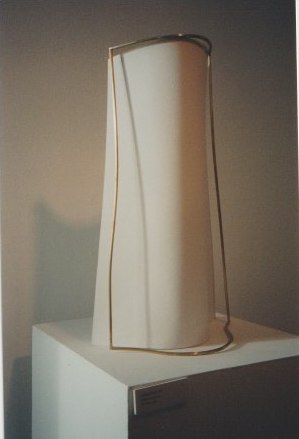
In 1999 an exhibition at the Yorkshire Sculpture Park featured a work by a Japanese sculptor which set a gold frame just in front of a curved white surface. The frame echoed the shape of the object but also allowed space for shifting perspectives as the viewer changed position. It suggests the possibility that some frames can be permissive, allowing us some element of choice about what is encompassed.

Sculpture exhibited at the Yorkshire Sculpture Park, 1999

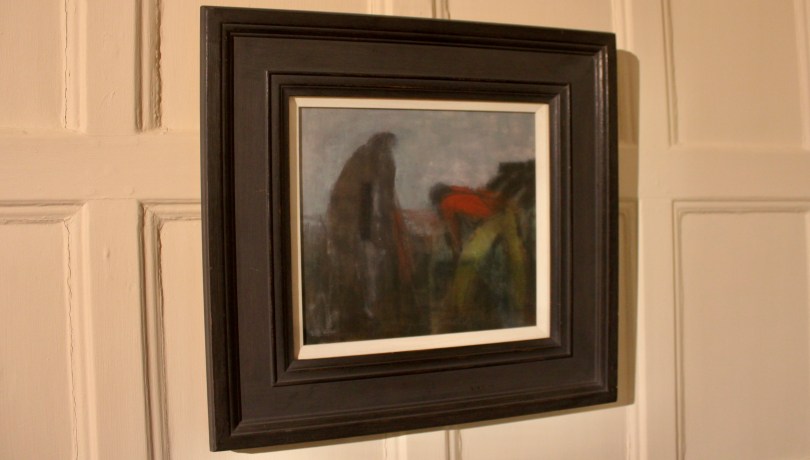
The picture at the header of this blog was painted in the Outer Hebrides by Ruth P’Dell. Entitled Peatcutters 3 it seems a timeless depiction of something that would have been a part of island life for centuries. When I bought it the gallery let me leaf through a number of unframed paintings of the same subject by the artist. In some of these the workers wore baseball caps – a detail which suddenly transformed an image that could have belonged to any era into something contemporary. During recent filming in York, I was similarly reminded how a simple detail can change the perception of the viewer (below). The crew of every period drama expends a great deal of effort excluding items which would otherwise shatter our illusion of another time.

Decisions about including and excluding content are a basic part of being human. I imagine that as we look back on the start of the pandemic, documentaries and films may focus on some initial detail. Something which seemed trivial at the time, but which in hindsight would have made clear the pressing and urgent need to act. We cannot see everything simultaneously, nor can our picture of unfolding events ever be complete. Perhaps, like the piece at the Sculpture Park, we need frames that allow some flexibility. Frames which give us the capacity to adjust our position just enough to allow a fresh perspective – and see the critical detail which transforms our recognition of what lies before us.

Acquired Invisibility

Many people know what it is to be ignored. It can stem from a range of attitudes about value and significance; learned behaviours or explicit choices. In the days when a bar could be crowded some people would find instant service, skipping ahead of others who had waited with patience. Not everyone is seen.

At some point this is an experience which we may all undergo as ageing changes our appearance, health and vigour. In Bleak House Krook quotes the despair of Tom Jarndyce that lengthy court proceedings are akin to being ‘drowned by drips’. Not all change is sudden, rapid and overwhelming. Usually our circumstances alter by small degrees, until we realise a bigger change has happened almost without our knowing. For the most part ageing follows this pattern until an event or illness makes us aware of both time and mortality.

A recent issue of the TLS featured a poem which captured the disparities of age and experience with insight and skill. Jamie McKendrick imagines meeting his younger self in a bar. Contrasting the two states of being – youth and maturity – McKendrick concludes with this assessment of his younger self:

All the fool seemed utterly sure of
was never in his life would he be me.

McKendrick, J. He Be Me The Times literary Supplement, 6 November 2020

Assumptions are dangerous things, especially when it comes to decision making in a pandemic. Care homes might often be regarded with benign indifference. Liminal places that sit at the edge of society’s thinking; policy-making; priorities. If ageing lends people invisibility then care homes find themselves similarly flickering in and out of the public imagination. For many years either a green or white Government paper has been promised. Yet, despite moments of recognised need, it seems that social care can recede into the background of political life with remarkable speed.

Matt Hancock at a UK Government Daily Briefing, 15 May 2020

The degree to which the importance and operation of care homes can be sidelined was nowhere clearer than in the BBC documentary Lockdown 1.0 – Following the Science. During the programme the interviewer asks one of the key pandemic modellers why the scientists thought care homes were shielded. It is a question that clearly causes Dr Ian Hall some difficulty and his reply is couched among pauses; a slightly anxious look away from the camera; and, finally, commendable honesty:

“… We were.. erm, erm … That’s a good question… We never checked…”

Dr Ian Hall, speaking during the BBC documentary Following the Science at 54 minutes

It appears that a number of casual assumptions were made about the circumstances and daily reality of how care homes work. It is hard to see that any critical enquiry was made, or any steps taken, to contact the wealth of people who would have been able to spell out the risks within a few moments.The fact is that the detailed operation of care homes was all but invisible to the scientists and politicians making decisions about the impact of COVID-19.

As with so many of the assumptions and behaviours that mean people are left in the shadows, this is not necessarily deliberate. The slow drip of ageist attitudes eventually sinks places of care for older people under a swell of political indifference. We either assume that we shall avoid these places ourselves, or fear that one day we’ll need them – and consequently prefer to shun them from our thoughts. Given the age of most senior scientists and politicians it is hard to imagine that many of them don’t have relatives in places of care. How could they have personal contact with care homes and yet remain so oblivious to the ways in which they work?

Perhaps the key post-pandemic task will be to shed the cloak of invisibility which appears to have covered care during advancing years. To lift the sector out of its obscurity and have a frank conversation about the provisions we would want to see as we age. This will be hard, as our desire to look away from this reality runs deep. Nevertheless, as the full picture of events within places of care emerges – probably during a public inquiry – there may be a moment to achieve a lasting change in our attitude to ageing.

Stirred – Not Shaken

Long ago I made a trip across Chile. Staying in a hotel in Santiago I was awakened by a sudden awareness that everything in the room was moving. Startled by this unexpected event, and only used to mild and infrequent UK earthquakes, I opened the door anticipating alarmed guests pouring out of their rooms. The corridor was empty; the shuddering stopped; the local TV made hardly a mention of the tremor.

As anyone watching the BBC documentary Following the Science? will appreciate, predicting approaching danger of global proportions isn’t easy. Especially when decisions need to be taken before the full force of an event is clear. Yet if you wait for the in-your-face evidence, it’s a sure sign that you’ve left it too late. In humanity’s history apocalyptic events overtake us rapidly, and our inability to exert control and mastery is laid bare.

In the 1980s I studied theology and English Literature at the University of Hull. It was a combination I’d recommend as there’s a very natural traffic between the two – not least in poetry. I recall reading WB Yeats’s The Second Coming while looking out over the wolds from the top floor of the Brynmor Jones library. Of the various apocalyptic prospects during my life there have been the Cold War; Climate Change; and now Coronavirus. Writing about the Yeats poem in the context of the current pandemic, Dorian Linskey is right that world-ending prospects aren’t infrequent. The real one will be unique in leaving a complete absence of literature.

That’s why it is a poem for 1919 and 1939 and 1968 and 1979 and 2001 and 2016 and today and tomorrow. Things fall apart, over and over again, yet the beast never quite reaches Bethlehem.

Dorian Lynskey, ‘Things fall apart’: the apocalyptic appeal of WB Yeats’s The Second Coming The Guardian 30 May 2020

Today is the final Sunday in the Church’s liturgical year. For centuries the Collect read on this Sunday has begun with the request to be ‘stirred up’. It is a reminder that as we plod on from day-to-day we risk getting lost in detail and weakening our sense of purpose about what life is for. The petition to be stirred concerns our ‘will’, the engine of desire that drives us for good or ill. When our will rests in God, Jesus suggests that we’ll remain unshaken even by those events which may seem life-changing. Jesus takes a measured view of Millenarianism. He pictures those who follow his teaching as the calm within the storm; the stable points of hope in a landscape of panic and pessimism.

For nation will rise against nation, and kingdom against kingdom; there will be earthquakes in various places; there will be famines. This is but the beginning of the birth pangs… Beware, keep alert for you do not know when the time will come.

Mark 13: verse 8 and verse 33 (NRVS)
Book of Common Prayer, Collect for the Twenty-fifth Sunday after Trinity

A week today the Church’s new year commences with Advent Sunday. Often the themes of Advent are lost in the run-up to Christmas. In parishes there are nativity plays, toy services, Christingles and more: but not this year. As we continue to live in a time of pandemic the serious themes of the season deserve our full attention. Traditionally these are death; judgement; heaven and hell. York Minster is running four online reflections with excellent speakers starting at 3 pm on 26 November. The first contributor is Professor John Swinton, who will be introducing a discussion about death. Each talk is linked to a panel of the Great East Window, which portrays images based on texts from the Book of Revelation.

The Great East Window – ‘Behold I make all thing new’ Revelation 21: 2-5

It appears that apocalypses come and go. Each generation can feel that it teeters on the edge of fragmentation – only to survive. In the Gospels Jesus warns his followers against getting too eager about the prospect. These things will happen, until the final and decisive time arrives. As we continue to journey through adversity it’s important not to confuse the temporary with the ultimate.

As we approach Advent there is an opportunity to engage afresh with the theme of God’s will for the world. In the book of Micah this requires mortals ‘to do justly and to love mercy, and to walk humbly with your God’. It is a theme reiterated in the New Testament and lies within the family prayer of the faithful: ‘your will be done’. A call to action and a way of living which can change the world if we have the grace and generosity to live as things will be – not only as they are. On a Sunday when we ask for our wills to be reanimated it is a call to be stirred, not shaken, in apocalyptic times.

(Heading image by Gerd Altmann)