Something Art Can Do

A recent visit to the Auckland Project exceeded my expectations. The investment in a range of cultural, historic and artistic exhibits in this market town has been extraordinary. The excessive scale and grandeur of the Bishop of Durham’s official residence has been transformed into a visitor attraction, with a new gallery of world faiths added to the property. While the timing of the project’s opening was ill-fated, coming just months before the first lockdown in early 2020, it appears that in recent years the ambition to make the former mining town a major tourist destination has been realised.

In the episcopal residence, Auckland Castle, rooms have been themed according to many of the former bishops. This means that the furnishings are contemporaneous with the figure being celebrated, and in some cases an audio or visual loop of material is featured. For example, in remembering the controversial prelate David Jenkins, there is an extract of an interview in which he speaks about his understanding of faith and the central tenets of Christianity.

Close to the centre of Bishop Auckland, just a short walk from the Castle, there is the Spanish Gallery. Billed as “the UK’s first gallery dedicated to the art and culture of the Spanish Golden Age”, it is an impressive collection. The connection that underpins this addition to the town lies in the famous paintings which fill the walls of the Bishop’s dining room in the Castle. These are Jacob and his Twelve Sons by Francisco de Zurbarán, bought by the Bishop of Durham in 1757. It would be hard to find any collection of Spanish art in the UK, outside of London, which could compete with what has been brought together in this northern market town.

“This world class gallery, which is spread across four floors and housed in two stunning Grade II listed buildings, is fast becoming a must-see for art enthusiasts across the North East of England and beyond”.

Reflecting on both the gallery and the Castle, there is an interesting juxtaposition of inspiring artwork and the more mundane “management of religion”. Bishops have no doubt inspired many people over the centuries but, for much of the time, they have turned the wheels of religion to maintain the institution and – in the case of the Church of England – upheld the status quo. This is particularly true for the prince bishops of Durham, who often served as the State’s enforcer in the north. Such a role entitled the bishops to the magnificence of a stately home, great wealth and the other privileges of office. Some, including Bishop Westcott and David Jenkins, subverted these expectations by siding with the miners during industrial disputes. However, they appear to have been the exception rather than the rule.

“The Bishop was loudly cheered by the miners, who had assembled in large numbers in the streets of Bishop Auckland; and he has every reason to congratulate himself on the results of his intervention”.

The Spectator, “The intervention of the Bishop of Durham (Dr. Westcott) in the Durham miners’ strike” 4 June 1892

The question my visit provoked is about the relationship between the bureaucracy of faith and the creativity which often inspires and disturbs our taken-for-granted expectations. Finding them sitting so closely side-by-side at the Auckland Project was an unusual experience. When Bishop Richard Trevor bought the paintings for the Auckland Castle dining room, they were not for general viewing. This was an experience for the elite and the Castle and grounds exuded wealth and privilege. While the Auckland Project has opened up these treasures (for a reasonable price), and located them close to several narratives about previous bishops, it begs a question about the role of the Established Church. Many major works of art have been commissioned by wealthy prelates, and some of these continue to provide inspiration today, but how is a far less mighty Church maintaining its task of providing space and inspiration for wide variety of people to engage, contemplate and be changed? There was a glimmer of hope about this at the end of the faith exhibition where major works by the contemporary artist, Roger Wagner, are hung. Wagner is someone who knows how transformative art can be in the journey of faith:

“It was the first thing that brought a sense of personal connection with the Gospels – which I’d studied, but never seen that you could enter into them in that kind of way. Something art could do which I’d never envisaged before”.

Roger Wagner speaking to The Church Times in 2013.

A Healthy Grave

Yorkshire seems to have had more than its fair share of notable clergy. My forthcoming Lent book concerns one of these, Laurence Sterne, but another distinguished figure is remembered in York – Sydney Smith. Born just three years after Sterne’s death, Smith became known for his wit, politics, writing, and philosophy. He had a remarkable turn of phrase. For example, when wishing to convey the remoteness of his country parish at Foston-le-Clay, he wrote:

‘My living in Yorkshire was so far out of the way, that it was actually twelve miles from a lemon.’

That probably wasn’t true as Foston was only five miles away from Castle Howard where, I can only assume, lemons and every other kind of produce were in rich supply. However, Smith was no doubt correct that he was living a considerable distance from the nearest place to buy a lemon. At Castle Howard he is remembered and celebrated with a plaque that was installed in 1999 by the Sydney Smith Association.

I am fortunate in living not more than twelve yards from a lemon, and therefore I can only guess at Smith’s experience of rural deprivation. However, for much of his working life Smith knew what it was to have lemons close at hand, and the requirements of rural ministry may have come as something of a shock. Elsewhere he writes: “I have no relish for the country; it is a kind of healthy grave”. He had lived in the metropolis of Edinburgh and was undoubtedly used to a wide choice of comestibles, culture and company (well, as wide as it got in the early 19th century). It was here that Smith was involved in launching the Edinburgh Review in 1802. This was a potent platform for liberal views, and began to call for political reform.

The church at Foston appears to have been neglected for a significant period before Smith arrived. There had been no rector, the duties being devolved to a curate. One of Smith’s first tasks was therefore to plan the construction of a fitting rectory. Illustrating the moribund state of the parish Smith wrote:

“When I began to thump the cushion of my pulpit … as is my wont when I preach, the accumulated dust of hundred and fifty years made such a cloud that for some minutes I lost sight of my congregation.”

Smith’s stature as a witty cleric, inclined to political reform, brought him the prospect of preferment in the Church. There was a time when it was possible he would have become a bishop, but for various reasons this never came to pass. When Lord Grey became prime minister in 1830 he was able, within a year, to advance Smith to a residentiary canonry at St Paul’s Cathedral. However, that was the last preferment which Smith received, and he soon realised that further progression was not in prospect. To the end, Smith retained and exemplified a generous spirit and commitment to a constructive and humane expression of religion.

“I hate the insolence, persecution and Intolerance, which so often pass under the name of religion, and, as you know, have fought against them”.

* The photo heading this blog is of the church at Foston: by Stephen Horncastle, CC BY-SA 2.0, https://commons.wikimedia.org/w/index.php?curid=9290721

The Little Church

As happens from time to time, I caught different parts of the same radio programme on separate days. The topic was the rise and fall of Little Chef, the roadside restaurant chain which began in 1958. At various times the firm found itself in trouble and experienced rescues and takeovers. For a long while it was a popular brand although I recall, in the early 90s, experiencing slow and variable service; uncertain standards of cleanliness; and very indifferent food. I began to avoid them at all costs!

The Radio 4 programme, in the series Toast, was first broadcast back in April. In many ways it was the sorry story of a brand that had lost its way, despite some frontline staff putting considerable faith in its culture and potential. At one point the many of the properties used by the chain were bought, then sold and leased back, in order to raise cash to invest in the fabric and the food. Despite the understandable attraction of this approach there are many examples of companies that come to regret the long-term obligations to the freeholder that are integral to leasing. Come rain or shine, prosperity or austerity, charges stipulated from the lease continue regardless of the wider economic realities.

“The main lesson for this, is to not let nostalgia make you fall in love with something that no longer has a purpose in the society that we live in today”.

Sam Alper, entrepreneur, speaking on “Sliced Bread. Toast – Little Chef” Radio 4, 25 August 2024

Hearing Sam Alper’s final assessment of Little Chef’s difficulties and eventual demise, I could not avoid thinking of the Church of England. Of course, I don’t believe that the C of E lacks a purpose. Presumably Little Chef was served by the underlying reality that everyone gets hungry, not least on a long journey. The appetite was there and Little Chef attempted to deliver the goods in a way that was appealing to people and made it their preference when choosing where to eat. The Church exists in a culture awash with spiritual needs; a desire to be loved and included; and people’s hunger for life’s purpose and meaning. However, the Church has largely failed to connect the story it carries with the needs of the people it is called to serve.

In the silly season of summer news reports, it was hardly surprising that some unrelated stories and commentaries were nicely turned into a yarn about how the C of E was trying to rebrand. The delightful – if erroneous – narrative was that the Church wants to stop using the word ‘church’. Andrew Brown in the Church Times gives a synopsis of how the story emerged. The difficulty in wholly denying the idea is that various churches and new expressions of church have indeed chosen a more zappy and (allegedly) appealing nomenclature. Why bother with the fusty old church when you could attend Sanctuary, complete with complementary bacon rolls?

Of course, none of the new ecclesial communities are free. There is very weak evidence to suggest that these entities establish the kind of commitment and income associated with traditionally parish churches. The flip side of the doom-and-gloom about the health of parishes is that so many manage to sustain their viability with the dedicated work of such a small number of people. Ancient buildings are maintained; children are baptised; weddings take place; and some money is channeled towards the diocese. Often these churches are in double-digit groups served by a single vicar or, indeed, a priest doing the work voluntarily. Across much of north Yorkshire these churches are open daily and welcome walkers, cyclists and those wishing to discover a significant cultural and spiritual space.

If the fundamental nature of the Church of England is changing the consequent risk is that it ceases to be the Church of England. The embedded reality of parish ministry, with the local cleric living in and among the people, meant that there was time for the vicar to be involved in a wide range of social, cultural and civic activities. These could range from the governance of schools, to local charities, to the annual pantomime. This was not a perfect system, and clergy inevitably vary in their gifts and qualities for this kind of ministry. Yet, at its best, people knew the parson and there were countless opportunities for serious conversations about faith to take place in different contexts every day. As a curate in the early 1990s there was a rich variety of engagement with a broad cross-section of the parish. Between individual conversations, and presiding at funerals and weddings, several thousand people each year had the opportunity to hear and experience our expression of the Gospel, in all its imperfection and glory. This wasn’t all down to the vicar, but paid staff can provide a particular focus, representation, and professional knowledge which, when shared and supported, can be empowering and transformative.

Perhaps I am simply being nostalgic. When Tony Blair came to power in 1997 there was a moment when it appeared he might want to harness the role of the Church of England to achieve social change. For example, he intervened to influence the appointment of the Bishop of Liverpool. At the same time the Secretary of State for Health met with leaders in hospital chaplaincy to launch a landmark programme of diversification and inclusion. Tellingly, following Keir Starmer’s landslide victory, there has been no talk about the role of the Church of England in supporting a programme of change. The little Church appears too diminished and distant to be considered a meaningful partner in supporting the vision of a social Gospel of national consequence, in the style of William Temple’s Christianity and the Social Order.

The remedy? Have faith in the parishes; support the parishes; fund the parishes. In an editorial in the Church Times it was calculated that the ‘cost’ of obtaining each new church member through innovative and strategic activities was about £5,800. I wonder what kind of Church of England we would have if every parish had been offered one-off support funding of £6K for each new regular worshipper they were able to attract? By support funding, I mean additional resources for developing initiatives appropriate to their context, be it launching food banks, purchasing high quality training or running missional programmes. Maybe even subsidising activities based on hospitality, such as Harvest Festivals or other community celebrations.

Above all, trusting the clergy and people of the parishes with what are, in essence, their historic funds, to further the vision of God they have discerned for their circumstances. I suspect that if that offer had been made, the Church would have become a lot more creative and exciting, with funding spread across all church traditions, and not weighted towards certain styles of community and worship. The end result, building up the parish system, might have amounted to a lot more than the little Church.

Lancashire Low

It’s probably a phrase which means nothing to all but a few people today, but ‘Lancashire Low’ was once a term applied to the character of the worship offered in the churches of that county. I heard it first when speaking with an ‘ACCM selector’. These figures were the driving force of the Church of England’s process for selecting candidates to train for ministry. Having lived all my life in Lancashire this description came as news to me although, intuitively, I recognised what it was describing. Not high up the candle ‘bells and smells’; nor ‘happy clappy’ evangelicalism, but a fairly sober, minimalist and no-frills approach to divine service. During my childhood and adolescence, as the C of E began to experiment with new liturgies, this character was beginning to change. Perhaps most notably, the Eucharist was becoming the most central act of worship, and a variety of vestments were beginning to be used more widely.

“the Lord’s Supper is a sacrament of our redemption by Christ’s death; it is not only a badge or token of our profession, but rather a certain sure witness and effectual sign of grace and God’s goodwill towards us, by which He doth work invisibly in us, and doth not only quicken, but also strengthen and confirm our faith in him”.

Mary Astell (1668-1731)

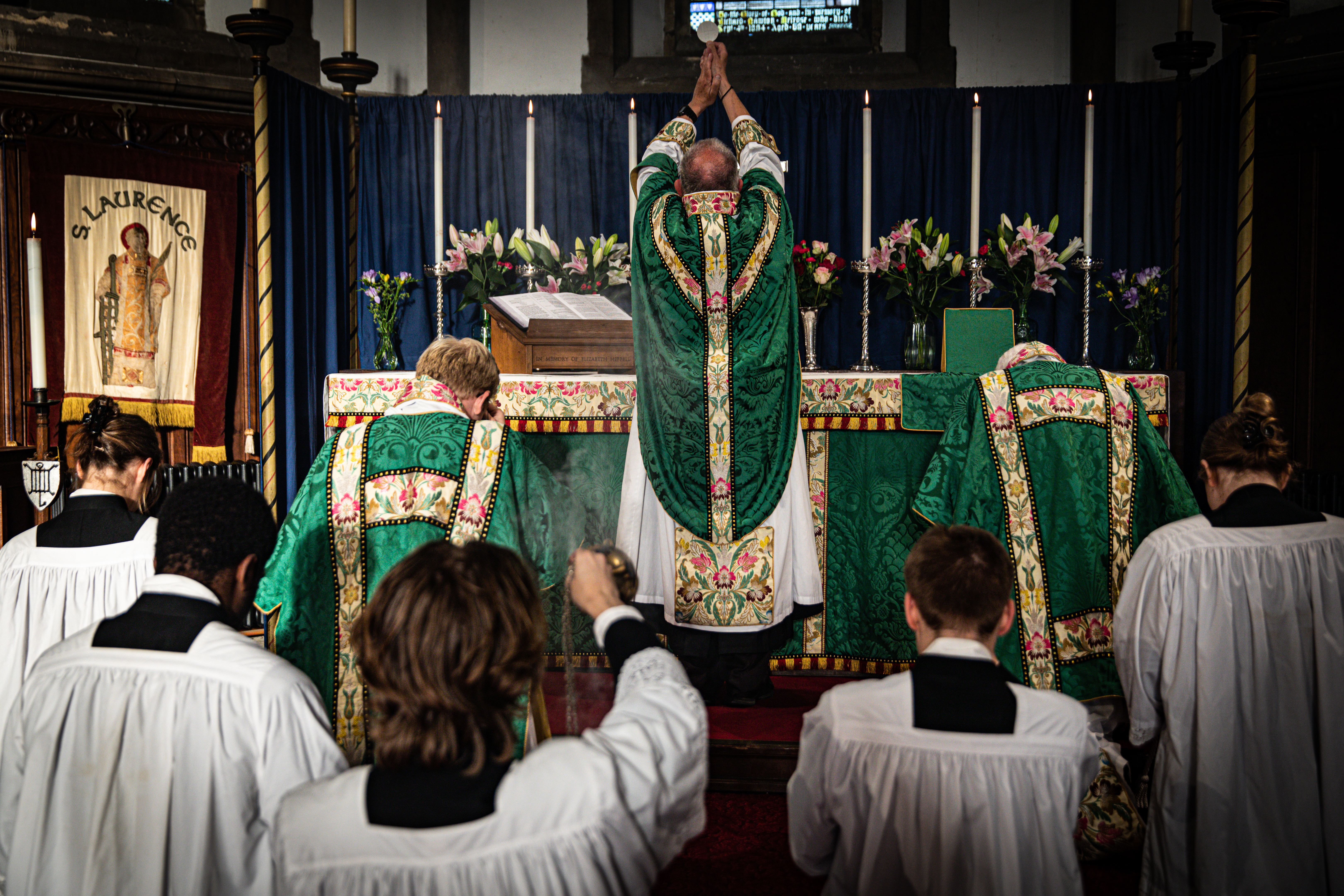
One of the parishes in York which I am supporting on Sundays could not be further removed from ‘Lancashire Low’. The church of St Lawrence, a few yards outside the city wall to the east, was built at the time of Catholic emancipation to offer a High Church, Book of Common Prayer, liturgy for people who might otherwise have been attracted across the Tiber. On Maundy Thursday, when the church is stripped of all adornments, the vestry overflows with the sheer quantity of vestments, candles, hangings etc. etc..

Despite the disparity between the church of my youth and this particular church, there are many interesting features in the character of St Lawrence’s. Firstly, located in an area of significant student accommodation, it counts many 18-30 year olds in its congregation. As is the manner of High Church liturgy, there are lots of ways for these young adults to get involved, for example, in the choir or serving. Perhaps in an age when choice continues to be elevated as the principal virtue, the given nature of the liturgy – its specification and detail – holds a counter-cultural appeal. Also, in a world of words, the presence of fabrics, colour, smells and bells, offers an in-person sensory experience that is welcome and appealing. All too often, when I assist at other churches, there is only the vaguest awareness of a pattern or tradition. “Wear what you like” can be the unhelpful response when I ask about the usual clergy attire for conducting the service. More often than not there are no vestments at the church or, if there are, the sets are incomplete.

Unusually, with an immense amount of hard work by dedicated laity, this church has been transformed from near-closure to become one of the better-attended churches in the city. There has been a sustained commitment to weekly Evensong on Sundays which has established a strong choral reputation and can see attendances reach a hundred. Generous gifts and successful grant applications have put the fabric of the building back into good order. None of this has been easy, not least because many students are only with the church for a few years while some, however, have decided to make York their home and continue to worship and assist at the church.

It is not possible to convey the Gospel, or help people shape and develop their religious life, without contact and engagement. Over many years the church of St Lawrence has done the hard work of building student engagement and outreach. Despite the assumption of many people that a church using the Prayer Book would be destined to failure, the opposite has been true. This is not without risks, as there can be a temptation in any tradition to see what is at hand and miss that to which it points, but you can’t get somewhere unless you start somewhere. In recent years several young men and women have entered on a journey of vocation leading to ordination. This is a church that has an ebb and flow of involvement, but it is unlikely – whatever happens in the future – that people will forget the experience of worship into which they are invited and immersed at a formative stage in their lives.

The Mystery of the Creation

I have always found that churches and chapels in remote locations have a certain appeal. Sometimes these might be a long way away, such as the Keills Chapel, dating from the 11th century and near the village of Tayvallich on the west coast of Scotland. In other instances they are much closer at hand, like the small church at Bossall a few miles east of York. In both cases these buildings stand in relative solitude, with only a handful of houses nearby. Like the poet Philip Larkin, visiting these empty spaces of ancient significance conjures an atmosphere both melancholic and reflective. Who were the people who built this place, attended services here and, on one particular day, held their last act of weekly worship?

Having strayed into the local second hand bookshop recently, I came across a volume of selected prose by RS Thomas. In one short chapter Thomas writes about “Two Chapels”, with only one thing in common: remoteness. The first is called Maes-yr-Onnen in Radnorshire. It was August and, as the building was locked, Thomas stretched himself out on the grass and began to think about the past visitors to the chapel:

“sober men and women dressed in sober fashion. I saw them leave the sunlight for the darkness of the chapel and then heard the rustling of the Bible pages and the murmur of soft voices mingling with the wind”.

RS Thomas, Selected Prose, Ed. Sandra Anstey, 1986, Poetry Wales Press.

It was in this revery of imagination that Thomas found, like St John on Patmos, he had a vision. It was a moment when he felt he comprehended “the breadth and length and depth and height of the mystery of creation”. Yet, beyond this, Thomas was unable to put the experience into words. Reading the little he wrote about this event reminds me of the visions of Julian of Norwich. In that moment Thomas discerned that “everything is a fountain welling up endlessly from immortal God”. It feels to me as though this ancient chapel suddenly became for Thomas a dark and brimming well, replenishing with living water a world that so often becomes disenchanted and descends into cynicism. Like God, whether attended or unattended, the Chapel stood its ground and told its truth.

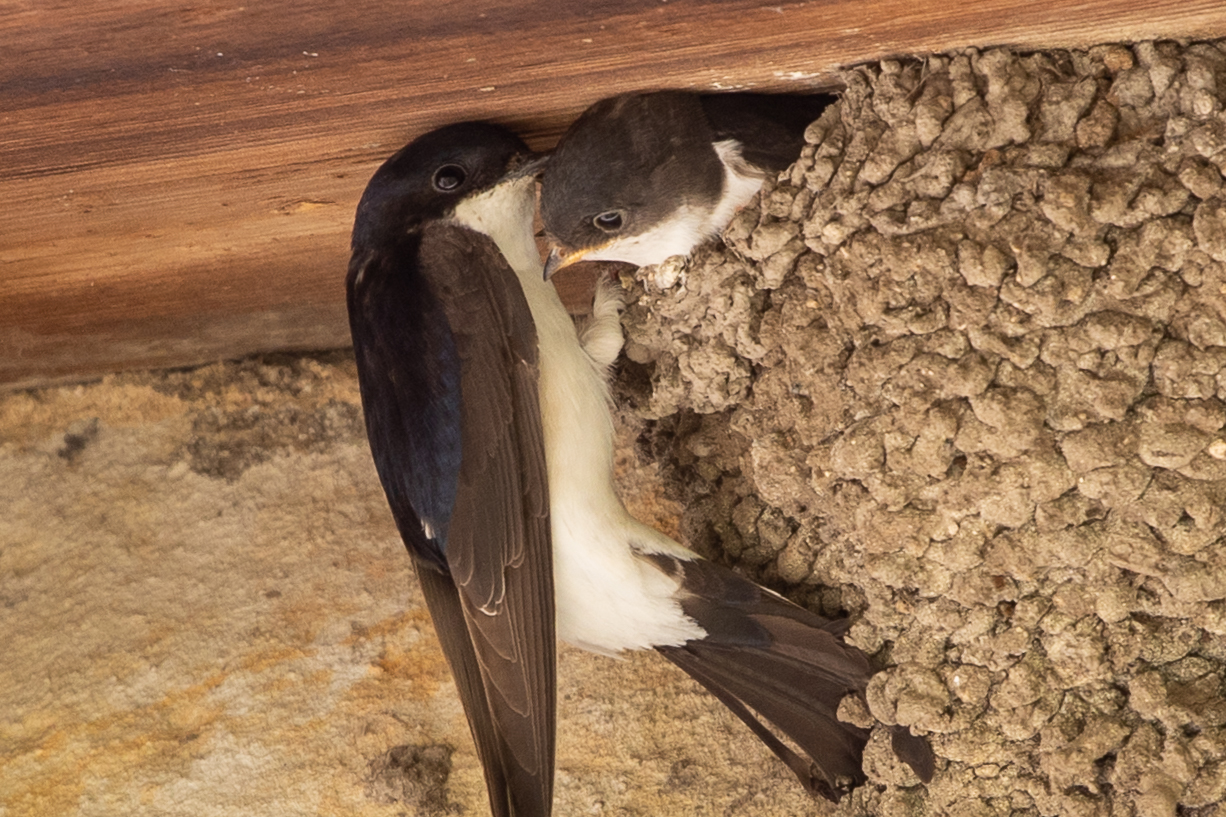
Out at the Church of St Botolph in Bossall, it is not difficult to share a little of the feeling Thomas encountered at Maes-yr-Onnen. It is the smallest parish in Yorkshire, built in the late 12th century, and is never open when I visit. The churchyard is overgrown and neglected, but seems to me to be none the worse for the lack of tidy graves or well-tended curb stones. What might seem to some to be a place of death is bustling with life. House martins are nesting in the eaves. A wyvern weathervane tells you from whence a gentle Yorkshire breeze is blowing. Swallows flit too and fro and, above them, swifts wheel and dive on the afternoon’s heat. Despite all our neglect of the planet, here is somewhere that time has forgotten to alter. One small red letterbox, opposite the church, is the only sign of connection to a wider network of society and even that, today, is largely unused.

RS Thomas believed strongly in the connection of people to the landscape of Wales. For him it was the case that “Here, in the soil and the dirt and the peat do we find life and heaven and hell”. To leave the land, and to live in towns and cities, was to abandon connection to the environment in which the Welsh should “forge their soul”. This may seem a romantic and unrealistic notion in 2024. However, as we have seen in recent weeks, it can hardly be said that the current society in England is one where there is peace and flourishing for all. We may not be able to have the kind of connection to the land that Thomas saw as spiritually needful, but perhaps we can make more of those places that offer a sense of spiritual location and peace. Places to stretch out, metaphorically or otherwise, and contemplate. Thankfully, almost without exception, they exist in all our communities and perhaps the call to the church in current circumstances, to quote words TS Eliot put into the mouth of Thomas Becket, is to “Unbar the doors! throw open the doors!” Most of these places are both close to communities but, remarkably, also other-worldly and distinct. They continue to have a part to play in our society but require the resources and support in order to fulfil their vocation to be at the service of all parishioners.

The Bible Unbound

Some years ago, an academic at the University of Leeds commented to me about his experiences in teaching students studying chaplaincy at postgraduate level. He was not a religious person. While many essays which he marked contained good arguments and relevant sources, he noted a tendency for several students to write a conclusion in which some random bit of the Bible would suddenly trump all previous discussion. This would happen in such a way that there was no context or scholarly debate – as though whatever it was that Jesus had said in the Gospel of Matthew was clearly intended to be the final word on the NHS in the 21st century. Sadly, I am not persuaded that this problem in hermeneutics has been addressed in the intervening years.

Reflecting on this issue I began to wonder, for the first time, whether the physical presentation of bibles is part of the problem. All the books are bound together as a single volume, with an identical font and layout. There are many advantages in doing this, not least the referencing system that allows a chapter and verse to be identified quickly and accurately. It also conveys the fact that these particular books have been given a distinct and common authority by the Church. However, I suspect it has some homogenising effect which may incline people to regard it as some kind of dictionary or encyclopedia, with a common framework of description and interpretation. Little could be further from the truth.

In preparing this piece I assembled a collection of 66 books. The photograph of these titles heads the blog. There is poetry; fiction; history; biography; law and much, much more. Of course, through their distinct bindings, illustrations and typefaces, all these books appear as individual volumes. Many of them relate in different ways to the same subject but, even then, the audiences for which they are written are different and this shapes the style and content of the writing. I offer this as a visual image of what the Bible might look like freed from the effects of common presentation. Perhaps, if we hold this diversity in our mind’s eye, we might read and understand the Bible differently.

Documents became ‘scripture’ not, initially, because they were thought to be divinely inspired but because people started to treat them differently.

Armstrong, K. (2009). The Bible: the biography (Vol. 8). Atlantic Books Ltd.

At the most simple level, it is a reasonable question to ask whether a book of poetry is the best place to find advice about writing laws. Or that an allegorical method of discussing suffering in a universe with a omnipotent God provides us with material for a book on history? When the presentation of books indicates their topic and approach, we start to read them in a way that is appropriate for their genre.

I am not a professor of biblical studies. Knowing that this is the case makes me all the more cautious about lifting isolated phrases from scripture to support particular arguments. It’s not that I think the books of the Bible are irrelevant to these debates, but I appreciate that understanding the context and purpose of biblical passages is a precaution against their misuse. It also seems to me that it is important to be open to where this kind of study of scripture takes us. It is all too easy to have a determined position on an issue and recruit the Bible to our cause. When supervising students’ work I often ask people to read Paul Ballard’s important chapter on the Bible and practical theology published in 2012. In this paper he appeals for more work to be done in this area but, alas, there appears to have been only limited development in the past decade.

“More important, the use of scripture is an area that has not received sufficient attention in practical theology. It is imperative, therefore, that greater attention be paid to how the Bible actually functions and how it acts as scripture. The Bible is too important to be left to biblical scholars and the systematic theologians”.

Ballard, P. (2012). The use of Scripture. The Wiley-Blackwell companion to practical theology, 163-172.

I shall continue to encourage students to review their use of scripture and consider how it is featured in practical theology and the study of chaplaincy. I certainly would not wish to see the Bible being avoided, but more nuance and awareness is needed when a few words are drawn upon and inserted into an otherwise well-argued essay. Perhaps my greatest concern is that people outside chaplaincy and ministry might assume that a sophisticated and well-informed knowledge of scripture should be a basic skill for clergy and licensed lay workers. All too often, at the moment, this does not seem to be the case.

Photo by Pixabay on Pexels.com

The Resurrections of Jesus

The shunned, the unloved, the bleeding – the despised and the dead – were all brought back into life by Jesus. In a culture of separation and holiness-by-isolation, the Nazarite Rabbi stepped over boundaries again, and again, and again. When that culminated in the raising of a man from the dead, Lazarus of Bethany, the authorities decided enough was enough. It was time for Jesus to go away. Better that one man should die than the nation perish. Utilitarian arguments often win the day, they are beguilingly simple and often easy to implement. Focused on what is obvious and immediate, they frequently omit or deny wider truths and bigger themes that are, perhaps, simply too inconvenient to contemplate.

Like the sower’s seed, or the prodigal’s father already upon the road, the resurrections of Jesus are strewn across the Gospels. He calls back to life those who have been taught to be dead. To the contamination of a bleeding woman who dares to touch him, a wretched life is made whole. Many are healed and the doubting are allowed to walk away. At a meal with his disciples a woman dares to waste the fragrance of rich perfume; anointing the feet beside which the barren branches bring forth blossom. Here is bread and water; body and blood, the words whispered to the unworthy and the hopeless: you are alive.

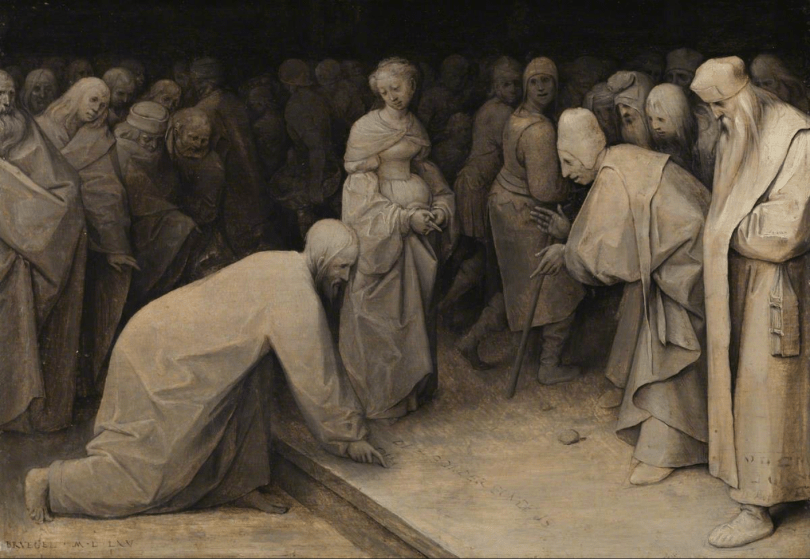
The picture at the head of this blog is called ‘Christ and the Woman Taken in Adultery‘ (1565) and was painted by Pieter Bruegel the Elder. The painting uses a technique called grisaille, meaning that it appears to be monochrome; everything is a neutral shade – sepia-like. It is hard to imagine any depiction which conveys a stronger sense of life drained away. In the crowded painting the head of Jesus is lowest of all. He writes. I have always believed that in this story, at this point, Jesus is incandescent with rage. He knows that the purpose of this moral tale is to trap him and condemn him. Did the Pharisees just happen to catch this woman in the very moment of committing adultery? Or did the lawyers’ question come first, and a cunning plan evolve to create the drama? She is caught in the act – and they know at that moment exactly where to find Jesus. He knows that those who bring her care neither for her sin nor her salvation. She is a prop. It is little wonder that this is one of very few Gospel stories where Jesus pauses and takes his time, perhaps to marshal his feelings before speaking.

“The stone-throwers walk away, one by one, according to age. Until the kneeling Christ and the standing woman remain, in an awkward reversal of their established sexual status. He tells her to go, to sin no more, to pass from this narrative, and out of our knowledge”.

https://www.theguardian.com/artanddesign/2011/sep/30/picture-this-iain-sinclair-bruegel?CMP=share_btn_url

The teachers and the crowd are dismissed by their recognition that no one is without sin. In this dismal tale of exploitation the one whom Christians claim has no sin does not pick up a stone. Violence is interrupted and a word of resurrection love is spoken: I do not condemn you. Like the woman at the well, she stands with Jesus alone. Another woman made the recipient of easy male judgement. The choreography of sin and punishment is cut short by someone who has no interest in this kind of dance. It is time for it all to stop.

On Good Friday we are supposed to think about the agony and suffering of Jesus, and so we should. But the resurrections continue, even on the cross. For the criminal who puts his faith in Jesus, the promise of the life to come: today. Slowly, the light of the world is extinguished. Its remains are planted in the darkness of the sealed tomb: and we wait. Today, at Easter, resurrection triumphs over death. The task of the church is to live this resurrection and set free people so quickly judged by those keen to weigh some sins more than others. To punish those whom it is easy to judge, and hide much greater sin in the folds of wealth. The resurrections of Jesus are not good news for everyone.

Photo credit: The Courtauld

Refreshment

Today passes by all sorts of names: Mothering Sunday; Mothers’ Day; Mid-Lent Sunday; Rose Sunday; Laetare Sunday; Simnel Sunday and Refreshment Sunday. Despite the differences, there is a kinship between them, laying emphasis on different aspects of this waypoint through the long sojourn of Lent. For the vast majority of people, who aren’t making any particular commitment to the season, Mother’s Day will be the most recognisable name.

Refreshment seldom seems a bad idea. When we embark upon any long project, or simply feel weighed down with the routine tasks of daily life, pausing to be refreshed sounds a positive step. In some churches, after the weeks of purple, the vestments and hangings on this Sunday will be a vibrant pink. Colour refreshes the dullness of abstinence, flowers will be given and received, and family dinners will be eaten. In gardens and parks in the northern hemisphere this moment in Lent is accompanied by the emerging colours of spring and, hopefully, some slightly drier and warmer days.

In some traditions and ways of living, the idea of refreshment might be regarded as an indulgence. The consequences of this can be seen all too plainly in Hard Times. Dickens locates the exclusion of play, childlike wonder and a lively imagination, in the pattern of life imposed by a father:

“You have been so careful of me that I never had a child’s heart. You have trained me so well that I never dreamed a child’s dream. You have dealt so wisely with me, Father, from my cradle to this hour, that I never had a child’s belief or a child’s fear”.

Dickens, C., Hard Times, 1854.

Dickens may have exaggerated several aspects of Victorian England in his novels, or placed together less common experiences in a single story, but it all flowed out of a reality with which he was familiar. Allowing space for refreshment in the 19th century could be a dangerous step. People might begin to think; to feel; to dream. Better to do your duty, however bleak the prospects, than imagine a life of being ‘fed on turtle soup and venison with a gold spoon’. In that era few were wealthy and many were poor, and finding any kind of middle way between the two was not in the interests of the powerful. ‘Plus ça change, plus c’est la même chose’.

Rather than being simply a pleasant 5 minutes pausing on a bench, or walking through a wood, refreshment can mean the moment we begin to see life anew, and wonder how to live the lives we are given. It might be the time we decide that change is needed, and that bobbing along as we are isn’t how we are meant to use this one, precious, opportunity we have to be here. Pulling the levers and turning the handles of our part of existence can fill the time – but it should never stop us pausing and lifting our eyes to the horizon.

Refreshment can be dangerous. It can lead to revolution. It may resolve our heart to pursue a different path. It is never time wasted – but the space in which a different future might be imagined.

An Incorruptible Crown

For many years the 30th of January was widely observed across England as the day King Charles I was executed. It is retained in the calendar of the Church of England, but the degree of emphasis attached to the commemoration has diminished. Charles King and Martyr is kept as a ‘lesser festival, 1649’ with a single prayer to be said. In the Book of Common Prayer there was a entire service provided for this day (removed in 1859).

“I go from a corruptible, to an incorruptible Crown; where no disturbance can be, no disturbance in the World”.

King Charles I, spoken at his place of execution 30 January 1649

Following the Restoration the Church of England played a significant role in shaping official history and sustaining the belief and convictions that underpin monarchy. Sermons were preached and many were published. The date provided the occasion for bishops and senior clergy to demonstrate their loyalty and prevent any thoughts returning to the idea of a commonwealth. Across the land, from village church to metropolitical cathedral, it was expected that royal subjects would observe this solemn day.

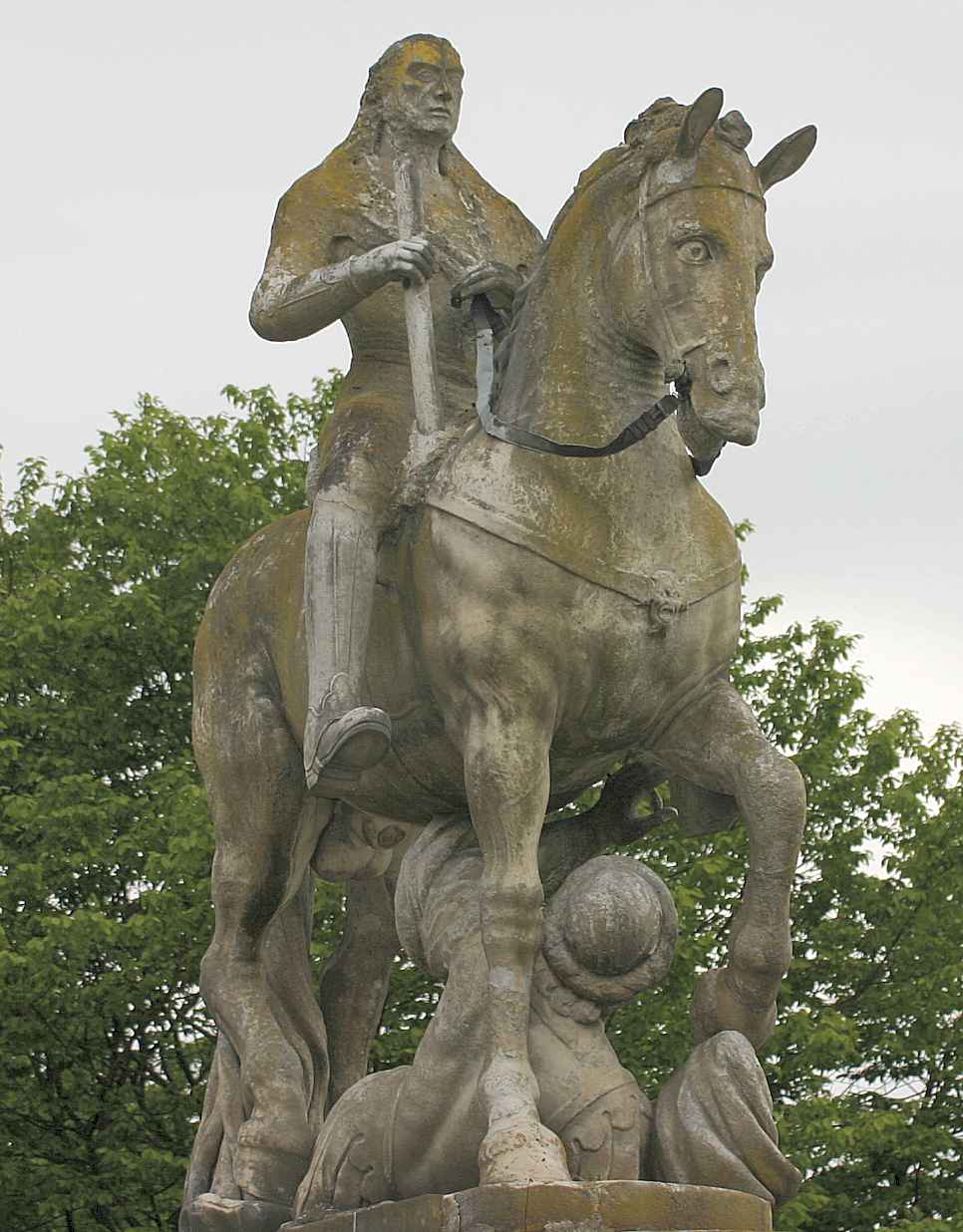
There were other ways in which the return of the monarchy was welded into popular imagination. This included the creative arts, especially portraiture. One enterprising donation took the form of a recycled statue. Now sited at Newby Hall in North Yorkshire, the monument to King Charles II was previously a statue showing the Polish commander John III Sobieski riding down a Turkish soldier. In its revised form substantial work was done to modify the head of the figure, to resemble Charles II, but the trampled figure of Oliver Cromwell retains a decidedly unusual appearance (i.e. he’s wearing a turban).

There should probably be a maxim to beware of sycophantic royalists bearing gifts. The first attempt to donate the statue to a prominent London location (the Royal Exchange) was rejected. The statue’s owner, Sir Robert Vyner – who might be said to have a stake in the royal franchise (he created new coronation regalia for Charles II) – then offered the work to a City church. This was accepted (perhaps it was too hard to say ‘no’?) and the statue occupied space at the Stocks Market. It later moved to Lincolnshire, before settling at Newby Hall in Yorkshire.

The recycled statue used to depict Charles II, Newby Hall, photo by David Bridgwater

The 17th century poet Andrew Marvell made satirical comment on the statue when it was still in London. He suggested that there was more than a passing resemblance between the horse rider and the man who had commissioned the work:

When each one that passes finds fault with the horse,
Yet all do affirm that the King is much worse ;
And some by the likeness Sir Robert suspect
That he did for the King his own statue erect.

Andrew Marvell, A Poem on the Statue in the Stocks-Market

Having been shuffled off to the north country, London had performed that subtle process of sifting out mediocre work at odds with its ambitions in art and public monuments. Following the Great Fire the city was modelling itself as an international capital for trade and culture where, alas, Sir Robert’s reworked homage did not belong. Marvell’s intimation that the statue bore a likeness to its commissioner may also have helped seal its fate.

As it is one of my principal areas of reading at present, I feel bound to mention that Laurence Sterne published a sermon marking the 30th January. Compared with many of the thundering homilies delivered on this date, Sterne’s offering has been described as ‘innocuous’. Although thoroughly loyal, and referencing ‘our forefathers trespass’, Sterne adds the comment that: ‘to avoid one extreme, we began to run into another’. Perhaps this indicates a more critical understanding of what led to the Civil War and how future progress might be made without recourse to arms. This appears to be a lesson the world is still struggling to comprehend, let alone enact.

Gates Drawn Apart

On most days we are heading towards either the longest day or the shortest day. On two days each year the world turns, and we are – for a moment – at the extremity of our shifting balance of night and day. The Church traditionally parked St Thomas on the day of greatest darkness. Perhaps a choice designed to support the idea that too much doubt can only lead into the night, so we better get our beliefs in order and welcome the returning sun.

I love the seasons, and regret that our colder days are fewer and farther between. Heat lasts later, and returns sooner, as we reap the consequences of human folly. The climate is a delicate mechanism and we have placed too great a burden on its capacity to absorb the punishment we mete out every hour. Thankfully, the reliability of the winter solstice is a reminder that while we might be intent on ruining the invaluable gift of our natural world, we cannot touch the vast expanse of space that doesn’t give two hoots whether or not humanity is intent on destroying its habitat.

Let us continue to enjoy it while we may, and do whatever we can to reduce the changes taking place. Part of my delight in the seasons lies in the subtle presence of another season buried in the one that precedes it. We have hardly entered December and the corkscrew hazel has finally shed its last leaves, revealing the tortuous structure of branches to which it owes its name. However, at this very moment, the catkins that will flourish in March have begun to appear. In branches that hold the darkness of winter, and twist hither and thither, the marks of spring are already written.

It was this interrelatedness of our seasons that became the central idea of a story I wrote in anticipation of our daughter’s birth, 27 years ago. It was the only time I worked on anything like this with my late father, as he provided illustrations for a story to celebrate his grandchild’s birth. We produced this simple book by photocopies and an office printer, happy to keep this piece of work purely for the family. His original artwork was framed and became a beautiful reminder of his joy in Abigail’s arrival.

As we journey through the final week of Advent, and some in the church will mark the feast of St Thomas, the season reminds us that time itself will one day cease. That all will be gathered in, and the work of the world will be done. As each season is intimated in the days of another, so the end of all things is bound up in the transitory lives we lead. For those who hold the light of faith this is not a doom of destruction but a making whole; a healing of every hurt; the final coming home of a humanity that has endured the final agonies of its own folly.

This year time’s nature will no more defeat you,
Nor all the promised moments in their passing cheat you.

This time they will not lead you round and back
To Autumn, one year older, by the well-worn track.

This year, this year, as all these flowers foretell,
We shall escape the circle and undo the spell.

Often deceived, yet open once again your heart,
Quick, quick, quick, quick! – the gates are drawn apart.

Part of ‘What the Bird Said Early in the Year’ by C.S. Lewis