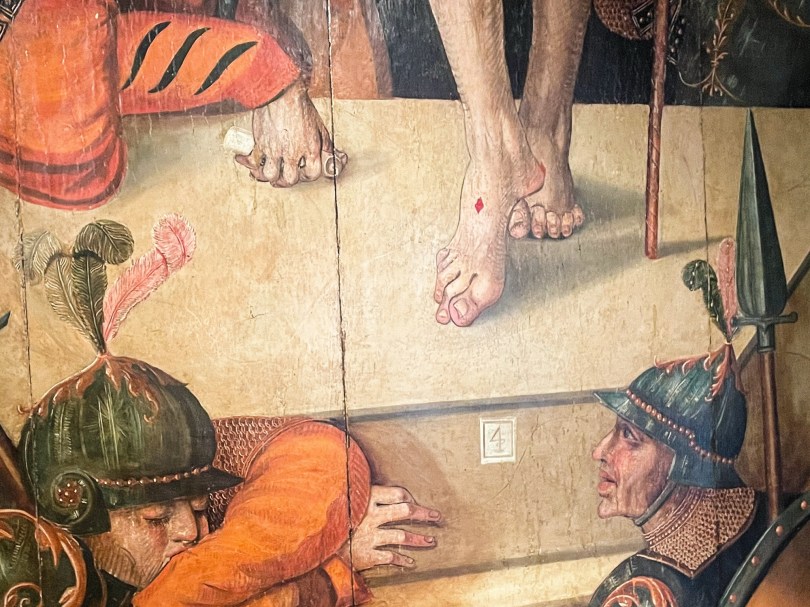
Perhaps the soldiers were sleeping because their task seemed so simple: to guard a dead man. In the painting, part of an altarpiece, only one soldier has been stirred by the strange sounds coming from the tomb. The feet of Christ stand simply on the grave slab, familiar to countless millions down the centuries by their telltale marks of blood.
The status of Jesus as dead and buried is suddenly transposed. Now, in the hour of resurrection, the guards are ‘so afraid of him that they shook and became like dead men’.
The soldiers are scattered out of fear. The women at the tomb also disperse but with different sentiments. They are ‘afraid yet filled with joy’. The feet Christ places on the earth do not bring vengeance or a settling of scores. They stand in confident conviction that a new era has begun when peace is more than a balance of arms.
A very Happy Easter to all blog readers, and especially to those who have struggled through ‘A Sterne Lent’ to reach this joyful Eastertide.
Another reader’s response to the marbled page stencil in ‘A Sterne Lent’.
We are about the enter Holy Week. Many Christians will mark these days by attending additional church services and spending time in reflection. I never tire of reading the passion narratives because I have no doubt that in them lie the central themes of Christianity. There is a crowd in an city eager to give the inspiring young rabbi their adulation. The intimacy of close friends at supper on an important festival. The isolation of the garden outside the city walls, and then the bitter work of captivity; costly fidelity; suffering and death.
At a time when the world has become increasingly chaotic it is important to be reminded of Christ’s stillness before the powers of his day. The High Priest and Pilate undoubtedly saw the brewing popularity of Jesus as something that would be ended by his execution. On all the metrics of religious power and secular control, the Jesus who goes to the cross is done. The watching world could agree with Jesus’ last words: “It is finished”. Perhaps those two leaders saw it as the messy and unfortunate price to be paid for maintaining control; keeping the peace. The sacrifice of Jesus would enable things to stay as they were – and as they should be.
Maybe Jesus didn’t know the art of the deal? His time in the wilderness at the beginning of Lent suggest that he had set his face against compromises in his ministry. When he stood before Pilate he had no cards to play. Or, perhaps, it is more accurate to say that he chose not to accept the terms of the game. Appearing to go meekly to his death probably confirmed to many of the leaders that Jesus simply didn’t understand the reality of the world he claimed to be saving. Sad, but there you go. One death wouldn’t change anything.
A Station of the Cross by Sepo b. Ntuluna from Tanzania, in the hotel Mattli Antoniushaus, Morschach – built on the grounds of the Franciscan Community in German-Speaking Switzerland.
Then there is the humanity of loss – of which we all know something. Mary caressing the body of her son. A parent unable to intervene to save her child. The powerlessness of love which cradles the life-left body of the son she would have done anything to save. This is the darkness of despair; the earth shaken; the light of the world put out. The day of absence.
‘Faith’ is perhaps the best answer as to why Jesus doesn’t do a deal. That our miserable card games take place inside a much, much bigger story than most of us are willing to acknowledge. Soldiers at the foot of the cross didn’t have cards, but they had dice. It would be beyond their imagining that 2000 years later the events of that sorry day would still be remembered. A miserable death a few hours before a dusk that would usher in the city’s shabbat. It would be hard to imagine something less important. It was ended – time to divvy up the possessions and go home.
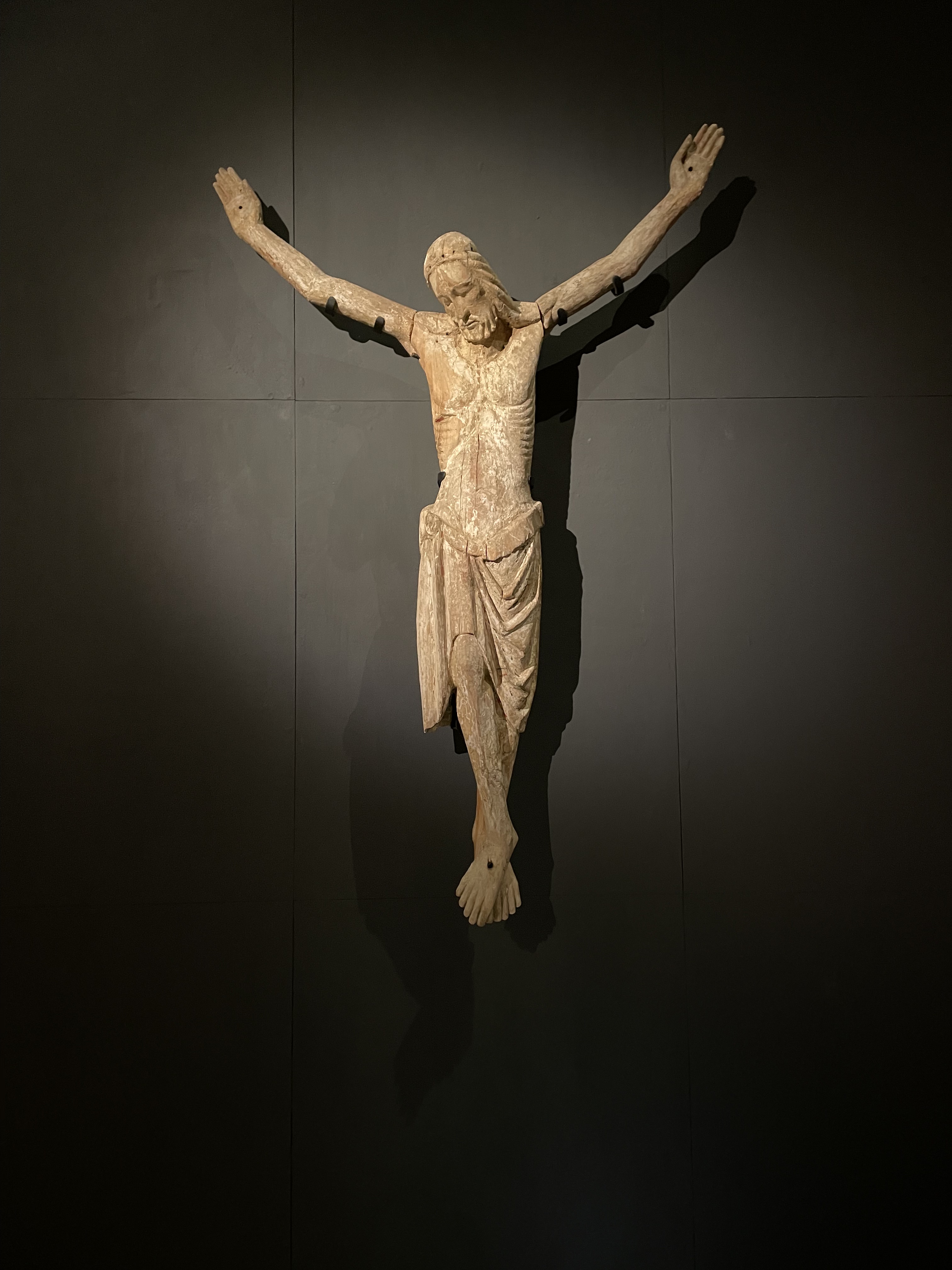
“Thou art God, Whose arms of love Aching, spent, the world sustain”.
WH Vanstone from Hymn to the Creator in ‘Love’s Endeavour, Love’s Expense‘
I’m not the kind of Christian who likes public witness. The sort of knocking-on-doors Christianity; or a beach mission; or even telling my “faith story” in a service feels embarrassing and uncomfortable. There are probably lots of reasons for this, which it would be tempting to dismiss with an air of Anglican superiority.
I am inclined naturally to a reflective and tentative articulation of faith. I don’t believe I have all the answers. “Now we see in a mirror dimly”. I have no doubt, for a host of reasons, that my faith is fractured and partial. It feels fuller and more complete when it is located within a community of faith, bringing many different experiences of God, past and present, under a single roof. Others have natural – and undoubtedly, spiritual – gifts for giving personal testimony. I don’t hesitate to say that this can be both inspiring and has a place within the life of faith. But we are not all created to be the same.
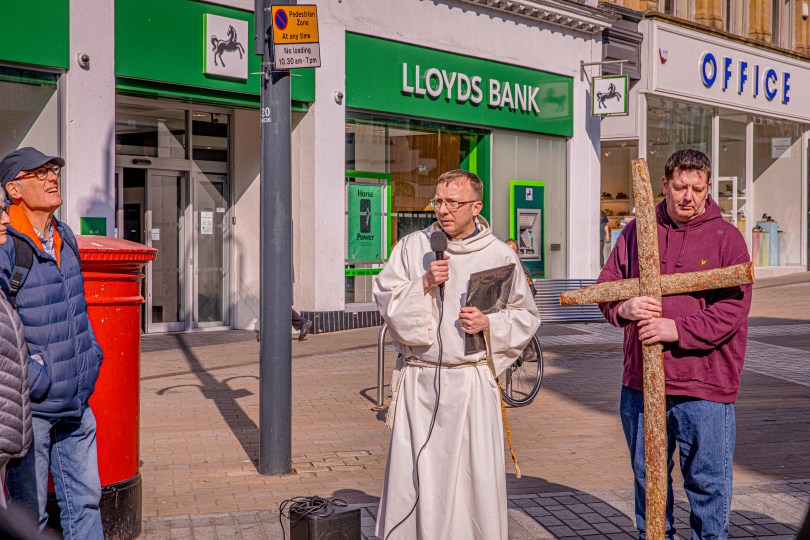
Hence, it was with some trepidation that I went along with the Gospel Streets Urban Pilgrimage in Leeds last week. Led by the admirable Lighthouse community, based in St George’s Crypt under the pastoral care of Jon Swales, the pilgrimage snaked though the streets of Leeds on a sunlit Thursday morning. Jon had a monk-ish aura wearing a cassock alb, and speaking passionately about the City while reading the Gospel of Mark. People stared at us. One passing youth shouted: “You’re all evil; you lot”.
What did it achieve?
For the thirty odd of us participating there were the kind of side-on conversations that people walking to the same destination often share. I met many people I hadn’t encountered before. Members of the Lighthouse community were with us, and it ended with a service of Holy Communion in the Crypt. We were present in spaces where religion is either excluded or extreme; the places where the more you consume the more you matter, and where street preachers tell the world that “the end is nigh”.
Our pilgrimage was less confrontational and more measured. The worst excesses of capitalism were described beside the city’s banks. People damaged by an urban environment that rejects them walked with us in a spirit of solidarity and purpose. Jon asked people sitting and reading in the sunshine of Mandella Gardens if they wouldn’t mind him speaking for a while (sooo Anglican!) and breaches of international law were mentioned by the war memorial.
I’m not sure what we achieved. A statement was made – it was enacted. In the pilgrimage through Lent, we reminded ourselves and anyone who cared to listen, that God is present in the city. That the Church is (or should be) a shelter from the storms of life and a community that is restless and longing for the Kingdom. Where people who have been rejected find a home, and where earthly power is reminded of its place.
It is absurd to retell here what happened there, far away and far ago when the idiot healed and said, and wept and left. A broken nonsense in the febrile world of expectation.
I have long been a fan ofThe West Wing, Aaron Sorkin’s masterful creation of an imagined, plausible, and ethical US Presidency. Although the programme foretold the election of a president who was Latino, it did not predict the right wing backlash that would follow. A much weaker version of Donald Trump features in an episode concerning a Republican challenger to President Jed Bartlett, who the sitting Democrat sees off without difficulty. Alas, recent months have seen a catastrophic implosion of the Democratic opposition in the USA, with global consequences.
In one episode of the series Jed Bartlett is asked a question about why Airforce One’s take-off had been delayed. Before giving the prosaic reason, Bartlett eulogises for a moment about what a lengthy night flight can mean:
“A long flight across the night. You know why late flights are good? Because we cease to be earthbound and burdened with practicality.”
I write this onboard a BA flight which is about to leave Cape Town on Friday 21 March. We weren’t sure whether this flight would make it into the air, given events at Heathrow. Perhaps we won’t land in the UK – the equivalent flight yesterday ended up at Barcelona. Nevertheless, we will have a long night flight in all events, and perhaps Bartlett was right that there is something unusual and potentially uplifting and thought-provoking about traversing the planet in this way (albeit with environmental considerations and impacts).
Once again South Africa has been impressive; challenging, and full of natural wonders. From visiting communities that experienced devastating flooding, to the wealthy areas of coastal communities along the Garden Route, we have once again experienced a country of contrasts. A nation where the enduring imprint of colonialism runs wide and deep. During our time there the SA Ambassador was asked to leave the USA and 70,000 Afrikaans have expressed interest in accepting refugee status in America. Making a nation is hard work – especially one so burdened by an evil regime that nurtured division as a basic strategy of education and government.
Perhaps due to the short span of our lives human beings do far too much far too quickly. Nothing appears to have been learned from COVID, recent global conflicts or the history that underpins Western privilege. In South Africa two experiences reminded me of our self-absorption and navel-gazing. One was the opportunity to see and photograph the Large Magellanic Cloud, a ‘nearby’ galaxy containing 30 billion stars, and only visible from the Southern Hemisphere.
The Large Magellanic Cloud
The other, quite different experience, was to go underground and visit the Cango caves. Here stalactites and stalagmites have formed over tens of thousands of years, in some cases forming vast columns when growth up has met with expansion down. Extraordinary beauty created by incredibly slow drips of calcium infused rainwater. A process now slowed by global warming.
What is above us and below us is a reminder that the environment we value has come into being through both unbelievably big cosmic events and incredibly small and sustained changes that over vast stretches of time have a mighty impact. We do not tread lightly upon the earth, expending in a couple of centuries resources that have taken millennia to create. The relentless energy of the systems that we have built do not work in favour of the whole of humanity, or even the few that appear to reap the benefits of extracted resources. We are not living sustainably and the blind optimism of some that we shall always find solutions to the problems we’ve created may, in the end be shown for what it is: a convenient narrative to permit the continuing exploitation of our planet.
It appears as a small detail in some classical depictions of the Annunciation, but it is not uncommon to find a tiny baby Jesus surfing a beam of celestial light towards the Virgin Mary. We might take this to be no more than an artistic expression of the theological significance of what was unfolding at this critical moment at the start of the Gospel. However, there is more to this illustration than meets the eye.
A middle part of so called Mérode Triptych, created in 1430’s in the workshop of a Master of Flémalle, and kept in the Metropolitan Museum of Art in New York
Anyone familiar with The Life and Opinions of Tristram Shandy, Gentleman will know that the clerical author, Laurence Sterne, makes play with the concept of “homunculi”. Developed to a significant extent by Aristotle, this idea centres on the belief that all the physical aspects of procreation resided with the man. Unbelievably small babies were thought to be present in semen which, at the moment of conception, were passed by the man to the woman. It is hard not to interpret this as a startling manifestation of misogyny. Life being so important it could only originate from a man; and pregnancy so inconvenient it must be the perpetual obligation of a woman. In Tristram Shandy this theory is mocked from the first page, when the conception of Tristram is interrupted by Mrs Shandy, who distracts her husband by asking: “Have you not forgot to wind up the clock?” The effect of this is to weaken the efforts of Mr Shandy, and results in irrevocable damage to the homunculus that is, and will become, Tristram.
It would be easy to underestimate the consequences of this belief. Sterne incorporates into his novel the real-life situation of the Duchess of Suffolk. When her husband and son died in quick succession she was granted administration of the estate. However, when it was contested, part of the appellant’s legal argument was the assertion that – based on an understanding of homunculi – she was not a blood relative of her son. The Duchess lost her right to inherit.
As the Church celebrates the Annunciation on 25th March it is worth asking the basic question: “What was going on?” The classical paintings of a tiny Jesus heading towards Mary imply that the infant saviour was a divine homunculus. The mother of Jesus was simply receiving a delivery from the Almighty, leaving her virgin state unaltered and confining her responsibilities to safe carriage. At its most extreme, Mary would be seen as having a vocation – but no blood relationship with Jesus.
In the classical world divergent views about conception include those of Aristotle, and an alternative approach can be found in the work of Galen. Galen’s understanding of conception sees both the man and the woman contributing seed to form an embryo. As Magdalena Łanuszka put it in a blog entitled “Flying Baby Jesus”, the homunculus interpretation lacks serious theological foundation:
Such a depiction suggests that Christ was incorporated as a human child somehow beyond Mary’s womb and then “placed” in it. That weird In Vitro is of course an idea absolutely theologically incorrect. Jesus’ body was formed entirely out of Mary’s body, not somewhere outside it.
In a timely inclusion, the current issue of The Church Times features a review of a new book focusing on the embodied experiences and theologies of birth. Pregnancy and Birth: Critical Theological Conceptions challenges the dearth of theological work done on these major topics. It is not difficult to imagine that if men underwent the experience of pregnancy, the number and variety of titles on these subjects would be immense. In another review of Karen O’Donnell and Claire Williams’ new book, Dr. Emma Percy, a researcher working in this field, offers some concluding reflections:
Pregnancy and all the complexities around reproduction should not be a niche topic, just for the feminist theologians or those who have been pregnant. We are all born from a body that gestated us for months. Jesus, as O’Donnell reminds us, shared this very human experience in the womb of Mary. There is much for all to learn from taking a more realistic look at a bodily experience that is so fundamental to our being human.
Sweet flying baby Jesus should concern us all. How we respond to this framing of the Annunciation and Incarnation is fundamental to our understanding of Christianity, and the God we worship. Sterne turned the evident nonsense of the homunculi into satire, but underneath the wit is a profound question about the humanity of the God in whom we place our faith. From what I have read, it is uncertain whether the writers of the Bible shared a uniform understanding of conception: they almost certainly didn’t. (There’s an excellent article about this by Laura Quick entitled Bitenosh’s Orgasm, Galen’s Two Seed and Conception Theory in the Hebrew Bible). Ultimately, when we lack the understanding of what the authors of Scripture thought when they were writing, we need to arrive at our own conclusions as to whether our interpretation enlarges our love of God and of neighbour, or diminishes it. For me, the idea of Jesus as a foetus implanted in Mary’s womb by the Holy Spirit undermines a primary doctrine of Christianity; namely, that the Word made flesh is both fully human and wholly divine.
Lent is almost upon us. Somehow, unlike several of our continental neighbours, England maintained the old words for this time, even as the Church’s Latin altered so much of our language. Lent probably came into English through Old Saxon, but its exact history is lost in the folds of antiquity. Nevertheless, the meaning is clear. It is to do with something long, possibly reflecting the lengthening days brought by spring in the northern hemisphere. Maybe, also, the sense that days of abstinence might be long days and, consequently, Lent is a season to be endured. It ends, of course, in Easter – another ancient name from Old English, with origins linked to Northumbrian Eostre. Perhaps the name of a Goddess, or a word for dawn, but in any event adopted by the early Christians of these isles as a fitting word for the new life that awaits at the end of Lent.
While our warming winters have changed our experience of the seasons, we may still see churchyards transformed with a late frost, or layered in a final fling of snow’s fleeting transformation. There is an added poignancy that these occasions are becoming fewer, with such brief visitations acting as a nostalgic reminder of how we once experienced these months. Much of English literature describes the tyranny of enduring and unavoidable cold, when even a hearthside might offer only limited and temporary relief.
Given their appearance in or around the start of Lent, purple is often the colour of choice for crocuses planted amongst the grave stones that surround our ancient parish churches. A fitting sign of both our mortality and also the liturgical season. From this coming Wednesday, until mid April, many churches will be draped in purple, signifying the Lenten focus on “self-examination and spiritual discipline”.
… crocuses Pale purple as if they had their birth In sunless Hades fields.
From The Sun Used to Shine by Edward Thomas
Perhaps ‘sombre’ isn’t the right word for these 40 days. As regular readers of this blog will know by now, I completed a project last year to write a Lent book for distribution before March 2025. A Sterne Lent refers in many places to the sermons preached by the vicar-novelist, Laurence Sterne. It is estimated that at least one third of these 45 homilies were preached in the time of Lent. This is not surprising as even in the 18th century the penitential season was marked by some effort towards thinking and reflection upon religious convictions and actions. For Sterne the denial of joy for such a lengthy period would have been a trial. Laughter spilled out of the unlikely parson, and a significant proportion of his 42 sermons (there are another 3, but those develop content from previous ones) were preached during Lent.
According to the Julian calendar, Sterne preached his sermon on ‘Penances’ on Palm Sunday 1750. Based on some circumstantial evidence it is probable that it was preached in York Minster. Sterne explores some of his core convictions which, alongside a side-swipe at Methodists, centres on a Deity who doesn’t want us to be endlessly glum, or excessively earnest. We were not created “on purpose to go mourning, all our lives long, in sack-cloth and ashes”. However, Lent is a time when our restraint can:
dispose us for cool and sober reflections, incline us to turn our eyes inwards upon ourselves, and consider what we are, – and what we have been doing; – for what intent we were sent into the world, and what kind of characters we were designed to act in it.
It is in this season that Sterne feels the discipline of Lent is intended to “call home the conscience”. In particular, Sterne is critical of our wasteful use of time. We fill up diaries with distractions, “parcelling out every hour of the day for one idleness or another”, and seem eager that when it comes to time we are endlessly inviting others “to come and take it off our hands”. Sterne cannot abide the idea that we reach older age only to discover we have lived “a life so miserably cast away”.
Lent is a time to contemplate what we are here for; how we spend the time we have been given – but not, as Sterne would see it, to fill up the season with so much dour reflection that there is no space for joy.
I usually skip through the online edition ofThe Church Times over breakfast on a Friday. It is a newspaper with a venerable history, having first hit the presses in 1863 (between the publication of The Origin of Species and the first sales of Turkish delight). In 1981 a scurrilous and highly enjoyable spoof of The Church Times was published under the title Not The Church Times, reflecting the popular use of the ‘not’ brand of satire in the 1980s. It came complete with adverts for high office, one of which stated:
Applicants are invited to apply, stating their public school, Oxbridge college, year at Westcott House, and Lodge.
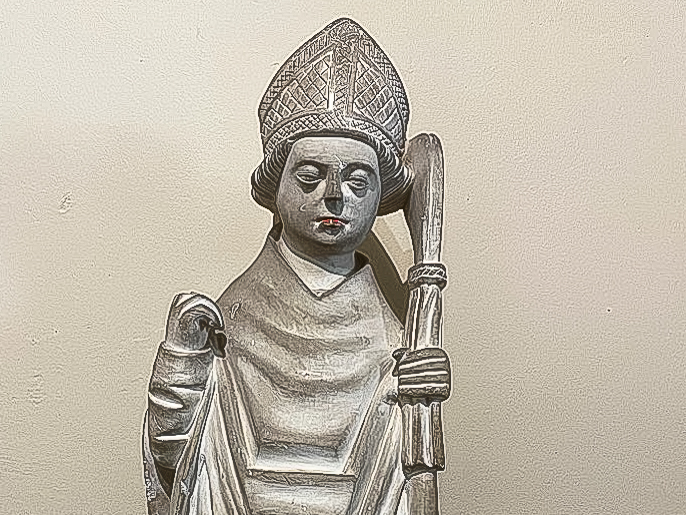
Sadly, I would qualify on only one of these criteria and even then, by 1990, Westcott was no longer the powerhouse of episcopal chumocracy for which it was once renowned. This undoubtedly explains why, when there is presently a surfeit of episcopal vacancies in the Church of England, no mitre is likely to fall on that pate so propitiously cleared of hair, which would be enhanced immeasurably by the imposition of a pointy hat. Alas, as Cervantes put it in Don Quixote – quoted later by Sterne – with a head so beaten about by the vagaries of life, if mitres were “suffered to rain down from heaven as thick as hail, not one of them would fit it.”
In recent years the criteria for preferment have undoubtedly changed from those in the 1980s. Favour has fallen on evangelical candidates; those perceived to have been successful in an organisation other than the church; and, more than anything else, priests who have a story of leading church growth. Once again, my credentials would make little impression in these categories of assessment.
All of this came to mind as I read through the classified section of this week’s issue of the ecclesiastical newspaper. My eye was drawn to an advertisement from my home diocese, the See of Blackburn. A creation of William Temple, consisting of parishes carved out of the rapidly growing Diocese of Manchester – itself an earlier Victorian offspring of the Diocese of Chester. The ad that caught my eye had a headline in a style not uncommon in The Church Times:
I pondered whether this was the same God responsible for the creation of the universe. That is, the entire reality identifiable from earth, which is at least 28 billion light years in diameter. The God who predates time and will draw time to a close. That God? I imagine that this God probably has rather a lot to do but, God being God, perhaps there would be an infinite supply of time so that spending a few minutes reviewing the needs of the Blackburn Archdeaconry wouldn’t be too onerous.
However, wouldn’t it be more honest and meaningful to ask: ‘Do you want to be the Archdeacon of Blackburn?’ Shouldn’t our desires be material to the concept of vocation, rather than being cast into doubt under a pall of implied sanctity. Perhaps it would lead to much greater honesty and candour if we explored the motivations of why anyone wants any particular role. As the Church of England struggles to address the abuse that has happened, and is happening, in situations where piety has been asserted and manipulated, it might produce a better culture if we began with a humble recognition of our own wants and needs. Wants and needs where, in various ways, God is already present and active. Teasing these out may be the best way to achieve greater honesty; self-knowledge; deeper discernment; and a safer Church.
Perhaps spiritual directors should run the C of E – they are the people, usually, who cut through the flummery and ask this kind of inconvenient question. Might God be calling any of them to Blackburn – or even to Canterbury?
As the Church approaches Lent, some Christians might have begun thinking about what to give up, or what to take up. Perhaps a small resolution of abstinence – alcohol or chocolate – and a desire to read something that will draw us a step closer to understanding everything to which Lent points. In some churches, while Holy Week might feature a visiting speaker to lead people through the final week, it has been the custom in cathedrals and elsewhere to have a different guest preacher each Sunday. This practice goes back a long way and can be found in various notices and signs that have survived the passage of time.
In 1725 Ash Wednesday fell on February 10th. Or did it? This statement requires some qualification. The calendar at that stage was still in the Julian form, meaning that the year began on 25 March, hence the Lent preachers list for St Paul’s is described as the year 1724-25. This practice was known as ‘dual dating‘ and caused considerable confusion. It finally ended in England in 1751 with the British Calendar Act and an effective transfer to the Gregorian calendar used by most of the rest of the world.
As the notice from St Paul’s demonstrates, Lent sermons were not confined to Sundays. The advertisement offers distinguished clerics on Wednesdays, Fridays and Sundays, throughout the 40 days. These occasions were not for the minor clergy, but moments when the cathedral staff themselves, or various other deans and bishops, might pronounce their theology and spiritual message.
Laurence Sterne, who was a well known and popular preacher, was aware that his humble station in the Church meant that he was unlikely to be invited into the nation’s highest pulpits. The steps that grace the cover of A Sterne Lent – Forty Days with the Celebrity Parson the Church Forgot, are elegant, simple and modest. They are the pulpit steps of All Hallows, Sutton on the Forest, where the preacher stands only a few feet higher than the congregation. Today, I understand that a less formal way of leading worship (and perhaps fewer parishioners) means that this beautiful 18th century piece of furniture is seldom used.
Many of Sterne’s surviving 45 sermons were first preached in the season of Lent. In keeping with the motif found across Sterne’s work, he was mindful of the contrast between success as an author and the skepticism about his character which would keep him out of high office in the Church.
“I just received a Translation into french of my Sermon upon the house of Mourning, from a Lady of Quality – who proposes to print it, for the Caresm, & to give ye people here a specimen of my Sermons – so You see, I shall be Lent Preacher at Paris, tho’ I shall never have the honour at London”
Letter from Laurence Sterne to Henry Egerton, written in Paris, March 8 1762. Quoted in Volume 7 page 233 of The Florida Edition
In a style characteristic of Sterne’s humour, his letter to Henry Egerton in March 1762 makes reference to the fact that his own death had been reported in newspapers back in England. Sterne’s congregation in Coxwold went into mourning. It took more than a week for corrections to appear in the English press. Sterne would undoubtedly have been fascinated by the eulogies which were published in the intervening days.
St Paul’s never beckoned the peculiar rural parson who had found fame – and a little fortune – through both his published sermons and Tristram Shandy. Undoubtedly Sterne has the last laugh, as the great names of that era, who graced the pulpits of the nation’s cathedrals, are now unknown. Yet, somehow, Sterne’s radical approach to the novel continues to stir the creative spirit of contemporary artists and authors across the world. I believe they also have a much neglected spiritual significance.
Perhaps one of the most attractive things about Sterne is his refusal to conform simply in order to ‘get on’. Yes, it rankled with him that there would be no palace to live in, or ample stipend to live off in a lavish style. Sterne can’t quite let go of the cost – the sacrifice – which witty writing and ecclesiastical satire had imposed on his prospects. Friends advised him to temper his writing until he was in the kind of exalted position no one could touch. However, I suspect that Sterne knew this beguiling suggestion for what it was, and that it would blunt the sharpness of his writing. Too many people have entered the church, or politics, certain that when they ‘arrive’ they will enact their intention to do something dazzling and different. Alas, how often do these well-intentioned ambitions become paralysed in the sticky web of power’s compromise? Sterne may not have preached in England’s most exalted pulpits – but the life we encounter in his writing is an enduring lesson on human weakness and hypocrisy, redeemed only by a God whose sense of forgiving humour is so much greater than the dismal depths of our everyday folly.
St Luke’s church in Cleckheaton is a barn of a building. Like so many of the churches thrown up to meet the needs of urban populations, this Victorian Gothic edifice had the working classes in its sights. A nearby Medieval church had assigned seating, and was no doubt the preferred place of worship for the landed gentry and families that looked to the countryside for their employment. St Luke’s, by contrast, was marking a new path in religion and a foundation stone in its porch made known the more egalitarian ambitions of its approach. As The Church Times of 28 October 1887 reported from the laying of the foundation stone: “It is to seat 650 persons, and the sittings are to be free and unappropriated”.
I was reminded of this bold statement of intent during this morning’s edition of Sunday on Radio 4. An item from BBC Radio Solent told the story of an Anglican church that has doubled up as a badminton court for more than 50 years. At Christ Church Melplash, one of the locals interviewed read out the statement made at its foundation that “the seats in this church are to be free and unappropriated forever”. The instruction was given by James Bandinel, the son of a cleric and a civil servant involved in implementing the abolition of slavery. His role was to supervise the suppression of slave trade activities and this included the seizure of boats. Bandinel received a good salary based on the funds generated by selling condemned slave ships. In turn, Bandinel used his wealth to fund the construction of Christ Church Melplash.
The approach to founding churches without assigned seating, or pew rents, perhaps responded to growing militancy in the population at large about privilege in the Church of England. Another example of churches taking this line includes Holy Trinity Stowupland, in Suffolk. Perhaps due to the nature of the its rural character, there were only two of these cheap, plain churches built in the county to meet the growing needs of urban populations.
‘here in the porch is the original foundation board, beginning This church was erected 1843. It contains 250 sittings,and in consequence of a grant from “The Incorporated Society for promoting the enlargement, building and repairing of Churches and Chapels”, the whole of that number are hereby declared to be free and unappropriated forever‘.
Which leads me, inevitably, to the Church of England today. The unique characteristics of the C of E mean that this is a church that belongs to the people of England – free and unappropriated. It’s why, in the current turbulence of the resignations; uncertainty; and instability, the outcome of events is more than a matter to be resolved by clergy and congregations. It must involve a wider consultation and engagement with parishioners and enable the Church to continue its historic mission to serve the people of England in the name of Christ. That’s why, on 27 November 2024, I wrote to the Prime Minister to express concerns about the ability of the C of E to resolve its own problems.
‘While the nature and resources of the Church of England has changed significantly over the past twenty years it continues to have an unparalleled presence across the cities, towns and villages of England. It has often played a key role in developing inter-faith relations, community cohesion and pastoral care, especially at times of national crisis or change. I believe that this role continues to be valuable and worthy of political support. However, it appears very uncertain that the Church of England can reform itself within the provision of its existing structures and leadership. The safe operation of the Church remains a concern”.
Extract from my Letter to Sir Keir Starmer, 27 November 2024
Unsurprisingly, the reply from the Correspondence Officer in the Cabinet Office did little more than refer the matter to the Honours Secretariat. In turn, the Secretariat pushed the issues into the court of General Synod. Perhaps the only slight indication that there is some concern at the level of political leadership has come in the form of a communication from the Charity Commission to members of General Synod. The letter is hosted on the UK Government website. The tone of the letter suggest that it is intended to be a “shot across the bows” of the C of E, reminding Synod members to “remain aware of your legal trustee duties during debate and voting on relevant Synod business”.
Over many centuries the C of E has benefited from charitable endowments and donations. It is duty bound to manage the charitable aspects of its structure for the good of the people it serves, in this case, the entire population of England. Narrow religious enterprises which fail to demonstrate public benefit must be brought under examination and the central purpose and mission of the C of E cannot be watered down in an attempt to shape itself to what many other churches already do very well. The C of E has a clear character, heritage and purpose. This must be upheld; funded; supported and encouraged.
Most poets love the liminal. At the University of Hull, in the mid 1980s, the poet Philip Larkin served as librarian. I recall him saying that the reason he chose to live and work in the city was that “it was more the end of England than anywhere else”. Being at the margins suited his temperament and talents. Little wonder that he declined the invitation to become Poet Laureate. Far too central – too Establishment.
For TS Eliot the edge of England was a place in the middle, a remote inland location, which fitted the bill: Little Gidding. Here was “England and nowhere”. Perfectly pleasant, dull, undulating agricultural land, punctuated by small villages and hamlets. Like transmitters of divine communication, the tower bells of Great Gidding speak to the distant spire of the now defunct Steeple Gidding and, in-between them, lies the humble chapel of Little Gidding. There is nothing glamorous about these buildings and little to attract the people hurtling between London and The North on the nearby A1. Perhaps the occasional pilgrim seeking to walk in the steps of Eliot, or of Nichols Farrer but, by and large, a deep, settled and impenetrable stillness. Yes: this might well be the end of England.
The Chapel, Little Gidding
Spaces at the end of things are, paradoxically, close to becoming something else. As the land of Wales begins to run out, the fields of England are drawing nearer. The final hours of a year beckon in the coming days of January. In these moments are the possibilities of change. Perhaps when we are between what has been and what is to come, there is a moment to redeem the past and shape the future. Transitions have a life and quality unlike anything else in human experience.
I write this having just said farewell to one decade and commenced another. This threshold puts me in mind of liminality, and the division of time humanity constructed from the ever rising and setting sun. Tempus fugit. Winter birthdays have their own character, when days are short and the light can be all the more impressive for its brilliance and rarity. In his poem Little Gidding TS Eliot wrote in response to the special quality of these days, as “sun flames the ice”, where “Between melting and freezing The soul’s sap quivers”.
Midwinter spring is its own season Sempiternal though sodden towards sundown, Suspended in time, between pole and tropic. When the short day is brightest, with frost and fire…
Extract from TS Eliot, Little Gidding
Byland Abbey, as seen reflected across flooded and frozen fields, 17 January 2025
Ancient ruins, perhaps especially religious haunts – scarred by the most bitter of human disputes – are also liminal places. Between past and present Byland Abbey stands in remote Yorkshire fields as one of the county’s many deserted religious houses. The area in the mid-1400s must have been a sight to behold – a countryside strewn with these ornate factories of prayer and produce. It is only a relatively short distance from Byland to the sites of Rievaulx; Rosedale; Newburgh; Mount Grace and Lastingham. For countless years. visitors have paused in these ruins and sensed the steps that lie below their steps; the footfall of centuries corralled into a single hallowed house. Lying less than two miles from Coxwold, Byland Abbey was visited by the parson-novelist Laurence Sterne on many occasions. He refers to the “delicious Mansions of our long-lost sisters”. Places to muse about the past and the present; to wonder perhaps, as he did about the English Civil War, of the repeatedly un-learned lesson of history, that in order to end one tyranny, we end up creating another. That sometimes the uncertainty of the liminal is far better than the heavy boots of certainty.
There are other places Which also are the world’s end, some at the sea jaws, Or over a dark lake, in a desert or a city— But this is the nearest, in place and time, Now and in England.













 Swift Reflections