
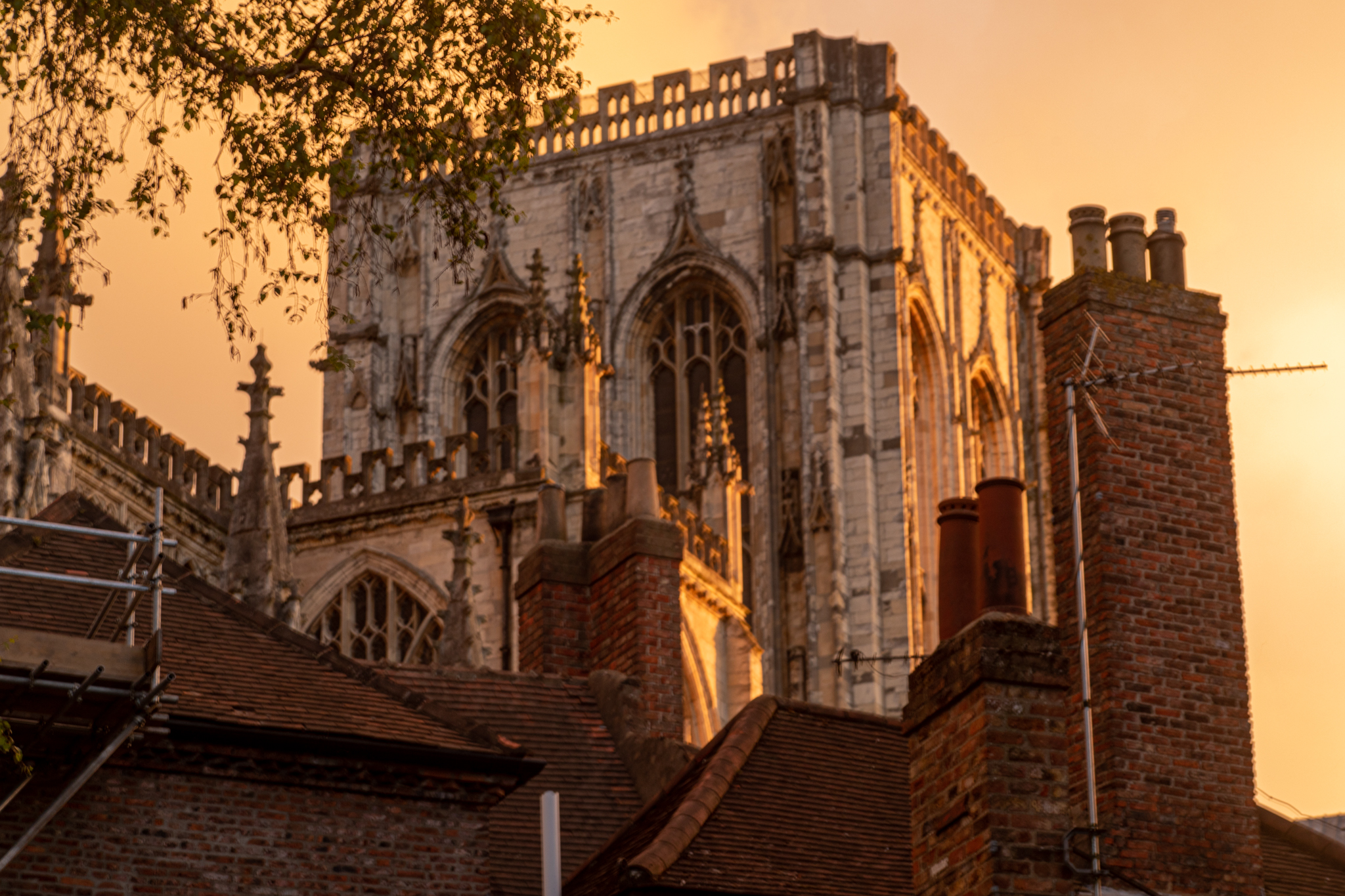
I probably shouldn’t be allowed in bookshops – perhaps, especially, the second hand variety. It’s not that I steal from them, but I am mesmerised by so many tantalising titles that whisper: ‘read me – come and see the world from where I’m standing’. All too often I succumb to the siren call of these exciting doors into new worlds of information; history; narrative and imagination. I am at a particular risk living where we are now, as the excellent Minster Gate Bookshop (pictured) stands less than a 3 minute walk away on the other side of the cathedral.
“A bookshop is an idea in time”
Carlos Pascual quoted in Carrión, J. (2016). Bookshops. Hachette UK.
Growing up there were few books in our house. These consisted of map books, a Bible, some children’s books, cookery tomes and a Readers’ Digest three volume ‘Great Encyclopaedic Dictionary’ (the latter now a mere £5 on Abebooks.com: I found it very helpful on many occasions). At my grandparents it was a different story. Bessie, my grandmother, had been a primary school teacher before her marriage to Robert. The small bookcase in the sitting room was crammed with novels by Walter Scott; Dickens and Thackeray. There was also an atlas with a remarkable number of countries shaded in red. It was here that my love of literature began, but its development and maturity came via a charismatic English teacher at secondary school. Before the first years’ long summer holiday Mrs Boll handed round a list of books. Apparently we were supposed to choose one to read: I misheard, and read them all (and I’m a slow reader).
When I look around the study where I am sitting, the books are a record of my evolving interests and passions. There are a few books from undergraduate studies in English Literature and Theology. A selection of novels and poetry titles. More books linked to my PhD research and subsequent publications. A Bible in Spanish. Copies of journals for which I’ve been an editor and a host of miscellaneous and probably ill-advised further purchases. Nevertheless, they are very good company and sometimes I’ll wander about looking for a title (which I know is somewhere) and become distracted picking up these old friends and reminding myself of their contents.
Some years ago I was given a copy of Jorge Carrión’s Bookshops. This recounts the author’s visits to bookshops in many different parts of the world. It has been described as an extended essay and ‘a vital manifesto for the future of the traditional bookshop’. Some of these bookshops are ancient; others are works of art in their own right, employing the skills of local carpenters to fashion the shelving. For Carrión such places are about more than the retail of print, they are the context for people to meet, debate, share new ideas and inspire one another. After all, books have always – to some degree – been dangerous. There is a reason that despotic regimes burn them. No doubt, today, the internet has provided another forum to share ideas and this can be shut down when authorities feel threatened. It’s much harder to track-down and deactivate inked paper.
My most recent visit to Minster Gate Bookshop saw me give in to temptation (twice). I could hide behind a facade of professional interest for one title, an exploration of Jeanette Winterson’s writing and its relationship to religion. I’ve always loved Winterson’s novels. The other is justifiable (I protest too much?) because it concerns Laurence Sterne, and his work is my current hobbyhorse. Incidentally, I have found on occasion that another advantage of second hand books is that they sometimes contain material from a previous owner. In one case this was a typed letter in which the author told a librarian that all his children had turned out to be nincompoops. Reflecting on the chronology, I suspect that they’re probably now all in high-powered jobs.
On the wall of my study is a work of art by Wilkinson. It contains a block of acetate pages printed with a novel, written by the artist: ‘The Alabaster Child’. The work appeals to me for a number of reasons. It gives physical expression to the fact that reading is not simply linear. Later chapters of a novel are in dialogue with earlier sections, or certain words, as they weave towards a particular conclusion. In the case of ‘The Alabaster Child: A Novel’, the sheen of the acetate captures the reflection of my bookshelves on the other side of the room. Books speak to books and the relationship is both constant and dynamic. All my reading, what I remember and what has shaped my unconscious imagination, is in dialogue. As Doris Lessing put it in her Nobel Prize acceptance speech: “it is our imaginations which shape us, keep us, create us – for good and for ill”.









 Swift Reflections