Tempus Fugit

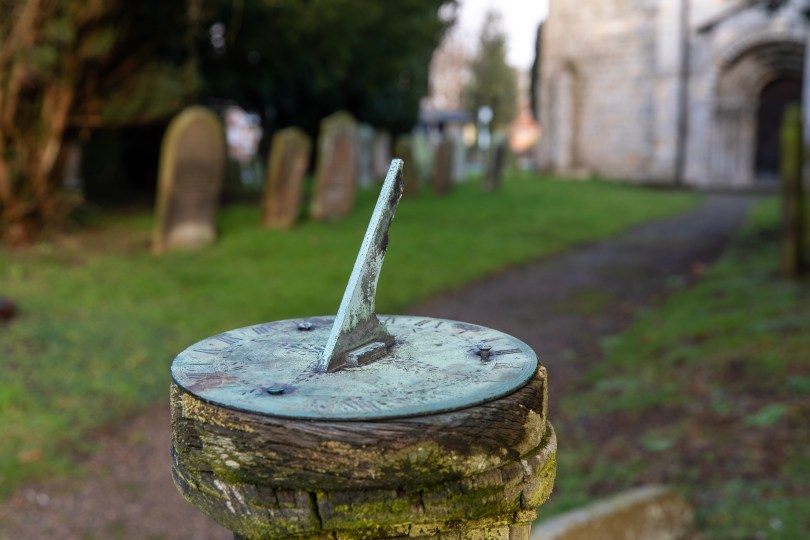
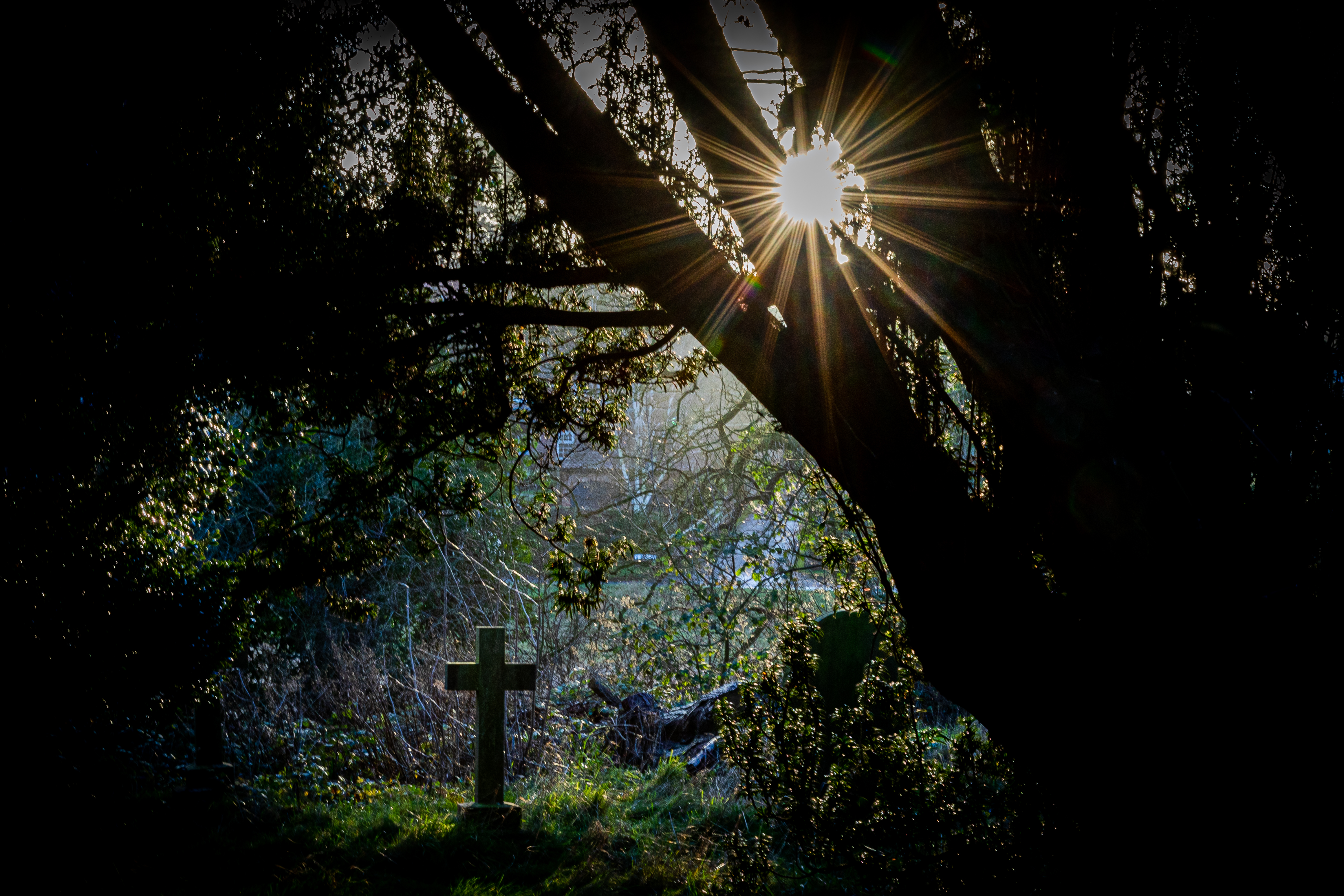
A churchyard feels an appropriate place for a sundial, even in January when the daylight is fleeting. In addition to its timepiece, the fabulous Norman church of Stillingfleet is surrounded by mature yew trees, with their pagan and Christian symbolism and, according to some, once offering a living arsenal for the bowmen of the village. Today they tower over graves that are a mix of the well-maintained and the tottering. In places the elements have gouged out the ancient letters, leaving a ribcage of indentations on the once smooth surface of stone.
Of course, as many have come to realise, Stillingfleet’s churchyard is a sanctuary for nature untroubled by construction and development. The dead offering protection for so much that is living but all too often struggling to survive in the modern world. From lichens to snowdrops, the gentle neglect of holy ground provides space and tranquility for life to flourish.

Beneath those rugged elms, that yew-tree’s shade,

         Where heaves the turf in many a mould’ring heap,

Each in his narrow cell for ever laid,

         The rude forefathers of the hamlet sleep.

Lines from Grey’s Elegy Written in a Country Churchyard

The most astonishing architectural feature of the church is the south door, described as ‘a door of national importance‘. I have written about this door previously, but as impressive as the door is the Norman doorway surround. The carved images of beaks and human figures are a marvellous survival across more than eight centuries. The clarity of the images today might owe something to their position on the south side of the building, and the durability of the stone used to create them. While we are familiar with seeing such churches surrounded by later buildings, they must have been a truly extraordinary sight when family dwellings were more rudimentary. On winter nights, candlelit services must have made these churches extraordinary images of light when so much of the world was in darkness, and homes couldn’t wholly keep out the elements.
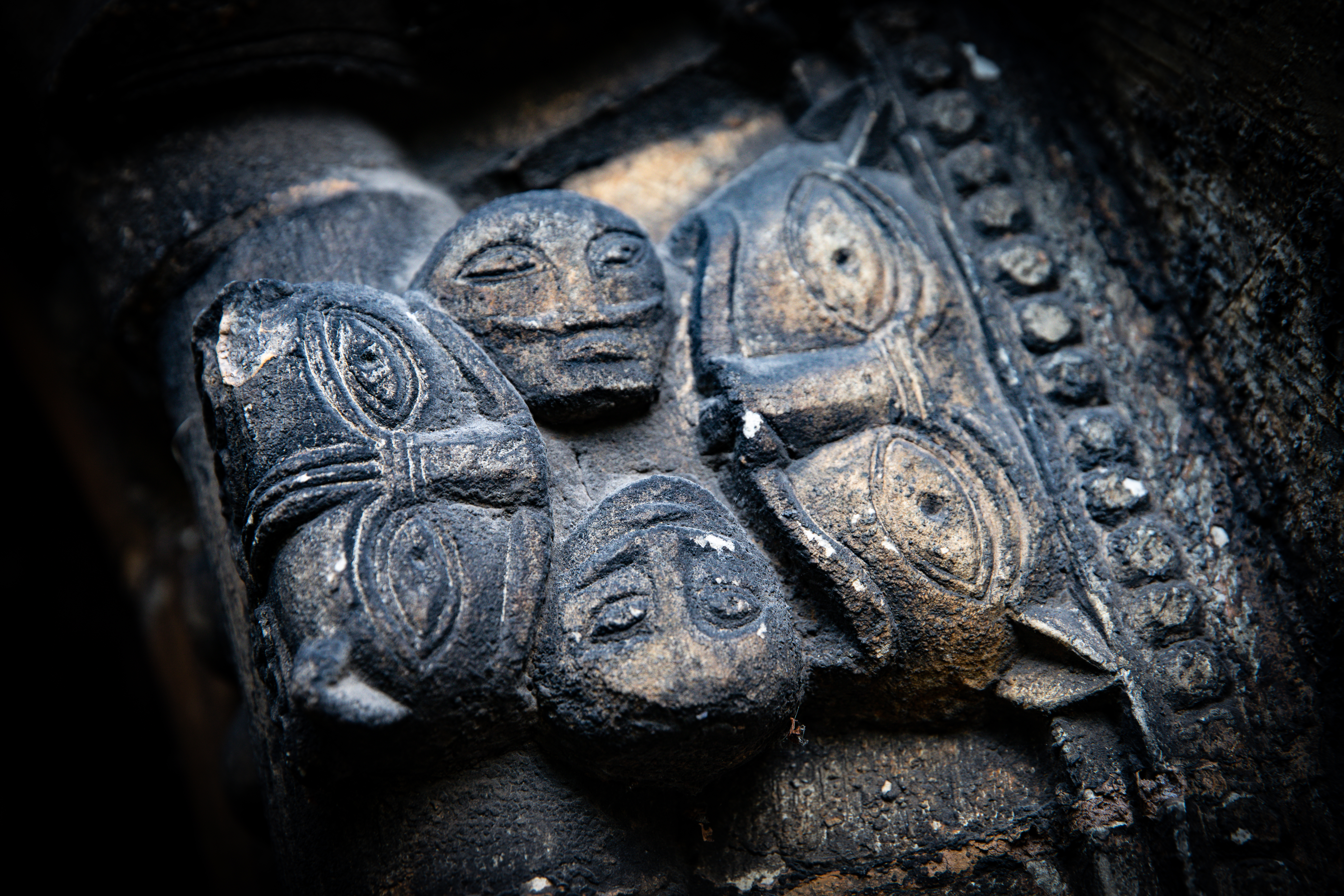
Across the many centuries in which churches have retained their ground and provided the space for worship, much has changed. The chaos of our own time would be familiar to many who have gone before us, and I’m quite sure that it will also be a part of the lives of generations to come. We have the time we’re given, an opportunity for good or ill, and we pass on its risks and opportunities to others. I haven’t entirely given up hope that the lanterns of faith left by former generations might still hold some light for the future, and trust that the prayers said by those lying in their narrow cells were not exclusively for their own salvation, but for the good of the world as a whole.
Language-bearers

In the earliest poem written in Old English, The Dream of the Rood, people are called “language bearers”. It is an intriguing descriptor-name, highlighting one of the unique characteristics of what it means to be human. While watching the new BBC series Human, I was reminded of this defining feature of our distinctiveness. Presenter Ella Al-Shamahi visited a cave in Botswana to make the case that the appearance of the first humans (who share an identity with us) was marked by the development of ritual. Behaviour that implies abstract thoughts and patterns, rendered material through actions that serve no immediate practical benefit.

However, while it may be the evidence of something, ritual must always follow in the wake of something else: the creation of story. Ritual is secondary; stories are primary. As human beings grappled to locate themselves under the stars, and at risk from the vagaries of the weather and nature, stories endow a sense of purpose in survival. We envisage a future, and that future shapes and influences our present actions. Stories also bind us together with those who share the same framework of meaning. It is for this reason that I have long thought of the book Genesis, not so much an account of creation, but as an act of creation. Sharing these particular stories meant you were knit together with the children of Israel, and shared their covenant with God. The story is the fabric that holds the people together and ritual develops out of the narratives to help anchor them within human experience. It may also be true that as stories are embedded in ritual, the act of creativity also shapes the way that the story is told.

At Helleristningene ved Sagelva, in Norway, this is one of two raindeer images ground into the rocks. They are approximately 9,000 years old.

In the way that time is so much greater than we imagine, the script of Humans reminds us that in the entire period that human beings have been around, writing has been present only for the last 1% of our history. It follows that tracing the origins of stories is an impossible task, with the evidence of ritual standing proxy for story’s presence and purpose. Very often we can only speculate about the narratives that lie behind these illustrations, or their purpose once completed. Given the harsh conditions in which early people lived, and the precious nature of resources (including time) needed to survive, the commitment to art and the creation of enduring heritage is surprising. Human being appear to have needed theologies and mythologies that wove experiences into a sense of purpose and blessing.

The poet Eamon Grennan wonders if the cave painters worked in silence, like monks illuminating Medieval manuscripts, or if they kept up a gossip of religious fervour as they created images of wonder in the given contours of rock:

It doesn’t matter: we know
they went with guttering rushlight
into the dark; came to terms
with the given world; must have had
—as their hands moved steadily
by spiderlight—one desire
we’d recognise: they would—before going on   
beyond this border zone, this nowhere   
that is now here—leave something
upright and bright behind them in the dark.

Extract from The Cave Painters by Eamon Grennan

  • The image at the head of this blog is sometimes described as ‘Viking graffiti’ and can be found in Skipwith Church, near York.

Pillow Talk

This title might conjure up the idea of gossip or salacious bedtime conversations. However, it is also the name of a particular kind of peony. In the garden where we live there are several clumps of this variety and in mid-May I am waiting for the copious buds to break into bloom. They are large and richly coloured flowers – pink meringues that dominate the herbaceous borders for a brief time and make for glorious arrangements in the fireplaces. The vitality of summer prefigured in a vase.

Along with the return of swifts to York in the past two weeks, the early signs of summer are gathering apace. The clear skies, longer daylight, and warm sunshine of recent days, add to the sense of the year’s turn. Already we have put out our garden sofa-swing. An extravagant purchase a couple of decades ago, but one that continues to provide enjoyment across the warmer months. Its comfort and gentle rocking often having the desired effect of inducing an afternoon snooze.

This year the English garden sofa-swing is celebrating its centenary, and a contemporary version of the rocker will be exhibited at the RHS Chelsea Flower Show later this week. It is often regarded as an example of English eccentricity – a bit of living room set in the outdoors. While I don’t go back anywhere near as far as the first appearance of this kind of garden furniture, one did feature very early in my childhood. My maternal grandmother was a fan of colour film for slides and I have some of her collection. (Bessie liked taking pictures of buildings that were about to disappear – including the dramatic demolition of mill chimneys in her native Lancashire).

This photograph was taken in 1966. Judging by the blossom behind the swing it may well have been the first May Bank Holiday weekend. The UK enjoyed some early heat in the first couple of days of the month in that year. I am the cheeky chap looking at the camera, slightly blurred by a sudden movement, and my brother is beside me. The company whose sofa-swing will be exhibited at Chelsea asked for customers’ photographs of historic examples to include in the display. Who knows, we might feature!

Part of my affection for the sofa-swing is connected with a childhood often overshadowed by illness. I had debilitating asthma throughout my pre-teen years, often missing school and struggling for breath. Lying on the swing in my grandparents’ garden, shielded from the sun and gently rocking, gave both comfort and relief. It was – and is – very soothing. As I lie on it today, gazing across at the pillow talk and listening to the plaintive call of a wood pigeon, I am reminded of the opening scene in A Portrait of a Lady, and Henry James’s paean to summer in an English garden:

“Real dusk would not arrive for many hours; but the flood of summer light had begun to ebb, the air had grown mellow, the shadows were long upon the smooth, dense turf. They lengthened slowly, however, and the scene expressed that sense of leisure still to come which is perhaps the chief source of one’s enjoyment of such a scene at such an hour. From five o’clock to eight is on certain occasions a little eternity”

Seaside in Winter

This is by far my favourite time of year to be at the coast. Walks with the dog before dawn, watching the clouds change from bruised purple to dazzling gold. Hiking later in the day along headlands and across beaches, with few other walkers about. At night a deep darkness allows the Milky Way to be seen along with the winter constellations. When it is frosty it becomes an altogether magical scene. Only once did I find myself snowed in at a seaside cottage. It is a rare event, especially in a world affected by climate change. Slowly, as the day progressed, each of the three main roads out of Whitby were closed. With nowhere to go it became a good reason to stay in and put another log on the fire.

Oyster Catchers flying in the early morning along the coast at Sandsend

Observed from somewhere warm, the winter seascapes and landscapes offer drama and space for contemplation. This is the time when monarchs in mead-halls would demand that a saga was told. Perhaps a storyteller giving voice to the rich imagery of Sir Gawain and the Green Knight or, earlier still, Beowulf. Stories that reflect the darkness and magic of mid-winter, when the slightest covering of snow transforms the world outside. Perhaps it is hard for us to imagine, in an age of instant entertainment, the majestic scope and spellbinding intricacy of these substantial narratives. Like all knowledge passed down the generations, no doubt a multitude of minor changes occurred over the years which each teller making it their own tale. Eventually, multiple written copies started to keep the narrative in a form that was more stable, and the teller’s individuality became focused on the way of telling.

The sea runs back against itself
With scarcely time for breaking wave
To cannonade a slatey shelf
And thunder under in a cave.

Before the next can fully burst
The headwind, blowing harder still,
Smooths it to what it was at first –
A slowly rolling water-hill.

John Benjamin ‘Winter Seascapes’

Fewer snowy days come in our time – although we are experiencing them in the UK as I write. Generally, winter days are milder, sometimes stormier, which perhaps makes the appearance of ice and snow all the more marvellous. Growing up my mother often said “we don’t get winters like we used to”. I didn’t believe her, thinking this was simply the effect of advancing years reflecting on memories of youth. Of course, she was right. These precious days, if and when they come, may cause disruption and difficulty as people go about their lives – especially for those who are homeless. But maybe they also invite reflection, wonder, and act as a reminder of the world we are all, to some degree, changing.

This Mortal Life

Pitched into the bleakness of winter arrives the season of Advent. In the northern hemisphere the beginning of Advent accompanies the slow march into darkness. Shorter days; longer nights; a steady drop in temperature. The themes of Advent – death; judgement; heaven and hell – match the somber mood of gloomier days. Threaded through topics of great moment, the story of the incarnation is pulled ever nearer. Alongside the readings in church of end-times and apocalypse, every village, town and city displays the brightness of festival lights. The cynical and despairing may shun these illuminations as simply a commercial gimmick; the cold work of retail-marketing to boost sales in a flagging economy. Yet for many of us, somehow, the glimmer of hope these lights celebrate, the baby lying in the crib, can never be given its proper price. There is something here, something to which Advent leads, which can’t be contained by the measure of this world, or our desire to conform everything to our own likeness.

It can often feel, as it does this year, that there is temerity in setting out lights as the nights draw in. How dare we suggest, imply or hint, that something might come to defeat the darkness? It is the ridiculous hope written down by John in the Prologue to his Gospel: “The light shines in the darkness, and the darkness comprehended it not”. Like Handel’s taunting rendition of St Paul’s words asking Death where its sting has gone, the hope that light might eventually overcome personal darkness, and the darkness of our world, feels an outrageous folly. Perhaps this is so because “the bleak midwinter” can feel so tangible, close and all-encompassing. Nordic countries have recently issued booklets to their citizens about surviving war. Sometimes it is so much easier to embrace fear and resignation, than fasten our eyes on something hardly visible; beyond the horizon; too good to be true.

Advent candle-bridges are a tradition in the windows of homes along Minster Yard in York.

Advent is not for everyone. The images of apocalypse and the ending of time are neither comfortable nor reassuring. “Like a thief in the night”. We cannot be permanently vigilant – we need to sleep. The metaphor suggests that the completion of things will come when we are oblivious to its approach. There is no warning or alarm. We will be shaken our of slumber and the myths with which we live will dissolve in the presence of the Divine reality. In another sections of Handel’s Messiah, we are reminded of the “refiner’s fire”. Who may abide the day of his coming?

Advent reminds us that we cannot control the appearance of sudden and defining events. We are always only a heartbeat away from immortality, and our own encounter with what Sterne’s character Tristram Shandy refers to as “this great catastrophe” which will – at some point – overtake us and bring our experience of this world to an end. Of course, following Friday’s vote in the UK parliament, it appears that there will be limited control, for some, about when that moment arrives. However, as one person said during the debates about this issue, it may also give rise to “internal coercion” and perhaps lead people to opt for something which does not reflect their personal wishes about either motivation and timing.

“We are standing upon the edge of a precipice, with nothing but the single thread of human life to hold us up”.

From a Sermon delivered by Laurence Sterne, quoted in A Sterne Lent 2024

Advent is – and should be – disconcerting. Angela Tilby’s excellent reflection in the current issue of The Church Times draws attention to Archbishop Laud’s prayer for the church. It is a succinct and impassioned petition for truth; peace; purity; and reform in the institution. All of these virtues and corrections are needed now almost as much as they were required in the 17th century. Canon Tilby concludes her piece with a simpler prayer which she wrote some years ago, but one which feels as pertinent as ever for 2024:

As light in the darkness,
As hope in our hearts.
Come, Lord Jesus, come.

Angela Tilby, The Church Times 29 November 2024

  • The photograph at the head of this blog features the underside of York Minster’s three metre wide Advent wreath, with the interior of the central tower seen in the centre.

‘Why Her Brethren?’

We are in the season of sanctity. First comes All Saints, followed swiftly by All Souls, as we remember those who have lived and died in years gone by – either people we have known, or people extolled by the Church as exemplars of faith. Of course, like so much else, sainthood is bestowed according to the fashion, politics and preferences of church leaders. For example, there are fewer female than male saints. Even so, not everyone makes the cut, nor should they. Part of the premise of my new Lent Book for 2025 is that sometimes the Church forgets those from whom it still has much to learn.

The 18th century vicar and author Laurence Sterne was not a saint, if by that we mean someone faultless in this life. The trouble with Sterne was not so much that he had faults, but that he was very candid about them. In his letters and books there is bawdy and innuendo; passion and compassion. Sterne is all too human and rejoices in a conviction that God had given him the capacity for joy which it would be a sin to deny. In the brief span allotted for his life (he died aged 54) there is an echo of Andrew Marvell’s reminder to His Coy Mistress that at his back he hears “Time’s wingèd chariot hurrying near”. For Sterne, life is too brief and precious to be lived as if it were “one cold eternal winter”.

When I renewed my interest in Sterne’s work, there were certain features that gave his writing a remarkably contemporary resonance. Corresponding with the black British abolitionist Ignatius Sancho Sterne pulls himself up short when he finds himself writing about the kin of a black character in his novel on:

“behalf of so many of her brethren and sisters, came to me—but why her
brethren?—or yours, Sancho! any more than mine?”

Laurence Sterne, Letters

Why indeed? Sterne has the capacity and honesty to recognise his inherent – thoughtless – separation of people on the basis of ethnicity. The plea for a recognition of our God-given and common humanity runs throughout Sterne’s work. When it comes to gender differences Sterne is equally pointed in describing the ‘logic’ which denies a women authority over her own body or, come to that, even the right in law to be regarded as a blood-relative of her own children. Wit is the tool which Sterne uses to excavate the absurdities of his day, bringing to light the thin veneer of social etiquette that enabled the continuation of ridiculous conventions. At the same time, living at Shandy Hall in rural North Yorkshire, Sterne is enmeshed in the society and behaviours of his day. He knows this and uses humour to escape the passive acquiescence to which most conformed. Little wonder that friends encouraged him to get his preferment before he embarked on satire. Wit that came close to the mark and exposed conventions for what they were, could cost you a mitre.

Section from “A Flap Upon the Heart”; one of two new drawings by Rob Oldfield commissioned for the book.

A Sterne Lent offers the opportunity to keep company for a while with this witty, mirthful, digressive and somewhat doubtful parson. The book is immersed in an age that can feel very different from our own, yet contains themes that speak at times with remarkable contemporaneity. Above all, Sterne offers a lively voice whose strength is uninhibited by the usual constraints of ambition. His daring portrayal of the world he inhabited has the saintliness of a child-like disposition to tell the truth, even when it comes at a material cost. Sterne’s accurate depiction of human society bubbles out from his quill and left an enduring impact on the development of the novel. I hope that this curious and intriguing book will provide readers with a glimpse into another England, yet also one that touches with humour on human traits that persist within both church and society.

Wings of Longing

Recently I was prompted to ponder whether angels have beards. I was visiting St John’s church at Howsham, in the Harton Benefice, north east of York. In the church’s porch is a carving of an angel sporting a beard (below). It was a sight that stimulated thoughts about angels, our tendency to anthropomorphise these heavenly beings, and what our long history says, across many faiths, about angels in the 21st century. As it happens, the appearance of angels has a lot to do with our imagination and how people conceived of beings who can span the divide between the secular and the sacred.

Today, on the Feast of St Michael and All Angels, it might be helpful to recall that many theologians across church history have not viewed angels as corporeal. Instead they have been regarded as expressions of Divine thought and agency; the light of heaven that breaks into the darkness of this world. Of course, in the history of art they are consistently represented as beings akin to people, albeit extra-shiny and with a pair of wings. Their expressions are typically impassive, like good servants they betray neither joy nor sorrow about the news being conveyed. The notable exception to this is the antics of the heavenly host at the Incarnation, joyfully praising God and generally whooping it up.

Thomas Aquinas, the Angelic Doctor, famously wrote of the “Bread of Angels, made the bread of people”. Panis angelicus is a stirring hymn of praise to God for the grace of sharing with humanity food which is the everyday fare of heaven. Consequently, at the Eucharist, angels are always referenced in the liturgy. As bread and wine are taken and consecrated, the material becomes one with the Divine, just as it did when the Word became flesh. This enacts a significant truth of Christianity: that in Christ the world is being redeemed. It is a central tenet of orthodox Christology, expressed in the Athanasian creed, that Jesus was perfectly divine and perfectly human. This was not God and a man sharing a room! The presence and witness of the angels in the liturgy expresses this fulfilment of the secular in the sacred. In the birth, death and resurrection of Christ, humanity is truly “ransomed, healed, restored, forgiven”.

“The beast taken” Revelation 19:20. York Minster Great East Window

Angels are not beings confined to churches and places of worship. The biblical references to them are most often in the secular, encountering people out in the world. Their strangeness and seemingly random appearances inspired the author of the Letter to the Hebrews to remind us that in our reception of others “some have entertained angels unawares”. During a time as poet in residence at Bradford Cathedral, Diane Pacitti published a collection of poems entitled Dark Angelic Mills. In the final entry, ‘Angels in Bradford’, Pacitti reflects that angels come in many guises. Perhaps as ‘kindertransport children, Asian workers, Syrian refugees, Rohingya Muslims’. In her poem, just as each church had its angel in the Book of Revelation, she invokes the spirit of St John to call into being the Cathedral’s angel:

Let it spread
huge-feathered wings over this hut of stone.
Let the song of wonder weave into its prayers
and seep into its silences. Angel-voice,
speaker of demanding truth, send out this church
to affirm the holy in what seems most broken.

Dark Angelic Mills by Diane Pacitti, Norwich, Canterbury Press, 2020.

The Church should always be the place which drives the heart of our participation in God’s mission of love for the world. We are drawn in, revitalised, and expelled back into the pathways that take us to both places of obvious significance, as well as to the peripheral and the neglected. In the ‘hut of stone’ where the church gathers we should encounter again the moment when the secular and the sacred meet: ‘the end of all symbols’ and the place where we are fed with the bread of angels.

A Healthy Grave

Yorkshire seems to have had more than its fair share of notable clergy. My forthcoming Lent book concerns one of these, Laurence Sterne, but another distinguished figure is remembered in York – Sydney Smith. Born just three years after Sterne’s death, Smith became known for his wit, politics, writing, and philosophy. He had a remarkable turn of phrase. For example, when wishing to convey the remoteness of his country parish at Foston-le-Clay, he wrote:

‘My living in Yorkshire was so far out of the way, that it was actually twelve miles from a lemon.’

That probably wasn’t true as Foston was only five miles away from Castle Howard where, I can only assume, lemons and every other kind of produce were in rich supply. However, Smith was no doubt correct that he was living a considerable distance from the nearest place to buy a lemon. At Castle Howard he is remembered and celebrated with a plaque that was installed in 1999 by the Sydney Smith Association.

I am fortunate in living not more than twelve yards from a lemon, and therefore I can only guess at Smith’s experience of rural deprivation. However, for much of his working life Smith knew what it was to have lemons close at hand, and the requirements of rural ministry may have come as something of a shock. Elsewhere he writes: “I have no relish for the country; it is a kind of healthy grave”. He had lived in the metropolis of Edinburgh and was undoubtedly used to a wide choice of comestibles, culture and company (well, as wide as it got in the early 19th century). It was here that Smith was involved in launching the Edinburgh Review in 1802. This was a potent platform for liberal views, and began to call for political reform.

The church at Foston appears to have been neglected for a significant period before Smith arrived. There had been no rector, the duties being devolved to a curate. One of Smith’s first tasks was therefore to plan the construction of a fitting rectory. Illustrating the moribund state of the parish Smith wrote:

“When I began to thump the cushion of my pulpit … as is my wont when I preach, the accumulated dust of hundred and fifty years made such a cloud that for some minutes I lost sight of my congregation.”

Smith’s stature as a witty cleric, inclined to political reform, brought him the prospect of preferment in the Church. There was a time when it was possible he would have become a bishop, but for various reasons this never came to pass. When Lord Grey became prime minister in 1830 he was able, within a year, to advance Smith to a residentiary canonry at St Paul’s Cathedral. However, that was the last preferment which Smith received, and he soon realised that further progression was not in prospect. To the end, Smith retained and exemplified a generous spirit and commitment to a constructive and humane expression of religion.

“I hate the insolence, persecution and Intolerance, which so often pass under the name of religion, and, as you know, have fought against them”.

* The photo heading this blog is of the church at Foston: by Stephen Horncastle, CC BY-SA 2.0, https://commons.wikimedia.org/w/index.php?curid=9290721

Lancashire Low

It’s probably a phrase which means nothing to all but a few people today, but ‘Lancashire Low’ was once a term applied to the character of the worship offered in the churches of that county. I heard it first when speaking with an ‘ACCM selector’. These figures were the driving force of the Church of England’s process for selecting candidates to train for ministry. Having lived all my life in Lancashire this description came as news to me although, intuitively, I recognised what it was describing. Not high up the candle ‘bells and smells’; nor ‘happy clappy’ evangelicalism, but a fairly sober, minimalist and no-frills approach to divine service. During my childhood and adolescence, as the C of E began to experiment with new liturgies, this character was beginning to change. Perhaps most notably, the Eucharist was becoming the most central act of worship, and a variety of vestments were beginning to be used more widely.

“the Lord’s Supper is a sacrament of our redemption by Christ’s death; it is not only a badge or token of our profession, but rather a certain sure witness and effectual sign of grace and God’s goodwill towards us, by which He doth work invisibly in us, and doth not only quicken, but also strengthen and confirm our faith in him”.

Mary Astell (1668-1731)

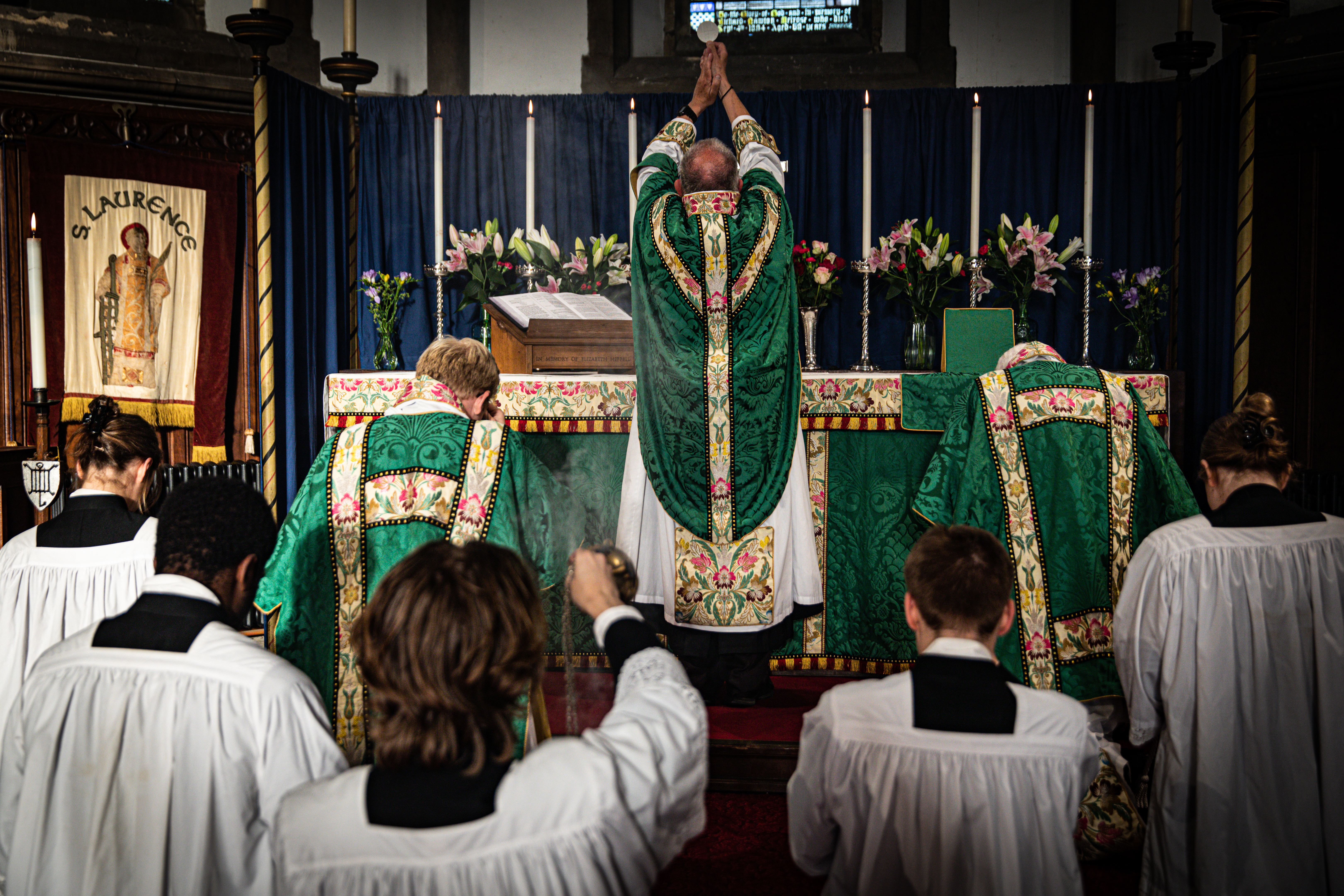
One of the parishes in York which I am supporting on Sundays could not be further removed from ‘Lancashire Low’. The church of St Lawrence, a few yards outside the city wall to the east, was built at the time of Catholic emancipation to offer a High Church, Book of Common Prayer, liturgy for people who might otherwise have been attracted across the Tiber. On Maundy Thursday, when the church is stripped of all adornments, the vestry overflows with the sheer quantity of vestments, candles, hangings etc. etc..

Despite the disparity between the church of my youth and this particular church, there are many interesting features in the character of St Lawrence’s. Firstly, located in an area of significant student accommodation, it counts many 18-30 year olds in its congregation. As is the manner of High Church liturgy, there are lots of ways for these young adults to get involved, for example, in the choir or serving. Perhaps in an age when choice continues to be elevated as the principal virtue, the given nature of the liturgy – its specification and detail – holds a counter-cultural appeal. Also, in a world of words, the presence of fabrics, colour, smells and bells, offers an in-person sensory experience that is welcome and appealing. All too often, when I assist at other churches, there is only the vaguest awareness of a pattern or tradition. “Wear what you like” can be the unhelpful response when I ask about the usual clergy attire for conducting the service. More often than not there are no vestments at the church or, if there are, the sets are incomplete.

Unusually, with an immense amount of hard work by dedicated laity, this church has been transformed from near-closure to become one of the better-attended churches in the city. There has been a sustained commitment to weekly Evensong on Sundays which has established a strong choral reputation and can see attendances reach a hundred. Generous gifts and successful grant applications have put the fabric of the building back into good order. None of this has been easy, not least because many students are only with the church for a few years while some, however, have decided to make York their home and continue to worship and assist at the church.

It is not possible to convey the Gospel, or help people shape and develop their religious life, without contact and engagement. Over many years the church of St Lawrence has done the hard work of building student engagement and outreach. Despite the assumption of many people that a church using the Prayer Book would be destined to failure, the opposite has been true. This is not without risks, as there can be a temptation in any tradition to see what is at hand and miss that to which it points, but you can’t get somewhere unless you start somewhere. In recent years several young men and women have entered on a journey of vocation leading to ordination. This is a church that has an ebb and flow of involvement, but it is unlikely – whatever happens in the future – that people will forget the experience of worship into which they are invited and immersed at a formative stage in their lives.

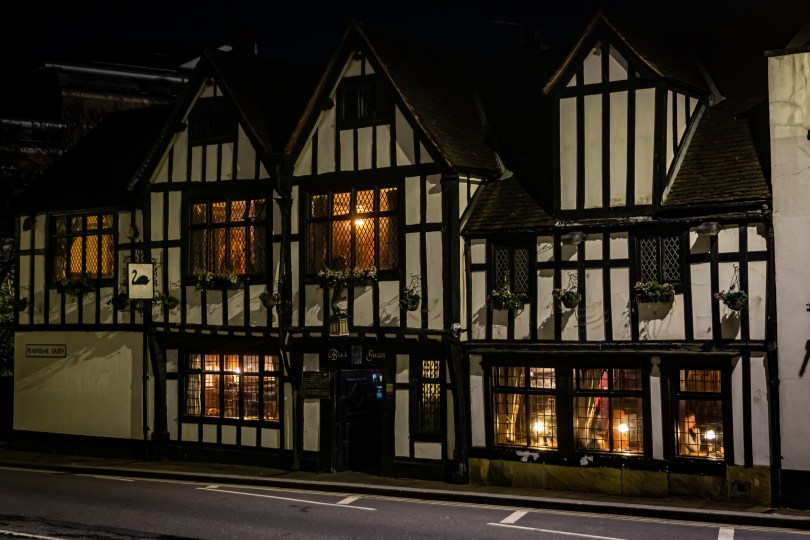
The Last Inn

I once worked with a secretary who was fond of pithy analogies. As we age, she remarked one day, it’s like the old fashioned reel-to-reel recording machines. As it nears the end the depleting spool turns ever faster. Perhaps it’s the effect of familiarity that means some days pass almost unnoticed – we are established in our routines and the lack of new experiences or surprises causes our perception of time to drift. This may be why just a few days away from home may seem to occupy much more time. A new location; new people to meet; unfamiliar experiences to share.

Since August last year I have been working on a project to produce a Lent book. This has developed as a conversation between my own experiences in ministry and the legacies, literary and otherwise, of Laurence Sterne, 18th century parson and author. There are several reasons for this choice, circumstantial and otherwise. The echoes of Sterne haunt the streets of York, from the Minster where he preached, to the nearby building where Tristram Shandy was first printed. The villages just north of the city contained the parsonages where he lived and Bishopthorpe Palace was home to his great grandfather. Much further afield the work of Sterne continues to inspire many different kinds of artistic response. The book for which he is best known, Tristram Shandy, has never been out of print since 1759. Sterne’s ghost is one whose latent power can still turn a coin.

Tristram Shandy was published episodically across many years, coming to an end with volume nine. During the production of the work Sterne’s health deteriorated. He suffered from tuberculosis and often travelled away from a cold and sodden Yorkshire to find a warmer clime. In volume seven he describes one such expedition, going by chaise and spending nights in various taverns. It is this setting that leads Tristram to think about his death (which he had already escaped once). Drawing on earlier writing, Sterne’s character reflects on his place of death, and which location would afford him the most comfort in his final hour.

The conclusion drawn is that an inn would be the best place for “this great catastrophe”. Tristram thinks that the understandable care and concern of friends, mopping his brow and smoothing his pillow, would “crucify my soul”. This thought occurs at an inn within the town of Abbeville where, it would appear, Tristram suddenly realised that choosing which pub might in fact be rather important. He concludes that it could not be the inn at Abbeville, even “if there was not another inn in the universe”. To avoid any possibility that it might be the setting for his last breath, the chapter ends with Tristram demanding that the coach and horses be ready to depart at four o’clock the next morning.

“He [Archbishop Leighton] used often to say, that if he were to choose a place to die in, it should be an inn; it looked like a Pilgrim’s going home, to whom this world was all an inn, and who was weary of the noise and confusion in it.”

Quoted in Bishop Burnet’s History of his own Time (1724)

If the wish that Sterne gave to Tristram was one which the author shared, then it was granted – partially. Sterne died on the 18th March 1768, away from his friends and family, in a boarding house that had become his London lodgings. Journeys constituted a significant part of Sterne’s life, both as a child and an adult, and his ultimate departure came in the city that had granted him fame and a modest fortune. In his last days he struggled even to pen a letter. In his final correspondence, to Anne James, he writes of being “at death’s door this week with pleurisy” and ends by commending her “to that Being who takes under his care the good and kind part of the world”. At 54 Sterne had gifted to the world a remarkable literary legacy and stimulated a debate about his life and thoughts which remains productive because it is still contested. He knew, as did Tristram Shandy, that life is fleeting – and he made the most of the joy that shone fleetingly between the clouds.