Virtually Being There

As I mentioned in my first pandemic blog, the issue of a chaplain’s presence in the context of distress has long seemed important. An embodied participation in events as they unfold is seen as critical to the practice of spiritual care. When God doesn’t appear to answer the deepest desires of human beings – for recovery or healing – the absence of a chaplain might feel like the confirmation of experience. Being there conveys pastoral response; compassion; and witness. This tragedy is not ignored – it has been seen.

During a recent conference on theology and Covid-19, I presented a paper on the topic. It is by no means a finished article, but rather a field report reaching towards theological reflection. The pandemic has provided plenty of good reasons to concentrate on the day job and shelve intellectual enquiry for better times. However, this suggests that theology is a task only for tranquil times and cloistered concentration, and I don’t believe that’s true. Theology needs to be done in difficult places and at difficult times or it risks becoming an irrelevance. Not only data gathering, but some of the thinking needs to be started in the compressed moments of critical times.

The conference reminded me of the existence of ‘trauma theology’ and the inspiring work of Shelly Rambo. Her seminal work, Spirit and Trauma: A Theology of Remaining, offers valuable material for anyone seeking to relate catastrophe and a theology which is engaged with people’s experience. At the moment the world continues to experience the sea-swell of sickness washing over every continent and island, leaving in its wake illness, death and all kinds of fear – from physical vulnerability to a paralysed economy. Rambo’s book takes its point of departure from hurricane Katrina and the devastation of New Orleans by a different kind of natural disaster. As she describes, while the critical time will come and go, the ‘after the storm’ remains. Global events of death and disruption linger long in the lives and memories of those affected, as we continue to see in the various ways by which WWII persists in both personal and public experience.

The impact of Covid-19 is already the subject of active contestation and dispute. Official narratives will be created alongside the stories of individuals who live this experience as a personal encounter with their mortality. As I observed last week, these stories have considerable power and can become something separate from the event itself – a mutating memory with the potential to shape and inform the present, for good or ill.

As a health care chaplain I often said that I tramped the familiar path between Good Friday and Holy Saturday. Usually, the resurrection was a distant possibility and the chaplain’s work oscillated between the moment of death and the experience of absence. Each death a figure swept from the landscape of someone’s life, very often creating the yawning gap of a potent presence. There was no magic which made this ‘alright’ but a painful living with what these defining moments of human existence mean for each of us.

Take courage; the time is near for God to heal you; take courage.

Book of Tobit, chapter 5 v. 10

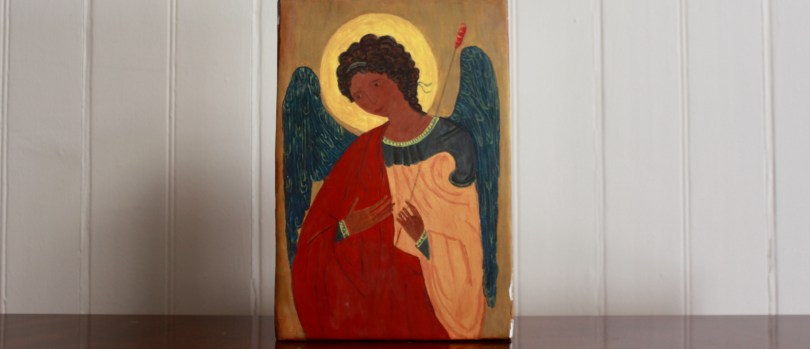
The picture which heads this blog is of the Archangel Raphael, and was painted by a friend who gave it to me during my time as a chaplain in the NHS. These strange figures flit too and fro in the scriptures of the world’s religions, greeting and warning, announcing and healing. Raphael is associated with the latter and can be found, amongst other places, in the Book of Tobit. Here Raphael both announces that a time of healing will come and offers to be a companion and guide on the journey which lies ahead.

In time we shall all live with the ‘after storm’ and wrestle with its consequences. There will be those keen to shake the dust of Covid-19 off their shoes and spring forward into a bright tomorrow. Yet this event will not be dismissed so easily. In health, the economy, psychology and spirituality, the question will not be ‘shall we continue to think about it?’ but rather how that thinking will be done. Faith affirms the persistent promise of hope – there is a greater good to which we move – while offering to stay with us while we make this journey. As in the Bible, angels may appear at first as strangers, but in time those who stay with us and guide us come to be known for the hope which they embody, and the transformation they bring.
Telling Tales

I have never doubted the power of story. As a hospital chaplain it was my privilege to hear countless tales of people’s lives, their hopes and fears. At times I felt I was curating these stories – being handed them like treasured items held close to the heart. So fragile, that mishandling them might cause these heirlooms to break. There was something very sacred about this curating. Being invited in whispered tones to hold this precious fragment; a meeting, a marriage, an illness – stray episodes of significance that only made sense lodged in someone’s long-crafted discourse.

Let us suppose our world is attacked by war, by the horrors that we all of us easily imagine. Let us suppose floods wash through our cities, the seas rise . . . but the storyteller will be there, for it is our imaginations which shape us, keep us, create us – for good and for ill.

Doris Lessing, ‘On not winning the Nobel Prize’, 2007

These key stories were often decades old, and rooted in someone’s sense of identity. The elderly woman, many years after her husband’s death, squeezing my hand as she told me once again about that fateful day when her life changed forever. The compassion of the nurse; the matter of fact tone of the doctor; a relationship which even death could not divide.

We are made up from stories. They are not just the furniture of existence but the walls and roofs of our reality. Sociologists know the power of the tales we develop during illness. As I found in my work on the wards of the NHS, new experiences need to be accommodated in the stories held dear. The person who feels ‘lucky’ that they could sign up for a particular clinical trial. Equally, the person whose stories appear to lie in tatters: a pregnancy ended and a life imagined suddenly gone.

During the Covid-19 crisis all kinds of stories are being created. For many this will be a watershed event, a moment which divides the before and the after, the old world and the new. It goes without saying that we may not like the ‘new’. It could be a time of previously unknown austerity for the world, an era when the taken-for-granted certainties of the West become persistent doubts. I recall living in Argentina in the late 1980s and learning of the frequent experience of people going unpaid for several months. Teachers, breaking up for summer holidays at Christmas, and unsure when the next pay cheque would arrive. Even when it did, it was eroded by inflation – but perhaps that was all part of the plan. The micro-securities of the West are aberrations in historical and global terms. This may be something, unwanted, which we shall have little choice but to learn.

Doris Lessing was right about the power of stories. They can transform the disaster of Dunkirk into a different kind of triumph, and open windows to see the world in new ways. The stories being shared on social media by the Black Lives Matter campaign are digging at the hidden foundations of the privilege on which power has rested for so long. The urgency of these renewed narratives enable people to see that inequality is not the fault of the poor and the oppressed. It is wired into societies and institutions which have chosen to look the other way and long avoided the tough questions about what we choose to celebrate; replicate and elevate.

Our daughter is about to graduate – or would be doing if the ceremony could happen. It reminded me of my graduation from the University of Hull in 1986. Antonia Fraser gave the speech and recalled a time she had been at a State function in Turkey. In a heated exchange about human rights she swore extensively to emphasise her point. The host was shocked at the language – but didn’t appear to be disturbed about the realities of injustice. She cautioned us to focus on the things that matter rather than the distractions of civility. This is one story that has become part of my story.

The last word – a hopeful word – needs to go to Doris Lessing and the conclusion of her tour de force Nobel acceptance speech:

It is our stories that will recreate us, when we are torn, hurt, even destroyed. It is the storyteller, the dream-maker, the myth-maker, that is our phoenix, that represents us at our best, and at our most creative.

Thank God, I have no doubt that they will.

Moral Injury of a Nation

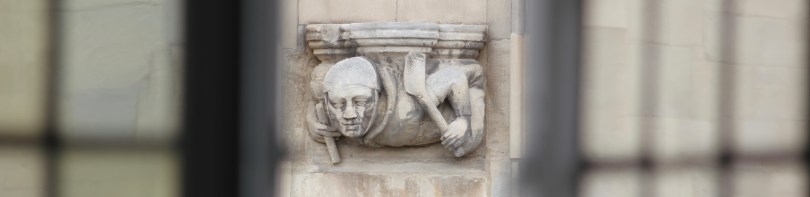
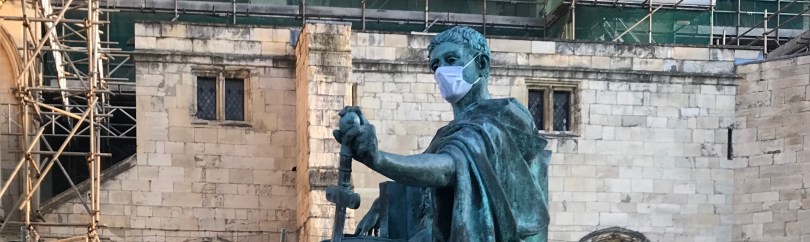
By the South door of York Minster sits a fine statue of the Emperor Constantine. His left hand rests on the pommel of his sword while the right is extended at leisure, hand relaxed. It is here that Constantine was proclaimed Emperor in 306 AD; leader of an empire in his mid-twenties.

Around the time of lockdown Constantine was given a surgical mask. I’ve no idea why, or by whom, but the addition reminded me of how power has been humbled by something so tiny. All the weaponry of the modern world is powerless in the face of this tide of sickness. The Prime Minister’s personal protection officers stood no chance of averting contagion and its consequences. Security gates, alarms and early warning systems, were useless when it came to Covid-19. While spending billions on sophisticated defences a virus has stolen into our lives and wreaked havoc. Tens of thousands dead; personal freedoms curtailed; economies heading into sharp decline with astonishing speed.

Even as we attempt to negotiate an exit from lockdown our capacity to return to anything like normality is in serious question. The threat of a second wave hovers over us and the NHS is on standby, prepared for its impact. We are both heaving a sigh of relief that the worst seems to be past, while feeling apprehensive about the consequences of more people being closer together.

Hidden in the worries about wellbeing and economic survival there is the risk of collective Moral Injury. This is a state of suffering distinct from PTSD and burnout, which reflects the implications of actions – or a lack of actions – in particular situations. Moral Injury as a distinct term is not yet twenty years old but offers a new way of understanding the impacts of behaviours which leave a deep sense of moral consequence. While initially developed in the context of military personnel it is a concept already recognised for its relevance in frontline health services. However, whatever moral pressures health systems were under before Covid-19, these have been magnified by the current crisis. As a fuller picture emerges, heath professionals are beginning to wonder what unintended consequences have followed a policy to send patients back into residential settings. This post-event dawning realisation is the stuff of Moral Injury.

Moral Injury is an evolving framework for the understanding of critical situations and their consequences for individuals. However, in the light of Covid-19 it is reasonable to ask whether this individual experience might take on a collective expression. If as a society we are shown to have given older people such limited priority in our planning and provision, what lasting consequences will there be for our national character? As I argued in a previous blog, there is a real question – when compared with other nations – as to whether the UK allowed a form of social amputation. James Childs, writing in March 2019, suggested that Moral Injury could have a kind of corporate manifestation:

When actions of government violate the ideals of our communal spirit, we as individual citizens, though not guilty, are nonetheless responsible for allowing our government to do such things and, therefore, share in that guilt as a community.

Childs, J., 2019. Can a nation suffer moral injury?. Dialog, 58(1), pp.3-6.

There is a long way to go before we emerge on the other side of the acute crisis caused by Covid-19. Perhaps the lesson we need to draw from Moral Injury is the need to allow space for the possibility of corporate responsibility in the memorial events which will take place. To acknowledge that even when the last person infected with Covid-19 has emerged from isolation, there will be questions we must live with for a very long time to come. The tempting short-term option is to sweep it all under the carpet (‘what else could we have done?’) rather than address real questions of responsibility with openness and mutual compassion. The emerging evidence of Moral Injury requires us to consider the longterm emotional cost of our response to the virus and act now to mitigate its damaging aftermath. After all, a future which aspires to achieve wellbeing for all can never be built on a buried past.

Only Connect

Only Connect: Worship and Liturgy from the Perspective of Pastoral Care, is a book by Robin Green published by DLT in 1987. It argues for the importance of liturgy connecting with the experiences of people, rather than simply meeting the preferences of the person leading liturgy. I read it while serving as a curate in Lancashire in the early 1990s and its persuasive argument helped shape my ministry. Many years afterwards I came across an early observation of how service content can fail to engage with lived experience. Charles Dickens, visiting a workhouse on a Sunday, attended the chapel service and listened to the sermon:

The service was decorously performed, though the sermon might have been much better adapted to the comprehension and to the circumstances of the hearers.

A Walk in the Workhouse, Charles Dickens

Although connecting faith and life is the task of every Christian, a minister is often seen as holding a particular and public responsibility for this work. When bereaved parents asked ‘why?’ they saw me as being in some way responsible for explanation. For reconciling this loving God with the wrenching pain of parting which, of course, cannot be done.

The experience of bearing the symbolism of myth in daily life is rarely a comfortable reality. It was often with eagerness that patients in a mental health hospital would seek conversation as soon as I was on the ward. Perhaps for those struggling to establish a coherent world the idea of a link with God offered some hope for reconciling contradiction. Yet, as was so often the case, words were a poor offering for the kind of answers that were being sought. Silence was probably nearer the mark. Not infrequently I wondered whether the experiences of patients arose from the accuracy, rather than the error, of their perception. As Jeanette Winterson observed: ‘To be ill adjusted to a deranged world is not a breakdown’.

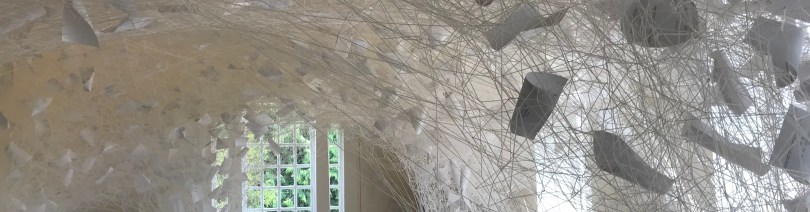
The installation and performance artist Chiharu Shiota created a work of art in the 18th century former chapel in the Yorkshire Sculpture Park. The picture at the heading of this blog comes from a visit I made to the installation in 2018. In the void of the building these seemingly infinite connections and crossings are peppered with stray sheets taken from hymn books. The work appears to introduce thin memories into the space, evoking the notes and words of well known lyrics such as ‘We plough the fields and scatter’. A spell of time-travel woven by this careful crafting of line, word and melody. The faithful witness of generations in this rural corner of Yorkshire appeared caught; fragile yet stilled. It as as though the winds of time have been frozen for a moment and the memories fixed and held.

As I reflect on the role of the chaplain I have often mused about the nature of site and connection. In a hospital I was asked with regularity ‘where’s your church?’ A minister is automatically connected with a place of worship and the community it serves. Next year will mark the 50th anniversary of the publication of one of the first empirical studies of chaplaincy in the UK – Michael Wilson’s The Hospital a Place of Truth. The project which led to the publication arose from the need to provide a chapel in a new hospital. The fact that the chapel’s construction was linked so strongly to the role of the chaplain says a lot. It seems hard to avoid the conclusion that for many people sacred space is connected to what is seen to be a sacred person. If this affinity is real, then a chaplain on a ward represents a skein of connection spanning holy places; family history; future hopes (and fears) as well as the defining moments of life, whose recollection is proffered so quickly in pastoral encounters. Perhaps, in the threads of the chaplain’s presence, we catch both the stray pages of the past as well as the thin notes that sound the future.

In understanding the chaplain’s role we need to pay more attention to these dynamics of presence. While much work is being done to establish the metrics for outcomes of spiritual care we should not ignore the significance of the chaplain’s identity. Just as the identity of a doctor or nurse shapes the character of interactions on the ward, so the nature of the chaplain also provides the context for a particular kind of discussion and disclosure. However, unlike many others working in a hospital or care home, the chaplain may mark the intersection of widely divergent narrative threads. As a religious building evokes particular thoughts and reflections, so the links of sacred space spill over into the perceived identity of the chaplain. In order to understand the value of spiritual care provided by a chaplain these issues of identity should not be ignored. Without them a crucial dimension of what the chaplain offers could be lost – and we may fail to ensure that what chaplains provide is adapted to the comprehension and circumstances of the hearers.

Did we opt for amputation?

As we consider the range of responses to Covid-19 around the globe it is clear that some strategies are being more successful than others. Nations such as Germany and New Zealand are having experiences of Covid-19 which differ markedly from countries elsewhere. In the UK the approach appears to have shifted during the course of the pandemic. The mortality figures are now disturbingly high. One commentator refers to epidemiologists’ concept of ‘harvesting‘, and wonders if this was the de facto public health policy for the UK. He goes on to suggest that if we need a lens through which to understand Covid-19 there is an obvious candidate:

Today, if you need a lens to examine any country’s response to coronavirus, look to its nursing homes. 

‘Harvesting’ is a terrible word – but it’s what has happened in Britain’s care homes | Richard Coker

Nursing homes already offer a dispiriting insight into this particular harvest. As Covid-19 sweeps the world it leaves in its wake a catalogue of devastated care facilities. In February multiple deaths linked to the virus were taking place at Kirkland, Washington State. By March there were reports of abandoned care homes in Spain and the discovery of deceased residents found in their beds. In Italy the death toll in homes was astonishing and, in at least one case, is now the subject of a police investigation.

Examining the UK’s early response to events David J Hunter writes about the way British attitudes may have influenced decisions. Hunter recounts a senior academic’s response when they heard suggestions that the UK was talking seriously about herd immunity. The only way the academic could make sense of the idea was by assuming “that this proposal was meant as satire“. There is every indication that Britain was being prepared to accept a major loss of life, with the statement from the medical director of the NHS that anything under 20,000 deaths would be a good result. At the time of writing the UK is approaching a point where it will report 40,000 deaths and estimates of the true figure put this north of 50K.

There is every reason to believe that the UK government was prepared to accept a major loss of life and to see this is a tragic but necessary reality of Covid-19. New Zealand is reporting 21 deaths with a population about 1/13 that of the UK. If the UK had the same rate of loss we would now be recording about 273 deaths. The difference is monumental and, in time, we may understand more about why this has happened. Of course there are many variable factors which may affect the rate of deaths, ranging from social structures to physical environment. However, it is likely that in time we’ll arrive at a comprehensive and robust analysis of all the factors involved and which were the best, and worst, national strategies to adopt. At the moment we already know that there is a major loss of life among older people, and people at particular risk include those who are BAME; living with dementia and/or disability; and people who survive on very limited economic means.

In the light of this I wonder whether ‘harvesting’ is the right term, or if ‘amputation’ is a better description?

Field ready for harvest near Little Gidding

While harvesting implies a general and equal cut, amputation removes a part of the body in an attempt, very often, to save the whole. It is sacrificed. The emerging data and evidence suggests that sections of some communities in the UK are being surrendered as a necessary cost for the country. At the top of the list are people of advanced age with complex health needs. The people most likely to be in a place of residential care.

As a nation the UK chose a confusing path with the Prime Minster suggesting there was a balance to strike between ‘taking it on the chin’ and more extreme restrictions on personal life. The Government did not use comprehensive testing in homes for a considerable time, even though it was obvious that this is where there were people with the greatest vulnerability. Compared with the NHS most residential homes support people who cannot co-operate well with restrictions. As I know from personal experience, purposeful walking by residents is hard to manage. The situation of nursing homes in several countries offered evidence which the government should have heeded and acted upon. However, we must consider the possibility that the NHS – rightly encouraged to be concerned about its capacity – effectively seeded Covid-19 positive patients in care home communities. If this proves to be even partially true, there will need to be a period of national soul-searching followed by a commitment to comprehensive, dynamic and enduring reform in the relationship of health and social care. Reform that doesn’t just regard social care as an expendable limb of the body politic, but as an essential part of what makes up the services that ensure we are a compassionate and just society.

Manna in the Wilderness

Before Covid-19 became the topic of daily news I was not taking church services. To be more precise, I had not presided at Holy Communion since mid-October 2019. As Maggie’s appointment meant a move to York I needed to go through the process of applying for ‘Permission to Officiate” or PTO. The granting of PTO allows a priest in the Church of England, who isn’t licensed to a particular church, to assist in services for the diocese. Thankfully, before the lockdown began, I gained PTO and started helping on Sunday services in February. At the beginning of March I was able to lead a retreat for lay leaders – Readers – which concluded with a service of Holy Communion on 8th March.

I am not a priest whose custom is to have daily communion. When I trained at Westcott House I joined the silent reflection before Morning Prayer, but hardly ever stayed for the communion service which followed. Maybe it was the ‘Lancashire low’ of my childhood, but the importance of Holy Communion was expressed more in its rarity than its frequency. This is not to pass judgement on the different approaches people take to this sacrament. While I was at Westcott I spent four months in Switzerland studying at the Ecumenical Institute at Bossey, where representatives from approximately 20 different Christian denominations studied together. During that time I came to appreciate many different eucharistic practices, which all expressed in their different ways a common sense of significance.

In my pre-Covid experience the lack of opportunity to celebrate Holy Communion began to make me feel restless; uneasy. It was becoming a wilderness. While I haven’t been a parish priest since 1997, the opportunity to lead Communion services was always there, either helping out in a local church or at the bedside in the NHS. When I started work as a chaplain at Leeds Teaching Hospitals in 2001 I didn’t feel settled in until I took a communion service for the first time with colleagues. In all the other things I did across the hospitals of the Trust, I feel at some level they were all linked back to those moments when I would stand beside bread and wine and announce that this was broken, and given, for people. Having the realisation of a wounded body at the heart of the Eucharist spoke volumes for me in the hospital. Here was fracture; loss; wounding; and exposure – offered not as despair, but rather as a future hope we can taste today.

Since leading my last church service on 15 March I have preached, but not presided, in Zoom services. Today that changed as I conducted a service via internet for Holy Trinity Micklegate. There was a small ‘virtual’ congregation on the call, and in so many ways it felt a very limited and inadequate experience. Disembodied voices sing, not always in tune, nor in unison, and rarely in time with the music. Verbal responses become a small chamber of echoes. It is easier when a single voice leads a reading or offers the prayers, yet I wouldn’t wish to silence the other voices which carry the faith of their owners.

As I read the Eucharistic Prayer I felt very moved. It hit home that I wouldn’t be pressing bread into anyone’s hand, or placing a sign of blessing on those not receiving. It felt wrong to keep the physical part of this celebration to myself. I miss the hands, always so different and bearing the marks of life, which get held out in desire and anticipation. The people who look me in the eye as they say their ‘amen’, and those whose gaze is downward, hardly daring to look at this moment of God-fed intimacy.

It will return. Holy Communion will be shared again. For now, perhaps sorrow is not a bad feeling for those who long to share once more in broken bread and a common cup. Yet how much worse it would be, and how telling of our faith, if this strange time occasioned no sense of loss. These meals that model a new way of being, with felon and gaoler side-by-side (yes, I’ve broken bread in prison). This banquet that promises a very different kind of power and community is not wholly or only about those present. It is about the world re-made. Perhaps, when it returns, we shall see this more clearly.

In his faithful interweaving of daily life and the Eucharist, Geoffrey Howard’s Dare to Break Bread is perhaps a fitting reading for these days. His chapter entitled ‘Real Presence’ ends with this:

Where Jesus is present and how he is present in this Eucharist, is still a mystery to me. But, that he is present is beyond doubt. Only Jesus of Nazareth could gather together round one table such beautiful and diverse people. The Lord is here and his presence is with us.

Howard, G. Dare to Break Bread: Eucharist in Desert and City DLT, London 1992 p., 53

In the era of Zoom-communion I have even less idea about this mystery, but take comfort in the knowledge that God continually surpasses our meagre expectations.

Using the Time Aright

One of the most remarkable episodes of my work as a chaplain began innocuously enough. As I was working in the office at a hospital in the north of England a volunteer walked through the door and wanted to discuss something. She went on to tell me that during her visiting she met a patient reading the Bible. Although rare, this was not unknown, and I wondered what had made this encounter so striking. “He was reading the Bible”, she told me; “in Greek”.

Patients reading a Bible in Greek were certainly very unusual (especially if they weren’t Greek!) What unfolded was an astonishing story about a minor episode in history of which I was unaware. Not only was the Bible in Greek but, when I visited, I found it carried an approval stamp featuring an eagle with outstretched wings. It transpired that the patient had been a prisoner in Germany during the Second World War. As the camp was for allied officers, it contained a number of captured chaplains. As they reflected on their forced confinement, the chaplains decided that they shared enough knowledge to deliver a course in theological studies, which might prepare men for ordination after the war. So the chaplains asked the troops if anyone thought they might have a calling to ministry and, if so, whether they’d like to sign up for study.

It seems quite amazing that these resourceful chaplains, without the aid of a theological library, managed to provide a comprehensive training programme. Some items were sent to the camp and approved for use, and there I was in the late 1990s, looking on this much loved and well-worn Greek New Testament. The officers even sat ‘General Ordination Examinations’ posted to them from London – while somewhere in the distance American bombers could be heard delivering their payload. Today is vocations Sunday, and my past experience reminds us of the strange circumstances in which a calling can come.

This encounter has remained with me as a powerful reminder that choices can still be made even when the circumstances of life seem very limited. People have a remarkable capacity to be creative; to think beyond the immediate challenges of life, and to see a way forward although things are very tough.

As we continue to live with the many consequences of the pandemic, we see each day the way in which people are using this moment for great creativity. At the same time, there are people finding this experience both overwhelming and soul-destroying. As we plot our way through the current crisis we need to enable people to use time well, while recognising and supporting those who struggle. As we learn more every day about the disparities of impact for different sections of society, our greatest resolve should be to ensure we come through this experience together; more united; and more strongly committed to limit the evils of inequality.

At the end of this week we’ll be marking VE Day. The unimaginable impact and consequences of war changed many societies, including our own. Not least it ushered in the National Health Service, whose continued operation has been so vital for combatting the impact of Covid-19. War could only be fought effectively if it was a co-ordinated national effort – and in the creation of the NHS, the lessons of war were applied for the purposes of peace. Our national response to the virus is reminding us that only concerted action can deliver positive outcomes to our greatest difficulties. Maybe it’s time once again to seize the good that can come out of turbulent times, and pursue a resolve to become a society that won’t tolerate anyone being left behind.

“When thou shalt look us out of pain”

During 20 years of chaplaincy in the NHS I faced all kinds of questions which might be grouped under the simple, short, yet daunting word: ‘why?’

It wasn’t only a question for people who might have seen themselves as religious. When I was present with families in traumatic circumstances there were often non-religious people among them. It seems that there is a basic assumption in life that there should be some reward for virtue, or at least a balance between the rain and sunshine. The suffering of the innocent, especially children, resists any attempt to attach constructive meaning. Occasionally a family member would venture something along the lines of ‘perhaps it’s for the best’, but when this happened it was often met with silence and muted rejection.

Time and again I was aware that in life-changing situations, when words were wholly inadequate to the experience of loss, the role of the chaplain was not orientated towards a solution. There was no good outcome, and in this context spiritual care was far more to do with helping shoulder pain than in any attempt to make things better. In my ethnographic writing about the experience of being a chaplain, offering compassionate presence in small spaces of great suffering, the simple fact of being there, bearing a particular group of associations, appear to be core components of the role.

There was more to this than pastoral empathy, valuable as that can be for people in distress. I was conscious at times that I was bringing the outside in. Even while being a member of staff, the religious identity I carried spoke of the wider community. When meeting a chaplain for the first time perhaps the most frequently asked question is: ‘where is your church?’, or mosque, synagogue or gurdwara. People of faith are linked to places of faith and the connection flows to and fro. In an institutional setting this can mean that the chaplain has a particular role in bearing the symbolism of community; connections to the past and the future; and a broad association with shared beliefs, culture, heritage and identity.

Yet there is a further dimension to this role – that of witness. The longer I worked in institutional settings the more aware I became that seeing what takes place, and holding that in the perspective of prayer and ritual, was part of what was expected. People cared that their experience, perhaps taking place at the dead of night in a large city, was not happening in seclusion. In their presence, words and actions, chaplains are personifying elements of the faith they profess. As I wrestled with this experience – and still wrestle – there is something in it about the God who doesn’t look away. I am not there to promote a God who can be bargained with in order to grant our wishes. The very least I can do is to behold this suffering, to touch and bless a life which is ending, and share the sorrow of the grieving whose lives are changing irrevocably. In the current circumstances of Covid-19 this can be experienced as a deprivation for both those in spiritual need and the chaplain tasked to provide it.

This element of pastoral ministry, the chaplain’s gaze, occurred to me again recently while reading Mark Oakley’s reflections on the poems of George Herbert. In The Glance, Herbert writes of a time when God “shalt look us out of pain”. It seems an odd notion, but I know from experience that looking has its own quality, and that in the silent relationship of beholding, much can be transacted. Following Herbert, this might be seen as a foretaste of a time when clarity of perception between God and humanity will dissolve the hurts and pains we all carry.

Maybe, in the request to witness those moments, and to be present with loved ones as they say farewell, there is a sign that this kind of seeing, and being seen, truly matters. That when we sense God’s presence with us, beholding our pain, there is hope that in the end this suffering will be lifted from us. It doesn’t diminish the experience we are passing through, with all its calamity, but it offers an unspoken hope that suffering is not – and never is – the last thing we see.

A Vow of Conversation

Recently I learned of the death of Tom Thompson.  Tom was the Lancashire vicar who provided my training during a 3 year curacy in the early 1990s.  I owe a lot to Tom and his seemingly inexhaustible patience when it came to shaping the ministry of the newly ordained.  Faithful, wise and unflagging, Tom kept a sense of perspective which fuelled his resilience and meant his beliefs were always grounded in the lives of the people he was called to serve.  As Anglican clergy we were both familiar with ‘physical distancing’, even before it became a sad consequence of Covid-19.  However, when I returned from London after taking part in the demonstration for women’s ordination on the day the Church of England voted for change, he greeted me with an instant and heartfelt hug.

There was a lot of laughter in the three years we worked together.  Tom was involved with various projects and responsibilities in the Diocese of Blackburn.  Blackburn was not seen as one of the most progressive dioceses in the Church, which had the advantage that church-going was still widespread and consistent.  It meant that our figures for church attendance were somewhat out of step with the wider church.  I’ll never forget Tom returning to the parish from Blackburn when some new data had been revealed.  At the meeting one of his colleagues had responded to the news with the excited exclamation: “At last, we’re catching up with the decline!”  Only in Blackburn…

While I was in the parish the local amateur dramatic society, based in the church hall, was resurrected.  It led to a host of pantos and plays, the kind of institution which acts as a place occupied by both church and non-churchgoing people.  It enabled the church to extend its pastoral ministry beyond the congregation and also, in time, see some people join the church family.  Perhaps the most ambitious production during that time was ‘Murder in the Cathedral’ by TS Eliot.  Tom took the part of Thomas Becket, with the play running for some eleven performances after Easter.  It was a demanding schedule but Tom put his heart and soul into it and found reward in the combined theology and poetry of the piece.  I was one of the tempters and recall the line I delivered to Becket: ‘the easy man lives to eat the best dinners’.  Tom was calm and persistent – not the clubbable type that used to do so well in the Church of England.  His best dinners were always with friends and family, not the suppers that nudged towards preferment.

As the Bishop of Norwich wrote in his obituary about him in The Church Times, it was Tom’s custom to give his curates a book when they were priested – usually a year into their curacy.  I shall never forget the moment Tom handed me this gift.  It was a book by the 20th century Catholic monk Thomas Merton, entitled ‘A Vow of Conversation’.  As I received it Tom said simply: ‘it’s what priesthood’s all about’.  In the 28 years that have followed I have learned the wisdom of his reflection as my understanding of what it means to be a priest has been widened and deepened by a host of conversations – with those close to me; with people confronting some of the most demanding experiences of life; and in prayer with God.

As I remember Tom and give thanks for his faith and ministry I look forward to the day when we can renew our conversation once again.  May he rest in peace.

“Those who trust in him will understand truth,
and the faithful will abide with him in love,
because grace and mercy are upon his elect,
and he watches over his holy ones.”


Acquainted with Grief

Handel’s Messiah was performed for the first time on April 13th 1742.  Easter Day was towards the end of March and the premier of the new oratorio fell within the 40 days of Easter celebrations.  Its majesty and scope take the listener from the words of the prophets, to the incarnation and on to resurrection.  Hearing the work again this year the words that stood out for me came in the text of the prophet Isaiah chapter 53 verse 3:

a man of sorrows, and acquainted with grief

Grief seems an apt emotion in the continuing turmoil of Covid-19.  It is grief at the loss of human life; the devastating impact on economic activities; dramatic social change and physical isolation; the severe restriction on cultural life and sporting events.  The world has been put on pause.  For the moment, we have come to grief.

At this most peculiar Easter, churches cannot even offer the consolation of people gathered together to say familiar words or sing joyful music of celebration.  Much will be done on-line and not in our usual places of worship.  For some even the theme of Easter Day may jar.  The suffering and isolation of Good Friday echoes our experience, as does the absence and silence of Holy Saturday.  Resurrection hope may seen a remote expectation for many.  The greeting between Jesus and Mary in the garden, a wishful reunion of the dead with the grieving; the lost with the living.

The biblical accounts of Good Friday describe events that shake our taken-for-granted certainties.  For the bystanders, soldiers and scattered disciples, the experience of the young rabbi’s death disturbs every complacent truth.  The solid earth moves; the daylight is darkened; the dead do not rest at peace in their tombs.  Profound grief, the loss of someone through whose eyes we saw and made sense of life, can shake and break and darken every point of reference that gives us our sense of place and purpose.  As one person said to me about her partner: ‘he was the landscape in which I lived’.

Many times I have stood or knelt beside those whose mourning is forever tied to a day when others are celebrating.  The times I have been in a delivery suite or neonatal unit on Christmas Day.  The conversation with a woman one Good Friday when her terminal diagnosis had re-framed the world and she found herself in that strange land between knowing an event is coming and the time of its arrival.  Grieving suddenly for all those moments of which she would never be a part – mourning the impending loss of what it means to be alive.  This Easter, perhaps more so than in previous years, many people will be reminded of the confluence of a special day and the experience of loss.

We can never move from Good Friday to Easter Day at a prescribed pace.  Telling the tidings of resurrection when people are still living with the pain of crucifixion or the absence of a loved one is worse than folly.  These journeys are made at their own speed, and for some it may never arrive in their lifetime.  For them it lies on the other side of mortality when ‘death thy endless mercies seal, and make the sacrifice complete’.

Easter is celebrated because of the one who was ‘acquainted with grief’.  It is marked by those who place their faith in a good shepherd who was killed without good reason.  A faith which should have remained shut up in the garden tomb; sealed and guarded against any possibility it would ever again see the light of day.  Yet I am sitting here, writing this, a disciple of a faith that was destined to die two thousand years ago.  Still believing that there is more to life than what we see; following in faith and doubt a path trodden by countless people before me.  Not perfect souls – people acquainted and damaged by grief – who dare to hope that when we least expect it,  we are greeted by a moment of resurrection.

At dawn the women made their way,
with spice and sweet perfume,
to where their Lord and Saviour lay
enshrouded in the tomb.
But, wonder and amazing grace
to those whose hearts were grieved –
they saw their Saviour face to face,
and with their love believed.

Mary Louise Bringle