Sternly Spoken

At some point during my BA studies at the University of Hull I encountered The Life and Opinions of Tristram Shandy, Gentleman. I was taking a degree in English Literature and Theology, and Sterne’s renowned work cropped up in a course on Augustan Literature. It felt a disorderly work compared with other writing from the period, but its many digressions are also its captivating quality. Like a fairground roller coaster, there are hairpin bends in this fictional tour de force. Little did I imagine that a few decades later I would be living quite so close to the places Sterne would have known during his life. Near to York Minster there was Sterne’s publisher. His uncle and patron Jaques Sterne was precentor in the Minster as well as Archdeacon of Cleveland. This morning I led the service at Priory Church of Holy Trinity Micklegate, where one of the characters thought to have been lampooned in his work is buried. Dr John Burton’s pioneering work in obstetrics appears to have inspired the figure of the ‘man-midwife’, Dr Slop.
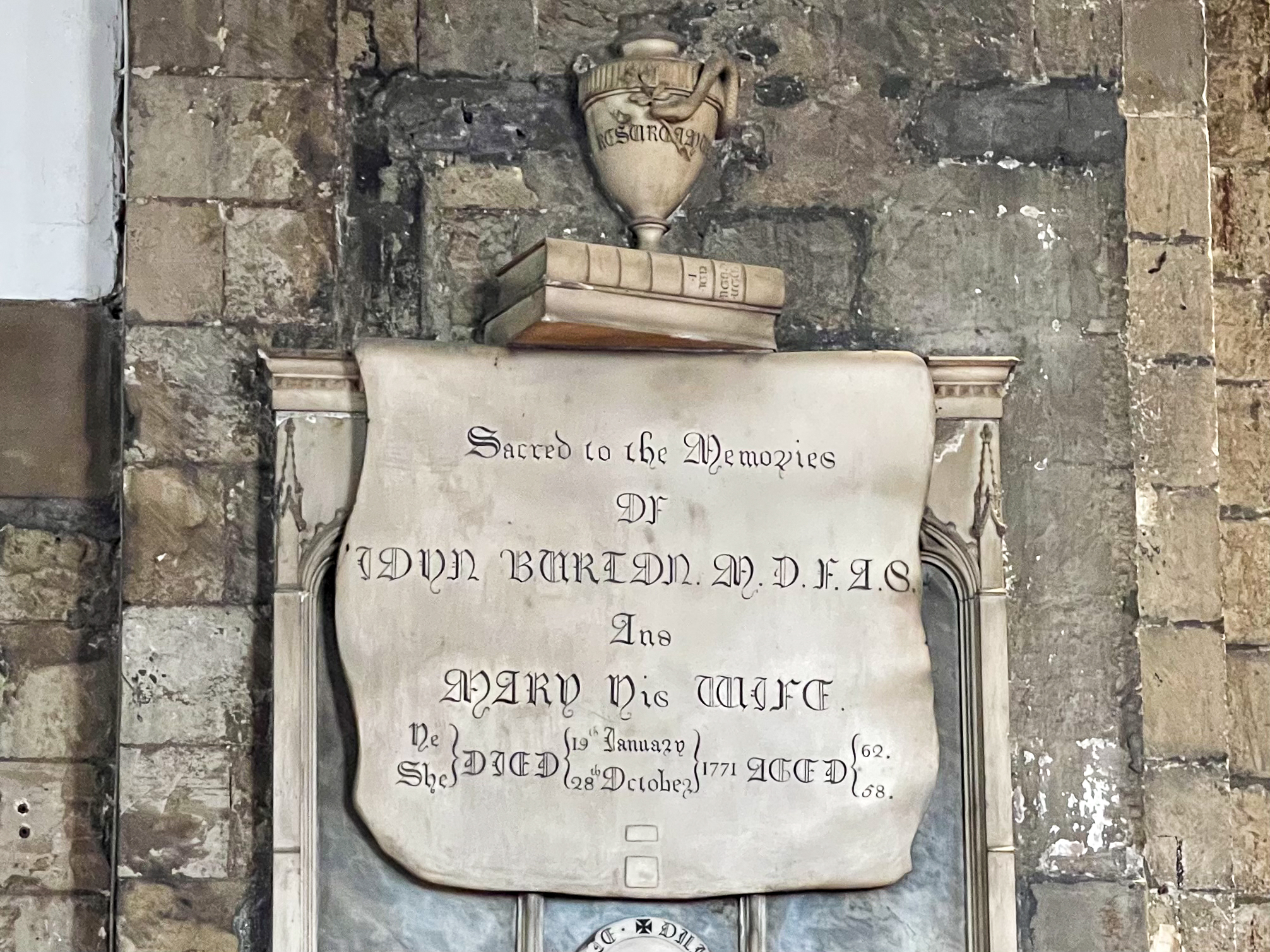
It may well be that Sterne attacked Dr Burton in this way due to the religious politics of the time. Burton was a Jacobite and Catholic sympathiser, something that landed him in goal at the instigation of the Precentor. Sterne was ordained by the time he wrote Shandy and it says something about the times that a cleric could publish something so candid about the realities of life and human follies. The novel came in at number 6 in a Guardian list of the best one hundred novels.

“Digressions, incontestably, are the sunshine;—they are the life, the soul of reading;—take them out of this book for instance,—you might as well take the book along with them;” 

The Life and Times of Tristram Shandy, Gentleman

For all the playful style of Tristram Shandy there is political weight in its portrayal of 18th century life. It is a book designed to wield influence, and in its hints and winks it would have tantalised people across a breadth of classes and situations. In an edition of In Our Time dedicated to the book, it was pointed out that the fictional writings of Sterne were seen as a way to increase the sale of his printed sermons, rather than the sermons advertising the novel. It reminds us how very different times were in Georgian England and how significant preaching was considered in this era.

While there is a lot to criticise about the way religion and politics has mixed in the past, there is also scope for concern about a church that walks away from politics. After all, politics is about the way we live – what governance permits or outlaws. It can no more be something the church should avoid than the preaching of the Gospel. The idea that Jesus wasn’t a political figure is ludicrous – in his clashes with the authorities, and teaching about the operation of institutions such as the Temple, he was entirely political.,

It has felt in recent years that the Church has had a vanishing presence in the political arena. Declining attendances combined with a focus on personal salvation have chipped away at the place the C of E once occupied. This is not the Church of Faith in the City, nor do parish clergy have the time they once enjoyed to participate extensively in civic life. Of course there’s a very good argument that laity ought to be doing this in any event, as the people of faith embedded in the community. However, the perspective of a person set aside to focus on spiritual concerns – with the experience of living and working in several communities – has a value that is unique.

Instead of providing strength, solace, inspiration, and communion, churches are decidedly human institutions comprised of the eccentric, the stupid, and the venal. 

The failure of organized religion in Laurence Sterne’s Tristram Shandy by David Dobbie Tull, 1991

The recently launched Archbishops’ Commissions may be a hopeful sign that the Church wishes to speak in the public square. Given the goings-on in British politics lately, surely there is a need for a moral voice (and possibly lampooning)? What took place concerning the scrutiny of MPs suggests a political leadership that is shameless of its self-interest, only responding when its fawning supporters in the media announce that things have gone too far. Today Sterne would have ample material for a new novel, without the need for very much invention. Despite all its constraints and interested parties, the Church is called to speak from its experience, beliefs and commitment – and sometimes that speech must be stern in making clear the yawning gap between the ideals of public service, and the shameless pursuit of personal interest.

Older Age: A Time of Truth

The title for this blog echoes a publication celebrating its 50th anniversary this year. In 1971 Michael Wilson’s The Hospital – A Place of Truth was published by the ‘University of Birmingham Institute for the Study of Worship and Religious Architecture’. The snappy title of the Institute does little justice to the work it sent to print. Wilson’s study is the first thorough, academic and professional enquiry into the role of the hospital chaplain. It took place between 1967 and 1971, and is well-written, with a scope that is broad and deep. Inevitably couched in the culture of its time (and a national church which didn’t enable women to be ordained), there is a wealth of valuable insight and evidence in its 385 pages. For example, we learn that the first Muslim chaplain had been appointed the year before publication. This landmark research remains a seminal example of an approach which is still relevant to chaplaincy today. In particular, Wilson asked all constituencies in the hospital and local community about what they found important concerning the presence of a chaplain. If you wish to know more about the publication James Woodward’s “The relevance of Michael Wilson’s chaplaincy research for healthcare chaplaincy today” is well worth reading.

In the 1960s institutions had very clear boundaries. In many cases staff lived on the site of the hospital. Today those boundaries are more porous and there is a constant but incomplete drive to make health care about a pathway rather than a place. For example, it has long seemed inequitable and undesirable that the experience of end of life care should depend so much on location. The contrast of final days spent on a busy general medical ward and those spent in a hospice bedroom, could not be starker. Despite all the efforts of skilled and committed staff, we are still working to make palliative care equally excellent in all settings.

Nevertheless, I would argue that place in now relatively less important when it comes to care than it was in the 1960s. While still significant settings, hospitals are not the kind of ‘total institutions’ once described by Erving Goffman. When considering older age I’m inclined to focus more on the experience than on the location. Whether in homes or places or care, many characterises of ageing remain the same.

Nearly a year ago I reflected on the conundrum of how institutions embedded in almost every community seem to be politically invisible. Despite the fact that most scientists and politicians have visited these communities, or have relatives living in them, it appears that we choose not to think about the realities of their complex operation. In March 2020 wild and wholly irresponsible assumptions were made about the safety of care homes in a pandemic. In September 2021 the supposed solution to the funding of social care almost entirely misperceives the needs of these vital care settings.

“Staff are dealing with their own ageing whilst also observing the ageing of their patients and the reaction to this of the relatives. None of this is particularly easy and spiritual practices seemed to help staff manage these complexities”

Mowat, Harriet. “Gerontological chaplaincy: the spiritual needs of older people and staff who work with them.” Health and Social Care Chaplaincy (2013): 27-31.

Ageing confronts us with truths about ourselves, and about our neighbours. These truths are not always easy to contemplate. It can feel in contemporary British society that we side with Shakespeare’s characterisation of our final years: ‘second childishness and mere oblivion’. Yet this is to allow our fears to avert our gaze before we can take the time to understand ageing and its effects with greater insight. It is the time of truth in as much the mastery of self, and in particular the suppression of desires, may give way as our cognitive capacities change. While relatives may often say their relation is ‘different’, sometimes that transformation reflects a clearer sense of identity and personality. Unsurprisingly we may fear this kind of truth for ourselves as well. A controlled temper may lose its restraint as the years progress. The truth is not always easy or comfortable. Yet ageing may equally well diminish a sense of fear and trepidation. There has been more than one centenarian sky-diver.

Last week I was reminded in one of the reading options for Morning Prayer that ageing can be seen in a number of ways. There is not, and never has been, only one interpretation of getting older.

“For old age is not honoured for length of time, or measured by number of years; but understanding is grey hair for anyone, and a blameless life is ripe old age”

Wisdom 4:7

It feels that in the UK Government’s settlement for social care an opportunity has been missed to learn the truths of the experiences of older people. The focus has been on finances and asset-preservation, rather than the understanding and retention of wisdom. The elderly are a political problem to manage, not a wealth of personality, love and experience to value. Somehow we need to achieve a breakthrough in how we relate to older people in our society. The cloak of invisibility needs to be removed so that we can see ageing as an important time of truth for us all – and not just for others.

Law and Disorder

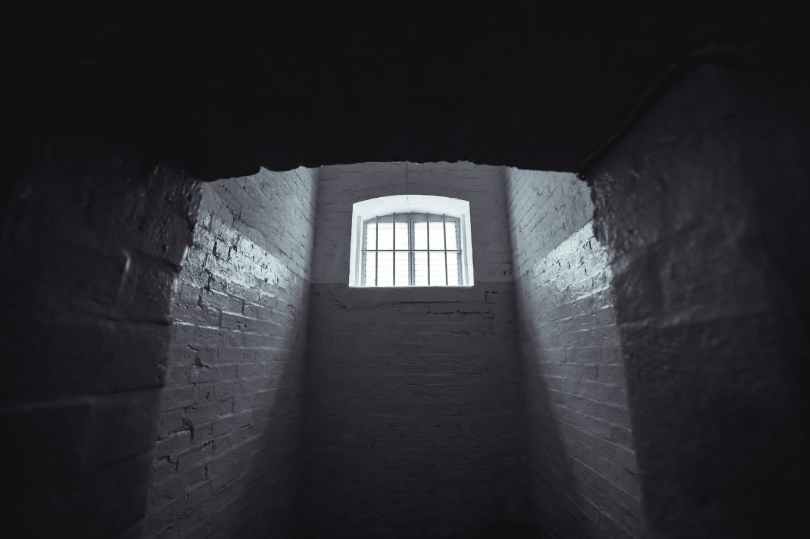
In the early days of my ministry I attended a prison. I had an interest in this that went back to the days when my mother worked as a secretary in a minimum security ‘open prison’, and facilitated a meeting for me with the chaplain. In turn that led a Sunday spent in the old Strangeways, with the remarkable Noel Proctor, and then to a visit to a prison where I was at university in Hull. I have no idea why I felt called to explore this, but it brought me into contact with a world often hidden from public view. Recently, much of the character of this concealed incarceration was portrayed with insight and skill by Jimmy McGovern in the outstanding BBC mini-series, Time. It has stimulated a much needed debate about the day-to-day reality of the criminal justice system.

“McGovern could be criticised for the sheer number of shocking scenes his protagonist witnesses and suffers. But there is nothing in the show that I have not seen first-hand during my time inside”.

“‘There’s nothing here I did not see inside’ – a former HMP inmate on Time” by Eric Allison in The Guardian 18 June 2021

These earlier experiences eventually led to a small role helping out the chaplaincy team close to where I served as a curate. Looking back I have no doubt that I was very innocent in my understanding of life behind bars. I was keen to make connections between this world and the local community and arranged two Sunday visits by our very large confirmation class. The prison Governor was happy to facilitate this on what was a reasonably quiet day of the week. Seeing some of the scenes in Time reminded me of these 11 and 12 year olds sitting in the chapel with many prisoners. The confirmation candidates experienced ‘church’ in a very different setting from the leafy suburbs nearby, and met people who had grown up in very different circumstances. I have no idea what lasting effect it may have had upon them.

The most striking part of McGovern’s drama was the realistic portrayal of corruption. It was not (and is not) a one-sided story. The drama portrays the small nudges and influences that push people further and further towards the edge of their usual behaviour.

“But ’tis strange: And oftentimes, to win us to our harm, the instruments of darkness tell us truths, win us with honest trifles, to betray’s in deepest consequence.”


Macbeth, Shakespeare Act I, Scene 3, lines 124-28

There are still many conversations and situations which took place during my brief chaplaincy that have shaped and informed my ministry. Seeing a Deputy Governor and a life-sentence prisoner side-by-side with hands outstretched, sharing Communion together. A prisoner feeling aggrieved about some injustice in the prison system, who started to tell me his tale but then decided: ‘but you haven’t got the power to sort it’ – and promptly walked away. A young man who had made a dreadful mistake and was determined to start afresh. The carol service which was both strange and deeply moving.

There is a chaplain in McGovern’s drama. It’s never easy to portray spiritual support in largely secular times but Time manages to achieve a sense of authenticity and purpose. So many things are beyond the chaplain’s power to resolve, but what can be done is very moving. It felt as though ‘Miss’ knew what she was about, nether colluding nor despairing, but walking a narrow corridor of integrity in a culture where violence was only ever a heartbeat away. A way of being that brought to mind the writings of Ety Hilesum.

“I know that those who hate have good reason to do so. But why should we always have to choose the cheapest and easiest way? It has been brought home forcibly to me here how every atom of hatred added to the world makes it an even more inhospitable place.”

Etty Hillesum, An Interrupted Life: The Diaries, 1941-1943; and Letters from Westerbork

Changing the dynamics that foster corruption and violence will never be easy. We need a spirituality that has no illusion about this reality but, like Hillesum, is equally if not more determined to resist the temptation to be less than we are. Thankfully, McGovern’s drama is not without realistic hope. At the outset it seems to lie only in the small frame of the chaplain, surrounded by forceful men on every side. She remains faithful to her task, even when help is rejected. As the storylines progress others find their own moment of resistance, often at cost, and discover a way through to somewhere that offers the possibility of redemption. To portray this in a realistic way is not easy – evil always seems more credible – but it is accomplished in this drama. Which is an important reminder that wholly giving way to despair is perhaps the greatest betrayal of all.

Loss and Love

Around this time of year I like to read Sir Gawain and the Green Knight. Either read, or listen to Simon Armitage recounting his own translation of the tale. It is a magical story of an imagined past, where the Christmas and New Year festivities are celebrated in the bitter cold of a Medieval winter. Full of detail and drama, the story is heard at its best while sitting beside a roaring fire on late afternoon during the first days of January.

“And wonder, dread and war
have lingered in that land
where loss and love in turn
have held the upper hand.”

Armitage, S. (2008). Sir Gawain and the Green Knight (A New Verse Translation). WW Norton & Company.

Fortunes change. Tragically, loss appears to have held the upper hand for much of 2020. Not only in the UK, but around the world, a tsunami of illness has broken on our shores and borne many away. It has been a year of mortality significantly above and beyond the pattern of recent decades. As we remember the people who have died it is also important to recognise the frightening illness many have experienced, with breathlessness and anxiety that this is ‘the end’. Doctors are only now starting to understand the many consequences of illness and the reality of long covid. We know that a legacy of mental illness will follow the events of 2020, whether linked to physical suffering or arising from that myriad of losses both great and small. Employment, education, key life events, holidays, income, and the company of family and friends. It seems endless.

At various points in the year we have been reminded this this will pass. That humanity will recover from this seismic stumble and continue to progress towards greater longevity, health and wealth. However, as we also know, this was at best a partial narrative. Plenty of places in the world were already suffering through lack of resources, access to clean water, education and food. In the UK we learned recently that UNICEF will be feeding children here for the first time in 70 years. Wealth inequalities continue to widen and there is some indication that sections of society in countries with the greatest inequality have been the most vulnerable to COVID-19.

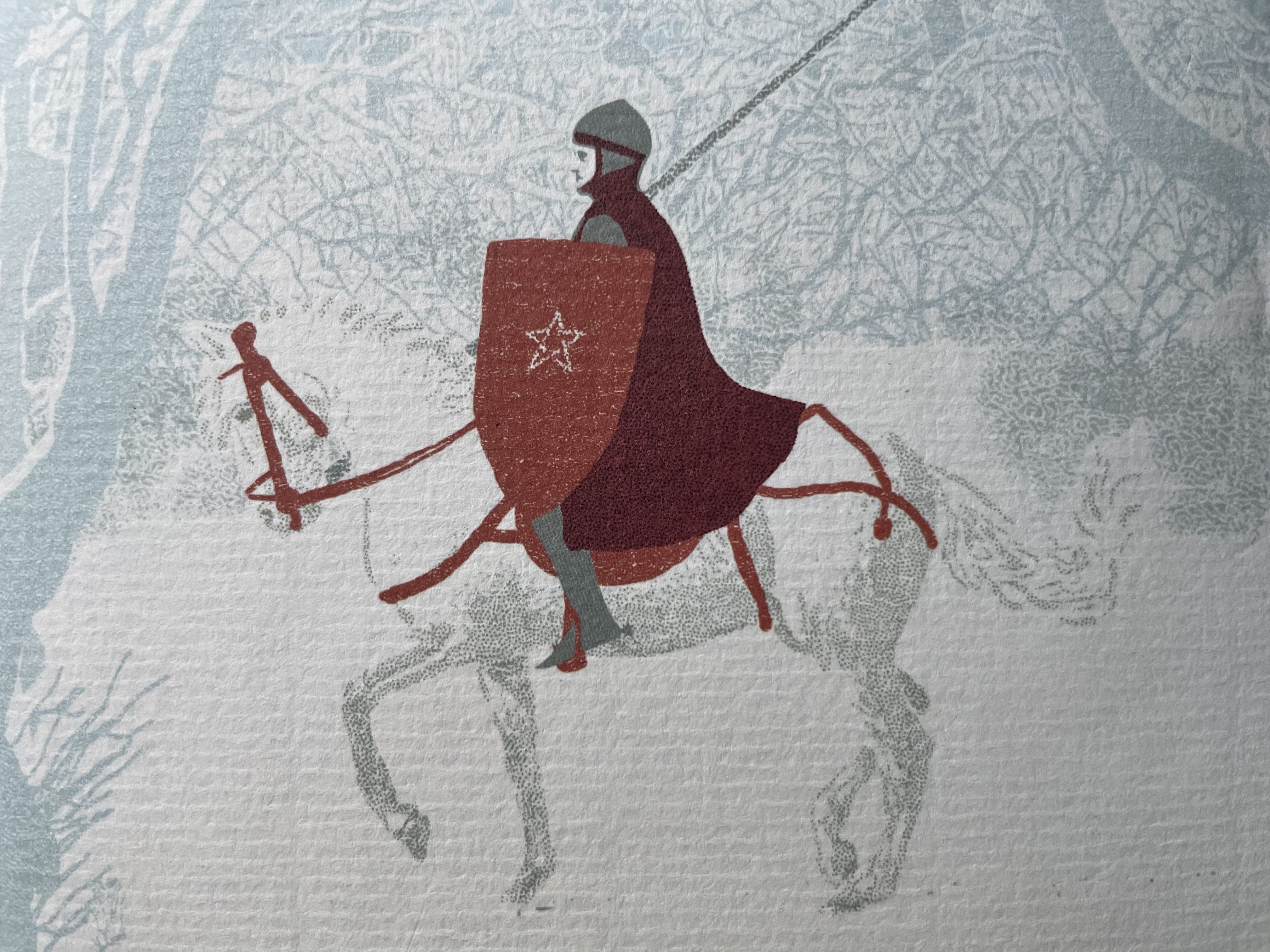
Cover illustration for Armitage’s Sir Gawain by Bevis Martin

We must do better. While the frost and freeze of a Medieval landscape may be enjoyable by a fireside, it cannot be the reality for people unable to keep warm for want of basic necessities. As the UK departs fully from the European Union, with many of the leaders of change seeking greater flexibility and entrepreneurialism, its cost cannot be carried by the poorest in our society. Success in this new venture must be measured by a change in fortune for the vulnerable in our communities, not only the privileged.

It is to be hoped that 2021 will not bring as much unexpected damage as its predecessor. The path ahead is still uncertain, which makes it all the more important to do whatever we can to help love have the upper hand in our personal and collective actions. This may seem a fanciful and unrealistic vision, but it can have real edge and ambition when we strive to implement its qualities. William Temple knew that loving your neighbour could not be a government policy but he believed that when love was expressed in any kind of social organisation it was experienced as justice. The emerging analysis of COVID-19 shows that wealthy societies denying many citizens a share in resources are both unjust and damaging – for everyone.

The author of Sir Gawain was no doubt an entertainer of an antique time. Yet even poets who please a crowd sew truth with the yarn they are telling. In this case it was the risks and rewards of chivalry and courtly love. Just before Christmas I was given a more contemporary poetic offering in Diane Pacitti’s 2020 title Dark Angelic Mills. It is beautifully written and delightfully northern. As we begin to digest an extraordinarily difficult year, and to build some of our experiences into 2021, we need poets to help us see more clearly the realities and opportunities of our time. In her poem A Prayer of St Hilda, Pacitti concludes as follows:

Transform each barrier wall into the tall
Support of a broad tent, a spacious hall;
Saint of wise love, it is to you we call;
Help us to build a sheltering home for all.

Diane Pacitti Dark Angelic Mills (2020) Canterbury Press

The Past; Present

‘Old age should be a crime’. Many times over the years I heard older people in hospital struggle with the implications of ageing. The oft given advice – ‘don’t get old’ – caused mixed feelings due to the implications of the alternative! However, especially when it came to illness and any loss of independence, people found the change hard.

At the same time, I have been involved in some remarkable conversations over the years. During pastoral encounters I have met the bravest; wisest; loving and insightful people. The elderly GP in hospital whose words after receiving Communion were simply this: ‘thank you; it brings me life’. The spirited woman of profound faith, now in a hospice, who was waiting with a patient faith to be called to begin the next stage of her life. The concentration camp survivor who railed against today’s politicians for failing to learn the lessons of the horrors she had witnessed.

Sometimes, my conversations with older people reminded me of the different worlds encompassed in a single lifetime. In the early 1990s, I met an elderly man with a vivid childhood memory of being lifted on his father’s shoulders in order to see Queen Victoria. In 2020 it seems extraordinary to have experienced this living link to a time that seems so remote.

At a recent funeral it was lovely to hear older mourners speak about their childhoods shared with the deceased. The husband says: ‘we used to meet in the local libraries and picture houses’. His wife responds quickly – ‘well you might have gone to the picture houses, but we couldn’t afford’. Memories of childhoods in Scotland in the 1930s and 40s told of the strength of local communities and the value of neighbourhoods. It was a different world.

Wedding, 1957

In the past century life expectancy has increased. Just as people in the West have grown used to a longer life, the pace of change has accelerated. As I meet people aged north of 90 I’m mindful of the different social and technological worlds they have known.

Today it was announced that Britain’s oldest person has died – aged 112. It is almost impossible to imagine the scale of change across such a long span of life. Born just a few years after the first powered aircraft flight, the century that followed brought both mass destruction and huge advances in technology, medicine and communication.

While the alteration in material circumstances might seem the most notable development, less conspicuous changes have perhaps left the greatest impression. Something of this is captured in TS Eliot’s Four Quartets, where the poet reflects on the experience of time in earlier eras:

Keeping time,

Keeping the rhythm of their dancing

As in their living in the living seasons

The time of the seasons and their constellations

The time of milking and the time of harvest

The time of the coupling of man and woman

And that of beast. Feet rising and falling.

Eating and drinking. Dung and death.


Eliot, T. S. (2014). East coker (p. 29). Faber & Faber.
Chicago

For Thomas Pfau this “contrast with modern time – abstract, linear, endlessly sub-dividing, and bereft of any transcendent dimension – is palpable”. While a bucolic reflection on an imagined past is open to the charge of nostalgia, the recognition that our experience of time has changed has merit. A whole industry exists to manage time. Time in work; time at leisure; and time in transit. We are all encouraged to worry about whether we are making the most of it.

Perhaps things are changing a little. Enforced restrictions on travel are leading many to think about time in a different way. Nature, in the form of Covid-19, is questioning our sense of control. At the same time, the consequences of modern life are putting the ecology of our habitat in extraordinary danger. In 2020 the threats to human life are both sudden, rapid and unexpected – and simultaneously slow, foreseeable and existentially dangerous. Maybe it is time we recognised the truth that our environment, in its widest sense, requires greater respect. That we need to stop rushing onwards and listen with more attention to those who have known a different time, and a different way to live with the landscape on which we all depend.

“But ask the animals, and they will teach you; the birds of the air, and they will tell you; ask the plants of the earth, and they will teach you; and the fish of the sea will declare to you. Who among all these does not know that the hand of the Lord has done this?”

Job 12: 7-10

A Time to Sing

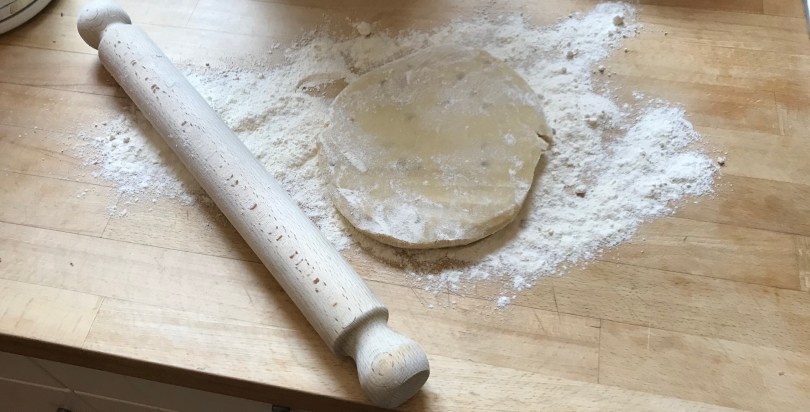
It is Sunday afternoon, on a rather cold Bank Holiday weekend. As I do from time-to-time, I combine baking with Radio 3’s broadcast of choral evensong. Both the listening and the production of shortbread are the kind of absorption that brings its own peace. It is not something I do routinely, but connects me with many moments across fifty years. A grandmother whose hands I can only ever remember as flour-dusted; the familiarity of a liturgy smoothed by the centuries; and a time of day that feels uniquely spacious.

The absence of live choral music, or any kind of group singing, has been striking in 2020. Sunday mornings do not feel the same without the hymns that bind a congregation and choir in a unity of intent. Words which should be sung feel flat if simply spoken.

In care homes singing has always been a powerful source of animation, bringing alive people who may have seemed lost in their own thoughts. At Methodist Homes (MHA) there is the added benefit of Music Therapists, combining the skills of musicians with the insights of psychology. A growing body of research underscores the value of music as a therapy which can be used effectively in the care of people living with dementia. The qualities of music to restore our senses and focus the mind go back at least as far as David’s playing of the harp for Saul (1 Samuel 16:23).

Perhaps this absence of singing will engender a new respect for something we too often take for granted. Music is for all seasons, and in our mourning and rejoicing it has a vital part to play. On Friday 4 September at 10:45 MHA will be holding a national memorial for everyone who has died during Covid-19. There will be a two-minute silence across all of MHA’s homes and schemes at 11 am. Sadly, the world will continue to lose people to the virus, but it feels right to pause at this point and recall those whose life on earth has ended. The online service contains pieces by our Music Therapists, and without them it would lack impact and the embodiment of our feelings.

Whether we are mourning or dancing, music lends any occasion a distinct dimension of expression and meaning. Without giving explanation, it can tell a powerful story. As we continue to journey through the days of Covid-19 we are in uncharted territory. The challenge is to find how we can sing the Lord’s song when the act of singing itself is the subject of concern. The absence of congregational singing removes one of our chief consolations at the moment we need it most. As choirs return I hope that we discover a new respect for the difference singing makes, and how music mingles with our souls.

Transgression

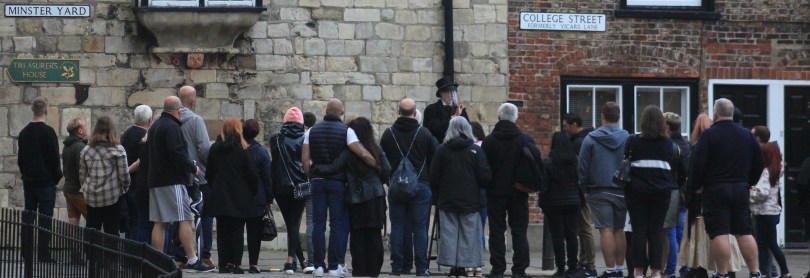
Since Covid-19 restrictions eased York’s ghost tours appear to be more popular than ever. On most days it’s possible to see as many as three separate groups, all well attended, dotted round the Minster. Maybe it’s a consequence of other places of entertainment being closed, combined with recent warm weather, but it’s a niche part of the economy that appears to be thriving.

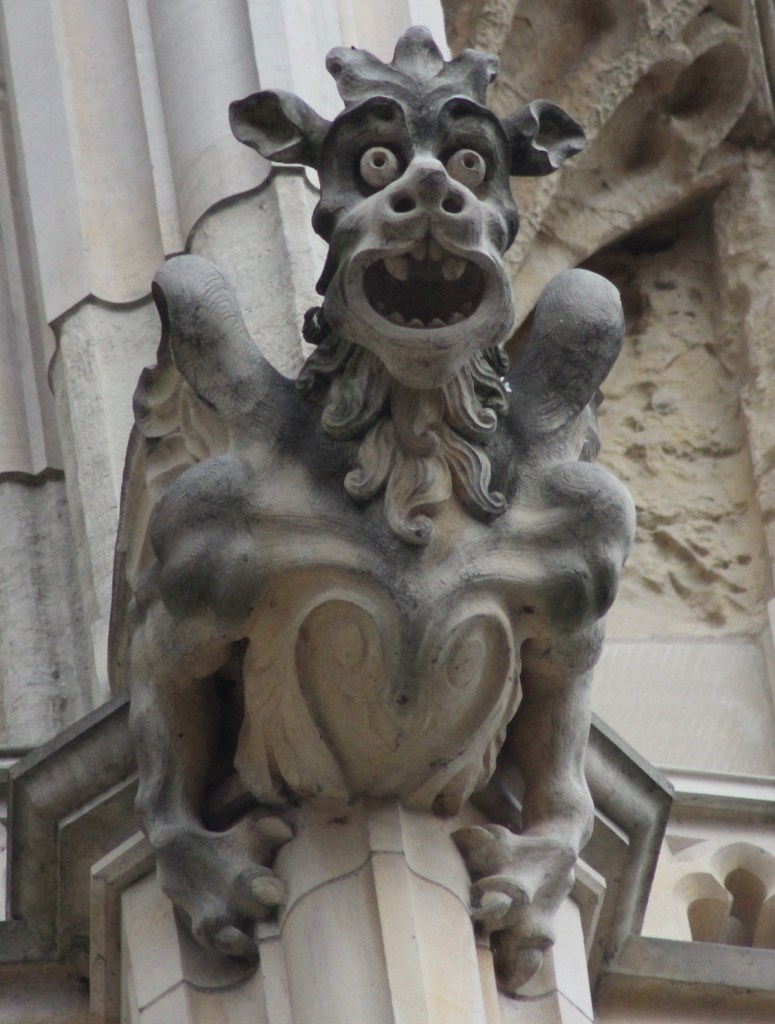
It’s understandable why York Minster is such a good location for these nightly escapades. The sheer scale of the building lets it sit in the city centre with benign indifference. It is as old and cumbersome as a dragon. There are numerous details around the area which suggest a sense of history and the supernatural. Over a decade ago gas lighting was returned to the surrounding streets, lending a hint of Victorian melancholy. The high walls of the Minster are peppered with grotesques which glower down on the tiny figures bustling around its base. These contorted statues leap out at right-angles from columns and towers, daring lesser spirits to meddle with the sacred space they guard. To all intents and purposes they are ecclesiastical scarecrows, protecting the territory as its custodians sleep.

As you can tell, even writing about it makes me come over a bit Gothic! Into this context the leaders of the ghost tours weave their stories. At dusk the stories are told about the girl who died in the Plague House; the marching Roman soldiers who could only be seen from their knees up; and much, much more. By gas light, and down cobbled streets, the past is conjured into life.

This can all be very entertaining. Yet I wonder if there is a little more to the pull of these invitations to the supernatural? Some years ago I was involved in research into the experiences of people who bereaved due to traumatic loss. Following the interviews I was struck by how many people either had a visceral experience of the deceased, or attended places (such as the Spiritualist Church) where this possibility would be envisaged or even encouraged. The study concluded:

people are reluctant to share their experiences of post-death encounters with health professionals because they fear that they will be diagnosed with mental illness or ridiculed.

Chapple, A., Swift, C., & Ziebland, S. (2011). The role of spirituality and religion for those bereaved due to a traumatic death. Mortality16(1), 1-19.

It was striking that on a visit to somewhere badly affected by Covid-19 one of the first things I was shown was a photograph. In this recent picture of a living person it was said that the image of a person who died from the virus could be seen. In the aftermath of World War One, sightings of the lost were a regular occurrence and shared in the newspapers. When mortality exceeds our expectations we experience things that can seem both comforting and disturbing.

Perhaps when there are few avenues to acknowledge experiences which don’t fit, people find their own alternatives. When the world we anticipate and take for granted is transgressed, it helps to be in a context where we can at least consider other possibilities. As the virus continues to take away so much, we may need new frameworks to articulate and understand our experiences. I’m not suggesting taking a ghost tour (although they can be fun) but churches could do more to give permission for people to speak about things which other contexts implicitly silence.

Like a Thunderbolt

Once, writing a Passion Play for a church, the only text I felt happy with was the opening line: ‘I can tell you nothing about anything from the time before telling’. The words came out of reflection on the Gospel of John and the opening words of the Bible. It struck me that Genesis is not so much an account of creation, as an act of creation. When people took to their hearts a shared narrative of their beginning, they ceased to be individuals and became a community bound by a story. Even as the words were spoken, shared and ingested, the shape of a nation was being fashioned. Genesis may not be the account of creation so much as an active (and ongoing) process of creation and renewal.

I’ve written previously about the power of stories to mediate our understanding of the world in which we live. In particular, the way a story can help us make sense of calamities and begin to find a way to cope with events. As the twentieth century demonstrated, the power of our stories can also be used to generate horrendous division and destruction. Not all stories are good. Like the discoveries of science, the way we connect events and interpret intentions, can be used in ways that are profoundly damaging. Language is technology, and probably the most useful skill humanity has developed.

The moment I became aware of the power and capacity of language was in primary school, aged 7, rummaging in a corner of the classroom. Goodness knows what I was supposed to be doing! I came across a book of poetry byTennyson. One in particular struck me then and the memory of its impact has remained with me ever since. Called simply The Eagle it is the briefest description of an eagle’s plunge towards its prey. Yet in its six lines something was switched on in my brain and I saw how words could bear the impress of reality. Words which, arranged in a particular way and rising out of a depth of feeling, carry within them a visceral sense of experience.

The wrinkled sea beneath him crawls, He watches from his mountain walls, And like a thunderbolt he falls.

Alfred, Lord Tennyson The Eagle, 1851

Over the years my appreciation of poetry has changed, but I owe something to those few lines which inspired a passion. The poetic use of language can shake us out of the tram lines of prose and jar us into startled attention. It allows words to be placed in unexpected associations, often with a hint of playfulness mixed into the experience, all of which lends itself to creative thought.

In recent months I have been reflecting on the way our choice of words reveals a lot about our response to the pandemic. Among the swath of texts about the new virus are signs that say much about our evolving thoughts. Countries where people spoke warmly about how well they had weathered COVID-19 now find that the virus has returned. There was an assumption made to see this as a single event passing around the world, whereas we now see a picture which is more complex, dynamic and repetitive. By now we know it would be wrong to think COVID-19 simply arrives and leaves. The language used a few months ago reveals how our understanding has changed.

In the early days of the UK’s experience Simon Armitage wrote a poem featured in The Guardian, and this weekend there is a piece published by Barbara Kingsolver in the same paper. Entitled How to Do Absolutely Nothing it’s a ‘shape’ poem capturing in its form the gradual loss of things, concluding with the word leave standing alone. As we all continue to face restrictions in response to the virus this poem resonates with different experiences of loss. In the life changes enforced by COVID-19 we may all be trying to ‘Find out what’s left’, and see with a new sense of value what we once took for granted.

.

Erratic Legacies

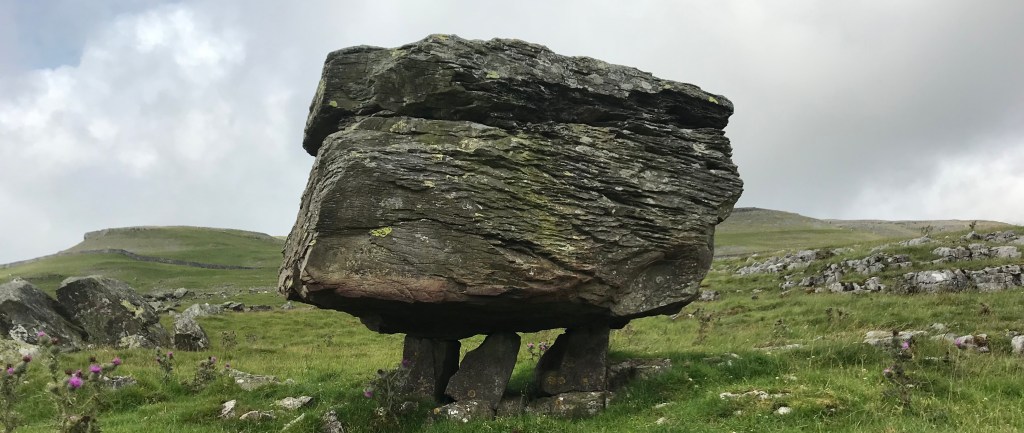
Thousands of years ago a glacier melted and deposited the Norber Erratics. Time and erosion then exposed these cuckoo slabs of sandstone and slate. High above the lush farmland of Austwick the vast boulders teeter on tiny limestone plinths. They are one of many examples of the way defining natural events in one era can shape our landscape for millennia.

My visit to the erratics comes at a point of psychological and spiritual recovery. As with many others working in areas massively impacted by COVID-19, events since March altered normal patterns of life. For about 100 days I woke everyday between 4 and 5 am. In the crisis of coronavirus this was part of how life was, in what the British Psychological Society call the active phase. The unbroken days of being in a state perhaps best described as ‘ready alert’; living in a rapidly changing situation, with frequent and sometimes contradictory information, and the need for instant response and action.

Like countless others caught up in these events the virus stimulated emotional need while simultaneously denying consolation. People have been bereaved – but unable to hug; families traumatised but unable to meet; prayer sought, but the faithful denied the opportunity to worship together. Prayer can take place anywhere, but there are places of spiritual significance that matter to many, and sometimes we want to sit among those who pray when we feel least able to pray ourselves.

prayer is more than an order of words, the conscious occupation Of the praying mind, or the sound of the voice praying.

Eliot, T. S. (1944). Little Gidding. Four Quartets. Collected Poems 1909–1962.

I walked to the erratics during a couple of days away. That should sound a very unsurprising sentence – except that I haven’t stayed away from home for several months and the novelty of the experience, face masks and all, was striking.

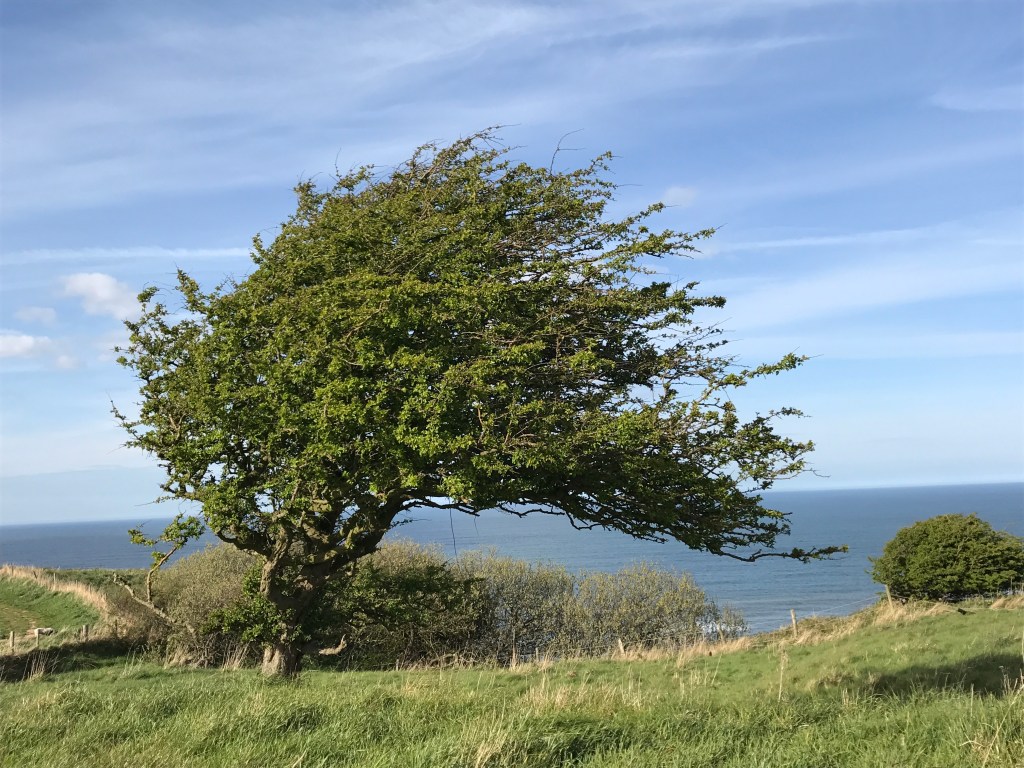
Events come in different shapes and sizes. Sometimes they may bring temporary change, like the tug of a breeze on the boughs of a tree. However, if there is a prevailing wind – if the gusts are more often a gale – then nature’s persistence has lasting consequences. It’s something I think of every time I walk from Whitby to Staithes and see the long suffering thorns. Over the years they have been sculpted by the wind into flame-like shapes, their branches drawn out towards the sea.

COVID-19 is a long way from its conclusion. It is a gale that has blown around the globe with astonishing speed, leaving devastated communities and economies in its wake. Already we know that this is more than a troubling breeze. The consequences for individuals, societies and economies will be part of our landscape for decades to come. At the moment it’s hard to discern what new shapes are forming. Only time will tell, but we all have something to offer as we support each other through this storm. Consolations may be interrupted, but the desire for the good of those around has never been stronger. Perhaps we need, now more than ever, to make the effort to communicate that care – in whatever way we can.

Surgery for the Soul?

It’s great to be back in a church building, sharing in services ‘in the flesh’. Yet the strangeness of our times is reinforced at every turn. From leaving my track and trace details on entry, to the procession of visored clergy, and the silent, sanitised, distribution of Holy Communion. Nothing is quite the same.

The elements of protective equipment have been familiar to me across 20 years of service in the NHS. In more recent times any visit to a care home involves a routine of infection control that includes the constant wearing of a mask. In the context of COVID-19 the delicate balance of homeliness and clinical safety has shifted resolutely in favour of the latter. How to help people live well while being safe is a vexing question for anyone operating places of residential care.

The appearance of ministers as medico-clerical hybrids reminds me of the way the sacred and secular co-existed in the Middle Ages. The physical served as a continual source of analogies for the spiritual. For example, the act of confession was compared with various elements of physical healing:

As the best physician, Christ ‘orders therapeutic baths through our outpouring of tears’ and the healthful diet of ‘fasts’. And the strongest and most effective medicine of all was penance.

Swift, C. (2016). Hospital chaplaincy in the twenty-first century: The crisis of spiritual care on the NHS. Routledge.

This correspondence of the physical and spiritual is sometimes startlingly visceral. In the York Mystery Plays the Barber Surgeons were allocated the section of the story dealing with the baptism of Jesus. Their contribution ended with a prayer addressed to the Lord, ‘as Sovereign Leech’, curing our ‘sore’. It feels very strange to exalt Jesus as the spiritual leech, yet it is entirely fitting with this Medieval desire to connect the physical and spiritual realms with unflinching determination. Why would Jesus not be equated with the key healing technique of the time, used for purging infection and restoring health?

The Shambles, York
The Shambles, York

Much has changed since York’s Medieval plays saw pageant wagons trundling through its narrow streets proclaiming the stories of the Christian faith. Fewer people today would see the spiritual world so closely aligned with the physical realm. Nevertheless, the realities of human sin; of greed, inequality and war, remain as real as ever. What we do with the material world, whatever we understand it to be, is a question of more than material consideration. Our beliefs allow us to turn a deaf ear to the consequences of climate change. We tolerate inequality in life not because the physical world tells us to do it – but because we choose to accept it. We choose to do less than we might to alter the ever expanding wealth of the rich.

Perhaps some radical surgery should be prescribed? Human beings require comfort for the damage we all carry, but also challenge for the damage our choices bring to others. Inequality is not a concern only for the powerful and the oppressed. It’s a concern for us all. Maybe the sight of clergy in visors should remind us that religion can be dangerous, in the best sense. Dangerous because it should not leave us alone, content with the injustices of which we are a part. Religious belief is designed to change us, to provide both consolation and, when needed, incision.

The churches are children playing on the floor with their chemistry sets, mixing up a batch of TNT to kill a Sunday morning. It is madness to wear ladies’ straw hats and velvet hats to church; we should all be wearing crash helmets. Ushers should issue life preservers and signal flares; they should lash us to our pews. For the sleeping god may wake someday and take offense, or the waking god may draw us out to where we can never return.

Dillard, A. (2016). Teaching a stone to talk: Expeditions and encounters (Vol. 57). Canongate Books.

Liturgy is full of symbolism, often ancient. As we witness the innovation of clerical PPE perhaps we should take a moment to reflect on what this physical barrier says to our spiritual insight. To be reminded that, like everything with the potential to transform, there is both power to create and power to destroy. We need to ‘handle with care’ the gift of faith and ensure that we live it in ways that strengthen the weak and weaken the mighty. To develop our belief as a remedy for the casually tolerated ills of our age, and allow the God-in-us to heal the terrible sores that are part of human life.