God in the City

In the late 1980s I spent a year as a youth worker in the Isle of Dogs. The youth club operated in the crypt of Christ Church, and catered for local children up to the age of 11. Although I’d lived and studied in Hull, this was the first time I worked in an urban context. At that time much of the East End was undergoing the transformation from urban poverty to city banks and their associated wealth. Sparkling new buildings were springing up alongside docks where once no one had wanted to live. I was told that in those days taxi drivers had refused to drive into the island at night. During the 1980s the two communities, old and new, lived together uneasily. Some in the increasingly expensive gated estates, others in the council housing that was yet to be sold.

In my new role as Director of Leeds Church Institute I am once again reflecting on the relationship of ‘faith and the city’. Incidentally, it’s exactly 40 years since the report with that title was published by the Church of England, to be met with the ire of Mrs Thatcher and many other conservative voices. In the mildest of possible forms, perhaps this was the C of E’s modest response to the influence of liberation theology – the school of praxis and thought which arose chiefly in the favelas of Latin America. However, one of the criticisms of the report was its lack of a significant and developed theology to frame its analysis and recommendations. A subsequent publication, Theology in the City, responded to this criticism, partly arguing that the alleged lacuna arose from the misunderstanding of the more implicit theological approach Faith in the City had embodied.

During a year in Argentina I read Gutierrez’s classic work Teología de la liberación. Living in Córdoba and Buenos Aires, I grew more and more aware of the particular dynamics of city living, with rich and poor living cheek by jowl. A few metres apart, but separated in their different worlds by steel and security. Cities concentrate divisions in way often unseen in more rural settings. Gutierrez inspired a way of thinking that reflected his conviction, based on a liberative hermeneutics of the Bible, that God has a preferential love for the poor. This understanding led many followers of liberation theology to locate themselves alongside the poor, exhibiting a commitment to share and to learn before even considering the option to teach.

After years in which the power of the Church was used to contain and constrain liberation theology, the Pontificate of Francis marked a sea-change of significance. Rather than beginning with doctrine and only seeing the world through its parameters, Francis favoured attention to concrete situations and experiences as the place from which theology emerged. This was reflected most keenly in his persistent interest in the wellbeing of the poor and his sometimes stern address to the world’s wealthy and powerful (be they institutions or individuals).

The Church cannot abandon the city, because every city is its people. If cities shelter some of the poorest people in society then God’s preference and presence cannot be ignored. As a chaplain in Leeds for 16 years I was privileged to meet the whole spectrum of city dwellers although, poverty and illness being what they are, those encounters were weighted towards the most marginalised people in Leeds. In the conduct of funerals funded by the hospital (due to lack of means and/ore relatives) I visited homes whose meagre furnishings reminded me that, ‘When sorrows come, they come not single spies but in battalions’. It would seem that when the balance favours the rich, with wealth removing many of the burdens of everyday life, the opposite end of the scale descends; as the weight of poverty, exclusion and injustices mount, one on top of another. As Francis wisely knew, a rich Church will never be sufficiently open to allow God to use it as a means to rectify and redress the fundamental injustices of the city. As he declared shortly after coming into office: “How I would like a church that is poor and for the poor”.

The Art of Not Taking the Deal

We are about the enter Holy Week. Many Christians will mark these days by attending additional church services and spending time in reflection. I never tire of reading the passion narratives because I have no doubt that in them lie the central themes of Christianity. There is a crowd in an city eager to give the inspiring young rabbi their adulation. The intimacy of close friends at supper on an important festival. The isolation of the garden outside the city walls, and then the bitter work of captivity; costly fidelity; suffering and death.

At a time when the world has become increasingly chaotic it is important to be reminded of Christ’s stillness before the powers of his day. The High Priest and Pilate undoubtedly saw the brewing popularity of Jesus as something that would be ended by his execution. On all the metrics of religious power and secular control, the Jesus who goes to the cross is done. The watching world could agree with Jesus’ last words: “It is finished”. Perhaps those two leaders saw it as the messy and unfortunate price to be paid for maintaining control; keeping the peace. The sacrifice of Jesus would enable things to stay as they were – and as they should be.

Maybe Jesus didn’t know the art of the deal? His time in the wilderness at the beginning of Lent suggest that he had set his face against compromises in his ministry. When he stood before Pilate he had no cards to play. Or, perhaps, it is more accurate to say that he chose not to accept the terms of the game. Appearing to go meekly to his death probably confirmed to many of the leaders that Jesus simply didn’t understand the reality of the world he claimed to be saving. Sad, but there you go. One death wouldn’t change anything.

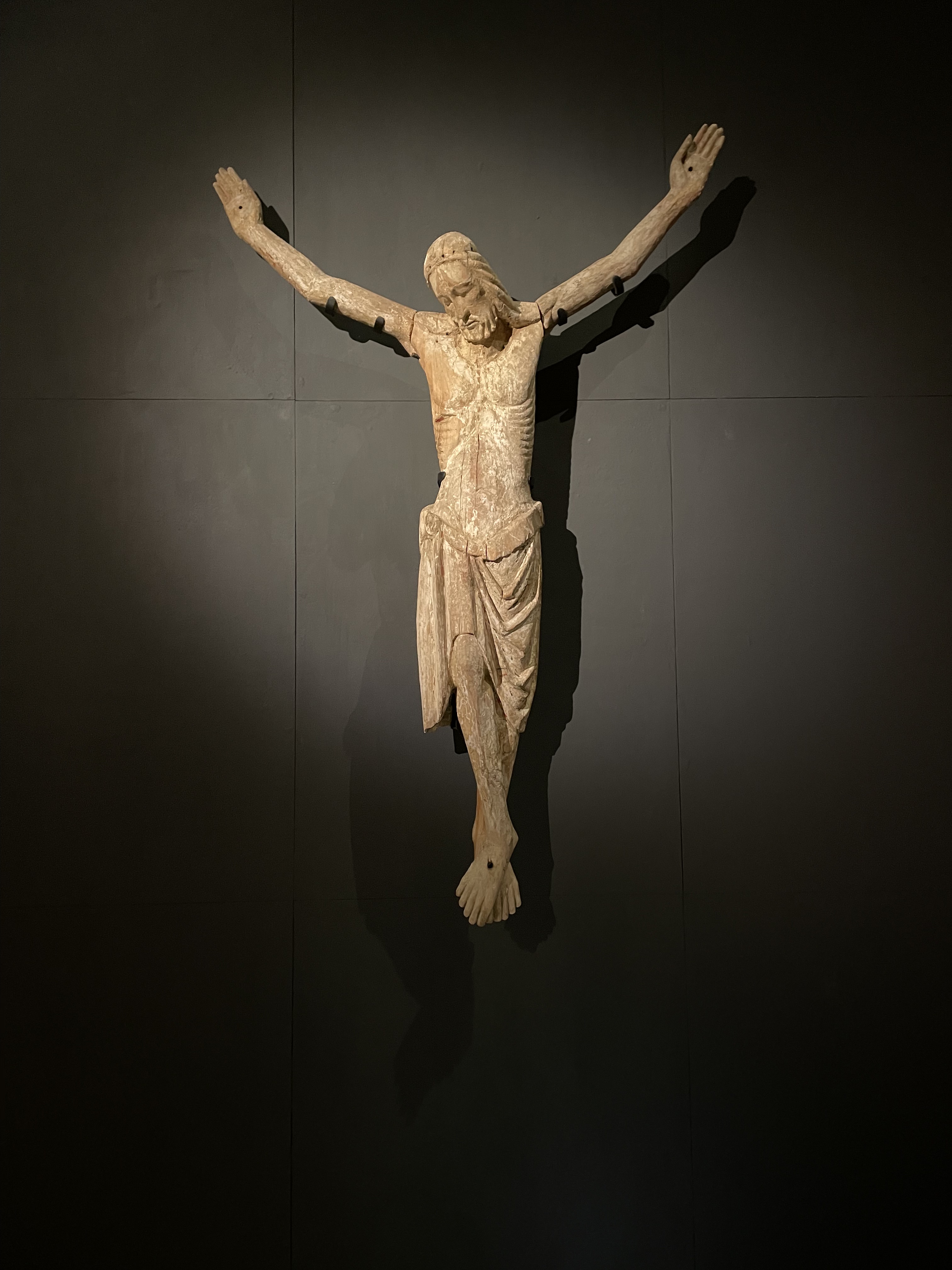
A Station of the Cross by Sepo b. Ntuluna from Tanzania, in the hotel Mattli Antoniushaus, Morschach – built on the grounds of the Franciscan Community in German-Speaking Switzerland.

Then there is the humanity of loss – of which we all know something. Mary caressing the body of her son. A parent unable to intervene to save her child. The powerlessness of love which cradles the life-left body of the son she would have done anything to save. This is the darkness of despair; the earth shaken; the light of the world put out. The day of absence.

‘Faith’ is perhaps the best answer as to why Jesus doesn’t do a deal. That our miserable card games take place inside a much, much bigger story than most of us are willing to acknowledge. Soldiers at the foot of the cross didn’t have cards, but they had dice. It would be beyond their imagining that 2000 years later the events of that sorry day would still be remembered. A miserable death a few hours before a dusk that would usher in the city’s shabbat. It would be hard to imagine something less important. It was ended – time to divvy up the possessions and go home.

“Thou art God, Whose arms of love
Aching, spent, the world sustain”.

WH Vanstone from Hymn to the Creator in ‘Love’s Endeavour, Love’s Expense

Exposed

I’m not the kind of Christian who likes public witness. The sort of knocking-on-doors Christianity; or a beach mission; or even telling my “faith story” in a service feels embarrassing and uncomfortable. There are probably lots of reasons for this, which it would be tempting to dismiss with an air of Anglican superiority.

I am inclined naturally to a reflective and tentative articulation of faith. I don’t believe I have all the answers. “Now we see in a mirror dimly”. I have no doubt, for a host of reasons, that my faith is fractured and partial. It feels fuller and more complete when it is located within a community of faith, bringing many different experiences of God, past and present, under a single roof. Others have natural – and undoubtedly, spiritual – gifts for giving personal testimony. I don’t hesitate to say that this can be both inspiring and has a place within the life of faith. But we are not all created to be the same.

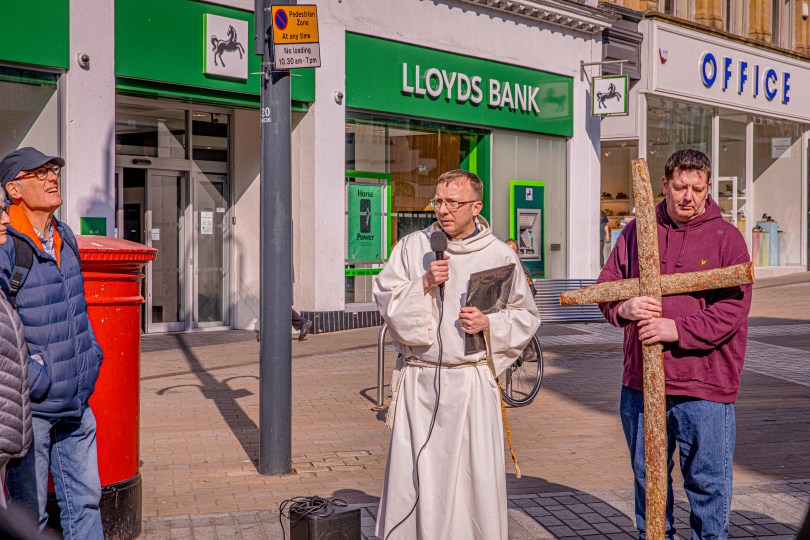
Hence, it was with some trepidation that I went along with the Gospel Streets Urban Pilgrimage in Leeds last week. Led by the admirable Lighthouse community, based in St George’s Crypt under the pastoral care of Jon Swales, the pilgrimage snaked though the streets of Leeds on a sunlit Thursday morning. Jon had a monk-ish aura wearing a cassock alb, and speaking passionately about the City while reading the Gospel of Mark. People stared at us. One passing youth shouted: “You’re all evil; you lot”.

What did it achieve?

For the thirty odd of us participating there were the kind of side-on conversations that people walking to the same destination often share. I met many people I hadn’t encountered before. Members of the Lighthouse community were with us, and it ended with a service of Holy Communion in the Crypt. We were present in spaces where religion is either excluded or extreme; the places where the more you consume the more you matter, and where street preachers tell the world that “the end is nigh”.

Our pilgrimage was less confrontational and more measured. The worst excesses of capitalism were described beside the city’s banks. People damaged by an urban environment that rejects them walked with us in a spirit of solidarity and purpose. Jon asked people sitting and reading in the sunshine of Mandella Gardens if they wouldn’t mind him speaking for a while (sooo Anglican!) and breaches of international law were mentioned by the war memorial.

I’m not sure what we achieved. A statement was made – it was enacted. In the pilgrimage through Lent, we reminded ourselves and anyone who cared to listen, that God is present in the city. That the Church is (or should be) a shelter from the storms of life and a community that is restless and longing for the Kingdom. Where people who have been rejected find a home, and where earthly power is reminded of its place.

It is absurd
to retell here what
happened there,
far away and far ago
when the idiot healed
and said, and wept
and left. A broken
nonsense in the febrile
world of expectation.

Ceasing to be Eathbound

I have long been a fan of The West Wing, Aaron Sorkin’s masterful creation of an imagined, plausible, and ethical US Presidency. Although the programme foretold the election of a president who was Latino, it did not predict the right wing backlash that would follow. A much weaker version of Donald Trump features in an episode concerning a Republican challenger to President Jed Bartlett, who the sitting Democrat sees off without difficulty. Alas, recent months have seen a catastrophic implosion of the Democratic opposition in the USA, with global consequences.

In one episode of the series Jed Bartlett is asked a question about why Airforce One’s take-off had been delayed. Before giving the prosaic reason, Bartlett eulogises for a moment about what a lengthy night flight can mean:

“A long flight across the night. You know why late flights are good? Because we cease to be earthbound and burdened with practicality.”

I write this onboard a BA flight which is about to leave Cape Town on Friday 21 March. We weren’t sure whether this flight would make it into the air, given events at Heathrow. Perhaps we won’t land in the UK – the equivalent flight yesterday ended up at Barcelona. Nevertheless, we will have a long night flight in all events, and perhaps Bartlett was right that there is something unusual and potentially uplifting and thought-provoking about traversing the planet in this way (albeit with environmental considerations and impacts).

Once again South Africa has been impressive; challenging, and full of natural wonders. From visiting communities that experienced devastating flooding, to the wealthy areas of coastal communities along the Garden Route, we have once again experienced a country of contrasts. A nation where the enduring imprint of colonialism runs wide and deep. During our time there the SA Ambassador was asked to leave the USA and 70,000 Afrikaans have expressed interest in accepting refugee status in America. Making a nation is hard work – especially one so burdened by an evil regime that nurtured division as a basic strategy of education and government.

Perhaps due to the short span of our lives human beings do far too much far too quickly. Nothing appears to have been learned from COVID, recent global conflicts or the history that underpins Western privilege. In South Africa two experiences reminded me of our self-absorption and navel-gazing. One was the opportunity to see and photograph the Large Magellanic Cloud, a ‘nearby’ galaxy containing 30 billion stars, and only visible from the Southern Hemisphere.

The other, quite different experience, was to go underground and visit the Cango caves. Here stalactites and stalagmites have formed over tens of thousands of years, in some cases forming vast columns when growth up has met with expansion down. Extraordinary beauty created by incredibly slow drips of calcium infused rainwater. A process now slowed by global warming.

What is above us and below us is a reminder that the environment we value has come into being through both unbelievably big cosmic events and incredibly small and sustained changes that over vast stretches of time have a mighty impact. We do not tread lightly upon the earth, expending in a couple of centuries resources that have taken millennia to create. The relentless energy of the systems that we have built do not work in favour of the whole of humanity, or even the few that appear to reap the benefits of extracted resources. We are not living sustainably and the blind optimism of some that we shall always find solutions to the problems we’ve created may, in the end be shown for what it is: a convenient narrative to permit the continuing exploitation of our planet.

Sweet Flying Baby Jesus

It appears as a small detail in some classical depictions of the Annunciation, but it is not uncommon to find a tiny baby Jesus surfing a beam of celestial light towards the Virgin Mary. We might take this to be no more than an artistic expression of the theological significance of what was unfolding at this critical moment at the start of the Gospel. However, there is more to this illustration than meets the eye.

A middle part of so called Mérode Triptych, created in 1430’s in the workshop of a Master of Flémalle, and kept in the Metropolitan Museum of Art in New York

Anyone familiar with The Life and Opinions of Tristram Shandy, Gentleman will know that the clerical author, Laurence Sterne, makes play with the concept of “homunculi”. Developed to a significant extent by Aristotle, this idea centres on the belief that all the physical aspects of procreation resided with the man. Unbelievably small babies were thought to be present in semen which, at the moment of conception, were passed by the man to the woman. It is hard not to interpret this as a startling manifestation of misogyny. Life being so important it could only originate from a man; and pregnancy so inconvenient it must be the perpetual obligation of a woman. In Tristram Shandy this theory is mocked from the first page, when the conception of Tristram is interrupted by Mrs Shandy, who distracts her husband by asking: “Have you not forgot to wind up the clock?” The effect of this is to weaken the efforts of Mr Shandy, and results in irrevocable damage to the homunculus that is, and will become, Tristram.

It would be easy to underestimate the consequences of this belief. Sterne incorporates into his novel the real-life situation of the Duchess of Suffolk. When her husband and son died in quick succession she was granted administration of the estate. However, when it was contested, part of the appellant’s legal argument was the assertion that – based on an understanding of homunculi – she was not a blood relative of her son. The Duchess lost her right to inherit.

As the Church celebrates the Annunciation on 25th March it is worth asking the basic question: “What was going on?” The classical paintings of a tiny Jesus heading towards Mary imply that the infant saviour was a divine homunculus. The mother of Jesus was simply receiving a delivery from the Almighty, leaving her virgin state unaltered and confining her responsibilities to safe carriage. At its most extreme, Mary would be seen as having a vocation – but no blood relationship with Jesus.

In the classical world divergent views about conception include those of Aristotle, and an alternative approach can be found in the work of Galen. Galen’s understanding of conception sees both the man and the woman contributing seed to form an embryo. As Magdalena Łanuszka put it in a blog entitled “Flying Baby Jesus”, the homunculus interpretation lacks serious theological foundation:

Such a depiction suggests that Christ was incorporated as a human child somehow beyond Mary’s womb and then “placed” in it. That weird In Vitro is of course an idea absolutely theologically incorrect. Jesus’ body was formed entirely out of Mary’s body, not somewhere outside it.

http://en.posztukiwania.pl/2014/06/01/flying-baby-jesus/

In a timely inclusion, the current issue of The Church Times features a review of a new book focusing on the embodied experiences and theologies of birth. Pregnancy and Birth: Critical Theological Conceptions challenges the dearth of theological work done on these major topics. It is not difficult to imagine that if men underwent the experience of pregnancy, the number and variety of titles on these subjects would be immense. In another review of Karen O’Donnell and Claire Williams’ new book, Dr. Emma Percy, a researcher working in this field, offers some concluding reflections:

Pregnancy and all the complexities around reproduction should not be a niche topic, just for the feminist theologians or those who have been pregnant. We are all born from a body that gestated us for months. Jesus, as O’Donnell reminds us, shared this very human experience in the womb of Mary. There is much for all to learn from taking a more realistic look at a bodily experience that is so fundamental to our being human.

Emma Percy book review in Theology. First published online January 8, 2025

Sweet flying baby Jesus should concern us all. How we respond to this framing of the Annunciation and Incarnation is fundamental to our understanding of Christianity, and the God we worship. Sterne turned the evident nonsense of the homunculi into satire, but underneath the wit is a profound question about the humanity of the God in whom we place our faith. From what I have read, it is uncertain whether the writers of the Bible shared a uniform understanding of conception: they almost certainly didn’t. (There’s an excellent article about this by Laura Quick entitled Bitenosh’s Orgasm, Galen’s Two Seed and Conception Theory in the Hebrew Bible). Ultimately, when we lack the understanding of what the authors of Scripture thought when they were writing, we need to arrive at our own conclusions as to whether our interpretation enlarges our love of God and of neighbour, or diminishes it. For me, the idea of Jesus as a foetus implanted in Mary’s womb by the Holy Spirit undermines a primary doctrine of Christianity; namely, that the Word made flesh is both fully human and wholly divine.

Where the Heart is

On holiday I am enjoying the time to read three very different books. One is poetry; another a novel; and the third theology. Despite being different, I am also seeing (or making) many connections between the narratives. This is unsurprising in one sense as I am their common denominator: the one reading. Like the handmade and unique marbled pages in each of the first edition volumes of Sterne’s Tristram Shandy, we perceive our own patterns as we mark and experience the stories mediated by print.

I came to A Dark and Stormy Night by Tom Stacey via an unusual route. At home we have a sculpture bequeathed by an old friend. In doing some research about the sculptor I came across the fact that her husband was a writer. In this novel, a bereaved suffragan bishop – a Dante scholar – gets lost in a forest in darkness while seeking a redundant chapel. It is notable that the bishop lived with and through his wife’s dementia – something Tom Stacey knew about at first hand. His description of this resonates strongly with what I experienced of my mother’s cognitive decline several years ago. Stacey’s insight evidently comes from deep and costly personal experience:

You are forever packing and re-packing to go home. To tell you we are at home only serves to rile you. This lost inner home of yours is never locatable.

Transgressing the boundaries of normal or accepted behaviour is a strong theme of Allan Boesak’s Children of the Waters of Meribah. Boesak is a South African theologian with an abiding commitment to liberation theology.

In a chapter exploring the story in Matthew’s Gospel of the Canaanite woman who comes to Jesus seeking healing for her daughter, Boesak conducts a masterclass in hermeneutics. Experience shapes both writing and reading. Unsurprisingly, Boesak is alert to the location of this account:

She is a Canaanite, the people whose land had been conquered and occupied by Jesus’s people.

What should have been home was no longer home or, at least, a place now made strange and punitive. The experience of being South African leads Boesak, and the scholars he cites, to read this account with the painful insight of experience. The woman comes to Jesus in a “spirit of protest and reclamation”.

The final book is a collection of poetry by Koleka Putuma entitled Collective Amnesia. It is a work that has set records in South Africa in terms of poetry sales. Inevitably, with a heritage of the Group Areas Act, this is a nation that continues to live with “ongoing collective trauma” for countless reasons, not least the dispossession of peoples’ homes. Putuma writes out of her experience with skill, candour and wit.

You will realise that the elders in the room

Learned the alphabet of hurting and falling apart differently

For you, healing looks like talking and transparency

For them, it is silence and burying

And both are probably valid

And

Then

You will realise

That

Coming home

And

Going home

Do not mean the same thing

From the poem ‘Graduation’ in the book ‘Collective Amnesia’ by Koleca Putuma

Is God Calling?

I usually skip through the online edition of The Church Times over breakfast on a Friday. It is a newspaper with a venerable history, having first hit the presses in 1863 (between the publication of The Origin of Species and the first sales of Turkish delight). In 1981 a scurrilous and highly enjoyable spoof of The Church Times was published under the title Not The Church Times, reflecting the popular use of the ‘not’ brand of satire in the 1980s. It came complete with adverts for high office, one of which stated:

Applicants are invited to apply, stating their public school, Oxbridge college, year at Westcott House, and Lodge.

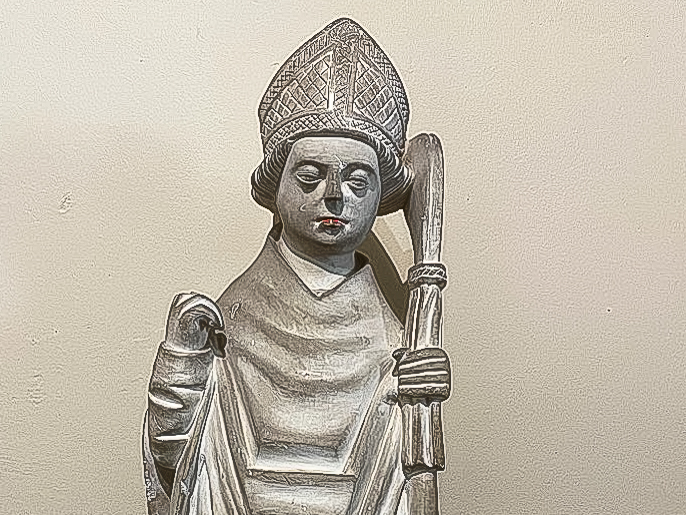
Sadly, I would qualify on only one of these criteria and even then, by 1990, Westcott was no longer the powerhouse of episcopal chumocracy for which it was once renowned. This undoubtedly explains why, when there is presently a surfeit of episcopal vacancies in the Church of England, no mitre is likely to fall on that pate so propitiously cleared of hair, which would be enhanced immeasurably by the imposition of a pointy hat. Alas, as Cervantes put it in Don Quixote – quoted later by Sterne – with a head so beaten about by the vagaries of life, if mitres were “suffered to rain down from heaven as thick as hail, not one of them would fit it.”

In recent years the criteria for preferment have undoubtedly changed from those in the 1980s. Favour has fallen on evangelical candidates; those perceived to have been successful in an organisation other than the church; and, more than anything else, priests who have a story of leading church growth. Once again, my credentials would make little impression in these categories of assessment.

All of this came to mind as I read through the classified section of this week’s issue of the ecclesiastical newspaper. My eye was drawn to an advertisement from my home diocese, the See of Blackburn. A creation of William Temple, consisting of parishes carved out of the rapidly growing Diocese of Manchester – itself an earlier Victorian offspring of the Diocese of Chester. The ad that caught my eye had a headline in a style not uncommon in The Church Times:

I pondered whether this was the same God responsible for the creation of the universe. That is, the entire reality identifiable from earth, which is at least 28 billion light years in diameter. The God who predates time and will draw time to a close. That God? I imagine that this God probably has rather a lot to do but, God being God, perhaps there would be an infinite supply of time so that spending a few minutes reviewing the needs of the Blackburn Archdeaconry wouldn’t be too onerous.

However, wouldn’t it be more honest and meaningful to ask: ‘Do you want to be the Archdeacon of Blackburn?’ Shouldn’t our desires be material to the concept of vocation, rather than being cast into doubt under a pall of implied sanctity. Perhaps it would lead to much greater honesty and candour if we explored the motivations of why anyone wants any particular role. As the Church of England struggles to address the abuse that has happened, and is happening, in situations where piety has been asserted and manipulated, it might produce a better culture if we began with a humble recognition of our own wants and needs. Wants and needs where, in various ways, God is already present and active. Teasing these out may be the best way to achieve greater honesty; self-knowledge; deeper discernment; and a safer Church.

Perhaps spiritual directors should run the C of E – they are the people, usually, who cut through the flummery and ask this kind of inconvenient question. Might God be calling any of them to Blackburn – or even to Canterbury?

Lent Preachers

As the Church approaches Lent, some Christians might have begun thinking about what to give up, or what to take up. Perhaps a small resolution of abstinence – alcohol or chocolate – and a desire to read something that will draw us a step closer to understanding everything to which Lent points. In some churches, while Holy Week might feature a visiting speaker to lead people through the final week, it has been the custom in cathedrals and elsewhere to have a different guest preacher each Sunday. This practice goes back a long way and can be found in various notices and signs that have survived the passage of time.

In 1725 Ash Wednesday fell on February 10th. Or did it? This statement requires some qualification. The calendar at that stage was still in the Julian form, meaning that the year began on 25 March, hence the Lent preachers list for St Paul’s is described as the year 1724-25. This practice was known as ‘dual dating‘ and caused considerable confusion. It finally ended in England in 1751 with the British Calendar Act and an effective transfer to the Gregorian calendar used by most of the rest of the world.

As the notice from St Paul’s demonstrates, Lent sermons were not confined to Sundays. The advertisement offers distinguished clerics on Wednesdays, Fridays and Sundays, throughout the 40 days. These occasions were not for the minor clergy, but moments when the cathedral staff themselves, or various other deans and bishops, might pronounce their theology and spiritual message.

Laurence Sterne, who was a well known and popular preacher, was aware that his humble station in the Church meant that he was unlikely to be invited into the nation’s highest pulpits. The steps that grace the cover of A Sterne Lent – Forty Days with the Celebrity Parson the Church Forgot, are elegant, simple and modest. They are the pulpit steps of All Hallows, Sutton on the Forest, where the preacher stands only a few feet higher than the congregation. Today, I understand that a less formal way of leading worship (and perhaps fewer parishioners) means that this beautiful 18th century piece of furniture is seldom used.

Many of Sterne’s surviving 45 sermons were first preached in the season of Lent. In keeping with the motif found across Sterne’s work, he was mindful of the contrast between success as an author and the skepticism about his character which would keep him out of high office in the Church.

“I just received a Translation into french of my Sermon upon the house of Mourning, from a Lady of Quality – who proposes to print it, for the Caresm, & to give ye people here a specimen of my Sermons – so You see, I shall be Lent Preacher at Paris, tho’ I shall never have the honour at London”

Letter from Laurence Sterne to Henry Egerton, written in Paris, March 8 1762. Quoted in Volume 7 page 233 of The Florida Edition

In a style characteristic of Sterne’s humour, his letter to Henry Egerton in March 1762 makes reference to the fact that his own death had been reported in newspapers back in England. Sterne’s congregation in Coxwold went into mourning. It took more than a week for corrections to appear in the English press. Sterne would undoubtedly have been fascinated by the eulogies which were published in the intervening days.

St Paul’s never beckoned the peculiar rural parson who had found fame – and a little fortune – through both his published sermons and Tristram Shandy. Undoubtedly Sterne has the last laugh, as the great names of that era, who graced the pulpits of the nation’s cathedrals, are now unknown. Yet, somehow, Sterne’s radical approach to the novel continues to stir the creative spirit of contemporary artists and authors across the world. I believe they also have a much neglected spiritual significance.

Perhaps one of the most attractive things about Sterne is his refusal to conform simply in order to ‘get on’. Yes, it rankled with him that there would be no palace to live in, or ample stipend to live off in a lavish style. Sterne can’t quite let go of the cost – the sacrifice – which witty writing and ecclesiastical satire had imposed on his prospects. Friends advised him to temper his writing until he was in the kind of exalted position no one could touch. However, I suspect that Sterne knew this beguiling suggestion for what it was, and that it would blunt the sharpness of his writing. Too many people have entered the church, or politics, certain that when they ‘arrive’ they will enact their intention to do something dazzling and different. Alas, how often do these well-intentioned ambitions become paralysed in the sticky web of power’s compromise? Sterne may not have preached in England’s most exalted pulpits – but the life we encounter in his writing is an enduring lesson on human weakness and hypocrisy, redeemed only by a God whose sense of forgiving humour is so much greater than the dismal depths of our everyday folly.

Holy Innocent

The 28th of December is the day on which the Church marks Holy Innocents. It is a day that focuses on the harrowing account in the Nativity story told by Matthew, of the orders King Herod gives to slay all male children under the age of two. Fearing the emergence of a rival, the King makes his fateful decision based on the Magi’s interpretation of the star they observed. 

Children are all too often, tragically, killed in conflict. However, the targeted destruction of the young is rare. In wartime, as we see around us in the world today, children die, are injured and become psychologically damaged through conflict. In WWII, as a consequence of indiscriminate bombing, almost 8,000 children died in the UK. The worst affected city was undoubtedly Coventry. On 14 November 1940 huge amounts of ordinance were dropped on the city leading to a significant loss of life; the destruction of countless buildings (including the cathedral); and widespread civilian trauma amongst those who survived. A few weeks’ after the attack the Dean of Coventry gathered as many choristers as he could in the ruins of the Cathedral and broadcast a rendition of the Coventry Carol to what was, at the time, the British Empire. This carol, which comes from the medieval Coventry mystery plays, recalls the massacre of the innocents. It must be one of the bleakest, most sombre and deeply moving items in the canon of Christmas music. The wartime clip from Coventry is featured in an emotional and thought-provoking episode of BBC Radio 4’s series Soul Music.

Laurence Sterne, the 18th century parson-novelist, says remarkably little about Christmas in any of his writing or preaching. Yet there is a sermon on Holy Innocents. Sterne knew from personal experience what it was to lose a child. He describes the massacre of the innocents as being:

So circumscribed with horror, that no time, how friendly soever to the mournful, – should ever be able to wear out the impressions.

When I worked in the NHS I recall very occasional instances when a mother contacted the hospital to ask about the mortal remains of their child, who had died many years ago. This arose out of the fresh attention given to the issues of organ and tissue retention, and burial practices, following the Bristol Royal Infirmary and the Royal Liverpool Children’s inquiries. In some cases mothers had given birth to a living child, who had died within a short time, and the mothers were told to go home and in essence – forget about it. They were provided with no information about what then happened to their babies or where they were buried. Records were kept, but the existence of a baby’s body in amongst an adult “shared grave” was not recorded on the headstone: unlike the adults. Once or twice I arranged to meet a mother at the entrance to the local cemetery and took her to the place where the records stated her baby was buried. I hope that, in some small measure, this helped a grief which had lain largely unexpressed for decades.

Holy Innocents begs many questions of the Church, and of the world. How could God’s miracle of the incarnation result in so much terror and destruction? Why is it that we continue to tolerate warfare that damages young lives? How do we help survivors who have witnessed unforgettable horrors? There are no easy answers to these questions. However, the presence of Holy Innocents in the Church’s calendar stubbornly insists that even while the tinsel is still hanging, the most dreadful realities of the world cannot be put aside or forgotten. They are always there and, hopefully, stir people of good faith of every religion and belief to seek peace with added urgency. Because the innocents are still being massacred today.

That woe is me, poor child, for thee
And ever mourn and may
For thy parting neither say nor sing,
“Bye bye, lully, lullay.”

From the Coventry Carol, 16th century

Living For

I am reading a book about the history of my new employer, Leeds Church Institute (LCI). History can be fascinating, both for the strangeness of how life was once lived and, occasionally, for the sudden resonance of a view or action which appears entirely modern.

The quarter century leading up to WWI is described in the book as “the golden age” of LCI. Wealth increased for some, and for others new legislation reduced working hours, meaning that in both cases more time and resources were available for recreation; discussions; hobbies; voluntary work; or religious associations. (The text “Eight Hours for Work, Eight Hours for Rest, Eight Hours for What We Will” was paraded on a union banner in 1889). It was the time when public schoolboys and undergraduates came to Leeds to live in “settlements”, often found in the poorer quarters of the city. Of course, this could be experienced as highly patronising and there’s a powerful quote in the book about LCI’s history from an older woman in one of these areas who declared: “I do so hate being ‘lived among‘”.

As we approach Christmas her words ring in my ears and remind me that the Incarnation was more than a gap year for an earnest deity. Public schoolboys didn’t renounce their learning, connections or resources when they came to reside among the poor. They were no doubt billeted in reasonable accommodation, forming a small community of young people who shared privileged backgrounds. These communities was set in a wider context of poverty; disadvantage and squaller. I can imagine many of these settlement workers, in future years, burnishing their credentials by referring to the time they “lived among” the poor. A year of their youth that bought the claim to a lifetime of social credibility.

“For all the rhetoric of ‘citizenship’, ‘democracy’ and ‘fellowship’, the governance of the settlements, at least in their early years, was in the hands of their patrician founders rather than their ‘members’.”

Freeman, M. (2002). ‘No finer school than a settlement’: the development of the educational settlement movement. History of Education31(3), 245-262.

The Word made flesh gives up language. The babe in the manger has no worldly connection that will hoist him out of misery. The infant son of a carpenter must play with the shavings on the workroom floor, and discern his own path through all the perils and possibilities of life. He must learn words and imbibe the teachings and practices of religion. As a young man driven into the desert, the vocation of Jesus is tested in the wilderness of the world, alone with his demons. Preaching, teaching and healing as a Rabbi he will come to challenge both temporal and spiritual authorities. Standing resolute before the powers of coercion and compromise, resolved in his calling and identity, will become the path to his destruction.

This is not living among. It is living with; it is living as; and it is living for.