Champagne Rules

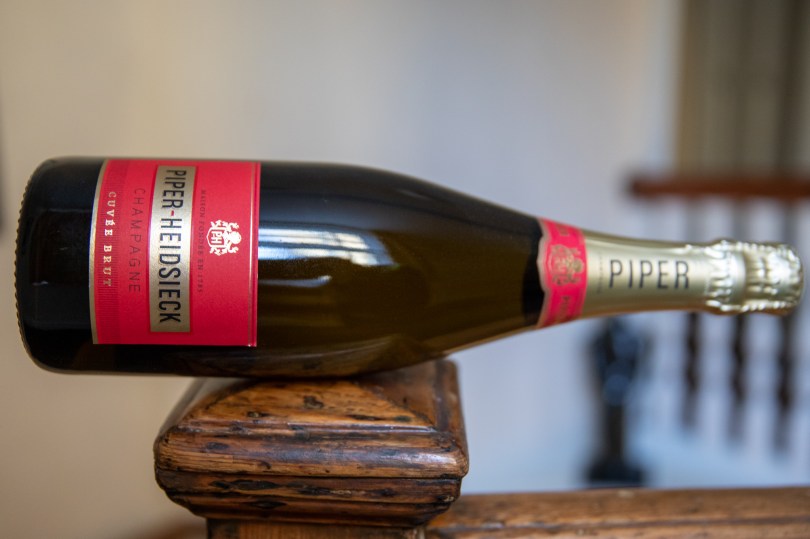
It became my custom to give up alcohol during Lent. I’m not sure when it started, but by the time I was ordained it was an established practice. With the eagerness of a new curate I was very clear that this was something I would observe, come what may. Like so many of the things we decide with absolute conviction, God is adept at questioning any rule we might turn into an idol. During those first few years of ordained life I found myself on one occasion at a 90th birthday celebration for a parishioner. Naturally, the fizz was circulating in abundance and there was to be a toast. I began to wonder whether my Lenten observance was pharisaical – placing the observance of a rule over its spirit and purpose. At that moment I took a glass and toasted the nonagenarian.

Rules can be very useful, even essential, but it can be important to know when they should be set aside for a greater purpose. In the Church of England the recent debates about same-sex blessings might be another example of the ‘champagne rule’. The moment when we realise that a rule no longer serves the purpose for which it was intended. When the Church realises it is operating a self-denying ordinance that leaves it skulking in the corner when the community we are called to serve is celebrating.

‘But to what will I compare this generation? It is like children sitting in the market-places and calling to one another, “We played the flute for you, and you did not dance; we wailed, and you did not mourn.”

For John came neither eating nor drinking, and they say, “He has a demon”; the Son of Man came eating and drinking, and they say, “Look, a glutton and a drunkard, a friend of tax-collectors and sinners!” Yet wisdom is vindicated by her deeds.’

Matthew 11: 16-19 NRSV

When we develop or change rules it can be unsettling. Many of those who have changed their mind on the topic of the blessings have done so because they have listened to people in relationships that are enriching each other, and the community: ‘Wisdom is vindicated by her deeds’. I am quite sure that they have also been open in prayer to seek what God is asking of the Church. Opponents simply battering on about marriage as something that has never changed (it has), or investing a particular interpretation and a huge weight on a few verses of the Bible, should not fly in the face of the overall purpose and direction of the Gospel. God is love, and enabling people in love to be blessed in the community does not seem un-Christian.

Perhaps it is only when we arrive at a particular moment, and are open to hear the whisper of wisdom, that we feel able to engage the champagne rules. For me it changed nothing about my overall observance of Lent. In fact, it helped dispel my youthful pride in a holy and sacrificial abstinence. God didn’t allow me to complete Lent with a clean sheet, but ensured that when there was a wedding or a birthday I always raised a glass. As the days of Lent progress it is important to remember that rules alone seldom (if ever) bring us closer to God.

‘Owe no one anything, except to love one another; for the one who loves another has fulfilled the law’.

Romans 13:8

Letting go

In a parish I once knew, long ago, there was a splendid cabinet in the vestry. Made from fine timber, it was a large chest with many drawers – in which, liturgical vestments were stowed. It had been given in memory of their father by two members of the choir.

When I was present to lead worship on a Sunday I often spent time in the vestry before the liturgy began. On several occasions these members of the choir would voice concern about something to do with ‘father’s chest’. An alien object had been placed on the top; or a drawer was sticking out; on more than one occasion it appeared to have been moved an inch one way or the other. The cry would go up: ‘what have they done to father’s chest?’

Over time a question began to form in my mind. Had this object really been given? The continuing bonds of attachment seemed so great, so proprietary, that it was hard to think of this as a gift that was given free, unencumbered and without strings.

“But when you give alms, do not let your left hand know what your right hand is doing, so that your alms may be done in secret, and your Father who sees in secret will reward you”.

Matthew 6: 3-4 NRSV

On Ash Wednesday I think there is much to consider about giving and detachment. The ashes remind us that our physical life is temporary, and that all we own will one day be dust. More significantly, God gives Jesus without any sense or implication of ownership. Horrifically, human beings did with this gift what happens to far too many lives. Even on the cross and hearing the cry of despair, God is silent. This is a gift – a true gift, and therefore God can make no claim even on that desperate day we shall mark six weeks on Friday.

All out genuine acts of letting go echo something of this divine gift. If we give we can never claim ownership or, indeed, any greater interest than anyone else. Perhaps this is why gifts are so rare. In his poem ‘Walking Away’ C Day-Lewis reflects on the moment his young child disappears, momentarily, for the first time:

That hesitant figure, eddying away
Like a winged seed loosened from its parent stem,
Has something I never quite grasp to convey
About nature’s give-and-take – the small, the scorching
Ordeals which fire one’s irresolute clay


I have had worse partings, but none that so
Gnaws at my mind still. Perhaps it is roughly
Saying what God alone could perfectly show –
How selfhood begins with a walking away,
And love is proved in the letting go.

A Jangling Noise

During a recent trip to Austria I decided it was time to learn some German. In the dim distant past, at secondary school, I’d done a couple of years studying the language – but with very limited success. Now the internet and various apps make language learning much more accessible and entertaining. Alongside this I decided to learn one or two phrases by rote, including ‘happy New Year!’, which had rather specific and time-limited utility. However, making any attempt to speak a local language brings rewards, not least as it conveys the desire to learn; to understand and to be understood.

The only language in which I have any proficiency is Spanish. Living for a year in a Latin American country immersed me in the sounds and the culture of a land which felt very different from my own. Slowly the words seeped into my thoughts and I realised for the first time that language is about far more than translation. Words approximate – but they are not identical. Living and speaking in a culture different from my own taught me that language is an embodied experience of a particular way of seeing the world. As a result, the way we speak offers a unique insight into how human beings encounter community; reflect history; and give voice to their desires.

In the book of Genesis there is a fascinating account of how human beings moved away from one language to having many. It is a myth of explanation that seeks to translate the phenomenon of linguistic diversity into a tale of divine intervention. In the beginning ‘the whole earth had one language and the same words’ (Genesis 11:1). This is typically interpreted as a story about human pride in which, in due course, we would be able to achieve anything. Consequently God intervened and ‘confused the language of all the earth’ (ibid., v. 9). As Milton puts it, God sowed a ‘jangling noise’ amongst the people. In effect, pluralism of language was a punishment designed to slow the development of human power in response to the growth of human ambition.

“But God who oft descends to visit men
Unseen, and through thir habitations walks
To mark thir doings, them beholding soon,
Comes down to see thir Citie, ere the Tower
Obstruct Heav’n Towrs, and in derision sets
Upon thir Tongues a various Spirit to rase
Quite out thir Native Language, and instead
To sow a jangling noise of words unknown”

J Milton, Paradise Lost, Book XII verses 48-55

Some interpretations of the Babel story have seen it as God’s response to Empire. When one people use their common heritage to mobilise resources and expand their territory, to such an extent that nothing seems impossible, their pride is met with punishment. This interpretation is linked in particular to the role of Babylon in the oppression of Israel and Judah. Undoubtedly this view is informed by the common practice of single-language empires to suppress (sometimes with violence) the use of local idioms. However, this interpretation feels at times to stretch a point beyond its supporting evidence, and some recent scholars have turned away from the ‘pride-and-punishment’ exegesis to focus on the narrative as a theme of cultural origins following the flood.

In his paper on the interpretation of the Babel story, Theodore Hibert, argues that the primary motive of construction is not to affront God (pride) but to remain in one place (i.e. to avoid being ‘scattered abroad upon the face of the whole earth’ ibid, v. 4). This suggests that God’s concern is that human culture will remain homogenous and limited. Strikingly, this interpretation is aware that language and land belong together. Therefore, the mixing of language and the dispersal of the people is an early recognition that cultural diversity is dependent on geographical location. While there is no explicit reference to it Genesis 11, it is tenable to infer that the desire of the people to be culturally uniform and in one place ran counter to God’s instruction earlier in the book for the people ‘to fill the earth’. Consequently, the cultural diversity that arises from dispersion is seen to be divinely desired and instigated. (see Hiebert, T., 2007. The Tower of Babel and the Origin of the World’s Cultures. Journal of Biblical Literature, 126(1), pp.29-58. Vancouver).

Yesterday The Guardian featured an article about the demise of many languages. The reason for this is primarily connected with climate change and the fact that many distinct cultures live in places liable to be harmed by global warming. The article reports the launch by the United Nations of a Decade of Indigenous Languages, recognising that this diversity is not only important for the people speaking these languages, but for all of humanity. As languages become extinct (which happens for one language every 40 days) we lose a distinctive way of seeing the world and, importantly, connecting with the natural environment. At the same time, as the late Ken Hale put it, losing any language is the cultural equivalent of ‘dropping a bomb on the Louvre’.

In a few weeks time Lent will begin, the 40 day period of reflection for Christians with a focus on the time Jesus spent in the wilderness. This Lent I’ll be mindful that in that brief span of time a language will die, and hope I shall be more motivated to contribute towards limiting climate change and its consequences – as well as continuing to learn and appreciate new languages. In my experience the rich diversity post-Babel is a joyful jangle, and God help us if we end up with the horror of a single voice.

This Doubtful Day

In Austria, on Palm Sunday, branches of pussy willow are used instead of palms to honour the entry of Jesus into Jerusalem. In the parish church of Viehhofen, in Hinterglemm, I found a spray of pussy willow attached to a processional cross as part of the Christmas decorations. I am unclear about the reason for this, and a search of the internet turned up little. However, it seems a fitting nod towards the passion of Christ and serves as a reminder that events in the Christian year are interlaced in ways that are sometimes surprising.

In 1608 John Donne wrote about the coincidence of the Annunciation (25 March 1608) falling on Good Friday. (We don’t need to worry about that happening in our lifetimes, no matter how young you are, as it occurs next in the year 2157. It happened last in 2016). Donne reflected on ‘the head Of life at once not yet alive, yet dead’, the day when news of great joy lands on the remembrance of deep sorrow. News about the same person – anticipation of new life held simultaneously with the pain and suffering of that life being extinguished. In the calendar, the Church transfers the celebration of the Annunciation to another date. It is almost impossible to attend fully to both these extremities without experiencing some kind of theological breakdown.

All this, and all between, this day hath shown,
Th’ abridgement of Christ’s story, which makes one—
As in plain maps, the furthest west is east—
Of th’ angels Ave, and Consummatum est.

The conclusion of Donne’s poem: On Annunciation and Passion Falling on the Same Day

As a hospital chaplain there were many occasions when joy and sorrow were held in the same time. I shall never forget working in the neonatal units at Christmas, when all attention in the outer world was fixed upon a particular birth but, tragically, I was baptising and blessing lives that would not last the day. Every Christmas I think of those parents and families, for whom this date of joy in the world had become a time of painful recollection. Our annual baby remembrance service was held in early December in order to allow families a ritual of acknowledged loss, and then proceed to keep Christmas as well as possible for other children in the family.

We tend to think that Christmas should be a time when we are shielded from the harsh experiences of being human. Sadly, as the UK has witnessed, violent deaths have taken place over the festivities. Families have been devastated by loss when so much public narrative focuses on being together; reunited. Police officers speaking about these events have often said words to the effect that: ‘while this would be appalling at any time, it is particularly difficult coming at Christmas’. The remembrance of families will forever be made in a context of public joy and celebration.

It is the work of the Church to hold these things together. It is always both ‘our duty and our joy’. The word death is spoken in front of the family and friends of a child brought to baptism; in the joy of a wedding we are reminded it is ’till death do us part’. In a funeral we hear the language of a life to come, and resurrection. The wonderful life which Mary brings into the world is destined for abuse; mockery; humiliation; and a criminal’s execution. Donne called the coming together of joy and sorrow in 1608 ‘this doubtful day’. He knew not whether to feast or fast.

The crucifix doesn’t leave the church to make our Christmas feast more palatable. Neither is it wrapped in tinsel to pretend that suffering can be masked, so that our carols might be more joyful. Pussy willow seems a fitting decoration. A foreshadowing of the Passion that begins on Palm Sunday – but also one of the first heralds of Spring, and a reminder that in the death of winter, new life is promised.

Works of Darkness

The nose of a Springer Spaniel is a remarkable thing. Not simply the nose, but the overall capacity to find. Our morning walks now take place in darkness, and as I launch a tennis ball into a landscape of lesser and greater obscurity, I never doubt the ball’s return. It may take time – but another remarkable thing about spaniels is their tenacity. I watch as various search patterns are executed. There is always a careful eye kept on me, and if I start to head in a particular direction, the ground is swept from side-to-side in advance of my approach. Occasionally – very occasionally and after a long time – we concede defeat. However, almost always, the panting hound returns to my feet tail rotating in triumph, and discards the ball so that the whole routine can begin again.

In these shortening days we head towards the old feast day of Thomas, the 21st of December. As the Revd Richard Coles commented at the recent York Minster Carol Concerts, these are days when ghost-stories come into their own. Reading a section of Simon Armitage’s rendering of Sir Gawain and the Green Knight (‘It was Christmas at Camelot…’), as well as A Christmas Carol, there is no doubting the antiquity of humanity’s imaginings during the days of darkness. In the Northern hemisphere this sense of gathering gloom, met with festive lights, seems an altogether fitting climate for Advent and the approach of Christmas.

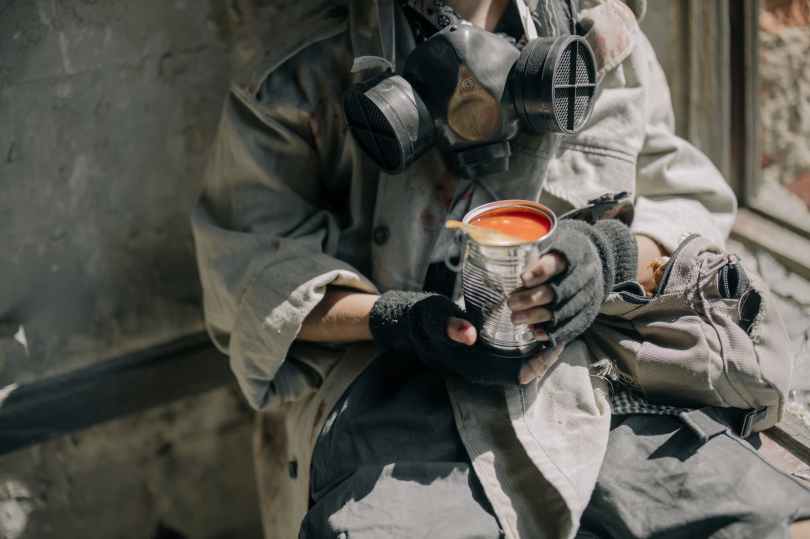
The Collect throughout Advent petitions for grace to ‘cast away the works of darkness’. Looking at the world today it can feel that this call continues to go unheeded. Both cold and darkness will be the experience for many people, some of whom would never have imagined a time when they would need to choose between eating and heating. In the trenches and dugouts of Eastern Ukraine, soldiers will face winter warfare away from family and friends. In a world where wealth abounds for the few, most will struggle to find the basic securities and necessities of life. There is little need for ghost stories when the grizzly realities of life are so close at hand.

Once lost, it is never easy to retrieve from darkness the things we took for granted. Nevertheless, both Advent and Christmas feed the imagination of a better time; a more just world; and salvation from our own, dreadful, folly. Churches – at the only time of year when many people attend – are charged with holding out the vision and promise of something more worthy of our potential. To speak especially to ‘the people who walk in darkness’ and to stand with those who know their need of God. During the next few weeks we shall invite people in to taste something of the ancient hope the church is called to cherish and proclaim. More often than not, it won’t be the powerful who ask for grace so that we might live in light. As the poet Stewart Henderson puts it:

Don’t miss Christmas –
the splendour of it all
our brittle, gift-wrapped anthem
sleeps in a cattle stall
as the poor and lost and starving
weakly start to sing
it seems only desperate subjects
recognise their King.

Extract from: Stewart Henderson, Don’t Miss Christmas’

Waiting & Hoping

While standing on the platform, expecting a train to Machu Picchu, I noticed the sign to the waiting room. In Spanish, a waiting room uses the word associated with hope (‘la esperanza’): it is the ‘sala de espera’. At times it can feel in the UK that ‘hope’ would be a more fitting description for a waiting room on our less reliable routes. However, it led me to ponder whether there is any real distinction between waiting and hoping. Looking up the Spanish led me to an interesting thread, which includes discussion about the Bible translations of the two terms. Although there are alternative words in Spanish, in many cases – where either waiting and hoping would be used in English translations – it is the single verb ‘esperar’ that is favoured.

Perhaps the principal difference lies in the passivity of waiting. As with the example of a train station, waiting is what precedes movement and change. On the other hand, hope can be part of the journey. The people who travel from across the world to Europe, or across the border in the USA, are hoping to find safety and a new way of life. Writing about hope and waiting in the lives of migrants, Bendixsen and Eriksen ask questions about the different ways in which this can be experienced by people in an uncertain state of seeking refuge:

“What is it that we ‘do’ when we wait for something, given that waiting is normally defined as the opposite of ‘doing’ something? In what way can waiting be converted into political resistance? Waiting does in fact entail an engagement based on anticipation – an in-order-to motivation – of an improved life. How do conceptualizations of the future influence the ways in which people wait? And what can we say about people’s capacity to act in future-oriented ways even in a condition of temporal limbo?”

Bendixsen, S., & Eriksen, T. H. (2018). Time and the other: Waiting and hope among irregular migrants. Ethnographies of waiting: Doubt, hope and uncertainty, 87-112.

In his seminal book The Stature of Waiting WH Vanstone sees in the act of waiting the unfolding of Christ’s purpose. From the moment when Jesus is handed over to the Roman soldiers his willingness to be subject to the actions of others becomes the driving force of his mission. Here, waiting is not an absence of purpose but the only way in which salvation can come.

There are many things that can incline someone to journey hopefully. Often there is a life-long dialogue between the difficult experiences that are all too real, and the hope that is far more than simply wishful thinking. Such hope is strongly connected to the now, and sees the world as it could be and should be. Because of this connection hope itself is not static, but shifts as both our understanding and desire grow. Most often it is killed off by certainties we have decided are fixed and beyond change. For anyone finding faith difficult, Ronnie Scharfman expresses both the struggle to hope, and the hope-against-hope that faith might be found in the struggle:

I have always hoped
that struggling towards You
is You.
But I am never
sure.
And that is, perhaps,
You, too.

Ronnie Scharfman, ‘Prayer’ in The Poet’s Quest for God, 21st Century Poems of Doubt, Faith and Wonder, ed. Brennan, O., Swift, T., and Myddleton-Evans, C. Eyewear Publishing Ltd., London. 2016

The hope of faith during Advent requires courage. It is a time when the liturgy of the Church makes no bones about the darkness and suffering of the world, or the fact that the world as we know if will come to an end. Given the multiple crises assaulting the planet at the moment this seems less difficult to imagine. Holding any hope is an act of courage – a defiance of doom and a way to connect with others who share the idea that there is a better way. Perhaps this brings waiting and hoping back together, because our hopes are seldom realised quickly, and dissatisfied waiting can be a vocal irritant to the people who block the path to change.

Cartoon Catastrophe

In the cycle of the Church’s year we are now in the ‘Kingdom Season’. It lasts until Advent Sunday and features a lot of readings from apocalyptic Bible passages, with an emphasis on judgement and the end of the world. The season concludes next week with the last Sunday in the Church’s year – a celebration of Christ the King.

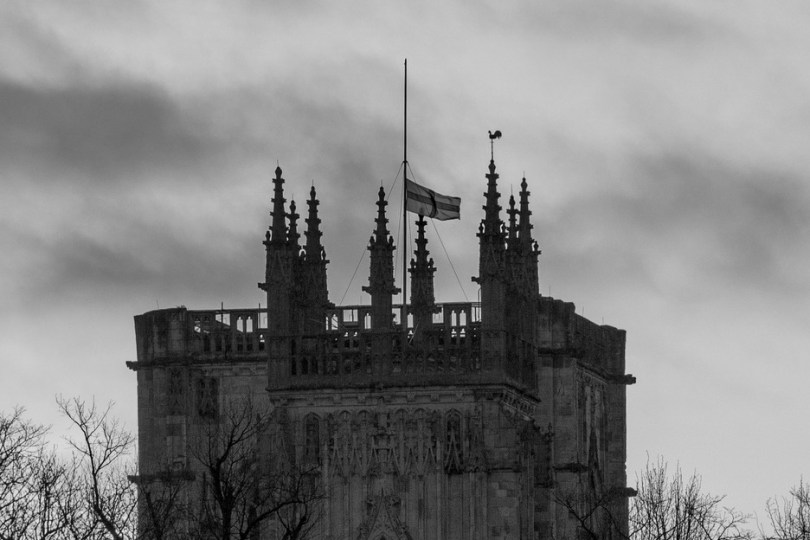
Sitting in Morning Prayer at York Minster during these days matches the appointed readings to the panels of the Great East Window. It is an experience that spans time. The Book of Revelations probably dates from the final years of the first century AD. The window was constructed between 1405 and 1408, and I ma sitting listening to one, and looking at the other, in the year 2022.

In some respects the window feels like a cartoon strip telling the story of the Book of Revelation. A way for people with limited reading ability to follow the Biblical account of the end times. The colours and depictions are vivid, with suitably grim and menacing monsters and angels variously inflicting several plagues. Each frame gives life to a passage from scripture, which can easily be followed with the excellent navigator website. Given the content of apocalyptic literature in the Bible, it is hardly surprising that it has enjoyed a very mixed reception. For George Bernard Shaw Revelation is “a curious record of the visions of a drug addict”. DH Lawrence hated it so much that he wrote his own commentary.

It is certainly true that outside the context in which it was written, the text is often puzzling and perplexing. When I did a course on the Book of Revelation in the 1980s, I recall being told that the text was meant to be heard – to be read aloud. Maybe it sits uncomfortably on the page because the visions and drive of the apocalypse is designed to be a crashing and pulsating narrative. The various sequences and repetitions suggest that this may be right.

In March 2020 many may have felt that apocalyptic events were unfolding in our own time. Perhaps there was an expectation that, however difficult, this was a trial humanity had to undergo before sunnier days would commence. Writing in the final weeks of 2022 it now appears that crises of major proportions are fact of life. Maybe there is something in the Book of Revelation that suggests an initial calamity precipitates subsequent disruptions? In choosing ‘permacrisis‘ for its 2022 ‘word of the year’, Collins Dictionaries is reflecting the challenge people are experiencing in attempting to return to turbulence of more familiar proportions. Along with the continuing lack of inter-governmental action on climate change, evidenced by the debates at Cop27, there is growing awareness of the plummeting diversity of species on the planet. It is certain that climate change and loss of biodiversity are connected issues. More and more of our planet bears the fingerprints of human involvement and, consequently, there is a vanishing number of true wildernesses in our world. On top of which, this year is likely to be the warmest on record for the UK.

Perhaps in the last 50 years we have become accustomed to a significant level of control in our economic and social order in the West. This is an exceptional experience for any human society, but there is plenty of compelling evidence to speculate that some fundamental issues may overpower us. In this respect at least, we have something in common with those who first heard the revelation of St John the Divine. Individually there is only a small amount we can do to meet the permacrises of the present. It requires a bigger and more international solution.

The apocalypse literature of this season encourages us to consider the shape of the future if we don’t change. The books of Daniel and Revelation suggest that we cannot predict the future as confidently as we should like. The dizzying imagery of these visions remind us that we sow today what we shall reap tomorrow. Both in personal faith and actions of collective responsibility, we cannot ignore the consequences of our actions. Apocalyptic literature should focus our minds and stir our spirits to work for a future where there is hope for our world.

The Hollow Crown

Part of what was so moving about Thursday’s events, was the experience common to so many families of sudden and unexpected news; the dash to a bedside; the realisation that life is ending. As a hospital chaplain I witnessed on many occasions the anxiety of families as to whether everyone would get there in time, the inevitable sorrow once the moment of death arrived, and the imperceptible shift in relationships that death precipitates. In many instances a death can be the end of an era. The moment when some familiar conversations about long-deceased relatives and neighbours are no longer possible.

The BBC series, The Hollow Crown, began in 2012 and featured several of Shakespeare’s history plays. It was a tour de force of casting and direction and will no doubt remain an important part of the BBC’s archive. One of the sublimely acted moments featured Simon Russell-Beale as the comic character, Falstaff. Sitting by a fireside at night, Falstaff reminisces with Shallow and Silence about the days of their youth. It is at once a sad and honest recognition of our mortality, and the days that pass so quickly.

Certain, ’tis certain; very sure, very sure: death,
as the Psalmist saith, is certain to all; all shall die.

King Henry IV, part II, Act 3, Scene 2, William Shakespeare 1660

In the conversation about their past, the protagonists avoid detail. Although the play is set in another era, looking back over the 55 years from the date of its performance, audiences would recognise how dangerous it was to discuss history. The beliefs, convictions and actions of one period could bring plaudits at the time but a decade later put someone in peril of trial and execution. It was much safer to say simply: ‘Ha, cousin Silence, that thou hadst seen that that this knight and I have seen!’

We do not now live in a country that presents this kind of risk. There may be a social expectation about public conduct and comments during the period of official mourning for the Queen, but there are no punitive sanctions. We can speak about the past, and voice convictions that may be at odds with the prevailing mood. This is not a freedom enjoyed everywhere and, travelling in Cuba some years ago, I was aware of how cautious local people could be in speaking about their society and its history.

The title for the BBC series is taken from Richard III and concerns the mortality of kings: ‘within the hollow crown That rounds the mortal temples of a king Keeps Death his court’. Despite all the layers of privilege and deference, sovereigns are mortal and death can come quickly. The empty crown is the enduring motif of royalty, with its void filled instantly, silently and seamlessly, the moment its last occupant dies. In the past this could be contested and fought over, whereas now the British monarchy’s succession is no longer disputed. After a reign of astonishing longevity, while its trappings and function may change, the likely succession of sovereigns appears guaranteed deep into the 22nd century.

While in no sense a presence in people’s immediate relationships, the departure of the Queen will be felt by many as the loss of a vital connection with the past. Her experience of WWII, and Prime Ministers from Churchill to Truss, highlight a consistency spanning generations. On the news of her death my thoughts went to my mother and grandmother, both keen supporters of the Queen. As an early and life-long member of the Mothers’ Union, my grandmother was an active participant in an organisation for which the Queen was Patron up until the moment of her death.

The poet John Donne was 31 years old when Elizabeth I died in 1603. His subsequent rise to become Dean of St Paul’s relied on Royal patronage, and was accompanied by the composition of some of the finest Metaphysical poetry in the English Language. Donne was very concerned with death, and one of his most memorable texts adopts the idea of literature to explore his theme.

When someone dies: “one chapter is not torn out of the book, but translated into a better language; and every chapter must be so translated; God employs several translators; some pieces are translated by age, some by sickness, some by war, some by justice; but God’s hand is in every translation, and his hand shall bind up all our scattered leaves again, for that library where every book shall lie open to one another”.

John Donne, Devotions Upon Emergent Occasions; Meditation XVII.

Understandably, the Queen’s life contained a series of volumes – possibly its own library – of public interactions and comments. Not to mention the private moments, the scattered leaves, that are also part of our story. She is now being translated into posterity and, spiritually, to a better place. To give Shakespeare the final word, even a long and notable Royal reign is fleeting in the sweep of human history. Our time on stage comes to an end and, when the ‘insubstantial pageant has faded’, no grandeur alters the truth we all hold in common: that ‘our little life is rounded with a sleep’.

Shock and Fear

In the suburbs of London it was odd to read a report where the cost of civic responsibility was described as the price of avoiding revolution. The article was in a local Barnet newspaper in 1910, and the revolt referred to which it referred was the French Revolution of 1789. The reference shows the very long shadow cast by that event across European popular thought. The comment arose in a discussion about the cost of poor relief in the borough. Business and property owners were moaning about the expense of looking after the poor, and it took a female member of the group to remind them that ‘charity’ was the price they paid to retain a system from which they benefitted considerably. Today, with the rapid rise of the ‘Enough is Enough’ campaign – uniting all kinds of people under the banner of unacceptable price increases – it appears that the prospect of popular agitation will force the hand of the next Prime Minister. However, rather than alter the operation of an economic system that favours the wealthy, just enough money will be dispersed to appease the masses. It remains to be seen whether we can continue as we are when an ever greater number of people fall into, or hover just above, poverty.

With what seems like a void at the heart of Government, there has been plenty of space for experts to voice their concerns about this unfolding energy crisis. Martin Lewis was clearly very angry when he spoke on Radio 4 on Friday. With appealing directness he defended ‘catastrophising’ for the very simple reason that, in the absence of Government aid, the energy price rise is a catastrophe. As someone who normally advises the less well-off about ideas to manage their funds more effectively, he had reached the point where he had nothing left to give. With a reputation built on creative solutions, the prospect of a financial dead-end for countless people had pushed Lewis to the edge.

It seems unlikely that the incoming Government will be able to replace the entire cost of rising energy prices across the economy. The suggestion so far is that low and middle income household will be supported – but it’s unclear what aid there will be for industry. This matters because without support industries will have little option other than to pass on price rises to consumers. It follows that inflation will remain high and, with below-inflation pay rises, people will be poorer. For this reason, even if there are funds to offset energy price rises, everyday life will in any event become more costly. People will have less cash, and even if gas and electricity bills remained the same, households would have to achieve savings in order to make ends meet. Heating or eating will remain a pressing question, because it is unlikely that government action will wholly mitigate the price rises that will touch every part of our economic system. The cost would be astronomical.

Macron said France and the French felt they were living through a series of crises, “each worse than the last”.

Quoted in The Guardian, 24 August 2022

Last week President Macron (according to Truss, a former ally of the UK), gave a very sombre speech. While criticised in some quarters for appearing to ignore those already suffering in France, Macron heralded the ‘end of abundance’. For the middle classes upwards this is perhaps an accurate description of recent decades and a warning that these days are over. To be fair to Macron, he described recent years as those which ‘could have seemed an era of abundance’. Perhaps, as we progress through the 2020s, there will be a growing appreciation that any sense of abundance belongs to an ever-shrinking group of people.

I have written previously that, by many measures, we are living in unprecedented times. The rise of food banks will now be augmented by the opening of ‘heat banks’. Public places where people can leave cold homes and gain some warmth and company. Quite what it will be like for people unable to leave their homes, or too far from heat banks, is yet to be seen. There are a host of medical conditions that will be aggravated by the cold, and in some cases it will lead to deterioration requiring hospital care. Once again we will have exceptional winter pressures in the NHS, whether or not COVID re-emerges as a significant issue.

One of the most worrying elements of the current crisis is the way it is impacting on households where two people are in work. When once this would have achieved enough income without support, people are facing in-work poverty. Even hospitals are contemplating hosting food banks to support their staff. A major achievement of the welfare state is that it moved support away from charity and promoted it as the organised actions of a just society. People didn’t need to feel ashamed or grateful. It was what ‘society’ meant, and offering support as a basic requirement was what people should expect. When Liz Truss, who is very likely to be our next Prime Minister, spoke about not wanting to give people ‘handouts’ it flies in the face of the post-war conception of society (but is very Thatcherite). A society which perpetuates a system excluding more and more people from a basic quality of life cannot go on indefinitely. I’m not advocating revolution – but it is something that becomes ever more likely as more and more people reach the point where ‘enough is enough’.

Repurposed

Former generations excelled at avoiding waste. My grandparents, having lived through two Word Wars, knew how to make sure that seemingly useless packaging, or clothes that were coming to end of their life, found a fresh purpose. Growing up in the 1960s and 70s this seemed to me to be a needless attachment to things best thrown away. I appreciate now that if more of us had living with their attitude to possessions the world now might be a better (and cooler) place. The disposable society is minting new mountains of refuse every day. By and large, we have not lived carefully with the planet or appreciated the consequences of a cultural attitude of ‘buy-and-bin’.

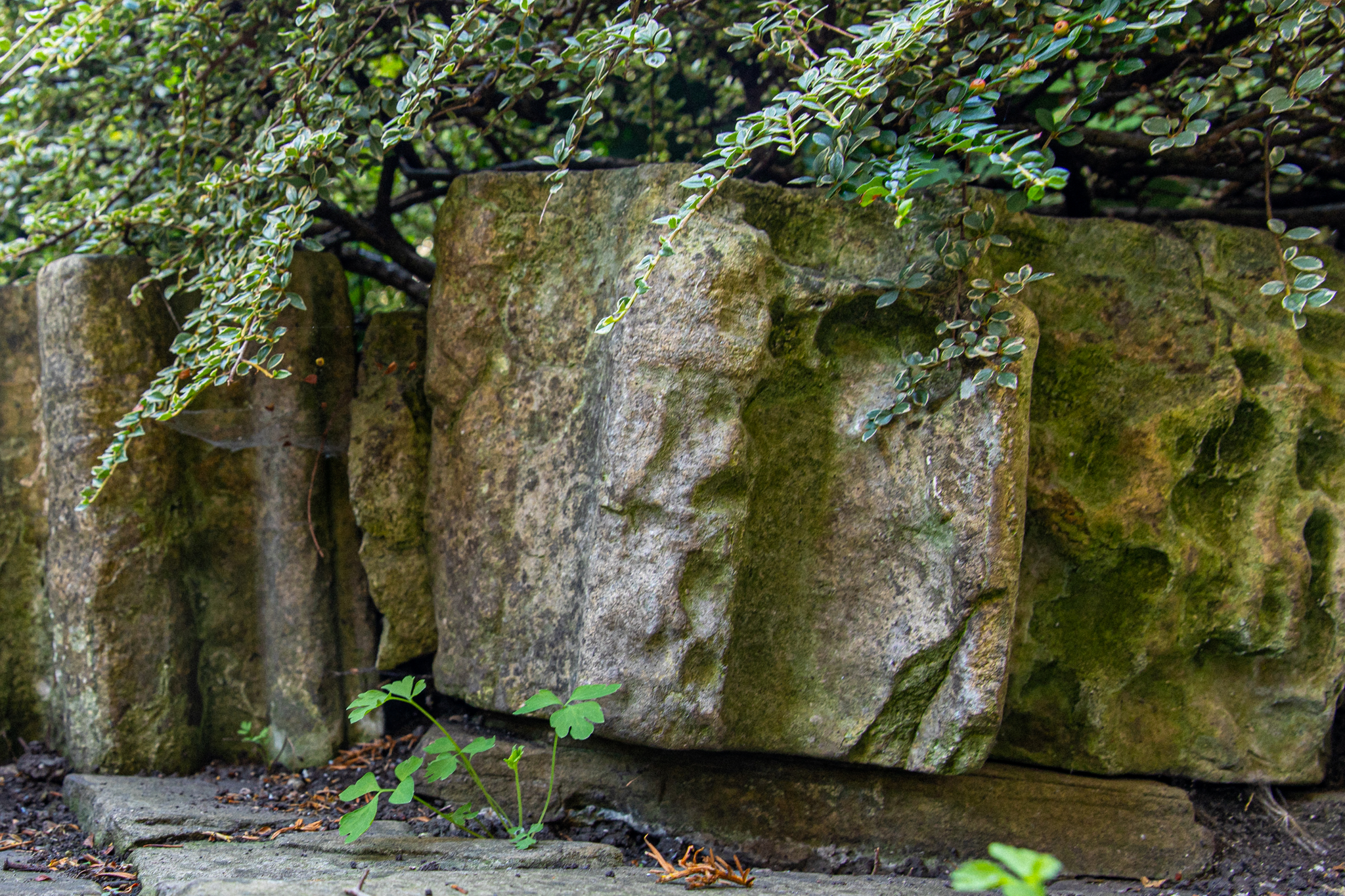
Living in York I am reminded of the care and thought that has gone into repurposing things that have come to the end of one life, and begin another. Whether the eroded masons’ work, now removed from the Minster, that forms a border in the garden, or the spectacular pinnace – replaced in the last decade – which sits in the grounds of the Deanery. (It is pictured at the top of this blog, lit with tea lights). In some ways this recycling can be functional, in others a curiosity, like the stonework brought down to ground level from well over 100 feet.

Eroded masonry from York Minster is often used in nearby gardens to form borders.

Last week a news report feature one of the UK’s largest centres for ‘upcycling’. Here, items that would normally have gone into landfill are careful brought back to life and refreshed so that they can continue to be used. In some cases items find a new purpose – perhaps in a garden or elsewhere around the home. Seeing the large warehouse full of items awaiting attention was a salutary reminder of how much we dispose of without a second thought as to value, purpose or potential.

“Every single one of us is a little civilization built on the ruins of any number of preceding civilizations, but with our own variant notions of what is beautiful and what is acceptable – which, I haste to add, we generally do not satisfy and by which we struggle to live.”

Marilynne Robinson, Gilead

Physical ruins are a visible reminder of the fragments of re-purposed ideas; conventions; and language, which are part of our current reality. Like the rubble of Roman occupation on which York Minster is built, we know that the civilisation of two thousand years ago is visible in our road system and forms of political administration. Very little is without precedent and each generation makes use of the past in its own way. Perhaps we are rather better at recycling (or up-cycling) ideas than physical items. Certainly politics seems to offer little more than various re-castings of former ideologies. The process to find a new leader for the Conservative Party – and Prime Minister – has candidates raiding the perceived ‘glory days’ of Thatcherism to curry favour with a nostalgic party membership.

Christianity is a material religion. The incarnation fuses matter and spirit, flesh and breath. God is not separate from this reality and, when discarded and destroyed, Jesus is encountered in resurrection as a physical being. As the central event of the Christian faith, this divine refusal to abide in death suggests that even our most disastrous experiences can never be wholly written-off. Like Lazarus in his tomb, we may find ourselves unexpectedly dragged back into life. Whether it be the prodigal son; a disgraced woman cast before Jesus; or the sick separated from society, God appears to be unusually concerned with what we rubbish. As the UK heads towards what the NHS Confederation this week characterised as the risk of a ‘humanitarian crisis’ it is the responsibility of the Church to speak and act to ensure that we are not complicit in forgetting people below the political horizon. Healing and restoration abound in the presence of Jesus and the Church cannot be itself without fulfilling the same mission.

“Bricolage involves skill in sewing, mending, refashioning, and building, but it also involves perception of possibilities and imagination; one must wonder what things might become once they can no longer be what they were…”

Lang Hearlson, C. (2021). Theological imagination in a throwaway society: Contending with waste. Theology Today, 78(2), 158-169. Chicago