The Fourth Craw

Recently I was given charge of a baby. Thankfully this was only temporary, as mum went with her older son for the start of his first day at school. We were visiting family in Scotland and I was delighted to spend a short while with this delightful child. However, it is some time since I last looked after a baby, and this level of responsibility does not come without anxiety! In my attempts to entertain the bairn, I wondered what nursery rhymes might be familiar to him – and this is when I discovered the ‘Three Craws’ (described as a Scots classic).

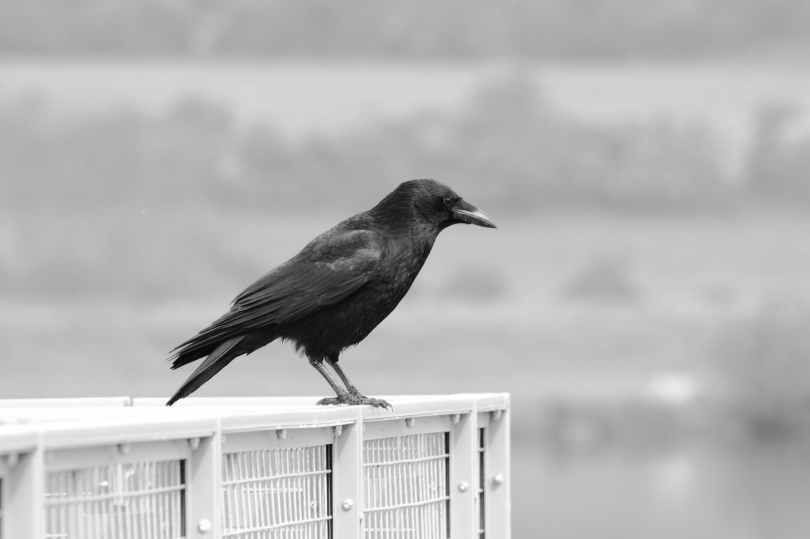
The ‘craws’ would be known in England as crows. In Scots it is a fine onomatopoeic rendition of the cry which the birds make. The craws in the rhyme are not doing very well. The first craw is crying for its mother; the second has broken its beak; the third is unable to fly. With the kind of simple repetition that makes the most effective nursery songs, each verse describes the crows sitting on a wall, sharing their woes on a cold and frosty morning. (It should be noted that the content of these verses varies, and people add their own).

At the end of one of the versions of the Three Craws, there is reference to a fourth craw – The fourth craw wasnae there at a’. It is an intriguing way to end. The rhyme is known as the Three Craws. The final craw never makes an appearance. Does this craw even exist – is it part of the gang? The song has a fourth craw, and yet it doesn’t. This bird is lacking, and seems to be the culmination of the losses that precede it. The craw missing its mother; the craw whose health has been impaired by a broken beak; and the craw unable to fly. It is an odd conclusion for our attention to be drawn to what is wholly absent.

A poetic response to this missing figure has been created by the Glasgow-based academic and writer Nalina Paul. The work is entitled The Fourth Craw and perhaps reflects the power of narratives as they emerge from the darkness of absence – the sparks of our imagination kindled by our earliest encounters with song and story:

Too much is said about night –
its fullness jug-heavy with distance
poured out into star-mapped flight.

But in the sky, protecting her addled head,
was a strange sense of grounding –
as if light were solid, for standing.

And from these things –
sparks in the high darkness
a smouldering moon –
came music, the raven’s song.

Its sound could wither the feathers of eagles
make fire from ice
play tricks with existence
changing form at a whim.

In the dim-lit great hall of glittering stories
the broken shine of the moon crackles.

Nalini Paul ‘The Fourth Craw’ 2015

The fourth craw is an absence and also an invitation. Travelling through Glencoe a couple of weeks ago I was reminded how much the landscape of Scotland fires the imagination, and has inspired many different forms of art. The colours and textures of the mountains; burns that gush with great force after the regular downpours; and trees lousy with lichen, branches encrusted in moss. Glencoe can hold a magical, childlike, atmosphere – even before it is layered with human narratives of heroism and betrayal. Sadly, as walkers and climbers discover every year, it can also be a very dangerous place.

The Three Craws suggests that, when we lament or suffer injury, being in company can make a difference. The birds are a small community of sorrow, who end by sharing an experience of the fourth bird’s absence. Even at a young age it appears that we prepare people for one of the central experiences of life, as well as providing the space for wonder, and the work of our imagination.

What is Life?

John Clare asked the question ‘what is life?’ at the beginning of his poem of the same title. It is a work that reflects the angst and instabilities experienced by this notable English poet. A figure who emerged from a family of agricultural workers, did a range of manual jobs, and came to be favoured by people of literary society. Clare’s emergence as a poet was partly driven by financial distress, and the need to generate funds to prevent the eviction of his parents from their home.

And what is Life?—An hour-glass on the run,
A Mist retreating from the morning sun,
A busy, bustling, still repeated dream;
Its length?—A minute’s pause, a moment’s thought;
And happiness?—A bubble on the stream,
That in the act of seizing shrinks to nought.

John Clare, included in Poems Descriptive of Rural Life and Scenery, 1820

Clare’s experience of life was distinct from other poets who were writing in this period. He was employed in what are often considered to be basic occupations. He would have known the relative powerlessness of his position in the social order, and how much material well-being rested on the decisions, patronage and preferences of wealthy people. The poem’s opening words assault us with a question that is both profound and also indicative of a question that has prompted the poet. It feels like a retort to someone who is pontificating about the value, pleasures and virtue of life.

The response of the poet is to focus on the ephemeral nature of our existence. Not only that, but even when we encounter a time of happiness, it is merely ‘a bubble on that stream’. If life is brief than Clare tells us that our better moments are simply an even more fleeting by-product of the water’s turbulent churn. A fraction of bliss in an otherwise downward torrent of vain hopes. In a life of brevity, happiness is a reprieve that bursts as soon as it encounters the rocks that lie all around.

I have always been rather suspicious of happiness. Perhaps that’s due to an American interpretation of it that has come to dominate our perceptions of a good time. There is a whole industry dedicated to what happiness is, and how to promote it. Inevitably, there is a lot of interest about this in marketing, where our perceptions of life can be harnessed to the priorities of consumerism. Any deficiency in our sense of well-being can become a target for products and experiences we are told will fill the void and deliver our happiness. Psychology and spirituality may often be drawn into this tension of anxiety; unsatisfactory lifestyle solutions to our needs; and consequent disenchantment. There are several ways in which happiness is identified and calibrated, such as the Oxford Happiness Questionnaire. This was influenced by the following understanding:

Argyle and Crossland (1987) suggested that happiness comprises three components: the frequency and degree of positive affect or joy; the average level of satisfaction over a period; and the absence of negative feelings, such as depression and anxiety.

Francis, L. (2010). Religion and happiness: Perspectives from the psychology of religion, positive psychology and empirical theology. In The Practices of Happiness (pp. 113-124). Routledge.

While I am sure that such tools and schemes of analysis have their uses I would question the particular concept of happiness that underpins the method of enquiry. In many respects the surveys appear to deal with a sense of well-being which is then conflated with happiness. These things are not the same. Twentieth century influences tend towards a very individualistic form of happiness, albeit that this may incorporate those people to whom we are closest. However, where is the political dimension that addresses how much our happiness (e.g. meaning, for some, to do what we want) is paid for by the misery of others? There are some researchers who have identified problems in the Western conception of happiness, advocating ‘an alternative approach, relational wellbeing, which is grounded in a relational ontology that can challenge dominant ideologies of the self’.

Religions have often had a complicated relationship with happiness. There is a recognition that, like a bubble on a stream, happiness can be momentary and elusive. As one hymn puts it: ‘Fading is the worldling’s pleasure’. Faith offers something that is not transitory. The focus is about wealth that does not decay – treasure we encounter now, but will experience fully in a life to come. There are risks with this conviction but also great possibilities. Not least, to live in some kind of peace with the world, and find value and joy in relationships. Challenging the narrow focus of ‘my’ happiness and focusing instead on our collective shalom seems a much healthier and constructive path to take. Perhaps then we might even discover that our personal happiness is what we are most likely to find we have when we have ceased to look for it.

A Bye Corner of the Kingdom

These are the words Laurence Sterne used to describe the vicarage at Coxwold. A ‘retired thatched house’ in a place remote from the concerns of even a provincial city, such as York. Perhaps Sterne did not see this as a promising location from which to change the course of world literature. It is difficult to imagine what life in a remote Yorkshire village was like in the 1700s. Far more people worked on the land, while today the holiday cottage dwellings mean occupancy fluctuates each week, and there will be seasons when only a few people inhabit the place. The population was 348 in the early 19th century – and 250 in 2021.

Despite a limited literary output, Sterne’s work is recognised for its transformative impact on the course of Anglo-Irish literature. It was an influence for James Joyce, Salman Rushdie and many others.

Sterne was adept in deflating many of the pompous debates of his time. In chapter 20 of the first book of The Life and Opinions of Tristram Shandy, where birth is such a central theme, there is a digression about the baptism of babies before they are born. The view in Catholic circles to this point had been that at least some part of the baby must be born in order for a baptism to take place. Inevitably, there were circumstances when the baby had died in the womb and where it was believed that baptism was impossible. (There is a history in northern Europe where the Church operated ‘Resurrection Chapels’ to enable the baptism of a baby which was stillborn – Swift, p.119). However, the debate that Sterne cites in this section of the book looks to marry advancing technology with the possibility that a baptism could take place before birth:

Le Chirurgien, qui consulte, prétend, par le moyen d’une petite canulle, de pouvoir baptiser immediatement l’enfant, sans faire aucun tort à la mere.

The surgeon who raises the question asserts that by means of a little injection-pipe he can baptize the child directly, without doing any harm to the mother.

Sterne, L. (1759). The Life and Opinions of Tristram Shandy, Gentleman (reissued).

In this debate Sterne is not oblivious to the dubious nature of a suggestion, in which male medics and male theologians decide that a medical procedure – with no medical benefit – will not result in any harm to the mother. In his imaginative response to this scholarly discussion Sterne takes the argument a stage further, and suggests that one way to avoid any doubt in the matter would be to baptise all of a man’s sperm. (This reflects thinking at the time that there was a fixed stock of sperm containing ‘homunculi’ – minuscule people ready to grow once in the womb). Chapter 20 concludes with the thought that a little injection-pipe could be inserted into the man (‘sans faire auxin tort au père’), between marriage and consummation, to ensure a ‘shorter and safer’ way to baptism. The reader is left to ponder whether male theologians and medics would find this a better solution.

Simultaneously this passage hints at how medical technology might affect sacramental practice, while lampooning male discussions which determine what will do no harm to women. In pushing the ideas further, Sterne discomforts his male readers – and certainly amuses his female audience – in suggesting that sticking a cannula into a penis would be more effective ‘without doing any harm to the father’. It would also provide an interesting ceremony on the day of the wedding.

St Michael and All Angels, Coxwold – where Laurence Sterne served as a priest.

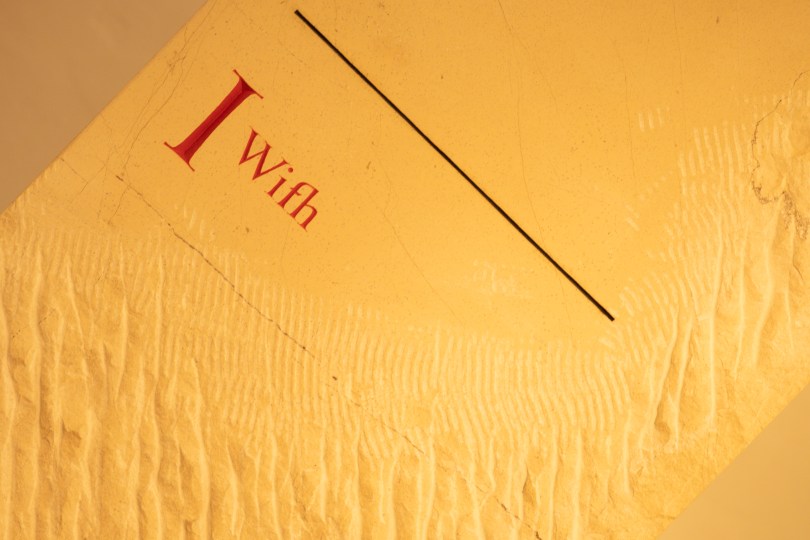
If Coxwold is a ‘bye corner of the Kingdom’ it didn’t stop Sterne writing some of the most adventurous and sophisticated prose of English literature. Thankfully, The Laurence Sterne Trust continues to stimulate interest in the author’s legacy and enable artists to engage with his work. In its most recent exhibition a range of creative people have been challenged to interpret the opening words of Shandy – ‘I wish’ – to reflect on their response to the text. This vibrant exhibition is a fitting contribution to the 50th anniversary celebrations of Shandy Hall’s existence as a public museum.

A Spell of Eternity

I come from that part of the world where a splinter in a finger might also be called a ‘spell’. Some years ago, researchers in Cambridge investigated the many words in the UK employed to describe a small piece of wood lodged under the skin. Spell has been used in the north of England, and was common until recent years in Lancashire where I was born – and in Yorkshire where I live. As I write, I am using splinter and spell to mean a small fraction of something much larger and, perhaps, an occasional cause of discomfort.

Departures from any community, rather like dying, tend to elicit comments that would not normally be made. As I left work at MHA there were many cards and words of appreciation, and this led me to reflect on what it is that a chaplain’s presence brings to any organisation. During nearly 30 years of working as a priest in secular settings, it has been rare for people to express their thoughts and feelings about what I have brought, other than by offering thanks in general. Rather like the cliché of ‘nice sermon, vicar’, while appreciation can be welcome, it is difficult to identify the elements of value if feedback is vague. Perhaps it is only at the point when something is taken away that the void becomes an impetus to articulation. Many writers have expressed the kind of sharp question posed by Jeanette Winterson: “Why is the measure of love loss?”

Research about chaplaincy inevitably focuses on the most tangible aspects of the role, such as active listening and the impact of specific rituals. There is far less literature concerning the chaplain’s identity and how the characteristics invested in the person of the chaplain (such as ordination) contribute to the kind of relationship that emerges during the practice of pastoral care. For example, that the chaplain might be a boundary-spanner for a variety of connections, including a physical church (when patients ask: ‘where’s your parish?’); reality beyond the present situation (e.g. heaven); links to people who have died; and association with a wider community or body of co-religionists. Often this can prompt or facilitate conversations which may not find an outlet during other interactions.

“Chaplains were identified as being impartial and having a shared discourse and experience which enabled patients to address existential issues that would promote their health and well-being that they felt unable to discuss with staff or family”.

Allison, E., Woodhall, J., Briggs, M., & Swift, C. (2023). Reconfiguring the health-promoting hospital: the role of chaplaincy in England. Health Promotion International, 38(4), daad068.

Being the temple-person, the cleric whose way wove between sanctuary and suffering, seemed to mimic for some people the connection of now with forever; temporal pain and eternal peace. At times – and perhaps especially at moments of departure – there might be a glimmer of this experience as people describe what they feel they are losing.

“You have always been a very reassuring presence around the building. It’s as if everything, whatever it is, is going to be ok because you’re there. Your very presence helps to create a sense of perspective about things and you might not realise that. Your humour definitely helps too!”

Personal Communication; 28 July 2023

I recall an Intensive Care nurse saying, many years ago, that when I was on the unit there was a distinct sense of calm. We didn’t explore that any further, but I took it to imply that the presence of a chaplain conveyed a sense of perspective, of a particular moment set in a much broader scheme of time, meaning and purpose. The chink of light in an opening door. It may be due to the heft of this perception that it is spoken about so rarely. Perhaps language might diminish the experience?

I need all the rage I can muster
to keep this calm; to sculpt space
to hold shifting, fragile colours.

Manon Ceridwen James, A Priest at a Funeral in Notes from a Eucharistic Life

The perception of a chaplain, rooted in particular associations, may shape space in a particular way. Like the communion kit and closed curtains that turn a hospital table into an altar, and the bedside into a sanctuary, signs are inherent in the chaplain’s presence. Despite our many failings and shortcomings, for some people some of the time we are spells of eternity. The splinter that irritates the skin of our self-assurance and certainty: a fraction of what is beyond our imagination. It is little wonder that humour is a necessity when bearing (or being?) the sign of something of such unspeakable scale.

The Cut Air

The garden is blissful in July late-in-the-day light. A blackbird calls in agitation from the margins of the lawn. The dog’s ears are pricked: perhaps there is a cat? Beyond the Georgian brickwork of the canonry the large mass of the Minster looms and the cry of a peregrine rises above the murmur of tourists in the precinct. Pigeons flutter hither and thither in alarm. At one point the scream of swifts breaks in, sudden and insistent, as three sets of scimitar wings slice the evening air. They appear and disappear in a moment. Bees toil amongst the lavender. In the walled garden the soil turns up fragments of clay pipes and not far below the surface there will be scaps of Roman detritus – ashes under Eboracum.

Sleepers over oceans in the mill of the world’s breathing. 
The grace to say they live in another firmament. 
A way to say the miracle will not occur, 
And watch the miracle.

Anne Stevenson, Swifts

Time stands thick in the bulk of the cathedral, the rustic garden bricks, and all that lies below. The long-dead masons and glaziers knew nothing about cluster bombs, and their small fires did little to harm the health of the world. Yes, there was fear of disease and the panic stirred by the silhouette of a longship appearing down the Ouse. Progress has dispelled misery but also birthed new anxieties. Now an exceptionally warm day can be an omen of humanity’s expansion and consumption, of heat that will change the way we live and drive the poorest to destruction. Our fingerprints are everywhere, with little but the length of days escaping some change wrought by our manipulation.

It is necessary to hold a balance between this becoming-future and the peace of an evening hour. Undoubtedly there is an imperative to act, but there is also a need to sit and stare, and savour the gift of all we must strive to save.

Behold, we know not everything;
I can but trust that good shall fall
At last – far off – at last, to all,
And every winter change to spring.

From In Memoriam A.A.H., by Alfred Tennyson

Milk to Faith

What, I wonder, do we ask for in prayer? I am thinking in particular of moments when we might petition to know God more fully; more deeply; more intimately. Perhaps our wish is for only the slightest indication that God is present with us – of no more substance than the passing brush of a moth. Often we prize these glimpses and signs, feeding on them for many years after the event itself.

In characteristic style, John Donne had no truck with these modest expectations of divine encounter. In one of his sonnets Donne demands a much more forceful – even brutal – experience of God:

Batter my heart, three-person’d God, for you
As yet but knock, breathe, shine, and seek to mend;
That I may rise and stand, o’erthrow me, and bend
Your force to break, blow, burn, and make me new.

Batter My Heart John Donne 1633

It is a metaphysical poem par excellence, full of paradox, wit and irony. In the relationship between the poet and God Donne pleads to be overpowered, even referencing in the opening line that the individual soul is outnumbered by this God of three persons. It is the text used for a remarkable aria by the contemporary American composer John Adams, in his opera Doctor Atomic. The opera concerns the first test of an atom bomb, known as the ‘Trinity’ test, a designation reflecting Robert Oppenheimer’s fascination with Donne’s poetry.

Jefrey Johnson, in his book about the theology of the 17th century dean, identifies the Trinity as Donne’s seminal Christian belief. As Fred Sanders put it some years ago, having examined his poetry and sermons, this belief was centred on the concept of sacred community:

That God is a unity rather than a singularity, a communion rather than a monad. And as we gather our scattered selves into the act of worshiping the triune God, we become more unified, more focused, more truly ourselves.

Fred Sanders: Today is John Donne’s Birthday, blog 2009

The visceral tone of Batter My Heart reflects Donne’s passionate desire to surrender the whole of himself to God. This is no insipid theology of cautious approach, but a demand to be broken, blinded and burnt in order to be restored; to see aright, and emerge, phoenix like, as a new creation. Left to the intellect alone the Trinity might remain a stumbling block and cause of confusion, but when engaged as God-in-community Donne sees the doctrine as a vibrant expression of sacred relationship. Perhaps it is for this reason that in his Litany Donne recognises fundamental differences between an approach to the Trinity that draws on philosophy and one where faith is placed at the heart of things:

O blessed glorious Trinity,
Bones to philosophy, but milk to faith,
Which, as wise serpents, diversely
Most slipperiness, yet most entanglings hath,
As you distinguish’d, undistinct,
By power, love, knowledge be,
Give me a such self different instinct,
Of these let all me elemented be,
Of power, to love, to know you unnumbered three.

Donne, John. Poems of John Donne. vol I. E. K. Chambers, ed. London: Lawrence & Bullen, 1896. 174-187.

Philosophers will ponder the meaning and nature of the Trinity until kingdom come. The Trinity remains, for people of faith, a vibrant community of persons, where equality of status is lived in a dynamic relationship of power, love and knowledge. If in Christ we are born again then it is in the Trinity that we learn to grow again, nurtured by the milk of a faith flowing from the God who shines upon us, and seeks to mend all that is done amiss.

Feature image is the Trinity depicted in stained glass at York Minster. Photo by Lawrence OP

Compassion and Complicity

Chaplains always walk a fine line between the pastoral care of distressed people and the risk of making the intolerable, tolerable. It is an experience that runs deep in the history of chaplaincy. The workhouse chaplain and the workhouse master were designed to operate as ‘good cop, bad cop’. One the stern disciplinarian; the other the ‘friend of the poor’. Perceptive critique of this relationship arrived at the jarring description of the chaplain as the Sunday gaoler.

More recently – the early 1990s – an NHS CEO was feeling somewhat anxious about selling the concept of greater autonomy to a largely left-wing audience. As one of the first implementers of the new ‘Trusts’, the CEO imagined that there could be popular opposition to anything that might smack of gradual privatisation. So he asked the medical director and the chaplain to sit on either side of him on the platform. Not only that, but he was keen to see the medic in a white coat and the chaplain in a clerical collar. Armed with the presence of medical authority and religious support, the CEO judged that this would help lessen the opposition.

In a similar way during the organ retention crisis it was often left to chaplains to engage with parents and conduct the ‘reunitings’ – when newly discovered remains were buried alongside the original casket. Around the country special religious services were held to mark the experiences of loss which these circumstances had made more complex. I was involved with the one at Leeds Minster and preached the sermon. After the service one relative said that he felt better about the sermon than he had when he attended a similar event in the south of England. On that occasion the local bishop had preached and, when the relative saw him after the service, he asked the bishop: ‘So when’s the NHS going to give you your thirty pieces of silver?’ The relative thought the bishop had done everything possible to defend the institution – but done nothing to express solidarity for the grieving families.

“There comes a point where we need to stop just pulling people out of the river. We need to go upstream and find out why they’re falling in.”

Desmond Tutu

Desmond Tutu’s reflection emphasises the need to ensure that pastoral concern is matched with prophetic witness. It is better to stop the circumstances that lead to suffering rather than focus exclusively on saving those already drowning. Many well-meaning people baulk at the political involvement that requires injustice to be challenged – but in doing so risk propping up systems that are fundamentally pernicious.

In meeting with members of the Faculty of Theology at the University of Stellenbosch I learned about the ‘Day of Courageous Conversations’. This took place in 2015 when the Anglican Archbishop of Cape Town, The Most Reverend Dr Thabo Makgoba, hosted representatives of the South African mining sector, civil society and faith communities to discuss the future of the mining industry. The aim was to see a way forward for sustainable mining that limited its damage to local communities.

The Most Reverend Dr Thabo Makgoba

One possible outcome of these conversations (which are continuing) might be the allocation of chaplains to the mines. Given that mining is undoubtedly at the sharp end of capitalism, not to mention environmental harm, chaplaincy in this context will be daunting. The balance between spiritual sticking plasters, and questioning unjust and injurious practices, will be extremely challenging. Perhaps, if chaplaincy is provided in this industry, there need to be clear and anonymous ways in which chaplains can reflect back to senior church leadership the concerns they identify. This could in turn enable and resource prophetic witness which would allow pastoral care to continue while moral questions are raised and pressed forward. Only time will tell if this is an ethical and faithful way in which to balance the need for compassion with the risk of complicity.

If any chaplain ever feels that there are no tensions between the organisation they serve and the people they pastor, this is probably the clearest warning that something is wrong in their ministry. Chaplaincy will always be at the messy interface of personal experience and institutional power. In the midst of all the distortions this creates, the chaplain’s calling is to stand by and for the things that belong to the Kingdom.

Wilful Ignorance

I’m sure that there will be a fancy word for it, but when our attention becomes invested in something, we often find that topic suddenly cropping up all over the place. I am about to go to South Africa and am becoming more and more aware of how entwined our histories have been. Not, I should add, by any sense of choice for the majority population of South Africa. On Friday afternoon, standing on a platform at Derby station, I suddenly noticed the plaque that heads this blog. A memorial with scores of names of the members of the Midland Railway Company’s staff who died ‘serving their country in the war in South Africa 1899-1902’.

The war was conducted, partly under the direction of lieutenant-general Kitchener, in a manner that was both new and terrifying. It gave to the world the concept of ‘Total War’, in which civilians were as much embroiled and harmed as combatants. It also saw the introduction of the kind of contained and controlled camps used to subjugate entire populations.

“This Total War strategy shattered the rural economy, leading to starvation and a humanitarian crisis. Displaced and captured civilians were taken to military managed refugee camps inside the military controlled zones. These camps became known first as refugee camps and then later as concentration camps and were established near towns, mines and railways sidings”.

Benneyworth, G. C. (2019). Traces and memory of African forced labour camps during the South African War (1899–1902). Traces, mémoires et mutations des camps de refugies. Investigations d’anthropologie prospective, 29-49.

It is perhaps no coincidence that the majority British perception of modern history begins in 1914. To stray back just a few years earlier, and look farther afield, brings a far less comfortable story of national conduct. Plaques like the memorial at Derby station are less common than those in memory of WWI and WWII, but they are more numerous than we might imagine.

“people conduct their daily affairs under the shadow of their own inevitable ignorance. People simply do not know everything about everything”.

Dunning, D. (2011). The Dunning–Kruger effect: On being ignorant of one’s own ignorance. In Advances in experimental social psychology (Vol. 44, pp. 247-296). Academic Press.

Dunning is right that ignorance is a fact of life. We make choices about the things we wish to understand, while simultaneously recognising that in some cases we are ignorant of our ignorance. However, there are also topics about which we make a decision – at some level – to avert our eyes. To avoid things too dangerous for our implicit sense of how the world works, and our place within it. This is when prophets discomfort our security and demand that we see the truth of difficult things. They ‘scatter the proud in the imagination of their hearts’ – something the proud will do anything to avoid. We are all proud.

I am looking forward to our time in South Africa, and to reunions with people we have met on their visits to the UK. Despite the histories of oppression and privilege, and the legacy of damage that is wired into the inequalities of society, human beings are not inevitably condemned to repeat the past. We should never be ignorant of what has made us who we are – or forgetful of how wealth is built on the misery of people we have othered. Thankfully, with great generosity and grace, I know that we are all interested in the future – and how the friendships and knowledge we share can lead to something more worthy, godly, life-giving and hopeful.

Hidden in Plain Sight

Churches pepper the landscape of England, to such an extent that there are few places without some kind of ecclesiastical edifice. Now well into my fourth decade of ordained ministry, I would be able to retire comfortably if I had received a pound for every time someone has remarked that the church is the people, not the building. I do not doubt the statement, but Christians are physical beings who need physical places in which to meet and pray. Even transient settings are altered for a few moments when a sacrament is shared. Countless times at a hospital bedside, with curtains drawn at the patient’s request, the ancient prayers and ritual have evoked a fleeting stillness and sense of the sacred. On very rare occasions, having heard the liturgy being spoken, a nurse has ducked into the space to received Communion as well – something I doubt there would be time for in today’s overstretched NHS.

There was a notable minority thread of comments on Twitter over Christmas from clergy who were not tweeting about full churches at midnight; crib services that were overflowing with children; or carols sung robustly by the faithful gathering of older parishioners. Away from the cathedrals and civic churches many services took place with thin congregations and in the absence of children. These were no doubt meaningful and moving, but they are also a reminder that in many communities the ‘fringe’ of people who attended on high days and holidays has mostly evaporated.

It was encouraging recently to be sharing in worship at rural churches in East Yorkshire where, statistically, a significant minority of the population attends church. I can well imagine that this is the kind of place where occasional worshippers would also be present at Christmas and Easter. It was encouraging, in conversation, to hear about plans to improve the welcome for new residents in the parishes, and fresh thoughts about how to connect and involve people who might be feeling isolated. All this within an Anglican-Methodist ecumenical partnership which is currently advertising for a Minister/Vicar.

The church building is at the heart of these communities. While maintaining them is problematic and costly they offer a focal point that pose questions of faith and purpose every hour of every day. It is quite true that on their own this seldom achieves very much – or some of the churches I’ve mentioned would be full to the rafters. The buildings require an active Christian community just as much as that community needs a place to meet, and a place to manifest the physical expression of faith over time. I’m not sure we understand fully, as a society, how precious and valuable our stock of churches is when it comes to art; social history; traditional crafts; and the evolution of theology and belief. Perhaps there is more that we need to do to enable these buildings to speak and, in their speaking, to tell afresh the faith that has inspired their creation.

“Comprehension of architectural monuments, signs, symbols, cultural codes allows students to penetrate into the spiritual life of another culture, especially the national character through comparison with their culture. Thus, when considering the semiotics of a Russian church and an English medieval cathedral, students’ attention is focused on symbolism, which helps decode non-verbal languages and meanings, helps to understand the mentality of the English people”.

Sabirova, D.R., Solovyova, E.G., Pomortseva, N.P. and Antonova, S.P., 2019. Comprehension of the english national character in building professional linguistic culture. Journal of Educational and Social Research9(3), pp.101-101.

Perhaps the lack of progress in this direction stems in part from anxieties concerning cultural heritage. For example, that prior to the 1950s Britain was a culturally much less diverse society than it is today. Using building to interpret the past could emphasise a narrow concept of being English and exclude the presence of the faiths now widely present in society. Furthermore, as the Church of England itself recognised with a debatable financial commitment, the construction of many churches was funded to varying degrees by the proceeds of slavery; exploitation; and the blessing of abusive power.

At the moment it seems that we do a modest amount to share the architectural marvels and complex histories that litter our countryside, towns and cities. In some cases, if just one of these buildings was somewhere in the USA, it would draw visitors from across the continent. Here many are closed most of the time; lack explanatory boards and information; and do little to make their presence known. No doubt funding is part of the problem – but that is also a catch 22. Without being open and communicative, fewer and fewer churches will have the vibrancy I encountered in rural East Yorkshire.

Today is Mothering Sunday and some people will be remembering with thanks a particular church in which their faith was once nurtured and inspired. A number of those church buildings will no longer be in use as a place of worship, while others will have disappeared entirely. However, the spiritual imprint of a church that has served us well is carried far beyond the walls of any given place. We carry its light into our daily lives, and hope that – meeting the lit shards of others’ faith and love – a pattern of greater purpose and beauty takes shape. At times this can feel a forlorn hope but, perhaps, it is the only meaningful hope we have.

A Fleeting Shadow

It is an incidental fact of the modern world that most of us are captured, unwittingly, in other people’s photos. Whereas once upon a time we might have dodged around the line-of-fire between camera and subject, there are now so many pictures being taken that it is almost impossible not to intrude. Outside York Minster cameras and phones are in all directions, with an almost continuous stream of snaps being taken from dawn until well after dusk. I’ve long given up trying to walk around.

No doubt my nonchalance about the risk of ruining an image is partly the result of technological progress. In my youth a photograph was a precious thing, involving physical film and a long delay between a click and seeing the image itself. If the camera was set incorrectly a whole reel of film could be lost, but you wouldn’t know until after all the photos had been taken and the cost of developing had been paid. As with all technology, there is a rearguard action against this progress and a growing interest in using film cameras, which market analysts expect to continue. Nevertheless, when I walk into someone’s line of sight today I know that more often than not the image can be deleted in a second, at no cost, and further attempts to capture the desired picture are almost unlimited.

In her new novel, The Hero of This Book, the novelist Elizabeth McCracken writes entertainingly about this shift in behaviour reflecting the altered state of the technology used in photography. At one point we find McCracken’s protagonist walking across the Millennium Bridge by Tate Modern:

I slowed but I didn’t stop. I strode out. “Well, that’s ruined it,” I heard a woman mutter as I passed. She was examining the screen of her camera – an actual camera, not a phone; she took herself seriously – and she wanted me to feel bad. The wind was pulling apart her ponytail in a quarrelsome way. I didn’t feel bad; I felt marvellous. For years I’d been polite around tourists taking pictures. I’d yielded, believing as many people did then, and some still do, that this was a moral law.

Elizabeth McCracken, The Hero of This Book, Jonathan Cape, London 2023 p. 38

Across the world millions of us will be captured on the edges and backgrounds of strangers’ photographs. In the Cloud there will probably be millions more – photos that will never see the light of day; be added to an album; or turned into images for cushions, mugs and mouse-mats. It is a theme picked up by the former doctor and hit TV script-writer Jed Mercurio (Line of Duty). In a semi-autobiographical novel that preceded his fame, Mercurio wrote about his time as a junior doctor in an NHS hospital. At one point he reflects on the fact that at the end of a patient’s life it is usually those closest to them who are present. However, there are also figures around the patient who have only appeared for the first time in the patient’s life at this critical moment: the clinical staff. As with many of the most significant moments in our lives, the images of this experience will be etched into memories for years to come. However, in those mental images – with key family members static by the bedside – the staff are little more than a blur:

Though I’m beside her I’m not part of the moment or part of another life ending for no reason I can comprehend. I’m a passer-by captured in a photograph who’s an out-of-focus streak of lines flashing through the frame and then gone. I’m a cold scalpel-sharp instrument slicing through scenes in other people’s lives and not ever being slowed.

Jed Mercurio, Bodies, Vintage Press, 2003, p. 134

I am less gloomy than Mercurio about the import and significance of the professionals’ fleeting presence. At our best we help foreground the key family members and the person whose life is ebbing away. By doing our work with suitable skill, attention and compassion we leave family members, not with the images of the clinical staff, but with an imprint of their loving concern and professional care. Many times I have heard people mention the commitment and dignity provided by professional staff when speaking about a critical moment in their life. The memory of faces may blur, but the impact of humanity and empathy remains. This isn’t only in the weeks and months following a loss, it can endure for a lifetime. What at the time may feel like a fleeting shadow, an intrusion into the frame of our family and friends, may leave a legacy of enduring goodness.