Lent Preachers

As the Church approaches Lent, some Christians might have begun thinking about what to give up, or what to take up. Perhaps a small resolution of abstinence – alcohol or chocolate – and a desire to read something that will draw us a step closer to understanding everything to which Lent points. In some churches, while Holy Week might feature a visiting speaker to lead people through the final week, it has been the custom in cathedrals and elsewhere to have a different guest preacher each Sunday. This practice goes back a long way and can be found in various notices and signs that have survived the passage of time.

In 1725 Ash Wednesday fell on February 10th. Or did it? This statement requires some qualification. The calendar at that stage was still in the Julian form, meaning that the year began on 25 March, hence the Lent preachers list for St Paul’s is described as the year 1724-25. This practice was known as ‘dual dating‘ and caused considerable confusion. It finally ended in England in 1751 with the British Calendar Act and an effective transfer to the Gregorian calendar used by most of the rest of the world.

As the notice from St Paul’s demonstrates, Lent sermons were not confined to Sundays. The advertisement offers distinguished clerics on Wednesdays, Fridays and Sundays, throughout the 40 days. These occasions were not for the minor clergy, but moments when the cathedral staff themselves, or various other deans and bishops, might pronounce their theology and spiritual message.

Laurence Sterne, who was a well known and popular preacher, was aware that his humble station in the Church meant that he was unlikely to be invited into the nation’s highest pulpits. The steps that grace the cover of A Sterne Lent – Forty Days with the Celebrity Parson the Church Forgot, are elegant, simple and modest. They are the pulpit steps of All Hallows, Sutton on the Forest, where the preacher stands only a few feet higher than the congregation. Today, I understand that a less formal way of leading worship (and perhaps fewer parishioners) means that this beautiful 18th century piece of furniture is seldom used.

Many of Sterne’s surviving 45 sermons were first preached in the season of Lent. In keeping with the motif found across Sterne’s work, he was mindful of the contrast between success as an author and the skepticism about his character which would keep him out of high office in the Church.

“I just received a Translation into french of my Sermon upon the house of Mourning, from a Lady of Quality – who proposes to print it, for the Caresm, & to give ye people here a specimen of my Sermons – so You see, I shall be Lent Preacher at Paris, tho’ I shall never have the honour at London”

Letter from Laurence Sterne to Henry Egerton, written in Paris, March 8 1762. Quoted in Volume 7 page 233 of The Florida Edition

In a style characteristic of Sterne’s humour, his letter to Henry Egerton in March 1762 makes reference to the fact that his own death had been reported in newspapers back in England. Sterne’s congregation in Coxwold went into mourning. It took more than a week for corrections to appear in the English press. Sterne would undoubtedly have been fascinated by the eulogies which were published in the intervening days.

St Paul’s never beckoned the peculiar rural parson who had found fame – and a little fortune – through both his published sermons and Tristram Shandy. Undoubtedly Sterne has the last laugh, as the great names of that era, who graced the pulpits of the nation’s cathedrals, are now unknown. Yet, somehow, Sterne’s radical approach to the novel continues to stir the creative spirit of contemporary artists and authors across the world. I believe they also have a much neglected spiritual significance.

Perhaps one of the most attractive things about Sterne is his refusal to conform simply in order to ‘get on’. Yes, it rankled with him that there would be no palace to live in, or ample stipend to live off in a lavish style. Sterne can’t quite let go of the cost – the sacrifice – which witty writing and ecclesiastical satire had imposed on his prospects. Friends advised him to temper his writing until he was in the kind of exalted position no one could touch. However, I suspect that Sterne knew this beguiling suggestion for what it was, and that it would blunt the sharpness of his writing. Too many people have entered the church, or politics, certain that when they ‘arrive’ they will enact their intention to do something dazzling and different. Alas, how often do these well-intentioned ambitions become paralysed in the sticky web of power’s compromise? Sterne may not have preached in England’s most exalted pulpits – but the life we encounter in his writing is an enduring lesson on human weakness and hypocrisy, redeemed only by a God whose sense of forgiving humour is so much greater than the dismal depths of our everyday folly.

Unappropriated Forever

St Luke’s church in Cleckheaton is a barn of a building. Like so many of the churches thrown up to meet the needs of urban populations, this Victorian Gothic edifice had the working classes in its sights. A nearby Medieval church had assigned seating, and was no doubt the preferred place of worship for the landed gentry and families that looked to the countryside for their employment. St Luke’s, by contrast, was marking a new path in religion and a foundation stone in its porch made known the more egalitarian ambitions of its approach. As The Church Times of 28 October 1887 reported from the laying of the foundation stone: “It is to seat 650 persons, and the sittings are to be free and unappropriated”.

I was reminded of this bold statement of intent during this morning’s edition of Sunday on Radio 4. An item from BBC Radio Solent told the story of an Anglican church that has doubled up as a badminton court for more than 50 years. At Christ Church Melplash, one of the locals interviewed read out the statement made at its foundation that “the seats in this church are to be free and unappropriated forever”. The instruction was given by James Bandinel, the son of a cleric and a civil servant involved in implementing the abolition of slavery. His role was to supervise the suppression of slave trade activities and this included the seizure of boats. Bandinel received a good salary based on the funds generated by selling condemned slave ships. In turn, Bandinel used his wealth to fund the construction of Christ Church Melplash.

The approach to founding churches without assigned seating, or pew rents, perhaps responded to growing militancy in the population at large about privilege in the Church of England. Another example of churches taking this line includes Holy Trinity Stowupland, in Suffolk. Perhaps due to the nature of the its rural character, there were only two of these cheap, plain churches built in the county to meet the growing needs of urban populations.

‘here in the porch is the original foundation board, beginning This church was erected 1843. It contains 250 sittings,and in consequence of a grant from “The Incorporated Society for promoting the enlargement, building and repairing of Churches and Chapels”, the whole of that number are hereby declared to be free and unappropriated forever‘.

www.suffolkchurches.co.uk – a journey through the churches of Suffolk

Plaque at the Church of the Holy Trinity, on the outskirts of Toronto: “free and unappropriated”

Which leads me, inevitably, to the Church of England today. The unique characteristics of the C of E mean that this is a church that belongs to the people of England – free and unappropriated. It’s why, in the current turbulence of the resignations; uncertainty; and instability, the outcome of events is more than a matter to be resolved by clergy and congregations. It must involve a wider consultation and engagement with parishioners and enable the Church to continue its historic mission to serve the people of England in the name of Christ. That’s why, on 27 November 2024, I wrote to the Prime Minister to express concerns about the ability of the C of E to resolve its own problems.

‘While the nature and resources of the Church of England has changed significantly over the past twenty years it continues to have an unparalleled presence across the cities, towns and villages of England. It has often played a key role in developing inter-faith relations, community cohesion and pastoral care, especially at times of national crisis or change. I believe that this role continues to be valuable and worthy of political support. However, it appears very uncertain that the Church of England can reform itself within the provision of its existing structures and leadership. The safe operation of the Church remains a concern”.

Extract from my Letter to Sir Keir Starmer, 27 November 2024

Unsurprisingly, the reply from the Correspondence Officer in the Cabinet Office did little more than refer the matter to the Honours Secretariat. In turn, the Secretariat pushed the issues into the court of General Synod. Perhaps the only slight indication that there is some concern at the level of political leadership has come in the form of a communication from the Charity Commission to members of General Synod. The letter is hosted on the UK Government website. The tone of the letter suggest that it is intended to be a “shot across the bows” of the C of E, reminding Synod members to “remain aware of your legal trustee duties during debate and voting on relevant Synod business”.

Over many centuries the C of E has benefited from charitable endowments and donations. It is duty bound to manage the charitable aspects of its structure for the good of the people it serves, in this case, the entire population of England. Narrow religious enterprises which fail to demonstrate public benefit must be brought under examination and the central purpose and mission of the C of E cannot be watered down in an attempt to shape itself to what many other churches already do very well. The C of E has a clear character, heritage and purpose. This must be upheld; funded; supported and encouraged.

Hear Our Voice

Churchyards are often depicted as ghostly places. A kind of hinterland between the lit windows of a “frowsty barn”, where prayers to the eternal are stacked, and the nearby houses and shops containing all the business of the living. Perhaps this cordon sanitaire around a church makes a fitting threshold between the mortal and the immortal. The hope of eternity and the certainty of the grave. They are always places that incline me to contemplation as I read each brief epitaph. How is a life of 90 years reduced to so few words? The dates of our arrival and departure; our names; perhaps a verse of Scripture or of sentiment. The information leads me to say, in whispered tones: “how young”; “how old”; “how many”.

Of course, this orderly arrangement of death feels a far cry from the magnitude of human loss recalled in the 80th anniversary of the liberation of Auschwitz (in Polish: Oświęcim). Tomorrow marks 80 years since its liberation. During my ministry I have spoken with two people who were prisoners in that utterly dreadful place. One of them is still alive. The other, who converted to Christianity not long after the war, had lost none of her ferocity when I encountered her in 2016. Seldom have I met someone so passionate for justice; so committed to the common good; and so entirely unafraid of asking difficult questions. Such souls are the pillars of a forthright and determined decency which upholds the fabric of caring communities.

I have been to Auschwitz once. During the time of its operation there were no graves dug to bury each victim of the wickedness which thrived in this place. Murder on an industrial scale. I wonder how far outside its evil centre the graveyard would extend if each person had been given a decent burial? Miles upon miles in all directions. A cemetery that would be visible from space. Instead, the scale of destruction is remembered in the piles of shoes; hair and other remains of the horror carried out by one people against another. On the day we visited, standing by the remains of the camp’s cremators, as dusk fell, the recitation of prayers came as an expression of hope in the face of an atrocity whose remembrance had left us dumbfounded.

I fear that as the last survivors of this terror leave us, we are entering a phase when history may be repeated. It was the legacy of liberating the concentration camps, and the truth about them which shocked the world, that gave energy to so much humanitarian work in the second half of the 20th century. There was an air of determination that human beings must never be treated this way again by any state. Tragically, they have been and they are, but our tolerance of the intolerable seems to be growing. Like so many in Nazi Germany who had doubts about the regime, we wring our hands and turn away. The questions and demands are too great. We’d like to help but…

In the entrance to Leeds City Art Gallery there is a painting by the artist Jacob Kramer (1892-1962). Kramer was born on the eastern edge of Ukraine, then in the Russian Empire, and spent part of his life working in Leeds. His painting “Hear our voice O Lord our God” was given to the Gallery by the Jewish community of the city in 1920. The text relates to one of Judaism’s most important prayers. This theme of the work reflected the reason Kramer fled Russia: the Pogroms that followed the killing of the Tsar. In the painting the widowed woman offers an agonising cry and an aspect of despair. It brings to my mind the words of Jeremiah chapter 31:

A voice is heard in Ramah,
lamentation and bitter weeping.
Rachel is weeping for her children;
she refuses to be comforted for her children,
because they are no more.

Let us remember, not to despair – but to act.

Midwinter Spring

Most poets love the liminal. At the University of Hull, in the mid 1980s, the poet Philip Larkin served as librarian. I recall him saying that the reason he chose to live and work in the city was that “it was more the end of England than anywhere else”. Being at the margins suited his temperament and talents. Little wonder that he declined the invitation to become Poet Laureate. Far too central – too Establishment.

For TS Eliot the edge of England was a place in the middle, a remote inland location, which fitted the bill: Little Gidding. Here was “England and nowhere”. Perfectly pleasant, dull, undulating agricultural land, punctuated by small villages and hamlets. Like transmitters of divine communication, the tower bells of Great Gidding speak to the distant spire of the now defunct Steeple Gidding and, in-between them, lies the humble chapel of Little Gidding. There is nothing glamorous about these buildings and little to attract the people hurtling between London and The North on the nearby A1. Perhaps the occasional pilgrim seeking to walk in the steps of Eliot, or of Nichols Farrer but, by and large, a deep, settled and impenetrable stillness. Yes: this might well be the end of England.

The Chapel, Little Gidding

Spaces at the end of things are, paradoxically, close to becoming something else. As the land of Wales begins to run out, the fields of England are drawing nearer. The final hours of a year beckon in the coming days of January. In these moments are the possibilities of change. Perhaps when we are between what has been and what is to come, there is a moment to redeem the past and shape the future. Transitions have a life and quality unlike anything else in human experience.

I write this having just said farewell to one decade and commenced another. This threshold puts me in mind of liminality, and the division of time humanity constructed from the ever rising and setting sun. Tempus fugit. Winter birthdays have their own character, when days are short and the light can be all the more impressive for its brilliance and rarity. In his poem Little Gidding TS Eliot wrote in response to the special quality of these days, as “sun flames the ice”, where “Between melting and freezing The soul’s sap quivers”.

Midwinter spring is its own season
Sempiternal though sodden towards sundown,
Suspended in time, between pole and tropic.
When the short day is brightest, with frost and fire…

Extract from TS Eliot, Little Gidding

Byland Abbey, as seen reflected across flooded and frozen fields, 17 January 2025

Ancient ruins, perhaps especially religious haunts – scarred by the most bitter of human disputes – are also liminal places. Between past and present Byland Abbey stands in remote Yorkshire fields as one of the county’s many deserted religious houses. The area in the mid-1400s must have been a sight to behold – a countryside strewn with these ornate factories of prayer and produce. It is only a relatively short distance from Byland to the sites of Rievaulx; Rosedale; Newburgh; Mount Grace and Lastingham. For countless years. visitors have paused in these ruins and sensed the steps that lie below their steps; the footfall of centuries corralled into a single hallowed house. Lying less than two miles from Coxwold, Byland Abbey was visited by the parson-novelist Laurence Sterne on many occasions. He refers to the “delicious Mansions of our long-lost sisters”. Places to muse about the past and the present; to wonder perhaps, as he did about the English Civil War, of the repeatedly un-learned lesson of history, that in order to end one tyranny, we end up creating another. That sometimes the uncertainty of the liminal is far better than the heavy boots of certainty.

There are other places
Which also are the world’s end, some at the sea jaws,
Or over a dark lake, in a desert or a city—
But this is the nearest, in place and time,
Now and in England.

Extract from TS Eliot, Little Gidding

Seaside in Winter

This is by far my favourite time of year to be at the coast. Walks with the dog before dawn, watching the clouds change from bruised purple to dazzling gold. Hiking later in the day along headlands and across beaches, with few other walkers about. At night a deep darkness allows the Milky Way to be seen along with the winter constellations. When it is frosty it becomes an altogether magical scene. Only once did I find myself snowed in at a seaside cottage. It is a rare event, especially in a world affected by climate change. Slowly, as the day progressed, each of the three main roads out of Whitby were closed. With nowhere to go it became a good reason to stay in and put another log on the fire.

Oyster Catchers flying in the early morning along the coast at Sandsend

Observed from somewhere warm, the winter seascapes and landscapes offer drama and space for contemplation. This is the time when monarchs in mead-halls would demand that a saga was told. Perhaps a storyteller giving voice to the rich imagery of Sir Gawain and the Green Knight or, earlier still, Beowulf. Stories that reflect the darkness and magic of mid-winter, when the slightest covering of snow transforms the world outside. Perhaps it is hard for us to imagine, in an age of instant entertainment, the majestic scope and spellbinding intricacy of these substantial narratives. Like all knowledge passed down the generations, no doubt a multitude of minor changes occurred over the years which each teller making it their own tale. Eventually, multiple written copies started to keep the narrative in a form that was more stable, and the teller’s individuality became focused on the way of telling.

The sea runs back against itself
With scarcely time for breaking wave
To cannonade a slatey shelf
And thunder under in a cave.

Before the next can fully burst
The headwind, blowing harder still,
Smooths it to what it was at first –
A slowly rolling water-hill.

John Benjamin ‘Winter Seascapes’

Fewer snowy days come in our time – although we are experiencing them in the UK as I write. Generally, winter days are milder, sometimes stormier, which perhaps makes the appearance of ice and snow all the more marvellous. Growing up my mother often said “we don’t get winters like we used to”. I didn’t believe her, thinking this was simply the effect of advancing years reflecting on memories of youth. Of course, she was right. These precious days, if and when they come, may cause disruption and difficulty as people go about their lives – especially for those who are homeless. But maybe they also invite reflection, wonder, and act as a reminder of the world we are all, to some degree, changing.

Holy Innocent

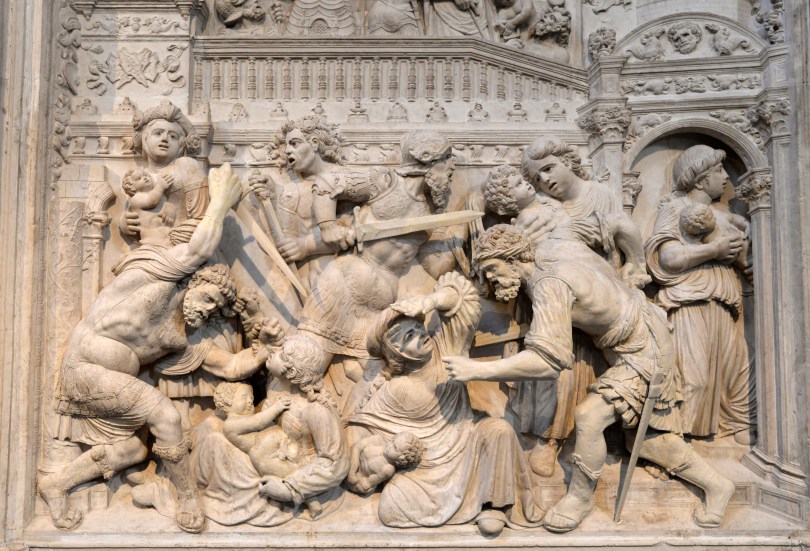
The 28th of December is the day on which the Church marks Holy Innocents. It is a day that focuses on the harrowing account in the Nativity story told by Matthew, of the orders King Herod gives to slay all male children under the age of two. Fearing the emergence of a rival, the King makes his fateful decision based on the Magi’s interpretation of the star they observed. 

Children are all too often, tragically, killed in conflict. However, the targeted destruction of the young is rare. In wartime, as we see around us in the world today, children die, are injured and become psychologically damaged through conflict. In WWII, as a consequence of indiscriminate bombing, almost 8,000 children died in the UK. The worst affected city was undoubtedly Coventry. On 14 November 1940 huge amounts of ordinance were dropped on the city leading to a significant loss of life; the destruction of countless buildings (including the cathedral); and widespread civilian trauma amongst those who survived. A few weeks’ after the attack the Dean of Coventry gathered as many choristers as he could in the ruins of the Cathedral and broadcast a rendition of the Coventry Carol to what was, at the time, the British Empire. This carol, which comes from the medieval Coventry mystery plays, recalls the massacre of the innocents. It must be one of the bleakest, most sombre and deeply moving items in the canon of Christmas music. The wartime clip from Coventry is featured in an emotional and thought-provoking episode of BBC Radio 4’s series Soul Music.

Laurence Sterne, the 18th century parson-novelist, says remarkably little about Christmas in any of his writing or preaching. Yet there is a sermon on Holy Innocents. Sterne knew from personal experience what it was to lose a child. He describes the massacre of the innocents as being:

So circumscribed with horror, that no time, how friendly soever to the mournful, – should ever be able to wear out the impressions.

When I worked in the NHS I recall very occasional instances when a mother contacted the hospital to ask about the mortal remains of their child, who had died many years ago. This arose out of the fresh attention given to the issues of organ and tissue retention, and burial practices, following the Bristol Royal Infirmary and the Royal Liverpool Children’s inquiries. In some cases mothers had given birth to a living child, who had died within a short time, and the mothers were told to go home and in essence – forget about it. They were provided with no information about what then happened to their babies or where they were buried. Records were kept, but the existence of a baby’s body in amongst an adult “shared grave” was not recorded on the headstone: unlike the adults. Once or twice I arranged to meet a mother at the entrance to the local cemetery and took her to the place where the records stated her baby was buried. I hope that, in some small measure, this helped a grief which had lain largely unexpressed for decades.

Holy Innocents begs many questions of the Church, and of the world. How could God’s miracle of the incarnation result in so much terror and destruction? Why is it that we continue to tolerate warfare that damages young lives? How do we help survivors who have witnessed unforgettable horrors? There are no easy answers to these questions. However, the presence of Holy Innocents in the Church’s calendar stubbornly insists that even while the tinsel is still hanging, the most dreadful realities of the world cannot be put aside or forgotten. They are always there and, hopefully, stir people of good faith of every religion and belief to seek peace with added urgency. Because the innocents are still being massacred today.

That woe is me, poor child, for thee
And ever mourn and may
For thy parting neither say nor sing,
“Bye bye, lully, lullay.”

From the Coventry Carol, 16th century

Living For

I am reading a book about the history of my new employer, Leeds Church Institute (LCI). History can be fascinating, both for the strangeness of how life was once lived and, occasionally, for the sudden resonance of a view or action which appears entirely modern.

The quarter century leading up to WWI is described in the book as “the golden age” of LCI. Wealth increased for some, and for others new legislation reduced working hours, meaning that in both cases more time and resources were available for recreation; discussions; hobbies; voluntary work; or religious associations. (The text “Eight Hours for Work, Eight Hours for Rest, Eight Hours for What We Will” was paraded on a union banner in 1889). It was the time when public schoolboys and undergraduates came to Leeds to live in “settlements”, often found in the poorer quarters of the city. Of course, this could be experienced as highly patronising and there’s a powerful quote in the book about LCI’s history from an older woman in one of these areas who declared: “I do so hate being ‘lived among‘”.

As we approach Christmas her words ring in my ears and remind me that the Incarnation was more than a gap year for an earnest deity. Public schoolboys didn’t renounce their learning, connections or resources when they came to reside among the poor. They were no doubt billeted in reasonable accommodation, forming a small community of young people who shared privileged backgrounds. These communities was set in a wider context of poverty; disadvantage and squaller. I can imagine many of these settlement workers, in future years, burnishing their credentials by referring to the time they “lived among” the poor. A year of their youth that bought the claim to a lifetime of social credibility.

“For all the rhetoric of ‘citizenship’, ‘democracy’ and ‘fellowship’, the governance of the settlements, at least in their early years, was in the hands of their patrician founders rather than their ‘members’.”

Freeman, M. (2002). ‘No finer school than a settlement’: the development of the educational settlement movement. History of Education31(3), 245-262.

The Word made flesh gives up language. The babe in the manger has no worldly connection that will hoist him out of misery. The infant son of a carpenter must play with the shavings on the workroom floor, and discern his own path through all the perils and possibilities of life. He must learn words and imbibe the teachings and practices of religion. As a young man driven into the desert, the vocation of Jesus is tested in the wilderness of the world, alone with his demons. Preaching, teaching and healing as a Rabbi he will come to challenge both temporal and spiritual authorities. Standing resolute before the powers of coercion and compromise, resolved in his calling and identity, will become the path to his destruction.

This is not living among. It is living with; it is living as; and it is living for.

This Mortal Life

Pitched into the bleakness of winter arrives the season of Advent. In the northern hemisphere the beginning of Advent accompanies the slow march into darkness. Shorter days; longer nights; a steady drop in temperature. The themes of Advent – death; judgement; heaven and hell – match the somber mood of gloomier days. Threaded through topics of great moment, the story of the incarnation is pulled ever nearer. Alongside the readings in church of end-times and apocalypse, every village, town and city displays the brightness of festival lights. The cynical and despairing may shun these illuminations as simply a commercial gimmick; the cold work of retail-marketing to boost sales in a flagging economy. Yet for many of us, somehow, the glimmer of hope these lights celebrate, the baby lying in the crib, can never be given its proper price. There is something here, something to which Advent leads, which can’t be contained by the measure of this world, or our desire to conform everything to our own likeness.

It can often feel, as it does this year, that there is temerity in setting out lights as the nights draw in. How dare we suggest, imply or hint, that something might come to defeat the darkness? It is the ridiculous hope written down by John in the Prologue to his Gospel: “The light shines in the darkness, and the darkness comprehended it not”. Like Handel’s taunting rendition of St Paul’s words asking Death where its sting has gone, the hope that light might eventually overcome personal darkness, and the darkness of our world, feels an outrageous folly. Perhaps this is so because “the bleak midwinter” can feel so tangible, close and all-encompassing. Nordic countries have recently issued booklets to their citizens about surviving war. Sometimes it is so much easier to embrace fear and resignation, than fasten our eyes on something hardly visible; beyond the horizon; too good to be true.

Advent candle-bridges are a tradition in the windows of homes along Minster Yard in York.

Advent is not for everyone. The images of apocalypse and the ending of time are neither comfortable nor reassuring. “Like a thief in the night”. We cannot be permanently vigilant – we need to sleep. The metaphor suggests that the completion of things will come when we are oblivious to its approach. There is no warning or alarm. We will be shaken our of slumber and the myths with which we live will dissolve in the presence of the Divine reality. In another sections of Handel’s Messiah, we are reminded of the “refiner’s fire”. Who may abide the day of his coming?

Advent reminds us that we cannot control the appearance of sudden and defining events. We are always only a heartbeat away from immortality, and our own encounter with what Sterne’s character Tristram Shandy refers to as “this great catastrophe” which will – at some point – overtake us and bring our experience of this world to an end. Of course, following Friday’s vote in the UK parliament, it appears that there will be limited control, for some, about when that moment arrives. However, as one person said during the debates about this issue, it may also give rise to “internal coercion” and perhaps lead people to opt for something which does not reflect their personal wishes about either motivation and timing.

“We are standing upon the edge of a precipice, with nothing but the single thread of human life to hold us up”.

From a Sermon delivered by Laurence Sterne, quoted in A Sterne Lent 2024

Advent is – and should be – disconcerting. Angela Tilby’s excellent reflection in the current issue of The Church Times draws attention to Archbishop Laud’s prayer for the church. It is a succinct and impassioned petition for truth; peace; purity; and reform in the institution. All of these virtues and corrections are needed now almost as much as they were required in the 17th century. Canon Tilby concludes her piece with a simpler prayer which she wrote some years ago, but one which feels as pertinent as ever for 2024:

As light in the darkness,
As hope in our hearts.
Come, Lord Jesus, come.

Angela Tilby, The Church Times 29 November 2024

  • The photograph at the head of this blog features the underside of York Minster’s three metre wide Advent wreath, with the interior of the central tower seen in the centre.

Holding Still

Over the past few days I drafted a blog, as I do most weeks. It was largely a litany of despair about the state of the Church of England and the nadir of leadership and direction to which we appear to have sunk. Today is the final Sunday in the Church’s liturgical year, but it might also feel like the dying days of a once great institution. Perhaps, if its demise would ensure more people’s safety and sanity, there will be those who think that extinguishing the final embers would be an act of kindness for all concerned. The Church has failed in one of its primary obligations – but I cannot quite abandon the idea of what it might be.

Instead of a dismal diatribe about the Church’s failings (mine included) I have decided to take a different tack. The “idea of what it might be” includes resurrecting the often unseen but invaluable work of spiritual and pastoral care. In early 2020 I was looking for a poem to accompany some reflections for a retreat, but couldn’t find anything that would fit. Given this sad lacuna in English Literature I decided to pen my own verse and, for better or worse, I offer it on this final Sunday of the year as the slightest intimation of what at its best has been, and might still be, in the life of the Church’s sacramental pastoral care.

Holding Still

This work of holding;
of the the task of being
still, in order to hear.
To shift weight without

disturbance; to keep
the hushed, spare –
space; the silence into
which another speaks.

It is not nothing;
this attending and
anointing; this taking
and bearing and blessing.

To touch what has died
with the strength of love;
to see in ashen form the
hope of resurrection.

The image at the head of this blog is a photograph of a ceramic sculpture by Antonia Salmon, entitled “Holding Piece”

A Time to Reform

In September 1957 my parents got married. Earlier in the year my grandfather had been asked to become ‘Vicar’s Warden’ at the local Parish Church. He accepted. A local tradesman and Rotarian, Robert’s family was slowly advancing in material circumstances and civic standing. When he became a churchwarden it was news (albeit locally). The gazette carried a report that he “will be sworn in by the archdeacon or chancellor at the annual visitation”. In the 1950s, perhaps especially in counties like Lancashire, the Church of England was a notable presence in most communities. I attended the church primary school across the road from the substantial sandstone bulk of St Michael’s, erected in 1822. On Ascension Day we had a half day – one of many minor observations that peppered the year and kept the school, town and community connected. I’m sure the growing number of working parents often cursed the annual appearance of what must have appeared to be a rather random and inconvenient half-day!

When I began ordained ministry in 1991, also at a parish in Lancashire, it seemed that every church had at least its own vicar if not a curate as well. A nearby incumbent, in a more rural parish, took most of one day a week to visit a local hospital using public transport. Perhaps it was an inefficient way to spend his time, but I bet there were some interesting conversations along the way. In the parish where I served we had over 80 baptisms in one year; a memorable Holy Week with one or more funerals every day; and a church hall that bore the brunt of heavy usage from uniformed groups, parish thespians and the might of the Parochial Church Council. There was certainly no shortage of work to do or activities to support. By the time youth group had ended on a Sunday evening, on a day that began at 7:30 am, I was very happy to slump into a comfortable chair.

Those days have gone – for better and for worse.

Had the Church of England stopped evolving in the 1990s it is hard to know what would be left today. Perhaps, if it had continued to invest and support as much parish ministry as possible, the numbers with which Church House and the Archbishops’ Council seem preoccupied would be little different from those we see today. When people bemoan churches that appear to be stuck in the past, or unchanging, there is good evidence around that these same churches are often doing very nicely. Of course, nothing remains genuinely unaltered because the people change, and so does society. The ordination of women as priests and bishops was a matter of both faith and justice, and has added fresh qualities and fulfilled vocations at a time when both were in decline.

We know from many different reports that in the past egregious wrongs were perpetrated by clergy, and laity, under the guise of virtue, holiness and a perverted theology. I suspect that what we know about is the tip of a very, very large iceberg. All too often clergy have been a law unto themselves and, when something has been raised, benefited from the collusion of powerful patrons. This lack of accountability has deep roots. When I researched the history of institutional spiritual care I came across the case of a Victorian workhouse chaplain, Frederick Pocock, who neglected his charge with impunity due to the unwavering support of his bishop. The Board of Governors of the institution was powerless.

At one level, it seems astonishing that the Church has failed to learn a lesson that goes back deep into its history. In another sense, for rogue clergy, the cover-ups and collusion were (are) a desirable facet of the mercurial behaviour of a Medieval institution embedded in the modern world. Perhaps it is unsurprising (although it was startling at the time) that when I told my grandfather that I was exploring a sense of vocation he immediately left the room to be sick. Looking back I wonder, as a churchwarden, what he had seen or heard that caused such a reaction? He never said.

There is much about Anglican reason, tradition and spirituality that appeals to me. At its best there is a generous and pastoral care for communities and the “frowsty barn”, as Larkin put it, that is often at the physical centre of towns and villages. Sometimes it is the spiritual centre as well – but not always. It feels that this is the moment when England needs to decide the fate of its Church. Whether through a Royal Commission – as Martyn Percy suggests in today’s Observer – or a different process, some definitive solution is needed to ensure the safety and ongoing purpose of the Church. Many of the attractive characteristics of the Church I grew up with have gone – but can something new emerge that preserves the best of it for the future? The 500th anniversary of the Act of Supremacy is on the horizon (2034). Perhaps even Thomas Cromwell might feel that now is the right time to begin reshaping the kind of Church he helped establish, to fulfil it’s calling in a new era?

“To reform church and state you must deal with the populace.”

Mantel, H. (2011). Wolf Hall (Vol. 1). Fazi Editore.