Something Art Can Do

A recent visit to the Auckland Project exceeded my expectations. The investment in a range of cultural, historic and artistic exhibits in this market town has been extraordinary. The excessive scale and grandeur of the Bishop of Durham’s official residence has been transformed into a visitor attraction, with a new gallery of world faiths added to the property. While the timing of the project’s opening was ill-fated, coming just months before the first lockdown in early 2020, it appears that in recent years the ambition to make the former mining town a major tourist destination has been realised.

In the episcopal residence, Auckland Castle, rooms have been themed according to many of the former bishops. This means that the furnishings are contemporaneous with the figure being celebrated, and in some cases an audio or visual loop of material is featured. For example, in remembering the controversial prelate David Jenkins, there is an extract of an interview in which he speaks about his understanding of faith and the central tenets of Christianity.

Close to the centre of Bishop Auckland, just a short walk from the Castle, there is the Spanish Gallery. Billed as “the UK’s first gallery dedicated to the art and culture of the Spanish Golden Age”, it is an impressive collection. The connection that underpins this addition to the town lies in the famous paintings which fill the walls of the Bishop’s dining room in the Castle. These are Jacob and his Twelve Sons by Francisco de Zurbarán, bought by the Bishop of Durham in 1757. It would be hard to find any collection of Spanish art in the UK, outside of London, which could compete with what has been brought together in this northern market town.

“This world class gallery, which is spread across four floors and housed in two stunning Grade II listed buildings, is fast becoming a must-see for art enthusiasts across the North East of England and beyond”.

Reflecting on both the gallery and the Castle, there is an interesting juxtaposition of inspiring artwork and the more mundane “management of religion”. Bishops have no doubt inspired many people over the centuries but, for much of the time, they have turned the wheels of religion to maintain the institution and – in the case of the Church of England – upheld the status quo. This is particularly true for the prince bishops of Durham, who often served as the State’s enforcer in the north. Such a role entitled the bishops to the magnificence of a stately home, great wealth and the other privileges of office. Some, including Bishop Westcott and David Jenkins, subverted these expectations by siding with the miners during industrial disputes. However, they appear to have been the exception rather than the rule.

“The Bishop was loudly cheered by the miners, who had assembled in large numbers in the streets of Bishop Auckland; and he has every reason to congratulate himself on the results of his intervention”.

The Spectator, “The intervention of the Bishop of Durham (Dr. Westcott) in the Durham miners’ strike” 4 June 1892

The question my visit provoked is about the relationship between the bureaucracy of faith and the creativity which often inspires and disturbs our taken-for-granted expectations. Finding them sitting so closely side-by-side at the Auckland Project was an unusual experience. When Bishop Richard Trevor bought the paintings for the Auckland Castle dining room, they were not for general viewing. This was an experience for the elite and the Castle and grounds exuded wealth and privilege. While the Auckland Project has opened up these treasures (for a reasonable price), and located them close to several narratives about previous bishops, it begs a question about the role of the Established Church. Many major works of art have been commissioned by wealthy prelates, and some of these continue to provide inspiration today, but how is a far less mighty Church maintaining its task of providing space and inspiration for wide variety of people to engage, contemplate and be changed? There was a glimmer of hope about this at the end of the faith exhibition where major works by the contemporary artist, Roger Wagner, are hung. Wagner is someone who knows how transformative art can be in the journey of faith:

“It was the first thing that brought a sense of personal connection with the Gospels – which I’d studied, but never seen that you could enter into them in that kind of way. Something art could do which I’d never envisaged before”.

Roger Wagner speaking to The Church Times in 2013.

Lines and Labyrinths

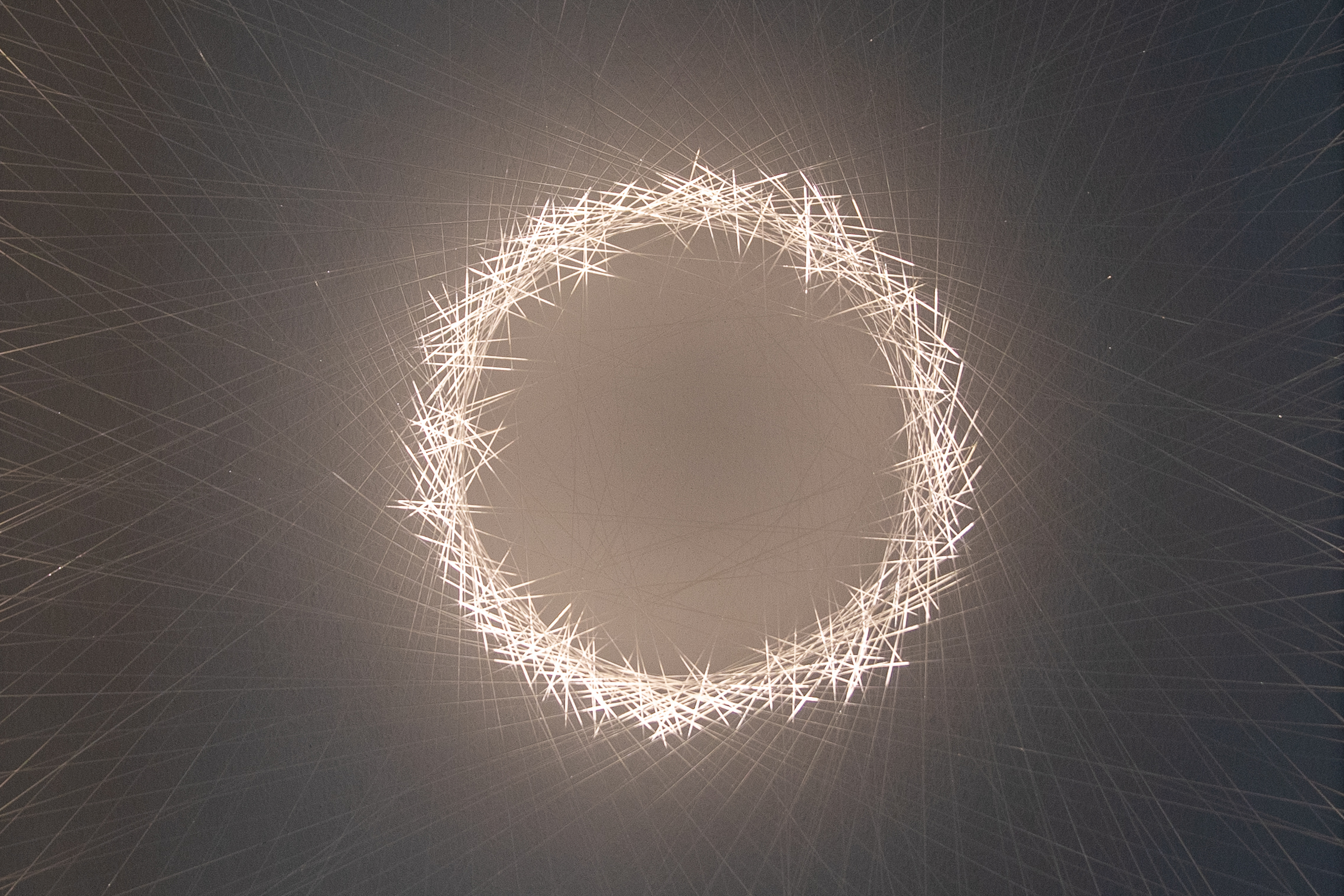
During our recent sojourn in Spain we visited the Centro de Arte Caja de Burgos. The exhibition currently on show comprises various works by the Swiss-born artist, Pablo Armesto. A key theme across the works is the use of light, shapes and, consequently, the implication of shadow. To quote Armesto: “Between science, geometry and spirituality, this is how I conceived this exhibition”.

This exhibition appealed to me because of the interaction of light and material surfaces. It is executed beautifully, and serves to remind us that casting a particular light can change completely the underlying structure on which the light falls – or doesn’t. In other words, by illuminating some threads rather than others the surface appearance can be changed radically. Our eyes are drawn to the light and the form it implies, not the unlit shape of everything underneath. As the commentary on the exhibition says, these are “installations in which light and shadow transform the chromatic perception of the viewer”. Here lines of light address our perception:

“The line is a metaphor for the path, both physical and allegorical, sometimes traveling parallel to the initial idea, sometimes divergent when it has to choose between different options, but never schismatic, never discordant”.

Pablo Armesto

The title for the exhibition is “Complejidad, araña, laberinto”. I think that this is best translated into English as “complexity, spider-webs, labyrinths”. This phrase comes from a poem by the Andalusian poet Rafael Alberti, entitled “a la linea” (‘To the line’). While a line may sound a modest thing to be the subject of a poem, Alberti reminds us of the joyous capacity for it to be a “beautiful expression of the different”. Certainly, in Armesto’s installations, the vibrancy of illuminated lines could not be made clearer. It reminded me of the well-known comment by the artist Paul Klee, in his Pedagogical Sketchbook of 1925, that he was engaged in “taking a line for a walk”.

A circle of light created with the use of curved lines – by Pablo Armesto

The recent work I have been doing about Laurence Sterne includes the representation of a physical gesture – the waving of a stick – in volume IX. It is nothing more than a squiggle; a pen-line dancing across the page. It is used to express the notion of liberty and is, perhaps, the representation of the neat text going ferrel. A reminder that the careful shaping of ink that allows us to see letters and to read them, is made of the same stuff as this dramatically inserted hieroglyph. Different forms of the same material may shatter our expectations and leave us wondering what will come next. Art has this capacity to subvert our smooth reading of life and question the solidity and what we see. Like Sterne, Armesto’s filaments stretch our imagination, providing an intense optical experience and stimulating our thoughts about patterns – whether they are there, or simply the imposition of our expectations on the otherwise chaotic things we behold.

Truth Stretched Thin

I love visiting Spain and Spanish-speaking countries. Ever since spending a year in South America in my early 20s, and acquiring a feel for the language, a small part of my growing up was rooted in hispanic culture. A recent trip to Spain brought introductions to new cities, including Burgos and Alcalá de Henares. The latter visit arose from a longstanding wish to see the birthplace of Spain’s most distinguished writer, Miguel de Cervantes Saavedra. The author of Don Quixote was born there in 1547 and it is where he spent the first four years of his life. Understandably, alongside his former home which is now a museum, the city celebrates its famous author in numerous statues, street names and public institutions. Don Quixote is considered to be the world’s first novel in the modern sense of the word.

Given the date of his birth and the febrile politics of a recently re-conquered Spain, Cervantes was born into a world in which it had been decided that the co-existence of faiths was intolerable. In 1492 the Muslims and Jews who had not converted to Christianity were expelled from Spain. Those who had converted lived amongst neighbours who, very often, sought any sign that the conversion was one of “convenience” and would report people to the authorities. This was the time when the Inquisition was in full force and those who converted were keen to appear compliant. Many years ago, while participating in a canyoning activity north of Almuñécar, in Andalusia, a young instructor accompanying us told me that his surname was the same as the name of a local village. His family’s story was that they had been Jewish and, like many of the converts who remained, they took the name of a local town in order to immerse themselves in Christian Spain and avoid suspicion. Such practices were commonplace.

There is a claim that the family name of Cervantes came from a town of that name in Galicia, and may have been taken for reasons of conversion. However, this is far from certain. The proximity of the Cervantes family’s home to the Jewish quarter of Alcalá de Henares might be a more persuasive argument for some kind of connection. Today, all that indicates the onetime presence of a synagogue and Jewish “corral”, as it was called, is a small plaque. Cervantes senior was a doctor and the family lived both opposite this old Jewish quarter and beside the city’s ancient hospital.

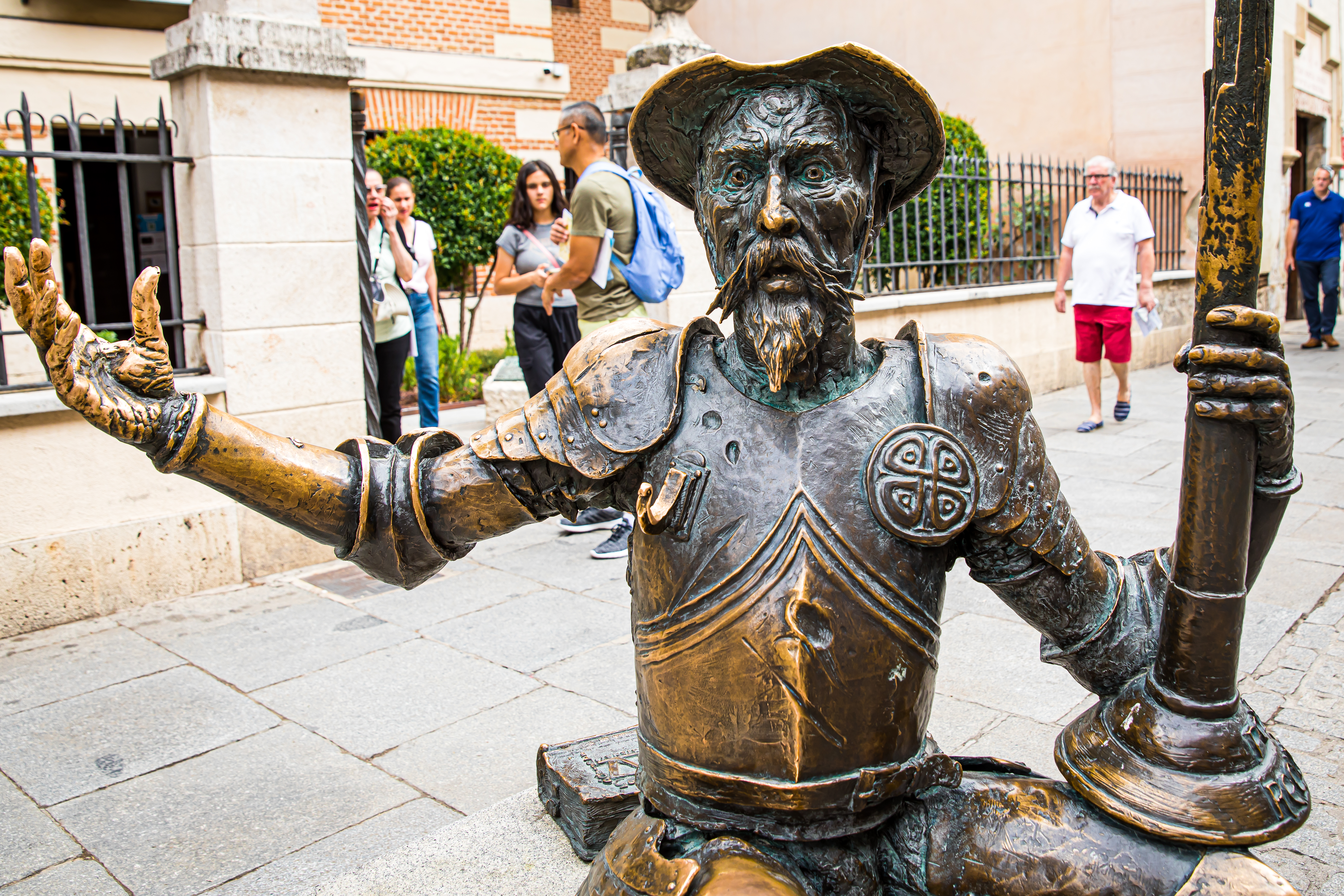
A statue of Don Quixote outside the house in which Cervantes spent the first four years of his life in Alcalá de Henares, near Madrid

Initially, after the Reconquest, the Jewish community experienced relative security compared with other European countries. This did not endure.

“Yet Jews were still better off than their Ashkenazic brethren in the rest of Europe who were expelled from England and France and faced continuing and unrelenting pogroms and persecution in Germany and Central Europe, eventually driving them eastwards to Poland and Lithuania. The Christian rulers of Spain exploited the skills of their Jewish subjects and a thin layer of upper class Jews remained wealthy and influential. The Jewish population of Spain generally still felt comfortable there. After all, they had lived as Spaniards for many centuries. Why should the situation change now?”

The Spanish Expulsion from the Jewish History website accessed 28/06/24

Perhaps the strongest argument that Cervantes had Jewish ancestry comes from evidence internal to Don Quixote. In an excellent BBC World Service edition of The Forum scholars argue that in his novel there is “an implicit cultural critique” which questions, as far as it can, some of the negative narratives about the descendants of Muslims and Jews still living in Spain. In a section of the novel where Don Quixote is in Toledo, he seeks and finds someone to translate a text in Arabic. By showing the continued presence of Hebrew and Arabic speakers in Spain Cervantes put in doubt the official story of a single, homogenous, Christian culture.

Out of the troubled waters of post-reconquest Spain Cervantes created a story capable of finding a broad and appreciative audience. Don Quixote might be seen as a kind of Rosetta Stone, enabling different communities to discern for themselves an intelligible and constructive place in Spanish society. That is no small feat, and the unparalleled significance of Cervantes in Spanish culture bears testimony to his achievement in enabling humour, insight and compassion to leaven the complex experience of living in a society where the past was an ever-present and potent challenge to the present.

“The truth may be stretched thin, but it never breaks, and it always surfaces above lies, as oil floats on water”.

Don Quixote