Is God Calling?

I usually skip through the online edition of The Church Times over breakfast on a Friday. It is a newspaper with a venerable history, having first hit the presses in 1863 (between the publication of The Origin of Species and the first sales of Turkish delight). In 1981 a scurrilous and highly enjoyable spoof of The Church Times was published under the title Not The Church Times, reflecting the popular use of the ‘not’ brand of satire in the 1980s. It came complete with adverts for high office, one of which stated:

Applicants are invited to apply, stating their public school, Oxbridge college, year at Westcott House, and Lodge.

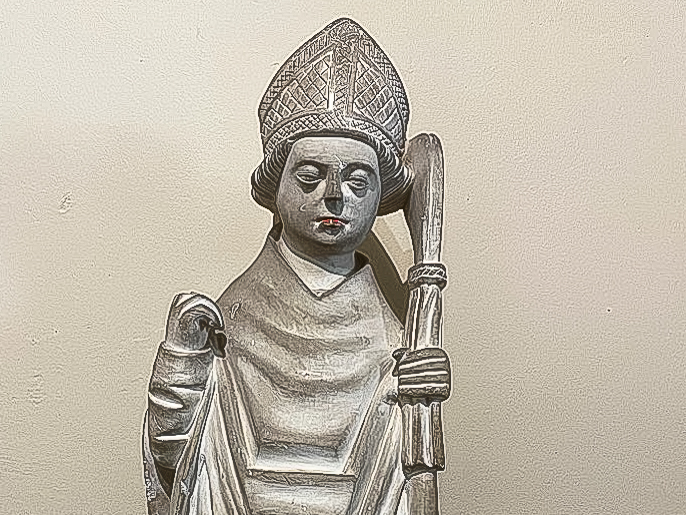
Sadly, I would qualify on only one of these criteria and even then, by 1990, Westcott was no longer the powerhouse of episcopal chumocracy for which it was once renowned. This undoubtedly explains why, when there is presently a surfeit of episcopal vacancies in the Church of England, no mitre is likely to fall on that pate so propitiously cleared of hair, which would be enhanced immeasurably by the imposition of a pointy hat. Alas, as Cervantes put it in Don Quixote – quoted later by Sterne – with a head so beaten about by the vagaries of life, if mitres were “suffered to rain down from heaven as thick as hail, not one of them would fit it.”

In recent years the criteria for preferment have undoubtedly changed from those in the 1980s. Favour has fallen on evangelical candidates; those perceived to have been successful in an organisation other than the church; and, more than anything else, priests who have a story of leading church growth. Once again, my credentials would make little impression in these categories of assessment.

All of this came to mind as I read through the classified section of this week’s issue of the ecclesiastical newspaper. My eye was drawn to an advertisement from my home diocese, the See of Blackburn. A creation of William Temple, consisting of parishes carved out of the rapidly growing Diocese of Manchester – itself an earlier Victorian offspring of the Diocese of Chester. The ad that caught my eye had a headline in a style not uncommon in The Church Times:

I pondered whether this was the same God responsible for the creation of the universe. That is, the entire reality identifiable from earth, which is at least 28 billion light years in diameter. The God who predates time and will draw time to a close. That God? I imagine that this God probably has rather a lot to do but, God being God, perhaps there would be an infinite supply of time so that spending a few minutes reviewing the needs of the Blackburn Archdeaconry wouldn’t be too onerous.

However, wouldn’t it be more honest and meaningful to ask: ‘Do you want to be the Archdeacon of Blackburn?’ Shouldn’t our desires be material to the concept of vocation, rather than being cast into doubt under a pall of implied sanctity. Perhaps it would lead to much greater honesty and candour if we explored the motivations of why anyone wants any particular role. As the Church of England struggles to address the abuse that has happened, and is happening, in situations where piety has been asserted and manipulated, it might produce a better culture if we began with a humble recognition of our own wants and needs. Wants and needs where, in various ways, God is already present and active. Teasing these out may be the best way to achieve greater honesty; self-knowledge; deeper discernment; and a safer Church.

Perhaps spiritual directors should run the C of E – they are the people, usually, who cut through the flummery and ask this kind of inconvenient question. Might God be calling any of them to Blackburn – or even to Canterbury?

The Outer Marker

Interpreting complex and dynamic information is never easy. As a hospital chaplain I was familiar with the necessity to appraise a situation and make a decision under significant time constraints. Finding the right words, rituals or other aspects of pastoral care, when death is imminent, has the capacity to focus both heart and mind. On rare occasions, when the family and friends of someone nearing the end of life presented a wide range of beliefs, great care was needed to find a form of recognition and support which was of genuine service to all concerned. Getting it “wrong” can have enduring consequences for the bereaved.

Five years ago we were getting to grips with the new phenomenon of SARS-COVID-19. Hardly anyone in society had experienced a serious pandemic in the UK. Working in the care sector, it soon became apparent that many leaders lacked the heath care background which would have supported a speedy awareness of the consequences inherent in the unfolding events. Perhaps most significantly, the understandable desire for clear evidence and guidance prevented early actions to stem the rate of infection. As I commented at the time, in a pandemic, waiting until the evidence is utterly compelling is the definition of leaving it too late.

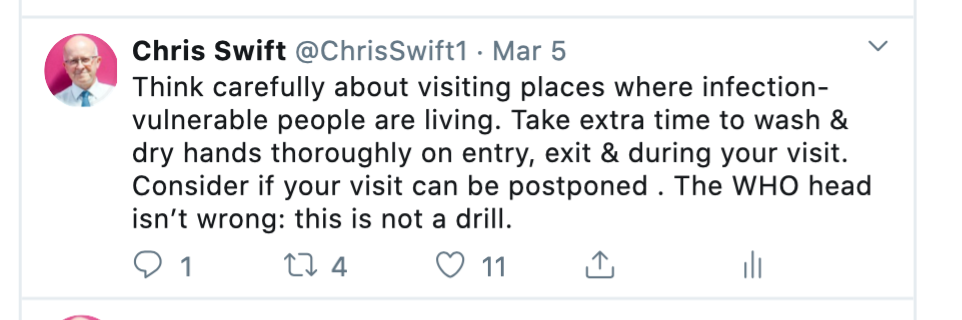
“we want to avoid any over-reaction but preparation seems wise”

Chris Swift email 11 February 2020

Viruses are most effective in the period when there is no immunity from prior infection; people feel no motivation to alter their routine behaviours; and when a delay between infection, illness and public reporting lasts several days. In care homes, where vulnerable people are kept close together, rooms are warm and many residents might forget requests to change behaviours, the risks of an easily transmissible respiratory infection are severe. By 5 March 2020 there was sufficient evidence available to determine that this wasn’t a rehearsal – but the emerging reality of a disease which spread quickly and had a high mortality rate amongst older populations. This was probably the prime date in the UK when decisive changes in behaviour would have saved the greatest number of lives. On 11 March 2020, I wrote to a colleague stating that, in my judgement, we were passing the outer marker of when it would be most beneficial to act. Finally, on 23 March, the UK went into its first national lockdown.

In 2020 different people came to a realisation of the need to act at different times. However, those differences undoubtedly had real-world consequences. If prompt actions made no impact there would, presumably, be no differences in the mortality rates of different countries. But there were significant disparities. Probably the best time to have acted in the UK would have been in the first few days of March. By the 11 March it felt as though we were heading into uncharted waters, beyond the zone in which wise actions would have made a significant difference to the incursion of infections. Sadly, in the UK and elsewhere, this delay undoubtedly multiplied the number of deaths; the incidence of care staff’s trauma; and the inevitable distress of relatives unable to be with loved ones at the end of life.

Five years still feels to be too brief a time for the world-changing events of 2020 to be fully digested or understood. It might be the case that we are in a phase of denial, finding it too difficult or too contentious to rake over the ashes of SARS-COVID-19. However, a time will come when we are ready to talk about the remarkable and tragic events which transformed our collective experiences of everyday living. Perhaps, when the UK Covid-19 Inquiry finally reports, we’ll be in a better place to take a measured view of what the global pandemic meant for us, and the lessons we can take into the future. Sadly, watching the world in the past five years, the international solidarity of lock downs and a shared experience of a sudden increase in mortality, appears to have done little to generate an enduring sense of our common humanity and interdependence. In times when threats to human life are intensifying and growing, the need to interpret dynamic data at a point when wise actions can still shape events, remains a critical need.

Lent Preachers

As the Church approaches Lent, some Christians might have begun thinking about what to give up, or what to take up. Perhaps a small resolution of abstinence – alcohol or chocolate – and a desire to read something that will draw us a step closer to understanding everything to which Lent points. In some churches, while Holy Week might feature a visiting speaker to lead people through the final week, it has been the custom in cathedrals and elsewhere to have a different guest preacher each Sunday. This practice goes back a long way and can be found in various notices and signs that have survived the passage of time.

In 1725 Ash Wednesday fell on February 10th. Or did it? This statement requires some qualification. The calendar at that stage was still in the Julian form, meaning that the year began on 25 March, hence the Lent preachers list for St Paul’s is described as the year 1724-25. This practice was known as ‘dual dating‘ and caused considerable confusion. It finally ended in England in 1751 with the British Calendar Act and an effective transfer to the Gregorian calendar used by most of the rest of the world.

As the notice from St Paul’s demonstrates, Lent sermons were not confined to Sundays. The advertisement offers distinguished clerics on Wednesdays, Fridays and Sundays, throughout the 40 days. These occasions were not for the minor clergy, but moments when the cathedral staff themselves, or various other deans and bishops, might pronounce their theology and spiritual message.

Laurence Sterne, who was a well known and popular preacher, was aware that his humble station in the Church meant that he was unlikely to be invited into the nation’s highest pulpits. The steps that grace the cover of A Sterne Lent – Forty Days with the Celebrity Parson the Church Forgot, are elegant, simple and modest. They are the pulpit steps of All Hallows, Sutton on the Forest, where the preacher stands only a few feet higher than the congregation. Today, I understand that a less formal way of leading worship (and perhaps fewer parishioners) means that this beautiful 18th century piece of furniture is seldom used.

Many of Sterne’s surviving 45 sermons were first preached in the season of Lent. In keeping with the motif found across Sterne’s work, he was mindful of the contrast between success as an author and the skepticism about his character which would keep him out of high office in the Church.

“I just received a Translation into french of my Sermon upon the house of Mourning, from a Lady of Quality – who proposes to print it, for the Caresm, & to give ye people here a specimen of my Sermons – so You see, I shall be Lent Preacher at Paris, tho’ I shall never have the honour at London”

Letter from Laurence Sterne to Henry Egerton, written in Paris, March 8 1762. Quoted in Volume 7 page 233 of The Florida Edition

In a style characteristic of Sterne’s humour, his letter to Henry Egerton in March 1762 makes reference to the fact that his own death had been reported in newspapers back in England. Sterne’s congregation in Coxwold went into mourning. It took more than a week for corrections to appear in the English press. Sterne would undoubtedly have been fascinated by the eulogies which were published in the intervening days.

St Paul’s never beckoned the peculiar rural parson who had found fame – and a little fortune – through both his published sermons and Tristram Shandy. Undoubtedly Sterne has the last laugh, as the great names of that era, who graced the pulpits of the nation’s cathedrals, are now unknown. Yet, somehow, Sterne’s radical approach to the novel continues to stir the creative spirit of contemporary artists and authors across the world. I believe they also have a much neglected spiritual significance.

Perhaps one of the most attractive things about Sterne is his refusal to conform simply in order to ‘get on’. Yes, it rankled with him that there would be no palace to live in, or ample stipend to live off in a lavish style. Sterne can’t quite let go of the cost – the sacrifice – which witty writing and ecclesiastical satire had imposed on his prospects. Friends advised him to temper his writing until he was in the kind of exalted position no one could touch. However, I suspect that Sterne knew this beguiling suggestion for what it was, and that it would blunt the sharpness of his writing. Too many people have entered the church, or politics, certain that when they ‘arrive’ they will enact their intention to do something dazzling and different. Alas, how often do these well-intentioned ambitions become paralysed in the sticky web of power’s compromise? Sterne may not have preached in England’s most exalted pulpits – but the life we encounter in his writing is an enduring lesson on human weakness and hypocrisy, redeemed only by a God whose sense of forgiving humour is so much greater than the dismal depths of our everyday folly.

Unappropriated Forever

St Luke’s church in Cleckheaton is a barn of a building. Like so many of the churches thrown up to meet the needs of urban populations, this Victorian Gothic edifice had the working classes in its sights. A nearby Medieval church had assigned seating, and was no doubt the preferred place of worship for the landed gentry and families that looked to the countryside for their employment. St Luke’s, by contrast, was marking a new path in religion and a foundation stone in its porch made known the more egalitarian ambitions of its approach. As The Church Times of 28 October 1887 reported from the laying of the foundation stone: “It is to seat 650 persons, and the sittings are to be free and unappropriated”.

I was reminded of this bold statement of intent during this morning’s edition of Sunday on Radio 4. An item from BBC Radio Solent told the story of an Anglican church that has doubled up as a badminton court for more than 50 years. At Christ Church Melplash, one of the locals interviewed read out the statement made at its foundation that “the seats in this church are to be free and unappropriated forever”. The instruction was given by James Bandinel, the son of a cleric and a civil servant involved in implementing the abolition of slavery. His role was to supervise the suppression of slave trade activities and this included the seizure of boats. Bandinel received a good salary based on the funds generated by selling condemned slave ships. In turn, Bandinel used his wealth to fund the construction of Christ Church Melplash.

The approach to founding churches without assigned seating, or pew rents, perhaps responded to growing militancy in the population at large about privilege in the Church of England. Another example of churches taking this line includes Holy Trinity Stowupland, in Suffolk. Perhaps due to the nature of the its rural character, there were only two of these cheap, plain churches built in the county to meet the growing needs of urban populations.

‘here in the porch is the original foundation board, beginning This church was erected 1843. It contains 250 sittings,and in consequence of a grant from “The Incorporated Society for promoting the enlargement, building and repairing of Churches and Chapels”, the whole of that number are hereby declared to be free and unappropriated forever‘.

www.suffolkchurches.co.uk – a journey through the churches of Suffolk

Plaque at the Church of the Holy Trinity, on the outskirts of Toronto: “free and unappropriated”

Which leads me, inevitably, to the Church of England today. The unique characteristics of the C of E mean that this is a church that belongs to the people of England – free and unappropriated. It’s why, in the current turbulence of the resignations; uncertainty; and instability, the outcome of events is more than a matter to be resolved by clergy and congregations. It must involve a wider consultation and engagement with parishioners and enable the Church to continue its historic mission to serve the people of England in the name of Christ. That’s why, on 27 November 2024, I wrote to the Prime Minister to express concerns about the ability of the C of E to resolve its own problems.

‘While the nature and resources of the Church of England has changed significantly over the past twenty years it continues to have an unparalleled presence across the cities, towns and villages of England. It has often played a key role in developing inter-faith relations, community cohesion and pastoral care, especially at times of national crisis or change. I believe that this role continues to be valuable and worthy of political support. However, it appears very uncertain that the Church of England can reform itself within the provision of its existing structures and leadership. The safe operation of the Church remains a concern”.

Extract from my Letter to Sir Keir Starmer, 27 November 2024

Unsurprisingly, the reply from the Correspondence Officer in the Cabinet Office did little more than refer the matter to the Honours Secretariat. In turn, the Secretariat pushed the issues into the court of General Synod. Perhaps the only slight indication that there is some concern at the level of political leadership has come in the form of a communication from the Charity Commission to members of General Synod. The letter is hosted on the UK Government website. The tone of the letter suggest that it is intended to be a “shot across the bows” of the C of E, reminding Synod members to “remain aware of your legal trustee duties during debate and voting on relevant Synod business”.

Over many centuries the C of E has benefited from charitable endowments and donations. It is duty bound to manage the charitable aspects of its structure for the good of the people it serves, in this case, the entire population of England. Narrow religious enterprises which fail to demonstrate public benefit must be brought under examination and the central purpose and mission of the C of E cannot be watered down in an attempt to shape itself to what many other churches already do very well. The C of E has a clear character, heritage and purpose. This must be upheld; funded; supported and encouraged.

Hear Our Voice

Churchyards are often depicted as ghostly places. A kind of hinterland between the lit windows of a “frowsty barn”, where prayers to the eternal are stacked, and the nearby houses and shops containing all the business of the living. Perhaps this cordon sanitaire around a church makes a fitting threshold between the mortal and the immortal. The hope of eternity and the certainty of the grave. They are always places that incline me to contemplation as I read each brief epitaph. How is a life of 90 years reduced to so few words? The dates of our arrival and departure; our names; perhaps a verse of Scripture or of sentiment. The information leads me to say, in whispered tones: “how young”; “how old”; “how many”.

Of course, this orderly arrangement of death feels a far cry from the magnitude of human loss recalled in the 80th anniversary of the liberation of Auschwitz (in Polish: Oświęcim). Tomorrow marks 80 years since its liberation. During my ministry I have spoken with two people who were prisoners in that utterly dreadful place. One of them is still alive. The other, who converted to Christianity not long after the war, had lost none of her ferocity when I encountered her in 2016. Seldom have I met someone so passionate for justice; so committed to the common good; and so entirely unafraid of asking difficult questions. Such souls are the pillars of a forthright and determined decency which upholds the fabric of caring communities.

I have been to Auschwitz once. During the time of its operation there were no graves dug to bury each victim of the wickedness which thrived in this place. Murder on an industrial scale. I wonder how far outside its evil centre the graveyard would extend if each person had been given a decent burial? Miles upon miles in all directions. A cemetery that would be visible from space. Instead, the scale of destruction is remembered in the piles of shoes; hair and other remains of the horror carried out by one people against another. On the day we visited, standing by the remains of the camp’s cremators, as dusk fell, the recitation of prayers came as an expression of hope in the face of an atrocity whose remembrance had left us dumbfounded.

I fear that as the last survivors of this terror leave us, we are entering a phase when history may be repeated. It was the legacy of liberating the concentration camps, and the truth about them which shocked the world, that gave energy to so much humanitarian work in the second half of the 20th century. There was an air of determination that human beings must never be treated this way again by any state. Tragically, they have been and they are, but our tolerance of the intolerable seems to be growing. Like so many in Nazi Germany who had doubts about the regime, we wring our hands and turn away. The questions and demands are too great. We’d like to help but…

In the entrance to Leeds City Art Gallery there is a painting by the artist Jacob Kramer (1892-1962). Kramer was born on the eastern edge of Ukraine, then in the Russian Empire, and spent part of his life working in Leeds. His painting “Hear our voice O Lord our God” was given to the Gallery by the Jewish community of the city in 1920. The text relates to one of Judaism’s most important prayers. This theme of the work reflected the reason Kramer fled Russia: the Pogroms that followed the killing of the Tsar. In the painting the widowed woman offers an agonising cry and an aspect of despair. It brings to my mind the words of Jeremiah chapter 31:

A voice is heard in Ramah,
lamentation and bitter weeping.
Rachel is weeping for her children;
she refuses to be comforted for her children,
because they are no more.

Let us remember, not to despair – but to act.

Midwinter Spring

Most poets love the liminal. At the University of Hull, in the mid 1980s, the poet Philip Larkin served as librarian. I recall him saying that the reason he chose to live and work in the city was that “it was more the end of England than anywhere else”. Being at the margins suited his temperament and talents. Little wonder that he declined the invitation to become Poet Laureate. Far too central – too Establishment.

For TS Eliot the edge of England was a place in the middle, a remote inland location, which fitted the bill: Little Gidding. Here was “England and nowhere”. Perfectly pleasant, dull, undulating agricultural land, punctuated by small villages and hamlets. Like transmitters of divine communication, the tower bells of Great Gidding speak to the distant spire of the now defunct Steeple Gidding and, in-between them, lies the humble chapel of Little Gidding. There is nothing glamorous about these buildings and little to attract the people hurtling between London and The North on the nearby A1. Perhaps the occasional pilgrim seeking to walk in the steps of Eliot, or of Nichols Farrer but, by and large, a deep, settled and impenetrable stillness. Yes: this might well be the end of England.

The Chapel, Little Gidding

Spaces at the end of things are, paradoxically, close to becoming something else. As the land of Wales begins to run out, the fields of England are drawing nearer. The final hours of a year beckon in the coming days of January. In these moments are the possibilities of change. Perhaps when we are between what has been and what is to come, there is a moment to redeem the past and shape the future. Transitions have a life and quality unlike anything else in human experience.

I write this having just said farewell to one decade and commenced another. This threshold puts me in mind of liminality, and the division of time humanity constructed from the ever rising and setting sun. Tempus fugit. Winter birthdays have their own character, when days are short and the light can be all the more impressive for its brilliance and rarity. In his poem Little Gidding TS Eliot wrote in response to the special quality of these days, as “sun flames the ice”, where “Between melting and freezing The soul’s sap quivers”.

Midwinter spring is its own season
Sempiternal though sodden towards sundown,
Suspended in time, between pole and tropic.
When the short day is brightest, with frost and fire…

Extract from TS Eliot, Little Gidding

Byland Abbey, as seen reflected across flooded and frozen fields, 17 January 2025

Ancient ruins, perhaps especially religious haunts – scarred by the most bitter of human disputes – are also liminal places. Between past and present Byland Abbey stands in remote Yorkshire fields as one of the county’s many deserted religious houses. The area in the mid-1400s must have been a sight to behold – a countryside strewn with these ornate factories of prayer and produce. It is only a relatively short distance from Byland to the sites of Rievaulx; Rosedale; Newburgh; Mount Grace and Lastingham. For countless years. visitors have paused in these ruins and sensed the steps that lie below their steps; the footfall of centuries corralled into a single hallowed house. Lying less than two miles from Coxwold, Byland Abbey was visited by the parson-novelist Laurence Sterne on many occasions. He refers to the “delicious Mansions of our long-lost sisters”. Places to muse about the past and the present; to wonder perhaps, as he did about the English Civil War, of the repeatedly un-learned lesson of history, that in order to end one tyranny, we end up creating another. That sometimes the uncertainty of the liminal is far better than the heavy boots of certainty.

There are other places
Which also are the world’s end, some at the sea jaws,
Or over a dark lake, in a desert or a city—
But this is the nearest, in place and time,
Now and in England.

Extract from TS Eliot, Little Gidding

Holy Innocent

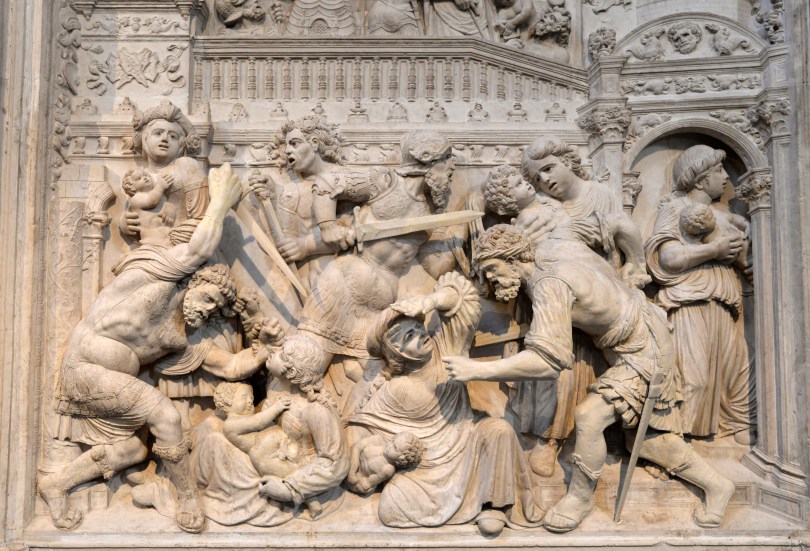
The 28th of December is the day on which the Church marks Holy Innocents. It is a day that focuses on the harrowing account in the Nativity story told by Matthew, of the orders King Herod gives to slay all male children under the age of two. Fearing the emergence of a rival, the King makes his fateful decision based on the Magi’s interpretation of the star they observed. 

Children are all too often, tragically, killed in conflict. However, the targeted destruction of the young is rare. In wartime, as we see around us in the world today, children die, are injured and become psychologically damaged through conflict. In WWII, as a consequence of indiscriminate bombing, almost 8,000 children died in the UK. The worst affected city was undoubtedly Coventry. On 14 November 1940 huge amounts of ordinance were dropped on the city leading to a significant loss of life; the destruction of countless buildings (including the cathedral); and widespread civilian trauma amongst those who survived. A few weeks’ after the attack the Dean of Coventry gathered as many choristers as he could in the ruins of the Cathedral and broadcast a rendition of the Coventry Carol to what was, at the time, the British Empire. This carol, which comes from the medieval Coventry mystery plays, recalls the massacre of the innocents. It must be one of the bleakest, most sombre and deeply moving items in the canon of Christmas music. The wartime clip from Coventry is featured in an emotional and thought-provoking episode of BBC Radio 4’s series Soul Music.

Laurence Sterne, the 18th century parson-novelist, says remarkably little about Christmas in any of his writing or preaching. Yet there is a sermon on Holy Innocents. Sterne knew from personal experience what it was to lose a child. He describes the massacre of the innocents as being:

So circumscribed with horror, that no time, how friendly soever to the mournful, – should ever be able to wear out the impressions.

When I worked in the NHS I recall very occasional instances when a mother contacted the hospital to ask about the mortal remains of their child, who had died many years ago. This arose out of the fresh attention given to the issues of organ and tissue retention, and burial practices, following the Bristol Royal Infirmary and the Royal Liverpool Children’s inquiries. In some cases mothers had given birth to a living child, who had died within a short time, and the mothers were told to go home and in essence – forget about it. They were provided with no information about what then happened to their babies or where they were buried. Records were kept, but the existence of a baby’s body in amongst an adult “shared grave” was not recorded on the headstone: unlike the adults. Once or twice I arranged to meet a mother at the entrance to the local cemetery and took her to the place where the records stated her baby was buried. I hope that, in some small measure, this helped a grief which had lain largely unexpressed for decades.

Holy Innocents begs many questions of the Church, and of the world. How could God’s miracle of the incarnation result in so much terror and destruction? Why is it that we continue to tolerate warfare that damages young lives? How do we help survivors who have witnessed unforgettable horrors? There are no easy answers to these questions. However, the presence of Holy Innocents in the Church’s calendar stubbornly insists that even while the tinsel is still hanging, the most dreadful realities of the world cannot be put aside or forgotten. They are always there and, hopefully, stir people of good faith of every religion and belief to seek peace with added urgency. Because the innocents are still being massacred today.

That woe is me, poor child, for thee
And ever mourn and may
For thy parting neither say nor sing,
“Bye bye, lully, lullay.”

From the Coventry Carol, 16th century

Living For

I am reading a book about the history of my new employer, Leeds Church Institute (LCI). History can be fascinating, both for the strangeness of how life was once lived and, occasionally, for the sudden resonance of a view or action which appears entirely modern.

The quarter century leading up to WWI is described in the book as “the golden age” of LCI. Wealth increased for some, and for others new legislation reduced working hours, meaning that in both cases more time and resources were available for recreation; discussions; hobbies; voluntary work; or religious associations. (The text “Eight Hours for Work, Eight Hours for Rest, Eight Hours for What We Will” was paraded on a union banner in 1889). It was the time when public schoolboys and undergraduates came to Leeds to live in “settlements”, often found in the poorer quarters of the city. Of course, this could be experienced as highly patronising and there’s a powerful quote in the book about LCI’s history from an older woman in one of these areas who declared: “I do so hate being ‘lived among‘”.

As we approach Christmas her words ring in my ears and remind me that the Incarnation was more than a gap year for an earnest deity. Public schoolboys didn’t renounce their learning, connections or resources when they came to reside among the poor. They were no doubt billeted in reasonable accommodation, forming a small community of young people who shared privileged backgrounds. These communities was set in a wider context of poverty; disadvantage and squaller. I can imagine many of these settlement workers, in future years, burnishing their credentials by referring to the time they “lived among” the poor. A year of their youth that bought the claim to a lifetime of social credibility.

“For all the rhetoric of ‘citizenship’, ‘democracy’ and ‘fellowship’, the governance of the settlements, at least in their early years, was in the hands of their patrician founders rather than their ‘members’.”

Freeman, M. (2002). ‘No finer school than a settlement’: the development of the educational settlement movement. History of Education31(3), 245-262.

The Word made flesh gives up language. The babe in the manger has no worldly connection that will hoist him out of misery. The infant son of a carpenter must play with the shavings on the workroom floor, and discern his own path through all the perils and possibilities of life. He must learn words and imbibe the teachings and practices of religion. As a young man driven into the desert, the vocation of Jesus is tested in the wilderness of the world, alone with his demons. Preaching, teaching and healing as a Rabbi he will come to challenge both temporal and spiritual authorities. Standing resolute before the powers of coercion and compromise, resolved in his calling and identity, will become the path to his destruction.

This is not living among. It is living with; it is living as; and it is living for.

Christian Mechanics

When I left my previous employment I had no idea what would come next. One of my colleagues asked me: “what are you going to do?” Without thinking I replied, “God knows!” Perhaps this response emerged out of a rather hollow bravado, or a faith which was more certain in words than it was in reality. In the first instance, rather than look around for another job, I decided to have a sabbatical. These are often taken by clergy every ten years or so but, because I was employed outside the Church, I’d never taken one in the thirty years of my ordained life. In the summer of 2023, I began what became a fruitful, fascinating, and rewarding sixteen months of space, reflection and study. A friend once referred to me during this time as a “flaneur’” which I needed to look up (“someone who saunters around observing society”). Fair point.

One of the fruits of this time was reading and learning more about a figure associated with Yorkshire and York Minster, Laurence Sterne. I knew of Sterne’s writing from undergraduate days and the many links with this mercurial vicar of the 18th century found in Yorkshire – not least the Shandy Hall Museum – became a focus of work to produce a Lent book. I ventured out by bicycle to visit various small churches connected to the novelist, not least Sutton-on-the-Forrest. Its pulpit steps, once used by Sterne, feature on the cover of the book.

While not looking for any permanent role, the post of director for Leeds Church Institute came to my attention. Perhaps this was the answer to “God knows”? In any event, I applied and was appointed. The Institutes were part of a movement in Victorian England which offered education and increased opportunity for people from poorer backgrounds. The first phase of these were the Mechanics Institutes. When the Rev. Walter Hook orchestrated the creation of the Leeds Church Institute it has been suggested that he was building a facility to develop “Anglican Mechanics”. In other words, to equip church people with a greater depth of knowledge about their faith and how to live it.

Arriving early on Monday morning (keen to get started) I walked around the city centre. In a small homage to the original home of the Institute, in Albion Place, I stopped for a few minutes to read the Leeds Civic plaque recording its creation. The Institute was ‘The powerhouse behind the advancement of religious and secular education on the principles of the Church of England’. The former home of LCI is in the main shopping area of the city, now decked out in all its Christmas glitz and glamour. I thought about what life must have been like there in the 1860s, when the building was opened. At that moment someone looking fairly dishevelled, who had perhaps spent the night on the streets, came and asked if I would buy him breakfast. I did. Walking a short distance further another man overtook me, apparently talking to himself, when he suddenly launched into an abusive tirade against a woman walking in the opposite direction. She stopped, I stopped, and we exchanged a look as she shrugged her shoulders and asked aloud: “what was all that in aid of?” The man continued on his way, still talking, gesticulating, and going at a good pace. Having checked that she was OK, the two of us carried on in our separate journeys.

Perhaps things have not changed as much as we might imagine since the founding days of LCI. During a phase of exponential growth in population, the philanthropists and civic leaders of Leeds faced a colossal task in addressing the basic needs of poorer communities. Today we would no doubt find their approach patronising and – possibly – coercive. The workhouses were in full operation and the poor had little access to either education or the opportunities that might change their circumstances. Walter Hook, the celebrated Vicar of Leeds, played his part in helping to found new churches and schools. His approach was allied to the principles of the Tractarian Movement, High-Church Anglicanism, but he had arrived at these independently of the movement. Unlike the dons and academics sheltering in ivory towers, Hook was the most significant figure of Anglo-Catholic reform in the parishes. Firstly, as a priest in Coventry, then in Leeds, he advanced the cause of High-Church liturgy and social action, enduring various attacks while he sought to fulfil his sense of calling. Newman wrote to him:

“You are in the thickest fire of the enemy; and I often think how easy it is for us to sit quietly here…”

Hook had not chosen an easy path, but his dedication to parish ministry and commitment to education has left an enduring legacy. It’s why LCI is still here in Leeds, in 2024, working to advance theological reflection and act as a creative fulcrum where spirituality, justice, and learning, meet and flourish. It’s mission remains both a daunting task, and an exciting enterprise.

  • At the head of this Blog: Old and new together – Dock Street, Leeds, close to Leeds Church Institute

This Mortal Life

Pitched into the bleakness of winter arrives the season of Advent. In the northern hemisphere the beginning of Advent accompanies the slow march into darkness. Shorter days; longer nights; a steady drop in temperature. The themes of Advent – death; judgement; heaven and hell – match the somber mood of gloomier days. Threaded through topics of great moment, the story of the incarnation is pulled ever nearer. Alongside the readings in church of end-times and apocalypse, every village, town and city displays the brightness of festival lights. The cynical and despairing may shun these illuminations as simply a commercial gimmick; the cold work of retail-marketing to boost sales in a flagging economy. Yet for many of us, somehow, the glimmer of hope these lights celebrate, the baby lying in the crib, can never be given its proper price. There is something here, something to which Advent leads, which can’t be contained by the measure of this world, or our desire to conform everything to our own likeness.

It can often feel, as it does this year, that there is temerity in setting out lights as the nights draw in. How dare we suggest, imply or hint, that something might come to defeat the darkness? It is the ridiculous hope written down by John in the Prologue to his Gospel: “The light shines in the darkness, and the darkness comprehended it not”. Like Handel’s taunting rendition of St Paul’s words asking Death where its sting has gone, the hope that light might eventually overcome personal darkness, and the darkness of our world, feels an outrageous folly. Perhaps this is so because “the bleak midwinter” can feel so tangible, close and all-encompassing. Nordic countries have recently issued booklets to their citizens about surviving war. Sometimes it is so much easier to embrace fear and resignation, than fasten our eyes on something hardly visible; beyond the horizon; too good to be true.

Advent candle-bridges are a tradition in the windows of homes along Minster Yard in York.

Advent is not for everyone. The images of apocalypse and the ending of time are neither comfortable nor reassuring. “Like a thief in the night”. We cannot be permanently vigilant – we need to sleep. The metaphor suggests that the completion of things will come when we are oblivious to its approach. There is no warning or alarm. We will be shaken our of slumber and the myths with which we live will dissolve in the presence of the Divine reality. In another sections of Handel’s Messiah, we are reminded of the “refiner’s fire”. Who may abide the day of his coming?

Advent reminds us that we cannot control the appearance of sudden and defining events. We are always only a heartbeat away from immortality, and our own encounter with what Sterne’s character Tristram Shandy refers to as “this great catastrophe” which will – at some point – overtake us and bring our experience of this world to an end. Of course, following Friday’s vote in the UK parliament, it appears that there will be limited control, for some, about when that moment arrives. However, as one person said during the debates about this issue, it may also give rise to “internal coercion” and perhaps lead people to opt for something which does not reflect their personal wishes about either motivation and timing.

“We are standing upon the edge of a precipice, with nothing but the single thread of human life to hold us up”.

From a Sermon delivered by Laurence Sterne, quoted in A Sterne Lent 2024

Advent is – and should be – disconcerting. Angela Tilby’s excellent reflection in the current issue of The Church Times draws attention to Archbishop Laud’s prayer for the church. It is a succinct and impassioned petition for truth; peace; purity; and reform in the institution. All of these virtues and corrections are needed now almost as much as they were required in the 17th century. Canon Tilby concludes her piece with a simpler prayer which she wrote some years ago, but one which feels as pertinent as ever for 2024:

As light in the darkness,
As hope in our hearts.
Come, Lord Jesus, come.

Angela Tilby, The Church Times 29 November 2024

  • The photograph at the head of this blog features the underside of York Minster’s three metre wide Advent wreath, with the interior of the central tower seen in the centre.