Seaside in Winter

This is by far my favourite time of year to be at the coast. Walks with the dog before dawn, watching the clouds change from bruised purple to dazzling gold. Hiking later in the day along headlands and across beaches, with few other walkers about. At night a deep darkness allows the Milky Way to be seen along with the winter constellations. When it is frosty it becomes an altogether magical scene. Only once did I find myself snowed in at a seaside cottage. It is a rare event, especially in a world affected by climate change. Slowly, as the day progressed, each of the three main roads out of Whitby were closed. With nowhere to go it became a good reason to stay in and put another log on the fire.

Oyster Catchers flying in the early morning along the coast at Sandsend

Observed from somewhere warm, the winter seascapes and landscapes offer drama and space for contemplation. This is the time when monarchs in mead-halls would demand that a saga was told. Perhaps a storyteller giving voice to the rich imagery of Sir Gawain and the Green Knight or, earlier still, Beowulf. Stories that reflect the darkness and magic of mid-winter, when the slightest covering of snow transforms the world outside. Perhaps it is hard for us to imagine, in an age of instant entertainment, the majestic scope and spellbinding intricacy of these substantial narratives. Like all knowledge passed down the generations, no doubt a multitude of minor changes occurred over the years which each teller making it their own tale. Eventually, multiple written copies started to keep the narrative in a form that was more stable, and the teller’s individuality became focused on the way of telling.

The sea runs back against itself
With scarcely time for breaking wave
To cannonade a slatey shelf
And thunder under in a cave.

Before the next can fully burst
The headwind, blowing harder still,
Smooths it to what it was at first –
A slowly rolling water-hill.

John Benjamin ‘Winter Seascapes’

Fewer snowy days come in our time – although we are experiencing them in the UK as I write. Generally, winter days are milder, sometimes stormier, which perhaps makes the appearance of ice and snow all the more marvellous. Growing up my mother often said “we don’t get winters like we used to”. I didn’t believe her, thinking this was simply the effect of advancing years reflecting on memories of youth. Of course, she was right. These precious days, if and when they come, may cause disruption and difficulty as people go about their lives – especially for those who are homeless. But maybe they also invite reflection, wonder, and act as a reminder of the world we are all, to some degree, changing.

Holding Still

Over the past few days I drafted a blog, as I do most weeks. It was largely a litany of despair about the state of the Church of England and the nadir of leadership and direction to which we appear to have sunk. Today is the final Sunday in the Church’s liturgical year, but it might also feel like the dying days of a once great institution. Perhaps, if its demise would ensure more people’s safety and sanity, there will be those who think that extinguishing the final embers would be an act of kindness for all concerned. The Church has failed in one of its primary obligations – but I cannot quite abandon the idea of what it might be.

Instead of a dismal diatribe about the Church’s failings (mine included) I have decided to take a different tack. The “idea of what it might be” includes resurrecting the often unseen but invaluable work of spiritual and pastoral care. In early 2020 I was looking for a poem to accompany some reflections for a retreat, but couldn’t find anything that would fit. Given this sad lacuna in English Literature I decided to pen my own verse and, for better or worse, I offer it on this final Sunday of the year as the slightest intimation of what at its best has been, and might still be, in the life of the Church’s sacramental pastoral care.

Holding Still

This work of holding;
of the the task of being
still, in order to hear.
To shift weight without

disturbance; to keep
the hushed, spare –
space; the silence into
which another speaks.

It is not nothing;
this attending and
anointing; this taking
and bearing and blessing.

To touch what has died
with the strength of love;
to see in ashen form the
hope of resurrection.

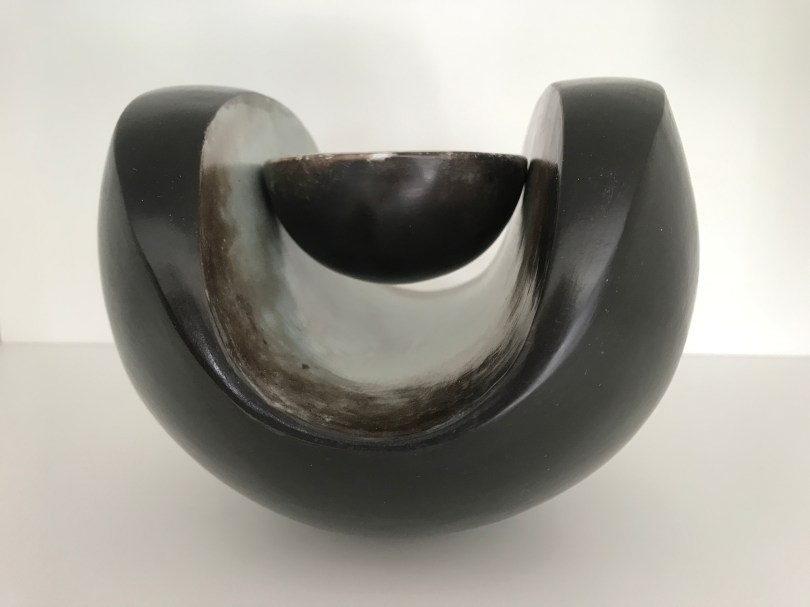
The image at the head of this blog is a photograph of a ceramic sculpture by Antonia Salmon, entitled “Holding Piece”

Divinity must live within herself

I am banned from cycling in misty conditions. This followed a rather painful altercation with some construction fencing that had strayed into the road at the bottom of a long downward incline. On a grey morning, in grey weather, and against a grey road-surface, the grey fencing didn’t register: until I hit it. Suddenly, I was sailing through the air, extending my left arm ahead of me, a reflex action of protection, and landed painfully some yards ahead of the now stationary bike. A lorry driver stopped. Dazed and disorientated I got myself up, beginning to feel an intense pain in my left shoulder. With all the ridiculous desire of an Englishman not wanting to make a fuss, I declined all offers of assistance, placed my bike out of the way, and decided to get a bus towards the hospital where I worked. Once there I went to my office in order to get changed before presenting myself at A&E (one has to have standards). I thought I had broken my shoulder but, it turned out, I had broken the fifth metacarpal of my left hand in two places. I soon learned that it’s an injury called “boxer’s fracture”. At a later date, casting an uncertain eye over me, a surgeon (who clearly didn’t feel I fitted his image of a pugilist) asked me how I acquired the breaks. He suggested that perhaps I should desist from cycling in the future.

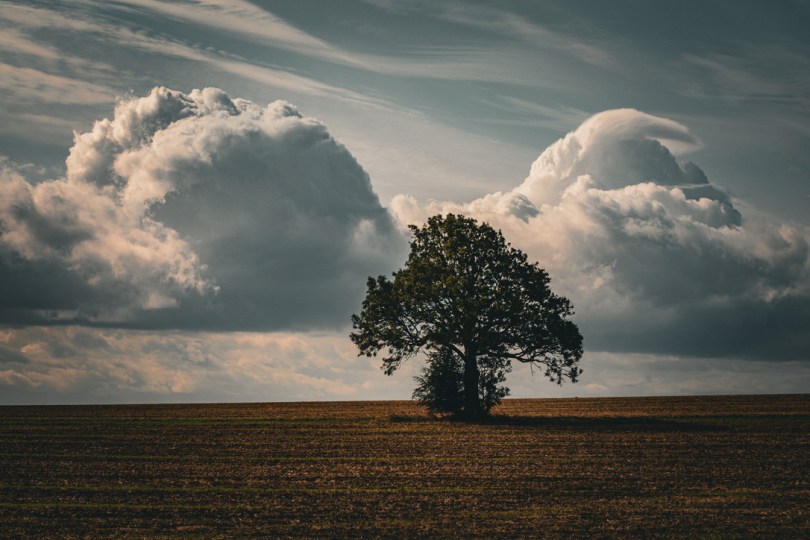
Low mist across a ploughed field, near Linton-on-Ouse, October 2024

I did not follow the consultant’s advice, although I have made it a general rule not to ride me bike when visibility is impaired. However, last week, setting out on a beautifully clear sunlit morning in York, I began to encounter misty conditions on the outskirts of the city. Weighing up the likelihood that conditions would improve I pressed on to my planned destination of the Aldwark Toll Bridge, about 15 miles from the centre of York. As I anticipated, when the sun got higher the mist receded and it turned into the kind of bright and clear autumnal day which is the muse of poets. Down country lanes the landscape spoke of the changing season: ploughed fields with the dark earth turned in readiness for growth to come. Trees beginning to bear a foliage of yellow, bronze and green-become-gold.

What is divinity if it can come
Only in silent shadows and in dreams?
Shall she not find in comforts of the sun,
In pungent fruit and bright, green wings, or else
In any balm or beauty of the earth,
Things to be cherished like the thought of heaven?
Divinity must live within herself:
Passions of rain, or moods in falling snow;
Grievings in loneliness, or unsubdued
Elations when the forest blooms; gusty
Emotions on wet roads on autumn nights;
All pleasures and all pains, remembering
The bough of summer and the winter branch.
These are the measures destined for her soul.

Extract from Sunday Morning by Wallace Stevens

It would be very hard to live without this cycle of outer change. In the northern hemisphere they are part and parcel of my spirituality. Within the altering length of days, and the transitions of spring and autumn, Western Christianity has moulded itself into the furniture of the seasons. From the heavenly sparks of Michaelmas, with the equinox behind us, to the remembrance of All Saints and All Souls, liturgy marches to the tune of a changing year. Over the past three decades I have taken funerals in autumn that have a particular poignancy – of change and decay – with a need, somehow, to return home before the darkness falls. A time to comfort one another in a season that tells us, as all seasons do, that while they might occupy a span of time, they can also be a mood; an atmosphere; and a state of being, which greets us on any given day. Divinity is not only something that comes to us in silence. Nor is she confined to some specific time of the year. God is in all these seasons, and the spirit of all these seasons dwells in us.

Wings of Longing

Recently I was prompted to ponder whether angels have beards. I was visiting St John’s church at Howsham, in the Harton Benefice, north east of York. In the church’s porch is a carving of an angel sporting a beard (below). It was a sight that stimulated thoughts about angels, our tendency to anthropomorphise these heavenly beings, and what our long history says, across many faiths, about angels in the 21st century. As it happens, the appearance of angels has a lot to do with our imagination and how people conceived of beings who can span the divide between the secular and the sacred.

Today, on the Feast of St Michael and All Angels, it might be helpful to recall that many theologians across church history have not viewed angels as corporeal. Instead they have been regarded as expressions of Divine thought and agency; the light of heaven that breaks into the darkness of this world. Of course, in the history of art they are consistently represented as beings akin to people, albeit extra-shiny and with a pair of wings. Their expressions are typically impassive, like good servants they betray neither joy nor sorrow about the news being conveyed. The notable exception to this is the antics of the heavenly host at the Incarnation, joyfully praising God and generally whooping it up.

Thomas Aquinas, the Angelic Doctor, famously wrote of the “Bread of Angels, made the bread of people”. Panis angelicus is a stirring hymn of praise to God for the grace of sharing with humanity food which is the everyday fare of heaven. Consequently, at the Eucharist, angels are always referenced in the liturgy. As bread and wine are taken and consecrated, the material becomes one with the Divine, just as it did when the Word became flesh. This enacts a significant truth of Christianity: that in Christ the world is being redeemed. It is a central tenet of orthodox Christology, expressed in the Athanasian creed, that Jesus was perfectly divine and perfectly human. This was not God and a man sharing a room! The presence and witness of the angels in the liturgy expresses this fulfilment of the secular in the sacred. In the birth, death and resurrection of Christ, humanity is truly “ransomed, healed, restored, forgiven”.

“The beast taken” Revelation 19:20. York Minster Great East Window

Angels are not beings confined to churches and places of worship. The biblical references to them are most often in the secular, encountering people out in the world. Their strangeness and seemingly random appearances inspired the author of the Letter to the Hebrews to remind us that in our reception of others “some have entertained angels unawares”. During a time as poet in residence at Bradford Cathedral, Diane Pacitti published a collection of poems entitled Dark Angelic Mills. In the final entry, ‘Angels in Bradford’, Pacitti reflects that angels come in many guises. Perhaps as ‘kindertransport children, Asian workers, Syrian refugees, Rohingya Muslims’. In her poem, just as each church had its angel in the Book of Revelation, she invokes the spirit of St John to call into being the Cathedral’s angel:

Let it spread
huge-feathered wings over this hut of stone.
Let the song of wonder weave into its prayers
and seep into its silences. Angel-voice,
speaker of demanding truth, send out this church
to affirm the holy in what seems most broken.

Dark Angelic Mills by Diane Pacitti, Norwich, Canterbury Press, 2020.

The Church should always be the place which drives the heart of our participation in God’s mission of love for the world. We are drawn in, revitalised, and expelled back into the pathways that take us to both places of obvious significance, as well as to the peripheral and the neglected. In the ‘hut of stone’ where the church gathers we should encounter again the moment when the secular and the sacred meet: ‘the end of all symbols’ and the place where we are fed with the bread of angels.

England’s Bloodiest Battle

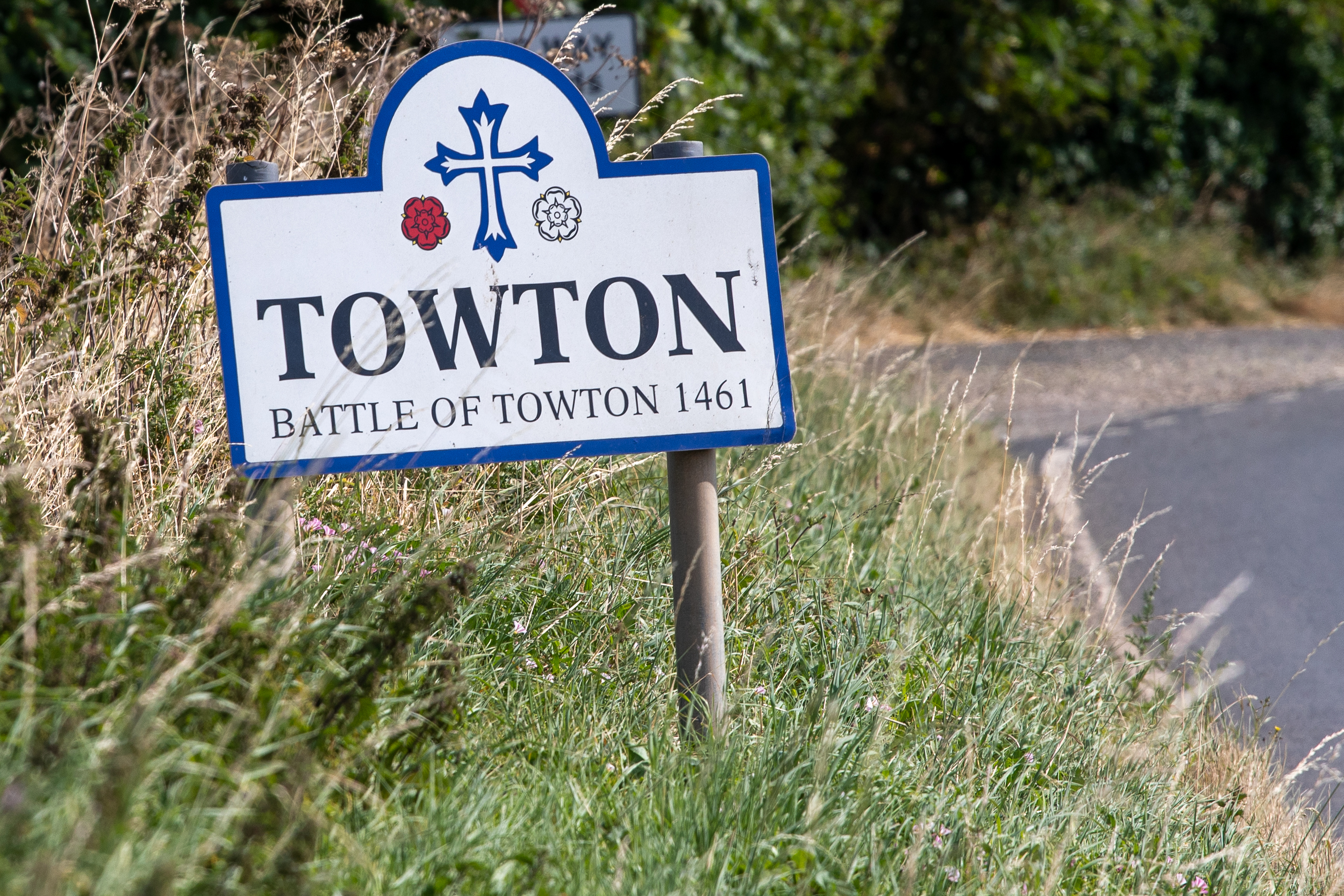
I had wanted for some time to visit the town of Towton. Not so much the town itself as for the fields which rise above it on the way to Saxton. Here a battle took place in the 15th century which may have cost more lives than any other conflict on English soil. It was part of the War of the Roses, and some estimates claim that 28,000 Lancastrian and Yorkist soldiers lost their lives in a single day. Over time the signs of battle have vanished from a landscape now given over to agriculture. It cannot be claimed with certainty where the spot lies on which the warfare took place. However, on the 29th of March 1461, during a snowstorm, two mighty armies clashed and laboured for several hours to prevail. It was Palm Sunday.

This battle is a central event in Shakespeare’s Henry VI part 3. The exhausting and bloody nature of a conflict in which the armies were evenly matched is expressed in words the Bard gives to King Henry:

Now sways it this way, like a mighty sea
Forced by the tide to combat with the wind;
Now sways it that way, like the selfsame sea
Forced to retire by fury of the wind.
Sometime the flood prevails, and then the wind;
Now one the better, then another best,
Both tugging to be victors, breast to breast,
Yet neither conqueror nor conquerèd.
So is the equal poise of this fell war.

Shakespeare, W. Henry VI part III, Act 2 scene 5.

Gazing across fields, above which huge clouds pass serenely, it is hard to imagine the butchery that took place here more than half a millennium ago. The loss of life is all the more extraordinary given the weapons available at the time. War was a matter of sustained labour, with sheer physical force being the principal means of achieving victory. Being a soldier required strength and stamina and the chances of survival were poor if you were injured in any way, as the medicines of the time had limited effects.

In Macbeth, Shakespeare describes another military encounter, also finely matched: “Doubtful it stood, As two spent swimmers that do cling together And choke their art”. This would be a fitting description of the struggle across the fields near Towton. Perhaps, in some cases, there are worse things than an immediate and crushing defeat. The attrition of balanced forces was devastating for the communities involved. At the time of the battle England’s population was under 2 million and the losses of the day may have amounted to more than one percent of the nation’s inhabitants. Inevitably, this figure would have included an even greater proportion of the able-bodied men of the time.

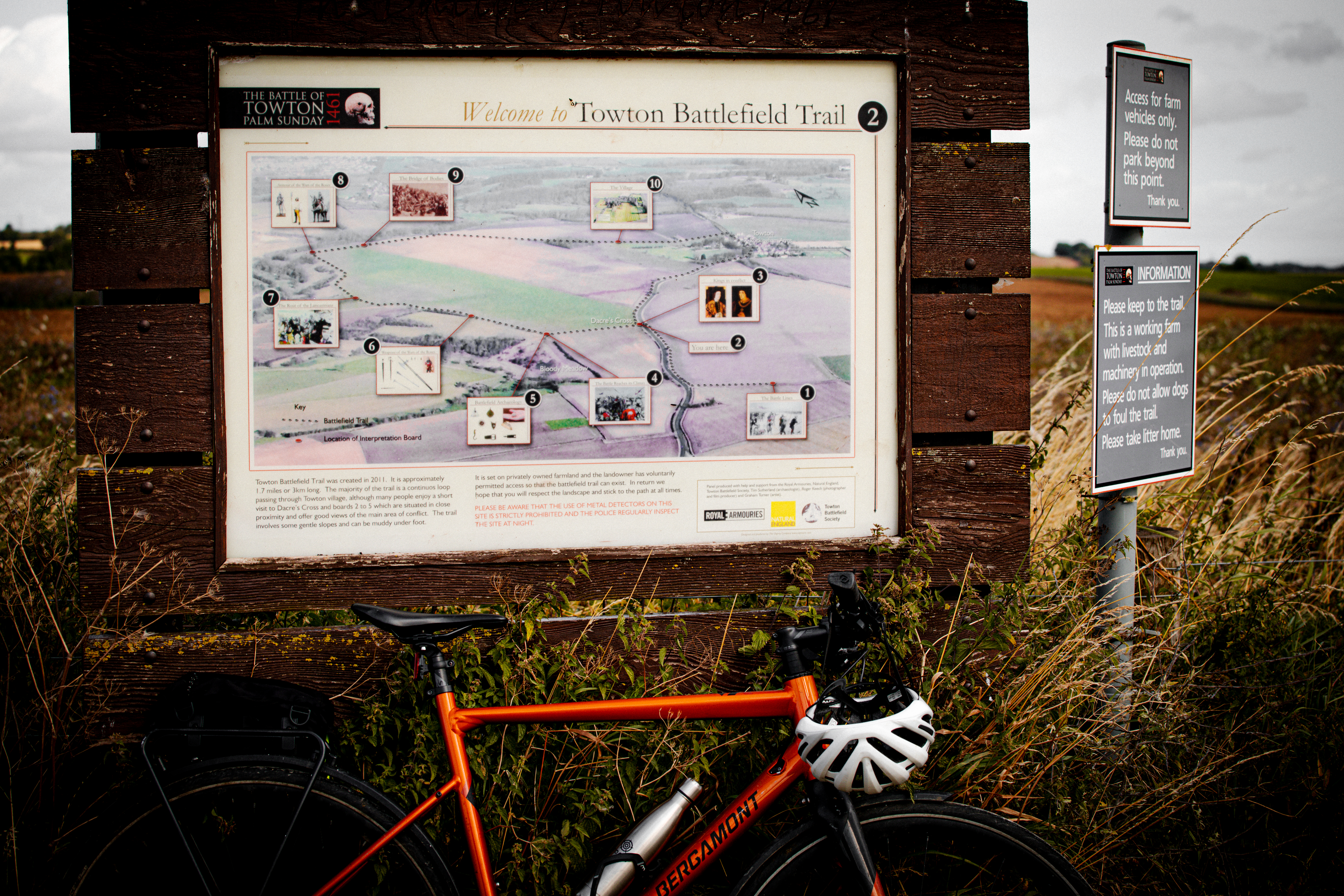
Today, the fields above Towton look no different from the the arable land that stretches east towards York and west towards Leeds. The history of the place is told on a couple of display boards with a trail that takes visitors across the most likely places of significance during the battle. The devastation of this domestic conflict is long disappeared, but it has become a place for people to visit and contemplate the history of warfare, politics and – it is to be hoped – the continuing necessity to labour for the peaceful resolution of conflict

The Mystery of the Creation

I have always found that churches and chapels in remote locations have a certain appeal. Sometimes these might be a long way away, such as the Keills Chapel, dating from the 11th century and near the village of Tayvallich on the west coast of Scotland. In other instances they are much closer at hand, like the small church at Bossall a few miles east of York. In both cases these buildings stand in relative solitude, with only a handful of houses nearby. Like the poet Philip Larkin, visiting these empty spaces of ancient significance conjures an atmosphere both melancholic and reflective. Who were the people who built this place, attended services here and, on one particular day, held their last act of weekly worship?

Having strayed into the local second hand bookshop recently, I came across a volume of selected prose by RS Thomas. In one short chapter Thomas writes about “Two Chapels”, with only one thing in common: remoteness. The first is called Maes-yr-Onnen in Radnorshire. It was August and, as the building was locked, Thomas stretched himself out on the grass and began to think about the past visitors to the chapel:

“sober men and women dressed in sober fashion. I saw them leave the sunlight for the darkness of the chapel and then heard the rustling of the Bible pages and the murmur of soft voices mingling with the wind”.

RS Thomas, Selected Prose, Ed. Sandra Anstey, 1986, Poetry Wales Press.

It was in this revery of imagination that Thomas found, like St John on Patmos, he had a vision. It was a moment when he felt he comprehended “the breadth and length and depth and height of the mystery of creation”. Yet, beyond this, Thomas was unable to put the experience into words. Reading the little he wrote about this event reminds me of the visions of Julian of Norwich. In that moment Thomas discerned that “everything is a fountain welling up endlessly from immortal God”. It feels to me as though this ancient chapel suddenly became for Thomas a dark and brimming well, replenishing with living water a world that so often becomes disenchanted and descends into cynicism. Like God, whether attended or unattended, the Chapel stood its ground and told its truth.

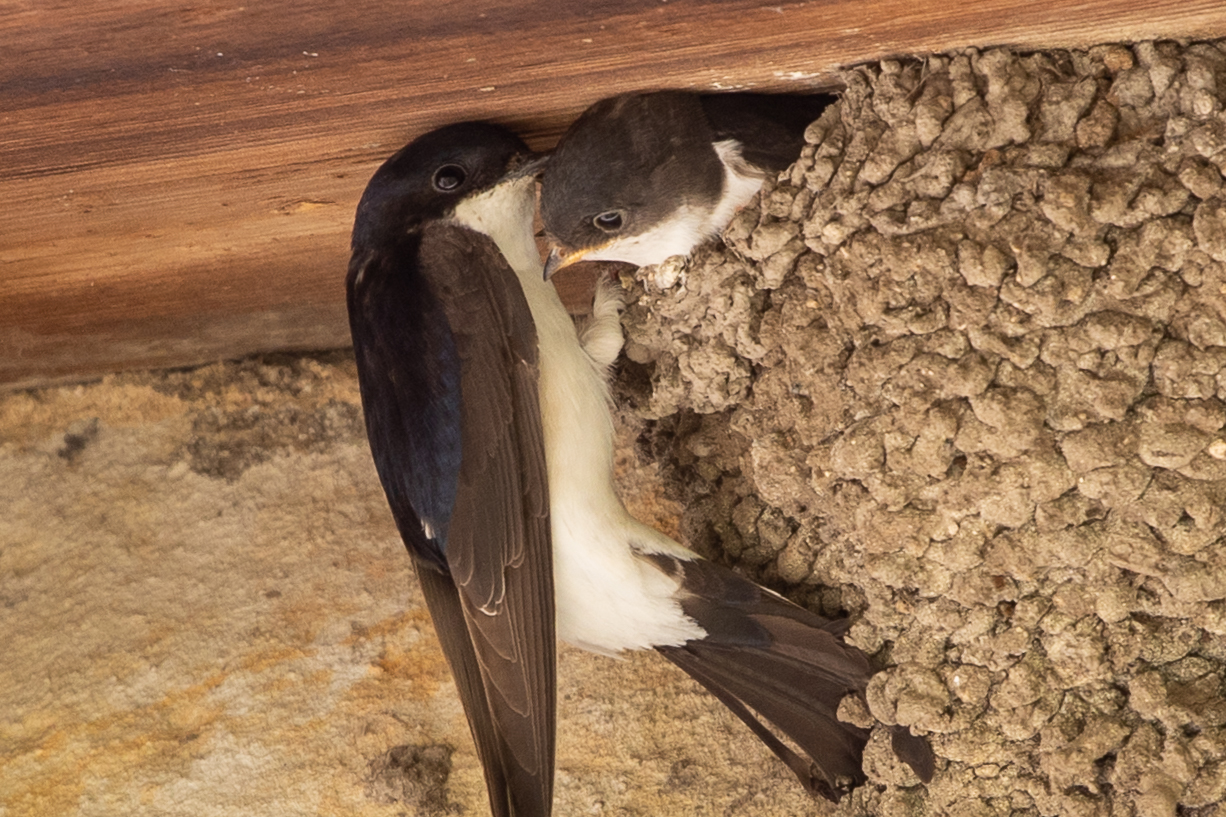
Out at the Church of St Botolph in Bossall, it is not difficult to share a little of the feeling Thomas encountered at Maes-yr-Onnen. It is the smallest parish in Yorkshire, built in the late 12th century, and is never open when I visit. The churchyard is overgrown and neglected, but seems to me to be none the worse for the lack of tidy graves or well-tended curb stones. What might seem to some to be a place of death is bustling with life. House martins are nesting in the eaves. A wyvern weathervane tells you from whence a gentle Yorkshire breeze is blowing. Swallows flit too and fro and, above them, swifts wheel and dive on the afternoon’s heat. Despite all our neglect of the planet, here is somewhere that time has forgotten to alter. One small red letterbox, opposite the church, is the only sign of connection to a wider network of society and even that, today, is largely unused.

RS Thomas believed strongly in the connection of people to the landscape of Wales. For him it was the case that “Here, in the soil and the dirt and the peat do we find life and heaven and hell”. To leave the land, and to live in towns and cities, was to abandon connection to the environment in which the Welsh should “forge their soul”. This may seem a romantic and unrealistic notion in 2024. However, as we have seen in recent weeks, it can hardly be said that the current society in England is one where there is peace and flourishing for all. We may not be able to have the kind of connection to the land that Thomas saw as spiritually needful, but perhaps we can make more of those places that offer a sense of spiritual location and peace. Places to stretch out, metaphorically or otherwise, and contemplate. Thankfully, almost without exception, they exist in all our communities and perhaps the call to the church in current circumstances, to quote words TS Eliot put into the mouth of Thomas Becket, is to “Unbar the doors! throw open the doors!” Most of these places are both close to communities but, remarkably, also other-worldly and distinct. They continue to have a part to play in our society but require the resources and support in order to fulfil their vocation to be at the service of all parishioners.

Grievous Sickness

It is approximately 4½ years since COVID first appeared. I am unconvinced that any of the hard work required in order to learn lessons from a profoundly difficult experience has taken place. I’m not referring to the various national inquiries that are underway, but to the more everyday reflection which generates learning and change. It would appear, as soon as we possibly could, we were desperate to return to the world we inhabited prior to 2020. All the rhetoric of care and compassion that sprouted during the darkest days of COVID-19 seemingly vanished as quickly as it came.

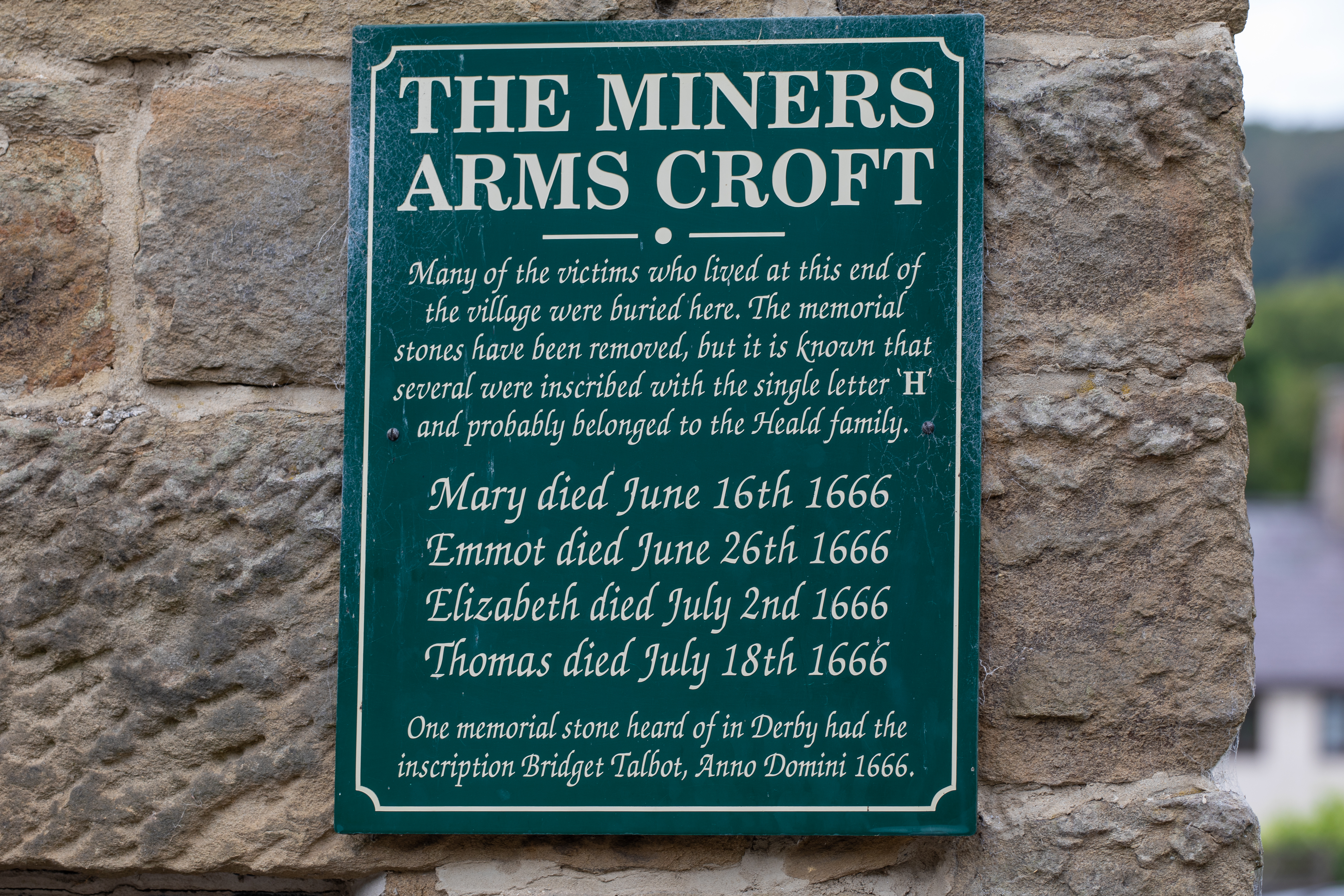
For the world, the effects of COVID were not as devastating as diseases in earlier centuries. Visiting the plague village of Eyam, in Derbyshire, I was reminded about the scale and consequence of the plague. At one house in the village only a single person survived the arrival of this deadly disease, and by the time it was over she had lost 25 relatives (including in-laws). Such a degree and speed of loss is beyond comprehension. While there were a few cases of multiple COVID fatalities in a family, these are remarkably rare. For example, one family experience 4 deaths due to the virus – a truly devastating experience for the family concerned.

Houses in Eyam tell the grim facts of what took place in 1665 and 1666

It is more than 350 years since the village of Eyam endured a sudden and apocalyptic rise in the mortality of its inhabitants. The ability to understand what was emerging, and devise a strategy for isolation and containment, was rudimentary. It is impossible to know how many deaths the world would have seen if COVID had spread abroad in the 17th century. In the 21st century we met the emergence of the virus with rapid progress in the development of vaccines. Knowledge about society and modern communications enabled some support to be offered and applied. Yet, as the first report from the UK COVID Inquiry makes clear, there was so much more that could have been done to mitigate harm. We had, with Pythonesque thinking, prepared for the wrong pandemic.

Speaking in response to the publication of Module-1 of the COVID Inquiry, Pat McFadden (Chancellor of the Duchy of Lancaster), shared with Parliament his thoughts for all those bereaved by COVID. He said that: “Their grief and the nature of their loss is harrowing, with so many loved ones lost before their time”. I think that these remarks are wise and sensitive. When the Government gave daily reports about the rising number of COVID deaths there was no accompanying statistic about the number of people denied access to their loved ones immediately before, and at, the time of their death. There were no figures about those unable to attend a funeral because the numbers were restricted. The sum total of altered rituals, and final farewells denied, will never be known.

There are many more lessons-learned that will come from the COVID Inquiry. The question is, do we have the desire and appetite to absorb those lessons and make changes that will protect more infection-vulnerable communities? COVID has not gone away, and some people continue to experience very debilitating periods of illness. At the moment, at least from a media perspective, this does not appear to be on our radar.

Back in March 2020, when the scale and consequence of the pandemic were becoming apparent, the poet Simon Armitage wrote a piece reflecting on the experience of Eyam. At that stage his hopeful and poetic focus was on the task of patience, and living through COVID knowing that, inevitability, it would pass – as all pandemics do. Taking the example of Eyam he celebrates many acts of individual and collective courage, as well as personal sacrifice, which came to confer on the Derbyshire village a revered status. It is impossible to quantify the number of lives saved by the villagers’ agreement to quarantine.

“the journey a ponderous one at times, long and slow
but necessarily so”

Simon Armitage, extract from “Lockdown”

It is not easy to be patient in a time of danger and uncertainty, and understandable that those who live through it wish to forget it as soon as possible. However, the risk of doing this is that we fail to learn important lessons and reflect properly on the society in which we wish to live. Perhaps it is not too late, and the publication of further Inquiry Modules will provide a basis for us to see clearly how vulnerable people were sacrificed. Already, it has been made clear that the impact of COVID “did not fall equally”. That alone is a fact that should help us to reflect on why some groups in society are deemed to be of lesser value than others.

Lines and Labyrinths

During our recent sojourn in Spain we visited the Centro de Arte Caja de Burgos. The exhibition currently on show comprises various works by the Swiss-born artist, Pablo Armesto. A key theme across the works is the use of light, shapes and, consequently, the implication of shadow. To quote Armesto: “Between science, geometry and spirituality, this is how I conceived this exhibition”.

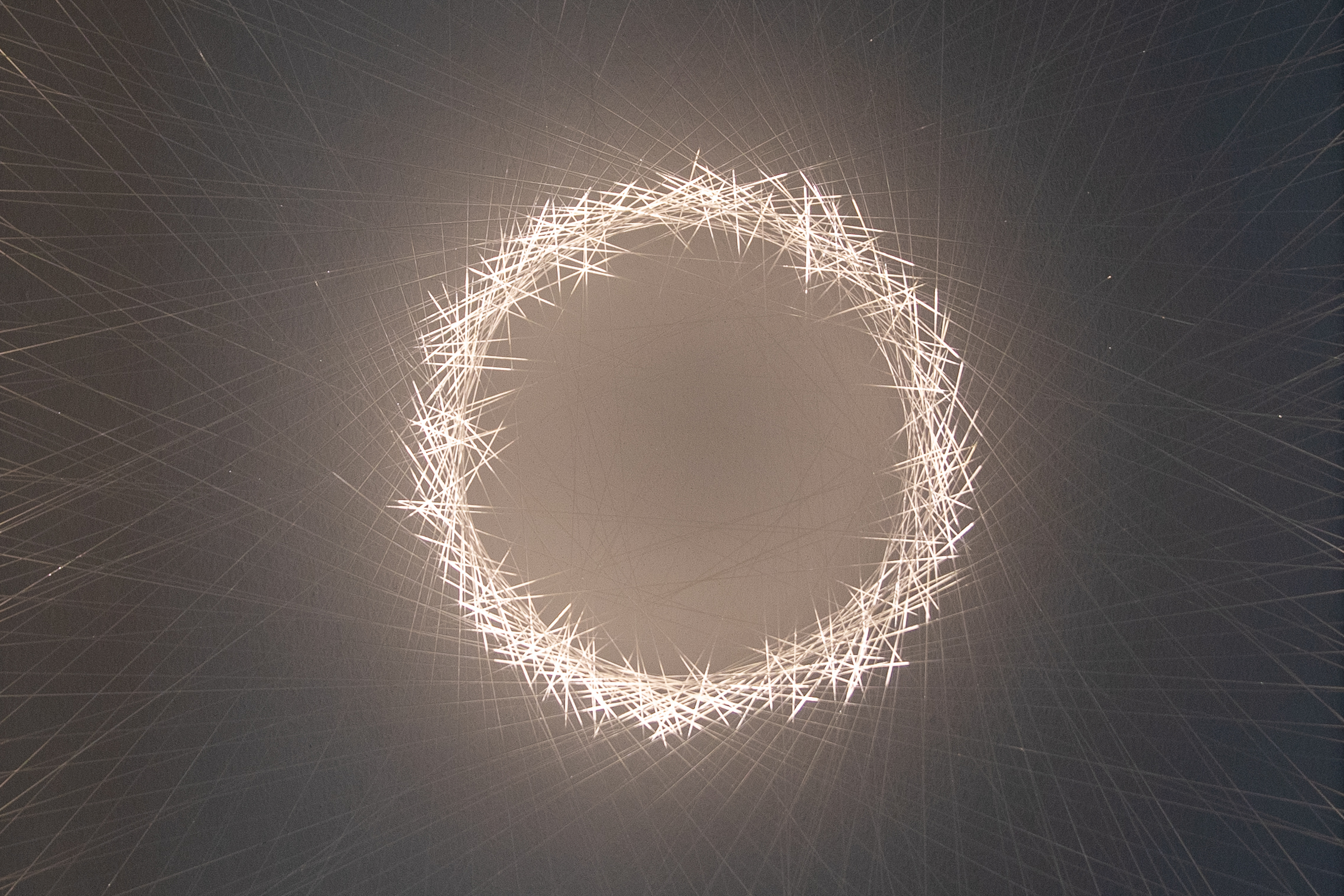
This exhibition appealed to me because of the interaction of light and material surfaces. It is executed beautifully, and serves to remind us that casting a particular light can change completely the underlying structure on which the light falls – or doesn’t. In other words, by illuminating some threads rather than others the surface appearance can be changed radically. Our eyes are drawn to the light and the form it implies, not the unlit shape of everything underneath. As the commentary on the exhibition says, these are “installations in which light and shadow transform the chromatic perception of the viewer”. Here lines of light address our perception:

“The line is a metaphor for the path, both physical and allegorical, sometimes traveling parallel to the initial idea, sometimes divergent when it has to choose between different options, but never schismatic, never discordant”.

Pablo Armesto

The title for the exhibition is “Complejidad, araña, laberinto”. I think that this is best translated into English as “complexity, spider-webs, labyrinths”. This phrase comes from a poem by the Andalusian poet Rafael Alberti, entitled “a la linea” (‘To the line’). While a line may sound a modest thing to be the subject of a poem, Alberti reminds us of the joyous capacity for it to be a “beautiful expression of the different”. Certainly, in Armesto’s installations, the vibrancy of illuminated lines could not be made clearer. It reminded me of the well-known comment by the artist Paul Klee, in his Pedagogical Sketchbook of 1925, that he was engaged in “taking a line for a walk”.

A circle of light created with the use of curved lines – by Pablo Armesto

The recent work I have been doing about Laurence Sterne includes the representation of a physical gesture – the waving of a stick – in volume IX. It is nothing more than a squiggle; a pen-line dancing across the page. It is used to express the notion of liberty and is, perhaps, the representation of the neat text going ferrel. A reminder that the careful shaping of ink that allows us to see letters and to read them, is made of the same stuff as this dramatically inserted hieroglyph. Different forms of the same material may shatter our expectations and leave us wondering what will come next. Art has this capacity to subvert our smooth reading of life and question the solidity and what we see. Like Sterne, Armesto’s filaments stretch our imagination, providing an intense optical experience and stimulating our thoughts about patterns – whether they are there, or simply the imposition of our expectations on the otherwise chaotic things we behold.

Pebbles and sea-light

When I was training for ministry (several decades ago) there were many memorable moments. On one occasion a tutor was preaching for an act of corporate worship in the college when she happened to remark that, amongst other things “good taste” would not save us. A frisson ran through the student body. Ordinands at Westcott House rather prided themselves in aspirations to good taste, and this act of plain speaking was not altogether welcome. However, it hit home and – as all sermons should – gave us food for reflection.

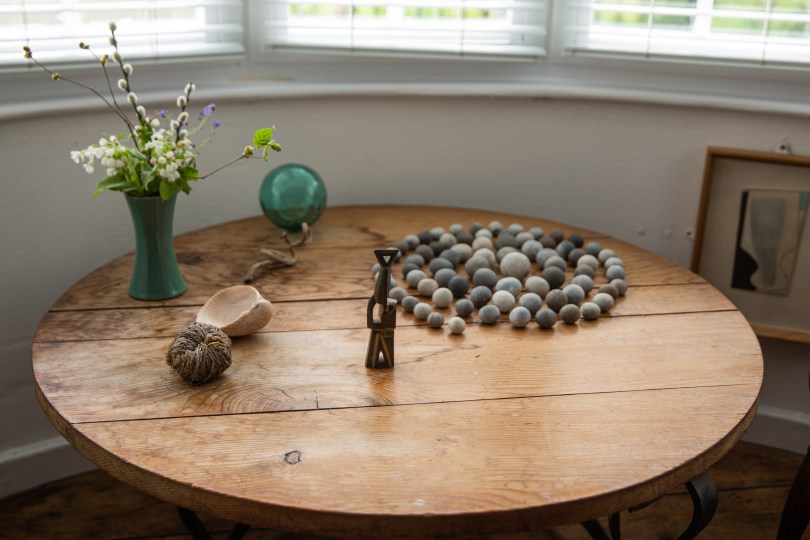
During a recent visit back to Cambridge I was reminded of this criticism. It occurred to me while visiting the fabulous Kettle’s Yard, the University’s collection of modern and contemporary art. This gallery-in-a-home is the last word in aesthetics, where each object is placed with exquisite care to balance and complement the whole experience of being there and responding to the art. Even down to the daily placement of a fresh lemon. The collection was the creation of Jim Ede, an enthusiastic supporter of young artists in the early days of their careers. The setting for the works Ede acquired was a reaction to “the greater austerity of the museum or public art gallery”. It was to be a place where people could sit in contemplation.

Pebbles and sea-light,
drift of grain across an ebbing floor,
land’s end. The wind is sharp as gulls
pat David Pembroke’s window,
lettering the e stars across
a winter wall.

Extract from Rowan Williams, “Kettle’s Yard”, 4 March 1984 in Williams, R. (2014). The Poems of Rowan Williams. Carcanet.

There is something inspiring and daunting about this relentless commitment to art in a domestic setting. The inclination is to take a seat in every room (this is allowed) and contemplate the shape of the space; the artworks; and the light coming from generous windows. I could have spent all day walking amongst this careful and spiritual placement of works by renowned 20th century artists. We went there with two friends from South Africa and they were equally bowled over by the rich diversity of works.

Because so much about Kettle’s Yard is breathtaking, it is hard to think that salvation cannot be achieved by art and aesthetics. Like the work of the tragically young Henri Gaudier-Brzeska, killed in the First World War, all these works point to something else: they are not consumed by their own necessity. Art is always going somewhere else and, even in the case of Gaudier-Brzeska who died aged 23, it is natural to ask ‘what would have been next?’ Given such talent at so young an age, what other works would this genius have brought into the world.

Good taste may not be salvation, but sharing thought-provoking beauty across so many different forms is surely a step to thinking beyond ourselves; to enlarge our world; and to wonder about what other acts of creativity are yet to enrich us.

“Finally, beloved, whatever is true, whatever is honourable, whatever is just, whatever is pure, whatever is pleasing, whatever is commendable, if there is any excellence and if there is anything worthy of praise, think about these things”.

Philippians 4:8-9

Nothings Monstered

I find being praised an uncomfortable experience. There are possibly several reasons for this, such as the inevitable injustice of elevating any one person’s efforts when so much excellent work goes unacknowledged and unseen. There is also the danger that praise is a tool of patronage and amounts to little more than a loan which will one day be called in. Lastly, the words used in praise inevitably fail to fully capture the deeds they describe: they are either too capacious or too perfunctory. Among other writers, Shakespeare is notable for his exploration of the ‘precarious correspondence between words and meanings’ (Sicherman, C. M. 1972. Coriolanus: the failure of words. ELH, 39(2), 189-207). Of course, praise can be genuine and well-intentioned – but I would much prefer not to be subjected to it.

Recently I watched a film adaptation of Coriolanus. The character of the play’s title is not a sympathetic figure. He is a stubborn, able and determined fighter, admired greatly by his troops. But he has very little time for ordinary people – the plebs – or their leaders. When he is seeking to become consul, encouraged by his mother, the Senate meets to recount the many worthy deeds which substantiate his appointment, Coriolanus moves to leave the chamber:

Your Honors, pardon.
I had rather have my wounds to heal again
Than hear say how I got them.

Coriolanus Act 2 scene 2

Despite attempting to persuade him to stay, Coriolanus eventually leaves the Senate. Perhaps he finds it impossible to remain when words sound so hollow compared with the deeds they describe. Warfare is a reality that none can imagine who have not stood within it, or know what it is to be such a danger to the lives of others. Oratory risks tidying away complex affairs and obliterating the wounds they leave. Before departing Coriolanus adds:

I had rather have one scratch my head i’ th’ sun
When the alarum were struck than idly sit
To hear my nothings monstered.

Ibid.

Perhaps surviving appears to be a nothing in the context of war. Many people caught up in the chance nature of conflicts, know that a decision to turn left, rather than right, is the difference between life and death. When I heard the remarkable Arek Hersh speaking about his time in a concentration camp, while standing in Auschwitz next to one of the kind of cattle trucks in which he was forced to travel decades before, it was a powerful testament to the apparent arbitrariness of survival.

USSR – CIRCA 1980: Postcard shows Italian Majolica from Hermitage Plate “Coriolanus’s mother and wife implore Coriolanus to spare Rome”, Faenza, 1523, workshop of Casa Priora, circa 1980

Shakespeare appears to have been very interested in ‘nothing’. The title of Much Ado is a play on the word, and ‘nothing’ occurs 34 times in King Lear. In Coriolanus’ bitter sense of rejection as he is sent away from Rome, he undergoes a fundamental crisis of identity. He has been a loyal and outstanding warrior for the Republic – his decision to cross into the camp of his enemy is a ‘Damascus Road’ transformation. His former commanding officer, Cominius, goes to entreat him to be at peace with Rome – and is rejected. Returning to the capital, Cominius describes the state in which he found his late deputy:

“Coriolanus”
He would not answer to, forbade all names.
He was a kind of nothing, titleless,
Till he had forged himself a name o’ th’ fire
Of burning Rome.

Shakespeare, W. Coriolanus Act 5 scene 1.

Forging a name in battle is a long-standing tradition in many cultures. As a result of his service in WWII Montgomery’s most senior title was ‘1st Viscount Montgomery of Alamein’. For Marcius it is the heat of battle that creates for him a title earned in combat, and takes a form of the name of the city where the battle occurred: Corioli. There appears to be genuine modesty in the response of Coriolanus to the gifts that are showered upon him in the moment of victory. He refuses the offer of a tithe of all the treasure in the city, and instead wants to receive the same portion as every other soldier. As he says: ‘I have done as you have done – that’s what I can’. However, refusing to play the game of reward and gratitude can be a dangerous course of action, as Coriolanus comes to discover. He is banished.

Renouncing his past titles and honours, walking away from his citizenship, leaves the resigned general in extreme isolation. I’m not sure that I agree with Ibsen that, “The strongest man upon the earth is he who stands most alone.” Nevertheless, Coriolanus sacrifices an enormity of rank and resources when he sides with his former enemy. As his mother tells him at one point: ‘You are too absolute’. In Shakespeare’s lifetime, people who took an absolute view about religion and the state could find themselves losing titles and property, not to mention their lives. The playwright was familiar with those who could, in a moment, become ‘a kind of nothing’. A state of loss which is perhaps the precursor of a wisdom that comes to us, all too often, far too late:

For wisdom is the property of the dead,
A something incompatible with life; and power, Like everything that has the stain of blood,
A property of the living …


William Butler Yeats, “Blood and Moon”