England’s Bloodiest Battle

I had wanted for some time to visit the town of Towton. Not so much the town itself as for the fields which rise above it on the way to Saxton. Here a battle took place in the 15th century which may have cost more lives than any other conflict on English soil. It was part of the War of the Roses, and some estimates claim that 28,000 Lancastrian and Yorkist soldiers lost their lives in a single day. Over time the signs of battle have vanished from a landscape now given over to agriculture. It cannot be claimed with certainty where the spot lies on which the warfare took place. However, on the 29th of March 1461, during a snowstorm, two mighty armies clashed and laboured for several hours to prevail. It was Palm Sunday.
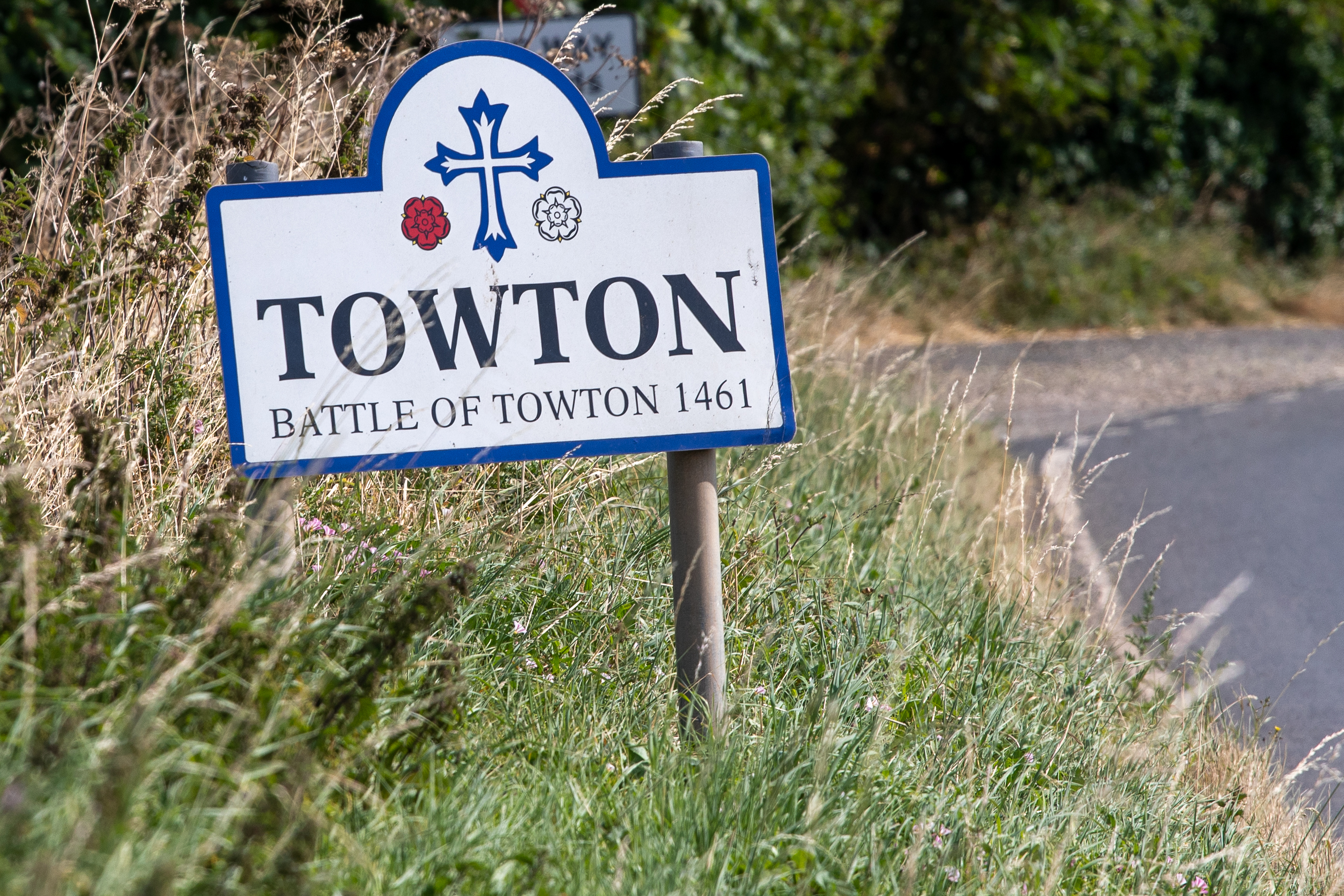
This battle is a central event in Shakespeare’s Henry VI part 3. The exhausting and bloody nature of a conflict in which the armies were evenly matched is expressed in words the Bard gives to King Henry:

Now sways it this way, like a mighty sea
Forced by the tide to combat with the wind;
Now sways it that way, like the selfsame sea
Forced to retire by fury of the wind.
Sometime the flood prevails, and then the wind;
Now one the better, then another best,
Both tugging to be victors, breast to breast,
Yet neither conqueror nor conquerèd.
So is the equal poise of this fell war.

Shakespeare, W. Henry VI part III, Act 2 scene 5.

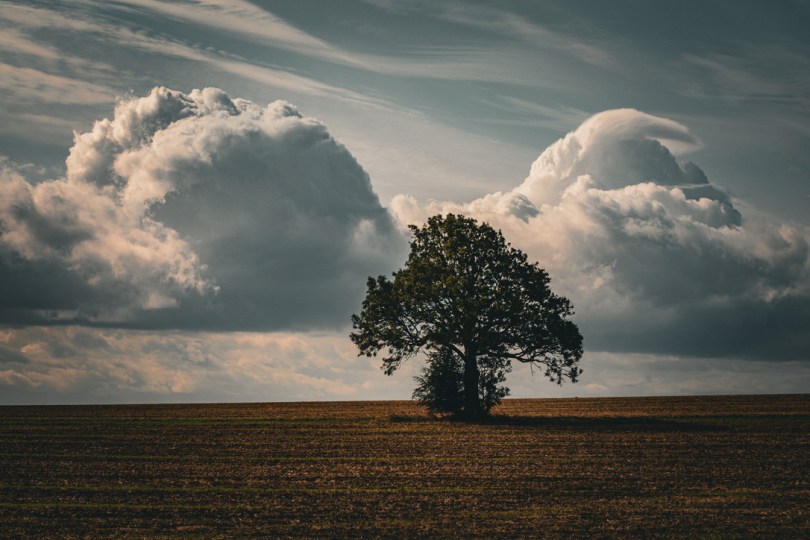
Gazing across fields, above which huge clouds pass serenely, it is hard to imagine the butchery that took place here more than half a millennium ago. The loss of life is all the more extraordinary given the weapons available at the time. War was a matter of sustained labour, with sheer physical force being the principal means of achieving victory. Being a soldier required strength and stamina and the chances of survival were poor if you were injured in any way, as the medicines of the time had limited effects.

In Macbeth, Shakespeare describes another military encounter, also finely matched: “Doubtful it stood, As two spent swimmers that do cling together And choke their art”. This would be a fitting description of the struggle across the fields near Towton. Perhaps, in some cases, there are worse things than an immediate and crushing defeat. The attrition of balanced forces was devastating for the communities involved. At the time of the battle England’s population was under 2 million and the losses of the day may have amounted to more than one percent of the nation’s inhabitants. Inevitably, this figure would have included an even greater proportion of the able-bodied men of the time.

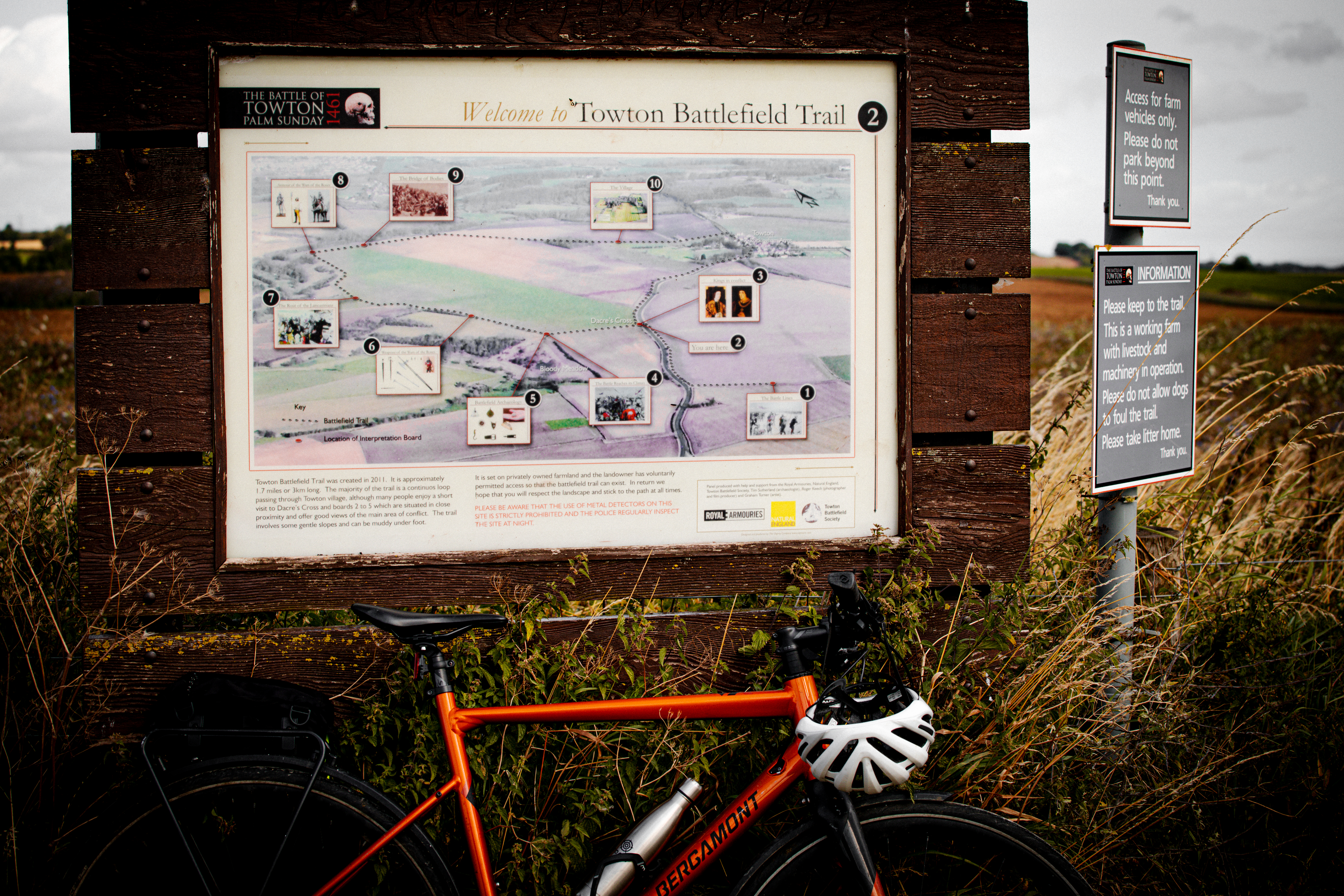
Today, the fields above Towton look no different from the the arable land that stretches east towards York and west towards Leeds. The history of the place is told on a couple of display boards with a trail that takes visitors across the most likely places of significance during the battle. The devastation of this domestic conflict is long disappeared, but it has become a place for people to visit and contemplate the history of warfare, politics and – it is to be hoped – the continuing necessity to labour for the peaceful resolution of conflict
The Mystery of the Creation

I have always found that churches and chapels in remote locations have a certain appeal. Sometimes these might be a long way away, such as the Keills Chapel, dating from the 11th century and near the village of Tayvallich on the west coast of Scotland. In other instances they are much closer at hand, like the small church at Bossall a few miles east of York. In both cases these buildings stand in relative solitude, with only a handful of houses nearby. Like the poet Philip Larkin, visiting these empty spaces of ancient significance conjures an atmosphere both melancholic and reflective. Who were the people who built this place, attended services here and, on one particular day, held their last act of weekly worship?

Having strayed into the local second hand bookshop recently, I came across a volume of selected prose by RS Thomas. In one short chapter Thomas writes about “Two Chapels”, with only one thing in common: remoteness. The first is called Maes-yr-Onnen in Radnorshire. It was August and, as the building was locked, Thomas stretched himself out on the grass and began to think about the past visitors to the chapel:

“sober men and women dressed in sober fashion. I saw them leave the sunlight for the darkness of the chapel and then heard the rustling of the Bible pages and the murmur of soft voices mingling with the wind”.

RS Thomas, Selected Prose, Ed. Sandra Anstey, 1986, Poetry Wales Press.

It was in this revery of imagination that Thomas found, like St John on Patmos, he had a vision. It was a moment when he felt he comprehended “the breadth and length and depth and height of the mystery of creation”. Yet, beyond this, Thomas was unable to put the experience into words. Reading the little he wrote about this event reminds me of the visions of Julian of Norwich. In that moment Thomas discerned that “everything is a fountain welling up endlessly from immortal God”. It feels to me as though this ancient chapel suddenly became for Thomas a dark and brimming well, replenishing with living water a world that so often becomes disenchanted and descends into cynicism. Like God, whether attended or unattended, the Chapel stood its ground and told its truth.

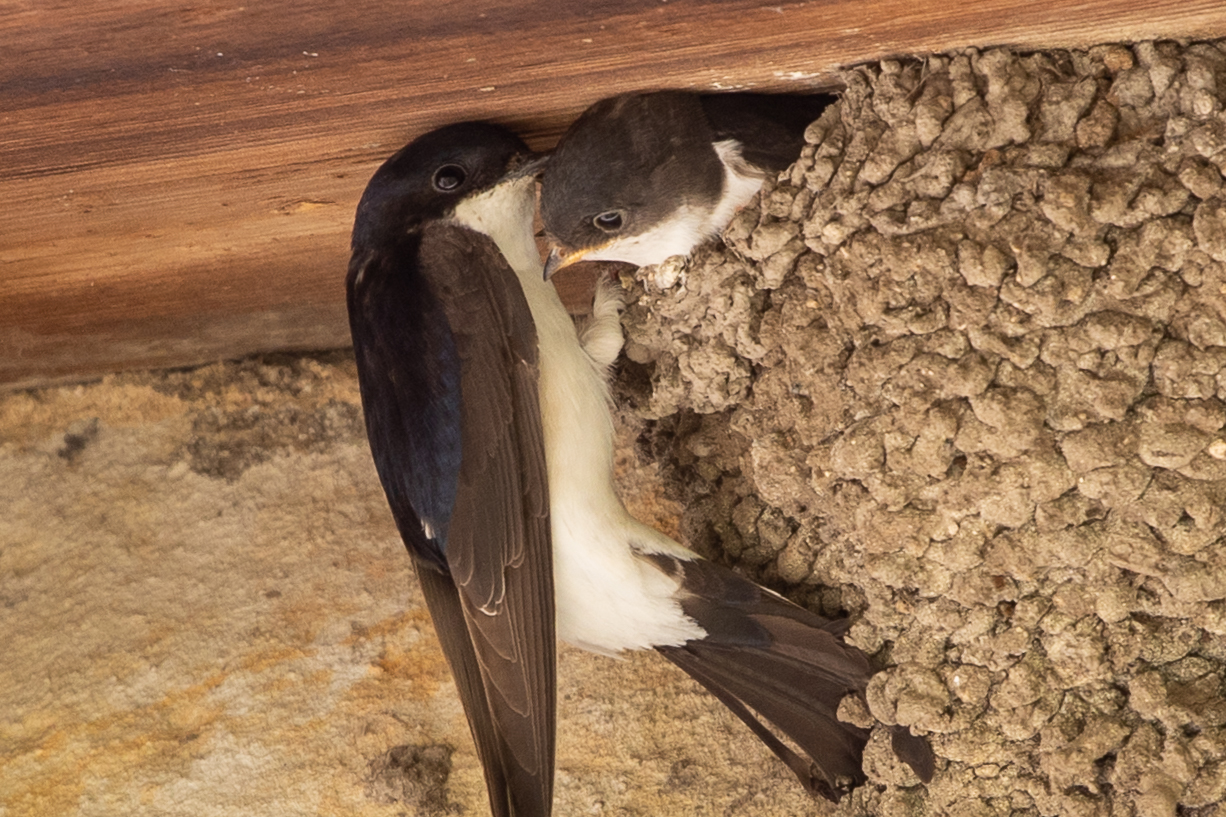
Out at the Church of St Botolph in Bossall, it is not difficult to share a little of the feeling Thomas encountered at Maes-yr-Onnen. It is the smallest parish in Yorkshire, built in the late 12th century, and is never open when I visit. The churchyard is overgrown and neglected, but seems to me to be none the worse for the lack of tidy graves or well-tended curb stones. What might seem to some to be a place of death is bustling with life. House martins are nesting in the eaves. A wyvern weathervane tells you from whence a gentle Yorkshire breeze is blowing. Swallows flit too and fro and, above them, swifts wheel and dive on the afternoon’s heat. Despite all our neglect of the planet, here is somewhere that time has forgotten to alter. One small red letterbox, opposite the church, is the only sign of connection to a wider network of society and even that, today, is largely unused.

RS Thomas believed strongly in the connection of people to the landscape of Wales. For him it was the case that “Here, in the soil and the dirt and the peat do we find life and heaven and hell”. To leave the land, and to live in towns and cities, was to abandon connection to the environment in which the Welsh should “forge their soul”. This may seem a romantic and unrealistic notion in 2024. However, as we have seen in recent weeks, it can hardly be said that the current society in England is one where there is peace and flourishing for all. We may not be able to have the kind of connection to the land that Thomas saw as spiritually needful, but perhaps we can make more of those places that offer a sense of spiritual location and peace. Places to stretch out, metaphorically or otherwise, and contemplate. Thankfully, almost without exception, they exist in all our communities and perhaps the call to the church in current circumstances, to quote words TS Eliot put into the mouth of Thomas Becket, is to “Unbar the doors! throw open the doors!” Most of these places are both close to communities but, remarkably, also other-worldly and distinct. They continue to have a part to play in our society but require the resources and support in order to fulfil their vocation to be at the service of all parishioners.

Lines and Labyrinths

During our recent sojourn in Spain we visited the Centro de Arte Caja de Burgos. The exhibition currently on show comprises various works by the Swiss-born artist, Pablo Armesto. A key theme across the works is the use of light, shapes and, consequently, the implication of shadow. To quote Armesto: “Between science, geometry and spirituality, this is how I conceived this exhibition”.

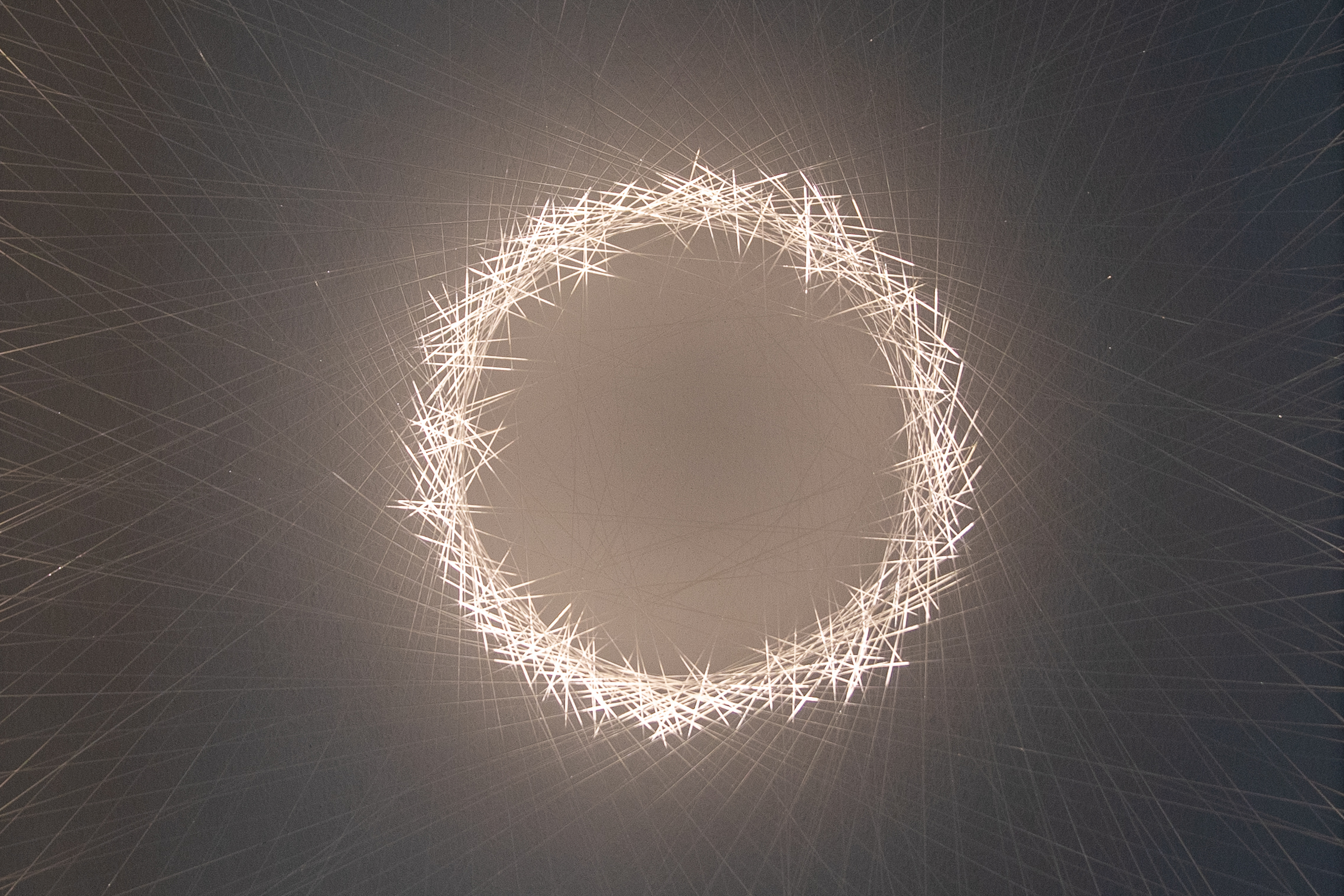
This exhibition appealed to me because of the interaction of light and material surfaces. It is executed beautifully, and serves to remind us that casting a particular light can change completely the underlying structure on which the light falls – or doesn’t. In other words, by illuminating some threads rather than others the surface appearance can be changed radically. Our eyes are drawn to the light and the form it implies, not the unlit shape of everything underneath. As the commentary on the exhibition says, these are “installations in which light and shadow transform the chromatic perception of the viewer”. Here lines of light address our perception:

“The line is a metaphor for the path, both physical and allegorical, sometimes traveling parallel to the initial idea, sometimes divergent when it has to choose between different options, but never schismatic, never discordant”.

Pablo Armesto

The title for the exhibition is “Complejidad, araña, laberinto”. I think that this is best translated into English as “complexity, spider-webs, labyrinths”. This phrase comes from a poem by the Andalusian poet Rafael Alberti, entitled “a la linea” (‘To the line’). While a line may sound a modest thing to be the subject of a poem, Alberti reminds us of the joyous capacity for it to be a “beautiful expression of the different”. Certainly, in Armesto’s installations, the vibrancy of illuminated lines could not be made clearer. It reminded me of the well-known comment by the artist Paul Klee, in his Pedagogical Sketchbook of 1925, that he was engaged in “taking a line for a walk”.

A circle of light created with the use of curved lines – by Pablo Armesto

The recent work I have been doing about Laurence Sterne includes the representation of a physical gesture – the waving of a stick – in volume IX. It is nothing more than a squiggle; a pen-line dancing across the page. It is used to express the notion of liberty and is, perhaps, the representation of the neat text going ferrel. A reminder that the careful shaping of ink that allows us to see letters and to read them, is made of the same stuff as this dramatically inserted hieroglyph. Different forms of the same material may shatter our expectations and leave us wondering what will come next. Art has this capacity to subvert our smooth reading of life and question the solidity and what we see. Like Sterne, Armesto’s filaments stretch our imagination, providing an intense optical experience and stimulating our thoughts about patterns – whether they are there, or simply the imposition of our expectations on the otherwise chaotic things we behold.

Truth Stretched Thin

I love visiting Spain and Spanish-speaking countries. Ever since spending a year in South America in my early 20s, and acquiring a feel for the language, a small part of my growing up was rooted in hispanic culture. A recent trip to Spain brought introductions to new cities, including Burgos and Alcalá de Henares. The latter visit arose from a longstanding wish to see the birthplace of Spain’s most distinguished writer, Miguel de Cervantes Saavedra. The author of Don Quixote was born there in 1547 and it is where he spent the first four years of his life. Understandably, alongside his former home which is now a museum, the city celebrates its famous author in numerous statues, street names and public institutions. Don Quixote is considered to be the world’s first novel in the modern sense of the word.

Given the date of his birth and the febrile politics of a recently re-conquered Spain, Cervantes was born into a world in which it had been decided that the co-existence of faiths was intolerable. In 1492 the Muslims and Jews who had not converted to Christianity were expelled from Spain. Those who had converted lived amongst neighbours who, very often, sought any sign that the conversion was one of “convenience” and would report people to the authorities. This was the time when the Inquisition was in full force and those who converted were keen to appear compliant. Many years ago, while participating in a canyoning activity north of Almuñécar, in Andalusia, a young instructor accompanying us told me that his surname was the same as the name of a local village. His family’s story was that they had been Jewish and, like many of the converts who remained, they took the name of a local town in order to immerse themselves in Christian Spain and avoid suspicion. Such practices were commonplace.

There is a claim that the family name of Cervantes came from a town of that name in Galicia, and may have been taken for reasons of conversion. However, this is far from certain. The proximity of the Cervantes family’s home to the Jewish quarter of Alcalá de Henares might be a more persuasive argument for some kind of connection. Today, all that indicates the onetime presence of a synagogue and Jewish “corral”, as it was called, is a small plaque. Cervantes senior was a doctor and the family lived both opposite this old Jewish quarter and beside the city’s ancient hospital.

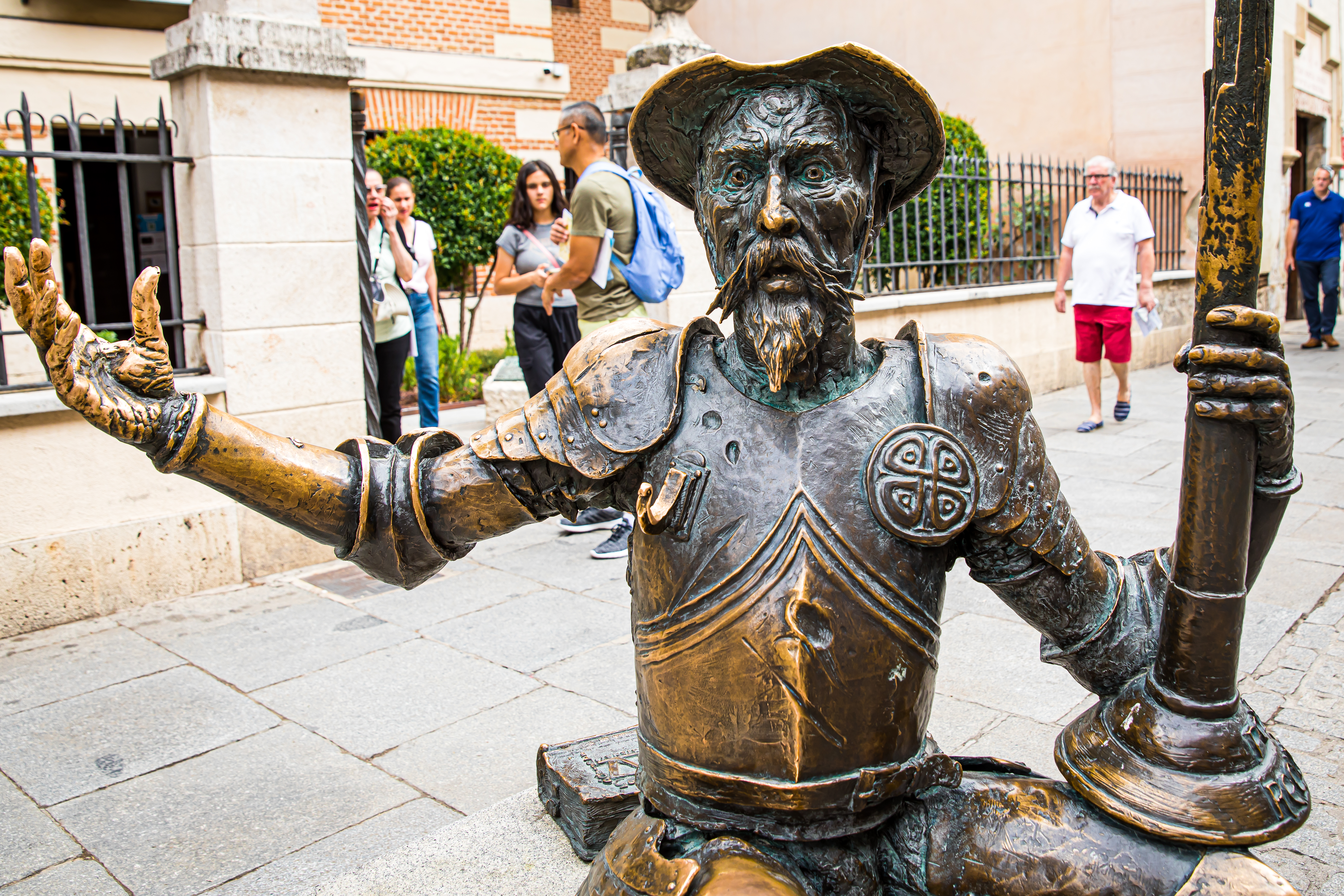
A statue of Don Quixote outside the house in which Cervantes spent the first four years of his life in Alcalá de Henares, near Madrid

Initially, after the Reconquest, the Jewish community experienced relative security compared with other European countries. This did not endure.

“Yet Jews were still better off than their Ashkenazic brethren in the rest of Europe who were expelled from England and France and faced continuing and unrelenting pogroms and persecution in Germany and Central Europe, eventually driving them eastwards to Poland and Lithuania. The Christian rulers of Spain exploited the skills of their Jewish subjects and a thin layer of upper class Jews remained wealthy and influential. The Jewish population of Spain generally still felt comfortable there. After all, they had lived as Spaniards for many centuries. Why should the situation change now?”

The Spanish Expulsion from the Jewish History website accessed 28/06/24

Perhaps the strongest argument that Cervantes had Jewish ancestry comes from evidence internal to Don Quixote. In an excellent BBC World Service edition of The Forum scholars argue that in his novel there is “an implicit cultural critique” which questions, as far as it can, some of the negative narratives about the descendants of Muslims and Jews still living in Spain. In a section of the novel where Don Quixote is in Toledo, he seeks and finds someone to translate a text in Arabic. By showing the continued presence of Hebrew and Arabic speakers in Spain Cervantes put in doubt the official story of a single, homogenous, Christian culture.

Out of the troubled waters of post-reconquest Spain Cervantes created a story capable of finding a broad and appreciative audience. Don Quixote might be seen as a kind of Rosetta Stone, enabling different communities to discern for themselves an intelligible and constructive place in Spanish society. That is no small feat, and the unparalleled significance of Cervantes in Spanish culture bears testimony to his achievement in enabling humour, insight and compassion to leaven the complex experience of living in a society where the past was an ever-present and potent challenge to the present.

“The truth may be stretched thin, but it never breaks, and it always surfaces above lies, as oil floats on water”.

Don Quixote