Faith and the City

My grandfather would not have approved. A former church warden of a large market-town parish church, he voted Tory at every opportunity, and would have seen the Church’s critical examination of urban life – Faith in the City – as the latest example of its waywardness. Every day he awaited the arrival of his copy of The Daily Mail, which he embraced as a comfort blanket for all his favourite prejudices. He waved the paper at me energetically when it earnestly condemned various speakers in the televised General Synod debate on nuclear deterrence in 1983. (He had less to say about the owner of The Mail’s enthusiastic admiration of Hitler back in the 1930s). When I argued with him about the valuable work of the post-war Labour Government he was quick to reply that those politicians were “different”. I very much doubt he said that at the time.

As I commented earlier this year, 2025 marks the 40th anniversary of the publication of Faith in the City, and several small celebrations have been held. Most of us attending the one in Sheffield were north of 60, with Alan Billings, one of the original commissioners and a speaker at the conference, being in his 80s. I wasn’t altogether clear why the event was taking place on the same weekend as General Synod, but perhaps it reflects the Church of England’s limited interest in questions of urban theology and action. More than one speaker noted that in the twenty years after the report there was considerable activity by the CofE in the cities. However, the last 20 years have told a different story.
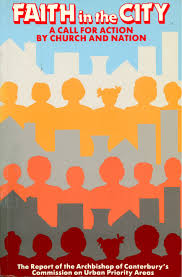
I was in the middle year of my undergraduate degree, living in Hull, when Faith in the City hit the presses. Alan told us that the Cabinet had leaked the report to the right wing press, enabling its publication to be met with claims of Marxism and a Church failing to attend to its primary task. While many in the Church supported the report, I recall a parishioner in the rural parish where my parents lived asking: “what about the rural areas – where’s the support for us?” I’ve no doubt that those comments were widespread in rural communities.

It felt in the 1980s that the Church of England could still occupy that strange land of “critical solidarity” with the institutions of which it was also a part. Not easy, but it was also the decade in which Archbishop Runcie dared to pray for the dead on both sides at the Falklands Memorial Service in 1982, saying that: “a shared anguish can be a bridge of reconciliation; our neighbours are indeed like us”. Mrs Thatcher was not pleased. In 1984, the Church led by Runcie consecrated David Jenkins as the bishop for Durham. Once again, the Church supplied the right-wing press with oodles of content to bolster its appetite for righteous indignation. My grandfather had gone to glory by that stage but he would have enjoyed the temporal exasperations of the tabloid press.

Looking back is not always a good idea. The seeds of change were already planted in the Church of England of the 1980s. Fewer vocations; difficulties in recruiting to inner-city parishes; a world changing as a rate of knots. However, I’m less certain that those around at the time could have envisaged how radical the changes would become, and the number of parishes that would be forced to merge. The unwinding of Anglicanism’s commitment to provide every church with a parson; a parsonage and burden of finance that could be borne, has happening at a dizzying pace. Volunteers have vanished and the struggle to maintain a meaningful presence has intensified.

It isn’t all doom and gloom. The church I assist at once a month has rallied without any jazzy new initiatives from the centre. Speaking with the organist (a working farmer) he told me that they had got down to an attendance of 10 on a typical Sunday morning. Now it’s at 30. Why? He put it down to the loving pastoral care of a Reader, who made some simple improvements to worship but – perhaps most importantly – helped keep the service at the same time every Sunday. Sometimes it is Morning Prayer and at others, Holy Communion – but the people come nonetheless. In the cities there are also signs of renewed interest in Christianity, with a more diverse population bringing fresh energy to places of worship. The context of Faith in the City has changed – but faith is to be found nonetheless, and the questions raised 40 years ago remain relevant today.

What remains constant, however, is the need for deep listening, authentic presence, recognition of transience and journey, and genuine collaboration. As one of us concluded, “It has to be ‘we’ if we are to make a difference”.

William Temple Foundation blog, 21 May 2025

God in the City

In the late 1980s I spent a year as a youth worker in the Isle of Dogs. The youth club operated in the crypt of Christ Church, and catered for local children up to the age of 11. Although I’d lived and studied in Hull, this was the first time I worked in an urban context. At that time much of the East End was undergoing the transformation from urban poverty to city banks and their associated wealth. Sparkling new buildings were springing up alongside docks where once no one had wanted to live. I was told that in those days taxi drivers had refused to drive into the island at night. During the 1980s the two communities, old and new, lived together uneasily. Some in the increasingly expensive gated estates, others in the council housing that was yet to be sold.

In my new role as Director of Leeds Church Institute I am once again reflecting on the relationship of ‘faith and the city’. Incidentally, it’s exactly 40 years since the report with that title was published by the Church of England, to be met with the ire of Mrs Thatcher and many other conservative voices. In the mildest of possible forms, perhaps this was the C of E’s modest response to the influence of liberation theology – the school of praxis and thought which arose chiefly in the favelas of Latin America. However, one of the criticisms of the report was its lack of a significant and developed theology to frame its analysis and recommendations. A subsequent publication, Theology in the City, responded to this criticism, partly arguing that the alleged lacuna arose from the misunderstanding of the more implicit theological approach Faith in the City had embodied.

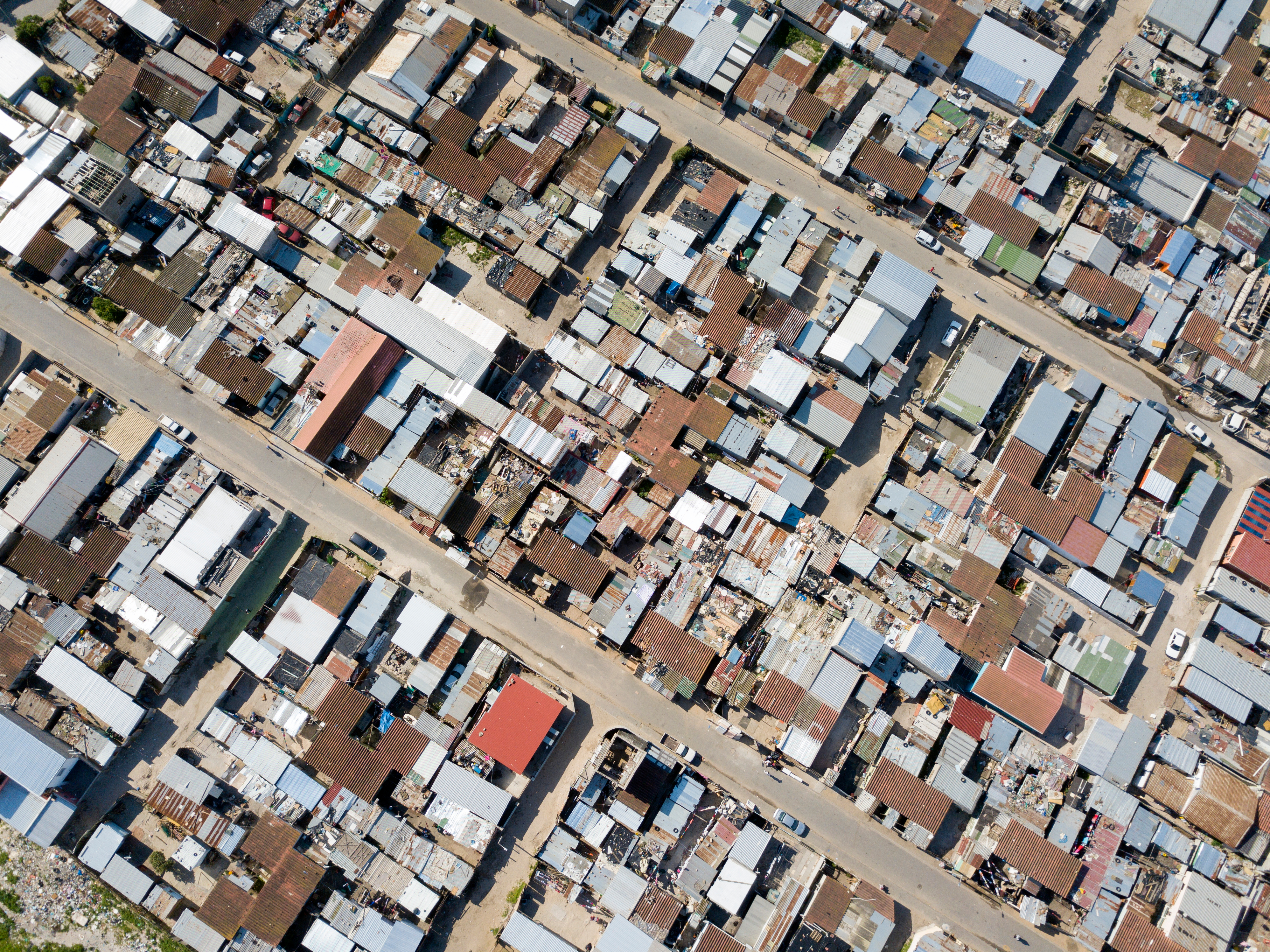
During a year in Argentina I read Gutierrez’s classic work Teología de la liberación. Living in Córdoba and Buenos Aires, I grew more and more aware of the particular dynamics of city living, with rich and poor living cheek by jowl. A few metres apart, but separated in their different worlds by steel and security. Cities concentrate divisions in way often unseen in more rural settings. Gutierrez inspired a way of thinking that reflected his conviction, based on a liberative hermeneutics of the Bible, that God has a preferential love for the poor. This understanding led many followers of liberation theology to locate themselves alongside the poor, exhibiting a commitment to share and to learn before even considering the option to teach.

After years in which the power of the Church was used to contain and constrain liberation theology, the Pontificate of Francis marked a sea-change of significance. Rather than beginning with doctrine and only seeing the world through its parameters, Francis favoured attention to concrete situations and experiences as the place from which theology emerged. This was reflected most keenly in his persistent interest in the wellbeing of the poor and his sometimes stern address to the world’s wealthy and powerful (be they institutions or individuals).

The Church cannot abandon the city, because every city is its people. If cities shelter some of the poorest people in society then God’s preference and presence cannot be ignored. As a chaplain in Leeds for 16 years I was privileged to meet the whole spectrum of city dwellers although, poverty and illness being what they are, those encounters were weighted towards the most marginalised people in Leeds. In the conduct of funerals funded by the hospital (due to lack of means and/ore relatives) I visited homes whose meagre furnishings reminded me that, ‘When sorrows come, they come not single spies but in battalions’. It would seem that when the balance favours the rich, with wealth removing many of the burdens of everyday life, the opposite end of the scale descends; as the weight of poverty, exclusion and injustices mount, one on top of another. As Francis wisely knew, a rich Church will never be sufficiently open to allow God to use it as a means to rectify and redress the fundamental injustices of the city. As he declared shortly after coming into office: “How I would like a church that is poor and for the poor”.

Exposed

I’m not the kind of Christian who likes public witness. The sort of knocking-on-doors Christianity; or a beach mission; or even telling my “faith story” in a service feels embarrassing and uncomfortable. There are probably lots of reasons for this, which it would be tempting to dismiss with an air of Anglican superiority.

I am inclined naturally to a reflective and tentative articulation of faith. I don’t believe I have all the answers. “Now we see in a mirror dimly”. I have no doubt, for a host of reasons, that my faith is fractured and partial. It feels fuller and more complete when it is located within a community of faith, bringing many different experiences of God, past and present, under a single roof. Others have natural – and undoubtedly, spiritual – gifts for giving personal testimony. I don’t hesitate to say that this can be both inspiring and has a place within the life of faith. But we are not all created to be the same.

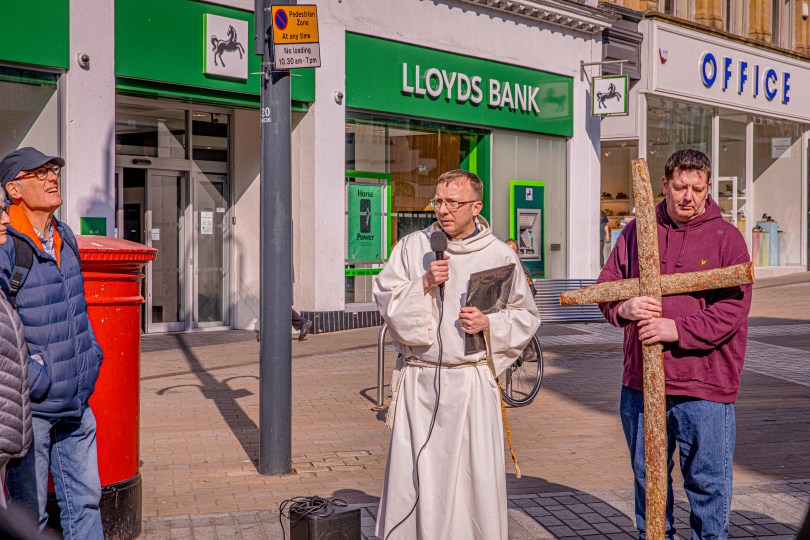
Hence, it was with some trepidation that I went along with the Gospel Streets Urban Pilgrimage in Leeds last week. Led by the admirable Lighthouse community, based in St George’s Crypt under the pastoral care of Jon Swales, the pilgrimage snaked though the streets of Leeds on a sunlit Thursday morning. Jon had a monk-ish aura wearing a cassock alb, and speaking passionately about the City while reading the Gospel of Mark. People stared at us. One passing youth shouted: “You’re all evil; you lot”.

What did it achieve?

For the thirty odd of us participating there were the kind of side-on conversations that people walking to the same destination often share. I met many people I hadn’t encountered before. Members of the Lighthouse community were with us, and it ended with a service of Holy Communion in the Crypt. We were present in spaces where religion is either excluded or extreme; the places where the more you consume the more you matter, and where street preachers tell the world that “the end is nigh”.

Our pilgrimage was less confrontational and more measured. The worst excesses of capitalism were described beside the city’s banks. People damaged by an urban environment that rejects them walked with us in a spirit of solidarity and purpose. Jon asked people sitting and reading in the sunshine of Mandella Gardens if they wouldn’t mind him speaking for a while (sooo Anglican!) and breaches of international law were mentioned by the war memorial.

I’m not sure what we achieved. A statement was made – it was enacted. In the pilgrimage through Lent, we reminded ourselves and anyone who cared to listen, that God is present in the city. That the Church is (or should be) a shelter from the storms of life and a community that is restless and longing for the Kingdom. Where people who have been rejected find a home, and where earthly power is reminded of its place.

It is absurd
to retell here what
happened there,
far away and far ago
when the idiot healed
and said, and wept
and left. A broken
nonsense in the febrile
world of expectation.

Hear Our Voice

Churchyards are often depicted as ghostly places. A kind of hinterland between the lit windows of a “frowsty barn”, where prayers to the eternal are stacked, and the nearby houses and shops containing all the business of the living. Perhaps this cordon sanitaire around a church makes a fitting threshold between the mortal and the immortal. The hope of eternity and the certainty of the grave. They are always places that incline me to contemplation as I read each brief epitaph. How is a life of 90 years reduced to so few words? The dates of our arrival and departure; our names; perhaps a verse of Scripture or of sentiment. The information leads me to say, in whispered tones: “how young”; “how old”; “how many”.

Of course, this orderly arrangement of death feels a far cry from the magnitude of human loss recalled in the 80th anniversary of the liberation of Auschwitz (in Polish: Oświęcim). Tomorrow marks 80 years since its liberation. During my ministry I have spoken with two people who were prisoners in that utterly dreadful place. One of them is still alive. The other, who converted to Christianity not long after the war, had lost none of her ferocity when I encountered her in 2016. Seldom have I met someone so passionate for justice; so committed to the common good; and so entirely unafraid of asking difficult questions. Such souls are the pillars of a forthright and determined decency which upholds the fabric of caring communities.

I have been to Auschwitz once. During the time of its operation there were no graves dug to bury each victim of the wickedness which thrived in this place. Murder on an industrial scale. I wonder how far outside its evil centre the graveyard would extend if each person had been given a decent burial? Miles upon miles in all directions. A cemetery that would be visible from space. Instead, the scale of destruction is remembered in the piles of shoes; hair and other remains of the horror carried out by one people against another. On the day we visited, standing by the remains of the camp’s cremators, as dusk fell, the recitation of prayers came as an expression of hope in the face of an atrocity whose remembrance had left us dumbfounded.

I fear that as the last survivors of this terror leave us, we are entering a phase when history may be repeated. It was the legacy of liberating the concentration camps, and the truth about them which shocked the world, that gave energy to so much humanitarian work in the second half of the 20th century. There was an air of determination that human beings must never be treated this way again by any state. Tragically, they have been and they are, but our tolerance of the intolerable seems to be growing. Like so many in Nazi Germany who had doubts about the regime, we wring our hands and turn away. The questions and demands are too great. We’d like to help but…

In the entrance to Leeds City Art Gallery there is a painting by the artist Jacob Kramer (1892-1962). Kramer was born on the eastern edge of Ukraine, then in the Russian Empire, and spent part of his life working in Leeds. His painting “Hear our voice O Lord our God” was given to the Gallery by the Jewish community of the city in 1920. The text relates to one of Judaism’s most important prayers. This theme of the work reflected the reason Kramer fled Russia: the Pogroms that followed the killing of the Tsar. In the painting the widowed woman offers an agonising cry and an aspect of despair. It brings to my mind the words of Jeremiah chapter 31:

A voice is heard in Ramah,
lamentation and bitter weeping.
Rachel is weeping for her children;
she refuses to be comforted for her children,
because they are no more.

Let us remember, not to despair – but to act.

Living For

I am reading a book about the history of my new employer, Leeds Church Institute (LCI). History can be fascinating, both for the strangeness of how life was once lived and, occasionally, for the sudden resonance of a view or action which appears entirely modern.

The quarter century leading up to WWI is described in the book as “the golden age” of LCI. Wealth increased for some, and for others new legislation reduced working hours, meaning that in both cases more time and resources were available for recreation; discussions; hobbies; voluntary work; or religious associations. (The text “Eight Hours for Work, Eight Hours for Rest, Eight Hours for What We Will” was paraded on a union banner in 1889). It was the time when public schoolboys and undergraduates came to Leeds to live in “settlements”, often found in the poorer quarters of the city. Of course, this could be experienced as highly patronising and there’s a powerful quote in the book about LCI’s history from an older woman in one of these areas who declared: “I do so hate being ‘lived among‘”.

As we approach Christmas her words ring in my ears and remind me that the Incarnation was more than a gap year for an earnest deity. Public schoolboys didn’t renounce their learning, connections or resources when they came to reside among the poor. They were no doubt billeted in reasonable accommodation, forming a small community of young people who shared privileged backgrounds. These communities was set in a wider context of poverty; disadvantage and squaller. I can imagine many of these settlement workers, in future years, burnishing their credentials by referring to the time they “lived among” the poor. A year of their youth that bought the claim to a lifetime of social credibility.

“For all the rhetoric of ‘citizenship’, ‘democracy’ and ‘fellowship’, the governance of the settlements, at least in their early years, was in the hands of their patrician founders rather than their ‘members’.”

Freeman, M. (2002). ‘No finer school than a settlement’: the development of the educational settlement movement. History of Education31(3), 245-262.

The Word made flesh gives up language. The babe in the manger has no worldly connection that will hoist him out of misery. The infant son of a carpenter must play with the shavings on the workroom floor, and discern his own path through all the perils and possibilities of life. He must learn words and imbibe the teachings and practices of religion. As a young man driven into the desert, the vocation of Jesus is tested in the wilderness of the world, alone with his demons. Preaching, teaching and healing as a Rabbi he will come to challenge both temporal and spiritual authorities. Standing resolute before the powers of coercion and compromise, resolved in his calling and identity, will become the path to his destruction.

This is not living among. It is living with; it is living as; and it is living for.

Christian Mechanics

When I left my previous employment I had no idea what would come next. One of my colleagues asked me: “what are you going to do?” Without thinking I replied, “God knows!” Perhaps this response emerged out of a rather hollow bravado, or a faith which was more certain in words than it was in reality. In the first instance, rather than look around for another job, I decided to have a sabbatical. These are often taken by clergy every ten years or so but, because I was employed outside the Church, I’d never taken one in the thirty years of my ordained life. In the summer of 2023, I began what became a fruitful, fascinating, and rewarding sixteen months of space, reflection and study. A friend once referred to me during this time as a “flaneur’” which I needed to look up (“someone who saunters around observing society”). Fair point.

One of the fruits of this time was reading and learning more about a figure associated with Yorkshire and York Minster, Laurence Sterne. I knew of Sterne’s writing from undergraduate days and the many links with this mercurial vicar of the 18th century found in Yorkshire – not least the Shandy Hall Museum – became a focus of work to produce a Lent book. I ventured out by bicycle to visit various small churches connected to the novelist, not least Sutton-on-the-Forrest. Its pulpit steps, once used by Sterne, feature on the cover of the book.

While not looking for any permanent role, the post of director for Leeds Church Institute came to my attention. Perhaps this was the answer to “God knows”? In any event, I applied and was appointed. The Institutes were part of a movement in Victorian England which offered education and increased opportunity for people from poorer backgrounds. The first phase of these were the Mechanics Institutes. When the Rev. Walter Hook orchestrated the creation of the Leeds Church Institute it has been suggested that he was building a facility to develop “Anglican Mechanics”. In other words, to equip church people with a greater depth of knowledge about their faith and how to live it.

Arriving early on Monday morning (keen to get started) I walked around the city centre. In a small homage to the original home of the Institute, in Albion Place, I stopped for a few minutes to read the Leeds Civic plaque recording its creation. The Institute was ‘The powerhouse behind the advancement of religious and secular education on the principles of the Church of England’. The former home of LCI is in the main shopping area of the city, now decked out in all its Christmas glitz and glamour. I thought about what life must have been like there in the 1860s, when the building was opened. At that moment someone looking fairly dishevelled, who had perhaps spent the night on the streets, came and asked if I would buy him breakfast. I did. Walking a short distance further another man overtook me, apparently talking to himself, when he suddenly launched into an abusive tirade against a woman walking in the opposite direction. She stopped, I stopped, and we exchanged a look as she shrugged her shoulders and asked aloud: “what was all that in aid of?” The man continued on his way, still talking, gesticulating, and going at a good pace. Having checked that she was OK, the two of us carried on in our separate journeys.

Perhaps things have not changed as much as we might imagine since the founding days of LCI. During a phase of exponential growth in population, the philanthropists and civic leaders of Leeds faced a colossal task in addressing the basic needs of poorer communities. Today we would no doubt find their approach patronising and – possibly – coercive. The workhouses were in full operation and the poor had little access to either education or the opportunities that might change their circumstances. Walter Hook, the celebrated Vicar of Leeds, played his part in helping to found new churches and schools. His approach was allied to the principles of the Tractarian Movement, High-Church Anglicanism, but he had arrived at these independently of the movement. Unlike the dons and academics sheltering in ivory towers, Hook was the most significant figure of Anglo-Catholic reform in the parishes. Firstly, as a priest in Coventry, then in Leeds, he advanced the cause of High-Church liturgy and social action, enduring various attacks while he sought to fulfil his sense of calling. Newman wrote to him:

“You are in the thickest fire of the enemy; and I often think how easy it is for us to sit quietly here…”

Hook had not chosen an easy path, but his dedication to parish ministry and commitment to education has left an enduring legacy. It’s why LCI is still here in Leeds, in 2024, working to advance theological reflection and act as a creative fulcrum where spirituality, justice, and learning, meet and flourish. It’s mission remains both a daunting task, and an exciting enterprise.

  • At the head of this Blog: Old and new together – Dock Street, Leeds, close to Leeds Church Institute