Sweet Flying Baby Jesus

It appears as a small detail in some classical depictions of the Annunciation, but it is not uncommon to find a tiny baby Jesus surfing a beam of celestial light towards the Virgin Mary. We might take this to be no more than an artistic expression of the theological significance of what was unfolding at this critical moment at the start of the Gospel. However, there is more to this illustration than meets the eye.

A middle part of so called Mérode Triptych, created in 1430’s in the workshop of a Master of Flémalle, and kept in the Metropolitan Museum of Art in New York

Anyone familiar with The Life and Opinions of Tristram Shandy, Gentleman will know that the clerical author, Laurence Sterne, makes play with the concept of “homunculi”. Developed to a significant extent by Aristotle, this idea centres on the belief that all the physical aspects of procreation resided with the man. Unbelievably small babies were thought to be present in semen which, at the moment of conception, were passed by the man to the woman. It is hard not to interpret this as a startling manifestation of misogyny. Life being so important it could only originate from a man; and pregnancy so inconvenient it must be the perpetual obligation of a woman. In Tristram Shandy this theory is mocked from the first page, when the conception of Tristram is interrupted by Mrs Shandy, who distracts her husband by asking: “Have you not forgot to wind up the clock?” The effect of this is to weaken the efforts of Mr Shandy, and results in irrevocable damage to the homunculus that is, and will become, Tristram.

It would be easy to underestimate the consequences of this belief. Sterne incorporates into his novel the real-life situation of the Duchess of Suffolk. When her husband and son died in quick succession she was granted administration of the estate. However, when it was contested, part of the appellant’s legal argument was the assertion that – based on an understanding of homunculi – she was not a blood relative of her son. The Duchess lost her right to inherit.

As the Church celebrates the Annunciation on 25th March it is worth asking the basic question: “What was going on?” The classical paintings of a tiny Jesus heading towards Mary imply that the infant saviour was a divine homunculus. The mother of Jesus was simply receiving a delivery from the Almighty, leaving her virgin state unaltered and confining her responsibilities to safe carriage. At its most extreme, Mary would be seen as having a vocation – but no blood relationship with Jesus.

In the classical world divergent views about conception include those of Aristotle, and an alternative approach can be found in the work of Galen. Galen’s understanding of conception sees both the man and the woman contributing seed to form an embryo. As Magdalena Łanuszka put it in a blog entitled “Flying Baby Jesus”, the homunculus interpretation lacks serious theological foundation:

Such a depiction suggests that Christ was incorporated as a human child somehow beyond Mary’s womb and then “placed” in it. That weird In Vitro is of course an idea absolutely theologically incorrect. Jesus’ body was formed entirely out of Mary’s body, not somewhere outside it.

http://en.posztukiwania.pl/2014/06/01/flying-baby-jesus/

In a timely inclusion, the current issue of The Church Times features a review of a new book focusing on the embodied experiences and theologies of birth. Pregnancy and Birth: Critical Theological Conceptions challenges the dearth of theological work done on these major topics. It is not difficult to imagine that if men underwent the experience of pregnancy, the number and variety of titles on these subjects would be immense. In another review of Karen O’Donnell and Claire Williams’ new book, Dr. Emma Percy, a researcher working in this field, offers some concluding reflections:

Pregnancy and all the complexities around reproduction should not be a niche topic, just for the feminist theologians or those who have been pregnant. We are all born from a body that gestated us for months. Jesus, as O’Donnell reminds us, shared this very human experience in the womb of Mary. There is much for all to learn from taking a more realistic look at a bodily experience that is so fundamental to our being human.

Emma Percy book review in Theology. First published online January 8, 2025

Sweet flying baby Jesus should concern us all. How we respond to this framing of the Annunciation and Incarnation is fundamental to our understanding of Christianity, and the God we worship. Sterne turned the evident nonsense of the homunculi into satire, but underneath the wit is a profound question about the humanity of the God in whom we place our faith. From what I have read, it is uncertain whether the writers of the Bible shared a uniform understanding of conception: they almost certainly didn’t. (There’s an excellent article about this by Laura Quick entitled Bitenosh’s Orgasm, Galen’s Two Seed and Conception Theory in the Hebrew Bible). Ultimately, when we lack the understanding of what the authors of Scripture thought when they were writing, we need to arrive at our own conclusions as to whether our interpretation enlarges our love of God and of neighbour, or diminishes it. For me, the idea of Jesus as a foetus implanted in Mary’s womb by the Holy Spirit undermines a primary doctrine of Christianity; namely, that the Word made flesh is both fully human and wholly divine.


The Sombre Season

Lent is almost upon us. Somehow, unlike several of our continental neighbours, England maintained the old words for this time, even as the Church’s Latin altered so much of our language. Lent probably came into English through Old Saxon, but its exact history is lost in the folds of antiquity. Nevertheless, the meaning is clear. It is to do with something long, possibly reflecting the lengthening days brought by spring in the northern hemisphere. Maybe, also, the sense that days of abstinence might be long days and, consequently, Lent is a season to be endured. It ends, of course, in Easter – another ancient name from Old English, with origins linked to Northumbrian Eostre. Perhaps the name of a Goddess, or a word for dawn, but in any event adopted by the early Christians of these isles as a fitting word for the new life that awaits at the end of Lent.

While our warming winters have changed our experience of the seasons, we may still see churchyards transformed with a late frost, or layered in a final fling of snow’s fleeting transformation. There is an added poignancy that these occasions are becoming fewer, with such brief visitations acting as a nostalgic reminder of how we once experienced these months. Much of English literature describes the tyranny of enduring and unavoidable cold, when even a hearthside might offer only limited and temporary relief.

Given their appearance in or around the start of Lent, purple is often the colour of choice for crocuses planted amongst the grave stones that surround our ancient parish churches. A fitting sign of both our mortality and also the liturgical season. From this coming Wednesday, until mid April, many churches will be draped in purple, signifying the Lenten focus on “self-examination and spiritual discipline”.

… crocuses
Pale purple as if they had their birth
In sunless Hades fields.

From The Sun Used to Shine by Edward Thomas

Perhaps ‘sombre’ isn’t the right word for these 40 days. As regular readers of this blog will know by now, I completed a project last year to write a Lent book for distribution before March 2025. A Sterne Lent refers in many places to the sermons preached by the vicar-novelist, Laurence Sterne. It is estimated that at least one third of these 45 homilies were preached in the time of Lent. This is not surprising as even in the 18th century the penitential season was marked by some effort towards thinking and reflection upon religious convictions and actions. For Sterne the denial of joy for such a lengthy period would have been a trial. Laughter spilled out of the unlikely parson, and a significant proportion of his 42 sermons (there are another 3, but those develop content from previous ones) were preached during Lent.

According to the Julian calendar, Sterne preached his sermon on ‘Penances’ on Palm Sunday 1750. Based on some circumstantial evidence it is probable that it was preached in York Minster. Sterne explores some of his core convictions which, alongside a side-swipe at Methodists, centres on a Deity who doesn’t want us to be endlessly glum, or excessively earnest. We were not created “on purpose to go mourning, all our lives long, in sack-cloth and ashes”. However, Lent is a time when our restraint can:

dispose us for cool and sober reflections, incline us to turn our eyes inwards upon ourselves, and consider what we are, – and what we have been doing; – for what intent we were sent into the world, and what kind of characters we were designed to act in it.

It is in this season that Sterne feels the discipline of Lent is intended to “call home the conscience”. In particular, Sterne is critical of our wasteful use of time. We fill up diaries with distractions, “parcelling out every hour of the day for one idleness or another”, and seem eager that when it comes to time we are endlessly inviting others “to come and take it off our hands”. Sterne cannot abide the idea that we reach older age only to discover we have lived “a life so miserably cast away”.

Lent is a time to contemplate what we are here for; how we spend the time we have been given – but not, as Sterne would see it, to fill up the season with so much dour reflection that there is no space for joy.

Lent Preachers

As the Church approaches Lent, some Christians might have begun thinking about what to give up, or what to take up. Perhaps a small resolution of abstinence – alcohol or chocolate – and a desire to read something that will draw us a step closer to understanding everything to which Lent points. In some churches, while Holy Week might feature a visiting speaker to lead people through the final week, it has been the custom in cathedrals and elsewhere to have a different guest preacher each Sunday. This practice goes back a long way and can be found in various notices and signs that have survived the passage of time.

In 1725 Ash Wednesday fell on February 10th. Or did it? This statement requires some qualification. The calendar at that stage was still in the Julian form, meaning that the year began on 25 March, hence the Lent preachers list for St Paul’s is described as the year 1724-25. This practice was known as ‘dual dating‘ and caused considerable confusion. It finally ended in England in 1751 with the British Calendar Act and an effective transfer to the Gregorian calendar used by most of the rest of the world.

As the notice from St Paul’s demonstrates, Lent sermons were not confined to Sundays. The advertisement offers distinguished clerics on Wednesdays, Fridays and Sundays, throughout the 40 days. These occasions were not for the minor clergy, but moments when the cathedral staff themselves, or various other deans and bishops, might pronounce their theology and spiritual message.

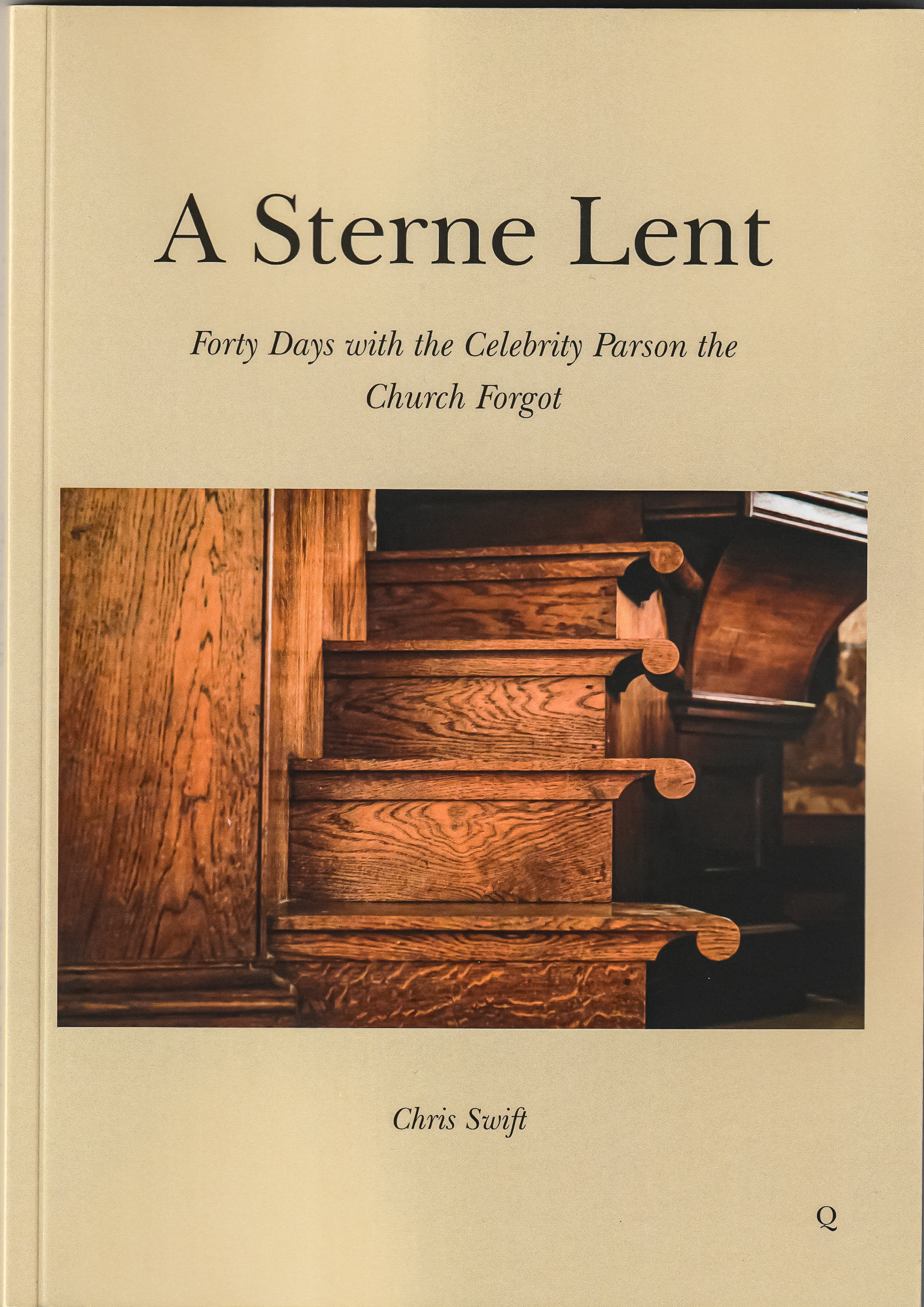
Laurence Sterne, who was a well known and popular preacher, was aware that his humble station in the Church meant that he was unlikely to be invited into the nation’s highest pulpits. The steps that grace the cover of A Sterne Lent – Forty Days with the Celebrity Parson the Church Forgot, are elegant, simple and modest. They are the pulpit steps of All Hallows, Sutton on the Forest, where the preacher stands only a few feet higher than the congregation. Today, I understand that a less formal way of leading worship (and perhaps fewer parishioners) means that this beautiful 18th century piece of furniture is seldom used.

Many of Sterne’s surviving 45 sermons were first preached in the season of Lent. In keeping with the motif found across Sterne’s work, he was mindful of the contrast between success as an author and the skepticism about his character which would keep him out of high office in the Church.

“I just received a Translation into french of my Sermon upon the house of Mourning, from a Lady of Quality – who proposes to print it, for the Caresm, & to give ye people here a specimen of my Sermons – so You see, I shall be Lent Preacher at Paris, tho’ I shall never have the honour at London”

Letter from Laurence Sterne to Henry Egerton, written in Paris, March 8 1762. Quoted in Volume 7 page 233 of The Florida Edition

In a style characteristic of Sterne’s humour, his letter to Henry Egerton in March 1762 makes reference to the fact that his own death had been reported in newspapers back in England. Sterne’s congregation in Coxwold went into mourning. It took more than a week for corrections to appear in the English press. Sterne would undoubtedly have been fascinated by the eulogies which were published in the intervening days.

St Paul’s never beckoned the peculiar rural parson who had found fame – and a little fortune – through both his published sermons and Tristram Shandy. Undoubtedly Sterne has the last laugh, as the great names of that era, who graced the pulpits of the nation’s cathedrals, are now unknown. Yet, somehow, Sterne’s radical approach to the novel continues to stir the creative spirit of contemporary artists and authors across the world. I believe they also have a much neglected spiritual significance.

Perhaps one of the most attractive things about Sterne is his refusal to conform simply in order to ‘get on’. Yes, it rankled with him that there would be no palace to live in, or ample stipend to live off in a lavish style. Sterne can’t quite let go of the cost – the sacrifice – which witty writing and ecclesiastical satire had imposed on his prospects. Friends advised him to temper his writing until he was in the kind of exalted position no one could touch. However, I suspect that Sterne knew this beguiling suggestion for what it was, and that it would blunt the sharpness of his writing. Too many people have entered the church, or politics, certain that when they ‘arrive’ they will enact their intention to do something dazzling and different. Alas, how often do these well-intentioned ambitions become paralysed in the sticky web of power’s compromise? Sterne may not have preached in England’s most exalted pulpits – but the life we encounter in his writing is an enduring lesson on human weakness and hypocrisy, redeemed only by a God whose sense of forgiving humour is so much greater than the dismal depths of our everyday folly.

Midwinter Spring

Most poets love the liminal. At the University of Hull, in the mid 1980s, the poet Philip Larkin served as librarian. I recall him saying that the reason he chose to live and work in the city was that “it was more the end of England than anywhere else”. Being at the margins suited his temperament and talents. Little wonder that he declined the invitation to become Poet Laureate. Far too central – too Establishment.

For TS Eliot the edge of England was a place in the middle, a remote inland location, which fitted the bill: Little Gidding. Here was “England and nowhere”. Perfectly pleasant, dull, undulating agricultural land, punctuated by small villages and hamlets. Like transmitters of divine communication, the tower bells of Great Gidding speak to the distant spire of the now defunct Steeple Gidding and, in-between them, lies the humble chapel of Little Gidding. There is nothing glamorous about these buildings and little to attract the people hurtling between London and The North on the nearby A1. Perhaps the occasional pilgrim seeking to walk in the steps of Eliot, or of Nichols Farrer but, by and large, a deep, settled and impenetrable stillness. Yes: this might well be the end of England.

The Chapel, Little Gidding

Spaces at the end of things are, paradoxically, close to becoming something else. As the land of Wales begins to run out, the fields of England are drawing nearer. The final hours of a year beckon in the coming days of January. In these moments are the possibilities of change. Perhaps when we are between what has been and what is to come, there is a moment to redeem the past and shape the future. Transitions have a life and quality unlike anything else in human experience.

I write this having just said farewell to one decade and commenced another. This threshold puts me in mind of liminality, and the division of time humanity constructed from the ever rising and setting sun. Tempus fugit. Winter birthdays have their own character, when days are short and the light can be all the more impressive for its brilliance and rarity. In his poem Little Gidding TS Eliot wrote in response to the special quality of these days, as “sun flames the ice”, where “Between melting and freezing The soul’s sap quivers”.

Midwinter spring is its own season
Sempiternal though sodden towards sundown,
Suspended in time, between pole and tropic.
When the short day is brightest, with frost and fire…

Extract from TS Eliot, Little Gidding

Byland Abbey, as seen reflected across flooded and frozen fields, 17 January 2025

Ancient ruins, perhaps especially religious haunts – scarred by the most bitter of human disputes – are also liminal places. Between past and present Byland Abbey stands in remote Yorkshire fields as one of the county’s many deserted religious houses. The area in the mid-1400s must have been a sight to behold – a countryside strewn with these ornate factories of prayer and produce. It is only a relatively short distance from Byland to the sites of Rievaulx; Rosedale; Newburgh; Mount Grace and Lastingham. For countless years. visitors have paused in these ruins and sensed the steps that lie below their steps; the footfall of centuries corralled into a single hallowed house. Lying less than two miles from Coxwold, Byland Abbey was visited by the parson-novelist Laurence Sterne on many occasions. He refers to the “delicious Mansions of our long-lost sisters”. Places to muse about the past and the present; to wonder perhaps, as he did about the English Civil War, of the repeatedly un-learned lesson of history, that in order to end one tyranny, we end up creating another. That sometimes the uncertainty of the liminal is far better than the heavy boots of certainty.

There are other places
Which also are the world’s end, some at the sea jaws,
Or over a dark lake, in a desert or a city—
But this is the nearest, in place and time,
Now and in England.

Extract from TS Eliot, Little Gidding

A Season of Sterne

For the past 18 months I have been journeying with the unlikely, contradictory and inspiring Laurence Sterne. In a few weeks’ time I’ll be making the formal launch of the Lent book which is the product of this reflection: A Sterne Lent: Forty Days with the Celebrity Parson the Church Forgot.

People have asked me, as well they might, why on earth I picked Sterne’s work as a muse for the serious spiritual reflections of Lent. There are a number of reasons. Firstly, being in the centre of York, I became aware of multiple connections with Sterne, all within a few yards of where I am living. Indeed, the cleric who built this house, William Ward, might be described as the creative impulse that launched Sterne’s literary career and consequent fame. This creative impetus took the form of Ward’s death. The demise of Ward opened the door to a deeply personal, bitter and decade-long dispute between the Archbishop of York’s legal officer and the Dean. It only ended when Sterne wrote his first book, a satire on the controversy, which was so accurate and witty that the Archbishop ordered all copies of A Political Romance to be burned. Thankfully a few survived.

Effigy of Richard Sterne, Archbishop of York 1664-1683. North Quire Aisle, York Minster

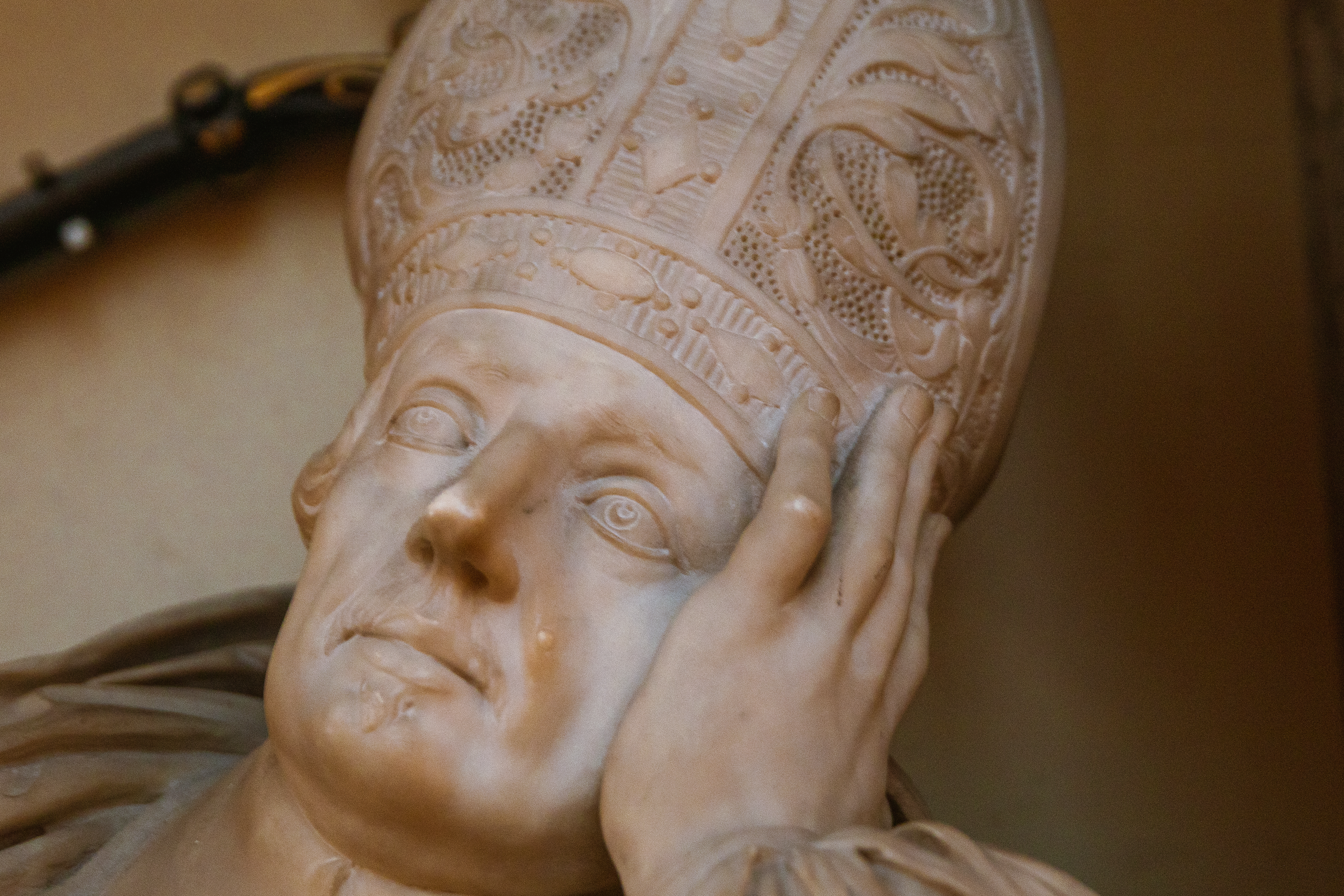
Inside York Minster, Laurence’s great grandfather lies in repose. This is Archbishop Richard Sterne, and his recumbent form was carved by Grinling Gibbons (detail pictured above) the notable Anglo-Dutch sculptor. Outside the Minster, but only a matter of yards away, are two civic plaques. The first is in celebration of Elizabeth Montagu, the “Queen of the Blues”, who led a group of privileged women interested in education and mutual support for the development of their respective interests. Montagu was a correspondent with Sterne and also his wife’s cousin. A little further along the same cobbled street is the plaque to Jaques Sterne, the writer’s uncle and one-time Precentor of the Minster. As a Prebendary, Laurence Sterne would often have been in the Minster, preaching or attending meetings of the governing body. On the opposite side of the cathedral, down the ancient Roman road of Stonegate, a stained-glass commemorative disk records the place where Sterne’s Tristram Shandy was first published. As it happens, this printer’s business lies in the lineage of the publisher of A Sterne Lent, Quacks The Printer, which is today found a short distance away on a road parallel to Stonegate.

All this is interesting – possibly – but there is more to A Sterne Lent than geographical convenience. Sterne’s work continues to be significant in the arts and humanities. Tristram Shandy has a sustained and enduring influence on English literature, and literature in other languages. In the fine arts Sterne’s legacy still generates new works. Yet in the Church, Sterne is largely forgotten. Unlike Samuel Johnson or John Donne, he is absent from the religious calendar. When I re-read Tristram Shandy, and took a look at Sterne’s sermons and other writing, I discovered themes that are relevant today and, in many respects, were absolutely groundbreaking in the 18th century. For example, he uses satire to make explicit the repeated absence of female voices from decisions about their bodies and financial independence. It never occurs to the men who pontificate on the acceptability of using a cannula to perform an emergency baptism, to seek a woman’s view about the matter. When spurious pseudo-scientific and legal arguments are cited during a dinner after a major church service, involving the disinheritance of a widow, no female voice is in the conversation.

I do not know what readers will make of A Sterne Lent. As DH Lawrence famously commented: “never trust the teller, trust the tale”. Perhaps that is true in particular for Lent books. Sterne is an unlikely figure to choose as a conversation partner for the most sober season of the Christian year. He is full of mirth; jocularity; and satirical juxtapositions. Giving up some pleasure for the sake of his soul would probably have seemed a bizarre suggestion to Sterne. He is full of humour and weaves a thread of radical and counter-intuitive thinking across his writing. Not only in the prose, but in the physical presentation of the novel, he deploys startling surprises, twists and turns. Like the fluidity of the marbled page, the narratives jostle together and suddenly find themselves emerging into a new and unexpected digressions. Is Sterne taking us for a ride – or on a revelatory and challenging journey? Never trust the teller…

The unsettling ambiguity of Sterne’s writing may help us see the world anew, and fashion questions we had not thought to ask. At a time when there is so much turmoil in the Church of England I would contend that this Lent book offers reflections which have found their moment juste. With a vacancy at Lambeth, Sterne’s writing on vocation, ambition and patronage, are as pertinent today as they were in 1759. If the Church is to change for the better it needs to interrogate and understand the historic power which continues to tick in the mechanism of its present. As any reader of Tristram Shandy will tell you, when it comes to important matters in life, we must at all costs mind what we are about – consider how much depends upon what we are doing – or live with the consequences.

A Sterne Lent can be obtained from Quacks books or Amazon – where a Kindle edition is available. The photograph at the head of this blog features Shandy Hall, Coxwold, the Museum dedicated to the life and work of Laurence Sterne.

Holy Innocent

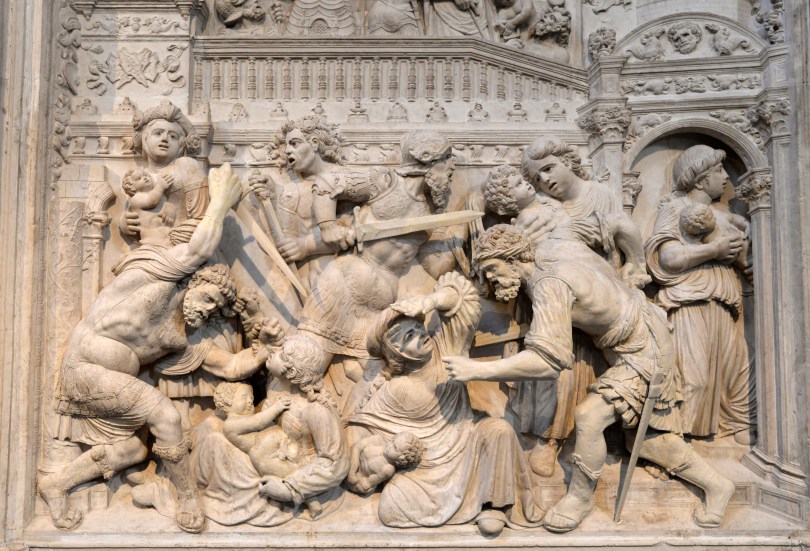
The 28th of December is the day on which the Church marks Holy Innocents. It is a day that focuses on the harrowing account in the Nativity story told by Matthew, of the orders King Herod gives to slay all male children under the age of two. Fearing the emergence of a rival, the King makes his fateful decision based on the Magi’s interpretation of the star they observed. 

Children are all too often, tragically, killed in conflict. However, the targeted destruction of the young is rare. In wartime, as we see around us in the world today, children die, are injured and become psychologically damaged through conflict. In WWII, as a consequence of indiscriminate bombing, almost 8,000 children died in the UK. The worst affected city was undoubtedly Coventry. On 14 November 1940 huge amounts of ordinance were dropped on the city leading to a significant loss of life; the destruction of countless buildings (including the cathedral); and widespread civilian trauma amongst those who survived. A few weeks’ after the attack the Dean of Coventry gathered as many choristers as he could in the ruins of the Cathedral and broadcast a rendition of the Coventry Carol to what was, at the time, the British Empire. This carol, which comes from the medieval Coventry mystery plays, recalls the massacre of the innocents. It must be one of the bleakest, most sombre and deeply moving items in the canon of Christmas music. The wartime clip from Coventry is featured in an emotional and thought-provoking episode of BBC Radio 4’s series Soul Music.

Laurence Sterne, the 18th century parson-novelist, says remarkably little about Christmas in any of his writing or preaching. Yet there is a sermon on Holy Innocents. Sterne knew from personal experience what it was to lose a child. He describes the massacre of the innocents as being:

So circumscribed with horror, that no time, how friendly soever to the mournful, – should ever be able to wear out the impressions.

When I worked in the NHS I recall very occasional instances when a mother contacted the hospital to ask about the mortal remains of their child, who had died many years ago. This arose out of the fresh attention given to the issues of organ and tissue retention, and burial practices, following the Bristol Royal Infirmary and the Royal Liverpool Children’s inquiries. In some cases mothers had given birth to a living child, who had died within a short time, and the mothers were told to go home and in essence – forget about it. They were provided with no information about what then happened to their babies or where they were buried. Records were kept, but the existence of a baby’s body in amongst an adult “shared grave” was not recorded on the headstone: unlike the adults. Once or twice I arranged to meet a mother at the entrance to the local cemetery and took her to the place where the records stated her baby was buried. I hope that, in some small measure, this helped a grief which had lain largely unexpressed for decades.

Holy Innocents begs many questions of the Church, and of the world. How could God’s miracle of the incarnation result in so much terror and destruction? Why is it that we continue to tolerate warfare that damages young lives? How do we help survivors who have witnessed unforgettable horrors? There are no easy answers to these questions. However, the presence of Holy Innocents in the Church’s calendar stubbornly insists that even while the tinsel is still hanging, the most dreadful realities of the world cannot be put aside or forgotten. They are always there and, hopefully, stir people of good faith of every religion and belief to seek peace with added urgency. Because the innocents are still being massacred today.

That woe is me, poor child, for thee
And ever mourn and may
For thy parting neither say nor sing,
“Bye bye, lully, lullay.”

From the Coventry Carol, 16th century

Christian Mechanics

When I left my previous employment I had no idea what would come next. One of my colleagues asked me: “what are you going to do?” Without thinking I replied, “God knows!” Perhaps this response emerged out of a rather hollow bravado, or a faith which was more certain in words than it was in reality. In the first instance, rather than look around for another job, I decided to have a sabbatical. These are often taken by clergy every ten years or so but, because I was employed outside the Church, I’d never taken one in the thirty years of my ordained life. In the summer of 2023, I began what became a fruitful, fascinating, and rewarding sixteen months of space, reflection and study. A friend once referred to me during this time as a “flaneur’” which I needed to look up (“someone who saunters around observing society”). Fair point.

One of the fruits of this time was reading and learning more about a figure associated with Yorkshire and York Minster, Laurence Sterne. I knew of Sterne’s writing from undergraduate days and the many links with this mercurial vicar of the 18th century found in Yorkshire – not least the Shandy Hall Museum – became a focus of work to produce a Lent book. I ventured out by bicycle to visit various small churches connected to the novelist, not least Sutton-on-the-Forrest. Its pulpit steps, once used by Sterne, feature on the cover of the book.

While not looking for any permanent role, the post of director for Leeds Church Institute came to my attention. Perhaps this was the answer to “God knows”? In any event, I applied and was appointed. The Institutes were part of a movement in Victorian England which offered education and increased opportunity for people from poorer backgrounds. The first phase of these were the Mechanics Institutes. When the Rev. Walter Hook orchestrated the creation of the Leeds Church Institute it has been suggested that he was building a facility to develop “Anglican Mechanics”. In other words, to equip church people with a greater depth of knowledge about their faith and how to live it.

Arriving early on Monday morning (keen to get started) I walked around the city centre. In a small homage to the original home of the Institute, in Albion Place, I stopped for a few minutes to read the Leeds Civic plaque recording its creation. The Institute was ‘The powerhouse behind the advancement of religious and secular education on the principles of the Church of England’. The former home of LCI is in the main shopping area of the city, now decked out in all its Christmas glitz and glamour. I thought about what life must have been like there in the 1860s, when the building was opened. At that moment someone looking fairly dishevelled, who had perhaps spent the night on the streets, came and asked if I would buy him breakfast. I did. Walking a short distance further another man overtook me, apparently talking to himself, when he suddenly launched into an abusive tirade against a woman walking in the opposite direction. She stopped, I stopped, and we exchanged a look as she shrugged her shoulders and asked aloud: “what was all that in aid of?” The man continued on his way, still talking, gesticulating, and going at a good pace. Having checked that she was OK, the two of us carried on in our separate journeys.

Perhaps things have not changed as much as we might imagine since the founding days of LCI. During a phase of exponential growth in population, the philanthropists and civic leaders of Leeds faced a colossal task in addressing the basic needs of poorer communities. Today we would no doubt find their approach patronising and – possibly – coercive. The workhouses were in full operation and the poor had little access to either education or the opportunities that might change their circumstances. Walter Hook, the celebrated Vicar of Leeds, played his part in helping to found new churches and schools. His approach was allied to the principles of the Tractarian Movement, High-Church Anglicanism, but he had arrived at these independently of the movement. Unlike the dons and academics sheltering in ivory towers, Hook was the most significant figure of Anglo-Catholic reform in the parishes. Firstly, as a priest in Coventry, then in Leeds, he advanced the cause of High-Church liturgy and social action, enduring various attacks while he sought to fulfil his sense of calling. Newman wrote to him:

“You are in the thickest fire of the enemy; and I often think how easy it is for us to sit quietly here…”

Hook had not chosen an easy path, but his dedication to parish ministry and commitment to education has left an enduring legacy. It’s why LCI is still here in Leeds, in 2024, working to advance theological reflection and act as a creative fulcrum where spirituality, justice, and learning, meet and flourish. It’s mission remains both a daunting task, and an exciting enterprise.

  • At the head of this Blog: Old and new together – Dock Street, Leeds, close to Leeds Church Institute

This Mortal Life

Pitched into the bleakness of winter arrives the season of Advent. In the northern hemisphere the beginning of Advent accompanies the slow march into darkness. Shorter days; longer nights; a steady drop in temperature. The themes of Advent – death; judgement; heaven and hell – match the somber mood of gloomier days. Threaded through topics of great moment, the story of the incarnation is pulled ever nearer. Alongside the readings in church of end-times and apocalypse, every village, town and city displays the brightness of festival lights. The cynical and despairing may shun these illuminations as simply a commercial gimmick; the cold work of retail-marketing to boost sales in a flagging economy. Yet for many of us, somehow, the glimmer of hope these lights celebrate, the baby lying in the crib, can never be given its proper price. There is something here, something to which Advent leads, which can’t be contained by the measure of this world, or our desire to conform everything to our own likeness.

It can often feel, as it does this year, that there is temerity in setting out lights as the nights draw in. How dare we suggest, imply or hint, that something might come to defeat the darkness? It is the ridiculous hope written down by John in the Prologue to his Gospel: “The light shines in the darkness, and the darkness comprehended it not”. Like Handel’s taunting rendition of St Paul’s words asking Death where its sting has gone, the hope that light might eventually overcome personal darkness, and the darkness of our world, feels an outrageous folly. Perhaps this is so because “the bleak midwinter” can feel so tangible, close and all-encompassing. Nordic countries have recently issued booklets to their citizens about surviving war. Sometimes it is so much easier to embrace fear and resignation, than fasten our eyes on something hardly visible; beyond the horizon; too good to be true.

Advent candle-bridges are a tradition in the windows of homes along Minster Yard in York.

Advent is not for everyone. The images of apocalypse and the ending of time are neither comfortable nor reassuring. “Like a thief in the night”. We cannot be permanently vigilant – we need to sleep. The metaphor suggests that the completion of things will come when we are oblivious to its approach. There is no warning or alarm. We will be shaken our of slumber and the myths with which we live will dissolve in the presence of the Divine reality. In another sections of Handel’s Messiah, we are reminded of the “refiner’s fire”. Who may abide the day of his coming?

Advent reminds us that we cannot control the appearance of sudden and defining events. We are always only a heartbeat away from immortality, and our own encounter with what Sterne’s character Tristram Shandy refers to as “this great catastrophe” which will – at some point – overtake us and bring our experience of this world to an end. Of course, following Friday’s vote in the UK parliament, it appears that there will be limited control, for some, about when that moment arrives. However, as one person said during the debates about this issue, it may also give rise to “internal coercion” and perhaps lead people to opt for something which does not reflect their personal wishes about either motivation and timing.

“We are standing upon the edge of a precipice, with nothing but the single thread of human life to hold us up”.

From a Sermon delivered by Laurence Sterne, quoted in A Sterne Lent 2024

Advent is – and should be – disconcerting. Angela Tilby’s excellent reflection in the current issue of The Church Times draws attention to Archbishop Laud’s prayer for the church. It is a succinct and impassioned petition for truth; peace; purity; and reform in the institution. All of these virtues and corrections are needed now almost as much as they were required in the 17th century. Canon Tilby concludes her piece with a simpler prayer which she wrote some years ago, but one which feels as pertinent as ever for 2024:

As light in the darkness,
As hope in our hearts.
Come, Lord Jesus, come.

Angela Tilby, The Church Times 29 November 2024

  • The photograph at the head of this blog features the underside of York Minster’s three metre wide Advent wreath, with the interior of the central tower seen in the centre.

‘Why Her Brethren?’

We are in the season of sanctity. First comes All Saints, followed swiftly by All Souls, as we remember those who have lived and died in years gone by – either people we have known, or people extolled by the Church as exemplars of faith. Of course, like so much else, sainthood is bestowed according to the fashion, politics and preferences of church leaders. For example, there are fewer female than male saints. Even so, not everyone makes the cut, nor should they. Part of the premise of my new Lent Book for 2025 is that sometimes the Church forgets those from whom it still has much to learn.

The 18th century vicar and author Laurence Sterne was not a saint, if by that we mean someone faultless in this life. The trouble with Sterne was not so much that he had faults, but that he was very candid about them. In his letters and books there is bawdy and innuendo; passion and compassion. Sterne is all too human and rejoices in a conviction that God had given him the capacity for joy which it would be a sin to deny. In the brief span allotted for his life (he died aged 54) there is an echo of Andrew Marvell’s reminder to His Coy Mistress that at his back he hears “Time’s wingèd chariot hurrying near”. For Sterne, life is too brief and precious to be lived as if it were “one cold eternal winter”.

When I renewed my interest in Sterne’s work, there were certain features that gave his writing a remarkably contemporary resonance. Corresponding with the black British abolitionist Ignatius Sancho Sterne pulls himself up short when he finds himself writing about the kin of a black character in his novel on:

“behalf of so many of her brethren and sisters, came to me—but why her
brethren?—or yours, Sancho! any more than mine?”

Laurence Sterne, Letters

Why indeed? Sterne has the capacity and honesty to recognise his inherent – thoughtless – separation of people on the basis of ethnicity. The plea for a recognition of our God-given and common humanity runs throughout Sterne’s work. When it comes to gender differences Sterne is equally pointed in describing the ‘logic’ which denies a women authority over her own body or, come to that, even the right in law to be regarded as a blood-relative of her own children. Wit is the tool which Sterne uses to excavate the absurdities of his day, bringing to light the thin veneer of social etiquette that enabled the continuation of ridiculous conventions. At the same time, living at Shandy Hall in rural North Yorkshire, Sterne is enmeshed in the society and behaviours of his day. He knows this and uses humour to escape the passive acquiescence to which most conformed. Little wonder that friends encouraged him to get his preferment before he embarked on satire. Wit that came close to the mark and exposed conventions for what they were, could cost you a mitre.

Section from “A Flap Upon the Heart”; one of two new drawings by Rob Oldfield commissioned for the book.

A Sterne Lent offers the opportunity to keep company for a while with this witty, mirthful, digressive and somewhat doubtful parson. The book is immersed in an age that can feel very different from our own, yet contains themes that speak at times with remarkable contemporaneity. Above all, Sterne offers a lively voice whose strength is uninhibited by the usual constraints of ambition. His daring portrayal of the world he inhabited has the saintliness of a child-like disposition to tell the truth, even when it comes at a material cost. Sterne’s accurate depiction of human society bubbles out from his quill and left an enduring impact on the development of the novel. I hope that this curious and intriguing book will provide readers with a glimpse into another England, yet also one that touches with humour on human traits that persist within both church and society.

Lines and Labyrinths

During our recent sojourn in Spain we visited the Centro de Arte Caja de Burgos. The exhibition currently on show comprises various works by the Swiss-born artist, Pablo Armesto. A key theme across the works is the use of light, shapes and, consequently, the implication of shadow. To quote Armesto: “Between science, geometry and spirituality, this is how I conceived this exhibition”.

This exhibition appealed to me because of the interaction of light and material surfaces. It is executed beautifully, and serves to remind us that casting a particular light can change completely the underlying structure on which the light falls – or doesn’t. In other words, by illuminating some threads rather than others the surface appearance can be changed radically. Our eyes are drawn to the light and the form it implies, not the unlit shape of everything underneath. As the commentary on the exhibition says, these are “installations in which light and shadow transform the chromatic perception of the viewer”. Here lines of light address our perception:

“The line is a metaphor for the path, both physical and allegorical, sometimes traveling parallel to the initial idea, sometimes divergent when it has to choose between different options, but never schismatic, never discordant”.

Pablo Armesto

The title for the exhibition is “Complejidad, araña, laberinto”. I think that this is best translated into English as “complexity, spider-webs, labyrinths”. This phrase comes from a poem by the Andalusian poet Rafael Alberti, entitled “a la linea” (‘To the line’). While a line may sound a modest thing to be the subject of a poem, Alberti reminds us of the joyous capacity for it to be a “beautiful expression of the different”. Certainly, in Armesto’s installations, the vibrancy of illuminated lines could not be made clearer. It reminded me of the well-known comment by the artist Paul Klee, in his Pedagogical Sketchbook of 1925, that he was engaged in “taking a line for a walk”.

A circle of light created with the use of curved lines – by Pablo Armesto

The recent work I have been doing about Laurence Sterne includes the representation of a physical gesture – the waving of a stick – in volume IX. It is nothing more than a squiggle; a pen-line dancing across the page. It is used to express the notion of liberty and is, perhaps, the representation of the neat text going ferrel. A reminder that the careful shaping of ink that allows us to see letters and to read them, is made of the same stuff as this dramatically inserted hieroglyph. Different forms of the same material may shatter our expectations and leave us wondering what will come next. Art has this capacity to subvert our smooth reading of life and question the solidity and what we see. Like Sterne, Armesto’s filaments stretch our imagination, providing an intense optical experience and stimulating our thoughts about patterns – whether they are there, or simply the imposition of our expectations on the otherwise chaotic things we behold.