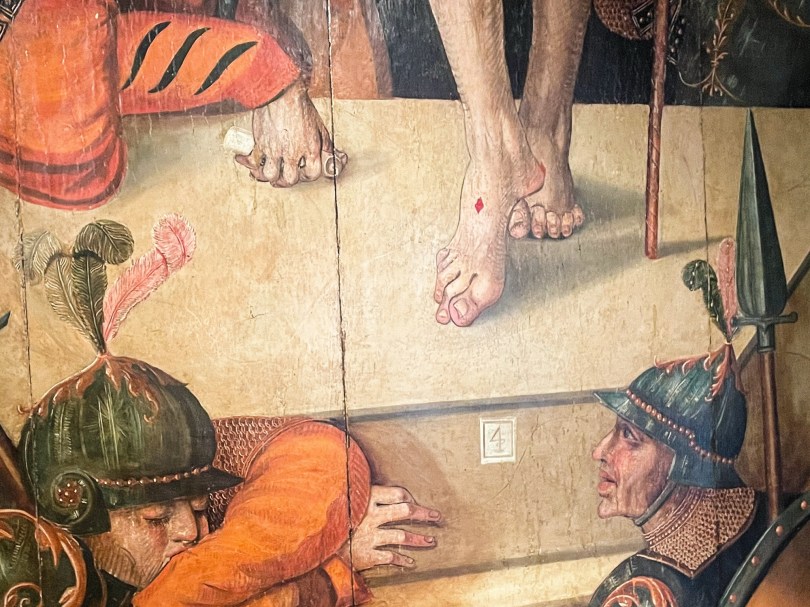
Perhaps the soldiers were sleeping because their task seemed so simple: to guard a dead man. In the painting, part of an altarpiece, only one soldier has been stirred by the strange sounds coming from the tomb. The feet of Christ stand simply on the grave slab, familiar to countless millions down the centuries by their telltale marks of blood.
The status of Jesus as dead and buried is suddenly transposed. Now, in the hour of resurrection, the guards are ‘so afraid of him that they shook and became like dead men’.
The soldiers are scattered out of fear. The women at the tomb also disperse but with different sentiments. They are ‘afraid yet filled with joy’. The feet Christ places on the earth do not bring vengeance or a settling of scores. They stand in confident conviction that a new era has begun when peace is more than a balance of arms.
A very Happy Easter to all blog readers, and especially to those who have struggled through ‘A Sterne Lent’ to reach this joyful Eastertide.
Another reader’s response to the marbled page stencil in ‘A Sterne Lent’.
We are about the enter Holy Week. Many Christians will mark these days by attending additional church services and spending time in reflection. I never tire of reading the passion narratives because I have no doubt that in them lie the central themes of Christianity. There is a crowd in an city eager to give the inspiring young rabbi their adulation. The intimacy of close friends at supper on an important festival. The isolation of the garden outside the city walls, and then the bitter work of captivity; costly fidelity; suffering and death.
At a time when the world has become increasingly chaotic it is important to be reminded of Christ’s stillness before the powers of his day. The High Priest and Pilate undoubtedly saw the brewing popularity of Jesus as something that would be ended by his execution. On all the metrics of religious power and secular control, the Jesus who goes to the cross is done. The watching world could agree with Jesus’ last words: “It is finished”. Perhaps those two leaders saw it as the messy and unfortunate price to be paid for maintaining control; keeping the peace. The sacrifice of Jesus would enable things to stay as they were – and as they should be.
Maybe Jesus didn’t know the art of the deal? His time in the wilderness at the beginning of Lent suggest that he had set his face against compromises in his ministry. When he stood before Pilate he had no cards to play. Or, perhaps, it is more accurate to say that he chose not to accept the terms of the game. Appearing to go meekly to his death probably confirmed to many of the leaders that Jesus simply didn’t understand the reality of the world he claimed to be saving. Sad, but there you go. One death wouldn’t change anything.
A Station of the Cross by Sepo b. Ntuluna from Tanzania, in the hotel Mattli Antoniushaus, Morschach – built on the grounds of the Franciscan Community in German-Speaking Switzerland.
Then there is the humanity of loss – of which we all know something. Mary caressing the body of her son. A parent unable to intervene to save her child. The powerlessness of love which cradles the life-left body of the son she would have done anything to save. This is the darkness of despair; the earth shaken; the light of the world put out. The day of absence.
‘Faith’ is perhaps the best answer as to why Jesus doesn’t do a deal. That our miserable card games take place inside a much, much bigger story than most of us are willing to acknowledge. Soldiers at the foot of the cross didn’t have cards, but they had dice. It would be beyond their imagining that 2000 years later the events of that sorry day would still be remembered. A miserable death a few hours before a dusk that would usher in the city’s shabbat. It would be hard to imagine something less important. It was ended – time to divvy up the possessions and go home.
“Thou art God, Whose arms of love Aching, spent, the world sustain”.
WH Vanstone from Hymn to the Creator in ‘Love’s Endeavour, Love’s Expense‘
The shunned, the unloved, the bleeding – the despised and the dead – were all brought back into life by Jesus. In a culture of separation and holiness-by-isolation, the Nazarite Rabbi stepped over boundaries again, and again, and again. When that culminated in the raising of a man from the dead, Lazarus of Bethany, the authorities decided enough was enough. It was time for Jesus to go away. Better that one man should die than the nation perish. Utilitarian arguments often win the day, they are beguilingly simple and often easy to implement. Focused on what is obvious and immediate, they frequently omit or deny wider truths and bigger themes that are, perhaps, simply too inconvenient to contemplate.
Like the sower’s seed, or the prodigal’s father already upon the road, the resurrections of Jesus are strewn across the Gospels. He calls back to life those who have been taught to be dead. To the contamination of a bleeding woman who dares to touch him, a wretched life is made whole. Many are healed and the doubting are allowed to walk away. At a meal with his disciples a woman dares to waste the fragrance of rich perfume; anointing the feet beside which the barren branches bring forth blossom. Here is bread and water; body and blood, the words whispered to the unworthy and the hopeless: you are alive.
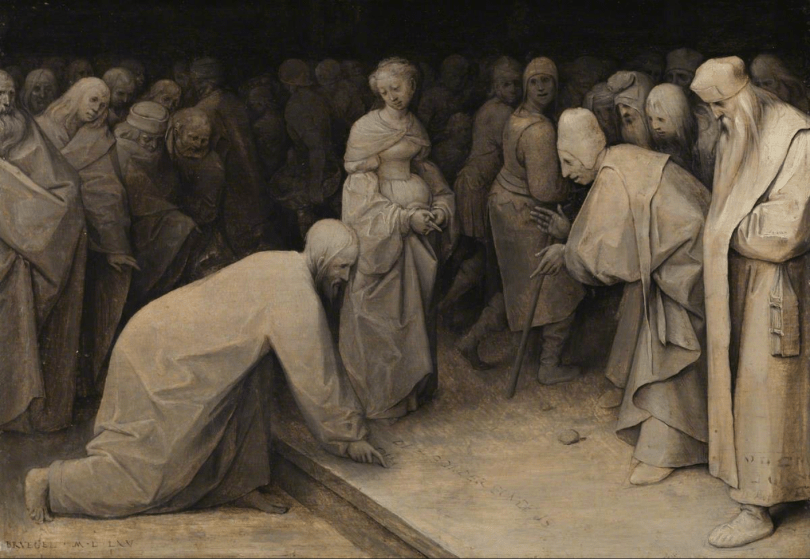
The picture at the head of this blog is called ‘Christ and the Woman Taken in Adultery‘ (1565) and was painted by Pieter Bruegel the Elder. The painting uses a technique called grisaille, meaning that it appears to be monochrome; everything is a neutral shade – sepia-like. It is hard to imagine any depiction which conveys a stronger sense of life drained away. In the crowded painting the head of Jesus is lowest of all. He writes. I have always believed that in this story, at this point, Jesus is incandescent with rage. He knows that the purpose of this moral tale is to trap him and condemn him. Did the Pharisees just happen to catch this woman in the very moment of committing adultery? Or did the lawyers’ question come first, and a cunning plan evolve to create the drama? She is caught in the act – and they know at that moment exactly where to find Jesus. He knows that those who bring her care neither for her sin nor her salvation. She is a prop. It is little wonder that this is one of very few Gospel stories where Jesus pauses and takes his time, perhaps to marshal his feelings before speaking.
“The stone-throwers walk away, one by one, according to age. Until the kneeling Christ and the standing woman remain, in an awkward reversal of their established sexual status. He tells her to go, to sin no more, to pass from this narrative, and out of our knowledge”.
The teachers and the crowd are dismissed by their recognition that no one is without sin. In this dismal tale of exploitation the one whom Christians claim has no sin does not pick up a stone. Violence is interrupted and a word of resurrection love is spoken: I do not condemn you. Like the woman at the well, she stands with Jesus alone. Another woman made the recipient of easy male judgement. The choreography of sin and punishment is cut short by someone who has no interest in this kind of dance. It is time for it all to stop.
On Good Friday we are supposed to think about the agony and suffering of Jesus, and so we should. But the resurrections continue, even on the cross. For the criminal who puts his faith in Jesus, the promise of the life to come: today. Slowly, the light of the world is extinguished. Its remains are planted in the darkness of the sealed tomb: and we wait. Today, at Easter, resurrection triumphs over death. The task of the church is to live this resurrection and set free people so quickly judged by those keen to weigh some sins more than others. To punish those whom it is easy to judge, and hide much greater sin in the folds of wealth. The resurrections of Jesus are not good news for everyone.
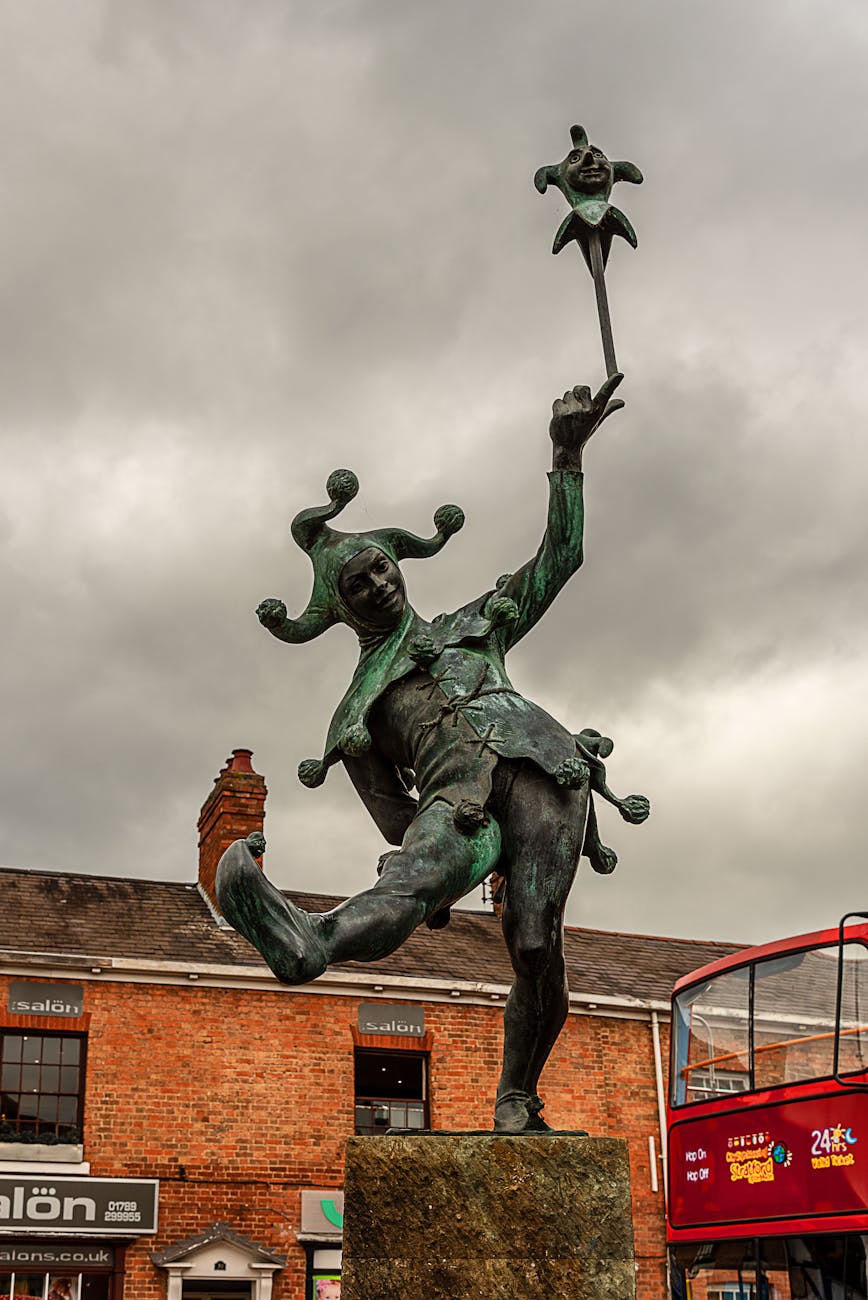
In the weird and wonderful world of Gulliver’s Travels, Jonathan Swift described servants who performed a particular occupation encountered by Gulliver on his third journey. These servants were called ‘flappers’ and their job was to accompany their master or mistress and make sure they were paying attention to what was going on. They did this with the aid of an inflated bladder on a short stick which, when they deemed it important for the person to be alert and listening, was used to flap them on the ear with the bladder. Equally, if it was something they needed to look at carefully, to flap their employer – gently – upon the eyes, thereby preventing them falling down a cliff.
This rather dramatic premonition of contemporary mindfulness was Swift’s satire on the distractedness and self-absorption of philosophers. These 18th century thinkers are portrayed by Swift as disconnected from the world around them, requiring a ‘flap’ or, I would suggest, a slap, to reawaken them to reality. Gulliver was unimpressed by the aristocratic figures who needed flapping, and spent more time conversing with the flappers themselves who, of course, had to pay attention to the world on behalf of others. Swift would be aware that his description is reminiscent of the role played by court jesters, who also used inflated bladders, and were sometimes the only people who could speak truth to power.
It is not easy to see the world with clarity. Often our gaze is overlaid with memories and interpretations that make our observations conform to views we hold already. This can mean that we fail to discern new patterns or new dangers, in a context where we pull reality towards the norms of our own expectation. I have written before about the value of stringent seeing and speaking, when we try to strip away the layers we impose and see something afresh. It is not easy. Perhaps we all need a flap to the head now and then.
Until I began preparing a sermon for Palm Sunday I hadn’t noticed a comment toward the end of the appointed Gospel reading. St Mark tells us that on entering the Temple, Jesus remained there until ‘he had looked around at everything’. Not preaching; not teaching; not healing or anything else: simply looking. Further research led me to discover that the Greek word used here, περιβλεψάμενος, occurs only seven times in the gospels with all but one of these found in Mark. Why is the evangelist so keen to make this point about the behaviour of Jesus?
Referring to an earlier use of this word in Marks’ Gospel, one suggestion is that the pause for observation “helps to intensify what Jesus is about to do” (Christal, J. 2011). This could be interpreted as a word used to convey dramatic effect: something major is about to happen. That would fit with Jesus’ Palm Sunday entry into Jerusalem and the impending denouement of his mission. Equally, it is possible that Mark’s presentation of the passion captures a growing disparity between what Jesus was realising about the coming days, and a world unaware of events that would come to change history. It reminds me a little of the 2011 film Margin Call about the 2007-8 financial crash. A young financier, working for a large company, had calculated that the world was on the eve of a commercial meltdown. As he is driven across the city he gazes out on a world he knows is about to change, where everyone he sees is oblivious to how their lives will be altered. The character ‘looked around at everything’ because nothing would ever be quite the same again.
I am not convinced that having a flapper around to bop my eyes or ears would necessarily help me to see the world any more clearly. Like the ping of a message on my mobile phone, it would probably lead to irritation. Nevertheless, the point Swift is making is entirely valid. We are parochial and complacent creatures, wrapped up in our own concerns and often lacking the will to shake up our way of seeing the world. In a church where there is often an emphasis to ‘make disciples’ and to be incurious about a theology that questions our way of looking, it might help to remember that Jesus took the time to simply pay attention to the world. At the start of Holy Week it is a helpful reminder to us to ‘look around at everything’. To allow the narratives of Maundy Thursday and Good Friday to jolt our compassion into life, and to look forward with hope to the day of resurrection.
Many of us go with the flow and make sure we don’t stand out from the crowd. At least on most topics. There is a human urge to fit in, accompanied by a fear of separation from the mainstream and finding ourselves isolated. Of course there are also people who love to disagree with the herd: the contrarians. Hopefully, somewhere between these polarities, there are people who disagree when they see its necessity; not for the sake of disagreement alone.
One of the most memorable sermons I recall was preached at the University Church in Oxford, sometime around 1984. The preacher was Trevor Huddleston, and his text was about as short as you can get: ‘Jesus stood’. It comes from Mark 10:46 when Jesus and his disciples are on their way out of Jericho and blind Bartimaeus keeps calling out to him. Bartimaeus was not falling in with the crowd. People were telling him to shut up and behave, but he wouldn’t stop. Despite the swell of the crowd and the momentum to leave the city, Jesus stood. It conjures the imagine of the tide breaking upon a rock.
Huddleston spoke about the anti-apartheid movement and the challenge of speaking out in a society where the weight of social expectation was to keep quiet and behave. To collude with systems of oppression designed to privilege the few. Like Jesus leaving Jericho, we need to courage to hear the voices from the edge of the crowd: to stop, to listen and to act.
There is a lot of appeal in going with the crowd and not making a stand. In one of my favourite quotes from Murder in the Cathedral a tempter reminds Thomas of the venal rewards of compliance, saying: ‘the easy man lives to eat the best dinners’. Join the club; keep quiet; do what’s expected and never, never, rock the boat. Such behaviour can bring handsome prizes.
In the Passion Gospel we find Jesus ‘stood before Pilate’ (Matthew 27:11). This time he isn’t there because of a voice heard on the margins. His posture is an enforced sign of respect. By contrast, as we go on to hear a few verses later, power sits to pass judgement. All the robes and symbols of authority, and troops at command, are with Pilate. Jesus is alone. Yet, if there is no choice of posture, there is a choice to be silent. In the face of the choreography of power Jesus fails to conform to the etiquette of the room. He does not plead for his life. He does not give a rambling defence or seek to implicate others. Silence. In the few verses in which this is described it is possible to feel the authority of Pilate ebbing away.
In 2000 I visited Alison Wilding’s remarkable ‘Passion Project’ exhibited at the Dean Clough Gallery in Halifax. One of the larger pieces in the collection comes under the heading ‘Disposition’. It consists of a huge concrete disc towering over a black mat, which appears to grow wavy stalks (it can be seen here). Abstract art demands work from the viewer, even when set in an exhibition with an overall theme. What is going on here? There is a world of difference between the objects – in almost every sense. They appear only to be connected by a tension that lies between them. In a temporal sense Pilate should be the stone – ready to crush whatever pathetic resistance grows out of the Judean darkness. Spiritually, the disc hints at perfection and eternity. It is balanced and complete, requiring nothing from the sprawling stems that stretch upwards. This is a standoff and the stone will not be moved.
“At the heart of this episode of the Passion is both conflict and stand-off. There is a perplexing estrangement between both objects; the scale of one bears no relationship to the other, but the space separating them is tense and compelling. In the dynamic of the sculpture one part is continually brought into focus and deflected by the other”
Alison Wilding, ‘Contract’, exhibition catalogue, October 2000
Those who make this kind of stand seldom come off unscathed. Jesus knows this and he holds no particular hope of release or escape. The machinery of power will take its course and suffering lies ahead. It is beyond the imagination of this anxious and self-interested power that somehow, by battering and breaking this solitary young rabbi, an alternative power will be released into the world. A power that will enable anyone, no matter how poor or peripheral, to receive a dignity that cannot be removed. To become a child of the living God.
Understandably, Evensong is about the ending of the day. As I have written before, it offers a space for reflection and prayer rendered in words that are centuries old. Once a staple ingredient of the worshipping diet of the Church of England, fewer and fewer churches hold the service with any regularity. Cathedrals still maintain its place as a mainstay of their existence and many are rewarded with appreciative congregations. York Minster saw many hundreds of people at its Easter Sunday Evensong, but this is the exception rather than the rule.
Recently I attended Evensong in the pretty port town of Whitby. I was fortunate in that my stay coincided with the one Sunday in the month when Evensong is held in one of the Anglican churches. This information wasn’t difficult to find on the internet – but I note that the local paper, the Whitby Gazette, no longer carries a listing for local church services. The publication has always felt a little retro (I’ve no idea how common the practice is) but until the pandemic there was always a sizeable entry reporting all the service times for Whitby and the surrounding villages for the forthcoming Sunday.
‘The other response to decline has been the creation of complex patterns of rotation of services’.
Bruce, S. (2011). Secularisation, church and popular religion. The Journal of Ecclesiastical History, 62(3), 543-561.
The service I attended took place at 6 pm in the large Victorian church of St Hilda, built in 1844. As I have found with a number of churches at service times, there was no external indication of what was about to take place. Admittance was by a modest door that stood open, but with no signage inviting entry. Coming to this service required a confident churchgoer. While there was no one there to greet worshippers, books with a service pamphlet were prepared and waiting on a table. Arriving just a few minutes before the service time I found that I was one of three worshippers sitting in the nave. On the hour a crucifer and robed choir in double figures entered via what appeared to be a side chapel, and the service began.
It was a good service. Three hymns were sung, all familiar to me and strongly led by the choir. There was no sermon. Yet in a town of thirteen thousand souls, with many more visiting as tourists on a Bank Holiday weekend, the congregation never rose above three (two of whom were clergy). I’m not very interested in nostalgia, but there may well be a place for lament. For Evensong aficionados the service was listed in the Choral Evensong website, but that made no discernable difference to the attendance. Although over a decade old, I think Steve Bruce identifies accurately many of the problems of religion in these coastal communities, and more widely. Numbers have dwindled; clergy are fewer; sustaining services across multiple benefice parishes has led to complex timetables; as churches have closed a wider network of folk religion has diminished. In all the counting done by church strategists, the existence and role of popular religion is mostly neglected. The people whose children went to Sunday school; who attended the Carol services and coffee mornings; who turned to the church for occasional offices. Throughout my ministry, this group has been a vital part of my pastoral ministry, whether as residents in a Lancashire suburban parish; as patients in hospital; or amongst the people now living into their tenth decade and beyond. The mood music of the C of E seems to require this group to make a decision: be a disciple or be gone.
‘a notional sense of affiliation and occasional and peripheral involvement in churches and chapels requires that there be functioning churches and chapels close at hand’.
Ibid.
While there are groups now fighting a rearguard action, such as ‘Save the Parish‘, the spiritual capital already squandered through closure, complexity and theological withdrawal, will not be regained. It was built over centuries and lost in a generation. To many of us the ‘disciple’ mantras from the centre sounds like an ever-narrowing agenda. The ark may have escaped our reach, but we are downsizing to lifeboats in order to accommodate the faithful few and float over an ocean of the un-saved. This pays little regard to the everyday sacred; the resources of our churches as wonderful places to ‘be’ (when they are open); the honest striving of people to make sense of their lives.
In the glories of High Church Victoriana, Evensong can feel like the faithful performance of am-dram Shakespeare. A mystery play forged through the fires of Reformation England, with local actors adding their accents to the long, long tradition of Anglican spirituality. Words that name our wretchedness, speak of the dead and lay hope in the resurrection. In a town where the physical landscape is used to such good effect, and where jet became the jewellery of mourning, I wonder if there is any chance that new life might be breathed into this ancient worship? Before we give up the ghost on this liturgy, perhaps we should consider the possibility of new links and relationships. Surely, if any piece of worship was ever made for the Goths who congregate in Whitby, it’s Choral Evensong.
The break of day is a moment that divides and defines the ambit of our experience. Perhaps we find it mundane and predictable, but each dawn is momentous. For most of us it stirs us to waking and unfolds the day ahead. I never fail to feel that each day is unique and marvellous – a never-to-be-repeated opportunity. Of course, days will recur: but never the same day. Like the blare of a siren we are aware of their approach, and with rapidity they fall behind us. There are countless days we shall forget and a small number that will remain with us until the grave. In literature the risks and possibilities of each day have been a foil for playwrights and poets:
Night’s candles are burnt out, and jocund day Stands tiptoe on the misty mountain tops. I must be gone and live, or stay and die.
Romeo and Juliet Act 3 Scene 5
It is little wonder that in Genesis the first words attributed to God are: ‘let there be light’. It is the division between light and dark which forms the fundamental aspect of life, perhaps the first element of conscious human awareness. It grants us the experience of time. In Mark 16, just as God created the first day, so the women go to the tomb ‘when the sun had risen’. It is another day; a second creation; the moment when ‘light shines in the darkness’ and humanity no longer has to dwell in night. For, although in creation day was divided from night, when the Psalmist thinks about God: ‘even the darkness is not dark to you; the night is as bright as the day, for darkness is as light to you’ (Psalm 139). Whether in the darkness of rooms behind locked doors, or when, ‘just after daybreak, Jesus stood on the beach’ (John 21) the resurrection stories contrast night and day. Easter is a daybreak that will never darken.
Converting 4 million tons of matter into energy every second, the sun constitutes about 99.86% of the mass of the Solar System
Perhaps the reliability of the sun’s daily appearance dulls our appreciation of what is taking place – both in space and time. Our brief lives are lived in orbit around this ancient and enduring fixed point. It was not always here, and it will not last forever, although in all probability it will outlive humanity. While its output fluctuates, to our senses it is constant and unchanging. Our days, months, years and hours are defined by its appearance. Like so many things, including historic perceptions of earth’s centrality to the universe, the sun’s significance is estimated from a human perspective. Despite all our technology and progress we have no ability to alter or influence its existence.
Of course, when the dog stirs at first light, I am not enamoured with the shift to longer days in the Northern hemisphere. (I think 05:30 is the limit of my tolerance for greeting the new day with a spring in my step). Watching the inexorable rise of the sun out of the sea is certainly a spiritual experience and prompts metaphysical questions. It is little wonder that many religions have tied their prayer times to reflect such moments, responding to the natural world with practices that invest meaning, seek relationship and prompt contemplation. Perhaps uniquely in the ancient churches of the world, only the Armenians developed a ‘Sunrise Office’. Touchingly, it describes monks ‘having awakened in awe’, instantly moved to pray. The service came to stand apart from Prime or Matins and included Psalm 112, a text reflecting on those who fear the Lord: ‘They rise in the darkness as a light for the upright; they are gracious, merciful, and righteous’.
This prayer signifies the second coming of Christ and the resurrection of humanity from the tombs on the first day of the week at the first hour. For the resurrection of all human natures will take place at that hour… he is the morning and the beginning of the dawning of the sun of righteousness, and it will take place at that first hour of the great day.
Findikyan, M. D. (2000). On the origins and early evolution of the Armenian office of sunrise. Orientalia Christiana Analecta, (260), 283-314
In a hot climate, the poet AE Stallings writes of the difficulty of locating a family grave in a cemetery. Someone goes in search of information to find the right place:
Then you came back With the coordinates, and snagged a priest Glistening in polyester black,
Who, at the grave, now found, Spoke of the rest and rising of the dead As if they were so many loaves of bread Tucked in their oblong pans In a kitchen gold with sunlight, rich with yeast.
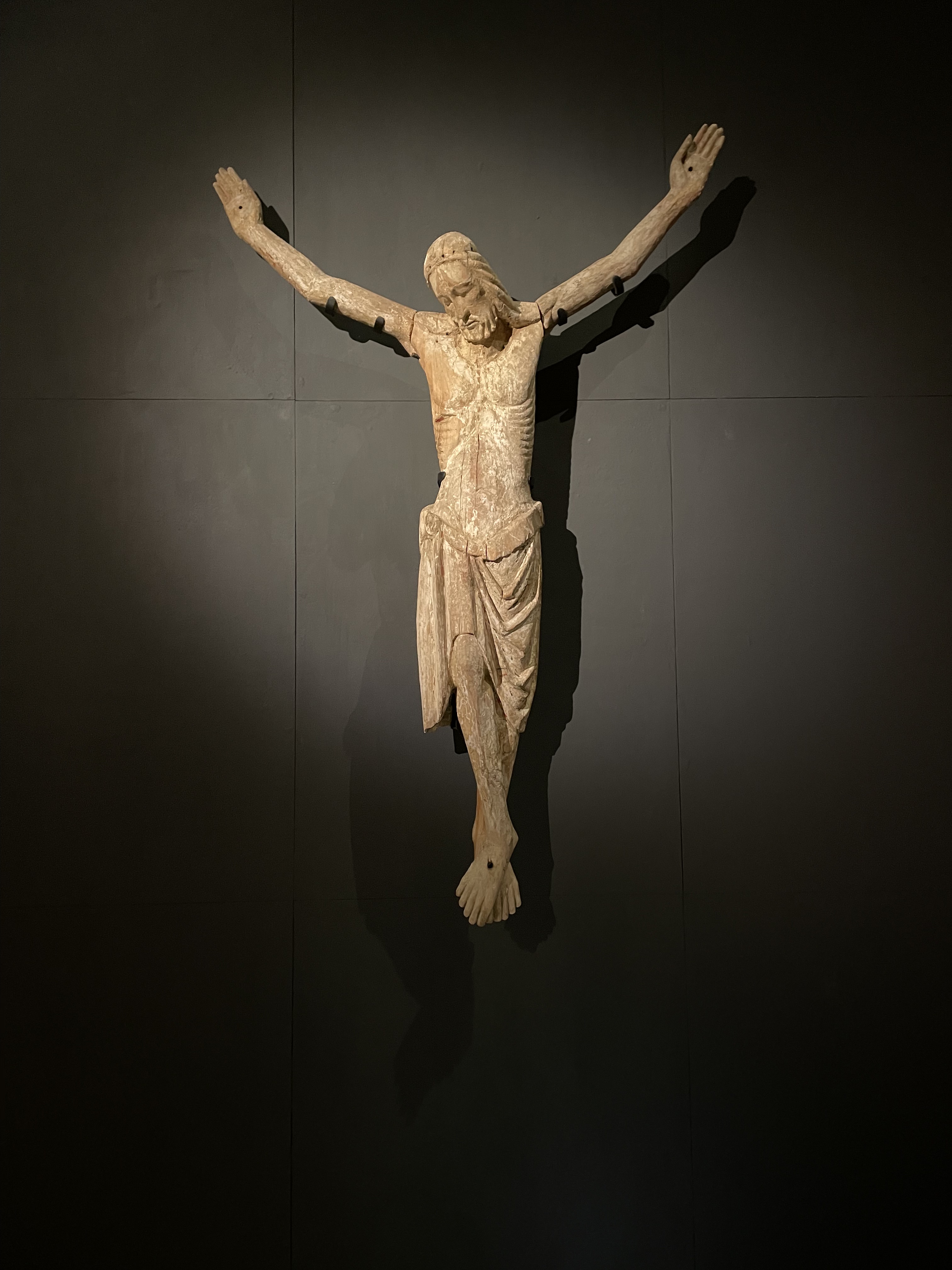
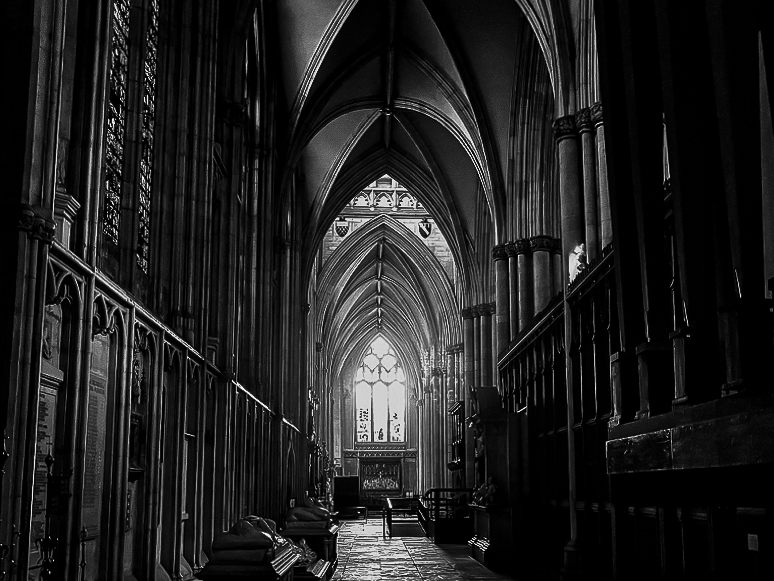
It is the thing which shouldn’t be there. High up in the crossing above the worn-smooth stones of the Cathedral floor. It is visible across the nave of the building, raised in front of newly refurbished organ pipes resplendent in gold and bright vermilion. Millions were spent bringing this huge instrument back to a state of excellence. Every note sounding pitch-perfect, and accompanying a choir of international renown. Below the organ pipes is the screen. Elaborate stonework and gilded kings – the work of master masons long departed this world. The Cathedral harvests the best that can be had, filling this barn of a building with the finest sculptures, carpentry and glasswork. During Lent, into all this splendour, is lifted a rough-hewn cross. As basic as you can imagine, two planks of unpolished, unvarnished and uninspiring timber hanging in space below the central tower.
Liturgy, and the context it inhabits, has a knack of creating paradox. When it seems that the church has been enthralled by worldly standards, with a hierarchy of clergy, the splendour of an Archbishop or Pope is cast aside on Maundy Thursday as they kneel to wash people’s feet. All the grandeur is subverted by the truth that the least will be greatest in the Kingdom of God, and the last shall be first. Stitched into our services is the recurring message that things will not always be as we expect. God can, and does, disturbs us in surprising ways.
The Lenten cross is yet another jarring sign of this unsettling truth: just when we think everything is polished and perfect, the rough and the ready is what we need to tell us what God is about.
“But lying there long while, I, troubled, beheld the Healer’s tree, until I heard its fair voice. Then best wood spoke these words: “It was long since – I yet remember it – that I was hewn at holt’s end, moved from my stem.”
Theology could not function without paradox. Christianity is not – and can never be – something that reconciles every aspect of human experience in a divine plan. Our worship requires us to recognise and name the most difficult aspects of human living. In baptism we say that this new life will one day die. At every marriage ceremony we are reminded that the commitments are made ‘until death us do part’. There is no shying away from these fundamental truths of human life. Yet our commitment to the limits of human existence is held in tension with a great hope. A hope which, on Good Friday, we affirm even in the shadow of the cross; the Healer’s tree. We cannot disregard the injustice, suffering and humiliation of this public execution. We see it and name it.
For some people it will not be Good Friday that is difficult. Human suffering is obvious and ubiquitous. The step of faith to Easter Day is the part of Christianity that stretches their credulity. Yet for those who follow the way of Christ, our response to suffering is lit with a hope that radiates from the empty tomb. Yes, suffering is real – but it is not all.
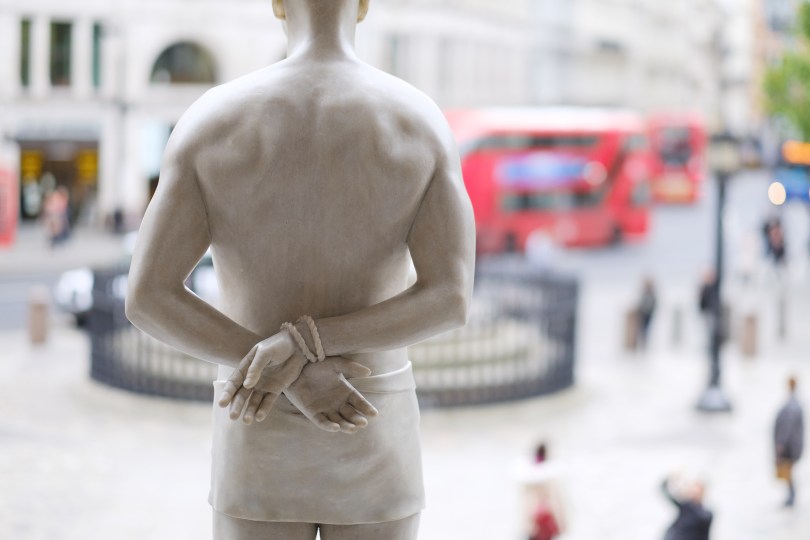
He hung there limply on the frame, His body beaten black and blue. Exposure was the thing; humiliation, too; To which the nails seemed superfluous When all you had to do was die of shame; Quietly expire, a minimum of fuss. But what a noise you made, Silent Messiah, Your humbling death, so nakedly exposed, Conquered forum, basilica and the choir Of poets with the love you interposed.
N. S. Thompson, ‘Silent Messiah’ in ‘The Poet’s Quest for God’ Eyewear Publishing 2016
Easter Day Sermon preached at St Andrew, Bishopthorpe
Last year we were not in church on Easter Sunday. April 2020 was the deadliest month of the first wave of the pandemic, and our hospitals and care homes were facing their toughest days. Many of us joined a service on the internet, but church buildings were empty. Few of us imagined that we would be in another lockdown during Easter 2021. Yet here we are – thankfully in Church, but still living with the changes which COVID-19 has brought to our lives.
I’m sure that in Bishopthorpe the time between these two Easters has been filled with many unrecorded acts of kindness. Neighbours looking out for one another; people mindful of those who are vulnerable; finding ways to help our front-line workers feel supported.
We shouldn’t underestimate all this compassion and care. It expresses something that flows out of our Christian faith. I’m not suggesting that people of other faiths and beliefs don’t care; we know that they do. Yet there is a shape to Christian living which is distinctive and reflects a choice of faith giving rise to action. A response to God rooted in the life, death and resurrection of Jesus Christ.
The moon just before dawn – the growing light catching the cockerel weather vane of All Saints North Street on Easter Day
Last week I commented that, at present, a gathering of 13 or more people in an upper room is illegal. Eating together in such a setting is also banned. Except here. Thankfully, in this spacious building, we can meet together and share this meal. The need for services to be held remotely is understandable, but – at least for me – it has never felt quite the same as being here. Perhaps our fast from meeting and eating together has borne spiritual fruit: a new awareness of what presence means and the privilege, when possible, of being together. Many continue to live this enforced fast, and our prayers are with them.
Part of the reason why I feel that being here matters, is that when Christians meet in worship we inhabit our spiritual home, and speak our mother tongue. It is not about the building – and yet the building is designed to emphasise elements of our faith. Following on from St Paul’s description of Christians as ‘ambassadors for Christ’, this place has the all hallmarks of an Embassy. A place filled with the things from home: the customs, the quirks and the idiom of that ‘other country’, where our souls belong.
Over the years I’ve led services of Holy Communion in many different places. With a few friends on the Isle of Iona, to inner-city care homes, people’s houses, in prison, in countless churches and chapels, with the sick and those about to leave this life. Every time, no matter what the setting, I have said the words that pattern a Christian’s sense of belonging. Words that remind us there is no hierarchy in God’s kingdom – all have sinned; self-worth is not the coin that can buy this sacrament. Love and longing invite us where there is no entitlement to be. All we can do is lift up our hands, for the food which comes by grace alone.
Who knows where we shall be next Easter. It’s certainly true for many of us in this pandemic that ‘Today’s trouble is enough for today’ (Matthew 6:34). As the women walking to the tomb were anxious about the huge stone that would obstruct them, we sometimes find that God has gone on ahead of our anxieties – and what we imagine is sealed, stands open.
This Easter I simply want to encourage you to nourish the roots of this faith. To be fed, strengthened and built up in the calling we receive in baptism. In our faith, and the way we live, to witness to God. As ambassadors striving to be faithful, living the truth of the Kingdom which is our home. Always seeking and knowing that in our acts of service we bring a message of life; finding wherever we go, that the Risen Christ has gone before us.
“Do not be alarmed; you are looking for Jesus of Nazareth… He has been raised; he is not here… he is going ahead of you… there you will see him, just as he told you”
Words from the Gospel of Mark chapter 16, from verses 6 & 7













 Swift Reflections