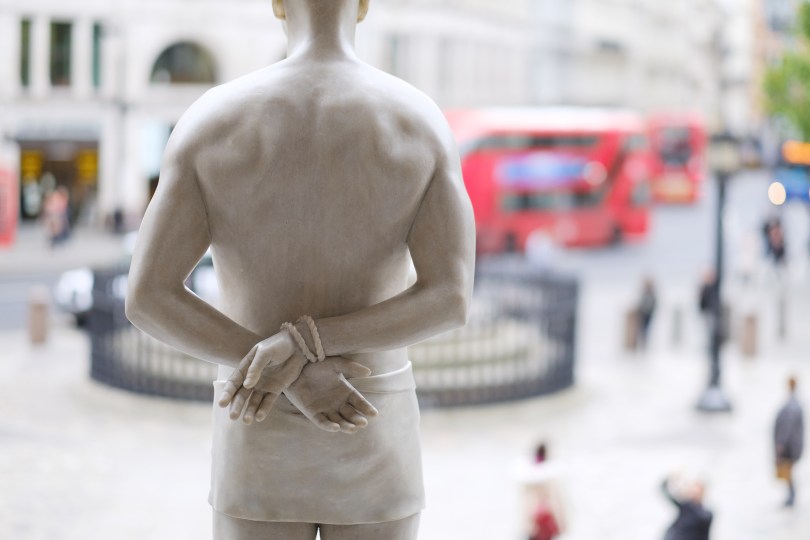
In the Midst

Increasingly I find Radio 4 a disturbing listen. Not because the content is controversial (usually), or offensive, but because every time I switch it on I realise how much I don’t know. Whether it’s In Our Time, or some other consideration of a niche topic, I’m made aware of the vast range and depth of human knowledge about which I was oblivious. One example of this arose last week, listening to the Seven Deadly Psychologies. While I certainly have views about why greed is bad, this programme delved into the mechanics of why this might be the case. In the discussion there was a fascinating debate about the fact that, generally speaking (but with notable exceptions), research has demonstrated that rich people have less empathy and compassion than poorer people. In charity, the poor overwhelming give away a significantly higher proportion of their wealth when compared with the financially advantaged.

One reason offered to explain this was that wealth meant people became more distant from communities. It was not possessing a fortune per se which caused this lack of compassion, but the acquisition of space. The consequence of an exclusive lifestyle is that it removes us from close company of our ‘fellow-passengers to the grave’, to quote A Christmas Carol. In turn, this increasing remoteness appears to dull the understanding of the thoughts and feelings of other people. Richer people often feel entitled to their wealth – and perhaps see poverty as simply other people’s failure to accrue resources. Perhaps some of the present UK Government should listen to this episode.

A crowded nativity scene in St. Hippolytus Pfarrkirche, Zell am See, Austria January 2023

While wealth and power no doubt brought King Herod a significant ‘exclusion zone’ this can hardly be said of Jesus. The narrative of the nativity describes a Bethlehem bursting at the seams. In the traditional portrayal, Jesus and his family are cheek by jowl with the beasts of the stall; receive a stream of uninvited visitors; and find themselves in a town where every bed is taken. Lack of worldly privilege ensured that Jesus grew up close to a wide variety of trades, in a community where modest livelihoods required people to cooperate.

Sovereignty in a cattle stall is one example of the paradox that runs through the Christian story. If wealth dulls our capacity to be compassionate it can also diminish our ability to recognise a God who expresses a preferential option for the poor. A God who, in Christ, is able to hear the plea of the Syro-Phoenician woman; the prisoner on the cross; the dilemma of the rich young man. Only when the Word-made-flesh pitches its tent in the heart of humanity is the gulf between God and creation closed. Ultimate power and splendour, commanding more space than we can ever imagine, chooses to renounce entitlement and make the ultimate identification with humanity.

For Dietrich Bonhoeffer the paradox lies partly in the idea that this God is not seen easily by those who have the most resources, or education, or stability in their lives.

“The celebration of Advent is possible only to those who are troubled in soul, who know themselves to be poor and imperfect, and who look forward to something greater to come.”

Dietrich Bonhoeffer

Knowing our need for one another, and our need of God, is a prerequisite for our spiritual growth and maturity. It is one of the reasons why Advent is an uncomfortable season. Many of us recognise the greed we feel for our own space, and to have the freedom to do as we wish. Community implies compromise and association, experiences which appear to have fading appeal in the West. However, to know God seems to require us to be immersed in the dependencies of human society – a truth which both Advent and Christmas impress upon us each passing year.

Advent’s Bitter Chill

The cold has come. In an era of climate change there is no guarantee that winters will bring us frost or snow – at least, not for any extended period of time. Parson Woodforde, an undistinguished parson in a small rural parish, would have been consigned to oblivion except for one unusual practice: he kept a diary. Woodforde’s world of the 18th century witnessed some of the final decades of the Little Ice Age, which began around 1300 and lasted until 1850. It is quite likely that the Christmas we call ‘Dickensian’ holds some folk memory of the unusually bitter weather that occurred before the Victorian era got into its stride. Woodforde’s winters are hard to imagine given our experiences today.

“We breakfasted, dined, &c. again at home. Very hard Frost indeed, last Night, froze above Stairs in the Stair-Case window quite hard. It froze the whole day within doors in a few Minutes – very severe Weather indeed – So cold last Night that it was a long time before I could get any sleep at all… We were obliged to have Holly-branches without berries to dress up our Windows &c. against Christmas, the Weather having been so severe all this Month, that the poor Birds have entirely already stript the Bushes.”

Christmas Eve, 1796

Perhaps some of us have childhood memories, before double-glazing and central heating, which include times when there was ice on the inside of the windows. However, on the whole, better insulation and heating – combined with climate change – mean that fewer of us experience this degree of harshness in winter. In a different age, Woodforde’s diligent pastoral ministry was no doubt challenging and costly. It also had its rewards and, however difficult it might have been, the clergy were better-off than the vast majority of their parishioners. The question for many of them was how to live in the style they associated with being a gentleman, and living in houses which towered above neighbouring dwellings. Nevertheless, there is a lovely detail in the diaries of how the parson’s diligent ministry was recognised with anonymous generosity:

“Had another Tub of Gin and another of the best Cognac Brandy brought me this Evening about 9. We heard a thump at the front Door at this time, but did not know what it was, till I went out and found the 2 Tubs – but nobody there”.

Woodforde, J. (2011). The diary of a country parson, 1758-1802. Hymns Ancient and Modern Ltd.

I’m not sure what quantity of liquor a tub contained but I’m confident it would have kept the parson and his guests well supplied during long winter evenings.

It is into this growing darkness and falling temperatures that Advent arrives. With Christmas Eve landing on a Sunday, this is the shortest period of Advent the calendar allows. Across the three frenetic weeks before Christmas the season urges reflection on sombre themes. Calling into a supermarket in the middle of York the other day, a member of staff on the till commented that it was so busy ‘you’d think the world was about to end’. Ironically, this may be the point where the extremes of consumerism and the message of Advent collide.

Worlds end all the time. In Gaza children have spoken about how they simply want things ‘to go back to the way they were’. Not that this was ideal, but there were homes, families, stability and some kind of future ahead. For them a world they knew has come to an end, in a way that is devastating. This is true across every theatre of war, where destruction is easy and instant – and building a meaningful future is slow, arduous and uncertain.

Advent can bring a chill that serves to focus our thoughts on the cost of these ongoing end-times, and the task of holding a light when surrounded by a cynicism that gives way to darkness. The cold reminds us of the need for homes, and the suffering of people who lack shelter, support or the means to find warmth. Advent tells us the sobering news that all we take for granted is only temporary, and we must be stirred and watchful for the moments God’s light breaks through. Parson Woodforde offers us perspective about the enduring nature of crisis. On Advent Sunday 1797, he wrote that ‘the present times seem to prognosticate e’er long very alarming circumstances. No appearance of Peace…’. To hold an improbable light in this fearful darkness is the work of Advent – and it is certainly needed no less today than it has been in centuries past.

Common Sense

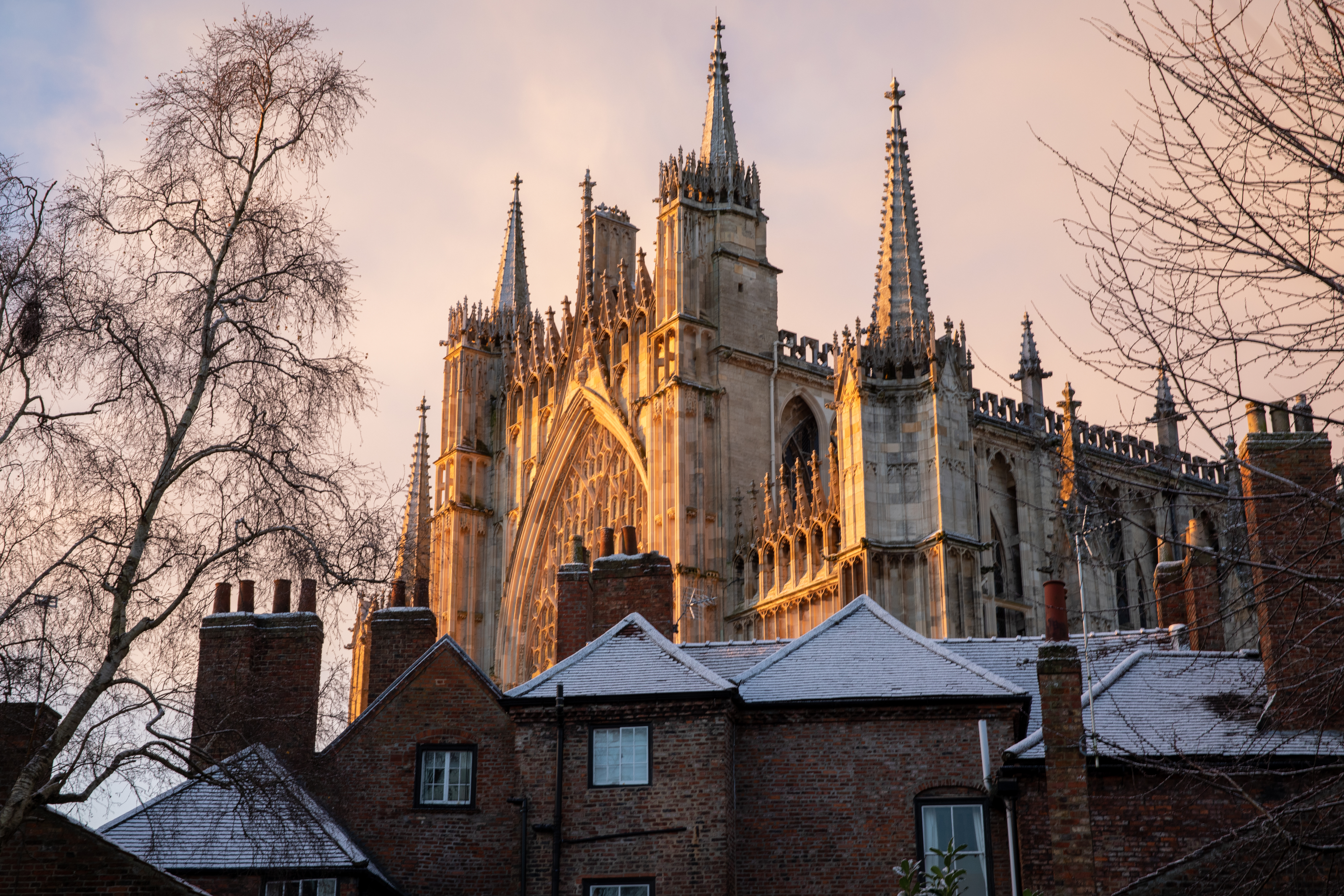
In the 18th century the fortunes of the city of York, along with its Minster and clergy, were enjoying a rise in both wealth and status. This led to the creation of prestigious new buildings, sweeping away some of the more mundane Medieval dwellings. This was a time when the buildings surrounding York Minster began to change with dramatic effect. Demolishing – and in some degree, incorporating – 15th century cottages to the north-east of the cathedral, Dr William Ward built himself a fine Georgian townhouse (pictured). He was the chief legal officer (‘commissar’) for the Dean and Chapter of York, a role which brought many pecuniary benefits. The new house was a fitting expression of his wealth and status.

The role of ‘commissary’ brought both influence and financial reward. There is every indication that Ward used his position to become wealthy and further the ambitions of his family. His daughter, Sarah, married a baronet and become Lady Fagg. While little is known about Ward, like many gentleman of his era, we know that he had a significant personal library. This is indicated by an Item in the late lawyer’s Last Will and Testament in which he bequeathed to his wife and daughter, ‘Forty English Books each such as they shall chuse out of my Library excepting the large Bible’. Perhaps foreseeing that this could lead to some dispute over which books each should have, Ward adds: ‘my wife to have the first choice’. In all likelihood the large bible would have passed to his son.

The wealth of legal officer such as Ward was built on a considerable degree of misery. Misery, that is, for the poor souls who came before the ecclesiastical courts. The leading Sterne scholar Arthur H. Cash described these courts as:

‘weak remnants of what had once been a terrifying Protestant inquisition’

Cash, A. H. (1971). Sterne as a Judge in the Spiritual Courts: The Groundwork of A Political Romance. In English Writers of the Eighteenth Century (pp. 17-36). Columbia University Press.

The main purpose of these courts was to deter pregnancy outside wedlock. It often led to both fines and public humiliation. It is hard for us to understand the level of pastoral disregard and cruelty which this system could produce. For example, Cash cites an incident where Robert Milburn was tried in 1753 in the village of Alne, just north of York, for antenuptial fornication ‘with Jane his wife, now dead’. It is little wonder that these courts were abolished or that clergy came to have a very mixed reputation through their enthusiasm to become judges. It provides some insight about how Lawrence Sterne came to be so familiar with a range of conduct and human emotion. Perhaps the perceived bawdiness of Tristram Shandy owes something to the process of examining cases that were brought to the courts by church wardens. In addition to his responsibilities as a parson, as the son of an army officer; a sometime farmer; and a judge in the courts, Sterne must have heard and seen a wide spectrum of life. Additionally, as a frequent visitor to nearby York, he was also connected to middle class mores and cosmopolitan life.

Perhaps William Ward’s main claim to fame is that his death precipitated a decade long dispute between the Dean of York and the Archbishop’s chief legal officer. It was a disagreement concerning the many legal roles which Ward had occupied and how these were to be inherited on his death. The Archbishop’s legal officer believed that the Dean had promised them to him, a promise on which he claimed the Dean reneged. Finally, after heated public exchanges between these two worthies, the situation provoked Laurence Sterne to publish his first significant literary work – a satire on the dispute entitled ‘A Political Romance’ or, as it is often known, ‘The History of a Good Warm Watch-Coat’. It was so accurate and effective that the Archbishop of York instructed all copies to be returned and the entire stock to be burned. Thankfully, at least six people either didn’t get the memo, or they decided not comply with the instruction.

Which brings me to common sense. Looking back it is easy to name the intolerable cruelties of another ago, or of a different place and people. In the style of Jonathan Swift, Sterne brings to the dispute a creative reframing that allows people to see their conduct in a different light. What may have appeared to be an obvious and inevitable response, suddenly becomes more complex and questionable. Creative writing invited the reader to wonder about the behaviour of those involved and the apparent inevitability of the dispute that unfolded. In many ways Sterne was an actor within events that seemed natural and necessary – and in the end he inherited some of Dr Ward’s legal responsibilities. However, he was also able to see beyond the near horizon of common sense and question the relationships and conduct which were doing little to promote the reputation of the church. Common sense in one age can appear as outrageously cruel in another – and I hope that in her new role of ‘minister for common sense’ Esther McVey will recognise the provisionality of her brief. The common sense of one group in society may be seen very differently by another group. Unless handled with the greatest of care, common sense can conserve and perpetuate some of our worst practices and behaviours.

  • The illustration of Dr Ward’s house, Chapter Yard, York, is by Allan T Adams BA FRSA FSAI

Satire in Disguise

The statement that ‘the parish system began to break down’ sounds like a commentary on the C of E in the 21st century. In fact they are words written about the church in the 18th century, taken from an article concerning religion and satire, by Misty G Anderson. It is a salutary reminder that the Church of England has experienced several phases of breakdown since the reformations of the 16th century. Anderson identifies satire as one of the most effective ways in which a highly privileged institution could be critiqued in public. This is because satire never makes things explicit, but relies on the audience’s existing awareness of the gaps between official rhetoric and the reality of practice.

‘Praise undeserved, is satire in disguise’

William Lisle Bowles, Alexander Pope (1820). “A reply to an “Unsentimental sort of critic,”: the reviewer of “Spence’s Anecdotes” in the Quarterly review for October [i.e. July] 1820; otherwise to a certain critic and grocer, the family of the Bowleses!!”, p.15

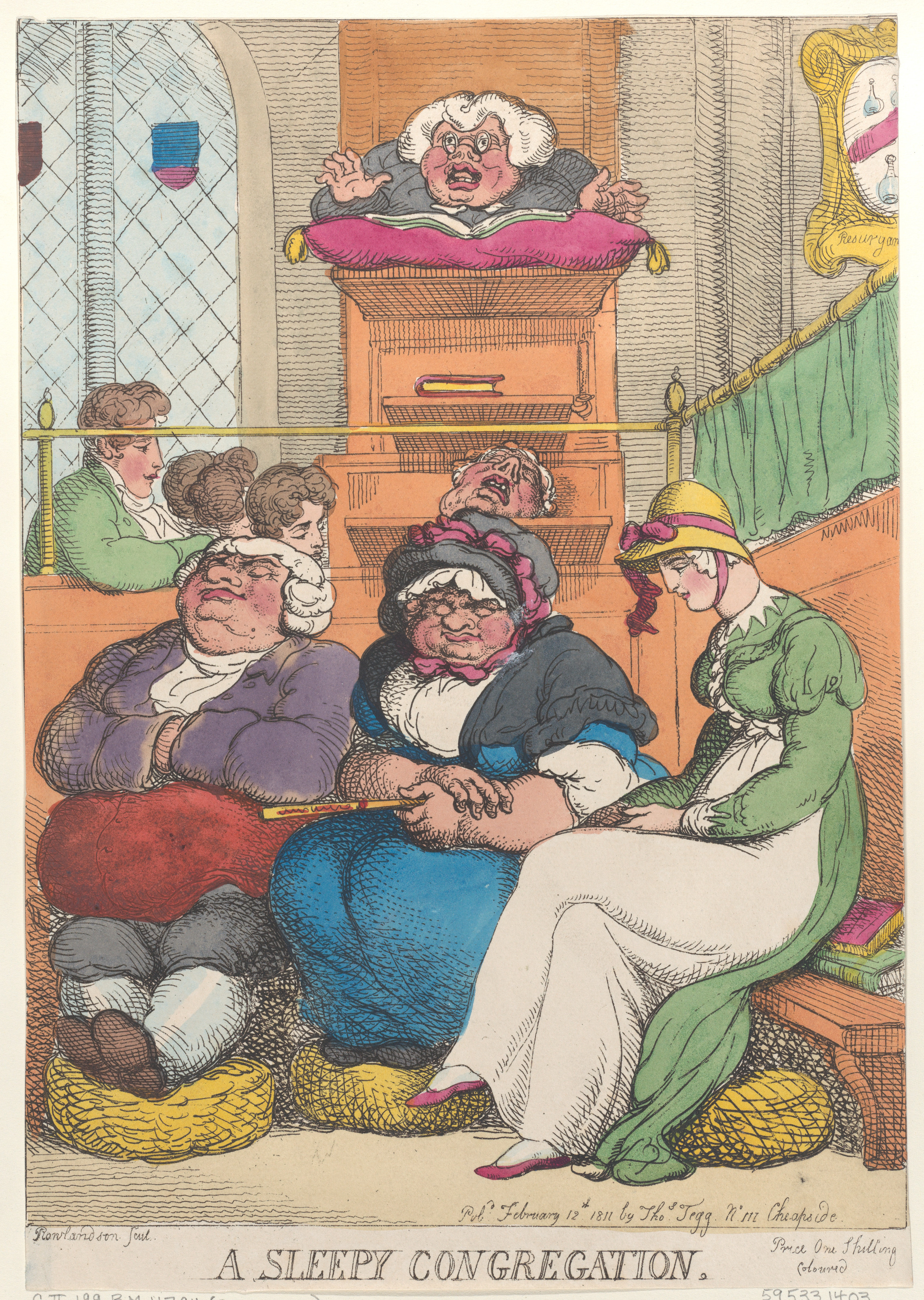
Satire always treads a fine line in achieving its effect. William Hogarth was warned that one of his prints risked being seen as an attack on religion itself – rather than the excesses of people’s interpretation. The definition of satire is far from easy or clear. On the whole it describes an artistic form which is intended to portray human behaviour in a humorous light, in order to make a political point or amusingly imply that a purported behaviour or action is susceptible to other (less attractive or virtuous) interpretations. Hence satire has often engaged with religions and religious practices to query the motives involved or the disparity between piety and more dubious practices. Many years ago I scripted a weekly cartoon that ran for a couple of terms at the theological college I attended. It was one way in which the weight and seriousness of ordination training was presented in a playful and creative light. It was quite popular.

Andix the Ordinand’ appeared as a six frame weekly cartoon for a couple of terms at Westcott House – recounting the adventures of the Scandinavian student and often satirised College customs and practices. Drawing by the John Brown.

Sadly, the C of E now appears to be so peripheral to much of society that it is seldom the subject for satire. As Gore Vidal observed, satire only works if you know the thing being satirised. Possibly due to the influence of the excellent Ian Hislop, Private Eye continues to identify some of the absurdities and failings of contemporary religion – but I imagine that the amount of print given to this has shrunk in recent decades. Indeed, more recently it has felt that the institution is satirising itself. In the last few weeks a message appeared from the Church of England’s main ‘X’ account heralding the opportunity to order a ‘new Christmas Advent calendar’. For a church where so many leaders try to maintain the distinctiveness of the Advent season this was a startling home-goal. The serious themes of hope, peace, love and joy surely deserve their own space for reflection and action this coming Advent?

A Sleepy Congregation by Thomas Rowlandson is licensed under CC-CC0 1.0

There is, of course, the risk that satire is misunderstood or taken to be factual. In the past this has led the Church of England to publish a clarification. However, at its best, satire teeters on the edge of credulity precisely in order to accomplish its task. We see something – or read something – and need to take a second look. Could that be true? In this way satire has prophetic qualities, pushing an argument or behaviour one stage further and, suggesting that what may now be humorous, could soon become a reality. Perhaps a Church of England that surrenders its presentation entirely to generic marketing would start conflating festivals and shape the church’s life to follow without critical or theological enquiry whatever sells?

A healthy church should encourage the satirists. It doesn’t help if people are too holy to be human or so caught up in self-importance that they fail to understand how marginal (or non-existent) the Church is to so many people in England. Satire is the humour which is perhaps more than any other, ‘of the moment’. It only works, if it works at all, because it touches on the conceits and follies of a particular time. For example, who can listen to the UK-Covid-19 Inquiry enquiry and not feel that people living and working in Number 10 must have known the vast gulf that existed between their public statements and what went on behind closed doors? Clearly some did. When executed well, satire may help steer the church and the world into more authentic territory – and make us smile and wince in equal measure.

‘You can’t make up anything any more. The world itself is a satire. All you are doing is recording it’


Art Buchvald

A Bye Corner of the Kingdom

These are the words Laurence Sterne used to describe the vicarage at Coxwold. A ‘retired thatched house’ in a place remote from the concerns of even a provincial city, such as York. Perhaps Sterne did not see this as a promising location from which to change the course of world literature. It is difficult to imagine what life in a remote Yorkshire village was like in the 1700s. Far more people worked on the land, while today the holiday cottage dwellings mean occupancy fluctuates each week, and there will be seasons when only a few people inhabit the place. The population was 348 in the early 19th century – and 250 in 2021.

Despite a limited literary output, Sterne’s work is recognised for its transformative impact on the course of Anglo-Irish literature. It was an influence for James Joyce, Salman Rushdie and many others.

Sterne was adept in deflating many of the pompous debates of his time. In chapter 20 of the first book of The Life and Opinions of Tristram Shandy, where birth is such a central theme, there is a digression about the baptism of babies before they are born. The view in Catholic circles to this point had been that at least some part of the baby must be born in order for a baptism to take place. Inevitably, there were circumstances when the baby had died in the womb and where it was believed that baptism was impossible. (There is a history in northern Europe where the Church operated ‘Resurrection Chapels’ to enable the baptism of a baby which was stillborn – Swift, p.119). However, the debate that Sterne cites in this section of the book looks to marry advancing technology with the possibility that a baptism could take place before birth:

Le Chirurgien, qui consulte, prétend, par le moyen d’une petite canulle, de pouvoir baptiser immediatement l’enfant, sans faire aucun tort à la mere.

The surgeon who raises the question asserts that by means of a little injection-pipe he can baptize the child directly, without doing any harm to the mother.

Sterne, L. (1759). The Life and Opinions of Tristram Shandy, Gentleman (reissued).

In this debate Sterne is not oblivious to the dubious nature of a suggestion, in which male medics and male theologians decide that a medical procedure – with no medical benefit – will not result in any harm to the mother. In his imaginative response to this scholarly discussion Sterne takes the argument a stage further, and suggests that one way to avoid any doubt in the matter would be to baptise all of a man’s sperm. (This reflects thinking at the time that there was a fixed stock of sperm containing ‘homunculi’ – minuscule people ready to grow once in the womb). Chapter 20 concludes with the thought that a little injection-pipe could be inserted into the man (‘sans faire auxin tort au père’), between marriage and consummation, to ensure a ‘shorter and safer’ way to baptism. The reader is left to ponder whether male theologians and medics would find this a better solution.

Simultaneously this passage hints at how medical technology might affect sacramental practice, while lampooning male discussions which determine what will do no harm to women. In pushing the ideas further, Sterne discomforts his male readers – and certainly amuses his female audience – in suggesting that sticking a cannula into a penis would be more effective ‘without doing any harm to the father’. It would also provide an interesting ceremony on the day of the wedding.

St Michael and All Angels, Coxwold – where Laurence Sterne served as a priest.

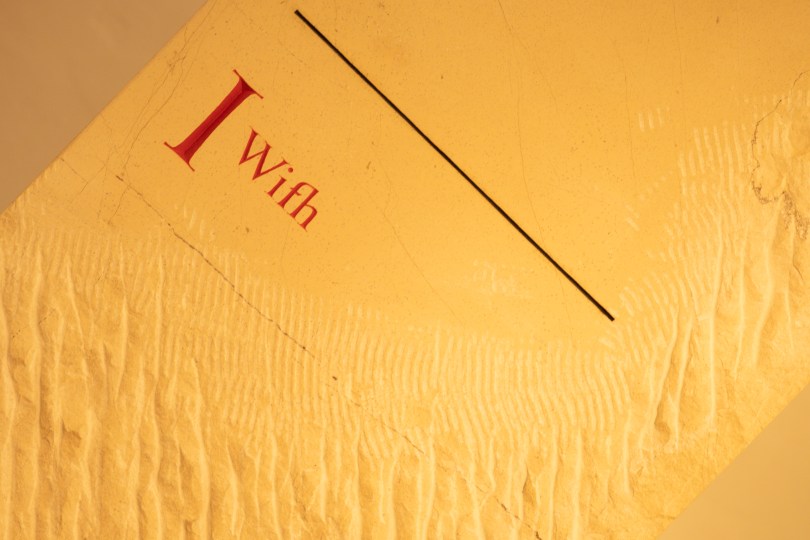
If Coxwold is a ‘bye corner of the Kingdom’ it didn’t stop Sterne writing some of the most adventurous and sophisticated prose of English literature. Thankfully, The Laurence Sterne Trust continues to stimulate interest in the author’s legacy and enable artists to engage with his work. In its most recent exhibition a range of creative people have been challenged to interpret the opening words of Shandy – ‘I wish’ – to reflect on their response to the text. This vibrant exhibition is a fitting contribution to the 50th anniversary celebrations of Shandy Hall’s existence as a public museum.

Sentry Duty

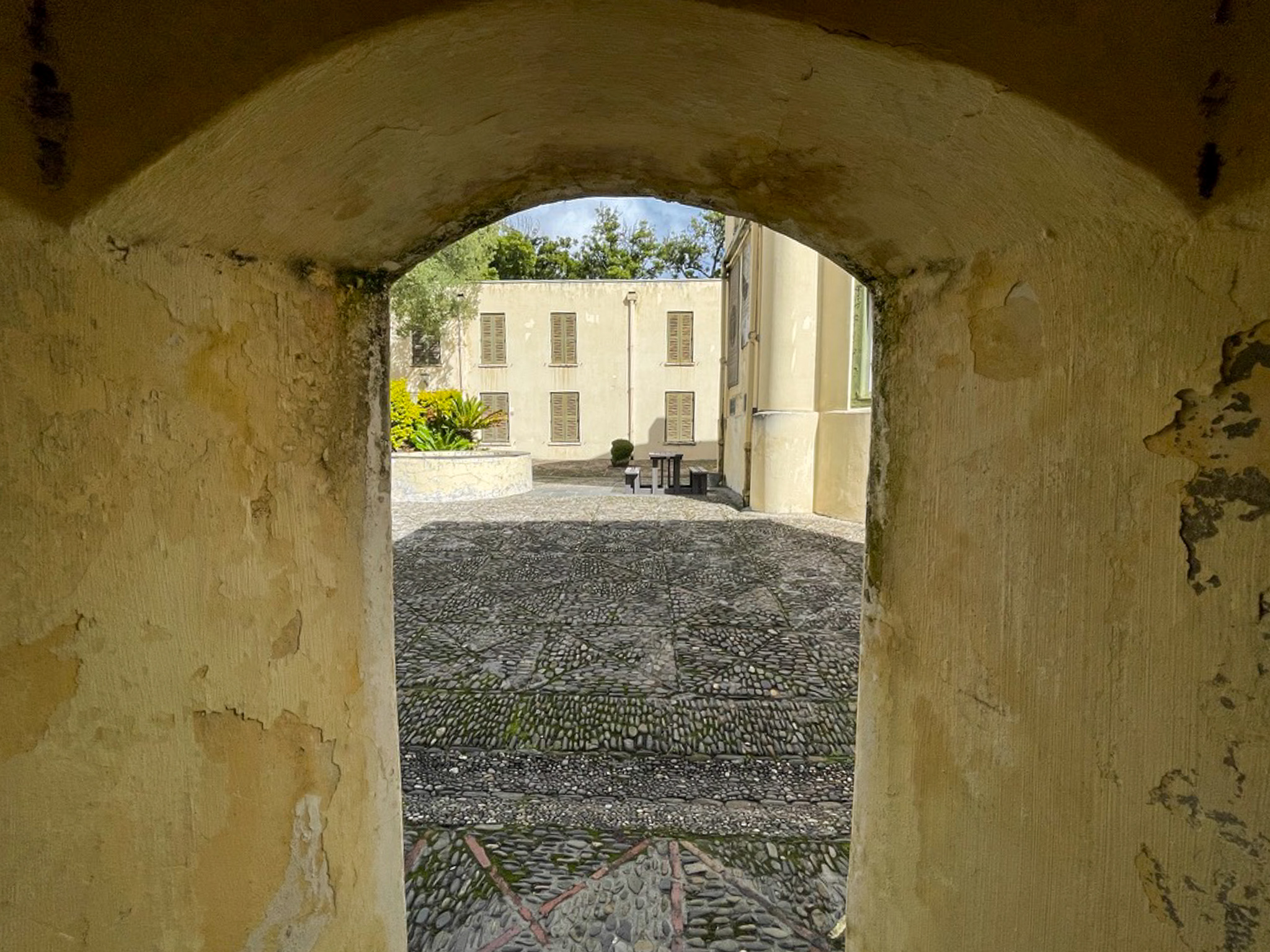
Observation alters behaviour. This was a truth made with notable clarity and force by the French philosopher Michel Foucault, in relation to prisons – but the effect is far wider. In the courtyard of the Slave Lodge in Cape Town there is a sentry box, re-sited from Fort Knokke (built in 1744). It was part of the infrastructure of military occupation that safeguarded colonial interests, not least those of the East India Company.

I can’t recall whether I’ve ever stood in a sentry box before. Spending some time walking around the box, and then standing inside, brought home to me the altered state that occupying the box brings. A soldier has the benefit of protection bought at the price of limited sight. Narrow slits afford some vantage, but these are inevitably narrow in perspective and focused on particular points of danger. Walking into the box demonstrated how much sound is altered in the small structure. Effectively the sentry’s perspective is limited and defined, while sound is muffled and becomes more distant. Simultaneously the guard is present in, and distanced from, the wider community.

The relationships which colonialism brings are invariably infantilising. The occupying powers ‘know best’ and inflict their religious, economic, military and political stamp on unwilling lands. Spending time with the people from The Warehouse in Cape Town reveals the lasting scars and consequences of a regime rooted in colonial attitudes. In a clear and autobiographical style, people shared with us their identities and histories, and explained how growing up in different decades in South Africa has affected their family relationships; education; type of work; place to live; and friendships.

It was encouraging to hear all this set within a framework of a theology that was natural to reference and practical in its insights. Equally, along with many other things, I found it disturbing to learn that at one point in its history the Dutch Reformed Church had decided that the common cup would not be shared between ethnic groups.

the discomfort of white members in sharing a cup during the offering of the sacraments led to the establishment of the coloured “daughter church” and later that of the black population, which came to be known as the Dutch Reformed Church in Africa.

Konzane, M. P. (2017). Mission calling in a congregation of the Dutch Reform Church of Africa in a transforming society: a case study in South Africa (Doctoral dissertation, North-West University (South-Africa)).

At the start and end of this first day in Cape Town we read Matthew 21. As our pilgrimage progressed I found resonance and connection with a detail towards the end of the passage, when the religious leaders say to Jesus: ‘Do you hear what these children are saying?’ The translation we are using says the leaders were ‘indignant’ when they asked this question. It is not uncommon for discriminatory language to belittle others by making a comparison to children, implying that some adults are less than they ought to be. Daughter churches? As we spoke about the decision to segregate the administration of Holy Communion it also led me to reflect on the common practice in many churches to exclude children from this sacrament. It may seen natural to some, but I wonder whether it is wise.

Inevitably, my first 48 hours in South Africa has raised questions about the mechanics of oppression; all the people caught up in its operation; and those bearing the brunt of its legacy. Where we stand shapes what we can see and how we can hear – and sometimes we all need to take the risk of stepping out of our box to engage with different perspectives. That, as much as anything else, should be our duty and our joy.

Jesus Stood

Many of us go with the flow and make sure we don’t stand out from the crowd. At least on most topics. There is a human urge to fit in, accompanied by a fear of separation from the mainstream and finding ourselves isolated. Of course there are also people who love to disagree with the herd: the contrarians. Hopefully, somewhere between these polarities, there are people who disagree when they see its necessity; not for the sake of disagreement alone.

One of the most memorable sermons I recall was preached at the University Church in Oxford, sometime around 1984. The preacher was Trevor Huddleston, and his text was about as short as you can get: ‘Jesus stood’. It comes from Mark 10:46 when Jesus and his disciples are on their way out of Jericho and blind Bartimaeus keeps calling out to him. Bartimaeus was not falling in with the crowd. People were telling him to shut up and behave, but he wouldn’t stop. Despite the swell of the crowd and the momentum to leave the city, Jesus stood. It conjures the imagine of the tide breaking upon a rock.

Huddleston spoke about the anti-apartheid movement and the challenge of speaking out in a society where the weight of social expectation was to keep quiet and behave. To collude with systems of oppression designed to privilege the few. Like Jesus leaving Jericho, we need to courage to hear the voices from the edge of the crowd: to stop, to listen and to act.

There is a lot of appeal in going with the crowd and not making a stand. In one of my favourite quotes from Murder in the Cathedral a tempter reminds Thomas of the venal rewards of compliance, saying: ‘the easy man lives to eat the best dinners’. Join the club; keep quiet; do what’s expected and never, never, rock the boat. Such behaviour can bring handsome prizes.

In the Passion Gospel we find Jesus ‘stood before Pilate’ (Matthew 27:11). This time he isn’t there because of a voice heard on the margins. His posture is an enforced sign of respect. By contrast, as we go on to hear a few verses later, power sits to pass judgement. All the robes and symbols of authority, and troops at command, are with Pilate. Jesus is alone. Yet, if there is no choice of posture, there is a choice to be silent. In the face of the choreography of power Jesus fails to conform to the etiquette of the room. He does not plead for his life. He does not give a rambling defence or seek to implicate others. Silence. In the few verses in which this is described it is possible to feel the authority of Pilate ebbing away.

In 2000 I visited Alison Wilding’s remarkable ‘Passion Project’ exhibited at the Dean Clough Gallery in Halifax. One of the larger pieces in the collection comes under the heading ‘Disposition’. It consists of a huge concrete disc towering over a black mat, which appears to grow wavy stalks (it can be seen here). Abstract art demands work from the viewer, even when set in an exhibition with an overall theme. What is going on here? There is a world of difference between the objects – in almost every sense. They appear only to be connected by a tension that lies between them. In a temporal sense Pilate should be the stone – ready to crush whatever pathetic resistance grows out of the Judean darkness. Spiritually, the disc hints at perfection and eternity. It is balanced and complete, requiring nothing from the sprawling stems that stretch upwards. This is a standoff and the stone will not be moved.

“At the heart of this episode of the Passion is both conflict and stand-off. There is a perplexing estrangement between both objects; the scale of one bears no relationship to the other, but the space separating them is tense and compelling. In the dynamic of the sculpture one part is continually brought into focus and deflected by the other”

Alison Wilding, ‘Contract’, exhibition catalogue, October 2000

Those who make this kind of stand seldom come off unscathed. Jesus knows this and he holds no particular hope of release or escape. The machinery of power will take its course and suffering lies ahead. It is beyond the imagination of this anxious and self-interested power that somehow, by battering and breaking this solitary young rabbi, an alternative power will be released into the world. A power that will enable anyone, no matter how poor or peripheral, to receive a dignity that cannot be removed. To become a child of the living God.

Hidden in Plain Sight

Churches pepper the landscape of England, to such an extent that there are few places without some kind of ecclesiastical edifice. Now well into my fourth decade of ordained ministry, I would be able to retire comfortably if I had received a pound for every time someone has remarked that the church is the people, not the building. I do not doubt the statement, but Christians are physical beings who need physical places in which to meet and pray. Even transient settings are altered for a few moments when a sacrament is shared. Countless times at a hospital bedside, with curtains drawn at the patient’s request, the ancient prayers and ritual have evoked a fleeting stillness and sense of the sacred. On very rare occasions, having heard the liturgy being spoken, a nurse has ducked into the space to received Communion as well – something I doubt there would be time for in today’s overstretched NHS.

There was a notable minority thread of comments on Twitter over Christmas from clergy who were not tweeting about full churches at midnight; crib services that were overflowing with children; or carols sung robustly by the faithful gathering of older parishioners. Away from the cathedrals and civic churches many services took place with thin congregations and in the absence of children. These were no doubt meaningful and moving, but they are also a reminder that in many communities the ‘fringe’ of people who attended on high days and holidays has mostly evaporated.

It was encouraging recently to be sharing in worship at rural churches in East Yorkshire where, statistically, a significant minority of the population attends church. I can well imagine that this is the kind of place where occasional worshippers would also be present at Christmas and Easter. It was encouraging, in conversation, to hear about plans to improve the welcome for new residents in the parishes, and fresh thoughts about how to connect and involve people who might be feeling isolated. All this within an Anglican-Methodist ecumenical partnership which is currently advertising for a Minister/Vicar.

The church building is at the heart of these communities. While maintaining them is problematic and costly they offer a focal point that pose questions of faith and purpose every hour of every day. It is quite true that on their own this seldom achieves very much – or some of the churches I’ve mentioned would be full to the rafters. The buildings require an active Christian community just as much as that community needs a place to meet, and a place to manifest the physical expression of faith over time. I’m not sure we understand fully, as a society, how precious and valuable our stock of churches is when it comes to art; social history; traditional crafts; and the evolution of theology and belief. Perhaps there is more that we need to do to enable these buildings to speak and, in their speaking, to tell afresh the faith that has inspired their creation.

“Comprehension of architectural monuments, signs, symbols, cultural codes allows students to penetrate into the spiritual life of another culture, especially the national character through comparison with their culture. Thus, when considering the semiotics of a Russian church and an English medieval cathedral, students’ attention is focused on symbolism, which helps decode non-verbal languages and meanings, helps to understand the mentality of the English people”.

Sabirova, D.R., Solovyova, E.G., Pomortseva, N.P. and Antonova, S.P., 2019. Comprehension of the english national character in building professional linguistic culture. Journal of Educational and Social Research9(3), pp.101-101.

Perhaps the lack of progress in this direction stems in part from anxieties concerning cultural heritage. For example, that prior to the 1950s Britain was a culturally much less diverse society than it is today. Using building to interpret the past could emphasise a narrow concept of being English and exclude the presence of the faiths now widely present in society. Furthermore, as the Church of England itself recognised with a debatable financial commitment, the construction of many churches was funded to varying degrees by the proceeds of slavery; exploitation; and the blessing of abusive power.

At the moment it seems that we do a modest amount to share the architectural marvels and complex histories that litter our countryside, towns and cities. In some cases, if just one of these buildings was somewhere in the USA, it would draw visitors from across the continent. Here many are closed most of the time; lack explanatory boards and information; and do little to make their presence known. No doubt funding is part of the problem – but that is also a catch 22. Without being open and communicative, fewer and fewer churches will have the vibrancy I encountered in rural East Yorkshire.

Today is Mothering Sunday and some people will be remembering with thanks a particular church in which their faith was once nurtured and inspired. A number of those church buildings will no longer be in use as a place of worship, while others will have disappeared entirely. However, the spiritual imprint of a church that has served us well is carried far beyond the walls of any given place. We carry its light into our daily lives, and hope that – meeting the lit shards of others’ faith and love – a pattern of greater purpose and beauty takes shape. At times this can feel a forlorn hope but, perhaps, it is the only meaningful hope we have.

Works of Darkness

The nose of a Springer Spaniel is a remarkable thing. Not simply the nose, but the overall capacity to find. Our morning walks now take place in darkness, and as I launch a tennis ball into a landscape of lesser and greater obscurity, I never doubt the ball’s return. It may take time – but another remarkable thing about spaniels is their tenacity. I watch as various search patterns are executed. There is always a careful eye kept on me, and if I start to head in a particular direction, the ground is swept from side-to-side in advance of my approach. Occasionally – very occasionally and after a long time – we concede defeat. However, almost always, the panting hound returns to my feet tail rotating in triumph, and discards the ball so that the whole routine can begin again.

In these shortening days we head towards the old feast day of Thomas, the 21st of December. As the Revd Richard Coles commented at the recent York Minster Carol Concerts, these are days when ghost-stories come into their own. Reading a section of Simon Armitage’s rendering of Sir Gawain and the Green Knight (‘It was Christmas at Camelot…’), as well as A Christmas Carol, there is no doubting the antiquity of humanity’s imaginings during the days of darkness. In the Northern hemisphere this sense of gathering gloom, met with festive lights, seems an altogether fitting climate for Advent and the approach of Christmas.

The Collect throughout Advent petitions for grace to ‘cast away the works of darkness’. Looking at the world today it can feel that this call continues to go unheeded. Both cold and darkness will be the experience for many people, some of whom would never have imagined a time when they would need to choose between eating and heating. In the trenches and dugouts of Eastern Ukraine, soldiers will face winter warfare away from family and friends. In a world where wealth abounds for the few, most will struggle to find the basic securities and necessities of life. There is little need for ghost stories when the grizzly realities of life are so close at hand.

Once lost, it is never easy to retrieve from darkness the things we took for granted. Nevertheless, both Advent and Christmas feed the imagination of a better time; a more just world; and salvation from our own, dreadful, folly. Churches – at the only time of year when many people attend – are charged with holding out the vision and promise of something more worthy of our potential. To speak especially to ‘the people who walk in darkness’ and to stand with those who know their need of God. During the next few weeks we shall invite people in to taste something of the ancient hope the church is called to cherish and proclaim. More often than not, it won’t be the powerful who ask for grace so that we might live in light. As the poet Stewart Henderson puts it:

Don’t miss Christmas –
the splendour of it all
our brittle, gift-wrapped anthem
sleeps in a cattle stall
as the poor and lost and starving
weakly start to sing
it seems only desperate subjects
recognise their King.

Extract from: Stewart Henderson, Don’t Miss Christmas’

Waiting & Hoping

While standing on the platform, expecting a train to Machu Picchu, I noticed the sign to the waiting room. In Spanish, a waiting room uses the word associated with hope (‘la esperanza’): it is the ‘sala de espera’. At times it can feel in the UK that ‘hope’ would be a more fitting description for a waiting room on our less reliable routes. However, it led me to ponder whether there is any real distinction between waiting and hoping. Looking up the Spanish led me to an interesting thread, which includes discussion about the Bible translations of the two terms. Although there are alternative words in Spanish, in many cases – where either waiting and hoping would be used in English translations – it is the single verb ‘esperar’ that is favoured.

Perhaps the principal difference lies in the passivity of waiting. As with the example of a train station, waiting is what precedes movement and change. On the other hand, hope can be part of the journey. The people who travel from across the world to Europe, or across the border in the USA, are hoping to find safety and a new way of life. Writing about hope and waiting in the lives of migrants, Bendixsen and Eriksen ask questions about the different ways in which this can be experienced by people in an uncertain state of seeking refuge:

“What is it that we ‘do’ when we wait for something, given that waiting is normally defined as the opposite of ‘doing’ something? In what way can waiting be converted into political resistance? Waiting does in fact entail an engagement based on anticipation – an in-order-to motivation – of an improved life. How do conceptualizations of the future influence the ways in which people wait? And what can we say about people’s capacity to act in future-oriented ways even in a condition of temporal limbo?”

Bendixsen, S., & Eriksen, T. H. (2018). Time and the other: Waiting and hope among irregular migrants. Ethnographies of waiting: Doubt, hope and uncertainty, 87-112.

In his seminal book The Stature of Waiting WH Vanstone sees in the act of waiting the unfolding of Christ’s purpose. From the moment when Jesus is handed over to the Roman soldiers his willingness to be subject to the actions of others becomes the driving force of his mission. Here, waiting is not an absence of purpose but the only way in which salvation can come.

There are many things that can incline someone to journey hopefully. Often there is a life-long dialogue between the difficult experiences that are all too real, and the hope that is far more than simply wishful thinking. Such hope is strongly connected to the now, and sees the world as it could be and should be. Because of this connection hope itself is not static, but shifts as both our understanding and desire grow. Most often it is killed off by certainties we have decided are fixed and beyond change. For anyone finding faith difficult, Ronnie Scharfman expresses both the struggle to hope, and the hope-against-hope that faith might be found in the struggle:

I have always hoped
that struggling towards You
is You.
But I am never
sure.
And that is, perhaps,
You, too.

Ronnie Scharfman, ‘Prayer’ in The Poet’s Quest for God, 21st Century Poems of Doubt, Faith and Wonder, ed. Brennan, O., Swift, T., and Myddleton-Evans, C. Eyewear Publishing Ltd., London. 2016

The hope of faith during Advent requires courage. It is a time when the liturgy of the Church makes no bones about the darkness and suffering of the world, or the fact that the world as we know if will come to an end. Given the multiple crises assaulting the planet at the moment this seems less difficult to imagine. Holding any hope is an act of courage – a defiance of doom and a way to connect with others who share the idea that there is a better way. Perhaps this brings waiting and hoping back together, because our hopes are seldom realised quickly, and dissatisfied waiting can be a vocal irritant to the people who block the path to change.