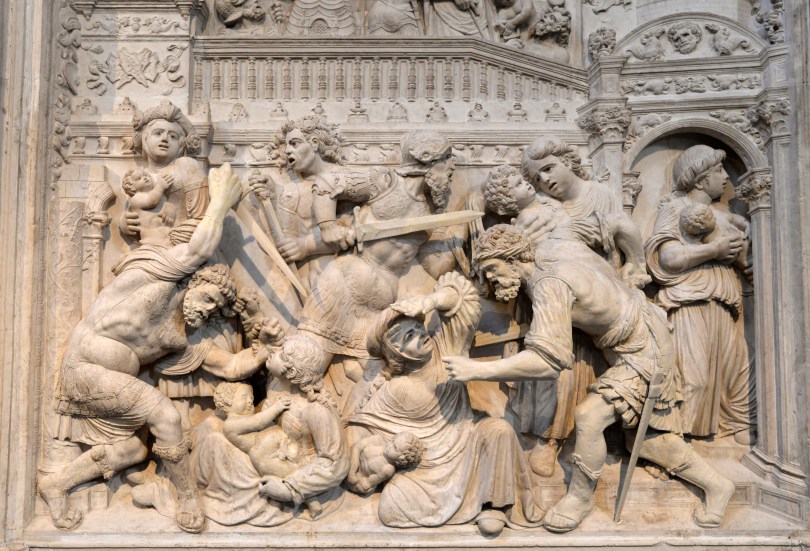
The 28th of December is the day on which the Church marks Holy Innocents. It is a day that focuses on the harrowing account in the Nativity story told by Matthew, of the orders King Herod gives to slay all male children under the age of two. Fearing the emergence of a rival, the King makes his fateful decision based on the Magi’s interpretation of the star they observed.
Children are all too often, tragically, killed in conflict. However, the targeted destruction of the young is rare. In wartime, as we see around us in the world today, children die, are injured and become psychologically damaged through conflict. In WWII, as a consequence of indiscriminate bombing, almost 8,000 children died in the UK. The worst affected city was undoubtedly Coventry. On 14 November 1940 huge amounts of ordinance were dropped on the city leading to a significant loss of life; the destruction of countless buildings (including the cathedral); and widespread civilian trauma amongst those who survived. A few weeks’ after the attack the Dean of Coventry gathered as many choristers as he could in the ruins of the Cathedral and broadcast a rendition of the Coventry Carol to what was, at the time, the British Empire. This carol, which comes from the medieval Coventry mystery plays, recalls the massacre of the innocents. It must be one of the bleakest, most sombre and deeply moving items in the canon of Christmas music. The wartime clip from Coventry is featured in an emotional and thought-provoking episode of BBC Radio 4’s series Soul Music.
Laurence Sterne, the 18th century parson-novelist, says remarkably little about Christmas in any of his writing or preaching. Yet there is a sermon on Holy Innocents. Sterne knew from personal experience what it was to lose a child. He describes the massacre of the innocents as being:
So circumscribed with horror, that no time, how friendly soever to the mournful, – should ever be able to wear out the impressions.
When I worked in the NHS I recall very occasional instances when a mother contacted the hospital to ask about the mortal remains of their child, who had died many years ago. This arose out of the fresh attention given to the issues of organ and tissue retention, and burial practices, following the Bristol Royal Infirmary and the Royal Liverpool Children’s inquiries. In some cases mothers had given birth to a living child, who had died within a short time, and the mothers were told to go home and in essence – forget about it. They were provided with no information about what then happened to their babies or where they were buried. Records were kept, but the existence of a baby’s body in amongst an adult “shared grave” was not recorded on the headstone: unlike the adults. Once or twice I arranged to meet a mother at the entrance to the local cemetery and took her to the place where the records stated her baby was buried. I hope that, in some small measure, this helped a grief which had lain largely unexpressed for decades.
Holy Innocents begs many questions of the Church, and of the world. How could God’s miracle of the incarnation result in so much terror and destruction? Why is it that we continue to tolerate warfare that damages young lives? How do we help survivors who have witnessed unforgettable horrors? There are no easy answers to these questions. However, the presence of Holy Innocents in the Church’s calendar stubbornly insists that even while the tinsel is still hanging, the most dreadful realities of the world cannot be put aside or forgotten. They are always there and, hopefully, stir people of good faith of every religion and belief to seek peace with added urgency. Because the innocents are still being massacred today.
That woe is me, poor child, for thee
And ever mourn and may
For thy parting neither say nor sing,
“Bye bye, lully, lullay.”From the Coventry Carol, 16th century








 Swift Reflections