
My grandfather would not have approved. A former church warden of a large market-town parish church, he voted Tory at every opportunity, and would have seen the Church’s critical examination of urban life – Faith in the City – as the latest example of its waywardness. Every day he awaited the arrival of his copy of The Daily Mail, which he embraced as a comfort blanket for all his favourite prejudices. He waved the paper at me energetically when it earnestly condemned various speakers in the televised General Synod debate on nuclear deterrence in 1983. (He had less to say about the owner of The Mail’s enthusiastic admiration of Hitler back in the 1930s). When I argued with him about the valuable work of the post-war Labour Government he was quick to reply that those politicians were “different”. I very much doubt he said that at the time.
As I commented earlier this year, 2025 marks the 40th anniversary of the publication of Faith in the City, and several small celebrations have been held. Most of us attending the one in Sheffield were north of 60, with Alan Billings, one of the original commissioners and a speaker at the conference, being in his 80s. I wasn’t altogether clear why the event was taking place on the same weekend as General Synod, but perhaps it reflects the Church of England’s limited interest in questions of urban theology and action. More than one speaker noted that in the twenty years after the report there was considerable activity by the CofE in the cities. However, the last 20 years have told a different story.
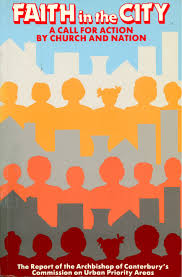
I was in the middle year of my undergraduate degree, living in Hull, when Faith in the City hit the presses. Alan told us that the Cabinet had leaked the report to the right wing press, enabling its publication to be met with claims of Marxism and a Church failing to attend to its primary task. While many in the Church supported the report, I recall a parishioner in the rural parish where my parents lived asking: “what about the rural areas – where’s the support for us?” I’ve no doubt that those comments were widespread in rural communities.
It felt in the 1980s that the Church of England could still occupy that strange land of “critical solidarity” with the institutions of which it was also a part. Not easy, but it was also the decade in which Archbishop Runcie dared to pray for the dead on both sides at the Falklands Memorial Service in 1982, saying that: “a shared anguish can be a bridge of reconciliation; our neighbours are indeed like us”. Mrs Thatcher was not pleased. In 1984, the Church led by Runcie consecrated David Jenkins as the bishop for Durham. Once again, the Church supplied the right-wing press with oodles of content to bolster its appetite for righteous indignation. My grandfather had gone to glory by that stage but he would have enjoyed the temporal exasperations of the tabloid press.
Looking back is not always a good idea. The seeds of change were already planted in the Church of England of the 1980s. Fewer vocations; difficulties in recruiting to inner-city parishes; a world changing as a rate of knots. However, I’m less certain that those around at the time could have envisaged how radical the changes would become, and the number of parishes that would be forced to merge. The unwinding of Anglicanism’s commitment to provide every church with a parson; a parsonage and burden of finance that could be borne, has happening at a dizzying pace. Volunteers have vanished and the struggle to maintain a meaningful presence has intensified.
It isn’t all doom and gloom. The church I assist at once a month has rallied without any jazzy new initiatives from the centre. Speaking with the organist (a working farmer) he told me that they had got down to an attendance of 10 on a typical Sunday morning. Now it’s at 30. Why? He put it down to the loving pastoral care of a Reader, who made some simple improvements to worship but – perhaps most importantly – helped keep the service at the same time every Sunday. Sometimes it is Morning Prayer and at others, Holy Communion – but the people come nonetheless. In the cities there are also signs of renewed interest in Christianity, with a more diverse population bringing fresh energy to places of worship. The context of Faith in the City has changed – but faith is to be found nonetheless, and the questions raised 40 years ago remain relevant today.
What remains constant, however, is the need for deep listening, authentic presence, recognition of transience and journey, and genuine collaboration. As one of us concluded, “It has to be ‘we’ if we are to make a difference”.













 Swift Reflections