
This is a question that many people in church pews might ask. For those absent from pews, or any place of worship, this questions would not even cross their minds. Why would it?
Professor Sarah Coakley dropped a pebble into this discussion in an extract from her lecture at Christ Church, Oxford, published in The Church Times. It became the most read on-line article of that week and sparked several responses, including a piece by Canon Jarel Robinson-Brown published on the Modern Church website.
Sarah Coakley’s paper is entitled: “Bring theology back to the parishes“. The context for her this was the 20th anniversary of the Littlemore Group. In the past I have raised my own concerns about theology, and where it is done. Oxbridge colleges are synonymous with the historic production of English Anglican theology and this may not have been the most promising location in which to call theology home to the parishes of the land. Nevertheless, Coakley’ s appeal certainly merits discussion.
“…it is surely not true that good theology (richly substantive and imaginatively engaging theology) is the enemy of mission and effective “leadership”. Rather it is precisely its necessary medium and handmaid”.
Extract from Sarah Coakley’s address to the Littlemore Group, published in the Church Times.
Coakley’s argument goes on to appeal for the development of high quality, imaginative and of politically relevant Anglican theology developed and available to all. There is recognition of the clerical habit of underestimating lay interest in theology, alongside the divisive debates within theology between what might be termed “academic” and “practical”. Coakley’s call, across such divisions, is for there to be good theology, defined as: “deep, demanding, contentful, prayerful, and imaginatively life-changing”.
Jarel Robinson-Brown’s response to Coakley’s work identifies a number of concerns. While in broad agreement with her objective, Robinson-Brown critiques the tendency for theology to appear indifferent to “the worlds that real flesh and blood humans inhabit”. I think this is a fair point. This year marks the 40th anniversary of the Kairos Document, which identified the false theological foundations which were claimed to legitimate Apartheid. Robinson-Brown, while not citing this specific example, nevertheless feels that Coakley has not acknowledged the need for theology to repent for its many errors and the damage those errors have done to people across the world.
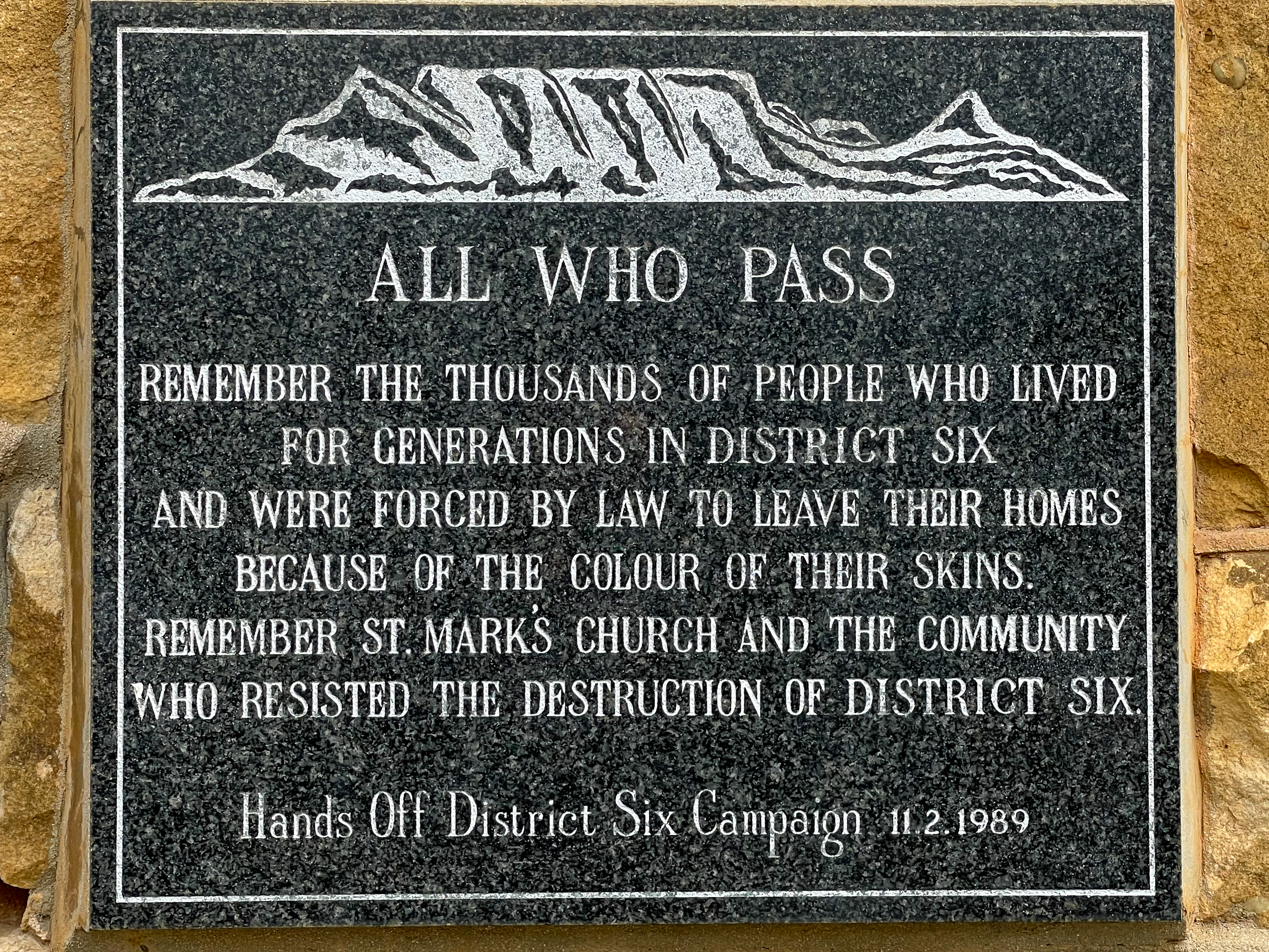
District Six is a former residential area in Cape Town, South Africa, known for its diverse community and vibrant culture before the apartheid era. It became a symbol of the forced removals and displacement caused by apartheid. The area was designated for white residents in 1966, and over 60,000 people were forcibly removed and relocated. St Mark’s Church became a focus for resistance against this process of segregation.
During a recent Journal Group meeting at the Leeds Church Institute, where I am Director, there was a good example of these tensions and differences. An engaging paper on theology and disability was presented, followed by a discussion about the strengths, weaknesses and applications of what was being argued. In a light-hearted manner, I observed that the paper contained some significant heresies. As I noted at the time, I wasn’t unduly concerned about these but – in terms of systematic theology – they were present. Chief among them was the notion of God being in need. Reflecting on this discussion I realise that my articulation of formal theology was guilty of closing down less orthodox but genuine, experience-informed theological discernment. Perhaps the material was heretical if measured by certain criteria, but it arose out of the lived experience of being a Christian, and from within a community that is repeatedly marginalised and made the object of condescending charity. It is also a community that has been the victim of theologically mandated disdain and shunning.
Between these two recent explorations of theology in the parish, I have been reading a paper from 2022 about intercultural theological education in South Africa, written by Professor Marilyn Naidoo. Here the author questions the universalising tendencies of Western knowledge, not least in the field of theology. Rather than imposing categories of heresy or orthodoxy, Naidoo argues for an approach that takes the experiences of oppressed people as a place from which theology must be generated.
“Classical theological methodology has always looked to scripture, tradition, and reason and found the person largely irrelevant”.
Naidoo, M. (2022). Nurturing intercultural theological education towards social justice ideals in South Africa. Religions, 13(9), 830.
The paper goes on to make the point that “the way scripture is interpreted and acted upon depends on a person’s lived reality”. In one way or another, and to varying extents, Coakley, Robinson-Brown and Naidoo re-assert the importance of people in the task of theology. This is not a minor correction but an urgent plea for theologians of all kinds to attend to the experiences of people – and to enable people to attend to the task of theology. It is not a question of theology being done for us – but a genuine intent for theology to be done by us, where “us” is not the ordained, but the baptised.
 Swift Reflections
Nice one Chris. I too was interested in the Coakley article. You are probably aware I am an occasional preacher as well as a pastoral minister. Our theology must surely be founded in bodies since it is only through our bodies we can encounter God. This is the thought of theologian Barbara Brown Taylor. (An alter in the world). Suddard Kennedy thought God must be affected by the mass destruction in the first world was trenches otherwise He could not be God.( the hardest part) William Brodrick says that once a child’s cry for help goes unanswered nothing is ever the same, even God changes ( day 3 meditation, book 2 Celtic Daily Prayer). Pelagius disagreed with Augustine and yet original blessings in the context of pastoral care is more meaningful than original sin. One raises up, the other casts down. Celtic theology took a bashing in Whitby 664 but my own experience in Iona drew me to new ways of being in the world. There is no distinction between the secular and the sacred.
kind regards
Richard
Many thanks for this thoughtful response.