I’m not the kind of Christian who likes public witness. The sort of knocking-on-doors Christianity; or a beach mission; or even telling my “faith story” in a service feels embarrassing and uncomfortable. There are probably lots of reasons for this, which it would be tempting to dismiss with an air of Anglican superiority.
I am inclined naturally to a reflective and tentative articulation of faith. I don’t believe I have all the answers. “Now we see in a mirror dimly”. I have no doubt, for a host of reasons, that my faith is fractured and partial. It feels fuller and more complete when it is located within a community of faith, bringing many different experiences of God, past and present, under a single roof. Others have natural – and undoubtedly, spiritual – gifts for giving personal testimony. I don’t hesitate to say that this can be both inspiring and has a place within the life of faith. But we are not all created to be the same.

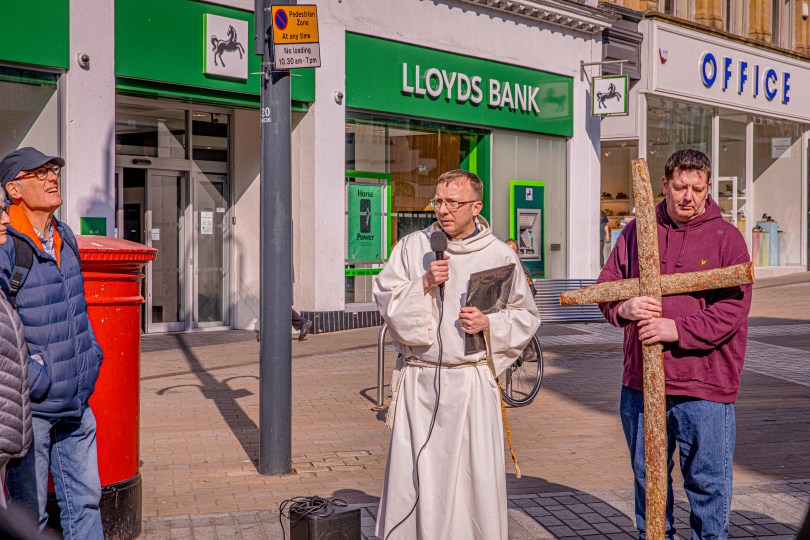
Hence, it was with some trepidation that I went along with the Gospel Streets Urban Pilgrimage in Leeds last week. Led by the admirable Lighthouse community, based in St George’s Crypt under the pastoral care of Jon Swales, the pilgrimage snaked though the streets of Leeds on a sunlit Thursday morning. Jon had a monk-ish aura wearing a cassock alb, and speaking passionately about the City while reading the Gospel of Mark. People stared at us. One passing youth shouted: “You’re all evil; you lot”.
What did it achieve?
For the thirty odd of us participating there were the kind of side-on conversations that people walking to the same destination often share. I met many people I hadn’t encountered before. Members of the Lighthouse community were with us, and it ended with a service of Holy Communion in the Crypt. We were present in spaces where religion is either excluded or extreme; the places where the more you consume the more you matter, and where street preachers tell the world that “the end is nigh”.
Our pilgrimage was less confrontational and more measured. The worst excesses of capitalism were described beside the city’s banks. People damaged by an urban environment that rejects them walked with us in a spirit of solidarity and purpose. Jon asked people sitting and reading in the sunshine of Mandella Gardens if they wouldn’t mind him speaking for a while (sooo Anglican!) and breaches of international law were mentioned by the war memorial.
I’m not sure what we achieved. A statement was made – it was enacted. In the pilgrimage through Lent, we reminded ourselves and anyone who cared to listen, that God is present in the city. That the Church is (or should be) a shelter from the storms of life and a community that is restless and longing for the Kingdom. Where people who have been rejected find a home, and where earthly power is reminded of its place.
It is absurd
to retell here what
happened there,
far away and far ago
when the idiot healed
and said, and wept
and left. A broken
nonsense in the febrile
world of expectation.
 Swift Reflections
Wonderful ♥️