
During our recent sojourn in Spain we visited the Centro de Arte Caja de Burgos. The exhibition currently on show comprises various works by the Swiss-born artist, Pablo Armesto. A key theme across the works is the use of light, shapes and, consequently, the implication of shadow. To quote Armesto: “Between science, geometry and spirituality, this is how I conceived this exhibition”.
This exhibition appealed to me because of the interaction of light and material surfaces. It is executed beautifully, and serves to remind us that casting a particular light can change completely the underlying structure on which the light falls – or doesn’t. In other words, by illuminating some threads rather than others the surface appearance can be changed radically. Our eyes are drawn to the light and the form it implies, not the unlit shape of everything underneath. As the commentary on the exhibition says, these are “installations in which light and shadow transform the chromatic perception of the viewer”. Here lines of light address our perception:
“The line is a metaphor for the path, both physical and allegorical, sometimes traveling parallel to the initial idea, sometimes divergent when it has to choose between different options, but never schismatic, never discordant”.
Pablo Armesto
The title for the exhibition is “Complejidad, araña, laberinto”. I think that this is best translated into English as “complexity, spider-webs, labyrinths”. This phrase comes from a poem by the Andalusian poet Rafael Alberti, entitled “a la linea” (‘To the line’). While a line may sound a modest thing to be the subject of a poem, Alberti reminds us of the joyous capacity for it to be a “beautiful expression of the different”. Certainly, in Armesto’s installations, the vibrancy of illuminated lines could not be made clearer. It reminded me of the well-known comment by the artist Paul Klee, in his Pedagogical Sketchbook of 1925, that he was engaged in “taking a line for a walk”.
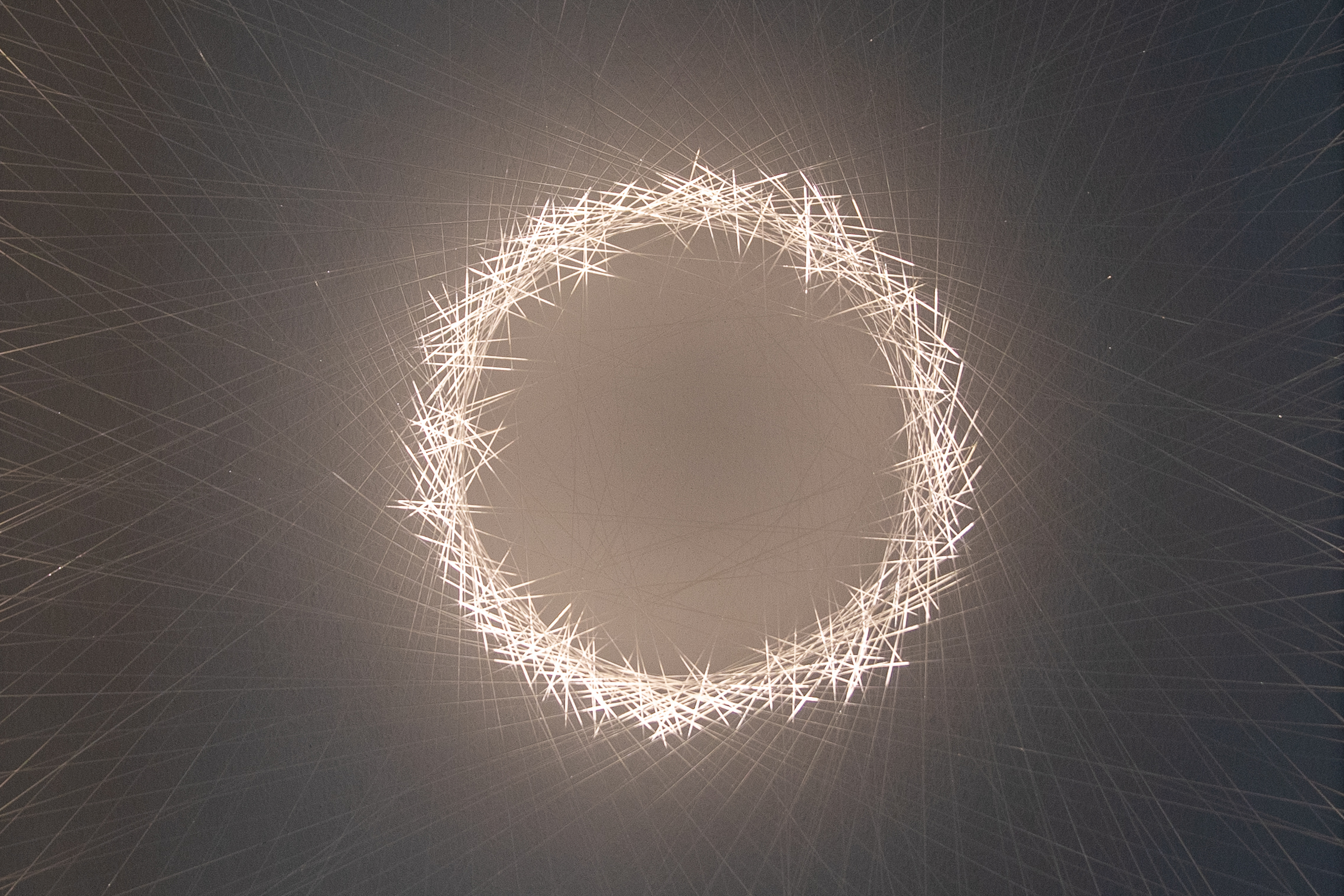
A circle of light created with the use of curved lines – by Pablo Armesto
The recent work I have been doing about Laurence Sterne includes the representation of a physical gesture – the waving of a stick – in volume IX. It is nothing more than a squiggle; a pen-line dancing across the page. It is used to express the notion of liberty and is, perhaps, the representation of the neat text going ferrel. A reminder that the careful shaping of ink that allows us to see letters and to read them, is made of the same stuff as this dramatically inserted hieroglyph. Different forms of the same material may shatter our expectations and leave us wondering what will come next. Art has this capacity to subvert our smooth reading of life and question the solidity and what we see. Like Sterne, Armesto’s filaments stretch our imagination, providing an intense optical experience and stimulating our thoughts about patterns – whether they are there, or simply the imposition of our expectations on the otherwise chaotic things we behold.
 Swift Reflections