Better Answers

Our visit to Cape Town created a palpable mix of emotions, thoughts, and insights. Encountering a world that is similar to and, simultaneously, different from the context of the UK can be a rich experience. From township Sunday worship conducted in Xhosa to the vistas from Table Mountain, including that distant icon of the horrors of apartheid: Robben Island.

Amongst all this I took the opportunity to meet colleagues at the Faculty of Theology at the University of Stellenbosch. In its own way, Stellenbosch is a very different emblem of apartheid. Its colonial era buildings communicate the purpose, wealth, privilege and power that enabled European-style institutions to rise in South Africa, and in so many other parts of the world. It was here that the nightmare of apartheid was conceived and developed.

Stellenbosch University has inextricable ties to the formulation of Apartheid Ideology and the formalisation of Afrikaans as academic language, and was thus central to the cultivation of Afrikaner Nationalism in the 20th century.

Stellenbosch University website

Thankfully a great deal has changed at Stellenbosch in recent years. In meeting members of the Faculty we were able to hear about the various initiatives and projects where theology is contributing to the Church’s work – and more widely. For example, this includes a key role in the ‘Courageous Conversations’ work that has brought together the parties involved in mining to address the working conditions and injustices faced by workers in the industry.

Canon Desmond Lambrecht, chaplain to the University, was kind enough to follow up our encounter at Stellenbosch with a visit while the group I was travelling with spent some days at the Volmoed Retreat centre. In our further discussions about chaplaincy Desmond gave me a copy of a book written by Allan Boesak: Pharaohs on Both Sides of the Blood-Red Waters (2017). This prophetic critique of Empire provides an excellent analysis of the persisting struggles and waves of nonviolent revolution across the globe. Boesak argues that this is evidence that we are not living in a post-racial and post-apartheid world, and that the Church has a critical role to play as a prophetic voice – a role Boesak finds it is failing to embrace.

A central plank of Boesak’s argument is found in the words of Pope Frances, when the Pontiff castigated the ‘globalisation of indifference’. A situation where we get excited about the latest digital device to enter the market while remaining comfortably numb to the egregious disparities of wealth and opportunity that are tolerated within a system of established injustice. In the West we travel on corridors which conveniently separate us from the sights and sounds of this economic apartheid. Standing outside a township church two weeks ago we became aware of how low and how loud the jets were as they came into land at Cape Town International airport. Silent forces continue to locate the poor in the places where others have no intention of living – and where the unaffordability and impracticality of double glazing mean that the sound and intrusion of the exhaust fumes of wealth are ever present.

Part of this indifference lies in our acceptance of poor answers to the challenges we face. Only in an economic system where relationships, communities and individuals are given little intrinsic value is it possible to operate the commercialism we take for granted. More than take for granted: comply with and perpetuate. It would be inhumane and illogical to conclude that there are no better answers than those we appear to accept as inevitable. For example, if the Church is comfortable with this status quo it means that its commission to preach the Kingdom of God is being abandoned. The Lord’s Prayer would need to be revised. Of all institutions, the Church cannot accede to the idea that there are no better answers for human society and creation.

Sentry Duty

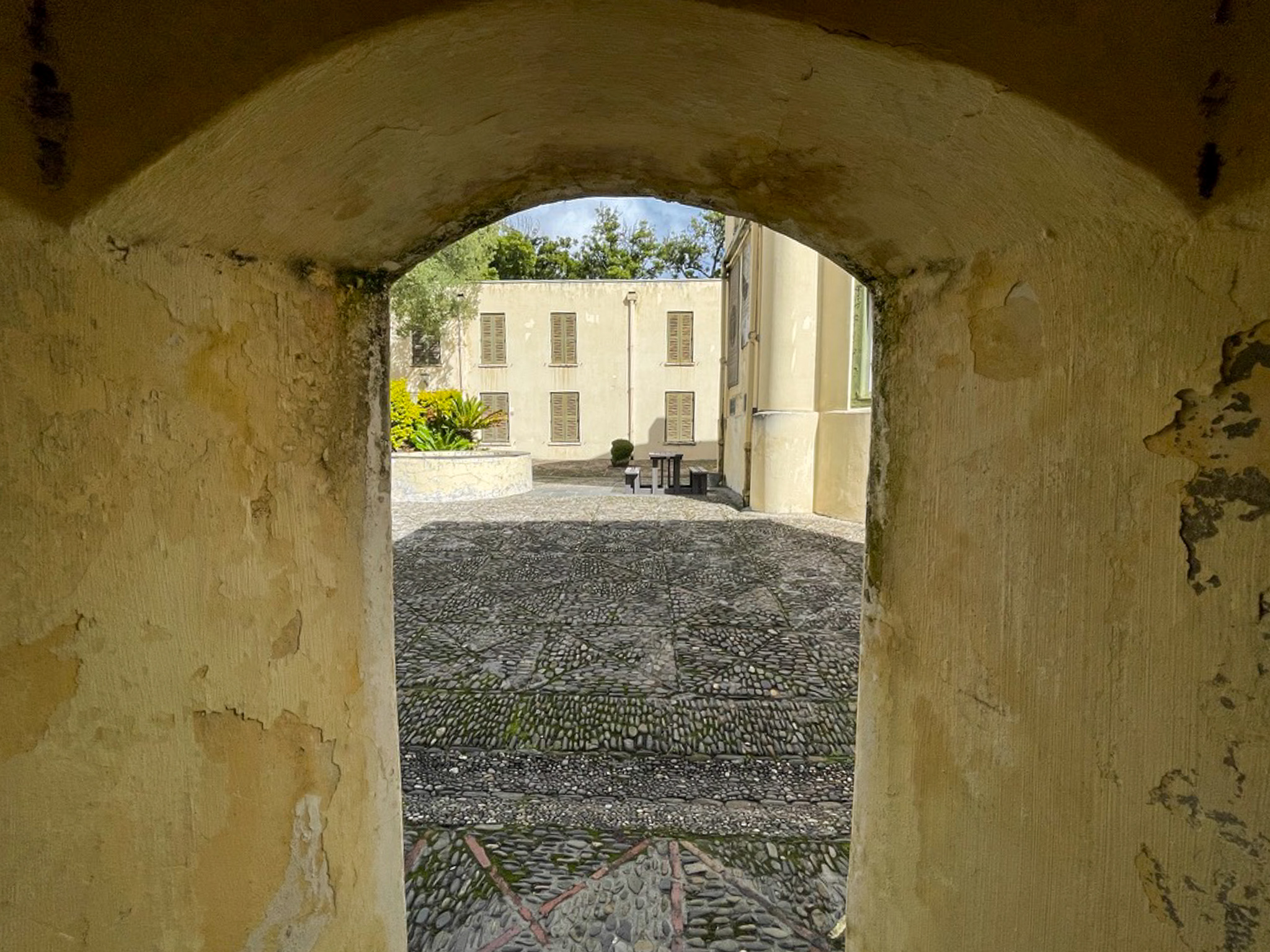
Observation alters behaviour. This was a truth made with notable clarity and force by the French philosopher Michel Foucault, in relation to prisons – but the effect is far wider. In the courtyard of the Slave Lodge in Cape Town there is a sentry box, re-sited from Fort Knokke (built in 1744). It was part of the infrastructure of military occupation that safeguarded colonial interests, not least those of the East India Company.

I can’t recall whether I’ve ever stood in a sentry box before. Spending some time walking around the box, and then standing inside, brought home to me the altered state that occupying the box brings. A soldier has the benefit of protection bought at the price of limited sight. Narrow slits afford some vantage, but these are inevitably narrow in perspective and focused on particular points of danger. Walking into the box demonstrated how much sound is altered in the small structure. Effectively the sentry’s perspective is limited and defined, while sound is muffled and becomes more distant. Simultaneously the guard is present in, and distanced from, the wider community.

The relationships which colonialism brings are invariably infantilising. The occupying powers ‘know best’ and inflict their religious, economic, military and political stamp on unwilling lands. Spending time with the people from The Warehouse in Cape Town reveals the lasting scars and consequences of a regime rooted in colonial attitudes. In a clear and autobiographical style, people shared with us their identities and histories, and explained how growing up in different decades in South Africa has affected their family relationships; education; type of work; place to live; and friendships.

It was encouraging to hear all this set within a framework of a theology that was natural to reference and practical in its insights. Equally, along with many other things, I found it disturbing to learn that at one point in its history the Dutch Reformed Church had decided that the common cup would not be shared between ethnic groups.

the discomfort of white members in sharing a cup during the offering of the sacraments led to the establishment of the coloured “daughter church” and later that of the black population, which came to be known as the Dutch Reformed Church in Africa.

Konzane, M. P. (2017). Mission calling in a congregation of the Dutch Reform Church of Africa in a transforming society: a case study in South Africa (Doctoral dissertation, North-West University (South-Africa)).

At the start and end of this first day in Cape Town we read Matthew 21. As our pilgrimage progressed I found resonance and connection with a detail towards the end of the passage, when the religious leaders say to Jesus: ‘Do you hear what these children are saying?’ The translation we are using says the leaders were ‘indignant’ when they asked this question. It is not uncommon for discriminatory language to belittle others by making a comparison to children, implying that some adults are less than they ought to be. Daughter churches? As we spoke about the decision to segregate the administration of Holy Communion it also led me to reflect on the common practice in many churches to exclude children from this sacrament. It may seen natural to some, but I wonder whether it is wise.

Inevitably, my first 48 hours in South Africa has raised questions about the mechanics of oppression; all the people caught up in its operation; and those bearing the brunt of its legacy. Where we stand shapes what we can see and how we can hear – and sometimes we all need to take the risk of stepping out of our box to engage with different perspectives. That, as much as anything else, should be our duty and our joy.

Wilful Ignorance

I’m sure that there will be a fancy word for it, but when our attention becomes invested in something, we often find that topic suddenly cropping up all over the place. I am about to go to South Africa and am becoming more and more aware of how entwined our histories have been. Not, I should add, by any sense of choice for the majority population of South Africa. On Friday afternoon, standing on a platform at Derby station, I suddenly noticed the plaque that heads this blog. A memorial with scores of names of the members of the Midland Railway Company’s staff who died ‘serving their country in the war in South Africa 1899-1902’.

The war was conducted, partly under the direction of lieutenant-general Kitchener, in a manner that was both new and terrifying. It gave to the world the concept of ‘Total War’, in which civilians were as much embroiled and harmed as combatants. It also saw the introduction of the kind of contained and controlled camps used to subjugate entire populations.

“This Total War strategy shattered the rural economy, leading to starvation and a humanitarian crisis. Displaced and captured civilians were taken to military managed refugee camps inside the military controlled zones. These camps became known first as refugee camps and then later as concentration camps and were established near towns, mines and railways sidings”.

Benneyworth, G. C. (2019). Traces and memory of African forced labour camps during the South African War (1899–1902). Traces, mémoires et mutations des camps de refugies. Investigations d’anthropologie prospective, 29-49.

It is perhaps no coincidence that the majority British perception of modern history begins in 1914. To stray back just a few years earlier, and look farther afield, brings a far less comfortable story of national conduct. Plaques like the memorial at Derby station are less common than those in memory of WWI and WWII, but they are more numerous than we might imagine.

“people conduct their daily affairs under the shadow of their own inevitable ignorance. People simply do not know everything about everything”.

Dunning, D. (2011). The Dunning–Kruger effect: On being ignorant of one’s own ignorance. In Advances in experimental social psychology (Vol. 44, pp. 247-296). Academic Press.

Dunning is right that ignorance is a fact of life. We make choices about the things we wish to understand, while simultaneously recognising that in some cases we are ignorant of our ignorance. However, there are also topics about which we make a decision – at some level – to avert our eyes. To avoid things too dangerous for our implicit sense of how the world works, and our place within it. This is when prophets discomfort our security and demand that we see the truth of difficult things. They ‘scatter the proud in the imagination of their hearts’ – something the proud will do anything to avoid. We are all proud.

I am looking forward to our time in South Africa, and to reunions with people we have met on their visits to the UK. Despite the histories of oppression and privilege, and the legacy of damage that is wired into the inequalities of society, human beings are not inevitably condemned to repeat the past. We should never be ignorant of what has made us who we are – or forgetful of how wealth is built on the misery of people we have othered. Thankfully, with great generosity and grace, I know that we are all interested in the future – and how the friendships and knowledge we share can lead to something more worthy, godly, life-giving and hopeful.

Jesus Stood

Many of us go with the flow and make sure we don’t stand out from the crowd. At least on most topics. There is a human urge to fit in, accompanied by a fear of separation from the mainstream and finding ourselves isolated. Of course there are also people who love to disagree with the herd: the contrarians. Hopefully, somewhere between these polarities, there are people who disagree when they see its necessity; not for the sake of disagreement alone.

One of the most memorable sermons I recall was preached at the University Church in Oxford, sometime around 1984. The preacher was Trevor Huddleston, and his text was about as short as you can get: ‘Jesus stood’. It comes from Mark 10:46 when Jesus and his disciples are on their way out of Jericho and blind Bartimaeus keeps calling out to him. Bartimaeus was not falling in with the crowd. People were telling him to shut up and behave, but he wouldn’t stop. Despite the swell of the crowd and the momentum to leave the city, Jesus stood. It conjures the imagine of the tide breaking upon a rock.

Huddleston spoke about the anti-apartheid movement and the challenge of speaking out in a society where the weight of social expectation was to keep quiet and behave. To collude with systems of oppression designed to privilege the few. Like Jesus leaving Jericho, we need to courage to hear the voices from the edge of the crowd: to stop, to listen and to act.

There is a lot of appeal in going with the crowd and not making a stand. In one of my favourite quotes from Murder in the Cathedral a tempter reminds Thomas of the venal rewards of compliance, saying: ‘the easy man lives to eat the best dinners’. Join the club; keep quiet; do what’s expected and never, never, rock the boat. Such behaviour can bring handsome prizes.

In the Passion Gospel we find Jesus ‘stood before Pilate’ (Matthew 27:11). This time he isn’t there because of a voice heard on the margins. His posture is an enforced sign of respect. By contrast, as we go on to hear a few verses later, power sits to pass judgement. All the robes and symbols of authority, and troops at command, are with Pilate. Jesus is alone. Yet, if there is no choice of posture, there is a choice to be silent. In the face of the choreography of power Jesus fails to conform to the etiquette of the room. He does not plead for his life. He does not give a rambling defence or seek to implicate others. Silence. In the few verses in which this is described it is possible to feel the authority of Pilate ebbing away.

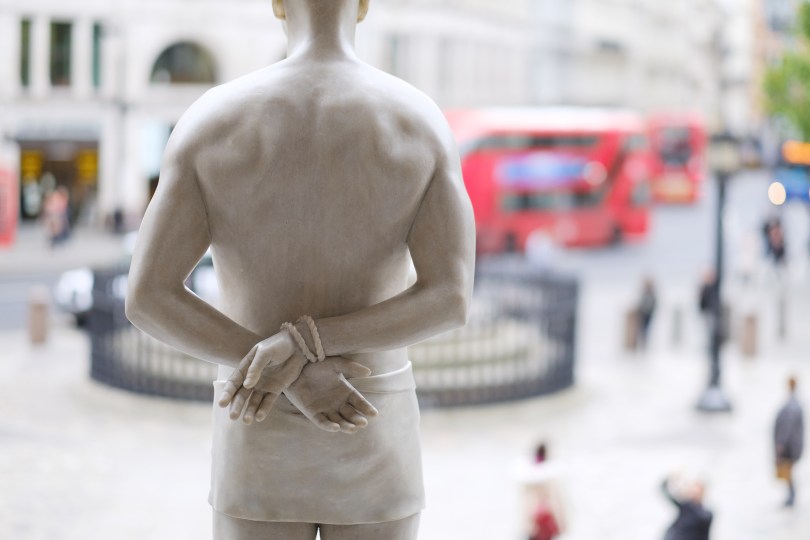
In 2000 I visited Alison Wilding’s remarkable ‘Passion Project’ exhibited at the Dean Clough Gallery in Halifax. One of the larger pieces in the collection comes under the heading ‘Disposition’. It consists of a huge concrete disc towering over a black mat, which appears to grow wavy stalks (it can be seen here). Abstract art demands work from the viewer, even when set in an exhibition with an overall theme. What is going on here? There is a world of difference between the objects – in almost every sense. They appear only to be connected by a tension that lies between them. In a temporal sense Pilate should be the stone – ready to crush whatever pathetic resistance grows out of the Judean darkness. Spiritually, the disc hints at perfection and eternity. It is balanced and complete, requiring nothing from the sprawling stems that stretch upwards. This is a standoff and the stone will not be moved.

“At the heart of this episode of the Passion is both conflict and stand-off. There is a perplexing estrangement between both objects; the scale of one bears no relationship to the other, but the space separating them is tense and compelling. In the dynamic of the sculpture one part is continually brought into focus and deflected by the other”

Alison Wilding, ‘Contract’, exhibition catalogue, October 2000

Those who make this kind of stand seldom come off unscathed. Jesus knows this and he holds no particular hope of release or escape. The machinery of power will take its course and suffering lies ahead. It is beyond the imagination of this anxious and self-interested power that somehow, by battering and breaking this solitary young rabbi, an alternative power will be released into the world. A power that will enable anyone, no matter how poor or peripheral, to receive a dignity that cannot be removed. To become a child of the living God.

Hidden in Plain Sight

Churches pepper the landscape of England, to such an extent that there are few places without some kind of ecclesiastical edifice. Now well into my fourth decade of ordained ministry, I would be able to retire comfortably if I had received a pound for every time someone has remarked that the church is the people, not the building. I do not doubt the statement, but Christians are physical beings who need physical places in which to meet and pray. Even transient settings are altered for a few moments when a sacrament is shared. Countless times at a hospital bedside, with curtains drawn at the patient’s request, the ancient prayers and ritual have evoked a fleeting stillness and sense of the sacred. On very rare occasions, having heard the liturgy being spoken, a nurse has ducked into the space to received Communion as well – something I doubt there would be time for in today’s overstretched NHS.

There was a notable minority thread of comments on Twitter over Christmas from clergy who were not tweeting about full churches at midnight; crib services that were overflowing with children; or carols sung robustly by the faithful gathering of older parishioners. Away from the cathedrals and civic churches many services took place with thin congregations and in the absence of children. These were no doubt meaningful and moving, but they are also a reminder that in many communities the ‘fringe’ of people who attended on high days and holidays has mostly evaporated.

It was encouraging recently to be sharing in worship at rural churches in East Yorkshire where, statistically, a significant minority of the population attends church. I can well imagine that this is the kind of place where occasional worshippers would also be present at Christmas and Easter. It was encouraging, in conversation, to hear about plans to improve the welcome for new residents in the parishes, and fresh thoughts about how to connect and involve people who might be feeling isolated. All this within an Anglican-Methodist ecumenical partnership which is currently advertising for a Minister/Vicar.

The church building is at the heart of these communities. While maintaining them is problematic and costly they offer a focal point that pose questions of faith and purpose every hour of every day. It is quite true that on their own this seldom achieves very much – or some of the churches I’ve mentioned would be full to the rafters. The buildings require an active Christian community just as much as that community needs a place to meet, and a place to manifest the physical expression of faith over time. I’m not sure we understand fully, as a society, how precious and valuable our stock of churches is when it comes to art; social history; traditional crafts; and the evolution of theology and belief. Perhaps there is more that we need to do to enable these buildings to speak and, in their speaking, to tell afresh the faith that has inspired their creation.

“Comprehension of architectural monuments, signs, symbols, cultural codes allows students to penetrate into the spiritual life of another culture, especially the national character through comparison with their culture. Thus, when considering the semiotics of a Russian church and an English medieval cathedral, students’ attention is focused on symbolism, which helps decode non-verbal languages and meanings, helps to understand the mentality of the English people”.

Sabirova, D.R., Solovyova, E.G., Pomortseva, N.P. and Antonova, S.P., 2019. Comprehension of the english national character in building professional linguistic culture. Journal of Educational and Social Research9(3), pp.101-101.

Perhaps the lack of progress in this direction stems in part from anxieties concerning cultural heritage. For example, that prior to the 1950s Britain was a culturally much less diverse society than it is today. Using building to interpret the past could emphasise a narrow concept of being English and exclude the presence of the faiths now widely present in society. Furthermore, as the Church of England itself recognised with a debatable financial commitment, the construction of many churches was funded to varying degrees by the proceeds of slavery; exploitation; and the blessing of abusive power.

At the moment it seems that we do a modest amount to share the architectural marvels and complex histories that litter our countryside, towns and cities. In some cases, if just one of these buildings was somewhere in the USA, it would draw visitors from across the continent. Here many are closed most of the time; lack explanatory boards and information; and do little to make their presence known. No doubt funding is part of the problem – but that is also a catch 22. Without being open and communicative, fewer and fewer churches will have the vibrancy I encountered in rural East Yorkshire.

Today is Mothering Sunday and some people will be remembering with thanks a particular church in which their faith was once nurtured and inspired. A number of those church buildings will no longer be in use as a place of worship, while others will have disappeared entirely. However, the spiritual imprint of a church that has served us well is carried far beyond the walls of any given place. We carry its light into our daily lives, and hope that – meeting the lit shards of others’ faith and love – a pattern of greater purpose and beauty takes shape. At times this can feel a forlorn hope but, perhaps, it is the only meaningful hope we have.

A Fleeting Shadow

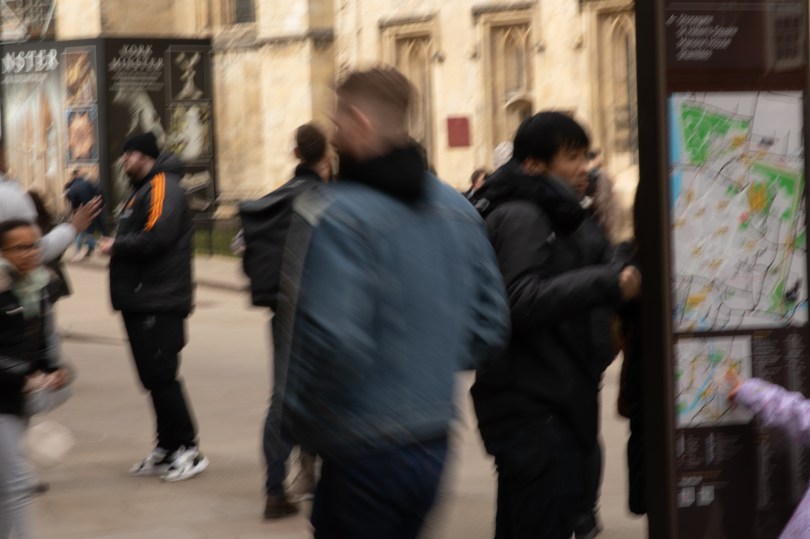
It is an incidental fact of the modern world that most of us are captured, unwittingly, in other people’s photos. Whereas once upon a time we might have dodged around the line-of-fire between camera and subject, there are now so many pictures being taken that it is almost impossible not to intrude. Outside York Minster cameras and phones are in all directions, with an almost continuous stream of snaps being taken from dawn until well after dusk. I’ve long given up trying to walk around.

No doubt my nonchalance about the risk of ruining an image is partly the result of technological progress. In my youth a photograph was a precious thing, involving physical film and a long delay between a click and seeing the image itself. If the camera was set incorrectly a whole reel of film could be lost, but you wouldn’t know until after all the photos had been taken and the cost of developing had been paid. As with all technology, there is a rearguard action against this progress and a growing interest in using film cameras, which market analysts expect to continue. Nevertheless, when I walk into someone’s line of sight today I know that more often than not the image can be deleted in a second, at no cost, and further attempts to capture the desired picture are almost unlimited.

In her new novel, The Hero of This Book, the novelist Elizabeth McCracken writes entertainingly about this shift in behaviour reflecting the altered state of the technology used in photography. At one point we find McCracken’s protagonist walking across the Millennium Bridge by Tate Modern:

I slowed but I didn’t stop. I strode out. “Well, that’s ruined it,” I heard a woman mutter as I passed. She was examining the screen of her camera – an actual camera, not a phone; she took herself seriously – and she wanted me to feel bad. The wind was pulling apart her ponytail in a quarrelsome way. I didn’t feel bad; I felt marvellous. For years I’d been polite around tourists taking pictures. I’d yielded, believing as many people did then, and some still do, that this was a moral law.

Elizabeth McCracken, The Hero of This Book, Jonathan Cape, London 2023 p. 38

Across the world millions of us will be captured on the edges and backgrounds of strangers’ photographs. In the Cloud there will probably be millions more – photos that will never see the light of day; be added to an album; or turned into images for cushions, mugs and mouse-mats. It is a theme picked up by the former doctor and hit TV script-writer Jed Mercurio (Line of Duty). In a semi-autobiographical novel that preceded his fame, Mercurio wrote about his time as a junior doctor in an NHS hospital. At one point he reflects on the fact that at the end of a patient’s life it is usually those closest to them who are present. However, there are also figures around the patient who have only appeared for the first time in the patient’s life at this critical moment: the clinical staff. As with many of the most significant moments in our lives, the images of this experience will be etched into memories for years to come. However, in those mental images – with key family members static by the bedside – the staff are little more than a blur:

Though I’m beside her I’m not part of the moment or part of another life ending for no reason I can comprehend. I’m a passer-by captured in a photograph who’s an out-of-focus streak of lines flashing through the frame and then gone. I’m a cold scalpel-sharp instrument slicing through scenes in other people’s lives and not ever being slowed.

Jed Mercurio, Bodies, Vintage Press, 2003, p. 134

I am less gloomy than Mercurio about the import and significance of the professionals’ fleeting presence. At our best we help foreground the key family members and the person whose life is ebbing away. By doing our work with suitable skill, attention and compassion we leave family members, not with the images of the clinical staff, but with an imprint of their loving concern and professional care. Many times I have heard people mention the commitment and dignity provided by professional staff when speaking about a critical moment in their life. The memory of faces may blur, but the impact of humanity and empathy remains. This isn’t only in the weeks and months following a loss, it can endure for a lifetime. What at the time may feel like a fleeting shadow, an intrusion into the frame of our family and friends, may leave a legacy of enduring goodness.

Champagne Rules

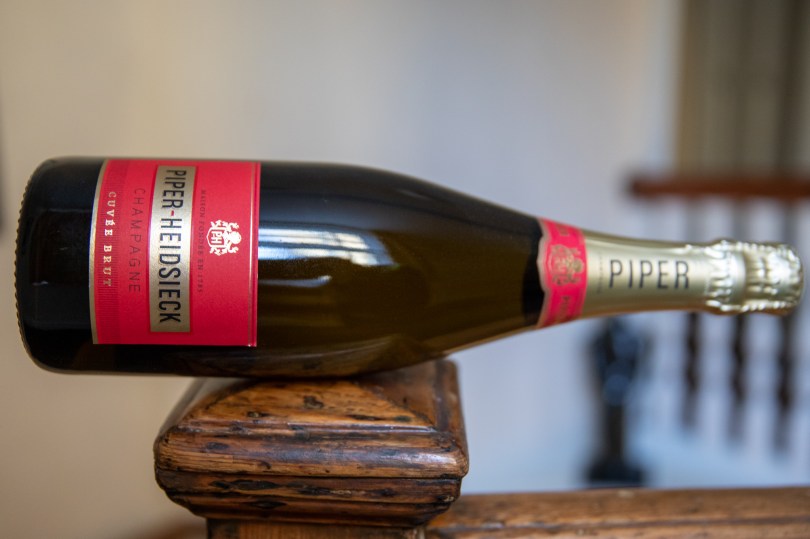
It became my custom to give up alcohol during Lent. I’m not sure when it started, but by the time I was ordained it was an established practice. With the eagerness of a new curate I was very clear that this was something I would observe, come what may. Like so many of the things we decide with absolute conviction, God is adept at questioning any rule we might turn into an idol. During those first few years of ordained life I found myself on one occasion at a 90th birthday celebration for a parishioner. Naturally, the fizz was circulating in abundance and there was to be a toast. I began to wonder whether my Lenten observance was pharisaical – placing the observance of a rule over its spirit and purpose. At that moment I took a glass and toasted the nonagenarian.

Rules can be very useful, even essential, but it can be important to know when they should be set aside for a greater purpose. In the Church of England the recent debates about same-sex blessings might be another example of the ‘champagne rule’. The moment when we realise that a rule no longer serves the purpose for which it was intended. When the Church realises it is operating a self-denying ordinance that leaves it skulking in the corner when the community we are called to serve is celebrating.

‘But to what will I compare this generation? It is like children sitting in the market-places and calling to one another, “We played the flute for you, and you did not dance; we wailed, and you did not mourn.”

For John came neither eating nor drinking, and they say, “He has a demon”; the Son of Man came eating and drinking, and they say, “Look, a glutton and a drunkard, a friend of tax-collectors and sinners!” Yet wisdom is vindicated by her deeds.’

Matthew 11: 16-19 NRSV

When we develop or change rules it can be unsettling. Many of those who have changed their mind on the topic of the blessings have done so because they have listened to people in relationships that are enriching each other, and the community: ‘Wisdom is vindicated by her deeds’. I am quite sure that they have also been open in prayer to seek what God is asking of the Church. Opponents simply battering on about marriage as something that has never changed (it has), or investing a particular interpretation and a huge weight on a few verses of the Bible, should not fly in the face of the overall purpose and direction of the Gospel. God is love, and enabling people in love to be blessed in the community does not seem un-Christian.

Perhaps it is only when we arrive at a particular moment, and are open to hear the whisper of wisdom, that we feel able to engage the champagne rules. For me it changed nothing about my overall observance of Lent. In fact, it helped dispel my youthful pride in a holy and sacrificial abstinence. God didn’t allow me to complete Lent with a clean sheet, but ensured that when there was a wedding or a birthday I always raised a glass. As the days of Lent progress it is important to remember that rules alone seldom (if ever) bring us closer to God.

‘Owe no one anything, except to love one another; for the one who loves another has fulfilled the law’.

Romans 13:8

Letting go

In a parish I once knew, long ago, there was a splendid cabinet in the vestry. Made from fine timber, it was a large chest with many drawers – in which, liturgical vestments were stowed. It had been given in memory of their father by two members of the choir.

When I was present to lead worship on a Sunday I often spent time in the vestry before the liturgy began. On several occasions these members of the choir would voice concern about something to do with ‘father’s chest’. An alien object had been placed on the top; or a drawer was sticking out; on more than one occasion it appeared to have been moved an inch one way or the other. The cry would go up: ‘what have they done to father’s chest?’

Over time a question began to form in my mind. Had this object really been given? The continuing bonds of attachment seemed so great, so proprietary, that it was hard to think of this as a gift that was given free, unencumbered and without strings.

“But when you give alms, do not let your left hand know what your right hand is doing, so that your alms may be done in secret, and your Father who sees in secret will reward you”.

Matthew 6: 3-4 NRSV

On Ash Wednesday I think there is much to consider about giving and detachment. The ashes remind us that our physical life is temporary, and that all we own will one day be dust. More significantly, God gives Jesus without any sense or implication of ownership. Horrifically, human beings did with this gift what happens to far too many lives. Even on the cross and hearing the cry of despair, God is silent. This is a gift – a true gift, and therefore God can make no claim even on that desperate day we shall mark six weeks on Friday.

All out genuine acts of letting go echo something of this divine gift. If we give we can never claim ownership or, indeed, any greater interest than anyone else. Perhaps this is why gifts are so rare. In his poem ‘Walking Away’ C Day-Lewis reflects on the moment his young child disappears, momentarily, for the first time:

That hesitant figure, eddying away
Like a winged seed loosened from its parent stem,
Has something I never quite grasp to convey
About nature’s give-and-take – the small, the scorching
Ordeals which fire one’s irresolute clay


I have had worse partings, but none that so
Gnaws at my mind still. Perhaps it is roughly
Saying what God alone could perfectly show –
How selfhood begins with a walking away,
And love is proved in the letting go.

Salty Language

Over ten thousand feet above sea level in central Peru it was surprising to find a whole industry dedicated to the production of salt. The Maras salt pans go back over a millennium to the Chanapata culture. As this civilisation gave way to the Inca Empire, they continued to provide their distinctive pink salt far and wide. At such a distance from the sea, and at such altitude, the steady supply of salt seems miraculous. Long ago, this land was below the sea and left salt hidden in the hills. A spring which runs through the complex of underground passages this enables the striking ‘pink gold’ to be extracted from the small stream that emerges above the pans. The rights to salt production are handed down through the generations, back to a time now lost to memory, with tourism adding further value to the enterprise. It is hard work, but the rewards can be significant.

Photo by Roger Duran on Pexels.com

For all of my life salt has been readily available and cheap. This was not always the case and for most of human history salt has been a precious commodity. In the Roman Empire it was taxed, and served a wide variety of uses – religious sacrifice, medicinal, fish preservation and, of course, the seasoning of food. Like anything that is taxed, this also made salt political. In Matthew chapter five, when Jesus says ‘you are the salt of the earth’, it follows only a few verses after the calling of the first disciples. In a way largely missed today, the leap from those involved in fishing, to an image of salt, was entirely natural. Everyone was connected to salt in some way; and no one doubted its value.

In the Jewish Scriptures there are intriguing references to the ‘covenant of salt’. In the various covenants God made, such as with Noah and Abraham, there is a theme of constancy (at least on God’s part). Probably due to its properties of preservation, salt was often used for these moments of commitment. In Numbers 18:19 we hear about the relationship of God to the people as ‘a covenant of salt forever before the Lord for you and your descendants’. A commitment made in salt was expected to endure.

In Greek and Latin the words for ‘salt’ also carry the sense of wit and sparkle. Salt put the zest into a meal, transforming the plain into the delicious. As an image used by Jesus (‘salt of the earth’) to address the crowds who came to hear him, it suggests that those who are alive to God should be the people changing the taste of living. Like the image of yeast used by Jesus, this isn’t about changing what would become the Christian Church, but about how the baptised are called to transform the world.

is it really the salt
that really matters
or is it the bitterness
that wakes us up
and lets us know
what this life is all
about

Ric Bastasa, 2009, The Salt of the Earth

Salt is undoubtedly a powerful and necessary part of our lives, but it is not benign. We talk about ‘rubbing salt into the wound’. When we distrust what we are being told we ‘take it with a pinch of salt’. Spilling it is seen by many as bad luck. The language about salt reminds us that anything significant can be used for good or ill. As Ric Bastasa conveys in his poem, we can spend too long wondering about the salt – and not enough time thinking about the changes it brings. Portrayed as the salt of the earth, the crowd was being encouraged to preserve its sparkle; never to lose its wit and flavour. Jesus may be suggesting – by comparison – that the religious leaders had grown bland and stale: ‘but if salt has lost its taste… It is no longer good for anything, but is thrown out and trampled under foot’. Without the responsibility to enliven others these leaders had failed in their calling: to enable people to be God’s salt for the world.

The Undeserving Rich

It feels as though the Victorian idea of ‘the deserving poor’ have largely dropped out of our consciousness. There are the frugal poor, the people using all the tips and tricks recommended by governments and gurus to try to keep our heads above water. While advice about saving costs and keeping warm is welcome, it freights the implication that the poor have some hand in their own misery. ‘If only they could be a bit wiser, a bit more canny, then everything would be OK’. Apart from that, even right wing politicians don’t feel much need to divvy up the poor between deserving and profligate. The poor are now one homogenous mass of food-bank using, low income living individuals, occasionally doled out a bit of help from the centre. Put bluntly, we are now a society content to live with high levels of endemic poverty – set alongside an elite that clearly deserve to be rich, and are entitled to become even richer.

Perhaps this is the chief legacy of Thatcherism. The import of the notably American idea that we make, or discard, our own opportunities to be self-made and wealthy. Consequently, poverty is simply individual failure. Despite the mountain of evidence that refutes this simplistic narrative it can feel as though it’s now welded into the psyche of modern Britain. The very fact that we can tolerate such significant rates of poverty, including child poverty, supports the view that we have somehow imbibed and owned this destructive myth. While there is general support for striking nurses and paramedics, there aren’t yet massed crowds present in support asking why an employee of a national health service should need the support of charity in order to live. Compare this with France, where a million people demonstrated in response to the proposal to change the state pension age from 62 to 64.

Last week an MP suggested that if someone couldn’t live on £35K a year without using food banks ‘something is wrong with your budgeting’. I found this reminiscent of the remark made a decade ago, that in the face of a strike by petrol tanker drivers, people should store a can of petrol in their garage. Apart from the lunacy that this would add to shortages by encouraging stock-piling (and potential danger in holding unnecessary petrol supplies at home), there was also the implication that everyone with a car had a garage. It appears to be a constant thread throughout the gaffs of wealthy politicians, that they are wildly out-of-touch with the circumstances of many voters.

Which brings me to the undeserving rich. It is not unreasonable to expect that wealthy people in public life would want to ensure they have done at least the minimum to contribute to the public good. Which is why the tax affairs of Nadhim Zahawi rightly raise serious questions about his suitability for political office. The penalty imposed by HMRC is a strong indication that Zahawi has (at best) been fairly uninterested in paying his correct contribution to the NHS, and everything else funded by the public for our collective wellbeing. I am sure that there will be voices speaking in his defence, implying that he is very important and very busy. Yet there seems to be no end of money that can be found by rich individuals to ensure accountants let them pay the minimum amount of tax. Why not spend a little bit of money on other accountants, who will ensure you never pay less than you should?

“Some people continue to defend trickle-down theories which assume that economic growth, encouraged by a free market, will inevitably succeed in bringing about greater justice in the world. This opinion, which has never been confirmed by the facts, expresses a crude and naïve trust in the goodness of those wielding economic power.”

Pope Francis as quoted in The Pope, the Bible and Trickle-Down Economics, by Obery M. Hendricks, Jr.

In 2022 the Joseph Rowntree Foundation set out a ‘minimum income standard’ (MIS) for the UK. If the nurse mentioned above is part of a couple with two children, then the JRF calculate that the household MIS would need to be £43,400. Given our current inflation this figure might now be closer to £50K and, it is important to emphasise, this is a minimum income. It can hardly come as a surprise that a nurse earning £35K might need to use a food bank.

Even if MPs lack personal experience of poverty or the challenges of low income, there is no excuse for a failure to engage with reputable and independent sources of data and analysis. Whether it is in a lack of attention to personal tax obligations, or the choice to live only in an echo-chamber of the likeminded, there is plenty of evidence that the undeserving rich are happily thriving in post-pandemic Britain. Change is long, long overdue.