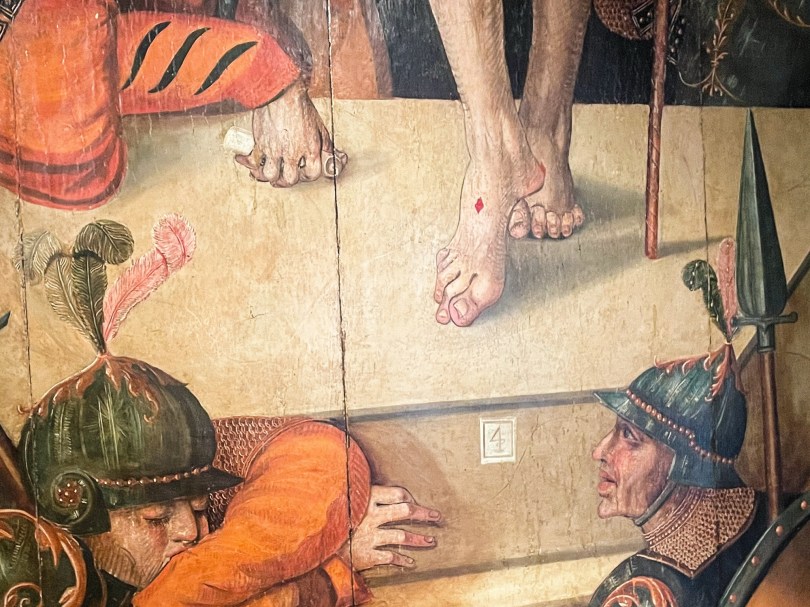
Perhaps the soldiers were sleeping because their task seemed so simple: to guard a dead man. In the painting, part of an altarpiece, only one soldier has been stirred by the strange sounds coming from the tomb. The feet of Christ stand simply on the grave slab, familiar to countless millions down the centuries by their telltale marks of blood.
The status of Jesus as dead and buried is suddenly transposed. Now, in the hour of resurrection, the guards are ‘so afraid of him that they shook and became like dead men’.
The soldiers are scattered out of fear. The women at the tomb also disperse but with different sentiments. They are ‘afraid yet filled with joy’. The feet Christ places on the earth do not bring vengeance or a settling of scores. They stand in confident conviction that a new era has begun when peace is more than a balance of arms.
A very Happy Easter to all blog readers, and especially to those who have struggled through ‘A Sterne Lent’ to reach this joyful Eastertide.
Another reader’s response to the marbled page stencil in ‘A Sterne Lent’.
Our visit to Cape Town created a palpable mix of emotions, thoughts, and insights. Encountering a world that is similar to and, simultaneously, different from the context of the UK can be a rich experience. From township Sunday worship conducted in Xhosa to the vistas from Table Mountain, including that distant icon of the horrors of apartheid: Robben Island.
Amongst all this I took the opportunity to meet colleagues at the Faculty of Theology at the University of Stellenbosch. In its own way, Stellenbosch is a very different emblem of apartheid. Its colonial era buildings communicate the purpose, wealth, privilege and power that enabled European-style institutions to rise in South Africa, and in so many other parts of the world. It was here that the nightmare of apartheid was conceived and developed.
Stellenbosch University has inextricable ties to the formulation of Apartheid Ideology and the formalisation of Afrikaans as academic language, and was thus central to the cultivation of AfrikanerNationalism in the 20th century.
Thankfully a great deal has changed at Stellenbosch in recent years. In meeting members of the Faculty we were able to hear about the various initiatives and projects where theology is contributing to the Church’s work – and more widely. For example, this includes a key role in the ‘Courageous Conversations’ work that has brought together the parties involved in mining to address the working conditions and injustices faced by workers in the industry.
Canon Desmond Lambrecht, chaplain to the University, was kind enough to follow up our encounter at Stellenbosch with a visit while the group I was travelling with spent some days at the Volmoed Retreat centre. In our further discussions about chaplaincy Desmond gave me a copy of a book written by Allan Boesak: Pharaohs on Both Sides of the Blood-Red Waters (2017). This prophetic critique of Empire provides an excellent analysis of the persisting struggles and waves of nonviolent revolution across the globe. Boesak argues that this is evidence that we are not living in a post-racial and post-apartheid world, and that the Church has a critical role to play as a prophetic voice – a role Boesak finds it is failing to embrace.
A central plank of Boesak’s argument is found in the words of Pope Frances, when the Pontiff castigated the ‘globalisation of indifference’. A situation where we get excited about the latest digital device to enter the market while remaining comfortably numb to the egregious disparities of wealth and opportunity that are tolerated within a system of established injustice. In the West we travel on corridors which conveniently separate us from the sights and sounds of this economic apartheid. Standing outside a township church two weeks ago we became aware of how low and how loud the jets were as they came into land at Cape Town International airport. Silent forces continue to locate the poor in the places where others have no intention of living – and where the unaffordability and impracticality of double glazing mean that the sound and intrusion of the exhaust fumes of wealth are ever present.
Part of this indifference lies in our acceptance of poor answers to the challenges we face. Only in an economic system where relationships, communities and individuals are given little intrinsic value is it possible to operate the commercialism we take for granted. More than take for granted: comply with and perpetuate. It would be inhumane and illogical to conclude that there are no better answers than those we appear to accept as inevitable. For example, if the Church is comfortable with this status quo it means that its commission to preach the Kingdom of God is being abandoned. The Lord’s Prayer would need to be revised. Of all institutions, the Church cannot accede to the idea that there are no better answers for human society and creation.
In Austria, on Palm Sunday, branches of pussy willow are used instead of palms to honour the entry of Jesus into Jerusalem. In the parish church of Viehhofen, in Hinterglemm, I found a spray of pussy willow attached to a processional cross as part of the Christmas decorations. I am unclear about the reason for this, and a search of the internet turned up little. However, it seems a fitting nod towards the passion of Christ and serves as a reminder that events in the Christian year are interlaced in ways that are sometimes surprising.
In 1608 John Donne wrote about the coincidence of the Annunciation (25 March 1608) falling on Good Friday. (We don’t need to worry about that happening in our lifetimes, no matter how young you are, as it occurs next in the year 2157. It happened last in 2016). Donne reflected on ‘the head Of life at once not yet alive, yet dead’, the day when news of great joy lands on the remembrance of deep sorrow. News about the same person – anticipation of new life held simultaneously with the pain and suffering of that life being extinguished. In the calendar, the Church transfers the celebration of the Annunciation to another date. It is almost impossible to attend fully to both these extremities without experiencing some kind of theological breakdown.
All this, and all between, this day hath shown, Th’ abridgement of Christ’s story, which makes one— As in plain maps, the furthest west is east— Of th’ angels Ave, and Consummatum est.
The conclusion of Donne’s poem: On Annunciation and Passion Falling on the Same Day
As a hospital chaplain there were many occasions when joy and sorrow were held in the same time. I shall never forget working in the neonatal units at Christmas, when all attention in the outer world was fixed upon a particular birth but, tragically, I was baptising and blessing lives that would not last the day. Every Christmas I think of those parents and families, for whom this date of joy in the world had become a time of painful recollection. Our annual baby remembrance service was held in early December in order to allow families a ritual of acknowledged loss, and then proceed to keep Christmas as well as possible for other children in the family.
We tend to think that Christmas should be a time when we are shielded from the harsh experiences of being human. Sadly, as the UK has witnessed, violent deaths have taken place over the festivities. Families have been devastated by loss when so much public narrative focuses on being together; reunited. Police officers speaking about these events have often said words to the effect that: ‘while this would be appalling at any time, it is particularly difficult coming at Christmas’. The remembrance of families will forever be made in a context of public joy and celebration.
It is the work of the Church to hold these things together. It is always both ‘our duty and our joy’. The word death is spoken in front of the family and friends of a child brought to baptism; in the joy of a wedding we are reminded it is ’till death do us part’. In a funeral we hear the language of a life to come, and resurrection. The wonderful life which Mary brings into the world is destined for abuse; mockery; humiliation; and a criminal’s execution. Donne called the coming together of joy and sorrow in 1608 ‘this doubtful day’. He knew not whether to feast or fast.
The crucifix doesn’t leave the church to make our Christmas feast more palatable. Neither is it wrapped in tinsel to pretend that suffering can be masked, so that our carols might be more joyful. Pussy willow seems a fitting decoration. A foreshadowing of the Passion that begins on Palm Sunday – but also one of the first heralds of Spring, and a reminder that in the death of winter, new life is promised.
A long time ago I spent a year working as a bread-wrapper – in an ASDA store on that U-bend in the Thames, the Isle of Dogs. This was back in 1988, when the Docklands Light Railway operated, but the foundations for Canary Wharf were still being dug. It was a time of transition, and the supermarket was rumoured to have an annual staff turnover of 110%. The old East End was giving way to a flood of wealth and gentrification that would soon alter the character of the local community, and move low-paid workers elsewhere.
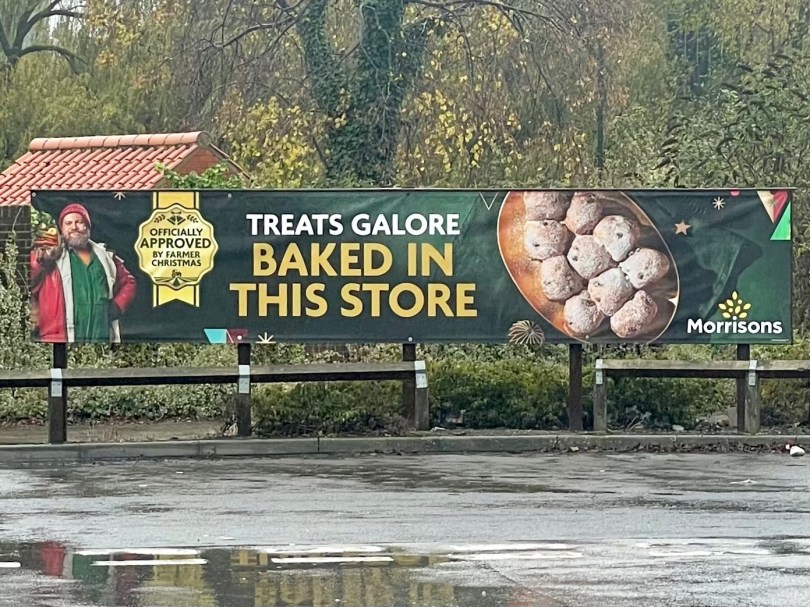
Working in the bakery at the store was an education. It enlightened me about the misleading nature of marketing, as the photo heading this blog illustrates. People might imagine that ‘baked in this store’ equates with ‘made in this store’. Little could be further from the truth. Frozen and chilled goods would arrive, produced in a factory far, far, away. The purpose of the bakery was to finish these products while filling the store with the comforting aroma of freshly baked bread.
As Christmas approached I opted for two overnight shifts. This only ever happened at Christmas. On the nights of 22/23 December, and 23/24, one baker and I staffed the bakery on a shop floor devoid of everyone bar a security guard or two (these were the days before 24/7 opening). The purpose was clear. Anything wrapped after 00:01 hours bore the date of the day yet to dawn. By 8 am whole stacks of baked goods were on the shelves ready for the deluge of shoppers eager for their festive essentials.
At this time of year special foods are synonymous with the season. Dodgy adverts also tend to proliferate, and we are lured into imagining that this gift, or fragrance or food, will enable us to have the perfect Christmas. More often than not, these illusions arrive part-cooked, and never deliver everything the advertising appears to promise.
Bethlehem comes from the Hebrew name ‘Bet Leḥem‘, meaning ‘House of Bread’. In the Bread House Jesus is made human, with all the pain and risk that any birth at that time might occasion. Wesley may be right, following George Herbert, that here is God ‘contracted to a span’, but incarnation isn’t the creation of a bite-size divinity. In Bethlehem and after Bethlehem, Jesus is being made flesh, and fashioned into the saviour he becomes. Bread that will feed the hungry and energise those seeking justice, but sticks in the craw of vested interests, and those bent on retaining privilege and power. I’m not always sure that the Church is advertising accurately the kind of God-incarnate who is ‘bad news’ for some, and a stumbling block to others.
But the child that is Noble and not Mild He lies in his cot. He is unbeguiled. He is Noble, he is not Mild, And he is born to make men wild.
Stevie Smith (1902-1971) From the poem ‘Christmas’
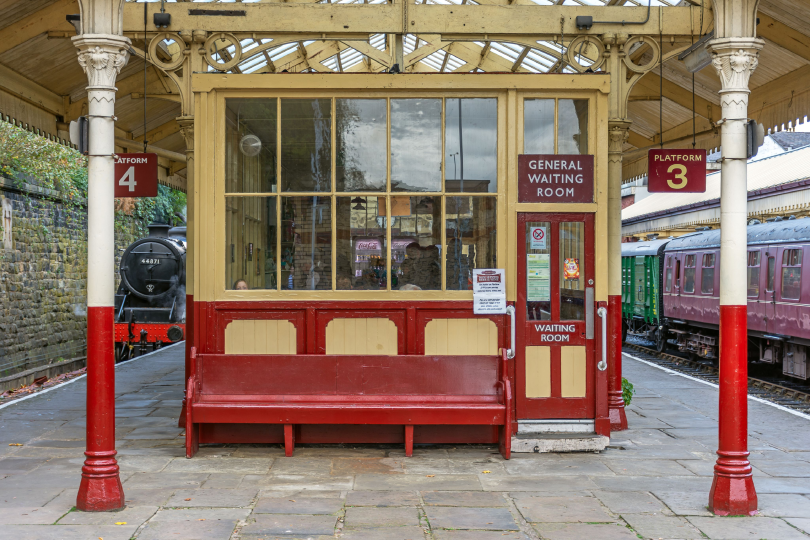
While standing on the platform, expecting a train to Machu Picchu, I noticed the sign to the waiting room. In Spanish, a waiting room uses the word associated with hope (‘la esperanza’): it is the ‘sala de espera’. At times it can feel in the UK that ‘hope’ would be a more fitting description for a waiting room on our less reliable routes. However, it led me to ponder whether there is any real distinction between waiting and hoping. Looking up the Spanish led me to an interesting thread, which includes discussion about the Bible translations of the two terms. Although there are alternative words in Spanish, in many cases – where either waiting and hoping would be used in English translations – it is the single verb ‘esperar’ that is favoured.
Perhaps the principal difference lies in the passivity of waiting. As with the example of a train station, waiting is what precedes movement and change. On the other hand, hope can be part of the journey. The people who travel from across the world to Europe, or across the border in the USA, are hoping to find safety and a new way of life. Writing about hope and waiting in the lives of migrants, Bendixsen and Eriksen ask questions about the different ways in which this can be experienced by people in an uncertain state of seeking refuge:
“What is it that we ‘do’ when we wait for something, given that waiting is normally defined as the opposite of ‘doing’ something? In what way can waiting be converted into political resistance? Waiting does in fact entail an engagement based on anticipation – an in-order-to motivation – of an improved life. How do conceptualizations of the future influence the ways in which people wait? And what can we say about people’s capacity to act in future-oriented ways even in a condition of temporal limbo?”
Bendixsen, S., & Eriksen, T. H. (2018). Time and the other: Waiting and hope among irregular migrants. Ethnographies of waiting: Doubt, hope and uncertainty, 87-112.
In his seminal book The Stature of Waiting WH Vanstone sees in the act of waiting the unfolding of Christ’s purpose. From the moment when Jesus is handed over to the Roman soldiers his willingness to be subject to the actions of others becomes the driving force of his mission. Here, waiting is not an absence of purpose but the only way in which salvation can come.
There are many things that can incline someone to journey hopefully. Often there is a life-long dialogue between the difficult experiences that are all too real, and the hope that is far more than simply wishful thinking. Such hope is strongly connected to the now, and sees the world as it could be and should be. Because of this connection hope itself is not static, but shifts as both our understanding and desire grow. Most often it is killed off by certainties we have decided are fixed and beyond change. For anyone finding faith difficult, Ronnie Scharfman expresses both the struggle to hope, and the hope-against-hope that faith might be found in the struggle:
I have always hoped that struggling towards You is You. But I am never sure. And that is, perhaps, You, too.
Ronnie Scharfman, ‘Prayer’ in The Poet’s Quest for God, 21st Century Poems of Doubt, Faith and Wonder, ed. Brennan, O., Swift, T., and Myddleton-Evans, C. Eyewear Publishing Ltd., London. 2016
The hope of faith during Advent requires courage. It is a time when the liturgy of the Church makes no bones about the darkness and suffering of the world, or the fact that the world as we know if will come to an end. Given the multiple crises assaulting the planet at the moment this seems less difficult to imagine. Holding any hope is an act of courage – a defiance of doom and a way to connect with others who share the idea that there is a better way. Perhaps this brings waiting and hoping back together, because our hopes are seldom realised quickly, and dissatisfied waiting can be a vocal irritant to the people who block the path to change.
The Age of Anxiety is the title of WH Auden’s final long poem. Born in York in 1907, Auden published the work in 1947 and won the Pulitzer Prize for poetry the following year. Its theme is human isolation, a condition indicated to be more frequent with the loss of traditions, and established forms of religious belief. Seventy-five years after its publication the presence of anxiety, isolation and purposelessness shows little sign of diminishing. Despite the rapid advances of technology and scientific understanding during the last eight decades, we appear to have arrived at a point of heightened anxiety. Within three years we have encountered unprecedented isolation due to a once-in-a-century pandemic; endured weather conditions never known before (e.g. over 40°C in the UK); and, with war in Europe, now have a global energy crisis that shows no immediate sign of abating. If there were need to add to this dismal catalogue, in the UK a new government has added to our woes with an economic policy favouring the wealthy.
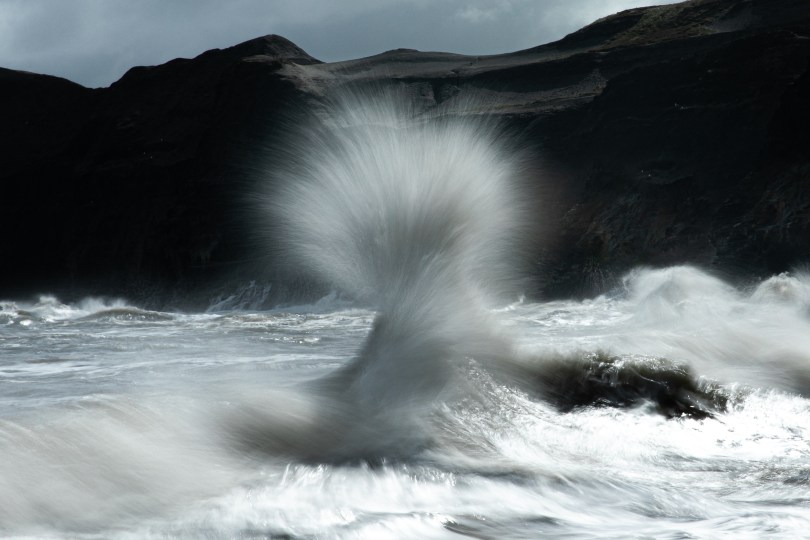
Like the breakers of a storm, the past 30 months has seen a rapid succession of events largely outside the experience of most people in the West. Anxiety has undoubtedly increased during this time, with serious and debilitating consequences. Following a research report, linking anxiety-induced dreams in middle age to the eventual development of dementia, it would appear that we even have reason to be anxious about our anxiety.
Intriguingly, some researchers have identified ‘awe’ as one antidote to anxiety. While academics have divided awe into ways that are either positive or negative, it is likely that even some of the negative implications (feeling ‘smaller’) might not be detrimental to overall wellbeing. Sometimes that experience of proportionality is only a corrective to an over-estimate of our place in the universe. As we are reminded in the Book of Job: “my days are a breath”. Seeing our significance more accurately might lessen a deceptive sense that the world around us relies on us. In that correction we may feel our anxiety diminish, although – understandably – for others this truth may feel very threatening.
“Awe seems to be a complex emotion or emotional construct characterized by a mix of positive (contentment, happiness), and negative affective components (fear and a sense of being smaller, humbler or insignificant).”
Arcangeli, M., Sperduti, M., Jacquot, A., Piolino, P., & Dokic, J. (2020). Awe and the experience of the sublime: A complex relationship. Frontiers in Psychology, 11, 1340.
From a religious perspective awe is tied to a sense of transcendence: ‘Ultimately wonder and awe are significant aspects of the religious experience‘. This is both something about a sense of perspective linked to a divine being, as well as finding in that perspective a sense of purpose. Time and again studies have found this sense of purpose plays a major part in our wellbeing and contentment. Religions usually promote a sense of purpose across the life-cycle, and continue to anticipate purpose even in advanced age (Simion/Anna). While many activities linked with personal worth and value may disappear with age (such as employment) even in the advanced years of retirement prayer and worship often remain active elements of life. For people living with dementia, especially if they have a deep background in religious belonging and participation, familiar patterns in the year (e.g. Easter/Christmas) as well as songs, liturgy and texts, locate someone in a broad narrative of transcendence.
Holding the narrative and space for religious awe has long been a role for the Church. Yet awe is not a word used often in discussions about contemporary developments in worship. This misses a primary purpose of the Church’s life in a local community. There are occasions, including State occasions in the UK, when the Church holds a particular kind of space for people in relation to a much larger story.
A church is a sacred space carved out of nature to represent the indwelling of grace and to impart an orientation. They are pointers to transcendence. When we enter a church, we cross a threshold pointing to a communion table of shared goods… Within this comprehensive orientation there are nodes or lodes of experience that open up the space of transcendence: the sense of unworthiness and rebuke in the presence of the holy, the trustful assurance of acceptance requiring nothing beyond openness to the pure gift of grace, the awareness of a calling to spiritual and moral order and a potential for transfiguration..
Martin, D. (2021). Pointing to Transcendence: Reflections from an Anglican Context. NTT Journal for Theology and the Study of Religion, 75(3/4), 310-336.
In his poem Auden suggests that human beings prefer to hang on to their fears, rather than risk change and risk: ‘We would rather be ruined than changed’. The experience of ‘awe’ is perhaps one of the few things that might encourage us to abandon our illusions and contemplate a greater reality. To realise that often our anxiety is generated by these self-same illusions, and are in reality shadows we need not flee. It has been the case that not only cathedrals, but even remote and seemingly insignificant churches, hold such a space – whether for RS Thomas in Aberdaron, or TS Eliot in Little Gidding. It is unclear in today’s church where the emphasis on transcendence now lies, or how people will be able to encounter ‘the bright field’, whose treasure transforms our living.
In a hot climate, the poet AE Stallings writes of the difficulty of locating a family grave in a cemetery. Someone goes in search of information to find the right place:
Then you came back With the coordinates, and snagged a priest Glistening in polyester black,
Who, at the grave, now found, Spoke of the rest and rising of the dead As if they were so many loaves of bread Tucked in their oblong pans In a kitchen gold with sunlight, rich with yeast.
It is the thing which shouldn’t be there. High up in the crossing above the worn-smooth stones of the Cathedral floor. It is visible across the nave of the building, raised in front of newly refurbished organ pipes resplendent in gold and bright vermilion. Millions were spent bringing this huge instrument back to a state of excellence. Every note sounding pitch-perfect, and accompanying a choir of international renown. Below the organ pipes is the screen. Elaborate stonework and gilded kings – the work of master masons long departed this world. The Cathedral harvests the best that can be had, filling this barn of a building with the finest sculptures, carpentry and glasswork. During Lent, into all this splendour, is lifted a rough-hewn cross. As basic as you can imagine, two planks of unpolished, unvarnished and uninspiring timber hanging in space below the central tower.
Liturgy, and the context it inhabits, has a knack of creating paradox. When it seems that the church has been enthralled by worldly standards, with a hierarchy of clergy, the splendour of an Archbishop or Pope is cast aside on Maundy Thursday as they kneel to wash people’s feet. All the grandeur is subverted by the truth that the least will be greatest in the Kingdom of God, and the last shall be first. Stitched into our services is the recurring message that things will not always be as we expect. God can, and does, disturbs us in surprising ways.
The Lenten cross is yet another jarring sign of this unsettling truth: just when we think everything is polished and perfect, the rough and the ready is what we need to tell us what God is about.
“But lying there long while, I, troubled, beheld the Healer’s tree, until I heard its fair voice. Then best wood spoke these words: “It was long since – I yet remember it – that I was hewn at holt’s end, moved from my stem.”
Theology could not function without paradox. Christianity is not – and can never be – something that reconciles every aspect of human experience in a divine plan. Our worship requires us to recognise and name the most difficult aspects of human living. In baptism we say that this new life will one day die. At every marriage ceremony we are reminded that the commitments are made ‘until death us do part’. There is no shying away from these fundamental truths of human life. Yet our commitment to the limits of human existence is held in tension with a great hope. A hope which, on Good Friday, we affirm even in the shadow of the cross; the Healer’s tree. We cannot disregard the injustice, suffering and humiliation of this public execution. We see it and name it.
For some people it will not be Good Friday that is difficult. Human suffering is obvious and ubiquitous. The step of faith to Easter Day is the part of Christianity that stretches their credulity. Yet for those who follow the way of Christ, our response to suffering is lit with a hope that radiates from the empty tomb. Yes, suffering is real – but it is not all.
He hung there limply on the frame, His body beaten black and blue. Exposure was the thing; humiliation, too; To which the nails seemed superfluous When all you had to do was die of shame; Quietly expire, a minimum of fuss. But what a noise you made, Silent Messiah, Your humbling death, so nakedly exposed, Conquered forum, basilica and the choir Of poets with the love you interposed.
N. S. Thompson, ‘Silent Messiah’ in ‘The Poet’s Quest for God’ Eyewear Publishing 2016
Life-drawing presents all kinds of challenges to the drawer – especially me. A fundamental issue is the need to unlearn our habits of seeing what we think is there, and focus on the reality of the subject. This requires careful attention to the relative size and scale of limbs and their disposition. For example, the face is only a small part of the head, even if our communication-centred focus leads us to privilege the eyes and the mouth. Drawing what we see as important delivers a disjointed and disproportionate view of the body.
For some time I have been intrigued by Anil Seth’s hypothesis that consciousness and our sense of self is best understood as a ‘controlled hallucination’. Reflecting on this I would be more inclined to amend the phrase to ‘collective’ rather than controlled. In every age there have been people who stood apart from a collective agreement about what constitutes a normal sense of self. Usually, they suffered for this nonconformity, even if their perspective later came to be an accepted view. For me the strength of Seth’s idea is not so much for people who share an agreed interpretation of objects and events, but as a way to explain behaviour when the hallucination is fractured. For example, with dementia, the way we order past and present might be rearranged. There is still engagement with the material world but this materiality might be significantly recast and reinterpreted. A husband and son are not recognised in these roles but instead named as the person’s father and brother. Sense-making appears to be less controlled and requires some lateral thinking in order to comprehend. In this example, in which I was involved, the person knew that these were her male relatives of different generations, but the designations were misplaced.
I noted some time ago that the pandemic has generated increasing interest in subjects such as those covered in York’s nightly ghost-tours. At the time I thought this was linked to increased mortality but in the light of a recent Guardian article I wonder if there is another reason. For example, whether the degree of social disruption has sent a significant earthquake through the ground of our perception. What was assumed to be certain was shaken, and many people are in the process of renegotiating the relative meaning and value we construct to make sense of the world. It is not necessarily the case that more people believe in ghosts, but they may be more open to the unexpected and the disruptive.
Prof Christopher French, head of the anomalistic psychology research unit at Goldsmiths, University of London, is not surprised to hear reports of a rise. “There is historical evidence for increased interest in, and reported experiences of, this kind of stuff at times of uncertainty, stress and turmoil.”
Emine Saner, ‘Spooky Britain: how ghosts became a national obsession’ The Guardian, 6 April 2022
How we draw a head, or how we order our experiences of the physical world, may not be as accurate as we would like to think. A significant aspect of religious experience is that the way we accept the world should be questioned and challenged. Today, Palm Sunday, is a day when the Church marks the start of a week in which the presence of Jesus questions a whole range of assumptions. Entering Jerusalem on a donkey, the expectation of sovereignty is placed in a posture of humility and service. This is a King who is not here to stamp authority on a subjugated people. Perhaps more potently, his action in washing the disciples’ feet on Maundy Thursday puts the teaching into action. Jesus’ words and deeds subvert the accepted relationships in society and open the possibility that we see and embrace a more proportionate understanding of our place in the world. A place where we see properly the people who are often peripheral to our vision; recognise our illusions of independence for what they are; and live at peace with our mortality. The foundational stories of the Abrahamic faiths all narrate how our clarity of sight has been corrupted and distorted. On our own we cannot see aright, and embracing this awareness should foster some humility and co-dependence as we seek to determine how best to live.
Outside York Minster on Palm Sunday 2022, the Processional Cross is ready to be lifted high
Christians live with a conviction that the world is not as it should be. The idea of the Kingdom of God points to an altered reality where a different kind of society lives in peace and justice. Having this belief may inspire discontent with the world as it is, as well as energise activity to aid this Kingdom emerge fully into our personal relationships and local communities. In this much there is hope, resisting the temptation simply to accept what is in front of us and ‘labour for what does not satisfy’ (Isaiah 55:2). When it is fully alive, the Christian story challenges false power by its persistent presence and emphasis on servant leadership. It questions those who misuse religious authority, and stands in profound silence before Pilate. At the end of this week those who oppose the petition ‘your Kingdom come’ find that even the certainty of a sealed tomb is not enough to extinguish this outrageous hope.
Last Sunday, as I begin to fill in the Register at a church where I’d just lead a service, my fountain pen broke in two. It was quite dramatic. Large blots of black ink formed on the page; my hand was doused in the stuff; a small amount pooled onto the floor. As far as possible, using tissues and wipes, I remedied the damage – but left an indelible mark of my (first!) visit to the church.
Returning home I turned to Google to see if I was alone in my experience. Apparently not. This trusted model from a good brand was known to suffer the occasional failure of a welded section, causing the split I had just experienced. I also learned that it is reparable, and during the week I parcelled up the parts to send to a UK agent for assessment and onward travel to Germany. Like many items we might have as we get older, not only was it – until this point – a reliable mainstay of my writing, it was also a gift from my father for my 50th birthday.
Although I have only caught glimpses of the BBC series The Repair Shop, it isn’t difficult to understand the popularity of the programme. Things that have aged and become damaged are brought back to their former glory. Through the process of repair we are connected with the past as heritage skills are used by the experts to restore the items. Of course, in the process, the person who has presented the treasured artefact tells us the story about its origin and arrival with the current owner. Often these accounts will involve bereavement and the role of the heirloom has a tangible connection with a vanished world.
It may be that this programme appeals to younger people – but I suspect the larger audience will be at the older end of the scale. People who have inherited items or been gifted them by friends or relatives when inevitably downsizing as the years advance. Perhaps some personalities are more invested in such things than others, but I imagine that almost everyone can recognise the feeling that an item from the past evokes a sudden sense of connection to a world where we once lived, and which is now past. Watching Kenneth Branagh’s Belfast last night led us to remark that it was like watching our childhoods, not because of the circumstances of growing up in Northern Ireland, but because of the consumer products, Christmas decorations, gifts and furnishings that were featured in the film.
Now in his late 80s, the unconventional former leader of the Episcopalian Church in Scotland, Richard Holloway, has been reflecting on melancholy in his latest book, The Heart of Things. Holloway’s writing in recent years has been a great blessing, not least because he is sharing with us considerable insight, intelligence and feeling from what might be called ‘the front line of later life’.
“Melancholy has become a kind of grateful sadness at what life has given us but which we can never cling to, because it is constantly passing, disappearing into the past. Melancholics find it impossible not to keep looking back at what time has wrought as it slips away behind them like the wake of a ship”.
Richard Holloway, ‘The Heart of Things: An Anthology of Memory & Lament’ Canongate 2021 p. 9
It is little wonder that so many of us enjoy repairing things from the past and re-lustering what has become dull over time. Through these physical fragments of heritage we achieve something we know is impossible for ourselves. We can pass on these keepsakes in near mint condition, while recognising that we share with their first users the reality of our own change and ultimate demise. Like Holloway, I don’t find this a depressing thought, and will be glad to receive back my fountain pen in one piece and use it for a while longer.
Religions typically invite their adherents to avoid investing excessive attachment to things. Whether it is putting wealth into barns or clinging onto power, the behaviour of Jesus in the wilderness is to reject the beguiling shortcuts to food and sovereignty. In his life and teaching Jesus makes clear that false attachments become a barrier to a spirituality that endures. We can live well with ‘things’ but need to be mindful that everything is lent to us for a time. Jesus doesn’t reject possessions entirely, but questions what his hearers ‘treasure’, aware that material things are not eternal. Living at ease with an awareness of irretrievably passing time can help us all live each day well. It is folly, like the example of Cnut, to think that the sands of the hour glass can be diverted or prevented. We live within their falling, and might live better lives if we were at peace with this reality – and our custody of things for a season.