Gates Drawn Apart

On most days we are heading towards either the longest day or the shortest day. On two days each year the world turns, and we are – for a moment – at the extremity of our shifting balance of night and day. The Church traditionally parked St Thomas on the day of greatest darkness. Perhaps a choice designed to support the idea that too much doubt can only lead into the night, so we better get our beliefs in order and welcome the returning sun.

I love the seasons, and regret that our colder days are fewer and farther between. Heat lasts later, and returns sooner, as we reap the consequences of human folly. The climate is a delicate mechanism and we have placed too great a burden on its capacity to absorb the punishment we mete out every hour. Thankfully, the reliability of the winter solstice is a reminder that while we might be intent on ruining the invaluable gift of our natural world, we cannot touch the vast expanse of space that doesn’t give two hoots whether or not humanity is intent on destroying its habitat.

Let us continue to enjoy it while we may, and do whatever we can to reduce the changes taking place. Part of my delight in the seasons lies in the subtle presence of another season buried in the one that precedes it. We have hardly entered December and the corkscrew hazel has finally shed its last leaves, revealing the tortuous structure of branches to which it owes its name. However, at this very moment, the catkins that will flourish in March have begun to appear. In branches that hold the darkness of winter, and twist hither and thither, the marks of spring are already written.

It was this interrelatedness of our seasons that became the central idea of a story I wrote in anticipation of our daughter’s birth, 27 years ago. It was the only time I worked on anything like this with my late father, as he provided illustrations for a story to celebrate his grandchild’s birth. We produced this simple book by photocopies and an office printer, happy to keep this piece of work purely for the family. His original artwork was framed and became a beautiful reminder of his joy in Abigail’s arrival.

As we journey through the final week of Advent, and some in the church will mark the feast of St Thomas, the season reminds us that time itself will one day cease. That all will be gathered in, and the work of the world will be done. As each season is intimated in the days of another, so the end of all things is bound up in the transitory lives we lead. For those who hold the light of faith this is not a doom of destruction but a making whole; a healing of every hurt; the final coming home of a humanity that has endured the final agonies of its own folly.

This year time’s nature will no more defeat you,
Nor all the promised moments in their passing cheat you.

This time they will not lead you round and back
To Autumn, one year older, by the well-worn track.

This year, this year, as all these flowers foretell,
We shall escape the circle and undo the spell.

Often deceived, yet open once again your heart,
Quick, quick, quick, quick! – the gates are drawn apart.

Part of ‘What the Bird Said Early in the Year’ by C.S. Lewis

In the Midst

Increasingly I find Radio 4 a disturbing listen. Not because the content is controversial (usually), or offensive, but because every time I switch it on I realise how much I don’t know. Whether it’s In Our Time, or some other consideration of a niche topic, I’m made aware of the vast range and depth of human knowledge about which I was oblivious. One example of this arose last week, listening to the Seven Deadly Psychologies. While I certainly have views about why greed is bad, this programme delved into the mechanics of why this might be the case. In the discussion there was a fascinating debate about the fact that, generally speaking (but with notable exceptions), research has demonstrated that rich people have less empathy and compassion than poorer people. In charity, the poor overwhelming give away a significantly higher proportion of their wealth when compared with the financially advantaged.

One reason offered to explain this was that wealth meant people became more distant from communities. It was not possessing a fortune per se which caused this lack of compassion, but the acquisition of space. The consequence of an exclusive lifestyle is that it removes us from close company of our ‘fellow-passengers to the grave’, to quote A Christmas Carol. In turn, this increasing remoteness appears to dull the understanding of the thoughts and feelings of other people. Richer people often feel entitled to their wealth – and perhaps see poverty as simply other people’s failure to accrue resources. Perhaps some of the present UK Government should listen to this episode.

A crowded nativity scene in St. Hippolytus Pfarrkirche, Zell am See, Austria January 2023

While wealth and power no doubt brought King Herod a significant ‘exclusion zone’ this can hardly be said of Jesus. The narrative of the nativity describes a Bethlehem bursting at the seams. In the traditional portrayal, Jesus and his family are cheek by jowl with the beasts of the stall; receive a stream of uninvited visitors; and find themselves in a town where every bed is taken. Lack of worldly privilege ensured that Jesus grew up close to a wide variety of trades, in a community where modest livelihoods required people to cooperate.

Sovereignty in a cattle stall is one example of the paradox that runs through the Christian story. If wealth dulls our capacity to be compassionate it can also diminish our ability to recognise a God who expresses a preferential option for the poor. A God who, in Christ, is able to hear the plea of the Syro-Phoenician woman; the prisoner on the cross; the dilemma of the rich young man. Only when the Word-made-flesh pitches its tent in the heart of humanity is the gulf between God and creation closed. Ultimate power and splendour, commanding more space than we can ever imagine, chooses to renounce entitlement and make the ultimate identification with humanity.

For Dietrich Bonhoeffer the paradox lies partly in the idea that this God is not seen easily by those who have the most resources, or education, or stability in their lives.

“The celebration of Advent is possible only to those who are troubled in soul, who know themselves to be poor and imperfect, and who look forward to something greater to come.”

Dietrich Bonhoeffer

Knowing our need for one another, and our need of God, is a prerequisite for our spiritual growth and maturity. It is one of the reasons why Advent is an uncomfortable season. Many of us recognise the greed we feel for our own space, and to have the freedom to do as we wish. Community implies compromise and association, experiences which appear to have fading appeal in the West. However, to know God seems to require us to be immersed in the dependencies of human society – a truth which both Advent and Christmas impress upon us each passing year.

Advent’s Bitter Chill

The cold has come. In an era of climate change there is no guarantee that winters will bring us frost or snow – at least, not for any extended period of time. Parson Woodforde, an undistinguished parson in a small rural parish, would have been consigned to oblivion except for one unusual practice: he kept a diary. Woodforde’s world of the 18th century witnessed some of the final decades of the Little Ice Age, which began around 1300 and lasted until 1850. It is quite likely that the Christmas we call ‘Dickensian’ holds some folk memory of the unusually bitter weather that occurred before the Victorian era got into its stride. Woodforde’s winters are hard to imagine given our experiences today.

“We breakfasted, dined, &c. again at home. Very hard Frost indeed, last Night, froze above Stairs in the Stair-Case window quite hard. It froze the whole day within doors in a few Minutes – very severe Weather indeed – So cold last Night that it was a long time before I could get any sleep at all… We were obliged to have Holly-branches without berries to dress up our Windows &c. against Christmas, the Weather having been so severe all this Month, that the poor Birds have entirely already stript the Bushes.”

Christmas Eve, 1796

Perhaps some of us have childhood memories, before double-glazing and central heating, which include times when there was ice on the inside of the windows. However, on the whole, better insulation and heating – combined with climate change – mean that fewer of us experience this degree of harshness in winter. In a different age, Woodforde’s diligent pastoral ministry was no doubt challenging and costly. It also had its rewards and, however difficult it might have been, the clergy were better-off than the vast majority of their parishioners. The question for many of them was how to live in the style they associated with being a gentleman, and living in houses which towered above neighbouring dwellings. Nevertheless, there is a lovely detail in the diaries of how the parson’s diligent ministry was recognised with anonymous generosity:

“Had another Tub of Gin and another of the best Cognac Brandy brought me this Evening about 9. We heard a thump at the front Door at this time, but did not know what it was, till I went out and found the 2 Tubs – but nobody there”.

Woodforde, J. (2011). The diary of a country parson, 1758-1802. Hymns Ancient and Modern Ltd.

I’m not sure what quantity of liquor a tub contained but I’m confident it would have kept the parson and his guests well supplied during long winter evenings.

It is into this growing darkness and falling temperatures that Advent arrives. With Christmas Eve landing on a Sunday, this is the shortest period of Advent the calendar allows. Across the three frenetic weeks before Christmas the season urges reflection on sombre themes. Calling into a supermarket in the middle of York the other day, a member of staff on the till commented that it was so busy ‘you’d think the world was about to end’. Ironically, this may be the point where the extremes of consumerism and the message of Advent collide.

Worlds end all the time. In Gaza children have spoken about how they simply want things ‘to go back to the way they were’. Not that this was ideal, but there were homes, families, stability and some kind of future ahead. For them a world they knew has come to an end, in a way that is devastating. This is true across every theatre of war, where destruction is easy and instant – and building a meaningful future is slow, arduous and uncertain.

Advent can bring a chill that serves to focus our thoughts on the cost of these ongoing end-times, and the task of holding a light when surrounded by a cynicism that gives way to darkness. The cold reminds us of the need for homes, and the suffering of people who lack shelter, support or the means to find warmth. Advent tells us the sobering news that all we take for granted is only temporary, and we must be stirred and watchful for the moments God’s light breaks through. Parson Woodforde offers us perspective about the enduring nature of crisis. On Advent Sunday 1797, he wrote that ‘the present times seem to prognosticate e’er long very alarming circumstances. No appearance of Peace…’. To hold an improbable light in this fearful darkness is the work of Advent – and it is certainly needed no less today than it has been in centuries past.

Common Sense

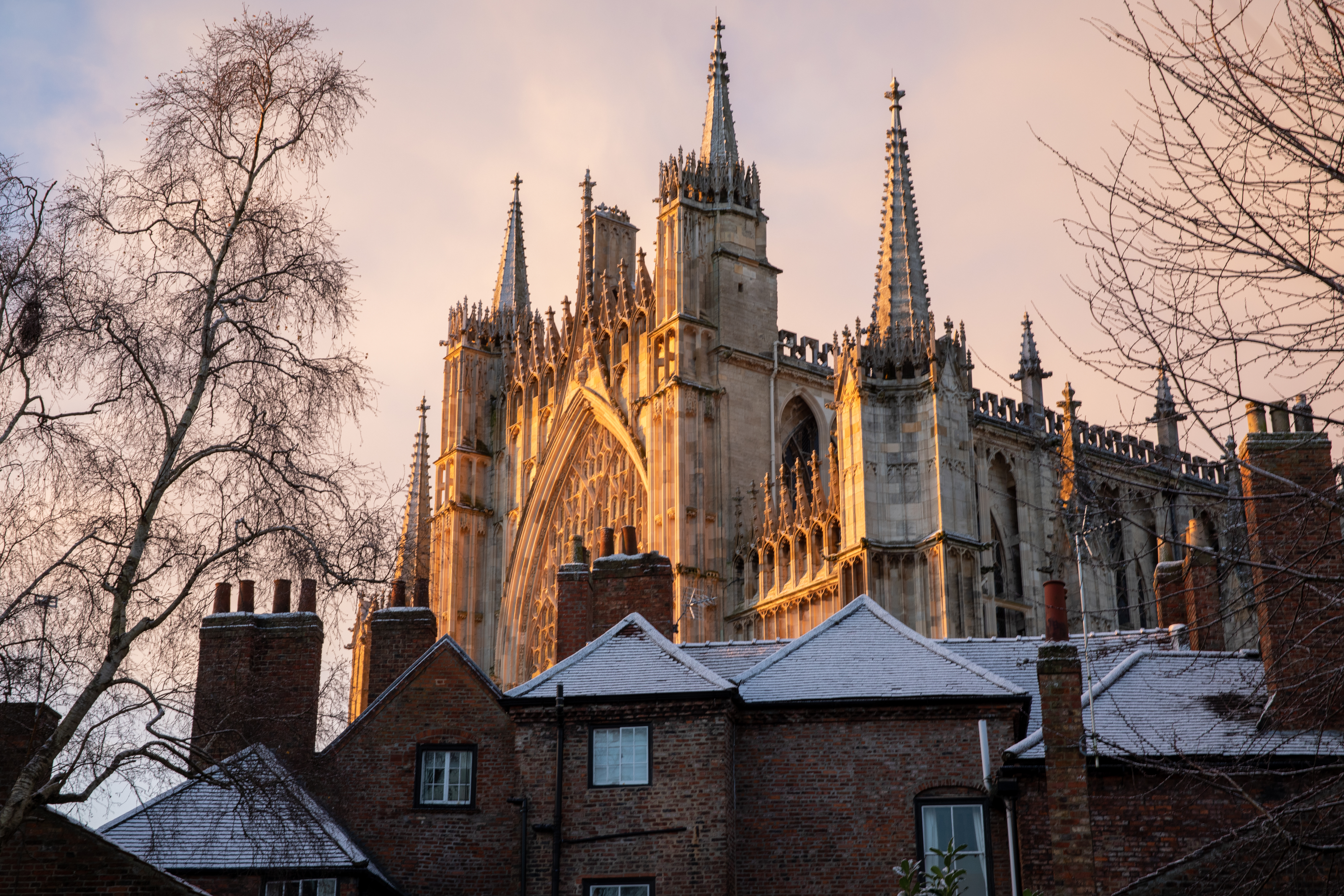
In the 18th century the fortunes of the city of York, along with its Minster and clergy, were enjoying a rise in both wealth and status. This led to the creation of prestigious new buildings, sweeping away some of the more mundane Medieval dwellings. This was a time when the buildings surrounding York Minster began to change with dramatic effect. Demolishing – and in some degree, incorporating – 15th century cottages to the north-east of the cathedral, Dr William Ward built himself a fine Georgian townhouse (pictured). He was the chief legal officer (‘commissar’) for the Dean and Chapter of York, a role which brought many pecuniary benefits. The new house was a fitting expression of his wealth and status.

The role of ‘commissary’ brought both influence and financial reward. There is every indication that Ward used his position to become wealthy and further the ambitions of his family. His daughter, Sarah, married a baronet and become Lady Fagg. While little is known about Ward, like many gentleman of his era, we know that he had a significant personal library. This is indicated by an Item in the late lawyer’s Last Will and Testament in which he bequeathed to his wife and daughter, ‘Forty English Books each such as they shall chuse out of my Library excepting the large Bible’. Perhaps foreseeing that this could lead to some dispute over which books each should have, Ward adds: ‘my wife to have the first choice’. In all likelihood the large bible would have passed to his son.

The wealth of legal officer such as Ward was built on a considerable degree of misery. Misery, that is, for the poor souls who came before the ecclesiastical courts. The leading Sterne scholar Arthur H. Cash described these courts as:

‘weak remnants of what had once been a terrifying Protestant inquisition’

Cash, A. H. (1971). Sterne as a Judge in the Spiritual Courts: The Groundwork of A Political Romance. In English Writers of the Eighteenth Century (pp. 17-36). Columbia University Press.

The main purpose of these courts was to deter pregnancy outside wedlock. It often led to both fines and public humiliation. It is hard for us to understand the level of pastoral disregard and cruelty which this system could produce. For example, Cash cites an incident where Robert Milburn was tried in 1753 in the village of Alne, just north of York, for antenuptial fornication ‘with Jane his wife, now dead’. It is little wonder that these courts were abolished or that clergy came to have a very mixed reputation through their enthusiasm to become judges. It provides some insight about how Lawrence Sterne came to be so familiar with a range of conduct and human emotion. Perhaps the perceived bawdiness of Tristram Shandy owes something to the process of examining cases that were brought to the courts by church wardens. In addition to his responsibilities as a parson, as the son of an army officer; a sometime farmer; and a judge in the courts, Sterne must have heard and seen a wide spectrum of life. Additionally, as a frequent visitor to nearby York, he was also connected to middle class mores and cosmopolitan life.

Perhaps William Ward’s main claim to fame is that his death precipitated a decade long dispute between the Dean of York and the Archbishop’s chief legal officer. It was a disagreement concerning the many legal roles which Ward had occupied and how these were to be inherited on his death. The Archbishop’s legal officer believed that the Dean had promised them to him, a promise on which he claimed the Dean reneged. Finally, after heated public exchanges between these two worthies, the situation provoked Laurence Sterne to publish his first significant literary work – a satire on the dispute entitled ‘A Political Romance’ or, as it is often known, ‘The History of a Good Warm Watch-Coat’. It was so accurate and effective that the Archbishop of York instructed all copies to be returned and the entire stock to be burned. Thankfully, at least six people either didn’t get the memo, or they decided not comply with the instruction.

Which brings me to common sense. Looking back it is easy to name the intolerable cruelties of another ago, or of a different place and people. In the style of Jonathan Swift, Sterne brings to the dispute a creative reframing that allows people to see their conduct in a different light. What may have appeared to be an obvious and inevitable response, suddenly becomes more complex and questionable. Creative writing invited the reader to wonder about the behaviour of those involved and the apparent inevitability of the dispute that unfolded. In many ways Sterne was an actor within events that seemed natural and necessary – and in the end he inherited some of Dr Ward’s legal responsibilities. However, he was also able to see beyond the near horizon of common sense and question the relationships and conduct which were doing little to promote the reputation of the church. Common sense in one age can appear as outrageously cruel in another – and I hope that in her new role of ‘minister for common sense’ Esther McVey will recognise the provisionality of her brief. The common sense of one group in society may be seen very differently by another group. Unless handled with the greatest of care, common sense can conserve and perpetuate some of our worst practices and behaviours.

  • The illustration of Dr Ward’s house, Chapter Yard, York, is by Allan T Adams BA FRSA FSAI

Satire in Disguise

The statement that ‘the parish system began to break down’ sounds like a commentary on the C of E in the 21st century. In fact they are words written about the church in the 18th century, taken from an article concerning religion and satire, by Misty G Anderson. It is a salutary reminder that the Church of England has experienced several phases of breakdown since the reformations of the 16th century. Anderson identifies satire as one of the most effective ways in which a highly privileged institution could be critiqued in public. This is because satire never makes things explicit, but relies on the audience’s existing awareness of the gaps between official rhetoric and the reality of practice.

‘Praise undeserved, is satire in disguise’

William Lisle Bowles, Alexander Pope (1820). “A reply to an “Unsentimental sort of critic,”: the reviewer of “Spence’s Anecdotes” in the Quarterly review for October [i.e. July] 1820; otherwise to a certain critic and grocer, the family of the Bowleses!!”, p.15

Satire always treads a fine line in achieving its effect. William Hogarth was warned that one of his prints risked being seen as an attack on religion itself – rather than the excesses of people’s interpretation. The definition of satire is far from easy or clear. On the whole it describes an artistic form which is intended to portray human behaviour in a humorous light, in order to make a political point or amusingly imply that a purported behaviour or action is susceptible to other (less attractive or virtuous) interpretations. Hence satire has often engaged with religions and religious practices to query the motives involved or the disparity between piety and more dubious practices. Many years ago I scripted a weekly cartoon that ran for a couple of terms at the theological college I attended. It was one way in which the weight and seriousness of ordination training was presented in a playful and creative light. It was quite popular.

Andix the Ordinand’ appeared as a six frame weekly cartoon for a couple of terms at Westcott House – recounting the adventures of the Scandinavian student and often satirised College customs and practices. Drawing by the John Brown.

Sadly, the C of E now appears to be so peripheral to much of society that it is seldom the subject for satire. As Gore Vidal observed, satire only works if you know the thing being satirised. Possibly due to the influence of the excellent Ian Hislop, Private Eye continues to identify some of the absurdities and failings of contemporary religion – but I imagine that the amount of print given to this has shrunk in recent decades. Indeed, more recently it has felt that the institution is satirising itself. In the last few weeks a message appeared from the Church of England’s main ‘X’ account heralding the opportunity to order a ‘new Christmas Advent calendar’. For a church where so many leaders try to maintain the distinctiveness of the Advent season this was a startling home-goal. The serious themes of hope, peace, love and joy surely deserve their own space for reflection and action this coming Advent?

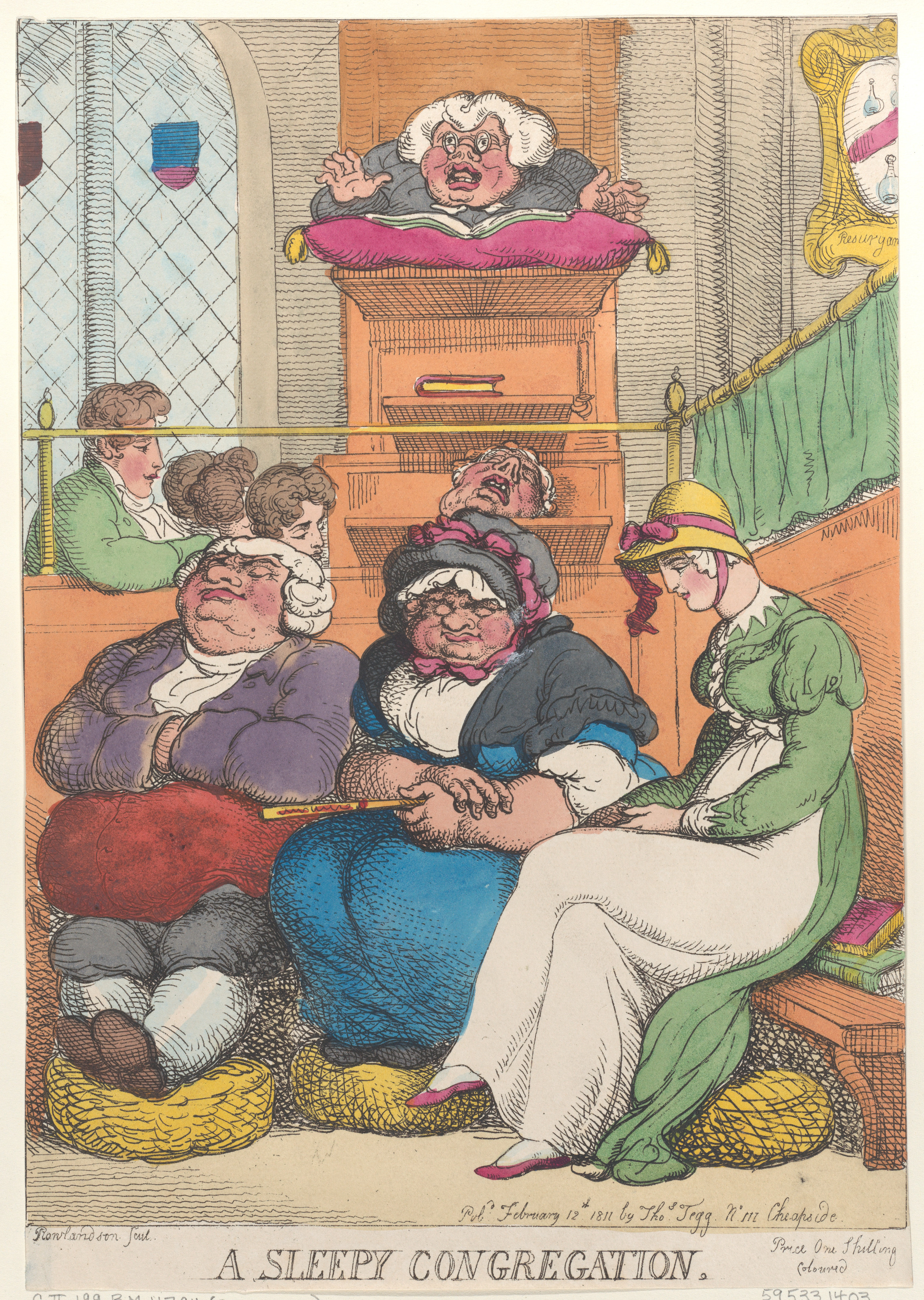
A Sleepy Congregation by Thomas Rowlandson is licensed under CC-CC0 1.0

There is, of course, the risk that satire is misunderstood or taken to be factual. In the past this has led the Church of England to publish a clarification. However, at its best, satire teeters on the edge of credulity precisely in order to accomplish its task. We see something – or read something – and need to take a second look. Could that be true? In this way satire has prophetic qualities, pushing an argument or behaviour one stage further and, suggesting that what may now be humorous, could soon become a reality. Perhaps a Church of England that surrenders its presentation entirely to generic marketing would start conflating festivals and shape the church’s life to follow without critical or theological enquiry whatever sells?

A healthy church should encourage the satirists. It doesn’t help if people are too holy to be human or so caught up in self-importance that they fail to understand how marginal (or non-existent) the Church is to so many people in England. Satire is the humour which is perhaps more than any other, ‘of the moment’. It only works, if it works at all, because it touches on the conceits and follies of a particular time. For example, who can listen to the UK-Covid-19 Inquiry enquiry and not feel that people living and working in Number 10 must have known the vast gulf that existed between their public statements and what went on behind closed doors? Clearly some did. When executed well, satire may help steer the church and the world into more authentic territory – and make us smile and wince in equal measure.

‘You can’t make up anything any more. The world itself is a satire. All you are doing is recording it’


Art Buchvald

Civilisation

Tied with sackcloth strips, the ears of wheat on the pew ends at Marton in the Forest appear timeless. A small token of thanks for a harvest safely gathered. In the rich land of North Yorkshire, where fields now bare the dark earth of recent ploughing, there is an atmosphere of plenty. No doubt there have been difficult years, and times when the crop has been reduced, but seldom will it have failed completely. It is a lush landscape through which countless streams murmur contentedly. Nevertheless, there has been change. In place of homes occupied by agricultural workers the villages have been gentrified with people in high-end professions, many no doubt enjoying home working in the post-lockdown world. Even in modest Marton there is an ‘Old Vicarage’, from a time when even the smallest community boasted (or endured) a parson.

Lack of food has led to human migration as long as humanity has existed. The Bible is full of such episodes and, in the Book of Ruth, it is famine that leads Naomi to go into the land of Moab with her husband Elimelech and their two sons. It could not have been an easy decision. Many commentators describe the relationship of the people of Israel and the people of Moab as one of ‘hatred’. Nevertheless, the family not only survive but the sons marry two of the Moabite women. Again, probably not something done lightly, but perhaps a small sign of the possibility of better relations emerging between the two peoples. Sadly, Elimelech and their sons perish and Naomi, and her two daughters-in-law are alone.

In an era when links to male family members was so important for security and subsistence this all-female household appeared to be untenable. Naomi decided that they must split up, each returning to their wider families. For Naomi this required a journey to Bethlehem while for the daughters-in-law it meant staying in Moab. One accepts this option; but not Ruth. Ruth comes to realise that if she wishes to remain loyal to her husband and in-laws it will require a decisive change of belief. We have no idea from the book how differences in religious faith were handled within the marriage itself but, at this point, Ruth gives voice the profundity of her decision:

““Do not press me to leave you,
            to turn back from following you!
Where you go, I will go;
    where you lodge, I will lodge;
your people shall be my people
    and your God my God.
Where you die, I will die,
    and there will I be buried”.

Book of Ruth, Chapter 1 . 16-17
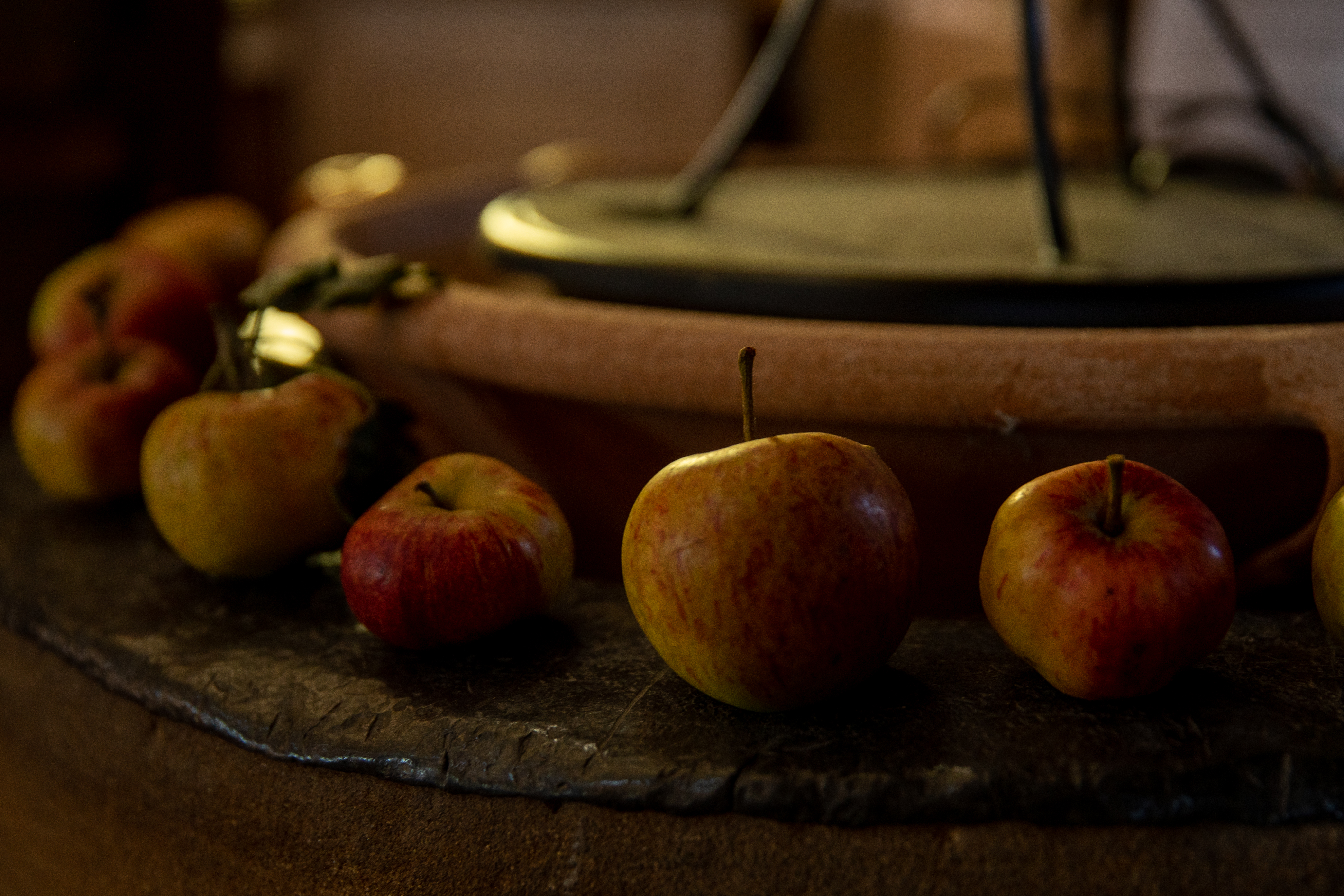
Harvest apples around the font at St Helen & the Holy Cross, Sheriff Hutton, October 2023

Remarkably, when the pair arrive back in Jerusalem, Naomi appears to overlook this astonishing daughter-in-law. Naomi announces that she has come back ‘with nothing’ and changes her name to Mara, meaning bitter. Accepting that they are at the bottom of the economic order, gleaning becomes the only way for them to both survive and secure a future. Gleaning was an activity for both gaining food and also for initiating relationships. The women might choose which group of young men to follow in their reaping and, as food was shared, so courtship began. Carefully, Ruth chooses to follow the older and wealthier Boaz rather than to fraternise with the younger reapers. Eventually this leads to marriage with Boaz and the birth of a son, something the women of Bethlehem assure Naomi will be: ‘a restorer of life and a nourisher of your old age’. These same women then tell Naomi, who came back ’empty’, that Ruth ‘is more to you than seven sons’. In the patriarchal society of the time this is an astonishing testimony.

Yesterday I conducted the wedding of two young people. At the end of a week filled with so much horror, hatred and destruction, it felt like the lighting of one small candle in the midst of darkness. Weddings feature a number of times in the teachings of Jesus, and they serve as an image for the Kingdom of Heaven. They bring together communities, recall the past, and chart a path to the future. They are often occasions to cement links between families and for everyone to pledge their support to the couple. However, for marriages like the one at Cana in Galilee to take place, a degree of peace, prosperity and security is required. These circumstances should never be taken for granted. As we see now, in both Gaza and Israel, there are planned marriages which will never take place – either one or both of the people have been killed. In several other contexts, the places and resources to hold a family wedding no longer exist. The threads of what make up a functioning society have been severed. Instead of a harvest there are only ashes; where joy could have been shared, there is only silence.

We have been here before, far too often, but now the weapons and technology enable hatred to do ever more damage. The ordinary things that make up civil society cannot be taken for granted. Destruction is quick and definitive – the creation of healthy communities takes much, much longer. At the moment it is hard to know how peace will return and flourish in so many places in our world. How the celebration of marriages and relationships of commitment will resume and contribute to societies of care and compassion. The first step on that journey must be the ending of hostilities, especially when innocent people become part of the collateral damage of a conflict in which they want no part. Endless violence, modelling violence to a new generation, is in the interests of nobody.

The Fourth Craw

Recently I was given charge of a baby. Thankfully this was only temporary, as mum went with her older son for the start of his first day at school. We were visiting family in Scotland and I was delighted to spend a short while with this delightful child. However, it is some time since I last looked after a baby, and this level of responsibility does not come without anxiety! In my attempts to entertain the bairn, I wondered what nursery rhymes might be familiar to him – and this is when I discovered the ‘Three Craws’ (described as a Scots classic).

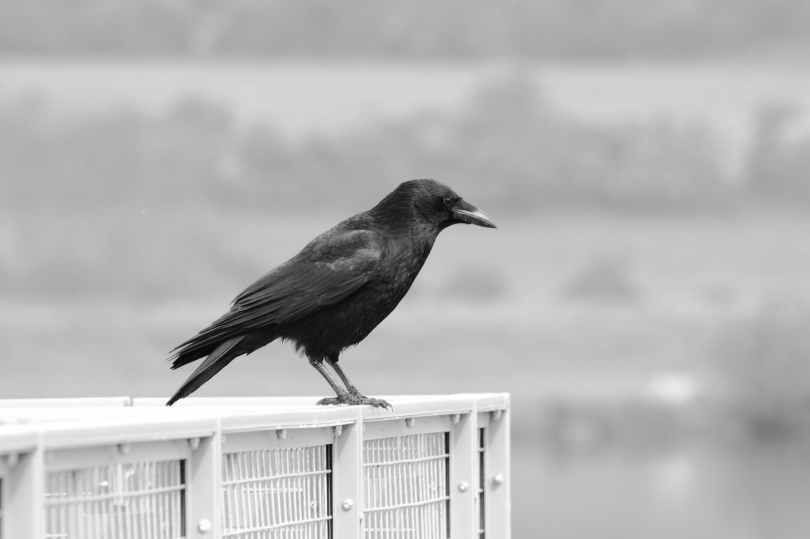
The ‘craws’ would be known in England as crows. In Scots it is a fine onomatopoeic rendition of the cry which the birds make. The craws in the rhyme are not doing very well. The first craw is crying for its mother; the second has broken its beak; the third is unable to fly. With the kind of simple repetition that makes the most effective nursery songs, each verse describes the crows sitting on a wall, sharing their woes on a cold and frosty morning. (It should be noted that the content of these verses varies, and people add their own).

At the end of one of the versions of the Three Craws, there is reference to a fourth craw – The fourth craw wasnae there at a’. It is an intriguing way to end. The rhyme is known as the Three Craws. The final craw never makes an appearance. Does this craw even exist – is it part of the gang? The song has a fourth craw, and yet it doesn’t. This bird is lacking, and seems to be the culmination of the losses that precede it. The craw missing its mother; the craw whose health has been impaired by a broken beak; and the craw unable to fly. It is an odd conclusion for our attention to be drawn to what is wholly absent.

A poetic response to this missing figure has been created by the Glasgow-based academic and writer Nalina Paul. The work is entitled The Fourth Craw and perhaps reflects the power of narratives as they emerge from the darkness of absence – the sparks of our imagination kindled by our earliest encounters with song and story:

Too much is said about night –
its fullness jug-heavy with distance
poured out into star-mapped flight.

But in the sky, protecting her addled head,
was a strange sense of grounding –
as if light were solid, for standing.

And from these things –
sparks in the high darkness
a smouldering moon –
came music, the raven’s song.

Its sound could wither the feathers of eagles
make fire from ice
play tricks with existence
changing form at a whim.

In the dim-lit great hall of glittering stories
the broken shine of the moon crackles.

Nalini Paul ‘The Fourth Craw’ 2015

The fourth craw is an absence and also an invitation. Travelling through Glencoe a couple of weeks ago I was reminded how much the landscape of Scotland fires the imagination, and has inspired many different forms of art. The colours and textures of the mountains; burns that gush with great force after the regular downpours; and trees lousy with lichen, branches encrusted in moss. Glencoe can hold a magical, childlike, atmosphere – even before it is layered with human narratives of heroism and betrayal. Sadly, as walkers and climbers discover every year, it can also be a very dangerous place.

The Three Craws suggests that, when we lament or suffer injury, being in company can make a difference. The birds are a small community of sorrow, who end by sharing an experience of the fourth bird’s absence. Even at a young age it appears that we prepare people for one of the central experiences of life, as well as providing the space for wonder, and the work of our imagination.

What is Life?

John Clare asked the question ‘what is life?’ at the beginning of his poem of the same title. It is a work that reflects the angst and instabilities experienced by this notable English poet. A figure who emerged from a family of agricultural workers, did a range of manual jobs, and came to be favoured by people of literary society. Clare’s emergence as a poet was partly driven by financial distress, and the need to generate funds to prevent the eviction of his parents from their home.

And what is Life?—An hour-glass on the run,
A Mist retreating from the morning sun,
A busy, bustling, still repeated dream;
Its length?—A minute’s pause, a moment’s thought;
And happiness?—A bubble on the stream,
That in the act of seizing shrinks to nought.

John Clare, included in Poems Descriptive of Rural Life and Scenery, 1820

Clare’s experience of life was distinct from other poets who were writing in this period. He was employed in what are often considered to be basic occupations. He would have known the relative powerlessness of his position in the social order, and how much material well-being rested on the decisions, patronage and preferences of wealthy people. The poem’s opening words assault us with a question that is both profound and also indicative of a question that has prompted the poet. It feels like a retort to someone who is pontificating about the value, pleasures and virtue of life.

The response of the poet is to focus on the ephemeral nature of our existence. Not only that, but even when we encounter a time of happiness, it is merely ‘a bubble on that stream’. If life is brief than Clare tells us that our better moments are simply an even more fleeting by-product of the water’s turbulent churn. A fraction of bliss in an otherwise downward torrent of vain hopes. In a life of brevity, happiness is a reprieve that bursts as soon as it encounters the rocks that lie all around.

I have always been rather suspicious of happiness. Perhaps that’s due to an American interpretation of it that has come to dominate our perceptions of a good time. There is a whole industry dedicated to what happiness is, and how to promote it. Inevitably, there is a lot of interest about this in marketing, where our perceptions of life can be harnessed to the priorities of consumerism. Any deficiency in our sense of well-being can become a target for products and experiences we are told will fill the void and deliver our happiness. Psychology and spirituality may often be drawn into this tension of anxiety; unsatisfactory lifestyle solutions to our needs; and consequent disenchantment. There are several ways in which happiness is identified and calibrated, such as the Oxford Happiness Questionnaire. This was influenced by the following understanding:

Argyle and Crossland (1987) suggested that happiness comprises three components: the frequency and degree of positive affect or joy; the average level of satisfaction over a period; and the absence of negative feelings, such as depression and anxiety.

Francis, L. (2010). Religion and happiness: Perspectives from the psychology of religion, positive psychology and empirical theology. In The Practices of Happiness (pp. 113-124). Routledge.

While I am sure that such tools and schemes of analysis have their uses I would question the particular concept of happiness that underpins the method of enquiry. In many respects the surveys appear to deal with a sense of well-being which is then conflated with happiness. These things are not the same. Twentieth century influences tend towards a very individualistic form of happiness, albeit that this may incorporate those people to whom we are closest. However, where is the political dimension that addresses how much our happiness (e.g. meaning, for some, to do what we want) is paid for by the misery of others? There are some researchers who have identified problems in the Western conception of happiness, advocating ‘an alternative approach, relational wellbeing, which is grounded in a relational ontology that can challenge dominant ideologies of the self’.

Religions have often had a complicated relationship with happiness. There is a recognition that, like a bubble on a stream, happiness can be momentary and elusive. As one hymn puts it: ‘Fading is the worldling’s pleasure’. Faith offers something that is not transitory. The focus is about wealth that does not decay – treasure we encounter now, but will experience fully in a life to come. There are risks with this conviction but also great possibilities. Not least, to live in some kind of peace with the world, and find value and joy in relationships. Challenging the narrow focus of ‘my’ happiness and focusing instead on our collective shalom seems a much healthier and constructive path to take. Perhaps then we might even discover that our personal happiness is what we are most likely to find we have when we have ceased to look for it.

A Bye Corner of the Kingdom

These are the words Laurence Sterne used to describe the vicarage at Coxwold. A ‘retired thatched house’ in a place remote from the concerns of even a provincial city, such as York. Perhaps Sterne did not see this as a promising location from which to change the course of world literature. It is difficult to imagine what life in a remote Yorkshire village was like in the 1700s. Far more people worked on the land, while today the holiday cottage dwellings mean occupancy fluctuates each week, and there will be seasons when only a few people inhabit the place. The population was 348 in the early 19th century – and 250 in 2021.

Despite a limited literary output, Sterne’s work is recognised for its transformative impact on the course of Anglo-Irish literature. It was an influence for James Joyce, Salman Rushdie and many others.

Sterne was adept in deflating many of the pompous debates of his time. In chapter 20 of the first book of The Life and Opinions of Tristram Shandy, where birth is such a central theme, there is a digression about the baptism of babies before they are born. The view in Catholic circles to this point had been that at least some part of the baby must be born in order for a baptism to take place. Inevitably, there were circumstances when the baby had died in the womb and where it was believed that baptism was impossible. (There is a history in northern Europe where the Church operated ‘Resurrection Chapels’ to enable the baptism of a baby which was stillborn – Swift, p.119). However, the debate that Sterne cites in this section of the book looks to marry advancing technology with the possibility that a baptism could take place before birth:

Le Chirurgien, qui consulte, prétend, par le moyen d’une petite canulle, de pouvoir baptiser immediatement l’enfant, sans faire aucun tort à la mere.

The surgeon who raises the question asserts that by means of a little injection-pipe he can baptize the child directly, without doing any harm to the mother.

Sterne, L. (1759). The Life and Opinions of Tristram Shandy, Gentleman (reissued).

In this debate Sterne is not oblivious to the dubious nature of a suggestion, in which male medics and male theologians decide that a medical procedure – with no medical benefit – will not result in any harm to the mother. In his imaginative response to this scholarly discussion Sterne takes the argument a stage further, and suggests that one way to avoid any doubt in the matter would be to baptise all of a man’s sperm. (This reflects thinking at the time that there was a fixed stock of sperm containing ‘homunculi’ – minuscule people ready to grow once in the womb). Chapter 20 concludes with the thought that a little injection-pipe could be inserted into the man (‘sans faire auxin tort au père’), between marriage and consummation, to ensure a ‘shorter and safer’ way to baptism. The reader is left to ponder whether male theologians and medics would find this a better solution.

Simultaneously this passage hints at how medical technology might affect sacramental practice, while lampooning male discussions which determine what will do no harm to women. In pushing the ideas further, Sterne discomforts his male readers – and certainly amuses his female audience – in suggesting that sticking a cannula into a penis would be more effective ‘without doing any harm to the father’. It would also provide an interesting ceremony on the day of the wedding.

St Michael and All Angels, Coxwold – where Laurence Sterne served as a priest.

If Coxwold is a ‘bye corner of the Kingdom’ it didn’t stop Sterne writing some of the most adventurous and sophisticated prose of English literature. Thankfully, The Laurence Sterne Trust continues to stimulate interest in the author’s legacy and enable artists to engage with his work. In its most recent exhibition a range of creative people have been challenged to interpret the opening words of Shandy – ‘I wish’ – to reflect on their response to the text. This vibrant exhibition is a fitting contribution to the 50th anniversary celebrations of Shandy Hall’s existence as a public museum.