Seaside in Winter

This is by far my favourite time of year to be at the coast. Walks with the dog before dawn, watching the clouds change from bruised purple to dazzling gold. Hiking later in the day along headlands and across beaches, with few other walkers about. At night a deep darkness allows the Milky Way to be seen along with the winter constellations. When it is frosty it becomes an altogether magical scene. Only once did I find myself snowed in at a seaside cottage. It is a rare event, especially in a world affected by climate change. Slowly, as the day progressed, each of the three main roads out of Whitby were closed. With nowhere to go it became a good reason to stay in and put another log on the fire.

Oyster Catchers flying in the early morning along the coast at Sandsend

Observed from somewhere warm, the winter seascapes and landscapes offer drama and space for contemplation. This is the time when monarchs in mead-halls would demand that a saga was told. Perhaps a storyteller giving voice to the rich imagery of Sir Gawain and the Green Knight or, earlier still, Beowulf. Stories that reflect the darkness and magic of mid-winter, when the slightest covering of snow transforms the world outside. Perhaps it is hard for us to imagine, in an age of instant entertainment, the majestic scope and spellbinding intricacy of these substantial narratives. Like all knowledge passed down the generations, no doubt a multitude of minor changes occurred over the years which each teller making it their own tale. Eventually, multiple written copies started to keep the narrative in a form that was more stable, and the teller’s individuality became focused on the way of telling.

The sea runs back against itself
With scarcely time for breaking wave
To cannonade a slatey shelf
And thunder under in a cave.

Before the next can fully burst
The headwind, blowing harder still,
Smooths it to what it was at first –
A slowly rolling water-hill.

John Benjamin ‘Winter Seascapes’

Fewer snowy days come in our time – although we are experiencing them in the UK as I write. Generally, winter days are milder, sometimes stormier, which perhaps makes the appearance of ice and snow all the more marvellous. Growing up my mother often said “we don’t get winters like we used to”. I didn’t believe her, thinking this was simply the effect of advancing years reflecting on memories of youth. Of course, she was right. These precious days, if and when they come, may cause disruption and difficulty as people go about their lives – especially for those who are homeless. But maybe they also invite reflection, wonder, and act as a reminder of the world we are all, to some degree, changing.

Holy Innocent

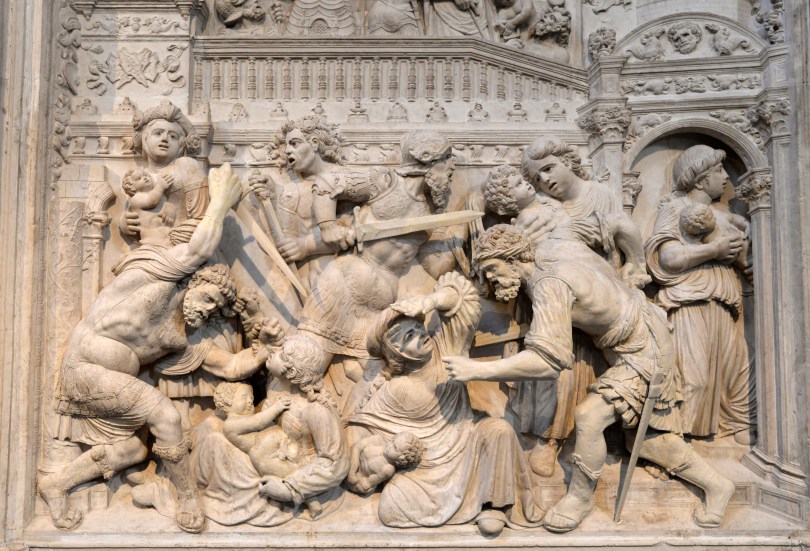
The 28th of December is the day on which the Church marks Holy Innocents. It is a day that focuses on the harrowing account in the Nativity story told by Matthew, of the orders King Herod gives to slay all male children under the age of two. Fearing the emergence of a rival, the King makes his fateful decision based on the Magi’s interpretation of the star they observed. 

Children are all too often, tragically, killed in conflict. However, the targeted destruction of the young is rare. In wartime, as we see around us in the world today, children die, are injured and become psychologically damaged through conflict. In WWII, as a consequence of indiscriminate bombing, almost 8,000 children died in the UK. The worst affected city was undoubtedly Coventry. On 14 November 1940 huge amounts of ordinance were dropped on the city leading to a significant loss of life; the destruction of countless buildings (including the cathedral); and widespread civilian trauma amongst those who survived. A few weeks’ after the attack the Dean of Coventry gathered as many choristers as he could in the ruins of the Cathedral and broadcast a rendition of the Coventry Carol to what was, at the time, the British Empire. This carol, which comes from the medieval Coventry mystery plays, recalls the massacre of the innocents. It must be one of the bleakest, most sombre and deeply moving items in the canon of Christmas music. The wartime clip from Coventry is featured in an emotional and thought-provoking episode of BBC Radio 4’s series Soul Music.

Laurence Sterne, the 18th century parson-novelist, says remarkably little about Christmas in any of his writing or preaching. Yet there is a sermon on Holy Innocents. Sterne knew from personal experience what it was to lose a child. He describes the massacre of the innocents as being:

So circumscribed with horror, that no time, how friendly soever to the mournful, – should ever be able to wear out the impressions.

When I worked in the NHS I recall very occasional instances when a mother contacted the hospital to ask about the mortal remains of their child, who had died many years ago. This arose out of the fresh attention given to the issues of organ and tissue retention, and burial practices, following the Bristol Royal Infirmary and the Royal Liverpool Children’s inquiries. In some cases mothers had given birth to a living child, who had died within a short time, and the mothers were told to go home and in essence – forget about it. They were provided with no information about what then happened to their babies or where they were buried. Records were kept, but the existence of a baby’s body in amongst an adult “shared grave” was not recorded on the headstone: unlike the adults. Once or twice I arranged to meet a mother at the entrance to the local cemetery and took her to the place where the records stated her baby was buried. I hope that, in some small measure, this helped a grief which had lain largely unexpressed for decades.

Holy Innocents begs many questions of the Church, and of the world. How could God’s miracle of the incarnation result in so much terror and destruction? Why is it that we continue to tolerate warfare that damages young lives? How do we help survivors who have witnessed unforgettable horrors? There are no easy answers to these questions. However, the presence of Holy Innocents in the Church’s calendar stubbornly insists that even while the tinsel is still hanging, the most dreadful realities of the world cannot be put aside or forgotten. They are always there and, hopefully, stir people of good faith of every religion and belief to seek peace with added urgency. Because the innocents are still being massacred today.

That woe is me, poor child, for thee
And ever mourn and may
For thy parting neither say nor sing,
“Bye bye, lully, lullay.”

From the Coventry Carol, 16th century

A Modern Nativity

As Christmas approaches, and the end of the year draws close, thank you to everyone who has taken the time in 2024 to read one of these blogs. As always, much has happened in the past twelve months, not least in those places still torn apart by violence and destruction. Our Christmas carols arm us not with weapons, but with the foolish hope of peace. The only humane, sane and holy hope which befits the dignity of creatures made in the image of God: and for whom in turn, and with astonishing grace, God chose to become human.

Oh hush the noise, ye men of strife,
And hear the angels sing!

From the Carol ‘It Came Upon the Midnight Clear’

A Modern Nativity by Miles David Moore

A noise at midnight in my garden shed
Drove the dog nuts. We stumbled out to see
A newborn baby sleeping peacefully
Inside a rag-stuffed wheelbarrow bed.
His mom and daddy stared at me with dread –
Two shabby working folks society
Cut loose. The single light bulb, hanging free,
Gathered a glow around the baby’s head.

What happened next? I’m not sure I can say.
I can’t describe just how I felt, or feel.
I heard a voice intoning, ‘You can stay’.
It offered them some blankets and a meal.
The dog stopped barking, which is not his way.
I had no earthly clue a dog could kneel.

Published in The Poet’s Quest for God: 21st Century Poems of Faith, Doubt and Wonder Ed. by Brennan, O., Swift, T. with Davio, K. and Cate Myddleton-Evans. Eyewear Publishing 2016.

Living For

I am reading a book about the history of my new employer, Leeds Church Institute (LCI). History can be fascinating, both for the strangeness of how life was once lived and, occasionally, for the sudden resonance of a view or action which appears entirely modern.

The quarter century leading up to WWI is described in the book as “the golden age” of LCI. Wealth increased for some, and for others new legislation reduced working hours, meaning that in both cases more time and resources were available for recreation; discussions; hobbies; voluntary work; or religious associations. (The text “Eight Hours for Work, Eight Hours for Rest, Eight Hours for What We Will” was paraded on a union banner in 1889). It was the time when public schoolboys and undergraduates came to Leeds to live in “settlements”, often found in the poorer quarters of the city. Of course, this could be experienced as highly patronising and there’s a powerful quote in the book about LCI’s history from an older woman in one of these areas who declared: “I do so hate being ‘lived among‘”.

As we approach Christmas her words ring in my ears and remind me that the Incarnation was more than a gap year for an earnest deity. Public schoolboys didn’t renounce their learning, connections or resources when they came to reside among the poor. They were no doubt billeted in reasonable accommodation, forming a small community of young people who shared privileged backgrounds. These communities was set in a wider context of poverty; disadvantage and squaller. I can imagine many of these settlement workers, in future years, burnishing their credentials by referring to the time they “lived among” the poor. A year of their youth that bought the claim to a lifetime of social credibility.

“For all the rhetoric of ‘citizenship’, ‘democracy’ and ‘fellowship’, the governance of the settlements, at least in their early years, was in the hands of their patrician founders rather than their ‘members’.”

Freeman, M. (2002). ‘No finer school than a settlement’: the development of the educational settlement movement. History of Education31(3), 245-262.

The Word made flesh gives up language. The babe in the manger has no worldly connection that will hoist him out of misery. The infant son of a carpenter must play with the shavings on the workroom floor, and discern his own path through all the perils and possibilities of life. He must learn words and imbibe the teachings and practices of religion. As a young man driven into the desert, the vocation of Jesus is tested in the wilderness of the world, alone with his demons. Preaching, teaching and healing as a Rabbi he will come to challenge both temporal and spiritual authorities. Standing resolute before the powers of coercion and compromise, resolved in his calling and identity, will become the path to his destruction.

This is not living among. It is living with; it is living as; and it is living for.

Christian Mechanics

When I left my previous employment I had no idea what would come next. One of my colleagues asked me: “what are you going to do?” Without thinking I replied, “God knows!” Perhaps this response emerged out of a rather hollow bravado, or a faith which was more certain in words than it was in reality. In the first instance, rather than look around for another job, I decided to have a sabbatical. These are often taken by clergy every ten years or so but, because I was employed outside the Church, I’d never taken one in the thirty years of my ordained life. In the summer of 2023, I began what became a fruitful, fascinating, and rewarding sixteen months of space, reflection and study. A friend once referred to me during this time as a “flaneur’” which I needed to look up (“someone who saunters around observing society”). Fair point.

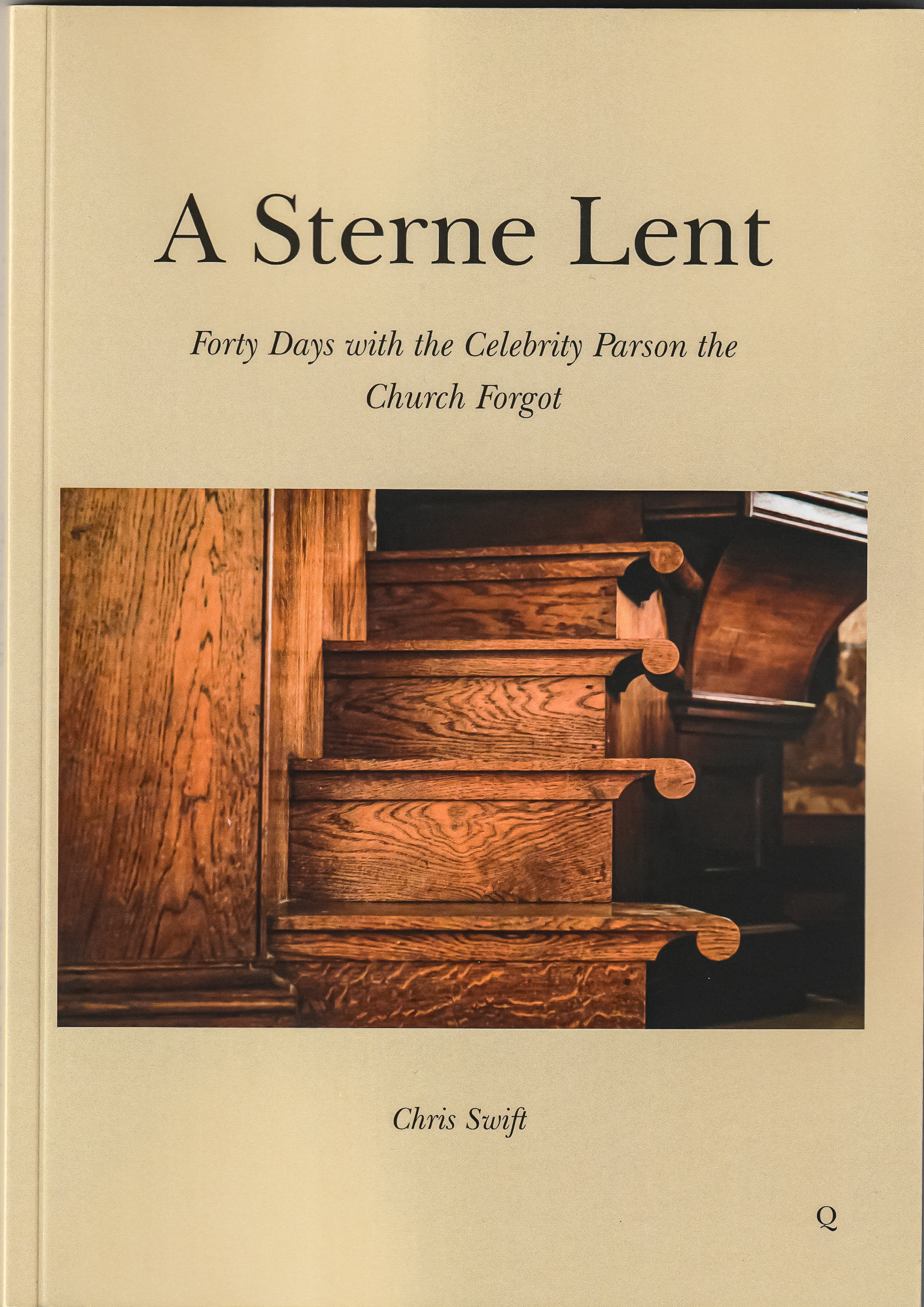
One of the fruits of this time was reading and learning more about a figure associated with Yorkshire and York Minster, Laurence Sterne. I knew of Sterne’s writing from undergraduate days and the many links with this mercurial vicar of the 18th century found in Yorkshire – not least the Shandy Hall Museum – became a focus of work to produce a Lent book. I ventured out by bicycle to visit various small churches connected to the novelist, not least Sutton-on-the-Forrest. Its pulpit steps, once used by Sterne, feature on the cover of the book.

While not looking for any permanent role, the post of director for Leeds Church Institute came to my attention. Perhaps this was the answer to “God knows”? In any event, I applied and was appointed. The Institutes were part of a movement in Victorian England which offered education and increased opportunity for people from poorer backgrounds. The first phase of these were the Mechanics Institutes. When the Rev. Walter Hook orchestrated the creation of the Leeds Church Institute it has been suggested that he was building a facility to develop “Anglican Mechanics”. In other words, to equip church people with a greater depth of knowledge about their faith and how to live it.

Arriving early on Monday morning (keen to get started) I walked around the city centre. In a small homage to the original home of the Institute, in Albion Place, I stopped for a few minutes to read the Leeds Civic plaque recording its creation. The Institute was ‘The powerhouse behind the advancement of religious and secular education on the principles of the Church of England’. The former home of LCI is in the main shopping area of the city, now decked out in all its Christmas glitz and glamour. I thought about what life must have been like there in the 1860s, when the building was opened. At that moment someone looking fairly dishevelled, who had perhaps spent the night on the streets, came and asked if I would buy him breakfast. I did. Walking a short distance further another man overtook me, apparently talking to himself, when he suddenly launched into an abusive tirade against a woman walking in the opposite direction. She stopped, I stopped, and we exchanged a look as she shrugged her shoulders and asked aloud: “what was all that in aid of?” The man continued on his way, still talking, gesticulating, and going at a good pace. Having checked that she was OK, the two of us carried on in our separate journeys.

Perhaps things have not changed as much as we might imagine since the founding days of LCI. During a phase of exponential growth in population, the philanthropists and civic leaders of Leeds faced a colossal task in addressing the basic needs of poorer communities. Today we would no doubt find their approach patronising and – possibly – coercive. The workhouses were in full operation and the poor had little access to either education or the opportunities that might change their circumstances. Walter Hook, the celebrated Vicar of Leeds, played his part in helping to found new churches and schools. His approach was allied to the principles of the Tractarian Movement, High-Church Anglicanism, but he had arrived at these independently of the movement. Unlike the dons and academics sheltering in ivory towers, Hook was the most significant figure of Anglo-Catholic reform in the parishes. Firstly, as a priest in Coventry, then in Leeds, he advanced the cause of High-Church liturgy and social action, enduring various attacks while he sought to fulfil his sense of calling. Newman wrote to him:

“You are in the thickest fire of the enemy; and I often think how easy it is for us to sit quietly here…”

Hook had not chosen an easy path, but his dedication to parish ministry and commitment to education has left an enduring legacy. It’s why LCI is still here in Leeds, in 2024, working to advance theological reflection and act as a creative fulcrum where spirituality, justice, and learning, meet and flourish. It’s mission remains both a daunting task, and an exciting enterprise.

  • At the head of this Blog: Old and new together – Dock Street, Leeds, close to Leeds Church Institute

This Mortal Life

Pitched into the bleakness of winter arrives the season of Advent. In the northern hemisphere the beginning of Advent accompanies the slow march into darkness. Shorter days; longer nights; a steady drop in temperature. The themes of Advent – death; judgement; heaven and hell – match the somber mood of gloomier days. Threaded through topics of great moment, the story of the incarnation is pulled ever nearer. Alongside the readings in church of end-times and apocalypse, every village, town and city displays the brightness of festival lights. The cynical and despairing may shun these illuminations as simply a commercial gimmick; the cold work of retail-marketing to boost sales in a flagging economy. Yet for many of us, somehow, the glimmer of hope these lights celebrate, the baby lying in the crib, can never be given its proper price. There is something here, something to which Advent leads, which can’t be contained by the measure of this world, or our desire to conform everything to our own likeness.

It can often feel, as it does this year, that there is temerity in setting out lights as the nights draw in. How dare we suggest, imply or hint, that something might come to defeat the darkness? It is the ridiculous hope written down by John in the Prologue to his Gospel: “The light shines in the darkness, and the darkness comprehended it not”. Like Handel’s taunting rendition of St Paul’s words asking Death where its sting has gone, the hope that light might eventually overcome personal darkness, and the darkness of our world, feels an outrageous folly. Perhaps this is so because “the bleak midwinter” can feel so tangible, close and all-encompassing. Nordic countries have recently issued booklets to their citizens about surviving war. Sometimes it is so much easier to embrace fear and resignation, than fasten our eyes on something hardly visible; beyond the horizon; too good to be true.

Advent candle-bridges are a tradition in the windows of homes along Minster Yard in York.

Advent is not for everyone. The images of apocalypse and the ending of time are neither comfortable nor reassuring. “Like a thief in the night”. We cannot be permanently vigilant – we need to sleep. The metaphor suggests that the completion of things will come when we are oblivious to its approach. There is no warning or alarm. We will be shaken our of slumber and the myths with which we live will dissolve in the presence of the Divine reality. In another sections of Handel’s Messiah, we are reminded of the “refiner’s fire”. Who may abide the day of his coming?

Advent reminds us that we cannot control the appearance of sudden and defining events. We are always only a heartbeat away from immortality, and our own encounter with what Sterne’s character Tristram Shandy refers to as “this great catastrophe” which will – at some point – overtake us and bring our experience of this world to an end. Of course, following Friday’s vote in the UK parliament, it appears that there will be limited control, for some, about when that moment arrives. However, as one person said during the debates about this issue, it may also give rise to “internal coercion” and perhaps lead people to opt for something which does not reflect their personal wishes about either motivation and timing.

“We are standing upon the edge of a precipice, with nothing but the single thread of human life to hold us up”.

From a Sermon delivered by Laurence Sterne, quoted in A Sterne Lent 2024

Advent is – and should be – disconcerting. Angela Tilby’s excellent reflection in the current issue of The Church Times draws attention to Archbishop Laud’s prayer for the church. It is a succinct and impassioned petition for truth; peace; purity; and reform in the institution. All of these virtues and corrections are needed now almost as much as they were required in the 17th century. Canon Tilby concludes her piece with a simpler prayer which she wrote some years ago, but one which feels as pertinent as ever for 2024:

As light in the darkness,
As hope in our hearts.
Come, Lord Jesus, come.

Angela Tilby, The Church Times 29 November 2024

  • The photograph at the head of this blog features the underside of York Minster’s three metre wide Advent wreath, with the interior of the central tower seen in the centre.

Holding Still

Over the past few days I drafted a blog, as I do most weeks. It was largely a litany of despair about the state of the Church of England and the nadir of leadership and direction to which we appear to have sunk. Today is the final Sunday in the Church’s liturgical year, but it might also feel like the dying days of a once great institution. Perhaps, if its demise would ensure more people’s safety and sanity, there will be those who think that extinguishing the final embers would be an act of kindness for all concerned. The Church has failed in one of its primary obligations – but I cannot quite abandon the idea of what it might be.

Instead of a dismal diatribe about the Church’s failings (mine included) I have decided to take a different tack. The “idea of what it might be” includes resurrecting the often unseen but invaluable work of spiritual and pastoral care. In early 2020 I was looking for a poem to accompany some reflections for a retreat, but couldn’t find anything that would fit. Given this sad lacuna in English Literature I decided to pen my own verse and, for better or worse, I offer it on this final Sunday of the year as the slightest intimation of what at its best has been, and might still be, in the life of the Church’s sacramental pastoral care.

Holding Still

This work of holding;
of the the task of being
still, in order to hear.
To shift weight without

disturbance; to keep
the hushed, spare –
space; the silence into
which another speaks.

It is not nothing;
this attending and
anointing; this taking
and bearing and blessing.

To touch what has died
with the strength of love;
to see in ashen form the
hope of resurrection.

The image at the head of this blog is a photograph of a ceramic sculpture by Antonia Salmon, entitled “Holding Piece”

A Time to Reform

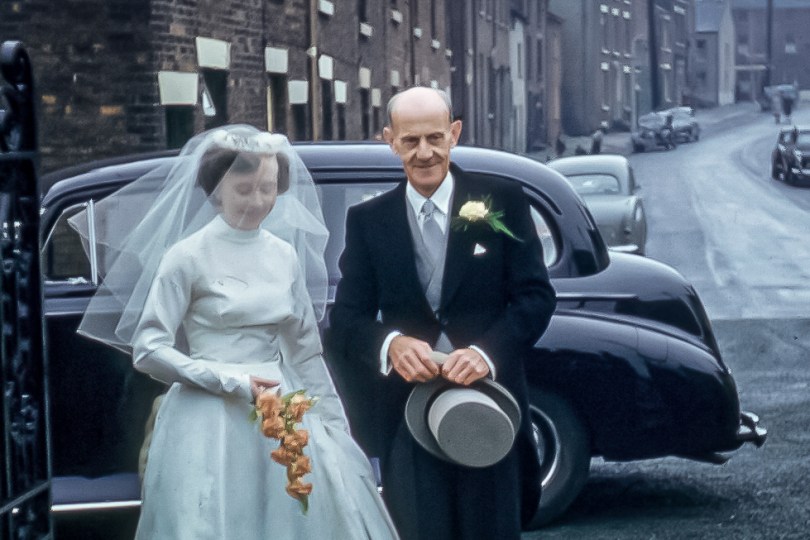
In September 1957 my parents got married. Earlier in the year my grandfather had been asked to become ‘Vicar’s Warden’ at the local Parish Church. He accepted. A local tradesman and Rotarian, Robert’s family was slowly advancing in material circumstances and civic standing. When he became a churchwarden it was news (albeit locally). The gazette carried a report that he “will be sworn in by the archdeacon or chancellor at the annual visitation”. In the 1950s, perhaps especially in counties like Lancashire, the Church of England was a notable presence in most communities. I attended the church primary school across the road from the substantial sandstone bulk of St Michael’s, erected in 1822. On Ascension Day we had a half day – one of many minor observations that peppered the year and kept the school, town and community connected. I’m sure the growing number of working parents often cursed the annual appearance of what must have appeared to be a rather random and inconvenient half-day!

When I began ordained ministry in 1991, also at a parish in Lancashire, it seemed that every church had at least its own vicar if not a curate as well. A nearby incumbent, in a more rural parish, took most of one day a week to visit a local hospital using public transport. Perhaps it was an inefficient way to spend his time, but I bet there were some interesting conversations along the way. In the parish where I served we had over 80 baptisms in one year; a memorable Holy Week with one or more funerals every day; and a church hall that bore the brunt of heavy usage from uniformed groups, parish thespians and the might of the Parochial Church Council. There was certainly no shortage of work to do or activities to support. By the time youth group had ended on a Sunday evening, on a day that began at 7:30 am, I was very happy to slump into a comfortable chair.

Those days have gone – for better and for worse.

Had the Church of England stopped evolving in the 1990s it is hard to know what would be left today. Perhaps, if it had continued to invest and support as much parish ministry as possible, the numbers with which Church House and the Archbishops’ Council seem preoccupied would be little different from those we see today. When people bemoan churches that appear to be stuck in the past, or unchanging, there is good evidence around that these same churches are often doing very nicely. Of course, nothing remains genuinely unaltered because the people change, and so does society. The ordination of women as priests and bishops was a matter of both faith and justice, and has added fresh qualities and fulfilled vocations at a time when both were in decline.

We know from many different reports that in the past egregious wrongs were perpetrated by clergy, and laity, under the guise of virtue, holiness and a perverted theology. I suspect that what we know about is the tip of a very, very large iceberg. All too often clergy have been a law unto themselves and, when something has been raised, benefited from the collusion of powerful patrons. This lack of accountability has deep roots. When I researched the history of institutional spiritual care I came across the case of a Victorian workhouse chaplain, Frederick Pocock, who neglected his charge with impunity due to the unwavering support of his bishop. The Board of Governors of the institution was powerless.

At one level, it seems astonishing that the Church has failed to learn a lesson that goes back deep into its history. In another sense, for rogue clergy, the cover-ups and collusion were (are) a desirable facet of the mercurial behaviour of a Medieval institution embedded in the modern world. Perhaps it is unsurprising (although it was startling at the time) that when I told my grandfather that I was exploring a sense of vocation he immediately left the room to be sick. Looking back I wonder, as a churchwarden, what he had seen or heard that caused such a reaction? He never said.

There is much about Anglican reason, tradition and spirituality that appeals to me. At its best there is a generous and pastoral care for communities and the “frowsty barn”, as Larkin put it, that is often at the physical centre of towns and villages. Sometimes it is the spiritual centre as well – but not always. It feels that this is the moment when England needs to decide the fate of its Church. Whether through a Royal Commission – as Martyn Percy suggests in today’s Observer – or a different process, some definitive solution is needed to ensure the safety and ongoing purpose of the Church. Many of the attractive characteristics of the Church I grew up with have gone – but can something new emerge that preserves the best of it for the future? The 500th anniversary of the Act of Supremacy is on the horizon (2034). Perhaps even Thomas Cromwell might feel that now is the right time to begin reshaping the kind of Church he helped establish, to fulfil it’s calling in a new era?

“To reform church and state you must deal with the populace.”

Mantel, H. (2011). Wolf Hall (Vol. 1). Fazi Editore.

Forgotten Conscripts

The consequences of war run wide and deep. While the focus of Remembrance may be soldiers on the battlefield, the effort of supporting a sustained conflict involved many, many, more people. At Bishop Auckland’s Mining Art Gallery, a new exhibition – Ted Holloway – A Bevin Boy Remembered – takes the work of a single Bevin Boy to present an insight into what it meant to be conscripted into the mines. Coal was essential to the overall war effort and the manufacturing capability of the country. It was in December 1943 that Ernest Bevin, the wartime Minister of Labour and National Service, devised the scheme to conscript by ballot a number of men of military age to go into the coal industry. Holloway, who was caught up in a form of work many would not have chosen, drew on his experiences to create art which reflects the hard and perilous experience of working underground. While many Bevin Boys were not working at the coalface they performed an invaluable role in maintaining the mine’s infrastructure, enabling regular miners to dig for coal and increase their productivity

“I was sent into the quarry, which was adjacent to the pit… That quarry work was the hardest work I have ever done in my life. It was through winter and you often had freezing water round your ankles and we had leather boots and no wellies, raw fingers, it was so cold, it was so hard and it sometimes rained and you had to carry on working. I looked forward to the warmth of going down the working pit, which came after about five weeks”.

I was called up for National Service in the autumn of 1943, by Douglas Ayres

There has been a long political campaign to honour the courage, effort and difference which the work of the Bevin Boys brought to the war. Sometimes referred to as the “forgotten conscripts” they finally achieved recognition when the Bevin Boys Veterans Badge became available after 2007. This still feels a modest acknowledgement of what they achieved, especially given the experience of many who, unlike other conscripts, did not return to their communities in uniform (or with the automatic right to resume their former employment).

Take Five (2006) Tom Lamb, Gemini Trust, Zurbarán Collection

War brings many horrors and devastates communities. The Bevin Boys remind us that the efforts of countless people to support a war effort often go unacknowledged and can be left in the dark. While the work of the British Legion and many other groups has been effective in widening the recognition of people (and animals) engaged in military struggle, it seems that too many national leaders forget this cost when new conflicts begin. I can only imagine that those who lived through the world wars would be incredulous that we continue to approach so many disputes with a call to arms. The post-war aspirations that new bodies, such as the UN, would manage disagreements differently, and peacefully, seems to have failed. Perhaps, as the last survivors of the world wars leave us, the risk of future conflagrations will increase. Maintaining some honest recollection of war’s human and material cost, and the legacy it leaves, might become more necessary than ever.

  • Above – The Bevin Boy Memorial, Alrewas, Staffordshire
  • The picture which heads this blog is taken from Miners’ Heads No. 2 by Ted Holloway.

‘Why Her Brethren?’

We are in the season of sanctity. First comes All Saints, followed swiftly by All Souls, as we remember those who have lived and died in years gone by – either people we have known, or people extolled by the Church as exemplars of faith. Of course, like so much else, sainthood is bestowed according to the fashion, politics and preferences of church leaders. For example, there are fewer female than male saints. Even so, not everyone makes the cut, nor should they. Part of the premise of my new Lent Book for 2025 is that sometimes the Church forgets those from whom it still has much to learn.

The 18th century vicar and author Laurence Sterne was not a saint, if by that we mean someone faultless in this life. The trouble with Sterne was not so much that he had faults, but that he was very candid about them. In his letters and books there is bawdy and innuendo; passion and compassion. Sterne is all too human and rejoices in a conviction that God had given him the capacity for joy which it would be a sin to deny. In the brief span allotted for his life (he died aged 54) there is an echo of Andrew Marvell’s reminder to His Coy Mistress that at his back he hears “Time’s wingèd chariot hurrying near”. For Sterne, life is too brief and precious to be lived as if it were “one cold eternal winter”.

When I renewed my interest in Sterne’s work, there were certain features that gave his writing a remarkably contemporary resonance. Corresponding with the black British abolitionist Ignatius Sancho Sterne pulls himself up short when he finds himself writing about the kin of a black character in his novel on:

“behalf of so many of her brethren and sisters, came to me—but why her
brethren?—or yours, Sancho! any more than mine?”

Laurence Sterne, Letters

Why indeed? Sterne has the capacity and honesty to recognise his inherent – thoughtless – separation of people on the basis of ethnicity. The plea for a recognition of our God-given and common humanity runs throughout Sterne’s work. When it comes to gender differences Sterne is equally pointed in describing the ‘logic’ which denies a women authority over her own body or, come to that, even the right in law to be regarded as a blood-relative of her own children. Wit is the tool which Sterne uses to excavate the absurdities of his day, bringing to light the thin veneer of social etiquette that enabled the continuation of ridiculous conventions. At the same time, living at Shandy Hall in rural North Yorkshire, Sterne is enmeshed in the society and behaviours of his day. He knows this and uses humour to escape the passive acquiescence to which most conformed. Little wonder that friends encouraged him to get his preferment before he embarked on satire. Wit that came close to the mark and exposed conventions for what they were, could cost you a mitre.

Section from “A Flap Upon the Heart”; one of two new drawings by Rob Oldfield commissioned for the book.

A Sterne Lent offers the opportunity to keep company for a while with this witty, mirthful, digressive and somewhat doubtful parson. The book is immersed in an age that can feel very different from our own, yet contains themes that speak at times with remarkable contemporaneity. Above all, Sterne offers a lively voice whose strength is uninhibited by the usual constraints of ambition. His daring portrayal of the world he inhabited has the saintliness of a child-like disposition to tell the truth, even when it comes at a material cost. Sterne’s accurate depiction of human society bubbles out from his quill and left an enduring impact on the development of the novel. I hope that this curious and intriguing book will provide readers with a glimpse into another England, yet also one that touches with humour on human traits that persist within both church and society.