Power & Glory?

I am reading Pat Baker’s latest instalment in her retelling of aspects of the Trojan War, in which the experiences of women are foregrounded. In The Voyage Home male power is also observed, and the restrictions of high office are described. On a superficial level, the acquisition of power implies the ability to choose – to do what you wish. In reality, people in power often find themselves constrained by all kinds of weighty expectations. In the Church, a vicar might have a wide scope for action and strategic choice, especially if leadership involves and respects the wishes of others. For a diocesan bishop, even before assuming office, the diary will already be full of duties and obligations which it is simply ‘expected’ (or required) that the bishop will fulfil.

In her book Baker imagines Agamemnon arguing with Queen Clytemnestra on his return home:

You’ve had power for the last ten years. How easy have you found it?” He sees her look away. “No, you see? It doesn’t solve everything, does. it? In fact, it’s bloody amazing how many things you can’t do with power”.

In the New Testament, Paul quotes Jesus saying, “My grace is sufficient for you, for my power is made perfect in weakness”. Looking at the life of Christ, and his ministry over three years, the paradox was that his power appeared to lie in the inability of the world to offer him anything he wanted. The whole of the temptations in the wilderness serve to confirm this refusal to be suborned. Standing before Pilate, Jesus suggests that he isn’t the one who is powerless. Pilate’s power comes from somewhere else – he’s a delegate, not a free agent. Jesus may be the captive, but he exercises the refusal to collude in the compromise that could secure his freedom – at a price.

We don’t need to feel sorry for the world’s powerful men and women. They live in gilded worlds and, somewhere along the line, they have chosen this way of life. Chosen it by standing for election, amassing wealth, or by electing not to exercise the ability to resign or abdicate. The example of Jesus reminds us that real power, sacred power, lies elsewhere. For Pope Francis it was important that the shepherds bore the scent of the sheep. This is not remote ‘flock management’ but a spirit of service that sees the shepherd in the heart of the fold. I believe that while this is spiritually significant it is also essential for theology to be useful. A priest cannot be everywhere, but a priest can touch closely many different spheres of life. In chaplaincy in the NHS I experienced it in the wide variety of people with whom I would speak in the course of a week. A CEO; mortuary staff; the delivery suit; the grieving; someone celebrating their 100th birthday; a nurse taking a moment to pause on ICU. Theology is about a God in relationship with everyone, and the power to listen to people in a wide range of settings expands our understanding of God, and the divine purpose for the world which God’s infinite love brought into being.

Barns and Bull-Boxes

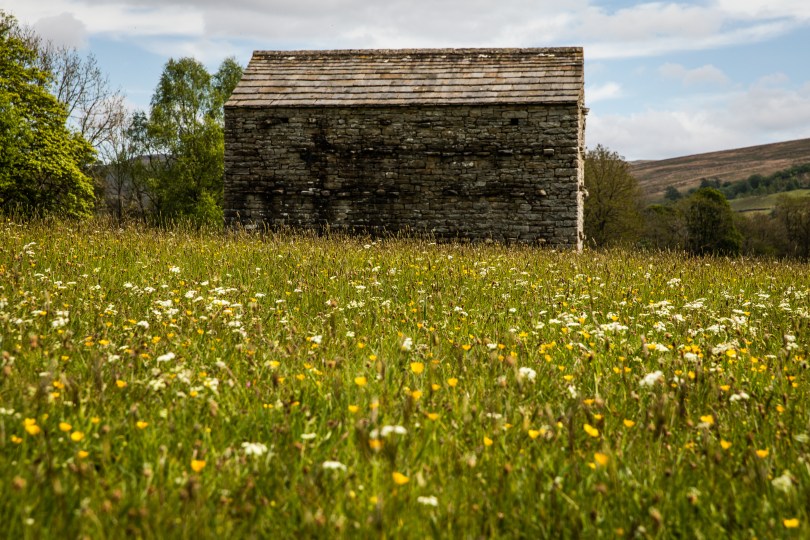
They are peppered across the landscape of Swaledale. The stone-built barns that are sited away from the farms, designed to reduce the transport of hay over difficult ground and enable the cattle to be fed from supplies close by. On the other side of the Pennines, in the Ribble Valley, the poet Glyn Hughes was offered a more modest structure, yet equally remote. For a year he used a stone bull-box as a base for writing poetry. This followed his diagnosis of cancer, and the book of poems to emerge from the experience was to be his last. He saw this small volume of work as the spiritual dimension of his healing.

These two kinds of agricultural structures suggest a long history, often filled with the hardship of rural living. There were undoubtedly precious days of warmth and relaxation but, for most of the people most of the time, life was a struggle against the elements.

The less you possess, the more they are
not decorations but what is more needed: icons
requiring as icons do small space to give up their worth –
this water jug, this stove, this lamp, this spade,
this small table and chair.
All of it “junk” in any place but here

Extract from A Year in the Bull-Box: A Poem Sequence by Glyn Hughes, published by ARC Publications, 2011.

For Hughes, going back was the best way forward in coming to terms with the short span of life he had left. His year in the bull-box brought him back to basic things, albeit with the knowledge of the modern world close at hand. Reviewing the poems in The Guardian Simon Armitage wrote: “I don’t ever remember being as moved by a book of poems”. Which is quite something from the Poet Laureate.

A year of rudimentary living gave Hughes a re-kindled experience of childhood – encountering the smallest things with new attention and fascination. Laughing, perhaps, at the folly of holding back stream water as much as he might have wished to stem forever the tide of illness which would soon overtake him. What might have seemed isolating, bleak or depressing became precious months of connection with the seasons of the year. A spiritual stillness in the midst of an ever-turning world.

I was immortal then, not seventy but
a lithe, inquisitive
child again.

Extract from A Year in the Bull-Box: A Poem Sequence by Glyn Hughes

Play is often dismissed as childish when, what so many of us need, is the spirit of wonder and recreation that childhood brings. Many years ago I heard Gordon Mursell speak at a Diocesan Conference. His theme was God’s playfulness and, in relation to this, he recounted a story from the life of Samuel Johnson. This great lexicographer, who had a reputation for wit and wisdom, had walked to the top of a hill. When he arrived at the summit he declared to his companions that he was determined to take a roll. When those with him worked out what he meant they tried to dissuade him. However, Dr Johnson said that “he had not had a roll for a long time”, and proceeded to empty his pockets before descending the hill horizontally.

We should never lose the ability to be playful explorers of the world. For Glyn Hughes a safe return to the most basic necessities of life became a doorway to re-enchantment. A place to distill what truly matters in life and to experience and contemplate a world we did nothing to create, but to which we remain inextricably a part.

Pillow Talk

This title might conjure up the idea of gossip or salacious bedtime conversations. However, it is also the name of a particular kind of peony. In the garden where we live there are several clumps of this variety and in mid-May I am waiting for the copious buds to break into bloom. They are large and richly coloured flowers – pink meringues that dominate the herbaceous borders for a brief time and make for glorious arrangements in the fireplaces. The vitality of summer prefigured in a vase.

Along with the return of swifts to York in the past two weeks, the early signs of summer are gathering apace. The clear skies, longer daylight, and warm sunshine of recent days, add to the sense of the year’s turn. Already we have put out our garden sofa-swing. An extravagant purchase a couple of decades ago, but one that continues to provide enjoyment across the warmer months. Its comfort and gentle rocking often having the desired effect of inducing an afternoon snooze.

This year the English garden sofa-swing is celebrating its centenary, and a contemporary version of the rocker will be exhibited at the RHS Chelsea Flower Show later this week. It is often regarded as an example of English eccentricity – a bit of living room set in the outdoors. While I don’t go back anywhere near as far as the first appearance of this kind of garden furniture, one did feature very early in my childhood. My maternal grandmother was a fan of colour film for slides and I have some of her collection. (Bessie liked taking pictures of buildings that were about to disappear – including the dramatic demolition of mill chimneys in her native Lancashire).

This photograph was taken in 1966. Judging by the blossom behind the swing it may well have been the first May Bank Holiday weekend. The UK enjoyed some early heat in the first couple of days of the month in that year. I am the cheeky chap looking at the camera, slightly blurred by a sudden movement, and my brother is beside me. The company whose sofa-swing will be exhibited at Chelsea asked for customers’ photographs of historic examples to include in the display. Who knows, we might feature!

Part of my affection for the sofa-swing is connected with a childhood often overshadowed by illness. I had debilitating asthma throughout my pre-teen years, often missing school and struggling for breath. Lying on the swing in my grandparents’ garden, shielded from the sun and gently rocking, gave both comfort and relief. It was – and is – very soothing. As I lie on it today, gazing across at the pillow talk and listening to the plaintive call of a wood pigeon, I am reminded of the opening scene in A Portrait of a Lady, and Henry James’s paean to summer in an English garden:

“Real dusk would not arrive for many hours; but the flood of summer light had begun to ebb, the air had grown mellow, the shadows were long upon the smooth, dense turf. They lengthened slowly, however, and the scene expressed that sense of leisure still to come which is perhaps the chief source of one’s enjoyment of such a scene at such an hour. From five o’clock to eight is on certain occasions a little eternity”

Golden

The saying tells is that “silence is golden”. It comes from Arabic culture, going back to the 9th century CE at least, and is the shortened version of the original phrase: “Speech is silver, silence is golden”. While I have considerable sympathy with the notion that silence is richer and more splendid than speech, there are darker interpretations of what an imposed silence might mean.

Reading the excellent book by Wren Radford, Lived Experiences and Social Transformations, I was reminded that being silenced – or coercion into quietness – is far from golden. Reflecting on her childhood Wren Radford recalls:

‘I have been reading to myself most of the day; being quiet, which is seen as the same as being good’

To fit into an adult world, not causing trouble or manifesting needs, is one kind of upbringing. In some contexts silence can be its own form of resistance, especially when speaking the truth might lead to punishment. Our present political culture appears to be silencing whole swathes of people; those who have been encouraged to see themselves as powerless and irrelevant. In such circumstances the unheard might turn towards more extreme politics as a way to voice their dissatisfaction with a status quo that relentlessly favours the wealthy and denies opportunities to those who place the community ahead of the individual.

I have been thinking about silenced voices while editing a forthcoming edition of Crucible on assisted dying/suicide. It was while doing this work that I came across a blog by a now-retired member of staff from the University of Leeds. I had done a little work with Professor Allan House and our interactions were always memorable. Allan is an emeritus professor of liaison psychiatry.

On the first occasion we met, Allan was teaching on the Postgraduate Certificate in Health Research. I was one of a group of 20 or so NHS employees, mainly doctors and some nurses, who had opted for this course of study. By way of introduction, Allan asked us to identify ourselves and our role in the hospital. When I had spoken, Allan moved on, but after the next introduction returned to me. He clearly found it intriguing and a bit ‘left field’ to have a chaplain on the course, which perhaps sparked off a number of questions and unusual considerations. Subsequently we met a few times to explore some research ideas. It was at the start of the first of these that Allan said with a suitable degree of firmness: “I’m an atheist and a republican”.

In his blog on the topic of current legislation about assisted dying/suicide, Allan is more vociferous than the Bishop of London. I don’t have any personal knowledge, but Allan may well be in favour of some kind of assisted dying – but he is clearly very strongly opposed to the current legislation. His blog post is entitled “The dark ideology behind the assisted suicide campaign”.

In giving evidence to the Bill committee, in a private capacity and as a subject matter expert, Allan was undoubtedly frustrated with the imprecision of what is being proposed. Firstly, he cannot see how this is anything other than the facilitation of the wishes of someone who is suicidal. Indeed, the current proposals include an alteration to the Suicide Act 1961, effectively exempting anyone (in end-of-life cases) of culpability for encouraging or assisting a suicide.

“At the core of this position is a libertarian or hyper-individualistic privileging of personal choice to the exclusion of all other considerations: it doesn’t matter why the choice is being made, only that it is being made by an ‘autonomous’ individual”.

Other considerations have been silenced. Supporters of the Bill push back every attempt to ensure that there is some exploration by a competent professional of why someone wants to be supported to end their life. This means that there is no evaluation of issues which might be either improved or removed by a suitable intervention. All that matters is that the individual has capacity and isn’t being explicitly coerced. House sees within the current Bill a judgement that applicants for the process “are leading a sort of un-life, something so self-evidently valueless that there is no need to explore why they don’t want it”. He clearly believes that this is both wrong and irresponsible.

Being quiet isn’t always the same thing as being good. Far from it. Many years ago, during a bust-up about chaplaincy provision in the NHS, when I believed the Church of England’s central body was acting badly, my Bishop shared with me that he’d checked out with the lead Bishop for the NHS that I wasn’t “getting in the way”. I was rather surprised to hear this (and I think he regretted sharing it) but had sufficient wit to reply: “Sometimes someone needs to get in the way”. Despite this moment of candour I know that all too often I’ve been silent and perhaps the issue for all of us, including myself, is to speak what is inconvenient to the people who would rather we remained quiet.

God in the City

In the late 1980s I spent a year as a youth worker in the Isle of Dogs. The youth club operated in the crypt of Christ Church, and catered for local children up to the age of 11. Although I’d lived and studied in Hull, this was the first time I worked in an urban context. At that time much of the East End was undergoing the transformation from urban poverty to city banks and their associated wealth. Sparkling new buildings were springing up alongside docks where once no one had wanted to live. I was told that in those days taxi drivers had refused to drive into the island at night. During the 1980s the two communities, old and new, lived together uneasily. Some in the increasingly expensive gated estates, others in the council housing that was yet to be sold.

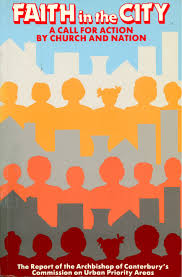
In my new role as Director of Leeds Church Institute I am once again reflecting on the relationship of ‘faith and the city’. Incidentally, it’s exactly 40 years since the report with that title was published by the Church of England, to be met with the ire of Mrs Thatcher and many other conservative voices. In the mildest of possible forms, perhaps this was the C of E’s modest response to the influence of liberation theology – the school of praxis and thought which arose chiefly in the favelas of Latin America. However, one of the criticisms of the report was its lack of a significant and developed theology to frame its analysis and recommendations. A subsequent publication, Theology in the City, responded to this criticism, partly arguing that the alleged lacuna arose from the misunderstanding of the more implicit theological approach Faith in the City had embodied.

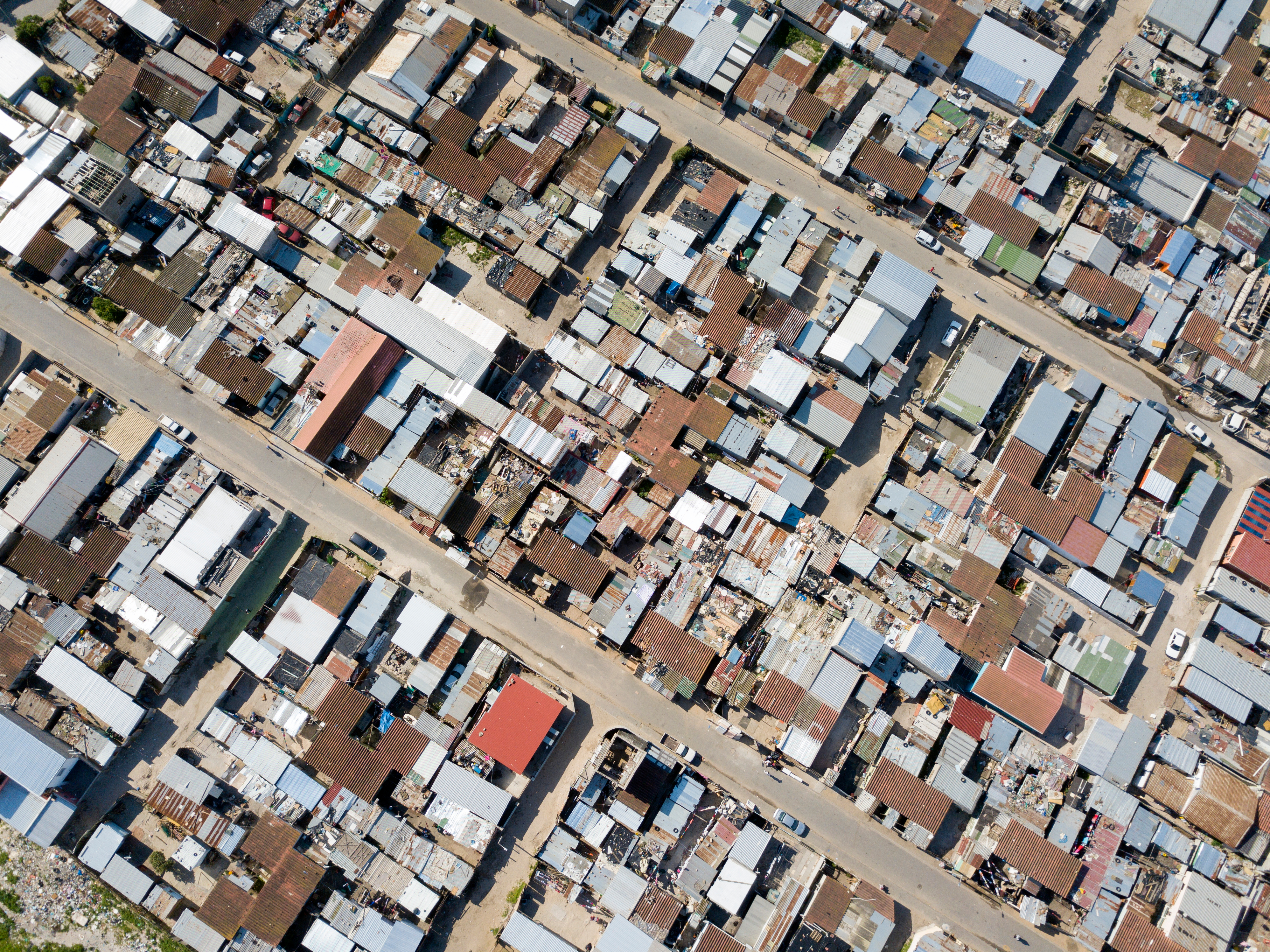
During a year in Argentina I read Gutierrez’s classic work Teología de la liberación. Living in Córdoba and Buenos Aires, I grew more and more aware of the particular dynamics of city living, with rich and poor living cheek by jowl. A few metres apart, but separated in their different worlds by steel and security. Cities concentrate divisions in way often unseen in more rural settings. Gutierrez inspired a way of thinking that reflected his conviction, based on a liberative hermeneutics of the Bible, that God has a preferential love for the poor. This understanding led many followers of liberation theology to locate themselves alongside the poor, exhibiting a commitment to share and to learn before even considering the option to teach.

After years in which the power of the Church was used to contain and constrain liberation theology, the Pontificate of Francis marked a sea-change of significance. Rather than beginning with doctrine and only seeing the world through its parameters, Francis favoured attention to concrete situations and experiences as the place from which theology emerged. This was reflected most keenly in his persistent interest in the wellbeing of the poor and his sometimes stern address to the world’s wealthy and powerful (be they institutions or individuals).

The Church cannot abandon the city, because every city is its people. If cities shelter some of the poorest people in society then God’s preference and presence cannot be ignored. As a chaplain in Leeds for 16 years I was privileged to meet the whole spectrum of city dwellers although, poverty and illness being what they are, those encounters were weighted towards the most marginalised people in Leeds. In the conduct of funerals funded by the hospital (due to lack of means and/ore relatives) I visited homes whose meagre furnishings reminded me that, ‘When sorrows come, they come not single spies but in battalions’. It would seem that when the balance favours the rich, with wealth removing many of the burdens of everyday life, the opposite end of the scale descends; as the weight of poverty, exclusion and injustices mount, one on top of another. As Francis wisely knew, a rich Church will never be sufficiently open to allow God to use it as a means to rectify and redress the fundamental injustices of the city. As he declared shortly after coming into office: “How I would like a church that is poor and for the poor”.

Fear and Joy

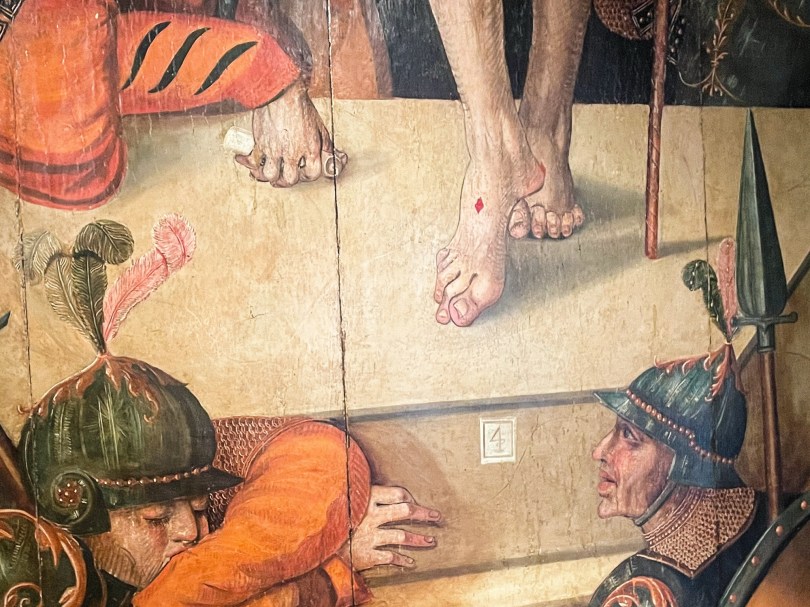
Perhaps the soldiers were sleeping because their task seemed so simple: to guard a dead man. In the painting, part of an altarpiece, only one soldier has been stirred by the strange sounds coming from the tomb. The feet of Christ stand simply on the grave slab, familiar to countless millions down the centuries by their telltale marks of blood.

The status of Jesus as dead and buried is suddenly transposed. Now, in the hour of resurrection, the guards are ‘so afraid of him that they shook and became like dead men’.

The soldiers are scattered out of fear. The women at the tomb also disperse but with different sentiments. They are ‘afraid yet filled with joy’. The feet Christ places on the earth do not bring vengeance or a settling of scores. They stand in confident conviction that a new era has begun when peace is more than a balance of arms.

A very Happy Easter to all blog readers, and especially to those who have struggled through ‘A Sterne Lent’ to reach this joyful Eastertide.

Another reader’s response to the marbled page stencil in ‘A Sterne Lent’.

The Art of Not Taking the Deal

We are about the enter Holy Week. Many Christians will mark these days by attending additional church services and spending time in reflection. I never tire of reading the passion narratives because I have no doubt that in them lie the central themes of Christianity. There is a crowd in an city eager to give the inspiring young rabbi their adulation. The intimacy of close friends at supper on an important festival. The isolation of the garden outside the city walls, and then the bitter work of captivity; costly fidelity; suffering and death.

At a time when the world has become increasingly chaotic it is important to be reminded of Christ’s stillness before the powers of his day. The High Priest and Pilate undoubtedly saw the brewing popularity of Jesus as something that would be ended by his execution. On all the metrics of religious power and secular control, the Jesus who goes to the cross is done. The watching world could agree with Jesus’ last words: “It is finished”. Perhaps those two leaders saw it as the messy and unfortunate price to be paid for maintaining control; keeping the peace. The sacrifice of Jesus would enable things to stay as they were – and as they should be.

Maybe Jesus didn’t know the art of the deal? His time in the wilderness at the beginning of Lent suggest that he had set his face against compromises in his ministry. When he stood before Pilate he had no cards to play. Or, perhaps, it is more accurate to say that he chose not to accept the terms of the game. Appearing to go meekly to his death probably confirmed to many of the leaders that Jesus simply didn’t understand the reality of the world he claimed to be saving. Sad, but there you go. One death wouldn’t change anything.

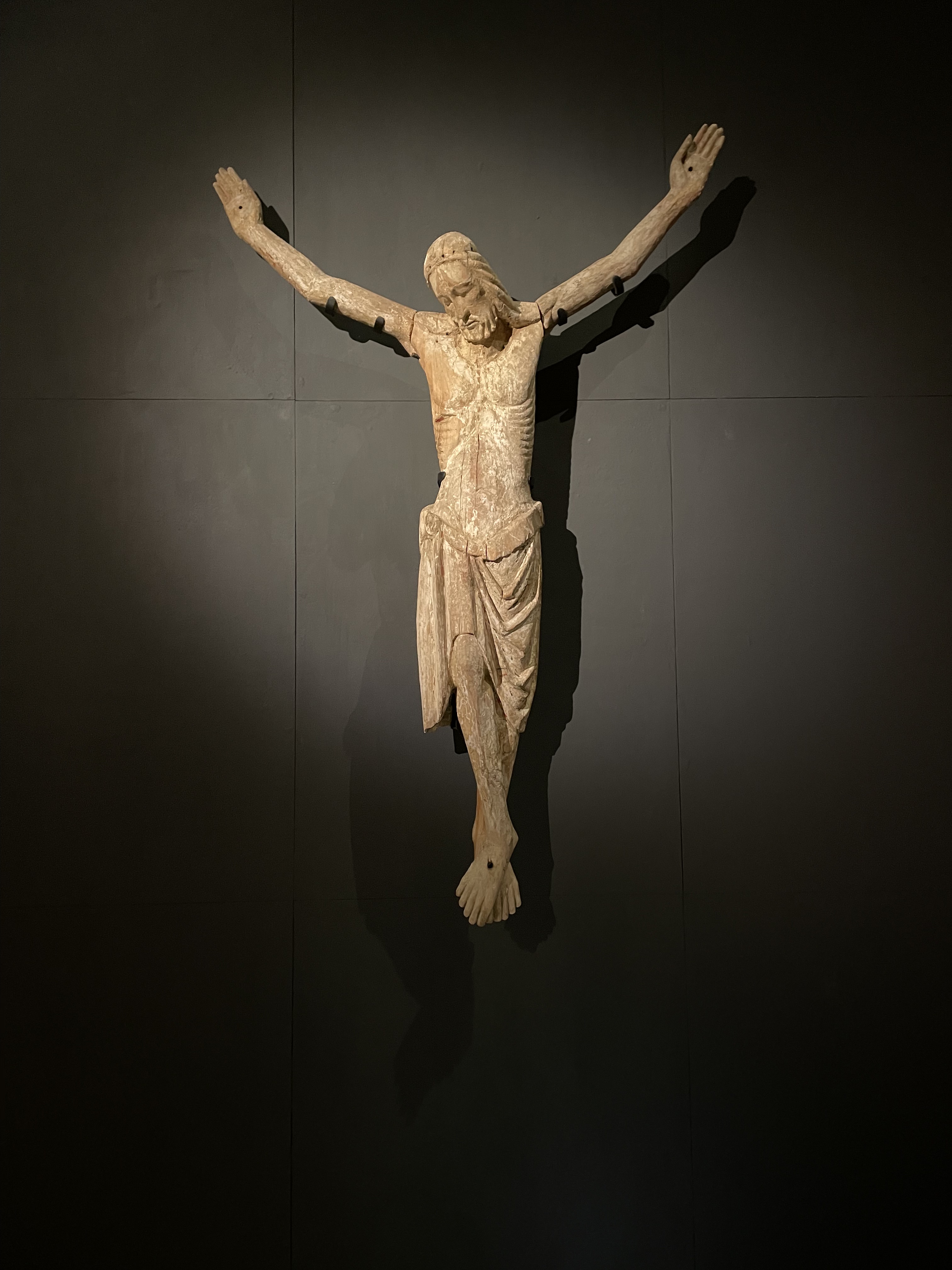
A Station of the Cross by Sepo b. Ntuluna from Tanzania, in the hotel Mattli Antoniushaus, Morschach – built on the grounds of the Franciscan Community in German-Speaking Switzerland.

Then there is the humanity of loss – of which we all know something. Mary caressing the body of her son. A parent unable to intervene to save her child. The powerlessness of love which cradles the life-left body of the son she would have done anything to save. This is the darkness of despair; the earth shaken; the light of the world put out. The day of absence.

‘Faith’ is perhaps the best answer as to why Jesus doesn’t do a deal. That our miserable card games take place inside a much, much bigger story than most of us are willing to acknowledge. Soldiers at the foot of the cross didn’t have cards, but they had dice. It would be beyond their imagining that 2000 years later the events of that sorry day would still be remembered. A miserable death a few hours before a dusk that would usher in the city’s shabbat. It would be hard to imagine something less important. It was ended – time to divvy up the possessions and go home.

“Thou art God, Whose arms of love
Aching, spent, the world sustain”.

WH Vanstone from Hymn to the Creator in ‘Love’s Endeavour, Love’s Expense

Exposed

I’m not the kind of Christian who likes public witness. The sort of knocking-on-doors Christianity; or a beach mission; or even telling my “faith story” in a service feels embarrassing and uncomfortable. There are probably lots of reasons for this, which it would be tempting to dismiss with an air of Anglican superiority.

I am inclined naturally to a reflective and tentative articulation of faith. I don’t believe I have all the answers. “Now we see in a mirror dimly”. I have no doubt, for a host of reasons, that my faith is fractured and partial. It feels fuller and more complete when it is located within a community of faith, bringing many different experiences of God, past and present, under a single roof. Others have natural – and undoubtedly, spiritual – gifts for giving personal testimony. I don’t hesitate to say that this can be both inspiring and has a place within the life of faith. But we are not all created to be the same.

Hence, it was with some trepidation that I went along with the Gospel Streets Urban Pilgrimage in Leeds last week. Led by the admirable Lighthouse community, based in St George’s Crypt under the pastoral care of Jon Swales, the pilgrimage snaked though the streets of Leeds on a sunlit Thursday morning. Jon had a monk-ish aura wearing a cassock alb, and speaking passionately about the City while reading the Gospel of Mark. People stared at us. One passing youth shouted: “You’re all evil; you lot”.

What did it achieve?

For the thirty odd of us participating there were the kind of side-on conversations that people walking to the same destination often share. I met many people I hadn’t encountered before. Members of the Lighthouse community were with us, and it ended with a service of Holy Communion in the Crypt. We were present in spaces where religion is either excluded or extreme; the places where the more you consume the more you matter, and where street preachers tell the world that “the end is nigh”.

Our pilgrimage was less confrontational and more measured. The worst excesses of capitalism were described beside the city’s banks. People damaged by an urban environment that rejects them walked with us in a spirit of solidarity and purpose. Jon asked people sitting and reading in the sunshine of Mandella Gardens if they wouldn’t mind him speaking for a while (sooo Anglican!) and breaches of international law were mentioned by the war memorial.

I’m not sure what we achieved. A statement was made – it was enacted. In the pilgrimage through Lent, we reminded ourselves and anyone who cared to listen, that God is present in the city. That the Church is (or should be) a shelter from the storms of life and a community that is restless and longing for the Kingdom. Where people who have been rejected find a home, and where earthly power is reminded of its place.

It is absurd
to retell here what
happened there,
far away and far ago
when the idiot healed
and said, and wept
and left. A broken
nonsense in the febrile
world of expectation.

Ceasing to be Eathbound

I have long been a fan of The West Wing, Aaron Sorkin’s masterful creation of an imagined, plausible, and ethical US Presidency. Although the programme foretold the election of a president who was Latino, it did not predict the right wing backlash that would follow. A much weaker version of Donald Trump features in an episode concerning a Republican challenger to President Jed Bartlett, who the sitting Democrat sees off without difficulty. Alas, recent months have seen a catastrophic implosion of the Democratic opposition in the USA, with global consequences.

In one episode of the series Jed Bartlett is asked a question about why Airforce One’s take-off had been delayed. Before giving the prosaic reason, Bartlett eulogises for a moment about what a lengthy night flight can mean:

“A long flight across the night. You know why late flights are good? Because we cease to be earthbound and burdened with practicality.”

I write this onboard a BA flight which is about to leave Cape Town on Friday 21 March. We weren’t sure whether this flight would make it into the air, given events at Heathrow. Perhaps we won’t land in the UK – the equivalent flight yesterday ended up at Barcelona. Nevertheless, we will have a long night flight in all events, and perhaps Bartlett was right that there is something unusual and potentially uplifting and thought-provoking about traversing the planet in this way (albeit with environmental considerations and impacts).

Once again South Africa has been impressive; challenging, and full of natural wonders. From visiting communities that experienced devastating flooding, to the wealthy areas of coastal communities along the Garden Route, we have once again experienced a country of contrasts. A nation where the enduring imprint of colonialism runs wide and deep. During our time there the SA Ambassador was asked to leave the USA and 70,000 Afrikaans have expressed interest in accepting refugee status in America. Making a nation is hard work – especially one so burdened by an evil regime that nurtured division as a basic strategy of education and government.

Perhaps due to the short span of our lives human beings do far too much far too quickly. Nothing appears to have been learned from COVID, recent global conflicts or the history that underpins Western privilege. In South Africa two experiences reminded me of our self-absorption and navel-gazing. One was the opportunity to see and photograph the Large Magellanic Cloud, a ‘nearby’ galaxy containing 30 billion stars, and only visible from the Southern Hemisphere.

The other, quite different experience, was to go underground and visit the Cango caves. Here stalactites and stalagmites have formed over tens of thousands of years, in some cases forming vast columns when growth up has met with expansion down. Extraordinary beauty created by incredibly slow drips of calcium infused rainwater. A process now slowed by global warming.

What is above us and below us is a reminder that the environment we value has come into being through both unbelievably big cosmic events and incredibly small and sustained changes that over vast stretches of time have a mighty impact. We do not tread lightly upon the earth, expending in a couple of centuries resources that have taken millennia to create. The relentless energy of the systems that we have built do not work in favour of the whole of humanity, or even the few that appear to reap the benefits of extracted resources. We are not living sustainably and the blind optimism of some that we shall always find solutions to the problems we’ve created may, in the end be shown for what it is: a convenient narrative to permit the continuing exploitation of our planet.

Sweet Flying Baby Jesus

It appears as a small detail in some classical depictions of the Annunciation, but it is not uncommon to find a tiny baby Jesus surfing a beam of celestial light towards the Virgin Mary. We might take this to be no more than an artistic expression of the theological significance of what was unfolding at this critical moment at the start of the Gospel. However, there is more to this illustration than meets the eye.

A middle part of so called Mérode Triptych, created in 1430’s in the workshop of a Master of Flémalle, and kept in the Metropolitan Museum of Art in New York

Anyone familiar with The Life and Opinions of Tristram Shandy, Gentleman will know that the clerical author, Laurence Sterne, makes play with the concept of “homunculi”. Developed to a significant extent by Aristotle, this idea centres on the belief that all the physical aspects of procreation resided with the man. Unbelievably small babies were thought to be present in semen which, at the moment of conception, were passed by the man to the woman. It is hard not to interpret this as a startling manifestation of misogyny. Life being so important it could only originate from a man; and pregnancy so inconvenient it must be the perpetual obligation of a woman. In Tristram Shandy this theory is mocked from the first page, when the conception of Tristram is interrupted by Mrs Shandy, who distracts her husband by asking: “Have you not forgot to wind up the clock?” The effect of this is to weaken the efforts of Mr Shandy, and results in irrevocable damage to the homunculus that is, and will become, Tristram.

It would be easy to underestimate the consequences of this belief. Sterne incorporates into his novel the real-life situation of the Duchess of Suffolk. When her husband and son died in quick succession she was granted administration of the estate. However, when it was contested, part of the appellant’s legal argument was the assertion that – based on an understanding of homunculi – she was not a blood relative of her son. The Duchess lost her right to inherit.

As the Church celebrates the Annunciation on 25th March it is worth asking the basic question: “What was going on?” The classical paintings of a tiny Jesus heading towards Mary imply that the infant saviour was a divine homunculus. The mother of Jesus was simply receiving a delivery from the Almighty, leaving her virgin state unaltered and confining her responsibilities to safe carriage. At its most extreme, Mary would be seen as having a vocation – but no blood relationship with Jesus.

In the classical world divergent views about conception include those of Aristotle, and an alternative approach can be found in the work of Galen. Galen’s understanding of conception sees both the man and the woman contributing seed to form an embryo. As Magdalena Łanuszka put it in a blog entitled “Flying Baby Jesus”, the homunculus interpretation lacks serious theological foundation:

Such a depiction suggests that Christ was incorporated as a human child somehow beyond Mary’s womb and then “placed” in it. That weird In Vitro is of course an idea absolutely theologically incorrect. Jesus’ body was formed entirely out of Mary’s body, not somewhere outside it.

http://en.posztukiwania.pl/2014/06/01/flying-baby-jesus/

In a timely inclusion, the current issue of The Church Times features a review of a new book focusing on the embodied experiences and theologies of birth. Pregnancy and Birth: Critical Theological Conceptions challenges the dearth of theological work done on these major topics. It is not difficult to imagine that if men underwent the experience of pregnancy, the number and variety of titles on these subjects would be immense. In another review of Karen O’Donnell and Claire Williams’ new book, Dr. Emma Percy, a researcher working in this field, offers some concluding reflections:

Pregnancy and all the complexities around reproduction should not be a niche topic, just for the feminist theologians or those who have been pregnant. We are all born from a body that gestated us for months. Jesus, as O’Donnell reminds us, shared this very human experience in the womb of Mary. There is much for all to learn from taking a more realistic look at a bodily experience that is so fundamental to our being human.

Emma Percy book review in Theology. First published online January 8, 2025

Sweet flying baby Jesus should concern us all. How we respond to this framing of the Annunciation and Incarnation is fundamental to our understanding of Christianity, and the God we worship. Sterne turned the evident nonsense of the homunculi into satire, but underneath the wit is a profound question about the humanity of the God in whom we place our faith. From what I have read, it is uncertain whether the writers of the Bible shared a uniform understanding of conception: they almost certainly didn’t. (There’s an excellent article about this by Laura Quick entitled Bitenosh’s Orgasm, Galen’s Two Seed and Conception Theory in the Hebrew Bible). Ultimately, when we lack the understanding of what the authors of Scripture thought when they were writing, we need to arrive at our own conclusions as to whether our interpretation enlarges our love of God and of neighbour, or diminishes it. For me, the idea of Jesus as a foetus implanted in Mary’s womb by the Holy Spirit undermines a primary doctrine of Christianity; namely, that the Word made flesh is both fully human and wholly divine.