The Sun Rising

In 2003, I visited Tate Modern in London to see Olafur Eliasson’s installation “The Weather Project”. It was an enormous sun set at the end of the vast Turbine Hall – on such a scale that it left me feeling I was on a spacecraft holding a star captured for scientific research, or to be used as energy. It was out of this world. The illusion was enhanced by artificial mist, adding to the sense of wonder and mystery.

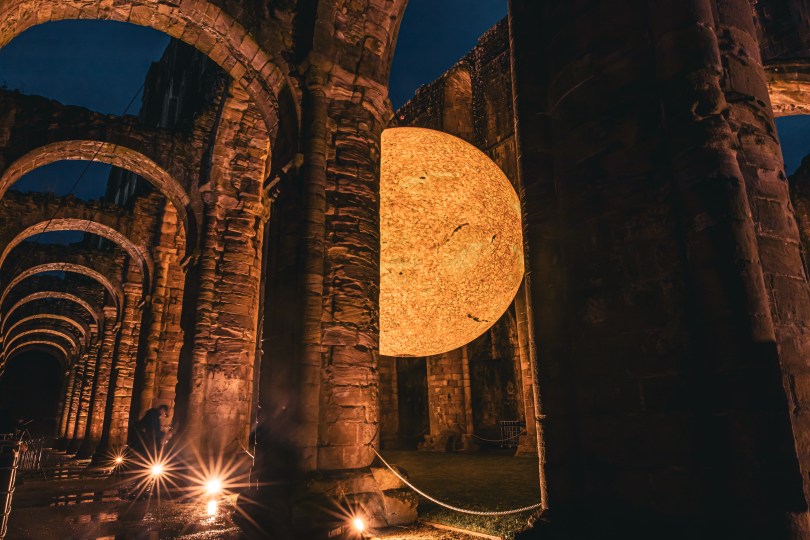
Last week I was one of thirty amateur photographers who booked to experience the Helios sun-installation at Fountain’s Abbey. The work of Luke Jerram, Helios is more than an impressive orange sphere; it has all the detail of the sun’s surface on display. At secondary school I enjoyed spending a lunchtime break using a telescope to project sunspots onto a sheet of paper. These cool and every-changing sites on the sun’s surface have a life of their own, tracking across the face of our closest star. Jerram’s installation also contains these darker shapes of magnetic activity, which on the sun’s surface come in a wide range of sizes and last for different lengths of time.

Dawn marks a moment of prayer in most of the world’s religions. One of the liturgical options in the Church of England is to use the “Acclamation of Christ at the Dawning of the Day”:

May Christ, the true, the only light banish all darkness from our hearts and minds.

In the large internal space of Fountain’s Abbey, the monks would have greeted the new day in prayer throughout the year. On Friday, at times in lashing rain, the grim reality of monasticism in Yorkshire could not have been more apparent. Some may have chosen this way of life, other may have found their options so restricted that the Abbey became a necessity. There will have been those who thrived, and some who felt they were living a life to which they were not called. Nevertheless, every day brings possibilities and perhaps in Matins more than any other service, there is a moment of hope for all. Gerard Manley Hopkins, in The Wreck of the Deutschland, is drawn to this diurnal brightness that triumphs over night, ever confident of Christ’s appearing:

Let him easter in us, be a dayspring to the dimness of us, be a crimson-cresseted east…

Some will wake, as Hopkins says in another poem, to “feel the fell of dark, not day”. The glow in the East doesn’t say to everyone that a promising day lies ahead. Many of us know the deceitful pause, when we have awoken blissfully unaware for a fleeting few seconds of a loss or tragedy. Only to find a sudden awareness flooding into the space that seemed momentarily free and unencumbered. There are hard days in every life, but some people appear to encounter a disproportionate degree of suffering. Once, discussing funeral arrangements with a family, I was asked to keep the service as brief as possible. They had attended multiple family funerals in the previous month and simply couldn’t deal with much more.

Spending time at Fountain’s Abbey, with relatively few people about, was a moving experience. As night was dispelled by a gathering tide of light, the shell of prayer was a poignant silhouette against the fast-moving clouds of a new day. I’ve little doubt that many visitors will experience the Abbey as a fossil of faith – where the life that inhabited it has either disappeared or moved on. There is a strong sense of this in Peter Levi’s lengthy poem, Ruined Abbeys, reflecting on England’s former monasteries and the silent stones that tell of the abbeys’ purpose and the human-bees once busy in prayer:

This is intellectual light:
day-working and night-waking,
the psalms sung with their eyes aching
the human darkness and midnight:
the bees of darkness in the hive
of light when the light was alive.

Peter Levi, Ruined Abbeys

Perhaps Luke Jerram’s installation, placed into this context, finds a new way to connect the light of the past with the spirituality of today.

The Aftermath of Absence

Oscar Wild wrote the line that “wisdom comes with winters”. He might also have added, that growing old should be done with great care. For most of us it is inevitable, and brings all the risks of rejecting the world that is emerging in our wake. It isn’t difficult to recall the pessimism of my grandfather, born before powered flight and dying after the launch of a space shuttle ceased to be headline news. Having lived through rationing he despaired at the “throwaway” society that emerged in the twentieth-century.

In an age when generative artificial intelligence has arrived on many people’s desktops and phones, it feels as though we are in another moment of defining change. Projecting myself into the future, I wonder whether this alteration will become coupled to COVID-19? In other words, before the pandemic, we were fairly certain – bar a ghost writer – that an author had scripted their text from the title to the final word. Yes, there was proof-reading, copy-editing and the influence of publishers, but the script remained the work of the author. After COVID, how do we know the extent to which AI has been used. For example, has it conjured up the title – or a selection of titles – from which the writer has made a choice? Was the overall plan of a novel generated by a computer, complete with chapter headings and key features of the plot? The fact of the existence of chat-GPT, Copilot, and the rest, means that we cannot be certain how far the fingerprints of AI stretch across the work. It will be very difficult for even the most diligent student, pulling her hair out at 2 am ahead of an essay deadline, not to simply press the button, copy what she needs, and go to bed.

The inexorable decline of the Church of England cannot be pegged to a particular event. The concave downward curve of the C of E stretches back to the 1950s, if not earlier. In the current issue of The Church Times, Andrew Brown and others look at the in-tray awaiting the next Archbishop of Canterbury. Brown’s contribution is to review the various past Archbishops and the many attempts, and initiatives, intended to stem the haemorrhaging congregations. Brown argues that the collapse of the Established Church was partly a consequence of wider societal changes to which the Church had been wedded:

“It would be unfair to blame any archbishop for the scale of the subsequent collapse. The Church had been an integral part of a hierarchical and militarised England — as recently as 1990, the Archbishop of Canterbury was a man who had won the MC in action as a tank commander — and, when that country was washed away like a magnificent sandcastle by the tides of history, most of the Church went with it”.

Speaking at a training day for Licensed Lay Ministers in Mirfield yesterday, I was reflecting on just how much the landscape of ministry has changed since I was deaconed on 1991. Every parish had its vicar and vicarage; a minimal amount of money – if any – was sent to the Diocese; local ecumenical work drew together congregants and paid staff from several denominations. As a good friend reminds me from time-to-time, at theological college I predicted that during my time in ministry we would arrive at a point where the only stipendiary post in a deanery would be the Area Dean. If that hasn’t happened yet, it must surely be very close.

Currently I assist on Sundays in a variety of rural churches around York. Many of the church buildings are architectural gems, listed grade one or two, and containing a rich record of parish history. However, it’s always important to take a stole as many of these churches no longer have the items I would expect to find as a visiting priest. In one vestry I noted a processional cross and accompanying candles leaning in the corner, strewn in cobwebs and perhaps last put down by the crucifer on the day the last choir processed back from singing Evensong.

I don’t want to give a false or inadequate impression of the clergy in the past. They were not always glory days, and the scandals of abuse tell a dark story of what happened below the surface. This was true of many professions before a culture of effective safeguarding was established. There were also plenty of spiteful, indolent and career-starved clergy who used the pulpit as a form of performative one-sided therapy. The opportunity to verbalise every prejudice and, of course, list the many failings of the diocesan bishop, who – after all – had the temerity to “overlook” him. The comfortable deanery for which he once hankered was now the cesspit of oligarchy. However, the ancient system of one-priest-one-parish at least allowed the possibility of good, and plenty of good was done. That a gifted parson with compassion, skill and personality might use all her strength to help those beleaguered by modernity, as well as pronounce the forgiveness sins that have been humanity’s lot since Eden.

Recently I’ve been reading Jeff Young’s Wild Twin, Winner of  the TLS Ackerley Prize, 2025. Described as an “hallucinatory memoir of Young’s time as a young man in the 1970s”, the connections of past and present abound in the book. For example, he describes his father’s early life in Liverpool:

“During the Blitz when he climbed up through the skylight onto the roof, he was the watcher of the skies, the overseer of oblivion. He had first-hand knowledge of a place being there, and then not being there, of a thing you know being present and then becoming absent. He was a witness to the erasure and the aftermath of absence”.

Jeff Young, Wild Twin – dream maps of a lost soul and drifter, Little Toller Books, 2024

To some extent we are all witnesses to various erasures, if we endure long enough. Thankfully many of us live without the first hand experience of war, but will live in a world where war is never far away, nor without the risk of escalation. The world is always becoming, and developments such as AI bring both opportunity and risk. Hopefully, AI will enable many people to see health-risks long before they arrive and take appropriate action to halt or temper the worst consequences of that illness. Perhaps, just possibly, the expansion of virtual experiences will lead some people to seek a spirituality that is earthed and rooted in direct experiences and in-person community. There is already some evidence that this is happening. Religion – the oldest cultural expression of humanity – may yet find the wisdom to achieve renewal in the aftermath of absence.
Sister Moon

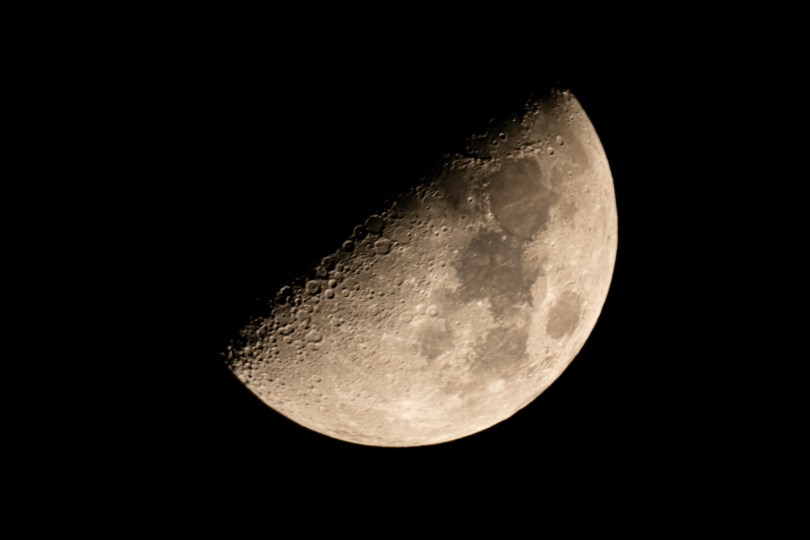
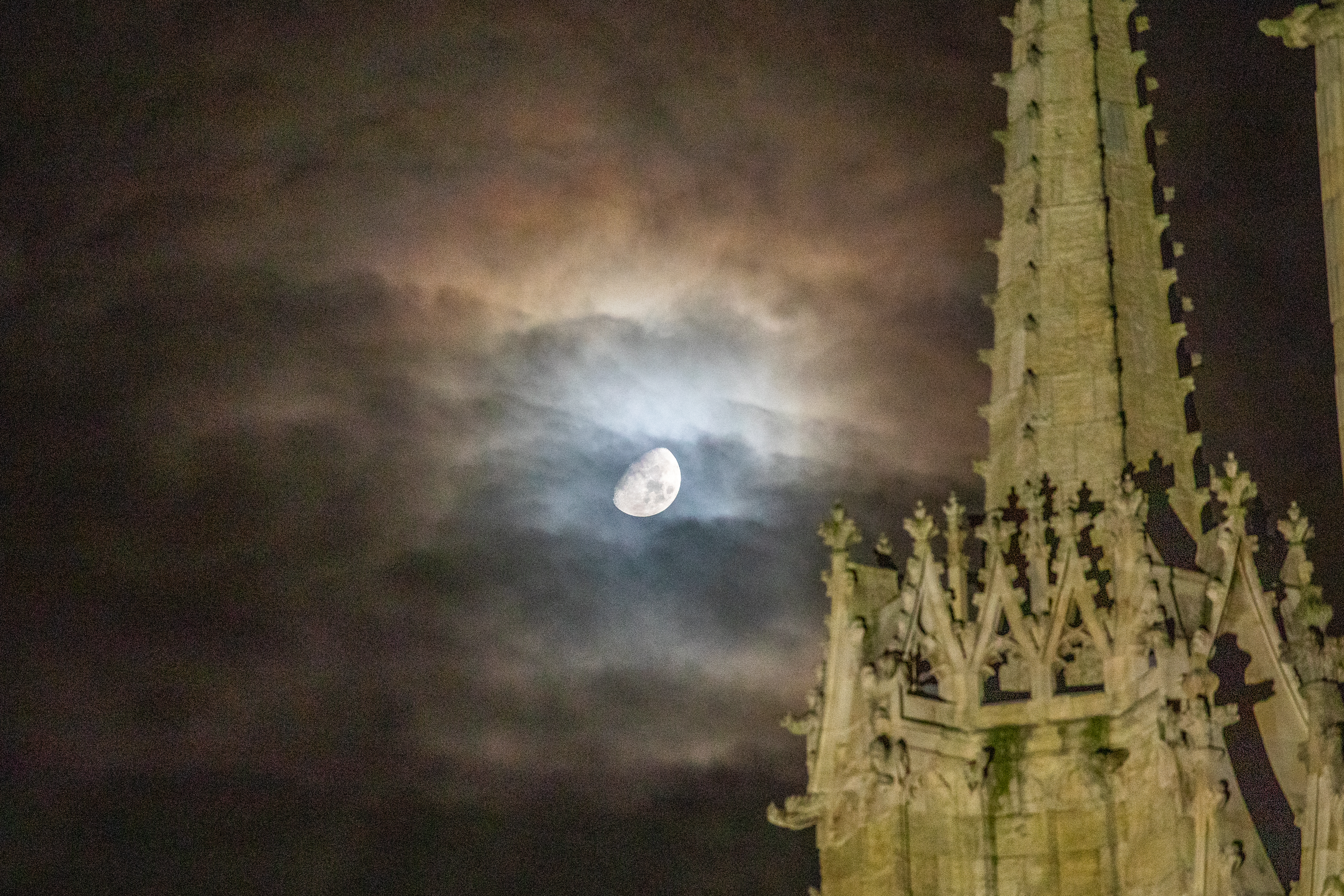
Like many others, I’ll probably make an effort to see tonight’s full moon. Noteworthy not only for its fullness but also, today, for the eclipse which will be at least partly visible from the UK. The ‘blood moon’, as it is called, might offer us a spectacular reminder of this strange and beautiful neighbouring globe, held in the earth’s gravity.

As a presenter on the BBC Radio 4 Today programme commented, events such as the eclipse somehow serve to put humanity’s woes into perspective. As we agonise about the various crises of our time, earth’s celestial companion is a daily reminder of a strange place to which few humans have ever been. Unlike the sun, here is an object at which we can stare, or observe with magnification, with little difficulty. When it is waxing or waning we can see the edge of craters silhouetted against the darkness of space.

Inevitably, the moon has always been part of human religious understanding. Intriguingly, although light is created on the first day of the Genesis account, neither the sun nor the moon appear until day four. Like the light on a cloudy day, it appears that the authors of the Genesis account distinguished between “general” light and the specific radiance of the sun and moon. The two bodies were seen as heavenly lamps, signifying that both generated different forms of light. It does not appear to have been understood at the time that the moon was simply reflecting sunlight.

“Genesis attributed another function to the Moon—marking the onset of Israelite festivals. Such a calendrical function of the phases of Moon is by no means restricted to Genesis. The calendrical function of the Moon has been so widespread around the world in other cultures that it might qualify as a cultural universal”.

Murray, G. F. (2021). Moon Traditions: An Overview of Changing Beliefs About Earth’s MoonThe Human Factor in the Settlement of the Moon: An Interdisciplinary Approach, 19-40.

One interpretation of the purpose of the creation narrative was to lend divine authority to the pattern of the seven day week, with the distinctive feature of a sabbath day. While not unique, the seven day week was not universal in biblical times. The Roman Empire, for example, used an eight day structure until the Jewish and Babylonian practice began to become ascendent. With the conversion of Emperor Constantine the seven day model became mandatory across the Empire. It has been suggested that the cause of this shift in the organisation of time, reflects the alteration of farming from a focus on livestock to one of land cultivation. The latter required much more intensive and back-breaking labour which may have made the concept of a sabbath day a necessary part of both human productivity and survival.

In Francis of Assisi’s Canticle of the Sun the stars and moon are praised as being “clear and precious and beautiful”. Within our understanding of the solar system as it stands today, we know that the position of sun, moon and stars reveal the dynamic character of the universe. We are on a planet that spins on its axis; in an orbit around the sun; with a moon in orbit around earth; in a solar system that orbits the centre of the Milky Way galaxy. The rare occurrence of a lunar eclipse reminds us of these movements, and the interplay of the heavenly bodies. It doesn’t stop us enjoying the beauty of these moments, or detract from the sense of awe that we live in a universe that is vast beyond our imagination, and exists without the slightest influence of human influence.

The Geography of Poverty

During research into the London hospitals at the Reformation, I discovered their role in policing the streets. Following the dissolution of the monasteries, each of the five re-founded hospitals maintained beadles, part of whose job was to patrol the streets around the institutions, retrieving the sick and poor into them, with the power to “expulse” sturdy vagrants from the City. This was done in response to concerns by city leaders that the city was looking disheveled. In the politics of reformation, this was an unwelcome development. In the document re-founding the London hospitals it was stated:

“considering the miserable estate of the poor aged sick sore and impotent people, as well men as women, lying and going about begging in the common streets of the said City of London and the suburbs of the same, to the great pain and sorrow of the same poor aged sick and impotent people, and to the great infection hurt and annoyance of his Grace’s loving subjects, which of necessity must daily go and pass by the same poor sick sore and impotent people being infected with divers great and horrible sicknesses and diseases...”

The Crown, 1546

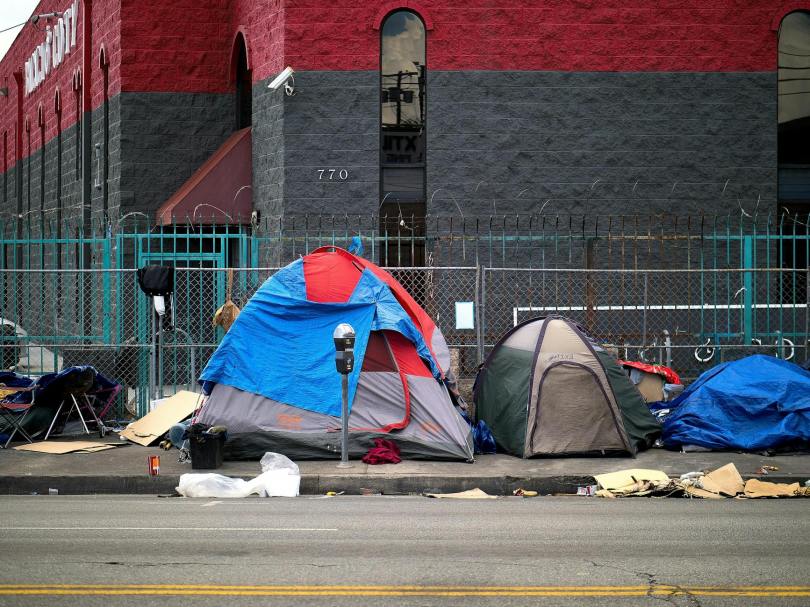
The last part suggests the true cause, despite protestations of concern for the homeless, of the creation of London’s post-Reformation hospitals. It allowed the poor and diseased to be put out of sight. This is a good example of how the geography of poverty matters a lot more than the existence of destitution. The myths of Robin Hood and his outlaws living in woodland reflects this expulsion into obscurity.

Medieval beggar, with crutch, rendered as a grotesque at York Minster

Plus ça change, plus c’est la même chose. Donald Trump didn’t like the view from his $1.5 million state Cadillac, and ordered parks in Washington DC to be cleared of temporary structures. He deployed the military. People were given scant notice of the impending eviction, and bulldozers arrived to complete the task.

The White House said it will offer to place people sleeping on the streets in homeless shelters and provide access to addiction or mental health services – but if they refuse, they will face fines or jail time.

From a BBC report posted on 17 August 2025

Immaculate public areas are not always a good or healthy sign of a compassionate society. I recall visiting Santiago in Chile in 1987, with General Pinochet in charge, and finding the subway exceptionally clean with classical music blaring out. Perhaps not a bad thing except, when a woman walked in while eating an ice cream, she was immediately surrounded and intimidated by security personnel. The ice cream had to be thrown into a bin. It would appear that for many leaders on the right, poverty doesn’t exist if it can’t be seen (by them) and perhaps many of us bother little about what’s “out of sight”.

The fantasy video which appeared after Trump’s statements about making Gaza a Mediterranean resort (re-tweeted by Trump on his own account) affirms this narrative of illusion. The poor will always be with us, but that doesn’t matter if they are out of view. Rather than allowing his motorcade trip to inspire programmes to alleviate poverty, it simply incentivised the violent and dramatic relocation of misery.

What is happening on the other side of the pond is, inevitably, stimulating similar attitudes here. Reform UK’s statement about mass deportations of asylum seekers is all about the geography of poverty. It doesn’t matter if it’s somewhere overseas, perhaps in a country whose economy and politics still labour under circumstances brought about by the aftermath of colonialism. The injustices of global trade are irrelevant when those in power simply want an outlook that’s neat and tidy.

What’s Theology Ever Done for Us?

This is a question that many people in church pews might ask. For those absent from pews, or any place of worship, this questions would not even cross their minds. Why would it?

Professor Sarah Coakley dropped a pebble into this discussion in an extract from her lecture at Christ Church, Oxford, published in The Church Times. It became the most read on-line article of that week and sparked several responses, including a piece by Canon Jarel Robinson-Brown published on the Modern Church website.

Sarah Coakley’s paper is entitled: “Bring theology back to the parishes“. The context for her this was the 20th anniversary of the Littlemore Group. In the past I have raised my own concerns about theology, and where it is done. Oxbridge colleges are synonymous with the historic production of English Anglican theology and this may not have been the most promising location in which to call theology home to the parishes of the land. Nevertheless, Coakley’ s appeal certainly merits discussion.

“…it is surely not true that good theology (richly substantive and imaginatively engaging theology) is the enemy of mission and effective “leadership”. Rather it is precisely its necessary medium and handmaid”.

Extract from Sarah Coakley’s address to the Littlemore Group, published in the Church Times.

Coakley’s argument goes on to appeal for the development of high quality, imaginative and of politically relevant Anglican theology developed and available to all. There is recognition of the clerical habit of underestimating lay interest in theology, alongside the divisive debates within theology between what might be termed “academic” and “practical”. Coakley’s call, across such divisions, is for there to be good theology, defined as: “deep, demanding, contentful, prayerful, and imaginatively life-changing”.

Jarel Robinson-Brown’s response to Coakley’s work identifies a number of concerns. While in broad agreement with her objective, Robinson-Brown critiques the tendency for theology to appear indifferent to “the worlds that real flesh and blood humans inhabit”. I think this is a fair point. This year marks the 40th anniversary of the Kairos Document, which identified the false theological foundations which were claimed to legitimate Apartheid. Robinson-Brown, while not citing this specific example, nevertheless feels that Coakley has not acknowledged the need for theology to repent for its many errors and the damage those errors have done to people across the world.

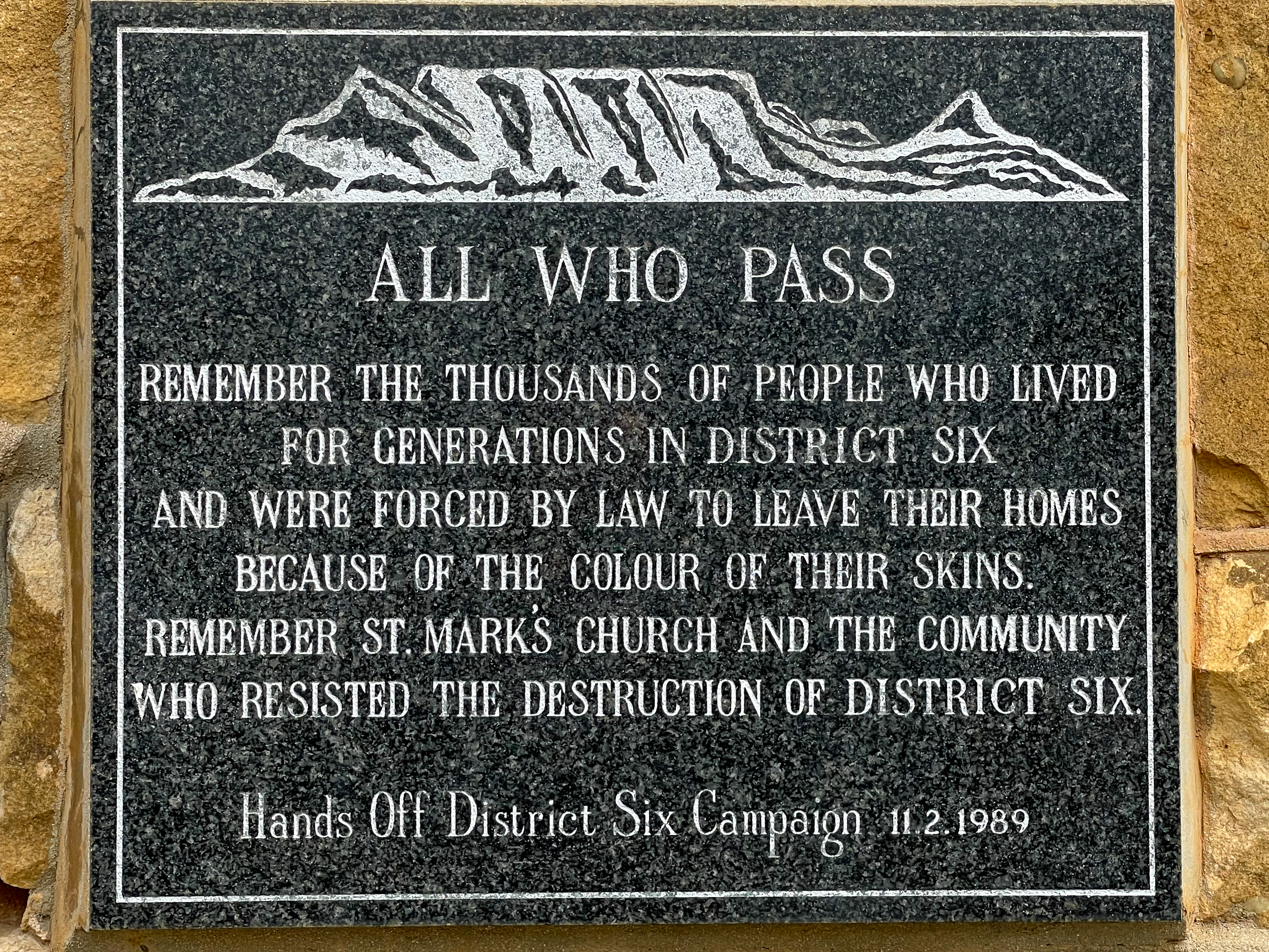
District Six is a former residential area in Cape Town, South Africa, known for its diverse community and vibrant culture before the apartheid era. It became a symbol of the forced removals and displacement caused by apartheid. The area was designated for white residents in 1966, and over 60,000 people were forcibly removed and relocated. St Mark’s Church became a focus for resistance against this process of segregation.

During a recent Journal Group meeting at the Leeds Church Institute, where I am Director, there was a good example of these tensions and differences. An engaging paper on theology and disability was presented, followed by a discussion about the strengths, weaknesses and applications of what was being argued. In a light-hearted manner, I observed that the paper contained some significant heresies. As I noted at the time, I wasn’t unduly concerned about these but – in terms of systematic theology – they were present. Chief among them was the notion of God being in need. Reflecting on this discussion I realise that my articulation of formal theology was guilty of closing down less orthodox but genuine, experience-informed theological discernment. Perhaps the material was heretical if measured by certain criteria, but it arose out of the lived experience of being a Christian, and from within a community that is repeatedly marginalised and made the object of condescending charity. It is also a community that has been the victim of theologically mandated disdain and shunning.

Between these two recent explorations of theology in the parish, I have been reading a paper from 2022 about intercultural theological education in South Africa, written by Professor Marilyn Naidoo. Here the author questions the universalising tendencies of Western knowledge, not least in the field of theology. Rather than imposing categories of heresy or orthodoxy, Naidoo argues for an approach that takes the experiences of oppressed people as a place from which theology must be generated.

“Classical theological methodology has always looked to scripture, tradition, and reason and found the person largely irrelevant”.

Naidoo, M. (2022). Nurturing intercultural theological education towards social justice ideals in South Africa. Religions, 13(9), 830.

The paper goes on to make the point that “the way scripture is interpreted and acted upon depends on a person’s lived reality”. In one way or another, and to varying extents, Coakley, Robinson-Brown and Naidoo re-assert the importance of people in the task of theology. This is not a minor correction but an urgent plea for theologians of all kinds to attend to the experiences of people – and to enable people to attend to the task of theology. It is not a question of theology being done for us – but a genuine intent for theology to be done by us, where “us” is not the ordained, but the baptised.

Thought Forgery

I have begun experimenting with artificial intelligence. Using the available free programmes I am exploring how AI might be used, and what risks or concerns need to shape my approach. It is fascinating – if a little disconcerting. For example, last week I resurrected the towering Anglican Archbishop of the 20th century, William Temple. I asked ChatGPT what Archbishop Temple might say to the Church of England today. At lightening speed, after presumably trawling all available Temple content in cyberspace – and assessing the state of the Church of England today – the headline answer emerged as follows:

Temple might say:

“The Church must never be merely the chaplain of the comfortable, but always the conscience of the nation. We are stewards not just of grace, but of justice.”

From what I know of Temple’s writing, and my awareness of the Church of England today, this isn’t half bad, or inconsistent with Temple’s thought. Who else might we resurrect to offer their historical voice to the contemporary world?

As any tutor will tell you, AI is plaguing the world of academia. Not only are students asking programmes to write their essays, but as a consequence, numbers are falling in lectures. Why bother going to the class if you aren’t going to be the one producing the work? One of the greatest challenges for markers is spotting and addressing an excessive use of ChatGPT. After all, this is not plagiarism. AI produces unique content depending on the question asked and the time of asking. I imagine, as time goes on, that AI will become bespoke and personalised for the user, mimicking their mistakes and linguistic styles. This will be all but impossible to identify and may be the path back to some element of supervised examination.

If not plagiarism, then perhaps AI is best described as forgery. I have no idea whether my blogs have been mined by AI, or my books scanned and absorbed. In generating Temple’s pithy comment to the CofE today, AI hasn’t copied his words – but created them based on what cyberspace contains of Temple’s own work and the many commentators on his theology and public statements. This is why it is becoming so difficult to tell fact from fiction and, into this space of doubt, a whole world of mischief can be wrought. When something sounds so like someone, how do we know if it is true? Similarly, it casts doubt on photographs and their authenticity which, in somewhere like Gaza, can both undermine genuine evidence of war crimes and simultaneously manufacture material that conceals what is going on.

Photo by Beyzaa Yurtkuran on Pexels.com

Undoubtedly, AI has arrived and is here to stay. The questions is, how are we to live in a world where the level of power and sophistication demonstrated by AI continues to grow. Media outlets like the BBC have an important role to play in fact-checking and evaluating the validity of information. They will not be perfect, but few individuals will have the time or skills to do this for themselves.

For better or for worse, I won’t be using AI to write or proof my blogs. Perhaps we need this kind of statement on material that is published, indicating the level of AI usage, from entire authorship to copy-editing. In the meantime, I imagine that everything I write will be scoured, consumed and used to inform the continuing development of artificial intelligence. Thoughts will increasingly emerge that are second-hand amalgams, seemingly undetectable forgeries that don’t arise out of direct experiences, but appear uncannily authentic. I wonder what would William Temple say about that?

Language-bearers

In the earliest poem written in Old English, The Dream of the Rood, people are called “language bearers”. It is an intriguing descriptor-name, highlighting one of the unique characteristics of what it means to be human. While watching the new BBC series Human, I was reminded of this defining feature of our distinctiveness. Presenter Ella Al-Shamahi visited a cave in Botswana to make the case that the appearance of the first humans (who share an identity with us) was marked by the development of ritual. Behaviour that implies abstract thoughts and patterns, rendered material through actions that serve no immediate practical benefit.

However, while it may be the evidence of something, ritual must always follow in the wake of something else: the creation of story. Ritual is secondary; stories are primary. As human beings grappled to locate themselves under the stars, and at risk from the vagaries of the weather and nature, stories endow a sense of purpose in survival. We envisage a future, and that future shapes and influences our present actions. Stories also bind us together with those who share the same framework of meaning. It is for this reason that I have long thought of the book Genesis, not so much an account of creation, but as an act of creation. Sharing these particular stories meant you were knit together with the children of Israel, and shared their covenant with God. The story is the fabric that holds the people together and ritual develops out of the narratives to help anchor them within human experience. It may also be true that as stories are embedded in ritual, the act of creativity also shapes the way that the story is told.

At Helleristningene ved Sagelva, in Norway, this is one of two raindeer images ground into the rocks. They are approximately 9,000 years old.

In the way that time is so much greater than we imagine, the script of Humans reminds us that in the entire period that human beings have been around, writing has been present only for the last 1% of our history. It follows that tracing the origins of stories is an impossible task, with the evidence of ritual standing proxy for story’s presence and purpose. Very often we can only speculate about the narratives that lie behind these illustrations, or their purpose once completed. Given the harsh conditions in which early people lived, and the precious nature of resources (including time) needed to survive, the commitment to art and the creation of enduring heritage is surprising. Human being appear to have needed theologies and mythologies that wove experiences into a sense of purpose and blessing.

The poet Eamon Grennan wonders if the cave painters worked in silence, like monks illuminating Medieval manuscripts, or if they kept up a gossip of religious fervour as they created images of wonder in the given contours of rock:

It doesn’t matter: we know
they went with guttering rushlight
into the dark; came to terms
with the given world; must have had
—as their hands moved steadily
by spiderlight—one desire
we’d recognise: they would—before going on   
beyond this border zone, this nowhere   
that is now here—leave something
upright and bright behind them in the dark.

Extract from The Cave Painters by Eamon Grennan

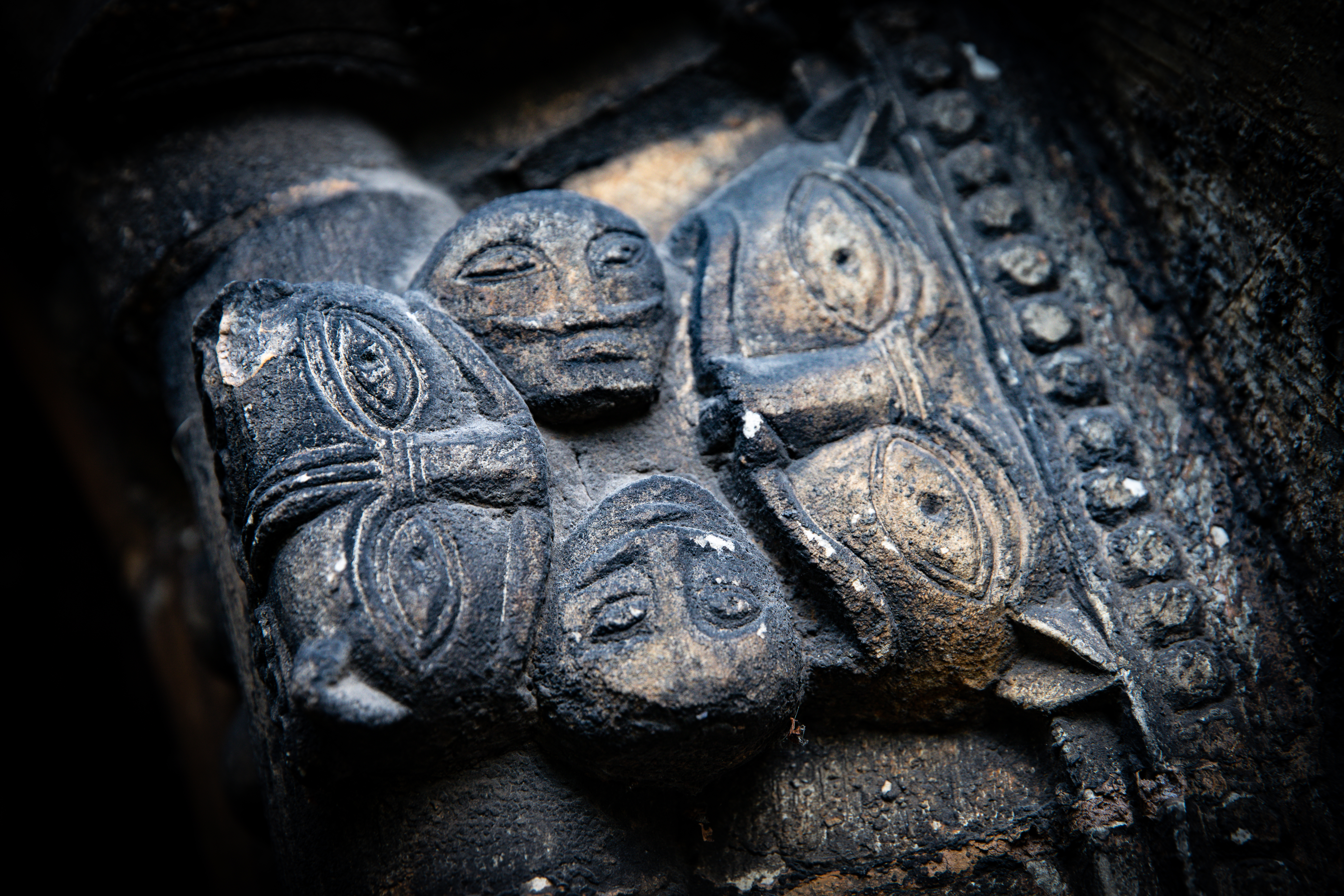
  • The image at the head of this blog is sometimes described as ‘Viking graffiti’ and can be found in Skipwith Church, near York.

Faith and the City

My grandfather would not have approved. A former church warden of a large market-town parish church, he voted Tory at every opportunity, and would have seen the Church’s critical examination of urban life – Faith in the City – as the latest example of its waywardness. Every day he awaited the arrival of his copy of The Daily Mail, which he embraced as a comfort blanket for all his favourite prejudices. He waved the paper at me energetically when it earnestly condemned various speakers in the televised General Synod debate on nuclear deterrence in 1983. (He had less to say about the owner of The Mail’s enthusiastic admiration of Hitler back in the 1930s). When I argued with him about the valuable work of the post-war Labour Government he was quick to reply that those politicians were “different”. I very much doubt he said that at the time.

As I commented earlier this year, 2025 marks the 40th anniversary of the publication of Faith in the City, and several small celebrations have been held. Most of us attending the one in Sheffield were north of 60, with Alan Billings, one of the original commissioners and a speaker at the conference, being in his 80s. I wasn’t altogether clear why the event was taking place on the same weekend as General Synod, but perhaps it reflects the Church of England’s limited interest in questions of urban theology and action. More than one speaker noted that in the twenty years after the report there was considerable activity by the CofE in the cities. However, the last 20 years have told a different story.

I was in the middle year of my undergraduate degree, living in Hull, when Faith in the City hit the presses. Alan told us that the Cabinet had leaked the report to the right wing press, enabling its publication to be met with claims of Marxism and a Church failing to attend to its primary task. While many in the Church supported the report, I recall a parishioner in the rural parish where my parents lived asking: “what about the rural areas – where’s the support for us?” I’ve no doubt that those comments were widespread in rural communities.

It felt in the 1980s that the Church of England could still occupy that strange land of “critical solidarity” with the institutions of which it was also a part. Not easy, but it was also the decade in which Archbishop Runcie dared to pray for the dead on both sides at the Falklands Memorial Service in 1982, saying that: “a shared anguish can be a bridge of reconciliation; our neighbours are indeed like us”. Mrs Thatcher was not pleased. In 1984, the Church led by Runcie consecrated David Jenkins as the bishop for Durham. Once again, the Church supplied the right-wing press with oodles of content to bolster its appetite for righteous indignation. My grandfather had gone to glory by that stage but he would have enjoyed the temporal exasperations of the tabloid press.

Looking back is not always a good idea. The seeds of change were already planted in the Church of England of the 1980s. Fewer vocations; difficulties in recruiting to inner-city parishes; a world changing as a rate of knots. However, I’m less certain that those around at the time could have envisaged how radical the changes would become, and the number of parishes that would be forced to merge. The unwinding of Anglicanism’s commitment to provide every church with a parson; a parsonage and burden of finance that could be borne, has happening at a dizzying pace. Volunteers have vanished and the struggle to maintain a meaningful presence has intensified.

It isn’t all doom and gloom. The church I assist at once a month has rallied without any jazzy new initiatives from the centre. Speaking with the organist (a working farmer) he told me that they had got down to an attendance of 10 on a typical Sunday morning. Now it’s at 30. Why? He put it down to the loving pastoral care of a Reader, who made some simple improvements to worship but – perhaps most importantly – helped keep the service at the same time every Sunday. Sometimes it is Morning Prayer and at others, Holy Communion – but the people come nonetheless. In the cities there are also signs of renewed interest in Christianity, with a more diverse population bringing fresh energy to places of worship. The context of Faith in the City has changed – but faith is to be found nonetheless, and the questions raised 40 years ago remain relevant today.

What remains constant, however, is the need for deep listening, authentic presence, recognition of transience and journey, and genuine collaboration. As one of us concluded, “It has to be ‘we’ if we are to make a difference”.

William Temple Foundation blog, 21 May 2025

War with Trolls

Norway is a country of stunning beauty which experiences, for some of the year, either endless light or total darkness. I can’t quite imagine what winter must be like here, with deep cold as well as an absence of the sun. In summer it is awash with light, at all hours. Perhaps the drama of this experience accounts for the great composers and poets who have come from Norway.

Henrik Ibsen is Norway’s celebrated playwright and the author of the world’s most frequently performed plays (after those of Shakespeare). Ibsen is highly critical of clergy and what he sees as the inhuman demands of upholding a certain kind of Christian Orthodoxy. As an outstanding dramatist, Ibsen crafts his plays to reflect and expose the failings of key institutions and how individuals strive to live authentic lives despite the ingrained failures and disappointments arising from the unattainable expectations of society. As Ibsen reflected from his Norwegian context: “To live is to war with trolls in heart and soul”. His plays go a long way to identify some of these trolls.

“the tragic poets and dramatists, such as Ibsen, those who seem to understand something like holiness, and that life’s real question, ‘the psycho-moral dilemma’, as Arthur Miller calls it, is not ‘How do I feel about God?’ but ‘What dealings have I with God?’, not as a concept but as the leading character in the unfolding drama”.

Goroncy, J. A. (2006). Bitter Tonic for our Time–Why the Church needs the World: Peter Taylor Forsyth on Henrik Ibsen. European journal of theology15(2).

As I mentioned in last week’s blog, during my time away I have been reading Hanna Reichel’s After Method: queer grace, conceptual design, and the possibility of theology. It is not a quick read, but one that has captivated my attention and provided lucid language to describe and interrogate issues in theology I have long experienced, but not always found the framework to express. At its heart this concerns the tensions, and illegibilities, between systematic theology and constructive theology. To illustrate this let me describe some correspondence from many years ago, which relates to something I experienced in ministry and wrote about previously: neonatal loss. From time to time I have been asked to baptise a baby that has died, or was alive only briefly, assisted by significant medical intervention. As I explored this and what it means, theologically, I came across a note in Common Worship written by the illustrious octogenarian (as of yesterday) and onetime Regius Professor of Moral and Pastoral Theology at Christ Church, Oliver O’Donovan. O’Donovan, a former professor of systematic theology, writes: “You cannot baptize someone who is dead”.

From the standpoint of systematic theology this is consistent with Scripture; the history of Church doctrine; and the practice of the Church’s ministry. Well, it is and it isn’t. As I discovered when researching this topic, the Church in its history has found ways round this situation to preserve doctrine and meet the pastoral needs of parents. This creativity lead to the creation of “resurrection chapels” where an apparently deceased child could be handed to a priest, who then disappeared into a chapel, and came back saying that the baby had miraculously been resurrected for a moment, baptised, but then – alas – died. This enabled the veneer of orthodoxy to be preserved while meeting the earnest and sincere needs of parents. In a desire to sustain a credible doctrinal position the Church tolerated these kinds of “work arounds” but failed to allow the realities of human experience to interrogate the substance of systematic theology itself.

The core problem, it seems to me, is that the attempt to uphold a systematic understanding of faith at all costs results in a punished humanity and a pedestrian God. A theological educator said to me some years ago, with an evident sense of relief, that he was so glad they’d abandoned the use of “case studies” in the seminary where he taught. Tales from the frontline of Christian living can be very inconvenient for certain kinds of theology. Preaching at Evensong in an Oxford college, I happened to mention a pastoral call I’d received in the early hours of that day from the northern hospital where I worked. The Master thanked me afterwards for bringing in some “réalité”. It amused me that a French word was required to express the real life that had intruded into the college chapel. The question arises, what kind of theology emerges when human life is stripped out of the equation? For some key critical commentators it is theology devoid of “the messiness of incarnation and real peoples’ lives”, which makes it difficult to imagine what use it is to the people orthodoxy claims to be at the centre of God’s mission.

Monstrous Theology

Over the centuries theologians have defended the continuation of slavery; National Socialism in Germany; and the creation of Apartheid. This is only to reference some of the most obscene and horrific examples of the countless ways in which theology has been corrupted. The Bible pillaged for verses to undergird human atrocities, deprivations of dignity and squalid efforts to impose conformity.

In a recent performance of Esther’s Revenge during the Leeds Lit Festival I was reminded once again of this disturbing truth. Esther – played by Bola Atiteba – entered her trial, in the setting of Leeds Minster, holding a Bible. While she clutched it close for much of the performance, it was never cited. No verses were read, yet its silent presence reminded the audience that the Good Book has been used to justify wickedness and, simultaneously, to inspire those who oppose everything that diminishes human life.

The monstrous abuse of Scripture, to enable the destruction of others, has been going on from at least the time its oral state was transformed into text. I have recently started reading Hanna Reichel’s fascinating new book After Method: queer grace, conceptual design, and the possibility of theology. It begins with the question as to whether we need better theology, responding in part to Kevin Garcia’s provocatively titled Bad Theology Kills. As Reichel puts it:

“I baulked at how the church hierarchy in Argentina had been hopelessly complicit in the dictatorship. Had their theology not protected them from the seductions of power and fear, even saw in their survival a greater good over the lives that they abandoned and betrayed?”

Reichel, H. (2023). After Method: Queer Grace, Conceptual Design, and the Possibility of Theology. Presbyterian Publishing Corp.

Reichel’s words are an encouraging affirmation of what I have long believed as a chaplain. Theology should be written in intensive care, not behind the walls of ivy-clad colleges. Charles Taylor puts it succinctly in his seminal work, A Secular Age, when he laments the tendency of the Church to be ‘excarnational’. For Taylor, many theologians have failed to live up to their promise because they have driven the discipline into their heads at the cost of embodied experience and learning. This has promoted theologies that have ignored the human cost of beliefs legitimated by centres of power and education.

Heading this blog is a photograph of an installation – ‘Beast’ – by the American artist Matthew Angelo Harrison. It is featured in the inaugural exhibition of PoMo, the new gallery of modern art in Trondheim, Norway. The beast is encased in a block of polyurethane resin: like a prehistoric creature preserved in amber. However, Harrison’s work is a monster of our own time, created and immersed in acrylic only last year. Attempting to photograph such an object is not easy. Wherever I was standing, my reflection was captured. Perhaps that was Harrison’s intent. We can look at the otherness of the terrifying but make little effort to identify our own complicity in its creation. As Reichel puts it, bad theology is always at work in the creation of ‘us-and-them’ myths that strive to legitimate monstrous deeds. There are those who might think that the easy answer is to dump theology as a whole. However, disposing of words won’t abolish the things to which they refer. Theology – good theology – will always be needed, because human beings will never cease to contest questions about ultimate purposes, what is sacred, and how we treat one another as we seek to determine our destiny.