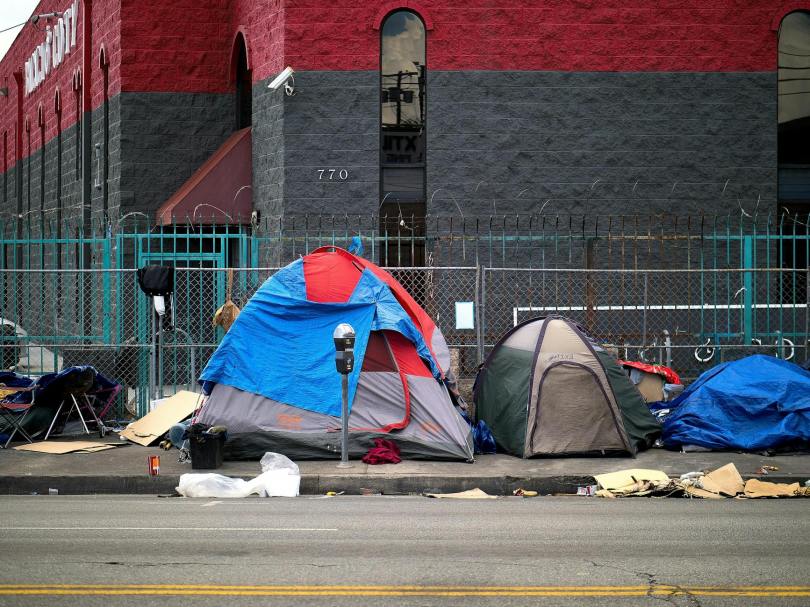
The Geography of Poverty

During research into the London hospitals at the Reformation, I discovered their role in policing the streets. Following the dissolution of the monasteries, each of the five re-founded hospitals maintained beadles, part of whose job was to patrol the streets around the institutions, retrieving the sick and poor into them, with the power to “expulse” sturdy vagrants from the City. This was done in response to concerns by city leaders that the city was looking disheveled. In the politics of reformation, this was an unwelcome development. In the document re-founding the London hospitals it was stated:

“considering the miserable estate of the poor aged sick sore and impotent people, as well men as women, lying and going about begging in the common streets of the said City of London and the suburbs of the same, to the great pain and sorrow of the same poor aged sick and impotent people, and to the great infection hurt and annoyance of his Grace’s loving subjects, which of necessity must daily go and pass by the same poor sick sore and impotent people being infected with divers great and horrible sicknesses and diseases...”

The Crown, 1546

The last part suggests the true cause, despite protestations of concern for the homeless, of the creation of London’s post-Reformation hospitals. It allowed the poor and diseased to be put out of sight. This is a good example of how the geography of poverty matters a lot more than the existence of destitution. The myths of Robin Hood and his outlaws living in woodland reflects this expulsion into obscurity.

Medieval beggar, with crutch, rendered as a grotesque at York Minster

Plus ça change, plus c’est la même chose. Donald Trump didn’t like the view from his $1.5 million state Cadillac, and ordered parks in Washington DC to be cleared of temporary structures. He deployed the military. People were given scant notice of the impending eviction, and bulldozers arrived to complete the task.

The White House said it will offer to place people sleeping on the streets in homeless shelters and provide access to addiction or mental health services – but if they refuse, they will face fines or jail time.

From a BBC report posted on 17 August 2025

Immaculate public areas are not always a good or healthy sign of a compassionate society. I recall visiting Santiago in Chile in 1987, with General Pinochet in charge, and finding the subway exceptionally clean with classical music blaring out. Perhaps not a bad thing except, when a woman walked in while eating an ice cream, she was immediately surrounded and intimidated by security personnel. The ice cream had to be thrown into a bin. It would appear that for many leaders on the right, poverty doesn’t exist if it can’t be seen (by them) and perhaps many of us bother little about what’s “out of sight”.

The fantasy video which appeared after Trump’s statements about making Gaza a Mediterranean resort (re-tweeted by Trump on his own account) affirms this narrative of illusion. The poor will always be with us, but that doesn’t matter if they are out of view. Rather than allowing his motorcade trip to inspire programmes to alleviate poverty, it simply incentivised the violent and dramatic relocation of misery.

What is happening on the other side of the pond is, inevitably, stimulating similar attitudes here. Reform UK’s statement about mass deportations of asylum seekers is all about the geography of poverty. It doesn’t matter if it’s somewhere overseas, perhaps in a country whose economy and politics still labour under circumstances brought about by the aftermath of colonialism. The injustices of global trade are irrelevant when those in power simply want an outlook that’s neat and tidy.

What’s Theology Ever Done for Us?

This is a question that many people in church pews might ask. For those absent from pews, or any place of worship, this questions would not even cross their minds. Why would it?

Professor Sarah Coakley dropped a pebble into this discussion in an extract from her lecture at Christ Church, Oxford, published in The Church Times. It became the most read on-line article of that week and sparked several responses, including a piece by Canon Jarel Robinson-Brown published on the Modern Church website.

Sarah Coakley’s paper is entitled: “Bring theology back to the parishes“. The context for her this was the 20th anniversary of the Littlemore Group. In the past I have raised my own concerns about theology, and where it is done. Oxbridge colleges are synonymous with the historic production of English Anglican theology and this may not have been the most promising location in which to call theology home to the parishes of the land. Nevertheless, Coakley’ s appeal certainly merits discussion.

“…it is surely not true that good theology (richly substantive and imaginatively engaging theology) is the enemy of mission and effective “leadership”. Rather it is precisely its necessary medium and handmaid”.

Extract from Sarah Coakley’s address to the Littlemore Group, published in the Church Times.

Coakley’s argument goes on to appeal for the development of high quality, imaginative and of politically relevant Anglican theology developed and available to all. There is recognition of the clerical habit of underestimating lay interest in theology, alongside the divisive debates within theology between what might be termed “academic” and “practical”. Coakley’s call, across such divisions, is for there to be good theology, defined as: “deep, demanding, contentful, prayerful, and imaginatively life-changing”.

Jarel Robinson-Brown’s response to Coakley’s work identifies a number of concerns. While in broad agreement with her objective, Robinson-Brown critiques the tendency for theology to appear indifferent to “the worlds that real flesh and blood humans inhabit”. I think this is a fair point. This year marks the 40th anniversary of the Kairos Document, which identified the false theological foundations which were claimed to legitimate Apartheid. Robinson-Brown, while not citing this specific example, nevertheless feels that Coakley has not acknowledged the need for theology to repent for its many errors and the damage those errors have done to people across the world.

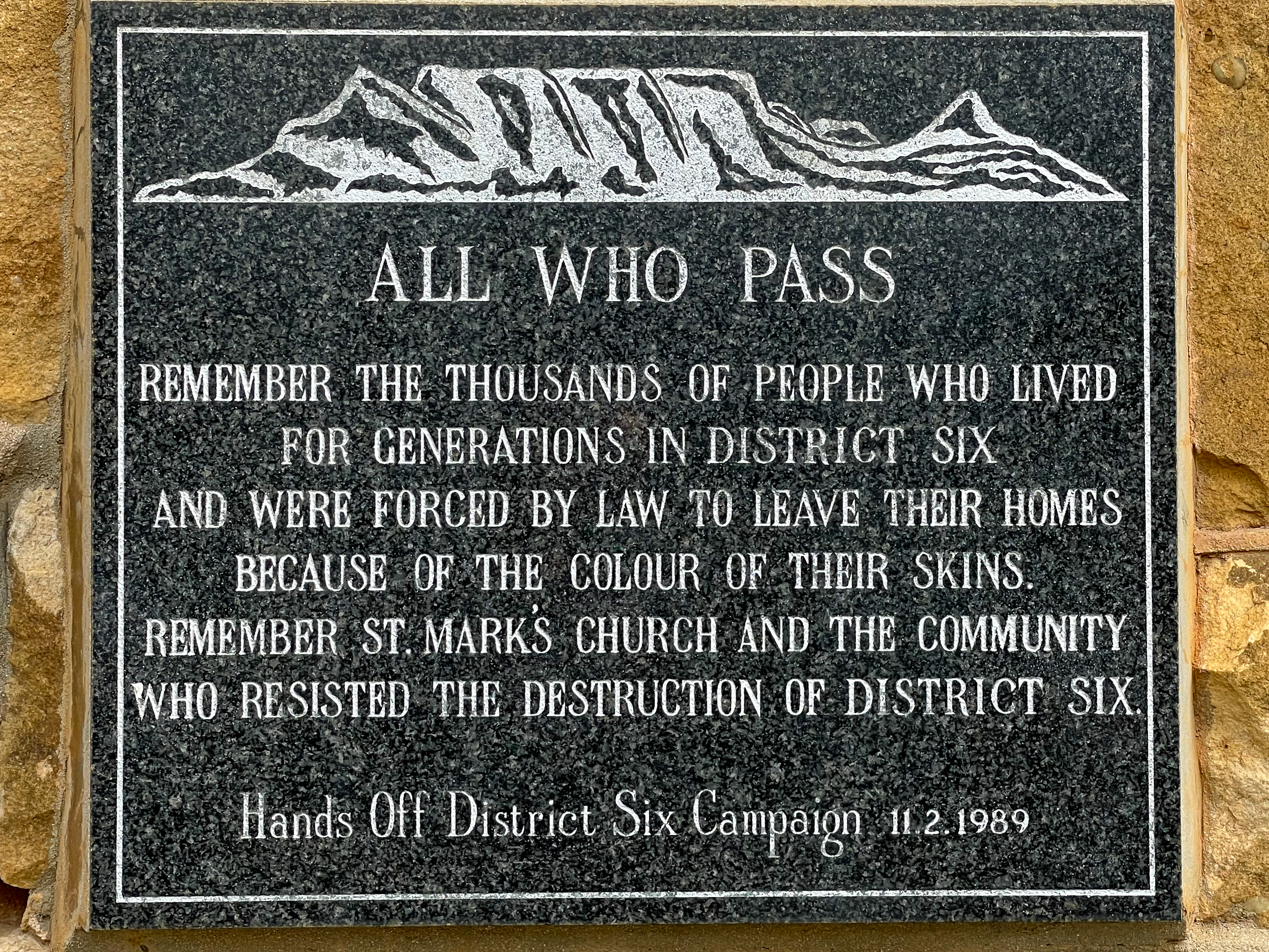
District Six is a former residential area in Cape Town, South Africa, known for its diverse community and vibrant culture before the apartheid era. It became a symbol of the forced removals and displacement caused by apartheid. The area was designated for white residents in 1966, and over 60,000 people were forcibly removed and relocated. St Mark’s Church became a focus for resistance against this process of segregation.

During a recent Journal Group meeting at the Leeds Church Institute, where I am Director, there was a good example of these tensions and differences. An engaging paper on theology and disability was presented, followed by a discussion about the strengths, weaknesses and applications of what was being argued. In a light-hearted manner, I observed that the paper contained some significant heresies. As I noted at the time, I wasn’t unduly concerned about these but – in terms of systematic theology – they were present. Chief among them was the notion of God being in need. Reflecting on this discussion I realise that my articulation of formal theology was guilty of closing down less orthodox but genuine, experience-informed theological discernment. Perhaps the material was heretical if measured by certain criteria, but it arose out of the lived experience of being a Christian, and from within a community that is repeatedly marginalised and made the object of condescending charity. It is also a community that has been the victim of theologically mandated disdain and shunning.

Between these two recent explorations of theology in the parish, I have been reading a paper from 2022 about intercultural theological education in South Africa, written by Professor Marilyn Naidoo. Here the author questions the universalising tendencies of Western knowledge, not least in the field of theology. Rather than imposing categories of heresy or orthodoxy, Naidoo argues for an approach that takes the experiences of oppressed people as a place from which theology must be generated.

“Classical theological methodology has always looked to scripture, tradition, and reason and found the person largely irrelevant”.

Naidoo, M. (2022). Nurturing intercultural theological education towards social justice ideals in South Africa. Religions, 13(9), 830.

The paper goes on to make the point that “the way scripture is interpreted and acted upon depends on a person’s lived reality”. In one way or another, and to varying extents, Coakley, Robinson-Brown and Naidoo re-assert the importance of people in the task of theology. This is not a minor correction but an urgent plea for theologians of all kinds to attend to the experiences of people – and to enable people to attend to the task of theology. It is not a question of theology being done for us – but a genuine intent for theology to be done by us, where “us” is not the ordained, but the baptised.

Thought Forgery

I have begun experimenting with artificial intelligence. Using the available free programmes I am exploring how AI might be used, and what risks or concerns need to shape my approach. It is fascinating – if a little disconcerting. For example, last week I resurrected the towering Anglican Archbishop of the 20th century, William Temple. I asked ChatGPT what Archbishop Temple might say to the Church of England today. At lightening speed, after presumably trawling all available Temple content in cyberspace – and assessing the state of the Church of England today – the headline answer emerged as follows:

Temple might say:

“The Church must never be merely the chaplain of the comfortable, but always the conscience of the nation. We are stewards not just of grace, but of justice.”

From what I know of Temple’s writing, and my awareness of the Church of England today, this isn’t half bad, or inconsistent with Temple’s thought. Who else might we resurrect to offer their historical voice to the contemporary world?

As any tutor will tell you, AI is plaguing the world of academia. Not only are students asking programmes to write their essays, but as a consequence, numbers are falling in lectures. Why bother going to the class if you aren’t going to be the one producing the work? One of the greatest challenges for markers is spotting and addressing an excessive use of ChatGPT. After all, this is not plagiarism. AI produces unique content depending on the question asked and the time of asking. I imagine, as time goes on, that AI will become bespoke and personalised for the user, mimicking their mistakes and linguistic styles. This will be all but impossible to identify and may be the path back to some element of supervised examination.

If not plagiarism, then perhaps AI is best described as forgery. I have no idea whether my blogs have been mined by AI, or my books scanned and absorbed. In generating Temple’s pithy comment to the CofE today, AI hasn’t copied his words – but created them based on what cyberspace contains of Temple’s own work and the many commentators on his theology and public statements. This is why it is becoming so difficult to tell fact from fiction and, into this space of doubt, a whole world of mischief can be wrought. When something sounds so like someone, how do we know if it is true? Similarly, it casts doubt on photographs and their authenticity which, in somewhere like Gaza, can both undermine genuine evidence of war crimes and simultaneously manufacture material that conceals what is going on.

Photo by Beyzaa Yurtkuran on Pexels.com

Undoubtedly, AI has arrived and is here to stay. The questions is, how are we to live in a world where the level of power and sophistication demonstrated by AI continues to grow. Media outlets like the BBC have an important role to play in fact-checking and evaluating the validity of information. They will not be perfect, but few individuals will have the time or skills to do this for themselves.

For better or for worse, I won’t be using AI to write or proof my blogs. Perhaps we need this kind of statement on material that is published, indicating the level of AI usage, from entire authorship to copy-editing. In the meantime, I imagine that everything I write will be scoured, consumed and used to inform the continuing development of artificial intelligence. Thoughts will increasingly emerge that are second-hand amalgams, seemingly undetectable forgeries that don’t arise out of direct experiences, but appear uncannily authentic. I wonder what would William Temple say about that?