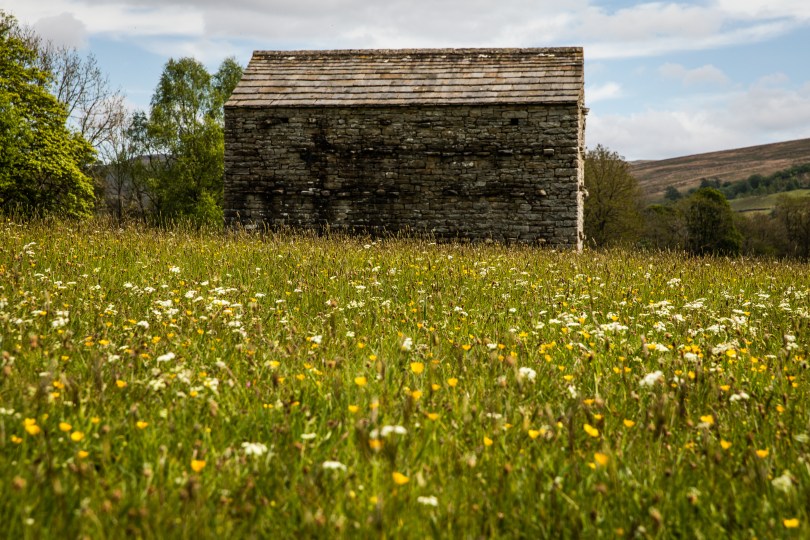
Barns and Bull-Boxes

They are peppered across the landscape of Swaledale. The stone-built barns that are sited away from the farms, designed to reduce the transport of hay over difficult ground and enable the cattle to be fed from supplies close by. On the other side of the Pennines, in the Ribble Valley, the poet Glyn Hughes was offered a more modest structure, yet equally remote. For a year he used a stone bull-box as a base for writing poetry. This followed his diagnosis of cancer, and the book of poems to emerge from the experience was to be his last. He saw this small volume of work as the spiritual dimension of his healing.

These two kinds of agricultural structures suggest a long history, often filled with the hardship of rural living. There were undoubtedly precious days of warmth and relaxation but, for most of the people most of the time, life was a struggle against the elements.

The less you possess, the more they are
not decorations but what is more needed: icons
requiring as icons do small space to give up their worth –
this water jug, this stove, this lamp, this spade,
this small table and chair.
All of it “junk” in any place but here

Extract from A Year in the Bull-Box: A Poem Sequence by Glyn Hughes, published by ARC Publications, 2011.

For Hughes, going back was the best way forward in coming to terms with the short span of life he had left. His year in the bull-box brought him back to basic things, albeit with the knowledge of the modern world close at hand. Reviewing the poems in The Guardian Simon Armitage wrote: “I don’t ever remember being as moved by a book of poems”. Which is quite something from the Poet Laureate.

A year of rudimentary living gave Hughes a re-kindled experience of childhood – encountering the smallest things with new attention and fascination. Laughing, perhaps, at the folly of holding back stream water as much as he might have wished to stem forever the tide of illness which would soon overtake him. What might have seemed isolating, bleak or depressing became precious months of connection with the seasons of the year. A spiritual stillness in the midst of an ever-turning world.

I was immortal then, not seventy but
a lithe, inquisitive
child again.

Extract from A Year in the Bull-Box: A Poem Sequence by Glyn Hughes

Play is often dismissed as childish when, what so many of us need, is the spirit of wonder and recreation that childhood brings. Many years ago I heard Gordon Mursell speak at a Diocesan Conference. His theme was God’s playfulness and, in relation to this, he recounted a story from the life of Samuel Johnson. This great lexicographer, who had a reputation for wit and wisdom, had walked to the top of a hill. When he arrived at the summit he declared to his companions that he was determined to take a roll. When those with him worked out what he meant they tried to dissuade him. However, Dr Johnson said that “he had not had a roll for a long time”, and proceeded to empty his pockets before descending the hill horizontally.

We should never lose the ability to be playful explorers of the world. For Glyn Hughes a safe return to the most basic necessities of life became a doorway to re-enchantment. A place to distill what truly matters in life and to experience and contemplate a world we did nothing to create, but to which we remain inextricably a part.

Pillow Talk

This title might conjure up the idea of gossip or salacious bedtime conversations. However, it is also the name of a particular kind of peony. In the garden where we live there are several clumps of this variety and in mid-May I am waiting for the copious buds to break into bloom. They are large and richly coloured flowers – pink meringues that dominate the herbaceous borders for a brief time and make for glorious arrangements in the fireplaces. The vitality of summer prefigured in a vase.

Along with the return of swifts to York in the past two weeks, the early signs of summer are gathering apace. The clear skies, longer daylight, and warm sunshine of recent days, add to the sense of the year’s turn. Already we have put out our garden sofa-swing. An extravagant purchase a couple of decades ago, but one that continues to provide enjoyment across the warmer months. Its comfort and gentle rocking often having the desired effect of inducing an afternoon snooze.

This year the English garden sofa-swing is celebrating its centenary, and a contemporary version of the rocker will be exhibited at the RHS Chelsea Flower Show later this week. It is often regarded as an example of English eccentricity – a bit of living room set in the outdoors. While I don’t go back anywhere near as far as the first appearance of this kind of garden furniture, one did feature very early in my childhood. My maternal grandmother was a fan of colour film for slides and I have some of her collection. (Bessie liked taking pictures of buildings that were about to disappear – including the dramatic demolition of mill chimneys in her native Lancashire).

This photograph was taken in 1966. Judging by the blossom behind the swing it may well have been the first May Bank Holiday weekend. The UK enjoyed some early heat in the first couple of days of the month in that year. I am the cheeky chap looking at the camera, slightly blurred by a sudden movement, and my brother is beside me. The company whose sofa-swing will be exhibited at Chelsea asked for customers’ photographs of historic examples to include in the display. Who knows, we might feature!

Part of my affection for the sofa-swing is connected with a childhood often overshadowed by illness. I had debilitating asthma throughout my pre-teen years, often missing school and struggling for breath. Lying on the swing in my grandparents’ garden, shielded from the sun and gently rocking, gave both comfort and relief. It was – and is – very soothing. As I lie on it today, gazing across at the pillow talk and listening to the plaintive call of a wood pigeon, I am reminded of the opening scene in A Portrait of a Lady, and Henry James’s paean to summer in an English garden:

“Real dusk would not arrive for many hours; but the flood of summer light had begun to ebb, the air had grown mellow, the shadows were long upon the smooth, dense turf. They lengthened slowly, however, and the scene expressed that sense of leisure still to come which is perhaps the chief source of one’s enjoyment of such a scene at such an hour. From five o’clock to eight is on certain occasions a little eternity”

Golden

The saying tells is that “silence is golden”. It comes from Arabic culture, going back to the 9th century CE at least, and is the shortened version of the original phrase: “Speech is silver, silence is golden”. While I have considerable sympathy with the notion that silence is richer and more splendid than speech, there are darker interpretations of what an imposed silence might mean.

Reading the excellent book by Wren Radford, Lived Experiences and Social Transformations, I was reminded that being silenced – or coercion into quietness – is far from golden. Reflecting on her childhood Wren Radford recalls:

‘I have been reading to myself most of the day; being quiet, which is seen as the same as being good’

To fit into an adult world, not causing trouble or manifesting needs, is one kind of upbringing. In some contexts silence can be its own form of resistance, especially when speaking the truth might lead to punishment. Our present political culture appears to be silencing whole swathes of people; those who have been encouraged to see themselves as powerless and irrelevant. In such circumstances the unheard might turn towards more extreme politics as a way to voice their dissatisfaction with a status quo that relentlessly favours the wealthy and denies opportunities to those who place the community ahead of the individual.

I have been thinking about silenced voices while editing a forthcoming edition of Crucible on assisted dying/suicide. It was while doing this work that I came across a blog by a now-retired member of staff from the University of Leeds. I had done a little work with Professor Allan House and our interactions were always memorable. Allan is an emeritus professor of liaison psychiatry.

On the first occasion we met, Allan was teaching on the Postgraduate Certificate in Health Research. I was one of a group of 20 or so NHS employees, mainly doctors and some nurses, who had opted for this course of study. By way of introduction, Allan asked us to identify ourselves and our role in the hospital. When I had spoken, Allan moved on, but after the next introduction returned to me. He clearly found it intriguing and a bit ‘left field’ to have a chaplain on the course, which perhaps sparked off a number of questions and unusual considerations. Subsequently we met a few times to explore some research ideas. It was at the start of the first of these that Allan said with a suitable degree of firmness: “I’m an atheist and a republican”.

In his blog on the topic of current legislation about assisted dying/suicide, Allan is more vociferous than the Bishop of London. I don’t have any personal knowledge, but Allan may well be in favour of some kind of assisted dying – but he is clearly very strongly opposed to the current legislation. His blog post is entitled “The dark ideology behind the assisted suicide campaign”.

In giving evidence to the Bill committee, in a private capacity and as a subject matter expert, Allan was undoubtedly frustrated with the imprecision of what is being proposed. Firstly, he cannot see how this is anything other than the facilitation of the wishes of someone who is suicidal. Indeed, the current proposals include an alteration to the Suicide Act 1961, effectively exempting anyone (in end-of-life cases) of culpability for encouraging or assisting a suicide.

“At the core of this position is a libertarian or hyper-individualistic privileging of personal choice to the exclusion of all other considerations: it doesn’t matter why the choice is being made, only that it is being made by an ‘autonomous’ individual”.

Other considerations have been silenced. Supporters of the Bill push back every attempt to ensure that there is some exploration by a competent professional of why someone wants to be supported to end their life. This means that there is no evaluation of issues which might be either improved or removed by a suitable intervention. All that matters is that the individual has capacity and isn’t being explicitly coerced. House sees within the current Bill a judgement that applicants for the process “are leading a sort of un-life, something so self-evidently valueless that there is no need to explore why they don’t want it”. He clearly believes that this is both wrong and irresponsible.

Being quiet isn’t always the same thing as being good. Far from it. Many years ago, during a bust-up about chaplaincy provision in the NHS, when I believed the Church of England’s central body was acting badly, my Bishop shared with me that he’d checked out with the lead Bishop for the NHS that I wasn’t “getting in the way”. I was rather surprised to hear this (and I think he regretted sharing it) but had sufficient wit to reply: “Sometimes someone needs to get in the way”. Despite this moment of candour I know that all too often I’ve been silent and perhaps the issue for all of us, including myself, is to speak what is inconvenient to the people who would rather we remained quiet.