God in the City

In the late 1980s I spent a year as a youth worker in the Isle of Dogs. The youth club operated in the crypt of Christ Church, and catered for local children up to the age of 11. Although I’d lived and studied in Hull, this was the first time I worked in an urban context. At that time much of the East End was undergoing the transformation from urban poverty to city banks and their associated wealth. Sparkling new buildings were springing up alongside docks where once no one had wanted to live. I was told that in those days taxi drivers had refused to drive into the island at night. During the 1980s the two communities, old and new, lived together uneasily. Some in the increasingly expensive gated estates, others in the council housing that was yet to be sold.

In my new role as Director of Leeds Church Institute I am once again reflecting on the relationship of ‘faith and the city’. Incidentally, it’s exactly 40 years since the report with that title was published by the Church of England, to be met with the ire of Mrs Thatcher and many other conservative voices. In the mildest of possible forms, perhaps this was the C of E’s modest response to the influence of liberation theology – the school of praxis and thought which arose chiefly in the favelas of Latin America. However, one of the criticisms of the report was its lack of a significant and developed theology to frame its analysis and recommendations. A subsequent publication, Theology in the City, responded to this criticism, partly arguing that the alleged lacuna arose from the misunderstanding of the more implicit theological approach Faith in the City had embodied.

During a year in Argentina I read Gutierrez’s classic work Teología de la liberación. Living in Córdoba and Buenos Aires, I grew more and more aware of the particular dynamics of city living, with rich and poor living cheek by jowl. A few metres apart, but separated in their different worlds by steel and security. Cities concentrate divisions in way often unseen in more rural settings. Gutierrez inspired a way of thinking that reflected his conviction, based on a liberative hermeneutics of the Bible, that God has a preferential love for the poor. This understanding led many followers of liberation theology to locate themselves alongside the poor, exhibiting a commitment to share and to learn before even considering the option to teach.

After years in which the power of the Church was used to contain and constrain liberation theology, the Pontificate of Francis marked a sea-change of significance. Rather than beginning with doctrine and only seeing the world through its parameters, Francis favoured attention to concrete situations and experiences as the place from which theology emerged. This was reflected most keenly in his persistent interest in the wellbeing of the poor and his sometimes stern address to the world’s wealthy and powerful (be they institutions or individuals).

The Church cannot abandon the city, because every city is its people. If cities shelter some of the poorest people in society then God’s preference and presence cannot be ignored. As a chaplain in Leeds for 16 years I was privileged to meet the whole spectrum of city dwellers although, poverty and illness being what they are, those encounters were weighted towards the most marginalised people in Leeds. In the conduct of funerals funded by the hospital (due to lack of means and/ore relatives) I visited homes whose meagre furnishings reminded me that, ‘When sorrows come, they come not single spies but in battalions’. It would seem that when the balance favours the rich, with wealth removing many of the burdens of everyday life, the opposite end of the scale descends; as the weight of poverty, exclusion and injustices mount, one on top of another. As Francis wisely knew, a rich Church will never be sufficiently open to allow God to use it as a means to rectify and redress the fundamental injustices of the city. As he declared shortly after coming into office: “How I would like a church that is poor and for the poor”.
Fear and Joy

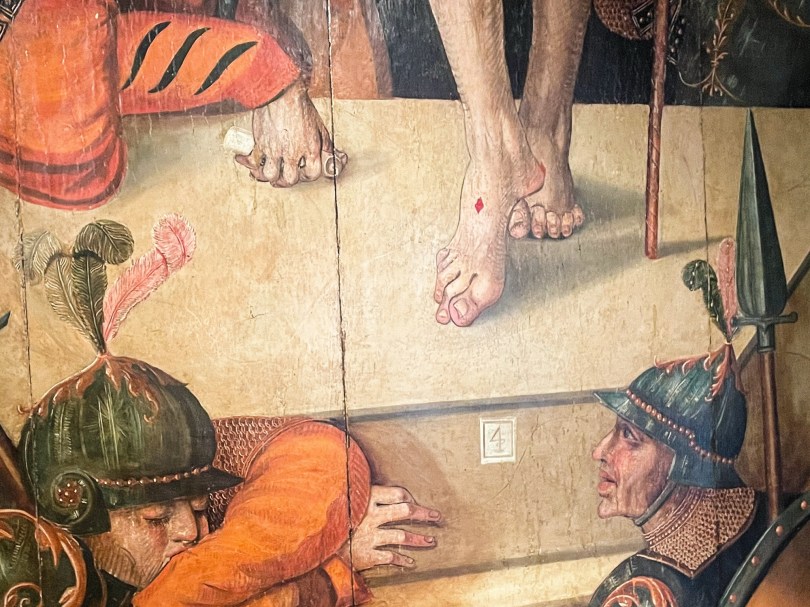
Perhaps the soldiers were sleeping because their task seemed so simple: to guard a dead man. In the painting, part of an altarpiece, only one soldier has been stirred by the strange sounds coming from the tomb. The feet of Christ stand simply on the grave slab, familiar to countless millions down the centuries by their telltale marks of blood.

The status of Jesus as dead and buried is suddenly transposed. Now, in the hour of resurrection, the guards are ‘so afraid of him that they shook and became like dead men’.

The soldiers are scattered out of fear. The women at the tomb also disperse but with different sentiments. They are ‘afraid yet filled with joy’. The feet Christ places on the earth do not bring vengeance or a settling of scores. They stand in confident conviction that a new era has begun when peace is more than a balance of arms.

A very Happy Easter to all blog readers, and especially to those who have struggled through ‘A Sterne Lent’ to reach this joyful Eastertide.

Another reader’s response to the marbled page stencil in ‘A Sterne Lent’.

The Art of Not Taking the Deal

We are about the enter Holy Week. Many Christians will mark these days by attending additional church services and spending time in reflection. I never tire of reading the passion narratives because I have no doubt that in them lie the central themes of Christianity. There is a crowd in an city eager to give the inspiring young rabbi their adulation. The intimacy of close friends at supper on an important festival. The isolation of the garden outside the city walls, and then the bitter work of captivity; costly fidelity; suffering and death.

At a time when the world has become increasingly chaotic it is important to be reminded of Christ’s stillness before the powers of his day. The High Priest and Pilate undoubtedly saw the brewing popularity of Jesus as something that would be ended by his execution. On all the metrics of religious power and secular control, the Jesus who goes to the cross is done. The watching world could agree with Jesus’ last words: “It is finished”. Perhaps those two leaders saw it as the messy and unfortunate price to be paid for maintaining control; keeping the peace. The sacrifice of Jesus would enable things to stay as they were – and as they should be.

Maybe Jesus didn’t know the art of the deal? His time in the wilderness at the beginning of Lent suggest that he had set his face against compromises in his ministry. When he stood before Pilate he had no cards to play. Or, perhaps, it is more accurate to say that he chose not to accept the terms of the game. Appearing to go meekly to his death probably confirmed to many of the leaders that Jesus simply didn’t understand the reality of the world he claimed to be saving. Sad, but there you go. One death wouldn’t change anything.

A Station of the Cross by Sepo b. Ntuluna from Tanzania, in the hotel Mattli Antoniushaus, Morschach – built on the grounds of the Franciscan Community in German-Speaking Switzerland.

Then there is the humanity of loss – of which we all know something. Mary caressing the body of her son. A parent unable to intervene to save her child. The powerlessness of love which cradles the life-left body of the son she would have done anything to save. This is the darkness of despair; the earth shaken; the light of the world put out. The day of absence.

‘Faith’ is perhaps the best answer as to why Jesus doesn’t do a deal. That our miserable card games take place inside a much, much bigger story than most of us are willing to acknowledge. Soldiers at the foot of the cross didn’t have cards, but they had dice. It would be beyond their imagining that 2000 years later the events of that sorry day would still be remembered. A miserable death a few hours before a dusk that would usher in the city’s shabbat. It would be hard to imagine something less important. It was ended – time to divvy up the possessions and go home.

“Thou art God, Whose arms of love
Aching, spent, the world sustain”.

WH Vanstone from Hymn to the Creator in ‘Love’s Endeavour, Love’s Expense

Exposed

I’m not the kind of Christian who likes public witness. The sort of knocking-on-doors Christianity; or a beach mission; or even telling my “faith story” in a service feels embarrassing and uncomfortable. There are probably lots of reasons for this, which it would be tempting to dismiss with an air of Anglican superiority.

I am inclined naturally to a reflective and tentative articulation of faith. I don’t believe I have all the answers. “Now we see in a mirror dimly”. I have no doubt, for a host of reasons, that my faith is fractured and partial. It feels fuller and more complete when it is located within a community of faith, bringing many different experiences of God, past and present, under a single roof. Others have natural – and undoubtedly, spiritual – gifts for giving personal testimony. I don’t hesitate to say that this can be both inspiring and has a place within the life of faith. But we are not all created to be the same.

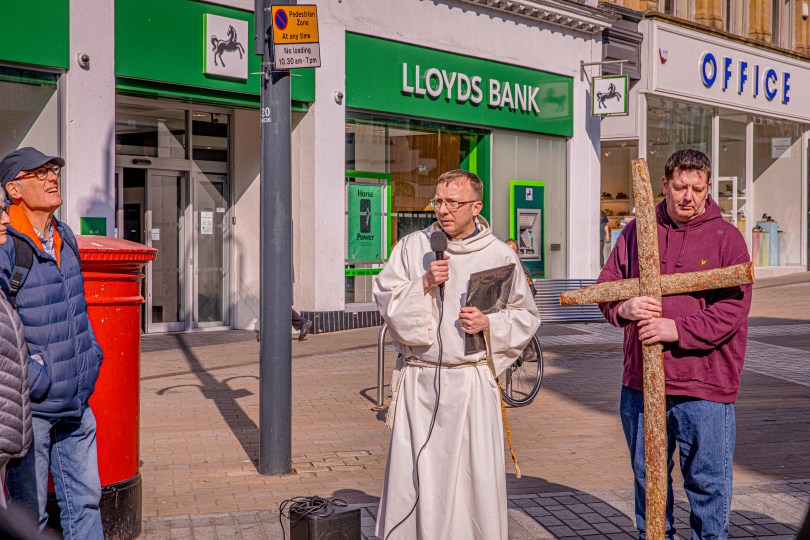
Hence, it was with some trepidation that I went along with the Gospel Streets Urban Pilgrimage in Leeds last week. Led by the admirable Lighthouse community, based in St George’s Crypt under the pastoral care of Jon Swales, the pilgrimage snaked though the streets of Leeds on a sunlit Thursday morning. Jon had a monk-ish aura wearing a cassock alb, and speaking passionately about the City while reading the Gospel of Mark. People stared at us. One passing youth shouted: “You’re all evil; you lot”.

What did it achieve?

For the thirty odd of us participating there were the kind of side-on conversations that people walking to the same destination often share. I met many people I hadn’t encountered before. Members of the Lighthouse community were with us, and it ended with a service of Holy Communion in the Crypt. We were present in spaces where religion is either excluded or extreme; the places where the more you consume the more you matter, and where street preachers tell the world that “the end is nigh”.

Our pilgrimage was less confrontational and more measured. The worst excesses of capitalism were described beside the city’s banks. People damaged by an urban environment that rejects them walked with us in a spirit of solidarity and purpose. Jon asked people sitting and reading in the sunshine of Mandella Gardens if they wouldn’t mind him speaking for a while (sooo Anglican!) and breaches of international law were mentioned by the war memorial.

I’m not sure what we achieved. A statement was made – it was enacted. In the pilgrimage through Lent, we reminded ourselves and anyone who cared to listen, that God is present in the city. That the Church is (or should be) a shelter from the storms of life and a community that is restless and longing for the Kingdom. Where people who have been rejected find a home, and where earthly power is reminded of its place.

It is absurd
to retell here what
happened there,
far away and far ago
when the idiot healed
and said, and wept
and left. A broken
nonsense in the febrile
world of expectation.