
For many years the 30th of January was widely observed across England as the day King Charles I was executed. It is retained in the calendar of the Church of England, but the degree of emphasis attached to the commemoration has diminished. Charles King and Martyr is kept as a ‘lesser festival, 1649’ with a single prayer to be said. In the Book of Common Prayer there was a entire service provided for this day (removed in 1859).
“I go from a corruptible, to an incorruptible Crown; where no disturbance can be, no disturbance in the World”.
King Charles I, spoken at his place of execution 30 January 1649
Following the Restoration the Church of England played a significant role in shaping official history and sustaining the belief and convictions that underpin monarchy. Sermons were preached and many were published. The date provided the occasion for bishops and senior clergy to demonstrate their loyalty and prevent any thoughts returning to the idea of a commonwealth. Across the land, from village church to metropolitical cathedral, it was expected that royal subjects would observe this solemn day.
There were other ways in which the return of the monarchy was welded into popular imagination. This included the creative arts, especially portraiture. One enterprising donation took the form of a recycled statue. Now sited at Newby Hall in North Yorkshire, the monument to King Charles II was previously a statue showing the Polish commander John III Sobieski riding down a Turkish soldier. In its revised form substantial work was done to modify the head of the figure, to resemble Charles II, but the trampled figure of Oliver Cromwell retains a decidedly unusual appearance (i.e. he’s wearing a turban).
There should probably be a maxim to beware of sycophantic royalists bearing gifts. The first attempt to donate the statue to a prominent London location (the Royal Exchange) was rejected. The statue’s owner, Sir Robert Vyner – who might be said to have a stake in the royal franchise (he created new coronation regalia for Charles II) – then offered the work to a City church. This was accepted (perhaps it was too hard to say ‘no’?) and the statue occupied space at the Stocks Market. It later moved to Lincolnshire, before settling at Newby Hall in Yorkshire.
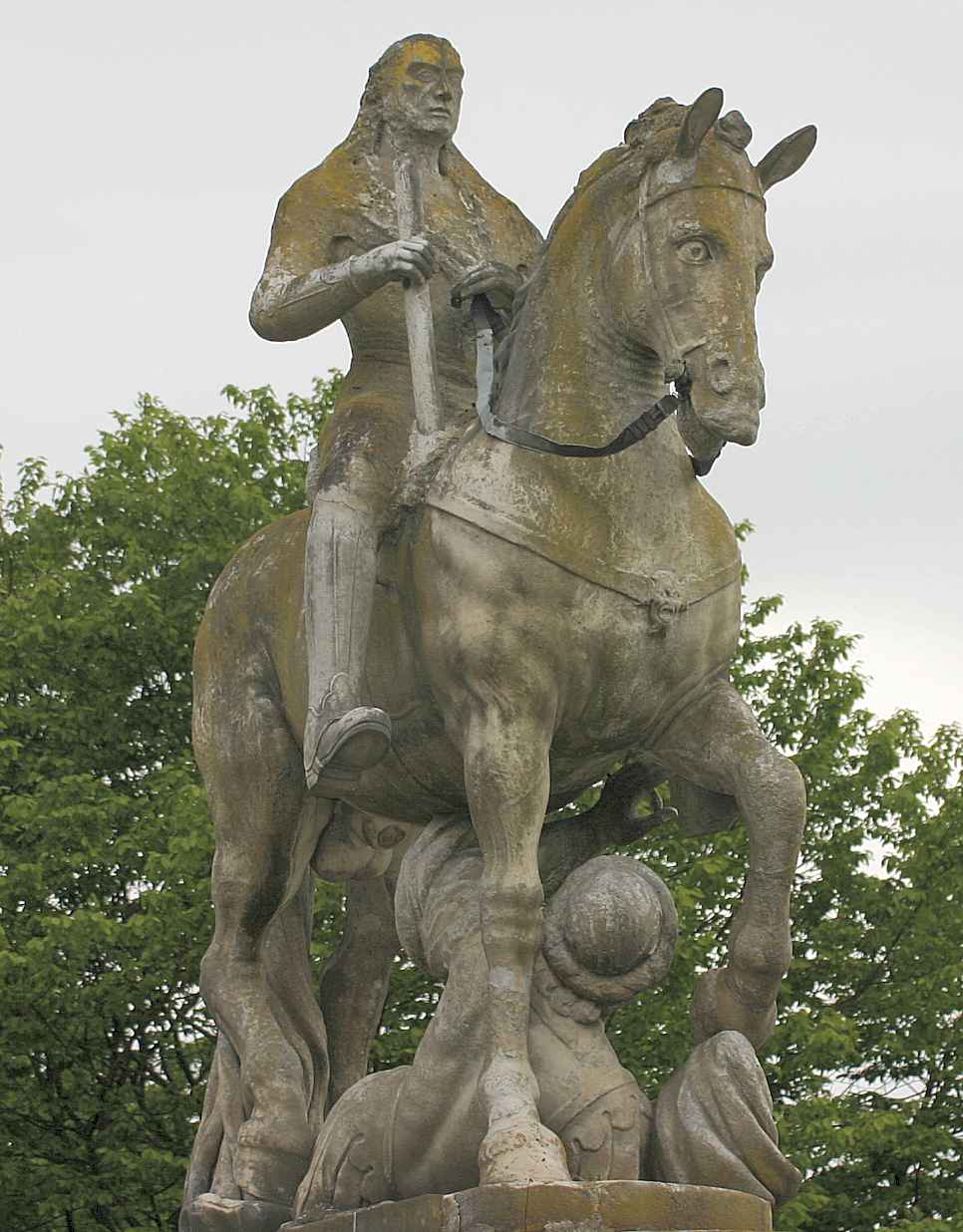
The recycled statue used to depict Charles II, Newby Hall, photo by David Bridgwater
The 17th century poet Andrew Marvell made satirical comment on the statue when it was still in London. He suggested that there was more than a passing resemblance between the horse rider and the man who had commissioned the work:
When each one that passes finds fault with the horse,
Andrew Marvell, A Poem on the Statue in the Stocks-Market
Yet all do affirm that the King is much worse ;
And some by the likeness Sir Robert suspect
That he did for the King his own statue erect.
Having been shuffled off to the north country, London had performed that subtle process of sifting out mediocre work at odds with its ambitions in art and public monuments. Following the Great Fire the city was modelling itself as an international capital for trade and culture where, alas, Sir Robert’s reworked homage did not belong. Marvell’s intimation that the statue bore a likeness to its commissioner may also have helped seal its fate.
As it is one of my principal areas of reading at present, I feel bound to mention that Laurence Sterne published a sermon marking the 30th January. Compared with many of the thundering homilies delivered on this date, Sterne’s offering has been described as ‘innocuous’. Although thoroughly loyal, and referencing ‘our forefathers trespass’, Sterne adds the comment that: ‘to avoid one extreme, we began to run into another’. Perhaps this indicates a more critical understanding of what led to the Civil War and how future progress might be made without recourse to arms. This appears to be a lesson the world is still struggling to comprehend, let alone enact.


 Swift Reflections