With thanks to all the readers of this Blog for support and encouragement during 2023, and wishing you every happiness in 2024.

With thanks to all the readers of this Blog for support and encouragement during 2023, and wishing you every happiness in 2024.

On most days we are heading towards either the longest day or the shortest day. On two days each year the world turns, and we are – for a moment – at the extremity of our shifting balance of night and day. The Church traditionally parked St Thomas on the day of greatest darkness. Perhaps a choice designed to support the idea that too much doubt can only lead into the night, so we better get our beliefs in order and welcome the returning sun.
I love the seasons, and regret that our colder days are fewer and farther between. Heat lasts later, and returns sooner, as we reap the consequences of human folly. The climate is a delicate mechanism and we have placed too great a burden on its capacity to absorb the punishment we mete out every hour. Thankfully, the reliability of the winter solstice is a reminder that while we might be intent on ruining the invaluable gift of our natural world, we cannot touch the vast expanse of space that doesn’t give two hoots whether or not humanity is intent on destroying its habitat.

Let us continue to enjoy it while we may, and do whatever we can to reduce the changes taking place. Part of my delight in the seasons lies in the subtle presence of another season buried in the one that precedes it. We have hardly entered December and the corkscrew hazel has finally shed its last leaves, revealing the tortuous structure of branches to which it owes its name. However, at this very moment, the catkins that will flourish in March have begun to appear. In branches that hold the darkness of winter, and twist hither and thither, the marks of spring are already written.
It was this interrelatedness of our seasons that became the central idea of a story I wrote in anticipation of our daughter’s birth, 27 years ago. It was the only time I worked on anything like this with my late father, as he provided illustrations for a story to celebrate his grandchild’s birth. We produced this simple book by photocopies and an office printer, happy to keep this piece of work purely for the family. His original artwork was framed and became a beautiful reminder of his joy in Abigail’s arrival.
As we journey through the final week of Advent, and some in the church will mark the feast of St Thomas, the season reminds us that time itself will one day cease. That all will be gathered in, and the work of the world will be done. As each season is intimated in the days of another, so the end of all things is bound up in the transitory lives we lead. For those who hold the light of faith this is not a doom of destruction but a making whole; a healing of every hurt; the final coming home of a humanity that has endured the final agonies of its own folly.
This year time’s nature will no more defeat you,
Nor all the promised moments in their passing cheat you.This time they will not lead you round and back
To Autumn, one year older, by the well-worn track.This year, this year, as all these flowers foretell,
We shall escape the circle and undo the spell.Often deceived, yet open once again your heart,
Quick, quick, quick, quick! – the gates are drawn apart.
Part of ‘What the Bird Said Early in the Year’ by C.S. Lewis

Increasingly I find Radio 4 a disturbing listen. Not because the content is controversial (usually), or offensive, but because every time I switch it on I realise how much I don’t know. Whether it’s In Our Time, or some other consideration of a niche topic, I’m made aware of the vast range and depth of human knowledge about which I was oblivious. One example of this arose last week, listening to the Seven Deadly Psychologies. While I certainly have views about why greed is bad, this programme delved into the mechanics of why this might be the case. In the discussion there was a fascinating debate about the fact that, generally speaking (but with notable exceptions), research has demonstrated that rich people have less empathy and compassion than poorer people. In charity, the poor overwhelming give away a significantly higher proportion of their wealth when compared with the financially advantaged.
One reason offered to explain this was that wealth meant people became more distant from communities. It was not possessing a fortune per se which caused this lack of compassion, but the acquisition of space. The consequence of an exclusive lifestyle is that it removes us from close company of our ‘fellow-passengers to the grave’, to quote A Christmas Carol. In turn, this increasing remoteness appears to dull the understanding of the thoughts and feelings of other people. Richer people often feel entitled to their wealth – and perhaps see poverty as simply other people’s failure to accrue resources. Perhaps some of the present UK Government should listen to this episode.

A crowded nativity scene in St. Hippolytus Pfarrkirche, Zell am See, Austria January 2023
While wealth and power no doubt brought King Herod a significant ‘exclusion zone’ this can hardly be said of Jesus. The narrative of the nativity describes a Bethlehem bursting at the seams. In the traditional portrayal, Jesus and his family are cheek by jowl with the beasts of the stall; receive a stream of uninvited visitors; and find themselves in a town where every bed is taken. Lack of worldly privilege ensured that Jesus grew up close to a wide variety of trades, in a community where modest livelihoods required people to cooperate.
Sovereignty in a cattle stall is one example of the paradox that runs through the Christian story. If wealth dulls our capacity to be compassionate it can also diminish our ability to recognise a God who expresses a preferential option for the poor. A God who, in Christ, is able to hear the plea of the Syro-Phoenician woman; the prisoner on the cross; the dilemma of the rich young man. Only when the Word-made-flesh pitches its tent in the heart of humanity is the gulf between God and creation closed. Ultimate power and splendour, commanding more space than we can ever imagine, chooses to renounce entitlement and make the ultimate identification with humanity.
For Dietrich Bonhoeffer the paradox lies partly in the idea that this God is not seen easily by those who have the most resources, or education, or stability in their lives.
“The celebration of Advent is possible only to those who are troubled in soul, who know themselves to be poor and imperfect, and who look forward to something greater to come.”
Dietrich Bonhoeffer
Knowing our need for one another, and our need of God, is a prerequisite for our spiritual growth and maturity. It is one of the reasons why Advent is an uncomfortable season. Many of us recognise the greed we feel for our own space, and to have the freedom to do as we wish. Community implies compromise and association, experiences which appear to have fading appeal in the West. However, to know God seems to require us to be immersed in the dependencies of human society – a truth which both Advent and Christmas impress upon us each passing year.

The cold has come. In an era of climate change there is no guarantee that winters will bring us frost or snow – at least, not for any extended period of time. Parson Woodforde, an undistinguished parson in a small rural parish, would have been consigned to oblivion except for one unusual practice: he kept a diary. Woodforde’s world of the 18th century witnessed some of the final decades of the Little Ice Age, which began around 1300 and lasted until 1850. It is quite likely that the Christmas we call ‘Dickensian’ holds some folk memory of the unusually bitter weather that occurred before the Victorian era got into its stride. Woodforde’s winters are hard to imagine given our experiences today.
“We breakfasted, dined, &c. again at home. Very hard Frost indeed, last Night, froze above Stairs in the Stair-Case window quite hard. It froze the whole day within doors in a few Minutes – very severe Weather indeed – So cold last Night that it was a long time before I could get any sleep at all… We were obliged to have Holly-branches without berries to dress up our Windows &c. against Christmas, the Weather having been so severe all this Month, that the poor Birds have entirely already stript the Bushes.”
Christmas Eve, 1796
Perhaps some of us have childhood memories, before double-glazing and central heating, which include times when there was ice on the inside of the windows. However, on the whole, better insulation and heating – combined with climate change – mean that fewer of us experience this degree of harshness in winter. In a different age, Woodforde’s diligent pastoral ministry was no doubt challenging and costly. It also had its rewards and, however difficult it might have been, the clergy were better-off than the vast majority of their parishioners. The question for many of them was how to live in the style they associated with being a gentleman, and living in houses which towered above neighbouring dwellings. Nevertheless, there is a lovely detail in the diaries of how the parson’s diligent ministry was recognised with anonymous generosity:
“Had another Tub of Gin and another of the best Cognac Brandy brought me this Evening about 9. We heard a thump at the front Door at this time, but did not know what it was, till I went out and found the 2 Tubs – but nobody there”.
Woodforde, J. (2011). The diary of a country parson, 1758-1802. Hymns Ancient and Modern Ltd.
I’m not sure what quantity of liquor a tub contained but I’m confident it would have kept the parson and his guests well supplied during long winter evenings.
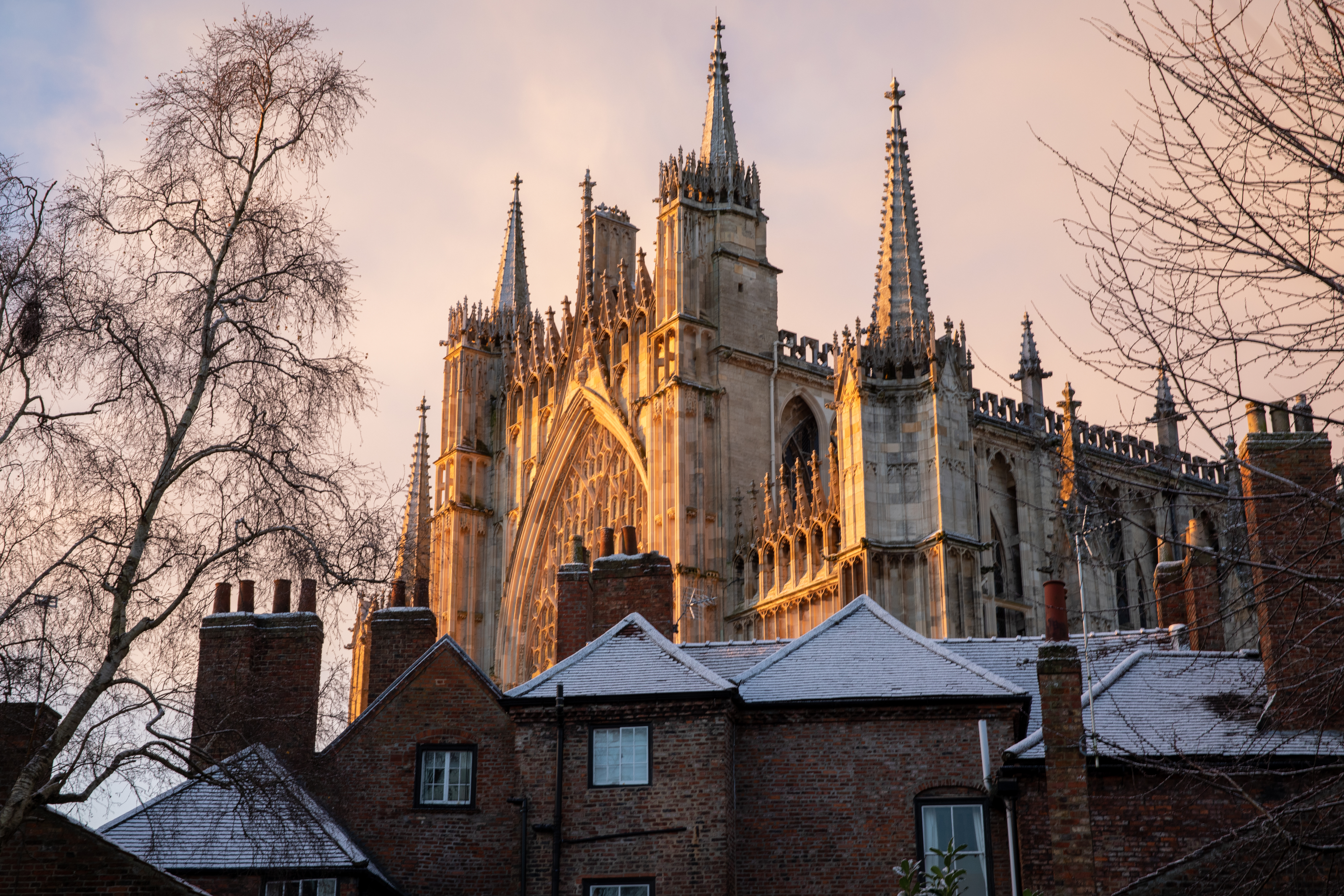
It is into this growing darkness and falling temperatures that Advent arrives. With Christmas Eve landing on a Sunday, this is the shortest period of Advent the calendar allows. Across the three frenetic weeks before Christmas the season urges reflection on sombre themes. Calling into a supermarket in the middle of York the other day, a member of staff on the till commented that it was so busy ‘you’d think the world was about to end’. Ironically, this may be the point where the extremes of consumerism and the message of Advent collide.
Worlds end all the time. In Gaza children have spoken about how they simply want things ‘to go back to the way they were’. Not that this was ideal, but there were homes, families, stability and some kind of future ahead. For them a world they knew has come to an end, in a way that is devastating. This is true across every theatre of war, where destruction is easy and instant – and building a meaningful future is slow, arduous and uncertain.
Advent can bring a chill that serves to focus our thoughts on the cost of these ongoing end-times, and the task of holding a light when surrounded by a cynicism that gives way to darkness. The cold reminds us of the need for homes, and the suffering of people who lack shelter, support or the means to find warmth. Advent tells us the sobering news that all we take for granted is only temporary, and we must be stirred and watchful for the moments God’s light breaks through. Parson Woodforde offers us perspective about the enduring nature of crisis. On Advent Sunday 1797, he wrote that ‘the present times seem to prognosticate e’er long very alarming circumstances. No appearance of Peace…’. To hold an improbable light in this fearful darkness is the work of Advent – and it is certainly needed no less today than it has been in centuries past.
 Swift Reflections