The Fourth Craw

Recently I was given charge of a baby. Thankfully this was only temporary, as mum went with her older son for the start of his first day at school. We were visiting family in Scotland and I was delighted to spend a short while with this delightful child. However, it is some time since I last looked after a baby, and this level of responsibility does not come without anxiety! In my attempts to entertain the bairn, I wondered what nursery rhymes might be familiar to him – and this is when I discovered the ‘Three Craws’ (described as a Scots classic).

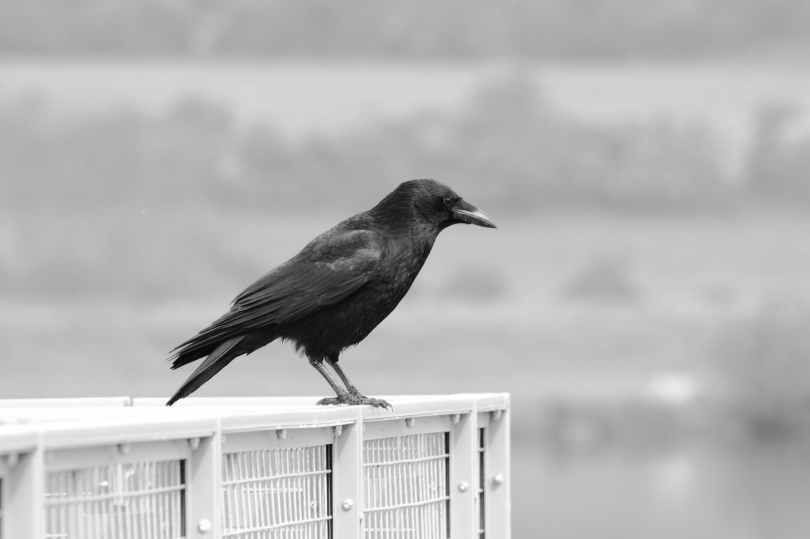
The ‘craws’ would be known in England as crows. In Scots it is a fine onomatopoeic rendition of the cry which the birds make. The craws in the rhyme are not doing very well. The first craw is crying for its mother; the second has broken its beak; the third is unable to fly. With the kind of simple repetition that makes the most effective nursery songs, each verse describes the crows sitting on a wall, sharing their woes on a cold and frosty morning. (It should be noted that the content of these verses varies, and people add their own).

At the end of one of the versions of the Three Craws, there is reference to a fourth craw – The fourth craw wasnae there at a’. It is an intriguing way to end. The rhyme is known as the Three Craws. The final craw never makes an appearance. Does this craw even exist – is it part of the gang? The song has a fourth craw, and yet it doesn’t. This bird is lacking, and seems to be the culmination of the losses that precede it. The craw missing its mother; the craw whose health has been impaired by a broken beak; and the craw unable to fly. It is an odd conclusion for our attention to be drawn to what is wholly absent.

A poetic response to this missing figure has been created by the Glasgow-based academic and writer Nalina Paul. The work is entitled The Fourth Craw and perhaps reflects the power of narratives as they emerge from the darkness of absence – the sparks of our imagination kindled by our earliest encounters with song and story:

Too much is said about night –
its fullness jug-heavy with distance
poured out into star-mapped flight.

But in the sky, protecting her addled head,
was a strange sense of grounding –
as if light were solid, for standing.

And from these things –
sparks in the high darkness
a smouldering moon –
came music, the raven’s song.

Its sound could wither the feathers of eagles
make fire from ice
play tricks with existence
changing form at a whim.

In the dim-lit great hall of glittering stories
the broken shine of the moon crackles.

Nalini Paul ‘The Fourth Craw’ 2015

The fourth craw is an absence and also an invitation. Travelling through Glencoe a couple of weeks ago I was reminded how much the landscape of Scotland fires the imagination, and has inspired many different forms of art. The colours and textures of the mountains; burns that gush with great force after the regular downpours; and trees lousy with lichen, branches encrusted in moss. Glencoe can hold a magical, childlike, atmosphere – even before it is layered with human narratives of heroism and betrayal. Sadly, as walkers and climbers discover every year, it can also be a very dangerous place.

The Three Craws suggests that, when we lament or suffer injury, being in company can make a difference. The birds are a small community of sorrow, who end by sharing an experience of the fourth bird’s absence. Even at a young age it appears that we prepare people for one of the central experiences of life, as well as providing the space for wonder, and the work of our imagination.

What is Life?

John Clare asked the question ‘what is life?’ at the beginning of his poem of the same title. It is a work that reflects the angst and instabilities experienced by this notable English poet. A figure who emerged from a family of agricultural workers, did a range of manual jobs, and came to be favoured by people of literary society. Clare’s emergence as a poet was partly driven by financial distress, and the need to generate funds to prevent the eviction of his parents from their home.

And what is Life?—An hour-glass on the run,
A Mist retreating from the morning sun,
A busy, bustling, still repeated dream;
Its length?—A minute’s pause, a moment’s thought;
And happiness?—A bubble on the stream,
That in the act of seizing shrinks to nought.

John Clare, included in Poems Descriptive of Rural Life and Scenery, 1820

Clare’s experience of life was distinct from other poets who were writing in this period. He was employed in what are often considered to be basic occupations. He would have known the relative powerlessness of his position in the social order, and how much material well-being rested on the decisions, patronage and preferences of wealthy people. The poem’s opening words assault us with a question that is both profound and also indicative of a question that has prompted the poet. It feels like a retort to someone who is pontificating about the value, pleasures and virtue of life.

The response of the poet is to focus on the ephemeral nature of our existence. Not only that, but even when we encounter a time of happiness, it is merely ‘a bubble on that stream’. If life is brief than Clare tells us that our better moments are simply an even more fleeting by-product of the water’s turbulent churn. A fraction of bliss in an otherwise downward torrent of vain hopes. In a life of brevity, happiness is a reprieve that bursts as soon as it encounters the rocks that lie all around.

I have always been rather suspicious of happiness. Perhaps that’s due to an American interpretation of it that has come to dominate our perceptions of a good time. There is a whole industry dedicated to what happiness is, and how to promote it. Inevitably, there is a lot of interest about this in marketing, where our perceptions of life can be harnessed to the priorities of consumerism. Any deficiency in our sense of well-being can become a target for products and experiences we are told will fill the void and deliver our happiness. Psychology and spirituality may often be drawn into this tension of anxiety; unsatisfactory lifestyle solutions to our needs; and consequent disenchantment. There are several ways in which happiness is identified and calibrated, such as the Oxford Happiness Questionnaire. This was influenced by the following understanding:

Argyle and Crossland (1987) suggested that happiness comprises three components: the frequency and degree of positive affect or joy; the average level of satisfaction over a period; and the absence of negative feelings, such as depression and anxiety.

Francis, L. (2010). Religion and happiness: Perspectives from the psychology of religion, positive psychology and empirical theology. In The Practices of Happiness (pp. 113-124). Routledge.

While I am sure that such tools and schemes of analysis have their uses I would question the particular concept of happiness that underpins the method of enquiry. In many respects the surveys appear to deal with a sense of well-being which is then conflated with happiness. These things are not the same. Twentieth century influences tend towards a very individualistic form of happiness, albeit that this may incorporate those people to whom we are closest. However, where is the political dimension that addresses how much our happiness (e.g. meaning, for some, to do what we want) is paid for by the misery of others? There are some researchers who have identified problems in the Western conception of happiness, advocating ‘an alternative approach, relational wellbeing, which is grounded in a relational ontology that can challenge dominant ideologies of the self’.

Religions have often had a complicated relationship with happiness. There is a recognition that, like a bubble on a stream, happiness can be momentary and elusive. As one hymn puts it: ‘Fading is the worldling’s pleasure’. Faith offers something that is not transitory. The focus is about wealth that does not decay – treasure we encounter now, but will experience fully in a life to come. There are risks with this conviction but also great possibilities. Not least, to live in some kind of peace with the world, and find value and joy in relationships. Challenging the narrow focus of ‘my’ happiness and focusing instead on our collective shalom seems a much healthier and constructive path to take. Perhaps then we might even discover that our personal happiness is what we are most likely to find we have when we have ceased to look for it.