A Bye Corner of the Kingdom

These are the words Laurence Sterne used to describe the vicarage at Coxwold. A ‘retired thatched house’ in a place remote from the concerns of even a provincial city, such as York. Perhaps Sterne did not see this as a promising location from which to change the course of world literature. It is difficult to imagine what life in a remote Yorkshire village was like in the 1700s. Far more people worked on the land, while today the holiday cottage dwellings mean occupancy fluctuates each week, and there will be seasons when only a few people inhabit the place. The population was 348 in the early 19th century – and 250 in 2021.

Despite a limited literary output, Sterne’s work is recognised for its transformative impact on the course of Anglo-Irish literature. It was an influence for James Joyce, Salman Rushdie and many others.

Sterne was adept in deflating many of the pompous debates of his time. In chapter 20 of the first book of The Life and Opinions of Tristram Shandy, where birth is such a central theme, there is a digression about the baptism of babies before they are born. The view in Catholic circles to this point had been that at least some part of the baby must be born in order for a baptism to take place. Inevitably, there were circumstances when the baby had died in the womb and where it was believed that baptism was impossible. (There is a history in northern Europe where the Church operated ‘Resurrection Chapels’ to enable the baptism of a baby which was stillborn – Swift, p.119). However, the debate that Sterne cites in this section of the book looks to marry advancing technology with the possibility that a baptism could take place before birth:

Le Chirurgien, qui consulte, prétend, par le moyen d’une petite canulle, de pouvoir baptiser immediatement l’enfant, sans faire aucun tort à la mere.

The surgeon who raises the question asserts that by means of a little injection-pipe he can baptize the child directly, without doing any harm to the mother.

Sterne, L. (1759). The Life and Opinions of Tristram Shandy, Gentleman (reissued).

In this debate Sterne is not oblivious to the dubious nature of a suggestion, in which male medics and male theologians decide that a medical procedure – with no medical benefit – will not result in any harm to the mother. In his imaginative response to this scholarly discussion Sterne takes the argument a stage further, and suggests that one way to avoid any doubt in the matter would be to baptise all of a man’s sperm. (This reflects thinking at the time that there was a fixed stock of sperm containing ‘homunculi’ – minuscule people ready to grow once in the womb). Chapter 20 concludes with the thought that a little injection-pipe could be inserted into the man (‘sans faire auxin tort au père’), between marriage and consummation, to ensure a ‘shorter and safer’ way to baptism. The reader is left to ponder whether male theologians and medics would find this a better solution.

Simultaneously this passage hints at how medical technology might affect sacramental practice, while lampooning male discussions which determine what will do no harm to women. In pushing the ideas further, Sterne discomforts his male readers – and certainly amuses his female audience – in suggesting that sticking a cannula into a penis would be more effective ‘without doing any harm to the father’. It would also provide an interesting ceremony on the day of the wedding.

St Michael and All Angels, Coxwold – where Laurence Sterne served as a priest.

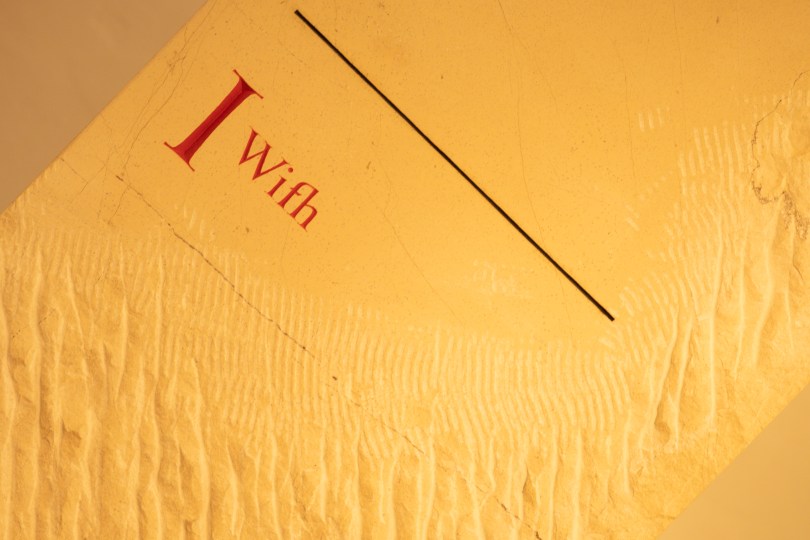
If Coxwold is a ‘bye corner of the Kingdom’ it didn’t stop Sterne writing some of the most adventurous and sophisticated prose of English literature. Thankfully, The Laurence Sterne Trust continues to stimulate interest in the author’s legacy and enable artists to engage with his work. In its most recent exhibition a range of creative people have been challenged to interpret the opening words of Shandy – ‘I wish’ – to reflect on their response to the text. This vibrant exhibition is a fitting contribution to the 50th anniversary celebrations of Shandy Hall’s existence as a public museum.

A Spell of Eternity

I come from that part of the world where a splinter in a finger might also be called a ‘spell’. Some years ago, researchers in Cambridge investigated the many words in the UK employed to describe a small piece of wood lodged under the skin. Spell has been used in the north of England, and was common until recent years in Lancashire where I was born – and in Yorkshire where I live. As I write, I am using splinter and spell to mean a small fraction of something much larger and, perhaps, an occasional cause of discomfort.

Departures from any community, rather like dying, tend to elicit comments that would not normally be made. As I left work at MHA there were many cards and words of appreciation, and this led me to reflect on what it is that a chaplain’s presence brings to any organisation. During nearly 30 years of working as a priest in secular settings, it has been rare for people to express their thoughts and feelings about what I have brought, other than by offering thanks in general. Rather like the cliché of ‘nice sermon, vicar’, while appreciation can be welcome, it is difficult to identify the elements of value if feedback is vague. Perhaps it is only at the point when something is taken away that the void becomes an impetus to articulation. Many writers have expressed the kind of sharp question posed by Jeanette Winterson: “Why is the measure of love loss?”

Research about chaplaincy inevitably focuses on the most tangible aspects of the role, such as active listening and the impact of specific rituals. There is far less literature concerning the chaplain’s identity and how the characteristics invested in the person of the chaplain (such as ordination) contribute to the kind of relationship that emerges during the practice of pastoral care. For example, that the chaplain might be a boundary-spanner for a variety of connections, including a physical church (when patients ask: ‘where’s your parish?’); reality beyond the present situation (e.g. heaven); links to people who have died; and association with a wider community or body of co-religionists. Often this can prompt or facilitate conversations which may not find an outlet during other interactions.

“Chaplains were identified as being impartial and having a shared discourse and experience which enabled patients to address existential issues that would promote their health and well-being that they felt unable to discuss with staff or family”.

Allison, E., Woodhall, J., Briggs, M., & Swift, C. (2023). Reconfiguring the health-promoting hospital: the role of chaplaincy in England. Health Promotion International, 38(4), daad068.

Being the temple-person, the cleric whose way wove between sanctuary and suffering, seemed to mimic for some people the connection of now with forever; temporal pain and eternal peace. At times – and perhaps especially at moments of departure – there might be a glimmer of this experience as people describe what they feel they are losing.

“You have always been a very reassuring presence around the building. It’s as if everything, whatever it is, is going to be ok because you’re there. Your very presence helps to create a sense of perspective about things and you might not realise that. Your humour definitely helps too!”

Personal Communication; 28 July 2023

I recall an Intensive Care nurse saying, many years ago, that when I was on the unit there was a distinct sense of calm. We didn’t explore that any further, but I took it to imply that the presence of a chaplain conveyed a sense of perspective, of a particular moment set in a much broader scheme of time, meaning and purpose. The chink of light in an opening door. It may be due to the heft of this perception that it is spoken about so rarely. Perhaps language might diminish the experience?

I need all the rage I can muster
to keep this calm; to sculpt space
to hold shifting, fragile colours.

Manon Ceridwen James, A Priest at a Funeral in Notes from a Eucharistic Life

The perception of a chaplain, rooted in particular associations, may shape space in a particular way. Like the communion kit and closed curtains that turn a hospital table into an altar, and the bedside into a sanctuary, signs are inherent in the chaplain’s presence. Despite our many failings and shortcomings, for some people some of the time we are spells of eternity. The splinter that irritates the skin of our self-assurance and certainty: a fraction of what is beyond our imagination. It is little wonder that humour is a necessity when bearing (or being?) the sign of something of such unspeakable scale.